
AI and BLE for Copper Processing
AI-Driven Operations for Integrated Shopping Complexes
AI and BLE for Shopping Complexes combines artificial intelligence, connected sensors, BLE beacons, BLE gateways, operational software, and shopping-complex data to improve how large retail facilities monitor assets, understand occupancy, manage maintenance, support visitors, and coordinate daily operations. An integrated shopping complex can use BLE-generated location and condition data as inputs to AI models that identify operational patterns, prioritize service requirements, detect anomalies, and support faster decisions. Applications can span tenant areas, common spaces, parking facilities, loading zones, security operations, maintenance rooms, and building services. BLE provides practical connectivity for location and sensor data, while AI converts those data streams into operational intelligence. For shopping-complex owners, facility operators, retailers, security teams, maintenance contractors, and property managers, the combination can improve visibility across distributed facilities without requiring every operational decision to be handled manually.
AI-Enabled Shopping Complex Operations: BLE and AI Infrastructure
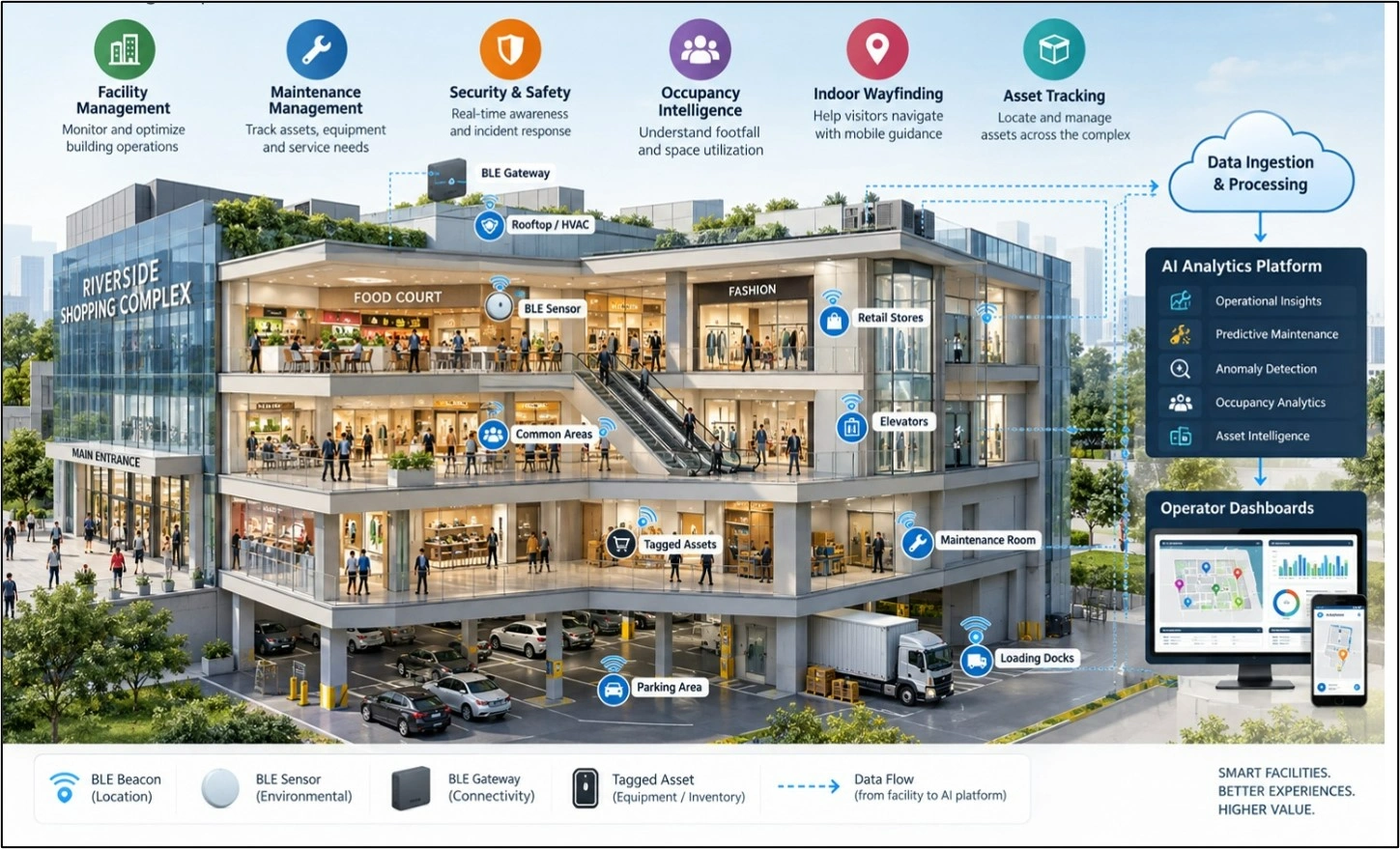
A professional technical illustration showing how BLE beacons, sensors, tagged assets, and gateways connect a shopping complex to AI-enabled operational intelligence. It highlights facility management, maintenance, security, occupancy intelligence, asset tracking, indoor wayfinding, and operator dashboards.
What AI and BLE Enable in Shopping Complexes
Shopping complexes contain highly dynamic environments. Retail stores open and close at different times, visitor density changes throughout the day, maintenance teams move between mechanical and electrical service areas, contractors require controlled access, and assets such as carts, cleaning equipment, portable maintenance tools, and service equipment can move between zones.
AI can use location, movement, environmental, occupancy, and operational data to identify conditions that are difficult to manage through manual observation alone. BLE is useful because low-power beacons and sensors can provide identification, proximity, location, and telemetry data across indoor areas where GPS is unreliable or unavailable.
Relevant AI applications include:
- Occupancy intelligence for entrances, common areas, food courts, corridors, elevators, and parking facilities
- Asset tracking for maintenance equipment, cleaning carts, mobile service equipment, and other tagged assets
- AI-assisted indoor wayfinding using BLE location signals
- Maintenance prioritization based on sensor readings, equipment status, service history, and operating patterns
- Anomaly detection for abnormal asset movement, unexpected equipment conditions, or unusual occupancy patterns
- Security support through location-aware monitoring of tagged equipment, restricted areas, and selected operational assets
- Retail operations analysis using location and movement information where appropriate and permitted
- Energy and environmental monitoring using BLE-connected sensors for temperature, humidity, occupancy, and other facility conditions
- Loading-dock and back-of-house visibility for service teams and facility operators
- Workforce coordination by providing operational teams with better visibility into asset and location information
The value comes from connecting these individual data points to the workflows used by shopping-complex personnel. A location event becomes more useful when it can be associated with a maintenance work order, a security event, a facility zone, or an operational threshold.
AI Applications for Shopping Complex Operations
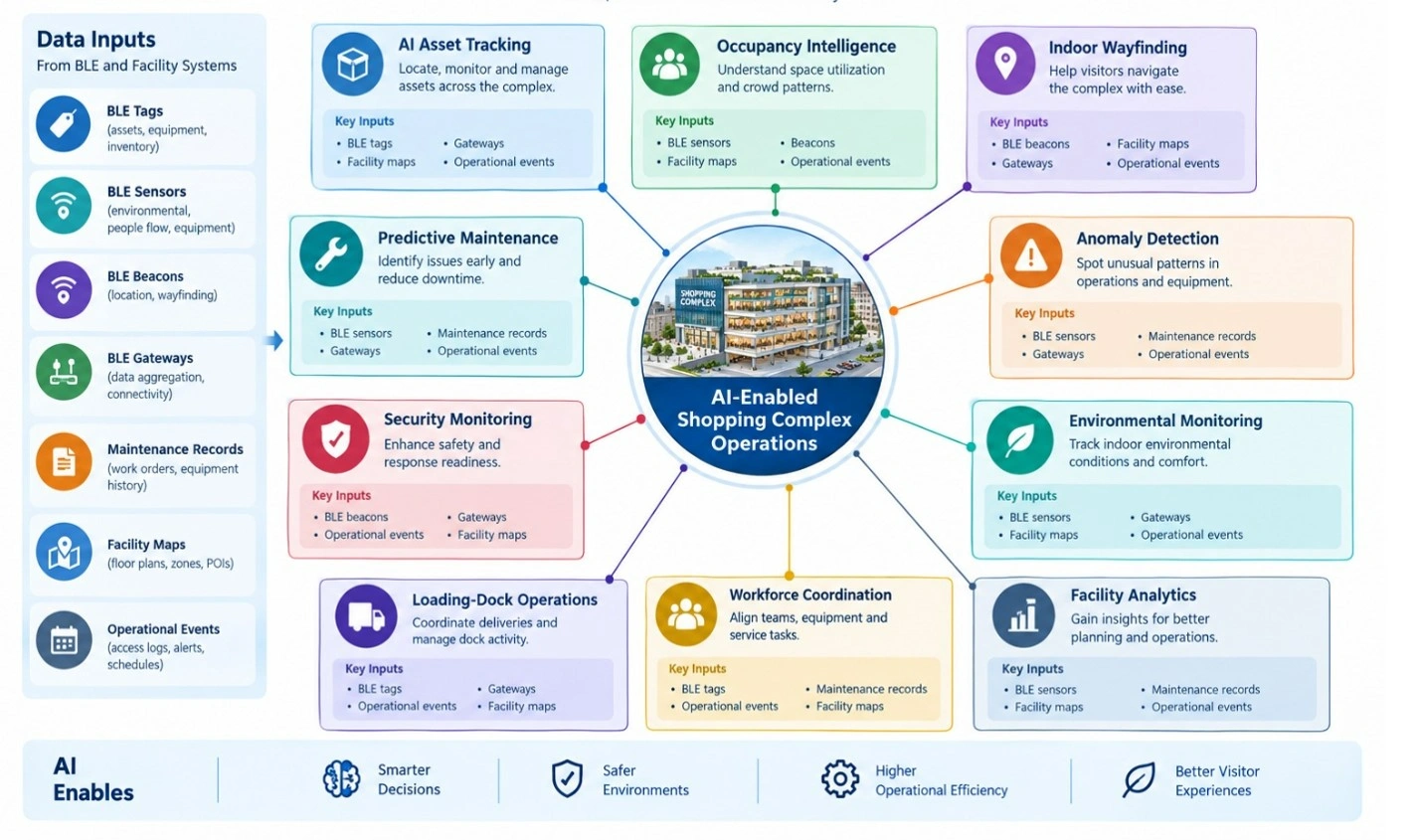
An enterprise infographic mapping key AI applications across shopping-complex operations, including asset tracking, occupancy intelligence, wayfinding, predictive maintenance, security, environmental monitoring, and facility analytics. It connects each use case to relevant BLE, facility, maintenance, and operational data inputs.
Shopping-Complex Applications and Operational Scenarios
AI Asset Tracking for Facility and Maintenance Teams
Shopping complexes operate large inventories of mobile operational equipment. Cleaning carts, maintenance tools, portable generators, ladders, inspection instruments, spare equipment, and service devices may be distributed across multiple floors or buildings.
BLE tags can provide location signals that are collected by strategically positioned gateways. AI software can use historical movement data and operational records to identify frequently misplaced assets, unusual movement patterns, or equipment that remains outside its expected service area.
A useful deployment should distinguish between location visibility and automated decision-making. Location data can indicate where an asset was last detected, while AI can help prioritize which assets require attention based on operational context.
AI Occupancy and Visitor-Flow Intelligence
Occupancy information can support facility planning, cleaning schedules, queue management, HVAC optimization, and safety operations. BLE sensors and location infrastructure can provide additional data points for selected zones.
AI models can analyze time-dependent patterns rather than treating occupancy as a static measurement. For example, a shopping complex may experience different utilization patterns during weekday mornings, lunch periods, evenings, weekends, holidays, and special events.
Facility managers can use these insights to adjust cleaning resources, investigate congestion, plan maintenance windows, and evaluate the utilization of common areas.
AI-Assisted Indoor Wayfinding
Large shopping complexes can contain multiple floors, entrances, parking levels, retail zones, food courts, entertainment areas, and service corridors. BLE beacons can support indoor positioning where satellite positioning cannot provide adequate accuracy.
AI can enhance wayfinding software by incorporating facility maps, destination information, operating conditions, accessibility requirements, and real-time location signals. The resulting system can support visitor navigation and operational routing while allowing facility operators to maintain location infrastructure.
Predictive Maintenance and Condition Monitoring
Facility equipment generates operational signals that can be difficult to interpret manually across a large property. BLE sensors can collect selected environmental or equipment-related measurements, while AI models can evaluate trends and identify conditions that warrant inspection.
Potential monitored conditions include temperature, humidity, vibration, equipment runtime, room conditions, and other measurements supported by the selected sensor hardware.
AI-based maintenance should be connected to existing maintenance processes rather than treated as an isolated analytics function. A detected anomaly becomes operationally useful when it can generate an inspection recommendation, maintenance priority, or work-order trigger subject to appropriate human review.
Security and Restricted-Zone Monitoring
BLE location data can help facility operators understand the movement of selected tagged assets and equipment. In restricted service areas, BLE infrastructure can support location-aware monitoring of authorized equipment or operational resources.
AI can identify deviations from expected movement patterns and route events to security or facility personnel for investigation. Such systems should incorporate access controls, retention policies, appropriate privacy controls, and clearly defined operational responsibilities.
A practical AI-enabled shopping-complex solution starts with data acquisition and continues through communication, processing, analytics, enterprise integration, and operational action.
- BLE beacons transmit identifiers and proximity signals within defined facility zones.
- BLE sensors capture selected measurements such as temperature, humidity, motion, occupancy-related conditions, or equipment status.
- BLE tags identify mobile assets and selected operational equipment.
- BLE gateways receive signals from nearby devices and forward relevant information to local or centralized software.
- Edge processing can normalize, filter, timestamp, and validate incoming events before transmission to higher-level systems.
- Middleware associates device identifiers with assets, zones, tenants, equipment records, and operational entities.
- Data services store historical events required for analytics, reporting, auditability, and model development.
- AI models analyze patterns, anomalies, trends, classifications, or predicted conditions.
- Facility-management, security, maintenance, or analytics software receives relevant outputs.
- Operators review alerts, recommendations, dashboards, or work-order information.
- Business actions can include dispatching maintenance personnel, locating equipment, changing cleaning schedules, investigating abnormal conditions, or adjusting facility operations.
- Feedback from completed work and operator decisions can be used to improve rules, thresholds, data quality, and AI models.
Shopping Complex AI and BLE Data-to-Decision Workflow
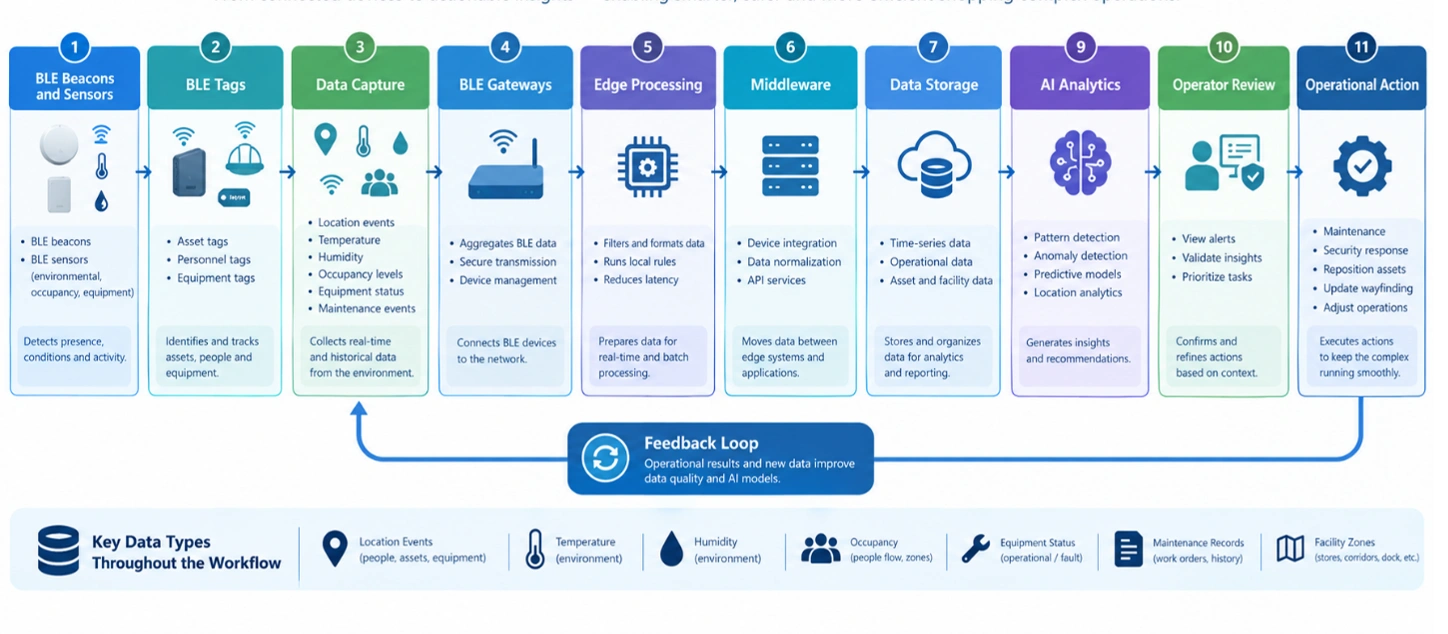
An end-to-end enterprise workflow showing how BLE beacons, sensors, and tags move through data capture, gateways, edge processing, middleware, storage, and AI analytics before reaching operator review and operational action. A feedback loop shows how operational results and new data can improve data quality and AI models.
Technology Components for AI-Enabled Shopping Complexes
BLE Beacons, Sensors, Tags, and Gateways
BLE beacons can provide fixed reference points for indoor positioning and proximity services. BLE sensors extend the system by capturing environmental or equipment-related measurements. BLE tags can identify mobile assets, while BLE gateways aggregate signals from devices operating within their coverage areas.
Gateway placement requires consideration of floor plans, wall materials, equipment rooms, elevators, stairwells, tenant boundaries, interference, coverage requirements, and expected location accuracy. A shopping complex should not assume that uniform gateway spacing automatically produces reliable positioning.
Edge Processing
Edge processing can reduce unnecessary data transmission and provide faster local handling of BLE events. Typical functions include signal filtering, event normalization, timestamp validation, device health monitoring, local buffering, and preliminary rule evaluation.
Edge processing is particularly useful where shopping-complex connectivity is variable or where operational events need rapid local handling.
AI and Machine Learning
AI models can support several classes of shopping-complex applications:
- Anomaly detection for unusual asset or sensor behavior
- Time-series analysis for facility conditions
- Classification of operational events
- Forecasting for occupancy or equipment conditions
- Prioritization models for maintenance activities
- Pattern recognition for asset movement and utilization
- Computer vision where camera-based analysis is independently deployed and appropriately governed
Model selection should follow the operational problem. A simple threshold or deterministic rule may be more reliable than machine learning for a clearly defined safety or equipment limit. Machine learning becomes more valuable when relationships among multiple variables are difficult to represent through fixed rules.
Middleware and Enterprise Software Integration
Middleware connects BLE data with the systems already used by shopping-complex operators. Depending on the deployment, integration may involve facility-management software, computerized maintenance management systems, security software, building-management systems, tenant-management applications, access-control systems, inventory systems, analytics databases, and notification services.
API-based integration, event messaging, device registries, asset identifiers, time synchronization, and standardized data models can reduce integration problems. Unique identifiers should be maintained consistently so that a BLE tag, physical asset, facility zone, and enterprise record refer to the same operational object.
BLE and AI Integration with Shopping Complex Software
A technical systems-integration diagram showing how BLE beacons, sensors, tags, and gateways connect through edge processing, middleware, and an AI analytics platform to existing shopping-complex software. It distinguishes device data, normalized events, AI outputs, and business-system actions across facility, maintenance, security, tenant, inventory, analytics, and operator systems.
Cloud Version
A cloud-hosted SaaS deployment is appropriate when shopping-complex operators need centralized management across multiple properties, remote analytics, centralized reporting, and elastic computing resources.
Cloud processing can support AI model training, historical analytics, fleet-level reporting, software updates, centralized device management, and multi-site operational visibility. Connectivity requirements should nevertheless be evaluated carefully. Critical local functions should not depend entirely on uninterrupted wide-area connectivity.
Server Version
A privately hosted server deployment can be appropriate where operators require greater control over data processing, integration with privately managed systems, or local operation within a shopping-complex facility or organizational data center.
Server deployments can run on edge servers, customer-managed servers, private data centers, or other privately hosted infrastructure. This approach can reduce dependence on external cloud connectivity and may fit environments with established IT governance and local data-processing requirements.
Technical Capabilities and Operational Benefits
AI becomes particularly valuable when shopping-complex operators have large volumes of location, sensor, maintenance, occupancy, and facility data that require continuous interpretation. BLE provides a practical source of proximity, identification, location, and sensor information, while AI can turn those events into operational priorities.
Improved Asset Visibility and Utilization
BLE-tagged maintenance equipment and mobile operational assets can provide facility teams with a more current view of asset locations. AI can analyze historical location events to identify utilization patterns, frequently misplaced equipment, unusual movements, and areas where additional equipment may be required.
This can help maintenance supervisors coordinate work without relying exclusively on telephone calls, manual searches, or spreadsheet-based asset records. GAO supplies BLE hardware products and systems that can support these types of asset-location applications when appropriately engineered for the facility.
More Responsive Facility Maintenance
AI-assisted maintenance can combine BLE sensor information with equipment history, work orders, environmental conditions, and operational schedules.
Rather than treating every sensor event as an emergency, AI can help rank events according to severity, persistence, historical patterns, and operational context. Maintenance personnel can then investigate the most relevant conditions first.
For shopping complexes, this can be particularly useful for distributed facility assets and service areas where technicians may otherwise spend substantial time identifying which equipment requires attention.
Better Occupancy Intelligence
Shopping-complex occupancy changes according to operating hours, tenant schedules, weekends, holidays, promotions, weather conditions, and special events.
AI models can analyze historical occupancy-related data to identify recurring patterns and unusual deviations. Facility teams can use those insights when planning cleaning resources, security coverage, maintenance windows, common-area utilization, and building-service adjustments.
Occupancy analytics should be designed around the accuracy requirements of the specific use case. A system intended to understand broad zone utilization does not necessarily require the same location precision as an application requiring room-level or asset-level positioning.
Faster Operational Response
AI can reduce the time between an operational event and an appropriate response by automatically correlating data from multiple sources.
For example, a facility-management workflow could associate a sensor anomaly with a physical zone, equipment record, maintenance history, and responsible service team. Instead of presenting an isolated device alert, the software can provide contextual information that helps personnel determine the next action.
More Effective Indoor Navigation
BLE-based positioning can support navigation across complex indoor environments. AI can improve route recommendations by considering facility maps, destination availability, accessibility requirements, temporary restrictions, and changing operational conditions.
The same underlying location information can also support internal workflows, such as directing technicians toward service areas or helping operational personnel locate tagged equipment.
Operational Anomaly Detection
Shopping complexes generate recurring operational patterns. AI can learn normal behavior from historical data and identify deviations that warrant investigation.
Examples include:
- Equipment remaining in an unexpected zone
- A tagged asset moving outside its expected operating area
- Environmental readings deviating from established patterns
- Unusual occupancy conditions within a monitored zone
- Unexpected changes in equipment operating behavior
- Repeated maintenance events associated with the same facility area
Anomaly detection should generate an investigation signal rather than automatically assuming that every deviation represents a fault.
Scalability Across Shopping Complexes and Properties
A shopping-complex deployment should be designed so that additional retail areas, floors, parking structures, tenants, sensors, gateways, and operational applications can be introduced without rebuilding the entire system.
Scalability depends on more than the number of BLE devices. Data ingestion capacity, gateway connectivity, identifier management, storage, AI processing, API throughput, network segmentation, device management, and operational support all affect the ability to expand.
A practical scaling strategy can include:
- Establishing common naming conventions for facilities, floors, zones, assets, gateways, and devices
- Maintaining consistent device and asset identifiers
- Separating device management from application logic
- Defining reusable integration interfaces
- Standardizing data structures for location and sensor events
- Using centralized device health monitoring
- Designing AI models around reusable operational features
- Maintaining separate configuration for each shopping complex
- Testing new deployments in representative areas before broad rollout
- Monitoring data quality as device populations increase
Multi-property operators may benefit from centralized cloud analytics when they need cross-site reporting. Privately hosted deployments can be appropriate when operational systems or data-management requirements favor customer-controlled infrastructure.
Interoperability with Shopping-Complex Systems
BLE and AI solutions deliver greater operational value when they exchange information with systems already used by facility teams.
Potential integration points include:
- Computerized maintenance management systems
- Facility-management software
- Building-management systems
- Access-control systems
- Security management software
- Tenant-management systems
- Inventory and asset-management software
- Parking-management systems
- Business intelligence and analytics systems
- Notification and incident-management software
- Mobile applications used by maintenance personnel
Integration should begin with clearly defined business events rather than simply exposing every available device message.
For example, a maintenance system may require an event containing an asset identifier, location, timestamp, sensor condition, severity, and associated equipment record. Sending raw BLE advertisements directly into the maintenance application would usually create unnecessary integration complexity.
API gateways, message brokers, middleware, event schemas, authentication mechanisms, and device registries can help separate BLE infrastructure from business applications.
AI Model Governance and Data Quality
AI output is only as reliable as the data and operational assumptions behind it. Shopping-complex deployments should therefore include data-quality monitoring alongside model development.
Important considerations include:
- Missing or delayed sensor events
- Incorrect device-to-asset associations
- Gateway connectivity interruptions
- Battery depletion
- Changes to floor layouts
- Tenant renovations
- New equipment
- Relocated gateways or beacons
- Seasonal occupancy changes
- Changes in maintenance procedures
- Inconsistent timestamps
- Duplicate or conflicting events
AI models should be validated using representative operational data before they influence important facility decisions. Model performance should also be monitored after deployment because shopping-complex conditions can change substantially over time.
Human review remains appropriate for decisions involving safety, security escalation, significant maintenance expenditure, or other consequences where automated interpretation could create operational risk.
Cybersecurity and Privacy Considerations
Connected shopping-complex systems create additional endpoints that must be included in facility IT and cybersecurity programs. BLE devices, gateways, edge servers, APIs, databases, dashboards, and mobile applications can each introduce security considerations.
Security design should include:
- Secure device provisioning
- Strong credentials and credential rotation
- Device identity management
- Network segmentation
- Least-privilege access
- Role-based permissions
- Secure API authentication
- Encryption for supported communication paths
- Firmware and software update procedures
- Gateway hardening
- Security logging and monitoring
- Backup and recovery procedures
- Incident response procedures
- Controlled administrative access
Location information requires additional governance when it can be associated with employees, contractors, tenants, or visitors. Operators should determine what information is actually necessary for each application and establish appropriate access, retention, and disclosure controls.
Privacy-by-design principles can reduce unnecessary collection. For example, an occupancy application may require zone-level utilization information without requiring persistent identification of individual visitors.
GAO’s experience supplying connected hardware and IoT systems makes hardware security, device lifecycle management, connectivity, and integration important considerations alongside application-level controls.
KPIs for AI-Enabled Shopping Complex Operations
Shopping-complex operators should define KPIs around measurable operational outcomes rather than device counts alone.
Relevant measures can include:
Operational Area Example KPI What It Helps Evaluate
Asset management Asset location visibility rate Availability of usable location information
Asset management Asset search time Effort required to locate operational equipment
Maintenance Mean time to acknowledge an alert Responsiveness to detected conditions
Maintenance Preventive maintenance compliance Execution of planned maintenance activities
Maintenance Repeat maintenance events Recurrence of equipment or facility issues
Occupancy Zone occupancy trend Utilization patterns across facility areas
Facility operations Cleaning response time Responsiveness to operational demand
Security Restricted-zone event response time Time required to investigate location-related events
Connectivity Gateway availability Health of the BLE infrastructure
Data quality Valid event rate Reliability of incoming operational data
AI operations Alert precision Usefulness of AI-generated alerts
AI operations False-alert rate Frequency of alerts that do not require action
Integration Successful event-processing rate Reliability of data exchange between systems
These KPIs should be established as part of the requirements phase. Baselines should be measured before deployment whenever practical so that the operator can distinguish system effects from normal operational variation.
Implementation Recommendations for Shopping Complexes
Successful implementation depends on aligning technical deployment with the operational responsibilities of property managers, facility engineers, maintenance teams, security personnel, IT teams, retailers, and service contractors.
Define the Business Problem First
The initial requirements should identify the operational problem, the users of the resulting information, the required response, and the measurable KPI.
An organization seeking to locate maintenance equipment has different requirements from one seeking occupancy intelligence or predictive maintenance. These differences affect BLE hardware, gateway placement, data models, AI methods, integrations, and cybersecurity requirements.
Perform a Physical and RF Site Survey
Shopping complexes should be surveyed before finalizing hardware locations. The survey should account for:
- Floor plans
- Wall construction
- Elevators and escalators
- Parking structures
- Mechanical rooms
- Loading docks
- Tenant partitions
- Metallic equipment
- Existing wireless infrastructure
- Expected location accuracy
- Gateway accessibility
- Power availability
- Network connectivity
Pilot testing should occur in representative areas rather than only in an open retail zone.
Establish a Controlled Pilot
A pilot can focus on one floor, operational zone, maintenance workflow, or asset category. The objective should be to validate data quality, location behavior, integration, user workflows, and AI outputs before wider deployment.
The pilot should include operational personnel because technically correct data may still be ineffective if alerts do not fit actual maintenance or facility workflows.
Integrate with Existing Processes
AI recommendations should reach the people responsible for taking action. A maintenance alert that exists only inside an analytics dashboard may not improve maintenance execution.
Where appropriate, AI outputs should be connected to existing work-order, incident, notification, facility-management, or security processes.
Commission and Test the System
Commissioning should include:
- Device enrollment
- Gateway connectivity testing
- BLE coverage validation
- Asset-tag association
- Sensor calibration where applicable
- Timestamp verification
- Data integrity checks
- API testing
- AI-output validation
- User acceptance testing
- Security testing
- Failure and recovery testing
Operational acceptance should confirm that facility personnel can interpret and act on the information produced by the system.
Plan for Lifecycle Management
BLE devices and gateways require ongoing management. Battery-powered devices need battery monitoring and replacement procedures. Gateway firmware and software require controlled updates. Facility modifications can require changes to beacon placement or positioning models.
AI models may also require periodic review when operational patterns change.
GAO can support organizations evaluating BLE hardware products and IoT system requirements, including considerations around device selection, deployment, integration, and technical support.
Building an Integrated AI and BLE Shopping-Complex Solution
AI and BLE can provide shopping-complex operators with a practical way to connect physical facility conditions with software-based decision support. BLE beacons, tags, sensors, and gateways provide operational data, while edge processing, middleware, AI models, facility software, and enterprise integrations turn those events into information that facility teams can use.
The strongest implementations begin with specific operational requirements, validate the physical environment, establish data-quality controls, integrate with existing workflows, and define measurable KPIs. Cloud and privately hosted deployments can both be appropriate depending on connectivity, IT governance, integration, data-management, and multi-property requirements.
GAO’s three decades of R&D and customer service in BLE, RFID, and IoT technologies provide a foundation for helping organizations evaluate connected hardware and system requirements for shopping-complex applications. GAO has served organizations in the United States and Canada, including Fortune 500 companies, research organizations, universities, and government agencies, with hardware products, systems, engineering support, and remote or onsite technical assistance.
Practical AI for Connected Shopping Complex Operations
AI can help shopping-complex operators move from isolated device data toward contextual operational decisions. BLE-enabled location and sensor information can support asset visibility, occupancy analysis, indoor navigation, maintenance intelligence, environmental monitoring, and selected security workflows.
Successful deployment requires more than installing BLE devices. Operators should establish business requirements, validate RF conditions, integrate with facility software, protect device and location data, monitor data quality, and measure operational outcomes.
Organizations evaluating AI-enabled shopping-complex solutions can work with GAO to assess BLE hardware, connected IoT systems, deployment requirements, integration approaches, and technical support needs.
Building the Future of Industrial AI and IoT with Aperture Venture Studio and GAO RFID Inc.
For more than three decades, GAO has invested heavily in R&D covering industrial BLE, RFID, and IoT. As generative AI became increasingly useful for industrial applications, we have continued developing AI and IoT technologies, including BLE and RFID, with applications relevant to connected shopping-complex operations. We have also founded Aperture Venture Studio to support the development and scaling of AI and IoT solutions for industries where connected data and intelligent software can address practical operational challenges.
Aperture has attracted AI and IoT technical experts, entrepreneurial and operational executives, investors, and leading companies.
We have also developed the Aperture Ventures Summit and TekSummit to facilitate discussion of advanced AI and IoT topics.
Together, these activities have helped build diverse technical communities around AI and IoT.
We welcome you to join us as:
- Advisors, Co-founders, or Employees
- Investors
- Customers