
AI and RFID for Commercial Vehicle Manufacturing
How AI Improves Traceability and Production Control in Commercial Vehicle Manufacturing
AI for commercial vehicle manufacturing combines machine learning, computer vision, Industrial AI, edge computing, connected equipment, and operational data with technologies such as RFID to improve how manufacturers identify parts, track work-in-process, manage production assets, detect quality issues, and make production decisions. RFID provides machine-readable identity and location events for components, containers, tools, and assemblies, while AI converts those events and other factory data into predictions, anomaly detection, production recommendations, and automated actions.
For commercial vehicle manufacturers, the value is particularly strong because trucks, buses, vans, specialty vehicles, and fleet-oriented chassis often contain large numbers of configurable components and require extensive material, quality, and assembly traceability. AI-driven RFID solutions can connect component genealogy with manufacturing execution systems, enterprise resource planning software, warehouse management, quality systems, and production equipment. The result is more reliable production visibility, faster response to shortages and deviations, better asset utilization, and stronger control of vehicle build records.
GAO supplies RFID, BLE, and IoT hardware and systems that can support these connected manufacturing requirements, including applications where reliable identification and data capture are prerequisites for higher-level AI analysis.
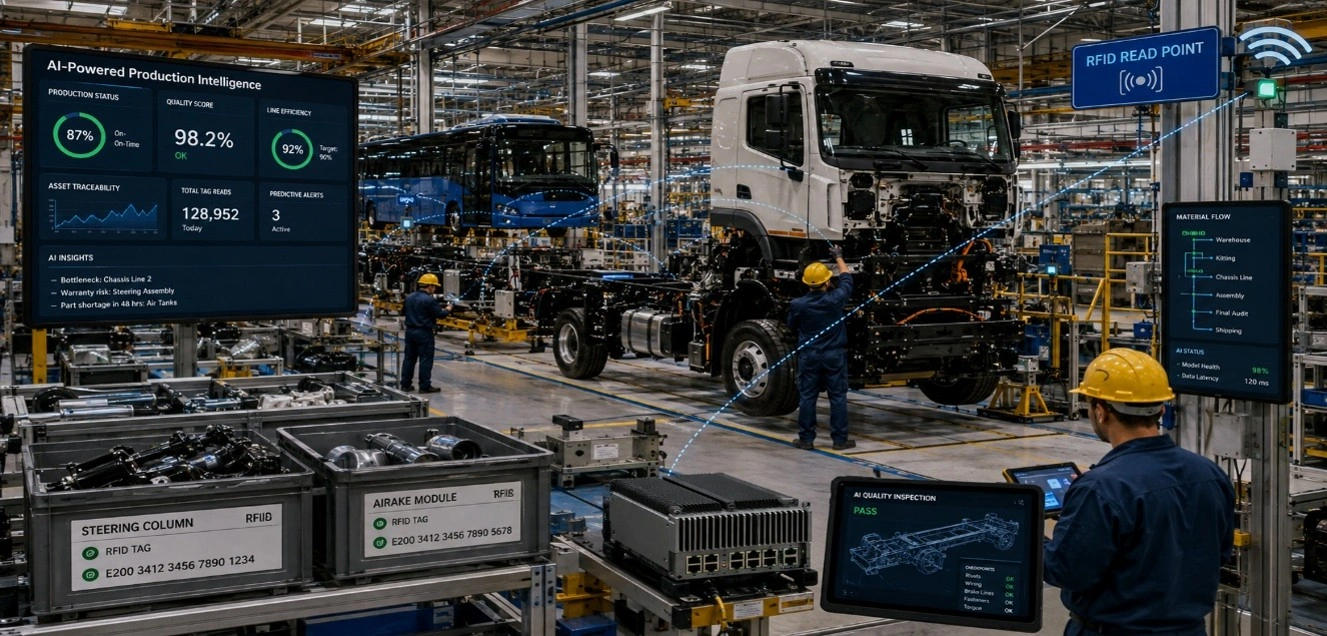
AI and RFID-Enabled Commercial Vehicle Manufacturing Factory
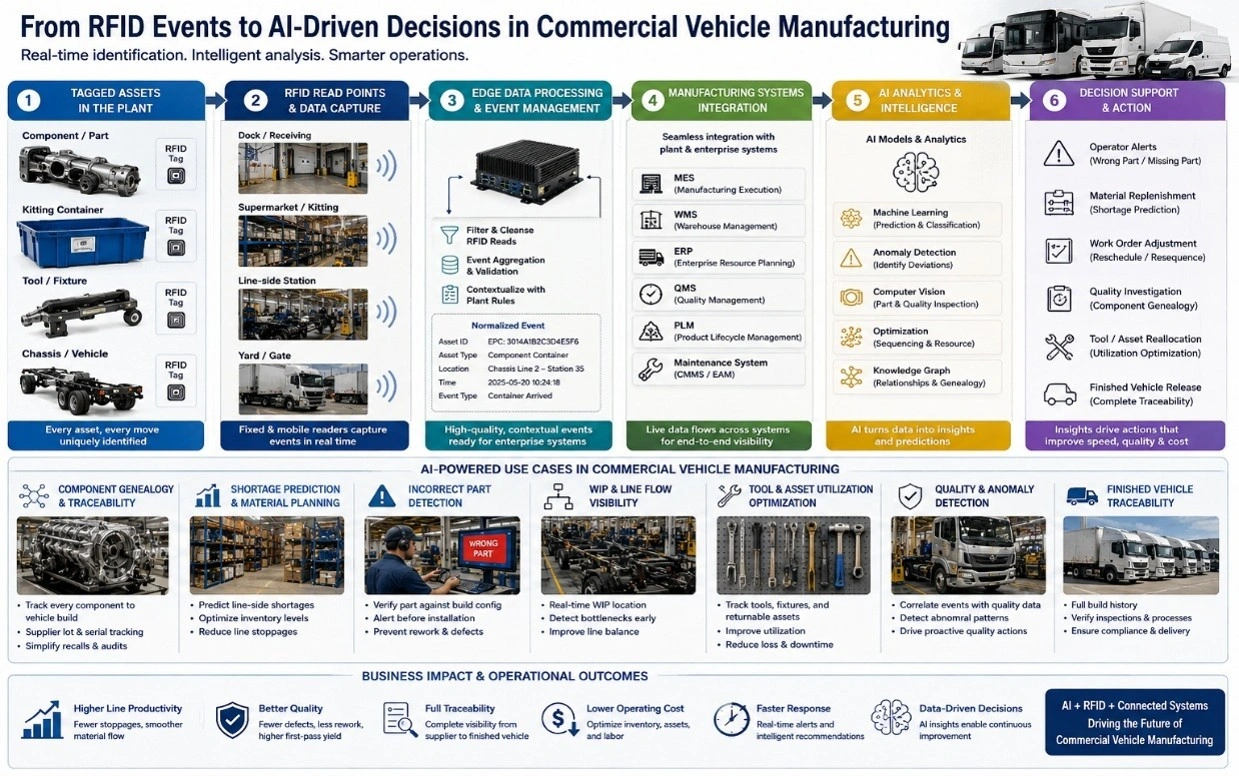
AI and RFID Data-to-Decision Workflow in Commercial Vehicle Manufacturing
The Role of AIoT in Commercial Vehicle Production
AIoT, or Artificial Intelligence of Things, combines artificial intelligence with IoT devices, sensors, connected equipment, and industrial systems. In commercial vehicle manufacturing, AIoT can combine RFID events with machine data, production orders, torque-tool records, vision inspection results, PLC signals, warehouse transactions, environmental sensors, and vehicle configuration data.
The objective is not simply to collect more factory data. The objective is to create operational intelligence from that data.
For example, an RFID event can establish that a specific steering component kit entered an assembly zone. A manufacturing execution system can associate that event with a particular vehicle build order. AI software can then evaluate whether the correct component family, production sequence, quality status, and required tooling conditions are present. If the data indicates a mismatch, the system can alert the workstation before assembly proceeds.
This approach is especially useful where commercial vehicle production involves high product variation, mixed-model assembly, engineered-to-order configurations, multiple suppliers, and strict component traceability.
Why Commercial Vehicle Manufacturing Needs More Than Basic RFID Tracking
RFID alone can answer questions such as:
- Which tagged asset was detected?
- Where was it detected?
- When was it detected?
- Which production zone or read point detected it?
AI adds another layer of operational reasoning:
- Is the detected component appropriate for the vehicle build configuration?
- Is a component moving through production slower than expected?
- Does a sequence of RFID events indicate a potential production disruption?
- Is an abnormal material movement associated with a quality event?
- Which returnable containers are likely to become unavailable?
- Which production assets show utilization patterns associated with future shortages or downtime?
That distinction is important for commercial vehicle manufacturing. RFID creates reliable identification events, while AI can correlate those events with manufacturing context and recommend or trigger business actions.
Commercial Vehicle Manufacturing Applications for AI-Driven Operations
Component Genealogy and Vehicle Build Traceability
Commercial vehicles require detailed records of installed components and assemblies. Depending on the vehicle program, traceability can extend from major assemblies such as engines, transmissions, axles, and battery packs to electronic modules, safety-related components, harnesses, and configured subassemblies.
RFID can associate tagged parts, containers, and assemblies with production stations. AI software can analyze these records alongside production orders, quality results, and configuration information to identify incomplete or inconsistent genealogy.
A practical implementation can create an auditable relationship between:
- Vehicle identification or build order
- Chassis and assembly information
- Component identity
- Supplier or lot information
- Production station
- Installation timestamp
- Quality inspection result
- Operator or work-center event
- Rework history
This helps manufacturers investigate quality events without depending entirely on manual records.
AI Material Sequencing and Line-Side Inventory
Commercial vehicle assembly frequently requires components to reach the correct workstation at the correct time. A shortage of a relatively small component can stop an assembly sequence even when the rest of the vehicle’s material is available.
RFID-enabled containers and component kits can provide real-time material movement information. AI can use that information together with production schedules, inventory levels, replenishment times, and historical consumption patterns to identify likely shortages before they become line stoppages.
The system can support decisions such as:
- Prioritizing replenishment for a vehicle build approaching a constrained station
- Detecting containers that remain in the wrong production area
- Predicting consumption of high-variation components
- Identifying abnormal material movement
- Supporting supermarket and line-side inventory optimization
GAO’s RFID hardware and connected identification systems can provide the physical data-capture layer required for these applications.
Work-in-Process and Assembly Progress
WIP visibility is difficult when a commercial vehicle moves through multiple assembly zones and its production state cannot be inferred reliably from a single enterprise transaction.
RFID read points at controlled transitions can establish production events without requiring manual scanning at every movement. AI can correlate these events with planned cycle times and station sequences.
A deviation can indicate:
- A vehicle remaining too long in an assembly zone
- A missing production event
- A rework loop
- An abnormal queue
- A material constraint
- An equipment-related delay
Manufacturers can use these signals to improve production scheduling and escalation procedures.
Quality Control and Anomaly Detection
Quality engineering benefits when production history can be associated accurately with a specific vehicle and its components.
AI models can evaluate relationships between RFID-derived genealogy, inspection results, torque measurements, machine parameters, supplier lots, and rework records. Statistical models and anomaly-detection techniques can identify combinations of conditions associated with quality deviations.
For example, if a particular component lot is repeatedly associated with rework at a specific assembly station, the system can flag the relationship for quality engineers. AI does not replace engineering validation. It helps narrow the investigation by identifying patterns that may be difficult to detect manually across large production datasets.
Tool, Fixture, and Returnable Asset Management
Commercial vehicle plants use specialized tools, fixtures, racks, pallets, carts, dunnage, and returnable containers. Lost or misplaced assets can create indirect production costs and disrupt material flow.
RFID can provide identity and movement events for these assets. AI can analyze utilization, dwell time, circulation patterns, and abnormal movements to identify underutilized or constrained assets.
For example, a manufacturer can identify returnable containers that repeatedly remain outside expected circulation paths and determine whether the problem is caused by supplier turnaround, internal staging, yard movement, or inaccurate transactions.
End-to-End AI and RFID Deployment in Commercial Vehicle Manufacturing
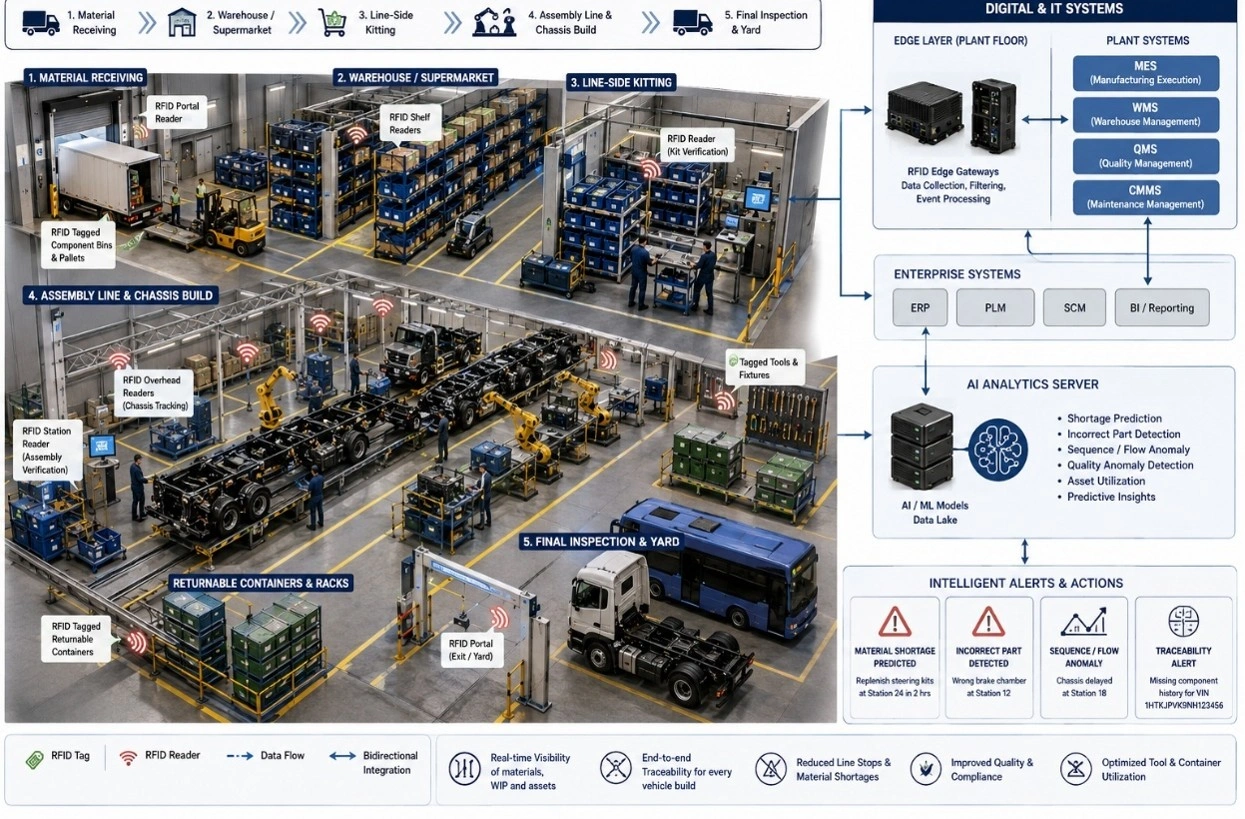
Commercial Vehicle Manufacturing Workflows Where AI Delivers the Most Value
AI and connected identification are most useful when they are attached to specific manufacturing workflows rather than deployed as isolated technology projects.
Receiving to Production
The workflow can begin when components arrive from suppliers. RFID identification can associate tagged containers or selected components with receiving transactions. Warehouse software can compare expected and actual material, while AI can identify abnormal receiving patterns or material that may affect upcoming production requirements.
Material then moves through storage, supermarket areas, kitting, and line-side staging. RFID events provide movement evidence, while AI can assess whether material is progressing according to the production plan.
Kitting and Mixed-Model Assembly
Commercial vehicle manufacturers frequently manage multiple configurations on the same production line. A kit prepared for one build cannot simply be substituted with an apparently similar component without considering the vehicle configuration.
A practical AI-enabled solution can correlate the production order, kit identity, RFID events, component master data, and workstation requirements. If an incorrect kit approaches a station, the system can generate an exception before assembly.
Assembly to Final Inspection
During assembly, RFID events can establish the presence of major components or assemblies at defined checkpoints. Other sensors and manufacturing systems provide process information.
AI can combine these data sources to detect missing events, abnormal cycle times, recurring rework patterns, and relationships between component history and inspection outcomes.
Final inspection can then use the accumulated vehicle genealogy as an input to quality review, service documentation, and controlled release processes.
Finished Vehicle and Yard Operations
Completed commercial vehicles may remain in staging or yard areas while awaiting inspection, documentation, customer allocation, transportation, or delivery.
RFID can provide controlled identification at yard gates and designated zones. AI can analyze dwell time, movement patterns, and dispatch requirements to identify vehicles that are not progressing according to expected schedules.
This is particularly useful when the plant manages high vehicle volumes across multiple parking or staging areas.
From RFID Events to AI-Driven Manufacturing Decisions
A production-grade implementation should treat data capture, processing, integration, analytics, and action as one connected operational workflow.
Data Acquisition
The physical layer can include UHF RFID readers and antennas for longer-range identification of tagged containers, pallets, tools, racks, and selected components. HF RFID can be appropriate for shorter-range controlled interactions or workstation-level identification, while LF RFID can serve specialized proximity-identification requirements where its characteristics are appropriate.
Reader selection should consider metal surfaces, tag mounting, read-zone geometry, conveyor or vehicle movement, electromagnetic interference, required read distance, tag orientation, and the acceptable false-read rate.
Edge Processing and Event Filtering
Raw RFID reads can contain duplicate detections and transient observations. Edge software or industrial gateways can filter, aggregate, timestamp, validate, and contextualize these events before sending them to higher-level software.
For a commercial vehicle plant, an event such as “tag detected” is usually less useful than a contextual event such as “component container entered the chassis assembly supermarket.”
This event processing layer is therefore critical to data quality.
Manufacturing Software Integration
Useful integration points can include:
- Manufacturing execution systems
- Enterprise resource planning systems
- Warehouse management systems
- Quality management systems
- Product lifecycle management systems
- Supplier management systems
- Maintenance management software
- Production scheduling software
- Industrial databases and historians
- PLC and industrial control systems
Integration may use REST APIs, MQTT, OPC UA, message brokers, database interfaces, or vendor-specific industrial protocols depending on the existing plant environment.
AI Analytics and Business Actions
AI models can operate on the resulting event stream and historical production data. Suitable methods may include supervised machine learning, anomaly detection, time-series forecasting, classification, clustering, computer vision, and optimization models.
The final output should be operationally meaningful. Examples include a material shortage warning, a suspected genealogy inconsistency, an abnormal WIP dwell alert, an asset circulation exception, or a production sequence recommendation.
AI and RFID Data-to-Decision Workflow for Commercial Vehicle Manufacturing
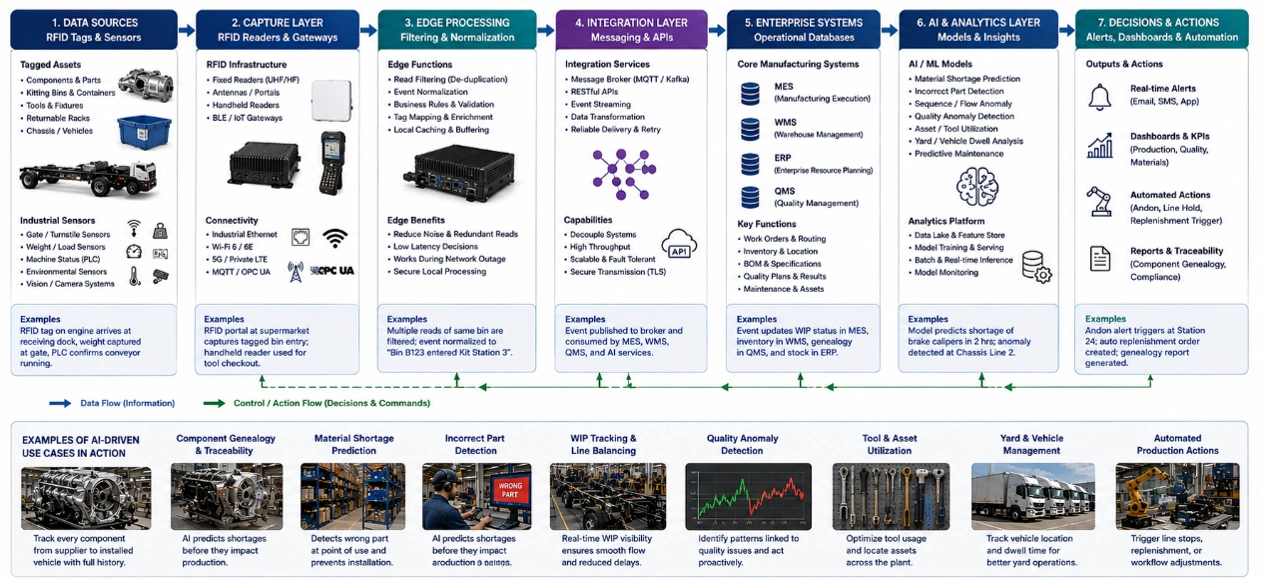
Hardware, Software, AI Models, and Deployment Choices for Commercial Vehicle Plants
A commercial vehicle manufacturing solution normally combines identification hardware, industrial connectivity, data-processing software, AI analytics, and integration with existing manufacturing applications. Component selection should be based on the physical production process rather than on RFID specifications alone.
RFID Hardware and Industrial Data Capture
UHF RFID is generally well suited to applications requiring longer read ranges, such as tagged pallets, containers, racks, kitted components, tools, and controlled movement through warehouse or production zones. However, commercial vehicle plants contain substantial metal structures, vehicles, tooling, and machinery, so antenna placement and tag selection require physical testing.
HF RFID is useful for short-range, deliberate identification interactions where controlled proximity is preferred. LF RFID can be appropriate for specialized low-frequency identification applications where its short-range behavior and operating characteristics match the use case.
Readers, antennas, tags, industrial gateways, edge computers, network switches, and appropriately engineered mounting hardware form the physical data-capture layer.
Edge, Server, and Cloud Processing
Edge computing is valuable when the plant requires local event processing, low-latency decisions, continued operation during intermittent connectivity, or controlled handling of production data.
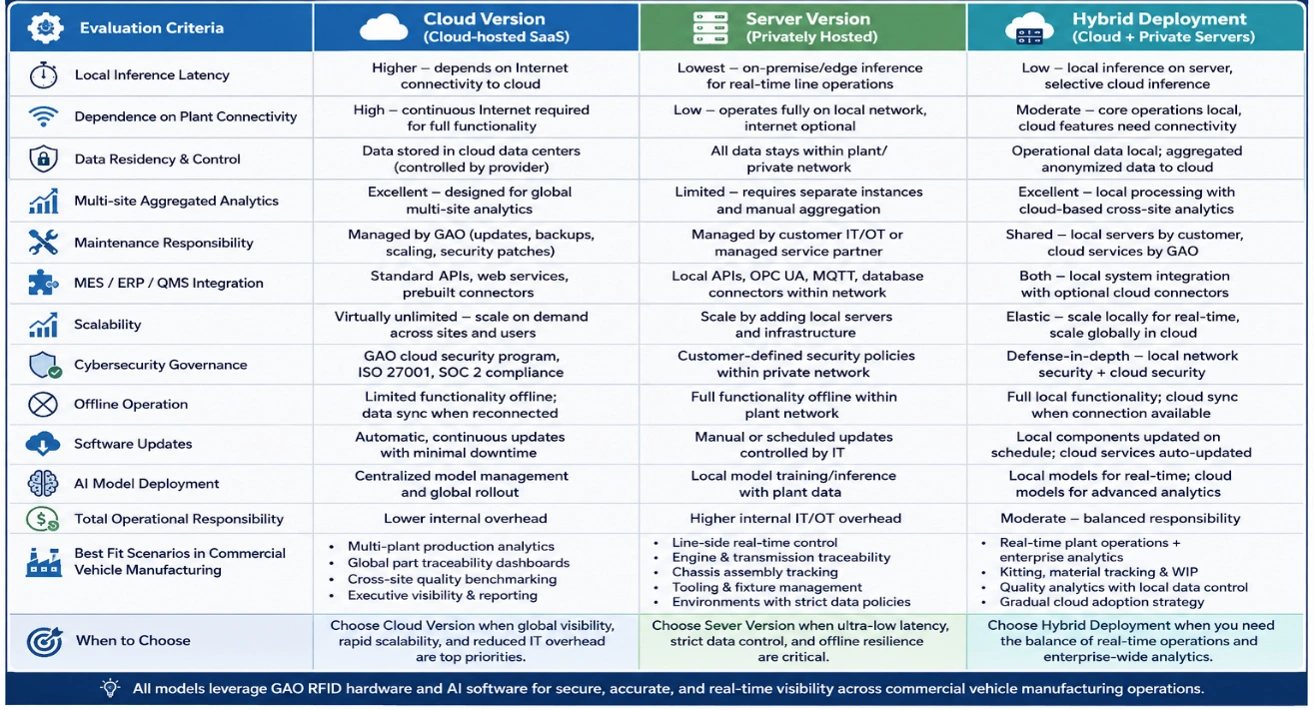
A Server Version can run on a factory server, customer-managed server, private data center, edge server, or other privately hosted enterprise infrastructure. This approach is often appropriate when commercial vehicle manufacturers require tighter control over data residency, plant connectivity, integration boundaries, or cybersecurity policies.
A Cloud Version is cloud-hosted software managed within cloud infrastructure. It can be useful for organizations operating multiple plants that need centralized analytics, common reporting, remote monitoring, or scalable computational resources.
A hybrid arrangement can retain time-sensitive production processing locally while sending selected operational data to cloud services for broader analytics.
Cloud, Server, and Hybrid Deployment for Commercial Vehicle Manufacturing
Cybersecurity and Operational Resilience
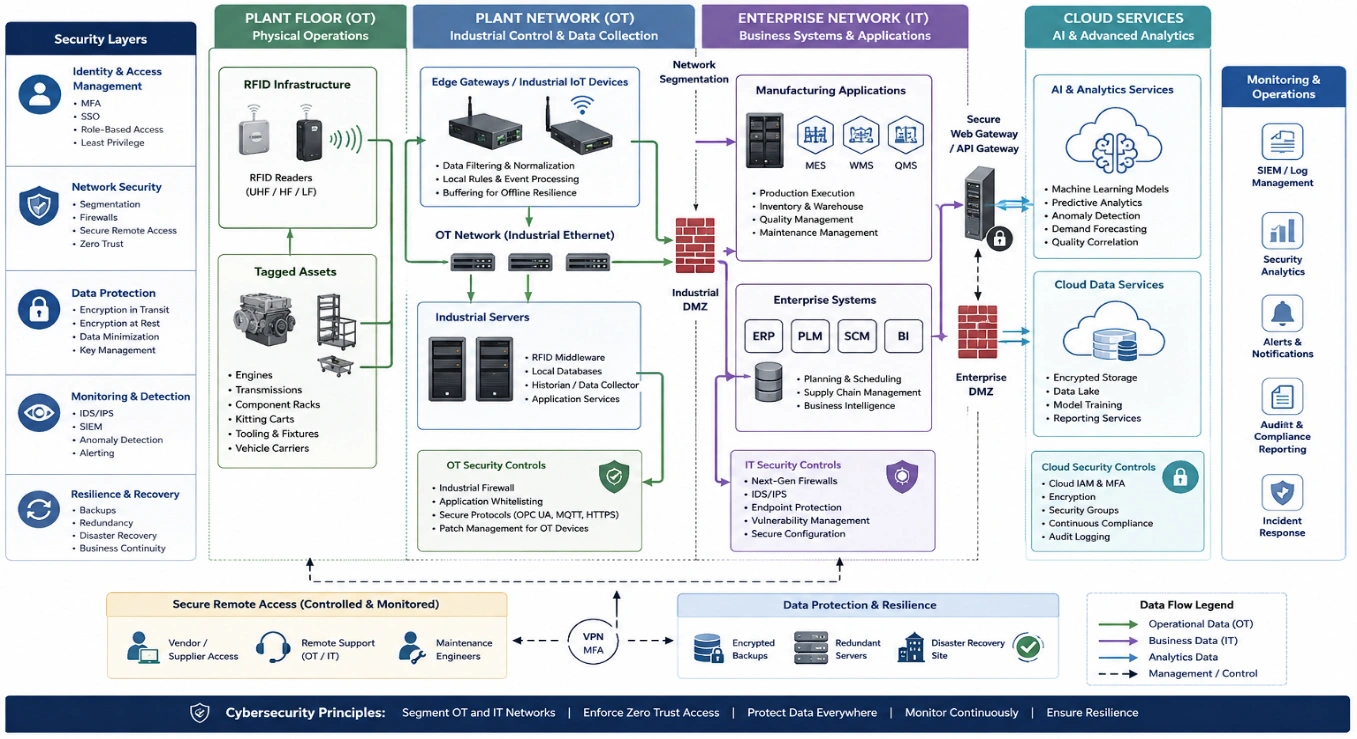
RFID readers and edge systems should not be treated as isolated devices. They can become part of the plant’s operational technology environment and should therefore be incorporated into network segmentation, access control, credential management, patching, logging, backup, and incident-response procedures.
Manufacturers should also consider:
- Segmentation between RFID/IoT devices, OT networks, and corporate IT
- Role-based access to manufacturing and traceability data
- Encryption for data in transit and at rest where appropriate
- Secure device credentials and certificate management
- Centralized logging and monitoring
- Controlled software updates
- Backup and recovery procedures
- Fail-safe behavior when connectivity or AI services become unavailable
- Validation of AI-generated recommendations before automated control actions
For safety-critical commercial vehicle production processes, AI recommendations should not bypass established engineering controls, quality gates, or validated machine safety functions.
GAO’s experience supplying connected hardware and systems to organizations in the United States and Canada supports practical deployment considerations where product reliability, integration, quality assurance, and technical support are important.
Cybersecurity Architecture for AI and RFID in Commercial Vehicle Manufacturing
Engineering Considerations Before Deploying AI and RFID
A technically successful deployment starts with the manufacturing process, not the reader specification.
Commercial vehicle plants should first identify the decisions they want to improve and the physical events required to support those decisions. Engineers should then map read zones, tag locations, material routes, workstation transitions, production states, and integration points.
Metal chassis, engine components, battery housings, racks, and other conductive surfaces can materially affect RFID performance. Tag selection should therefore be validated against the actual mounting surface. Reader sensitivity alone does not guarantee reliable identification.
Pilot testing should measure read accuracy, missed reads, duplicate reads, zone containment, event latency, network reliability, and integration behavior under real production conditions. AI models should also be validated against representative historical and live production data before they influence operational decisions.
This process helps prevent a common implementation mistake: collecting large volumes of RFID events without establishing whether those events accurately represent the manufacturing state that AI is expected to analyze.