
AI and RFID for Colleges: Intelligent Campus Operations with Smart RFID Solutions
How AI and RFID Are Transforming Modern Colleges
Artificial intelligence is reshaping how colleges manage physical assets, student services, campus safety, academic resources, and operational efficiency. When AI is combined with RFID technologies including UHF RFID, HF RFID, and LF RFID, colleges gain continuous visibility into people, equipment, facilities, and learning resources while enabling intelligent decision making based on real operational data.
Across modern colleges, AI analyzes RFID-generated data from classrooms, laboratories, libraries, residence halls, athletic facilities, maintenance departments, and campus infrastructure to identify trends, predict operational issues, automate routine processes, and improve resource utilization. Rather than relying on manual inventory counts or disconnected administrative systems, AI continuously evaluates RFID events to provide actionable insights for campus administrators, facilities managers, IT departments, librarians, security personnel, procurement teams, and academic leadership.
Educational institutions face increasing pressure to improve operational efficiency while supporting growing student populations, expanding technology inventories, stricter cybersecurity requirements, and higher expectations for campus services. AI-driven RFID solutions help address these challenges through automated identification, intelligent analytics, predictive maintenance, occupancy intelligence, asset visibility, and operational automation.
For more than three decades, GAO has supplied RFID, BLE, and IoT hardware products and systems supporting organizations throughout the United States and Canada. Our experience serving universities, research institutions, government organizations, and Fortune 500 companies provides practical engineering insight into deploying intelligent identification technologies within demanding educational environments.
AI-Enabled RFID Deployment Across a Modern College Campus
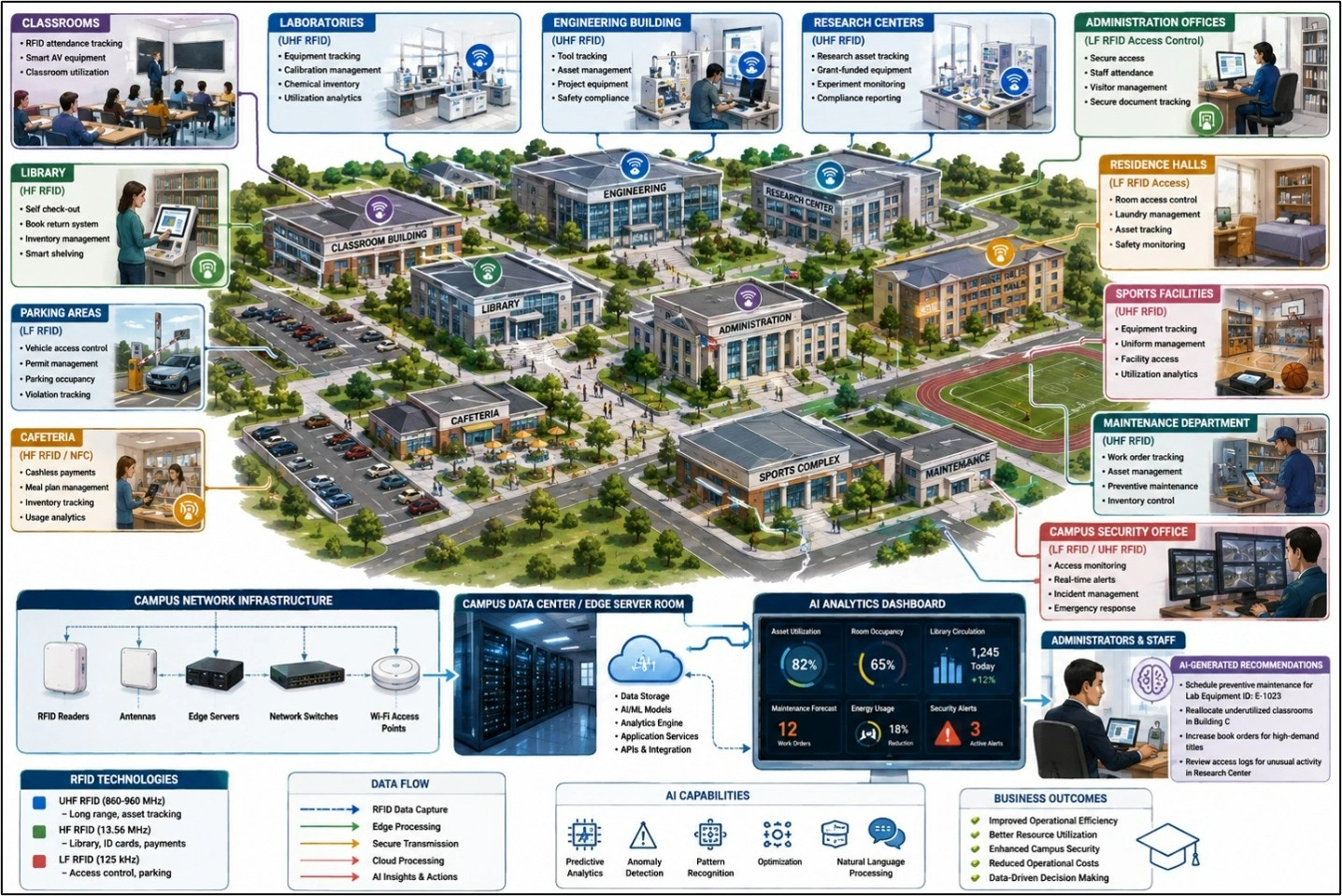
This infographic illustrates how AI-powered RFID technologies support intelligent operations across a college campus by connecting classrooms, laboratories, libraries, residence halls, sports facilities, administration offices, parking, cafeterias, maintenance, research centers, and campus security through UHF, HF, and LF RFID systems. It also highlights the supporting network infrastructure, edge computing, AI analytics dashboard, data flow, RFID technologies, AI capabilities, business outcomes, and AI-generated operational recommendations that enable real-time campus visibility and data-driven decision making.
Understanding AI Driven RFID Solutions for Colleges
Modern colleges manage thousands of interconnected assets and operational processes every day. Scientific instruments, library collections, classroom technology, student identification cards, laboratory chemicals, audiovisual equipment, maintenance tools, emergency devices, athletic equipment, research assets, and campus vehicles all require accurate tracking throughout their operational lifecycle.
RFID provides automated identification by assigning unique digital identities to physical objects. AI transforms this identification data into operational intelligence capable of improving planning, forecasting, automation, and decision support.
Within college environments, AI continuously evaluates RFID-generated information from multiple operational systems, including:
- Student attendance systems
- Library circulation systems
- Laboratory asset management
- Classroom equipment utilization
- Campus maintenance operations
- Dormitory access management
- Research equipment tracking
- IT hardware inventory
- Medical simulation laboratories
- Athletic equipment management
- Procurement systems
- Security monitoring
- Facilities management
- Parking operations
- Emergency response coordination
Rather than treating each department independently, AI correlates operational events across multiple campus functions to identify inefficiencies, predict shortages, recommend maintenance schedules, optimize equipment allocation, and improve overall campus performance.
This intelligent approach allows colleges to shift from reactive operations toward predictive campus management supported by continuously updated operational intelligence.
Why AI Powered RFID Is Becoming Essential for College Operations
Higher education institutions have become increasingly technology intensive. Engineering colleges operate advanced laboratories containing expensive instrumentation. Medical colleges manage regulated clinical simulation equipment. Research institutions maintain thousands of specialized assets. Libraries circulate hundreds of thousands of books and digital resources. Information technology departments support thousands of laptops, servers, networking devices, and classroom technologies.
Traditional manual inventory methods struggle to provide accurate visibility across these environments.
AI supported RFID solutions help colleges address operational challenges such as:
- Misplaced laboratory equipment
- Inefficient classroom utilization
- Delayed preventive maintenance
- Library inventory inaccuracies
- Lost IT equipment
- Student attendance verification
- Unauthorized asset movement
- Research equipment scheduling conflicts
- Maintenance workforce optimization
- Procurement planning
- Capital asset auditing
- Campus emergency preparedness
Instead of producing historical reports alone, AI continuously evaluates incoming RFID events, compares them against historical operational patterns, identifies anomalies, predicts future requirements, and recommends corrective actions before operational disruptions occur.
Because colleges operate across multiple buildings, departments, and campuses, intelligent automation significantly improves operational coordination while reducing administrative workload.
GAO has supported organizations requiring reliable RFID hardware, industrial identification systems, and technical expertise where operational reliability and long-term scalability remain critical deployment objectives.
Manual vs. AI-Enabled RFID Operations in Modern College Campuses
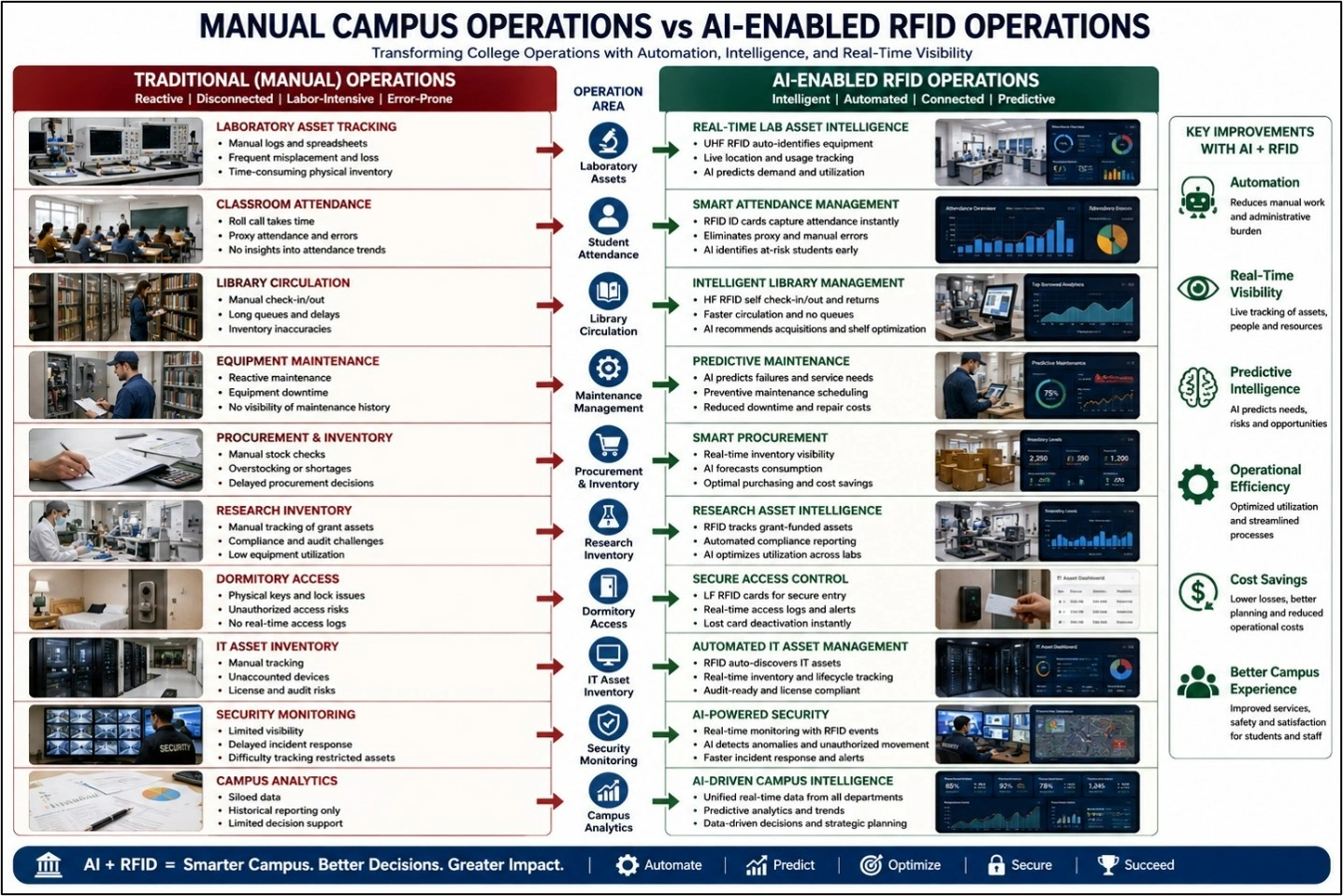
This side-by-side infographic compares traditional manual college operations with AI-enabled RFID workflows across key campus functions, including laboratory asset tracking, classroom attendance, library circulation, maintenance, procurement, research inventory, dormitory access, IT asset management, security monitoring, and campus analytics. It demonstrates how AI and RFID improve automation, real-time visibility, predictive intelligence, operational efficiency, cost savings, and decision making throughout the college environment.
AI Applications Across College Departments
Every college department produces operational data suitable for intelligent analysis. AI extracts meaningful operational insights from RFID-generated events while supporting different administrative and academic functions.
AI Laboratory Asset Management
Engineering, chemistry, biology, physics, medical, and manufacturing laboratories contain expensive instruments that frequently move between classrooms, faculty research, graduate projects, and maintenance facilities.
RFID enables automatic identification of:
- Oscilloscopes
- Spectrometers
- Microscopes
- CNC training equipment
- Robotics systems
- Medical simulation devices
- Chemical storage cabinets
- Calibration tools
- Portable analyzers
- Testing instruments
AI analyzes utilization frequency, idle time, maintenance history, calibration schedules, and equipment demand to recommend improved allocation across departments.
Benefits include:
- Reduced equipment loss
- Higher laboratory utilization
- Improved maintenance scheduling
- Better research equipment availability
- Simplified accreditation audits
AI Library Management
College libraries contain extensive collections including books, journals, archives, multimedia resources, research materials, laptops, tablets, and specialized academic equipment.
HF RFID supports automated circulation, self-service borrowing, inventory verification, and security monitoring.
AI enhances these functions by identifying:
- High-demand publications
- Seasonal borrowing patterns
- Collection utilization
- Shelf organization improvements
- Missing inventory prediction
- Resource allocation trends
- Student learning behavior
- Space utilization
Rather than simply recording checkouts, AI assists librarians in optimizing acquisitions, improving collection management, and increasing student access to educational resources.
AI Classroom Utilization
Colleges invest heavily in lecture halls, smart classrooms, seminar rooms, collaborative learning spaces, engineering laboratories, and specialized instructional facilities.
RFID occupancy information enables AI to evaluate:
- Classroom utilization
- Seat occupancy
- Scheduling efficiency
- Equipment usage
- Faculty resource allocation
- Building occupancy
- HVAC optimization
- Energy management
Administrative departments use these insights to improve scheduling while reducing operational costs.
AI Student Attendance Management
Student identification cards containing RFID technology automate attendance collection across classrooms, laboratories, workshops, examinations, libraries, residence halls, and campus events.
AI extends attendance beyond simple presence detection by analyzing:
- Attendance trends
- Student engagement
- Course participation
- Schedule conflicts
- Academic risk indicators
- Building occupancy
- Peak classroom demand
- Resource planning
Early identification of attendance anomalies allows academic advisors to intervene before academic performance declines.
AI Campus Facilities Management
Facilities departments oversee electrical infrastructure, HVAC systems, elevators, plumbing, generators, maintenance equipment, custodial supplies, landscaping machinery, and building assets.
RFID identifies maintenance assets throughout campus while AI predicts:
- Equipment failures
- Preventive maintenance schedules
- Spare parts demand
- Workforce allocation
- Building maintenance priorities
- Service request patterns
- Utility consumption
- Facility lifecycle planning
Predictive maintenance reduces unexpected downtime while extending infrastructure lifespan.
AI Research Asset Management
Research colleges frequently manage grant-funded equipment requiring strict accountability.
Examples include:
- Electron microscopes
- Environmental monitoring systems
- Biotechnology analyzers
- High performance computing equipment
- Data acquisition systems
- Experimental sensors
- Research servers
- Specialized instrumentation
AI combines RFID inventory information with research scheduling software to maximize equipment availability while supporting grant compliance, utilization reporting, and long-term capital planning.
AI-Enabled RFID Workflow Across College Departments
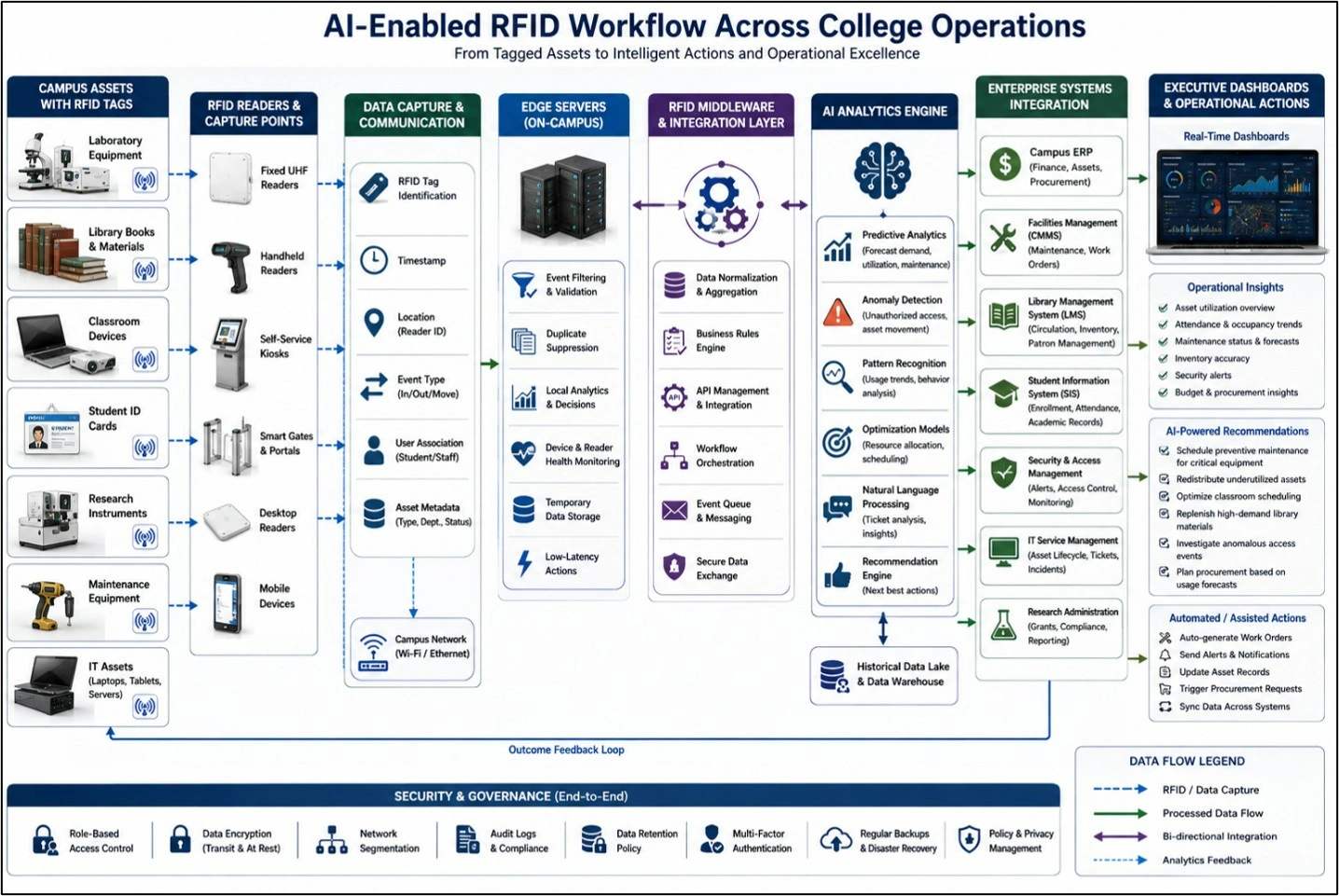
This workflow diagram illustrates how RFID-tagged laboratory equipment, library materials, classroom devices, student ID cards, research instruments, maintenance equipment, and IT assets generate real-time data that flows through RFID readers, edge servers, middleware, and AI analytics before integrating with campus ERP, facilities, library, security, and student information systems. It demonstrates how AI transforms RFID data into executive dashboards, predictive insights, automated workflows, and operational recommendations that improve asset visibility, campus security, maintenance planning, resource utilization, and decision making.
Operational Workflow of AI Enabled RFID Systems in Colleges
A successful college deployment requires coordinated interaction among identification hardware, networking infrastructure, software services, analytics engines, operational databases, and campus administrative systems.
The operational workflow generally follows these stages.
RFID Data Acquisition
RFID tags attached to laboratory equipment, library materials, classroom devices, maintenance tools, student identification cards, and research assets are automatically detected by fixed readers, handheld readers, security gates, desktop readers, mobile devices, and self-service kiosks.
Detection events include:
- Asset identification
- Timestamp
- Reader location
- Movement direction
- User association
- Department assignment
- Equipment status
- Transaction type
Communication Infrastructure
Captured RFID events are securely transmitted through Ethernet, Wi-Fi, industrial switches, fiber backbone networks, or secure VPN connections toward campus servers or managed cloud software.
Large colleges often deploy redundant communication paths across multiple academic buildings to improve operational resilience.
Edge Processing
Edge servers positioned within campus data centers perform immediate processing before forwarding selected information for long-term analytics.
Edge processing supports:
- Duplicate filtering
- Event validation
- Local decision making
- Device health monitoring
- Reader synchronization
- Temporary data storage
- Low latency automation
Edge computing becomes especially valuable for security-sensitive operations requiring rapid response without depending on external network connectivity.
AI, RFID, and Supporting Technologies for College Deployments
Successful AI-enabled RFID solutions for colleges rely on a combination of identification technologies, intelligent software, secure communications, and integrated operational systems. Rather than functioning as isolated technologies, these components work together to improve visibility, automate workflows, and support informed decision making across academic and administrative departments.
RFID Technologies Used Across Colleges
Different RFID frequencies are appropriate for different college applications.
UHF RFID
UHF RFID is commonly used where long read distances and rapid identification are required.
Typical college applications include:
- Laboratory equipment inventory
- Computer and IT asset management
- Classroom audiovisual equipment tracking
- Furniture inventory
- Warehouse and storeroom inventory
- Athletic equipment management
- Campus maintenance assets
- Research equipment tracking
HF RFID
HF RFID provides reliable short-range identification and is widely used for:
- Library circulation
- Self-checkout kiosks
- Book return systems
- Student identification
- Secure document management
- Archive management
LF RFID
LF RFID performs well around metal and moisture and is frequently selected for:
- Building access credentials
- Parking access
- Time and attendance
- Specialized laboratory environments
- Certain maintenance applications
Selecting the appropriate RFID frequency depends on read distance, environmental conditions, asset characteristics, infrastructure constraints, and operational objectives.
AI Models Supporting College Operations
Artificial intelligence processes RFID-generated operational data using multiple analytical approaches.
Common AI methods include:
- Machine learning for predicting laboratory equipment demand
- Predictive analytics for preventive maintenance scheduling
- Time-series forecasting for classroom occupancy
- Anomaly detection for identifying unauthorized asset movement
- Reinforcement learning for optimizing room utilization
- Natural language processing for maintenance ticket analysis
- Computer vision integrated with RFID for laboratory verification
- Recommendation engines for library acquisitions
- Classification models for equipment lifecycle planning
- Clustering algorithms for identifying operational usage patterns
These models continuously improve as additional operational data becomes available.
Supporting Hardware Components
Typical college deployments include:
- Fixed RFID readers
- Handheld RFID readers
- RFID security gates
- Desktop RFID readers
- Self-service library kiosks
- Student identification cards
- RFID asset labels
- Rugged industrial RFID tags
- Smart lockers
- Edge servers
- Network switches
- Wireless access points
- Backup power systems
- Environmental monitoring sensors
- Digital signage displays
Reliable hardware selection directly affects read accuracy, system availability, and long-term operational costs.
Software Components
A typical intelligent college solution integrates with several operational software systems.
Examples include:
- Student Information Systems (SIS)
- Learning Management Systems (LMS)
- Integrated Library Systems (ILS)
- Enterprise Resource Planning (ERP)
- Computerized Maintenance Management Systems (CMMS)
- Identity and Access Management (IAM)
- Asset Management Software
- Procurement Systems
- Research Administration Software
- Facilities Management Software
- IT Service Management Software
- Business Intelligence dashboards
Rather than replacing these systems, AI-enabled RFID software exchanges information through secure APIs, message queues, and middleware to provide unified operational intelligence.
Communication Infrastructure
Reliable communication is essential for continuous RFID operation across multiple academic buildings.
Typical infrastructure includes:
- Gigabit Ethernet
- Wi-Fi 6 and Wi-Fi 7
- Fiber backbone networks
- VPN connectivity
- Secure HTTPS communication
- MQTT where lightweight messaging is beneficial
- SNMP for infrastructure monitoring
- NTP for synchronized timestamps
- IPv6-ready networking
- Network segmentation using VLANs
Network redundancy and monitoring help maintain uninterrupted campus operations.
Cloud Version Versus Server Version
Cloud Version
Cloud-hosted software is appropriate when colleges require centralized management across multiple campuses with minimal local infrastructure.
Advantages include:
- Rapid deployment
- Automatic software updates
- Elastic computing resources
- Centralized AI model management
- Disaster recovery support
- Simplified scalability
- Remote administration
- Reduced infrastructure maintenance
Cloud deployments are often selected by multi-campus institutions, private colleges, and organizations seeking lower operational overhead.
Server Version
Server deployments place software within customer-managed infrastructure such as campus data centers, private cloud environments, regional hosting facilities, or dedicated enterprise servers.
Advantages include:
- Greater control over sensitive research data
- Compliance with institutional security policies
- Integration with legacy academic systems
- Local processing with reduced latency
- Independent software maintenance schedules
- Greater customization flexibility
Research universities, medical colleges, defense-funded laboratories, and institutions with strict data governance often prefer privately hosted server deployments.
GAO assists organizations by supplying RFID hardware and supporting deployment strategies compatible with both cloud-hosted and privately managed server environments.
Cloud-Hosted vs. Server-Hosted AI-Enabled RFID Deployments for Colleges
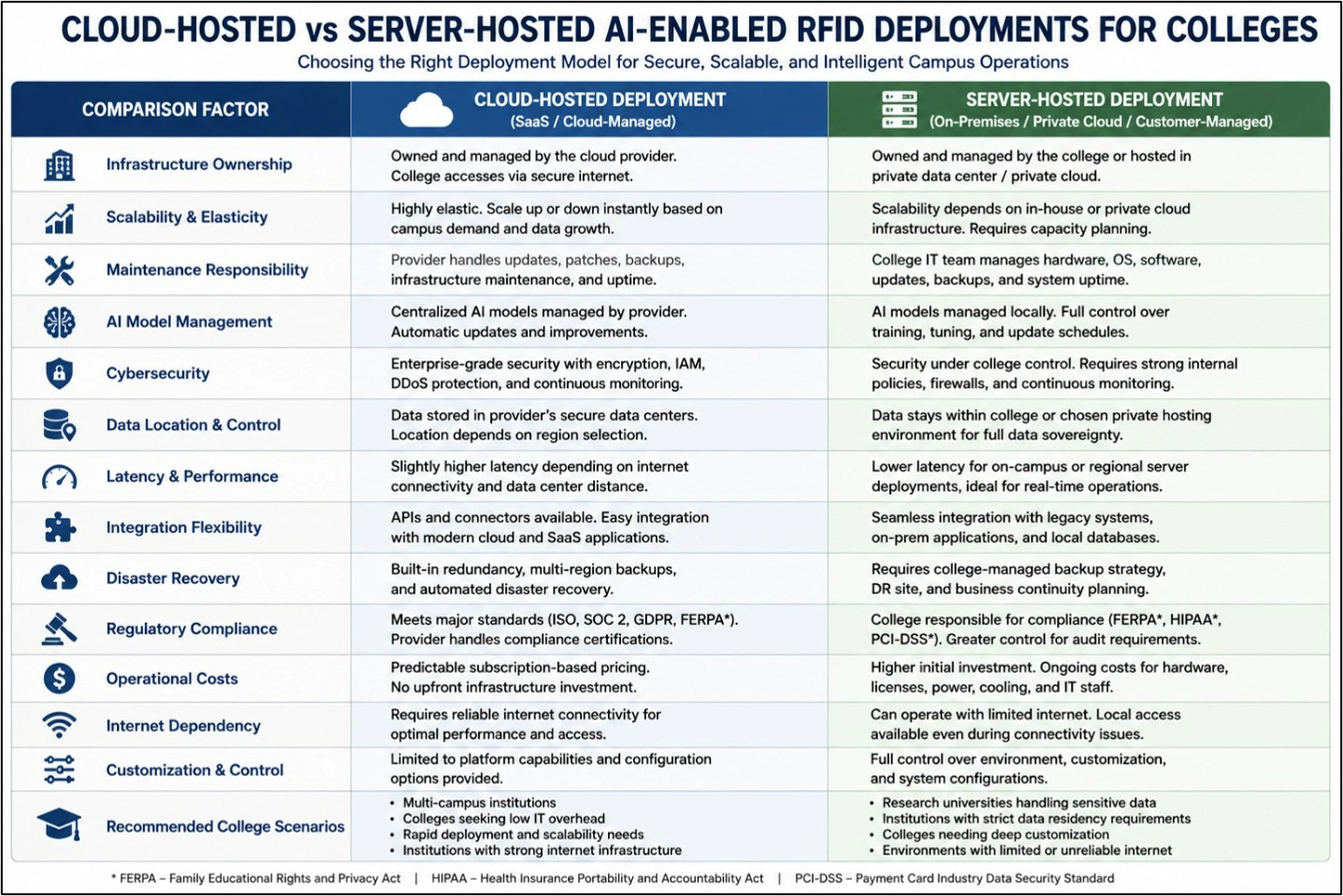
This comparison table evaluates cloud-hosted and server-hosted AI-enabled RFID deployments for colleges across critical technical and operational factors, including infrastructure ownership, scalability, maintenance, AI model management, cybersecurity, latency, integration flexibility, disaster recovery, regulatory compliance, operational costs, and deployment control. It helps college IT leaders, facilities managers, and technology decision-makers determine the most suitable deployment model based on institutional requirements, security policies, budget, and operational objectives.
Cybersecurity and Data Protection
Colleges process sensitive information related to students, faculty, researchers, financial records, and intellectual property. Security must therefore be incorporated throughout the solution lifecycle.
Recommended security controls include:
- Role-based access control
- Multi-factor authentication
- Encryption of RFID event data during transmission
- Encryption of operational databases
- Secure API authentication
- Network segmentation
- Continuous vulnerability assessments
- Security information and event management
- Audit logging
- Endpoint protection
- Digital certificate management
- Backup and disaster recovery planning
- Regular firmware updates
- Reader health monitoring
AI also strengthens security by identifying abnormal access patterns, unusual equipment movement, unauthorized inventory transfers, and suspicious operational behaviors that traditional monitoring systems may overlook.
Layered Cybersecurity Framework for AI-Enabled RFID College Systems
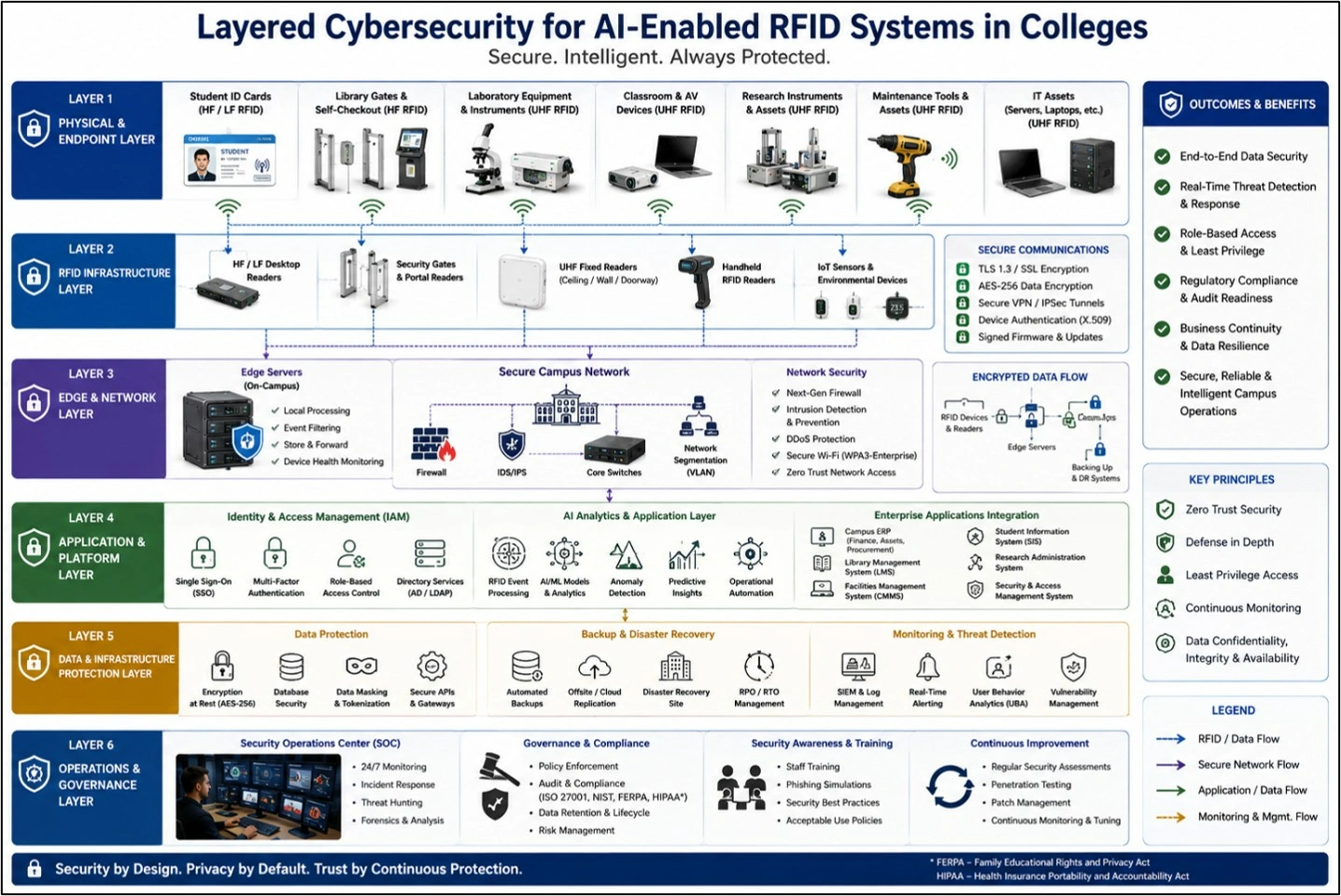
This security diagram illustrates a defense-in-depth approach for protecting AI-enabled RFID systems across a college campus, from RFID-enabled endpoints and secure communications to edge computing, identity and access management, enterprise applications, data protection, backup, and security operations. It demonstrates how encryption, authentication, network security, continuous monitoring, governance, and AI-driven threat detection work together to safeguard campus assets, student information, research resources, and operational systems.
Business Benefits of AI-Driven RFID in Colleges
Combining AI with RFID enables measurable improvements across academic, operational, and administrative functions.
Key benefits include:
- Improved laboratory equipment utilization
- Faster library inventory audits
- Reduced asset loss and unauthorized movement
- More accurate student attendance records
- Better classroom scheduling
- Increased research equipment availability
- Lower maintenance costs through predictive servicing
- Enhanced campus safety and emergency response
- Reduced manual administrative workload
- Improved procurement planning
- Better compliance with accreditation and audit requirements
- Increased visibility across multiple campuses
- More informed capital investment decisions
- Improved energy efficiency through occupancy insights
- Higher overall operational efficiency
These improvements help colleges allocate budgets more effectively while enhancing the educational experience for students and faculty.
Engineering Best Practices and Implementation Recommendations
Successful deployments begin with a clear understanding of institutional objectives rather than technology alone.
Recommended practices include:
- Conduct a comprehensive campus asset assessment before deployment.
- Select RFID frequencies based on application requirements and environmental conditions.
- Establish data governance policies for student, faculty, and research information.
- Integrate RFID software with existing SIS, ERP, ILS, and CMMS applications using standardized APIs.
- Validate reader placement through site surveys to minimize read gaps and interference.
- Pilot the solution within one department before expanding campus-wide.
- Monitor data quality and AI model performance continuously.
- Develop preventive maintenance schedules for readers, antennas, and supporting infrastructure.
- Train librarians, laboratory managers, facilities teams, and IT administrators on operational workflows.
- Review cybersecurity controls regularly to address evolving threats.
- Define key performance indicators and benchmark improvements after deployment.
Institutions that treat implementation as an ongoing operational improvement program typically achieve greater long-term value than those focusing solely on hardware installation.
AI-Enabled RFID Executive Dashboard for College Operations
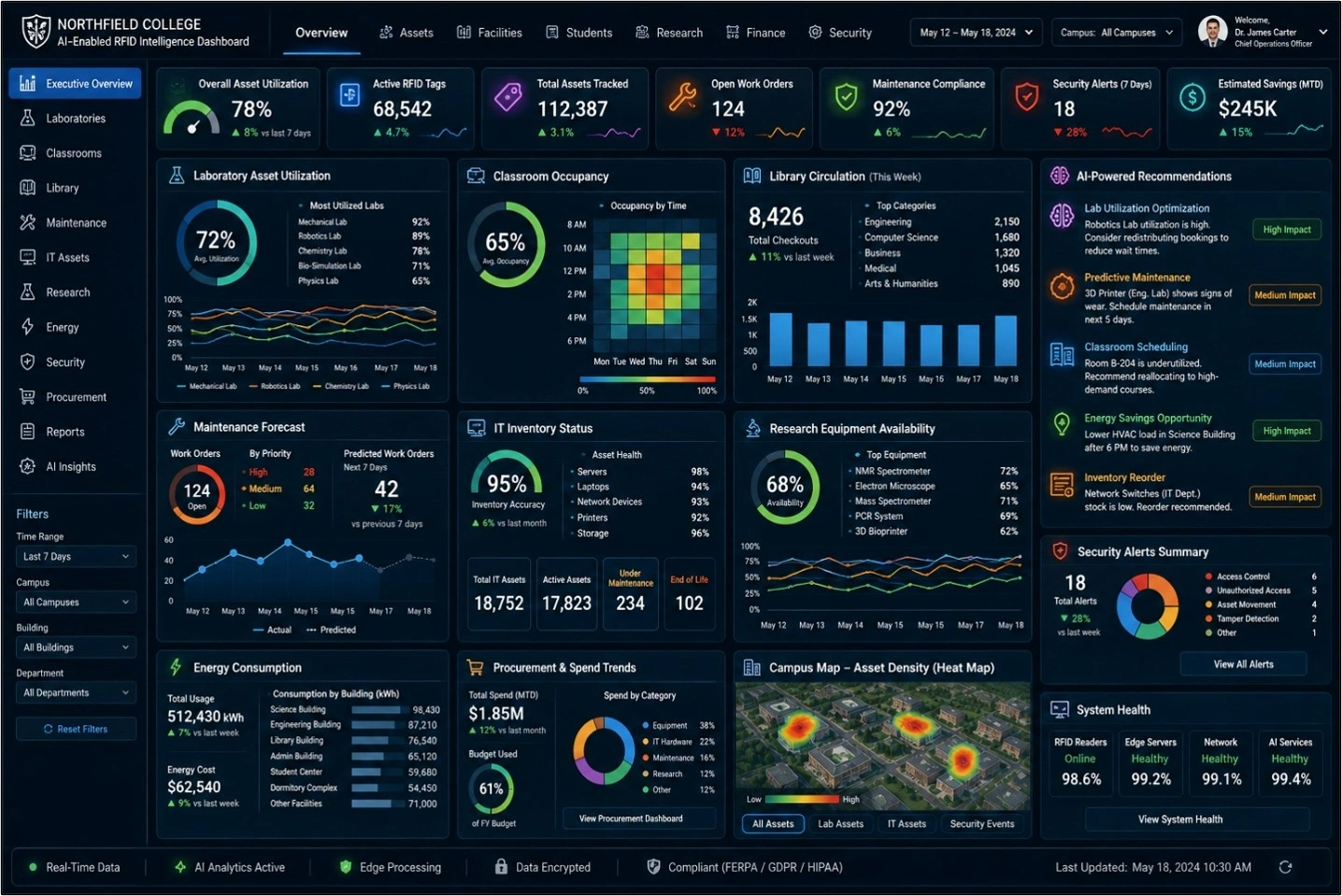
This executive dashboard demonstrates how AI transforms RFID data into real-time operational intelligence for college administrators by visualizing laboratory asset utilization, classroom occupancy, library circulation, maintenance forecasts, IT inventory, research equipment availability, energy consumption, procurement trends, security alerts, and overall system health. Interactive charts, heat maps, KPI cards, predictive analytics, and AI-generated recommendations help leadership optimize campus resources, improve operational efficiency, strengthen security, and support data-driven decision making.
Advancing Intelligent College Operations with AI and RFID
AI-powered RFID solutions are transforming how colleges manage assets, facilities, libraries, laboratories, classrooms, and student services. By combining automated identification with predictive analytics, colleges gain continuous operational visibility, improve resource utilization, strengthen security, and support better academic and administrative decision making.
Successful implementations depend on thoughtful planning, appropriate RFID technology selection, secure system integration, scalable software deployment, and continuous optimization. Institutions that align AI capabilities with operational goals are better positioned to improve efficiency, reduce costs, support research excellence, and enhance the campus experience.
Headquartered in New York City and Toronto, Canada, GAO is recognized among the world’s leading B2B and B2G suppliers of RFID and BLE technologies. Together with its sister companies, GAO Research and GAO Tek, GAO has served customers across the United States and Canada for more than three decades, including Fortune 500 companies, leading research organizations, prestigious universities, and government agencies. Through ongoing investment in research and development, rigorous quality assurance, and expert remote and onsite technical support, we help educational institutions deploy reliable RFID and AIoT solutions that meet demanding operational requirements. We invite you to learn more about GAO’s RFID hardware, intelligent identification systems, and technical expertise for modern college environments.
Building the Future of Industrial AI and IoT with Aperture Venture Studio and GAO
For more than three decades, GAO Group of Companies has invested extensively in research and development of industrial RFID, BLE, and IoT technologies. As generative AI demonstrated significant value for intelligent identification, automation, and operational analytics, we expanded our focus on AIoT solutions for sectors including higher education and established Aperture Venture Studio to accelerate the development and adoption of advanced AI and IoT innovations that address real-world operational challenges.
Aperture has attracted leading AI and IoT technical experts, experienced operational executives, influential investors, and recognized technology organizations. Through initiatives such as the Aperture Ventures Summit and TekSummit, we foster collaboration on emerging AI and IoT technologies while strengthening technical communities and knowledge sharing.
We welcome you to engage with us as:
- Advisors, co-founders, or employees
- Investors
- Customers