
AI and RFID for Biopharmaceutical Manufacturing
AI-Driven Manufacturing Visibility for Biopharmaceutical Production
AI and RFID are increasingly used together in biopharmaceutical manufacturing to improve material traceability, batch genealogy, cleanroom movement, inventory accuracy, equipment utilization, and production control. RFID provides machine-readable identification and location events for materials, containers, tools, samples, and other production assets, while AI converts those events into predictions, anomaly detection, workflow insights, and operational decisions. UHF RFID is useful for broader material and asset tracking, HF RFID can support controlled identification points and specialized workflows, and LF RFID can serve applications requiring short-range identification. For biopharmaceutical manufacturers, the value comes from connecting these identification events with MES, ERP, WMS, LIMS, QMS, CMMS, historian databases, and manufacturing data systems. This combination can strengthen electronic batch records, reduce manual scanning, identify process deviations earlier, and provide a more consistent operational record across manufacturing, warehousing, laboratories, and controlled environments.
AI and RFID-Enabled Biopharmaceutical Manufacturing Enterprise Architecture Diagram
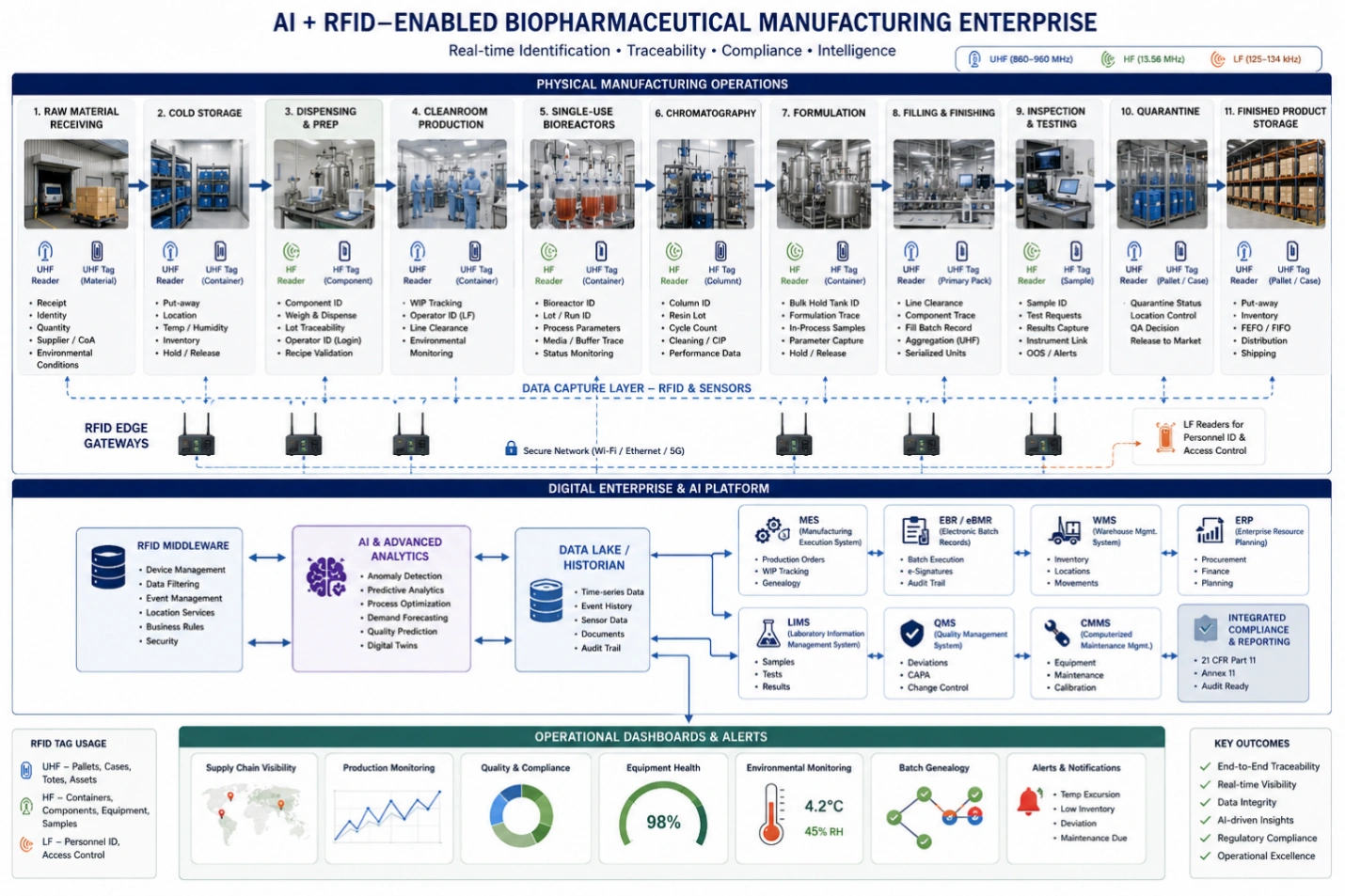
What AI and RFID Mean for Biopharmaceutical Manufacturing
Biopharmaceutical manufacturing involves highly controlled transformations in which the identity, condition, location, and genealogy of materials can directly affect product quality. Manufacturing activities may include media and buffer preparation, cell culture, upstream processing, downstream purification, formulation, aseptic filling, visual inspection, labeling, packaging, cold-chain storage, and release operations.
RFID contributes a persistent digital identity to physical objects. Depending on the application, an RFID tag can identify a raw-material container, intermediate product, single-use assembly, reusable vessel, mobile equipment item, sample carrier, pallet, tote, or finished-goods handling unit. The important engineering consideration is not simply attaching a tag. Tag placement, reader positioning, antenna orientation, read-zone control, shielding, environmental compatibility, tag material selection, and validation requirements determine whether RFID events are reliable enough for regulated production.
AI adds a decision layer to these events. Machine learning can identify unusual material movement, predict inventory depletion, detect workflow deviations, classify operational patterns, and correlate RFID events with production records and sensor data. Computer vision can complement RFID at dispensing, inspection, packaging, and access points where visual confirmation is required. Edge AI can process selected events close to the manufacturing operation when low latency or data-locality requirements make centralized processing less suitable.
The resulting system can answer operational questions that conventional identification alone cannot answer:
- Which lot, container, or component entered a manufacturing area?
- Was the material present at the expected dispensing or processing location?
- Did a component follow the approved manufacturing route?
- Which materials are approaching expiry or expected depletion?
- Which reusable assets have exceeded their cleaning, sterilization, or maintenance interval?
- Did a batch encounter an unusual sequence of material or equipment events?
- Which process steps require investigation because their observed event pattern differs from historical production?
GAO supplies RFID, BLE, and other IoT hardware products and systems that can support these types of identification, sensing, and connectivity requirements. For regulated biopharmaceutical applications, deployment decisions should be based on environmental conditions, validation requirements, data integrity, interoperability, and the specific manufacturing process rather than on RFID technology alone.
Priority AI Applications Across Biopharmaceutical Operations
AI Material Tracking and Batch Genealogy
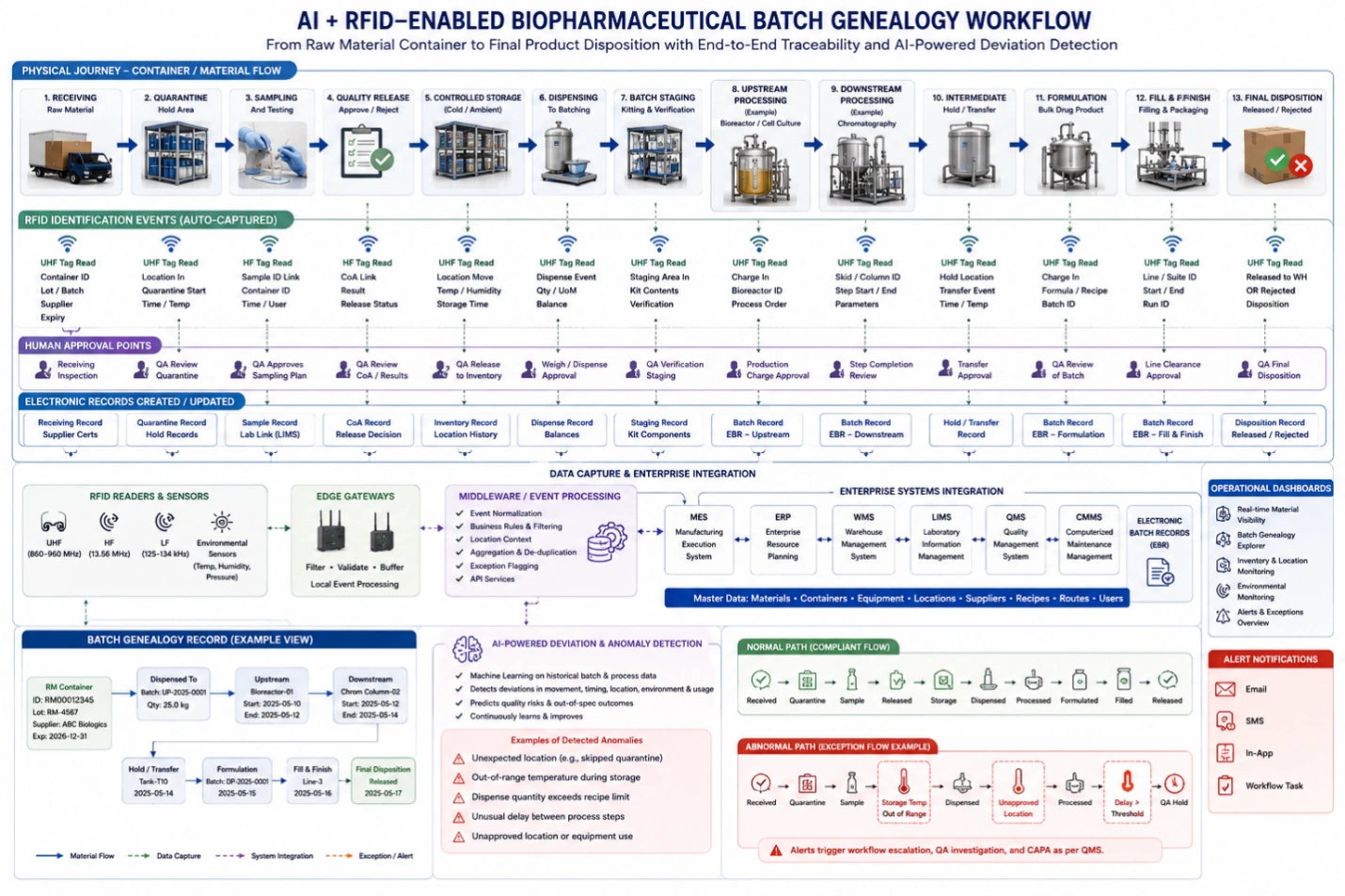
Material genealogy is a central requirement in biopharmaceutical production. Raw materials, buffers, media components, single-use assemblies, intermediates, and packaging materials may pass through multiple controlled locations before being consumed or released.
RFID events can automatically establish time-stamped movement records, while AI can correlate those events with lot numbers, expiration dates, manufacturing orders, storage requirements, and batch records. Anomaly detection can flag unexpected movement, missing transitions, prolonged dwell time, or material presence in an unauthorized process area.
This approach is particularly useful where operators currently rely on repeated barcode scans, manual entries, or paper-based movement records. RFID does not eliminate the need for validated records, but it can reduce the amount of manual identification activity feeding those records.
AI Inventory Management for Raw Materials and Consumables
Biopharmaceutical facilities manage materials with very different storage and handling requirements. These may include active pharmaceutical ingredients, excipients, culture media components, buffers, disposable assemblies, filters, tubing, connectors, sterile garments, packaging components, and laboratory consumables.
AI inventory software can combine RFID movement events with ERP and WMS records to estimate consumption rates and identify unusual depletion patterns. This enables inventory planners to distinguish normal production consumption from unexplained losses, misplaced materials, or demand changes.
For temperature-sensitive or controlled materials, RFID identification can also be combined with environmental IoT sensors. The resulting record can associate an item’s identity with storage location and relevant environmental observations, subject to the validation and data-integrity controls applicable to the process.
AI Cleanroom Workflow Monitoring
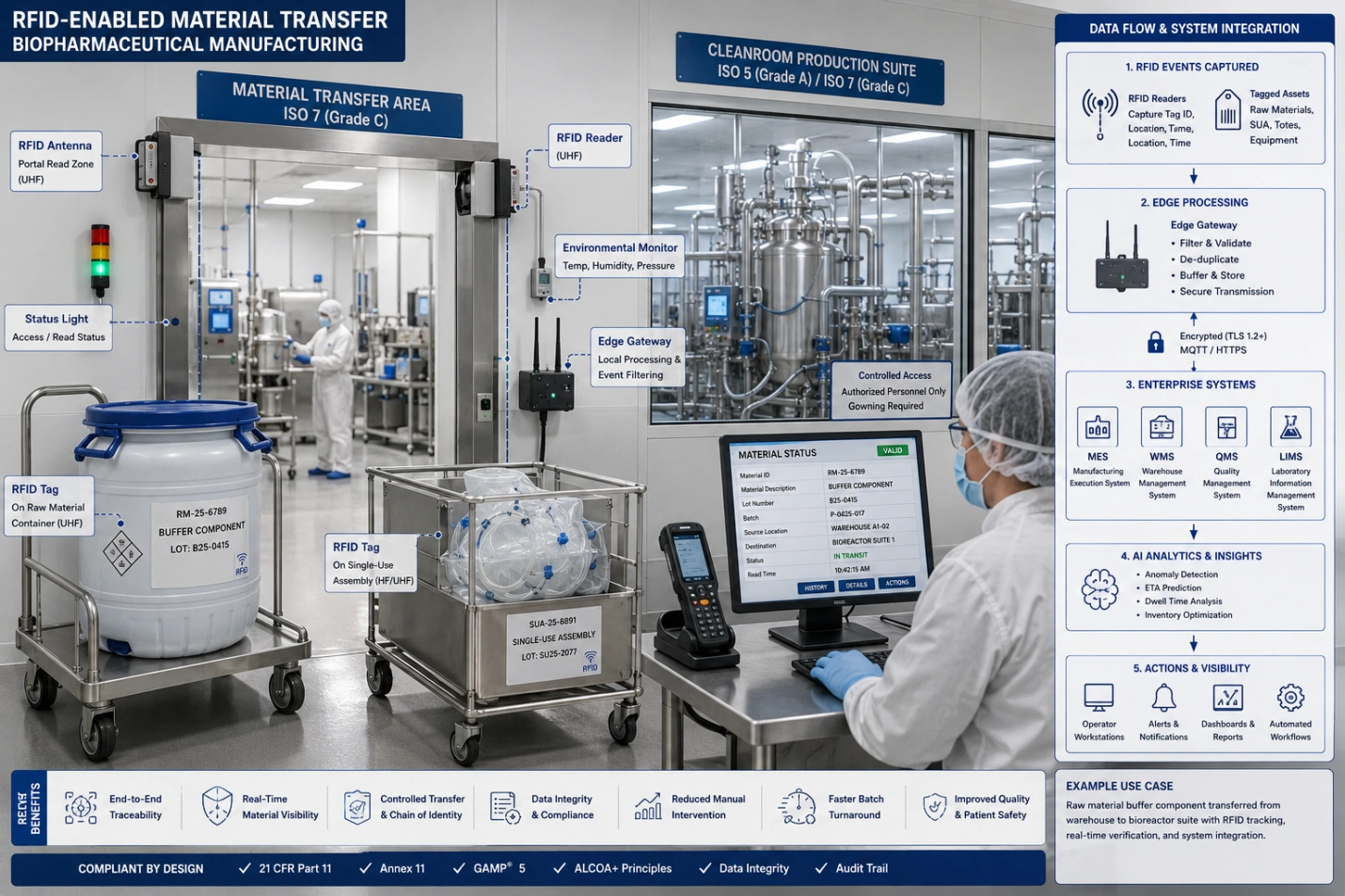
Cleanrooms impose strict controls on personnel movement, material transfer, environmental conditions, and contamination risk. RFID can identify approved material and equipment movements at controlled transitions such as airlocks, material pass-throughs, staging areas, and gowning-related zones.
AI can analyze movement patterns to identify unusual dwell times, repeated zone transitions, congestion, or deviations from expected material routes. UHF RFID may be appropriate for selected logistics flows, while HF or LF RFID can be considered for short-range controlled identification points where the read geometry is more constrained.
RFID should not be treated as a substitute for validated contamination-control procedures. Instead, it can provide additional electronic evidence that supports workflow monitoring and investigation.
AI Equipment and Single-Use Asset Tracking
Biopharmaceutical production depends on mobile equipment and specialized production assets, including pumps, carts, transfer assemblies, vessels, sensors, tools, stainless-steel containers, and reusable processing equipment. Single-use manufacturing adds another category of high-value components that require precise identification and lot control.
AI can use RFID-generated asset histories alongside CMMS records to identify underutilized equipment, unexpected movement, maintenance conflicts, or approaching service requirements. For reusable equipment, the system can associate asset identity with cleaning, calibration, preventive maintenance, and release status.
AI Traceability for Samples and Laboratory Materials
Samples move between manufacturing areas, quality-control laboratories, stability programs, analytical instruments, and storage locations. Misidentification or delayed movement can create significant operational and compliance risk.
RFID can provide automated identity events at designated transfer points. AI can analyze timestamps, route sequences, laboratory workload, and expected turnaround times to identify abnormal sample movement or bottlenecks. Integration with LIMS can connect physical sample events with analytical workflows without replacing validated laboratory records.
AI and RFID-Enabled Biopharmaceutical Batch Genealogy Workflow Diagram
Biopharmaceutical RFID, AI, and IoT Technology Stack
A practical AI-enabled RFID deployment normally combines identification hardware, IoT connectivity, edge computing, enterprise software, data management, and analytics. Each layer has a different engineering responsibility.
RFID Hardware for Controlled Manufacturing Environments
UHF RFID generally provides longer read ranges and can support pallet, tote, container, warehouse, and selected production-flow applications. HF RFID operates at a shorter range and is useful where controlled proximity identification is preferred. LF RFID provides short-range identification and can be useful for specialized identification scenarios where its physical characteristics fit the application.
Tag selection requires more than frequency compatibility. Biopharmaceutical facilities may involve stainless steel, liquids, foil packaging, glass, plastics, high humidity, cleaning agents, cold storage, sterilization processes, and other environmental conditions that can affect RFID performance. On-metal tags, encapsulated tags, specialized inlays, and application-specific mounting methods may therefore be necessary.
RFID readers, antennas, edge gateways, and industrial networking equipment should be positioned to create controlled read zones. Read-zone engineering is particularly important near doorways, material staging areas, and dense storage locations because unintended reads can create false workflow events.
Edge Processing and Communication
RFID readers can send events to an edge gateway or local server through Ethernet, Wi-Fi, or other suitable industrial connectivity. Middleware can normalize reader events, apply filtering and deduplication, associate device identifiers with locations, and forward meaningful events to enterprise applications.
MQTT can support lightweight event messaging, while HTTPS can support application interfaces. OPC UA or Modbus TCP may become relevant where RFID events are correlated with manufacturing equipment or industrial control data. Network segmentation should separate production systems, IoT devices, enterprise applications, and external services according to the facility’s cybersecurity requirements.
AI Analytics and Decision Support
AI models can operate on RFID events together with production, inventory, environmental, equipment, and quality data. Useful methods include anomaly detection, time-series forecasting, classification, clustering, predictive maintenance models, route analysis, and demand forecasting.
A key design principle is to distinguish an AI recommendation from a validated manufacturing decision. AI can prioritize an investigation or identify an unusual condition, while authorized personnel and validated manufacturing procedures remain responsible for regulated decisions.
Cloud Version and Server Version
A Cloud Version can provide centrally managed analytics, dashboards, model processing, and multi-site reporting through cloud-hosted software. This model can be suitable for organizations that require centralized visibility across several manufacturing facilities and have established controls for cloud connectivity, data governance, cybersecurity, and regulated workloads.
A Server Version can run on edge servers, customer-managed servers, private data centers, factory servers, or other privately hosted infrastructure. This approach can be advantageous when manufacturing data must remain within controlled facilities, when network connectivity is restricted, or when local processing and predictable latency are priorities.
A hybrid deployment can combine local RFID event processing with centralized analytics. For example, a manufacturing site can filter and validate RFID events locally while transmitting selected production data to a central analytics environment.
AI and RFID for Biopharmaceutical Manufacturing
AI-Enabled Traceability, Quality, and Production Control
The greatest value of AI-enabled RFID in biopharmaceutical manufacturing comes from connecting physical manufacturing events with validated digital records and operational data. RFID can establish when an identified object enters, leaves, or remains within a defined location, while AI can evaluate whether those events are consistent with expected production behavior.
Automated Material Verification
Material verification is particularly important when multiple lots, suppliers, strengths, or storage conditions are present in the same facility. RFID identification can support automated checks before dispensing, staging, or transfer.
An AI-enabled verification service can compare the observed RFID identity against the manufacturing order, approved material list, lot status, expiration information, storage requirements, and intended destination. A mismatch can generate an exception for operator review rather than allowing an incorrect material to proceed unnoticed.
This approach is especially useful around dispensing suites, weighing areas, staging rooms, and material airlocks where frequent movements create opportunities for manual identification errors.
AI Detection of Process and Movement Anomalies
AI can learn normal event sequences from production activity and identify deviations that warrant investigation. Examples include a material appearing in an unexpected room, an intermediate remaining in staging longer than normal, a reusable asset moving through an unusual route, or a production container generating an incomplete sequence of location events.
The model should distinguish genuine anomalies from normal operational variation. A read failure, maintenance activity, temporary staging change, or planned production interruption should not automatically become a quality event. This makes event filtering, contextual data, exception thresholds, and human review important parts of implementation.
Electronic Batch Record Support
RFID events can provide supporting evidence for electronic batch records by establishing machine-generated observations of material movement and identification. MES and manufacturing software can associate these events with work orders, batch identifiers, process steps, and operator actions.
The distinction between an RFID event and a validated batch record is important. RFID can provide source data, but regulated records require appropriate validation, audit controls, data integrity safeguards, and documented operating procedures.
For biopharmaceutical manufacturers following data-integrity principles such as attributable, legible, contemporaneous, original, and accurate records, automated identification can reduce transcription while strengthening the consistency of captured operational information.
End-to-End AI and RFID Data Workflow
A production-ready solution should be designed around the complete information path rather than treating RFID readers as isolated devices.
Data Acquisition at the Manufacturing Point
The process starts with RFID tags attached to approved physical objects. Readers capture identifiers at receiving docks, storage locations, controlled doors, staging points, dispensing areas, processing zones, laboratories, packaging operations, or other designated locations.
Additional data sources can include temperature sensors, humidity sensors, vibration sensors, pressure instruments, equipment controllers, barcode scanners, computer vision systems, and access-control systems.
The objective is to create a reliable event stream that describes what was identified, where it was observed, when the observation occurred, and which reader or process point generated it.
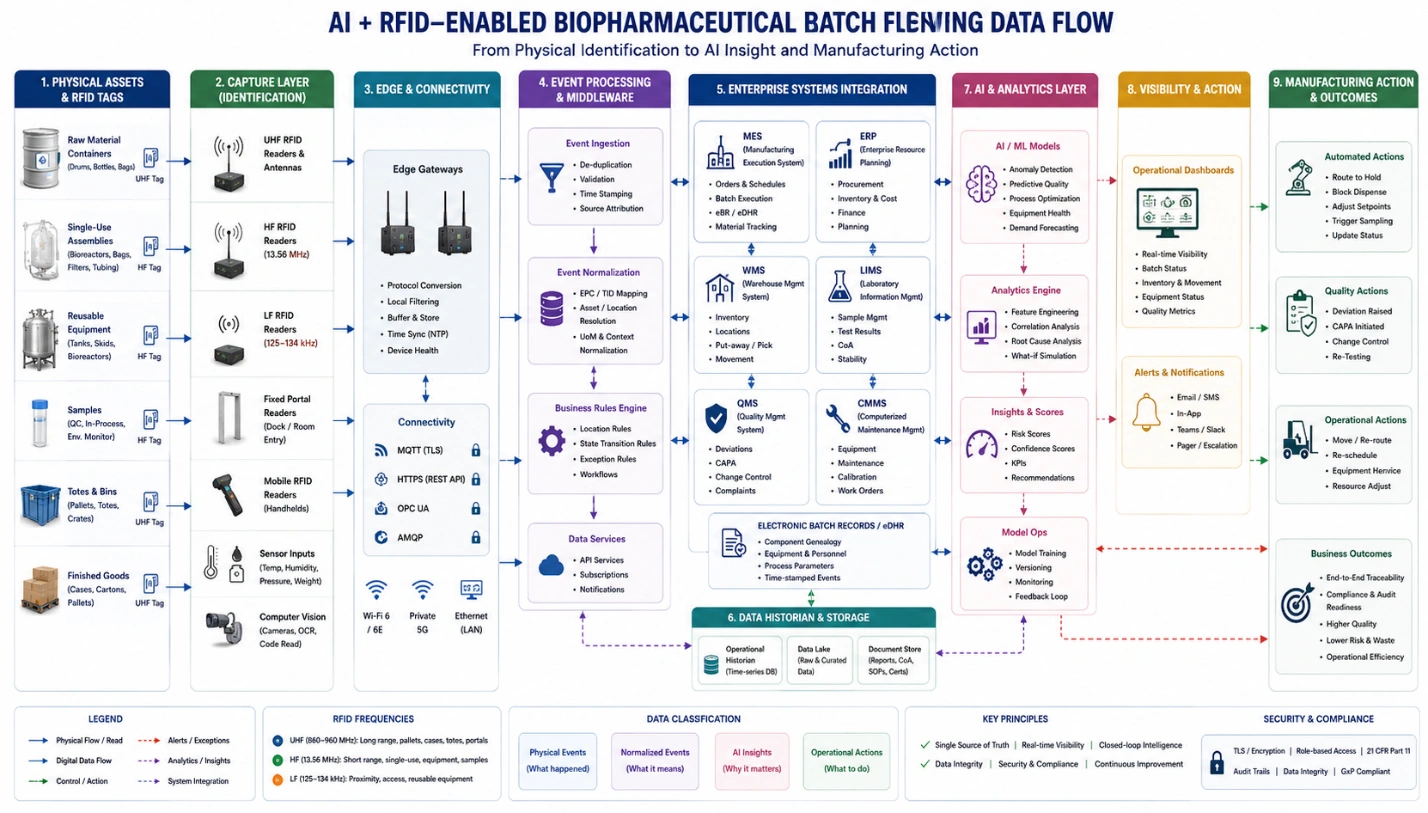
Edge Filtering and Event Normalization
Raw RFID reads may contain repeated observations because a tag remains within a reader’s field. Edge software can therefore apply deduplication, time windows, signal thresholds, reader-health checks, and location rules.
Normalized events can be expressed in a consistent structure containing information such as:
- Tag or asset identifier
- Material, lot, container, or equipment identity
- Reader and antenna identifier
- Manufacturing location
- Timestamp
- Event type
- Production order or batch association
- Reader confidence or quality indicators
- Relevant environmental or equipment context
This normalized layer allows downstream applications to consume meaningful events rather than raw reader traffic.
Middleware and Enterprise Integration
Middleware connects RFID infrastructure to manufacturing and business applications. Common integration targets include MES, ERP, WMS, LIMS, QMS, CMMS, electronic batch-record systems, serialization software, laboratory systems, and data historians.
APIs can transfer structured events to application software, while message brokers can support event-driven processing. Where appropriate, MQTT can transport lightweight IoT events, HTTPS can support application interfaces, and OPC UA can connect relevant industrial data sources.
Integration should preserve the source identity and timestamp of important events. This provides traceability when an investigation requires the organization to determine how an operational observation entered the information system.
AI Processing and Operational Decisions
AI processing can occur after event normalization. Models can evaluate material movement, inventory consumption, equipment utilization, workflow timing, and relationships between physical events and production records.
Examples include:
- Detecting an unexpected material route
- Forecasting consumable demand
- Identifying abnormal inventory depletion
- Predicting reusable equipment maintenance requirements
- Detecting prolonged material dwell time
- Recognizing unusual sample-transfer patterns
- Identifying repeated process exceptions
- Predicting production bottlenecks from movement history
The AI result can then trigger a dashboard alert, investigation task, inventory action, maintenance recommendation, or workflow notification.
AI and RFID-Enabled Biopharmaceutical Manufacturing Data Flow Diagram
Engineering Design Considerations for Biopharmaceutical RFID
RFID deployment in a regulated manufacturing environment requires careful engineering because the physical environment can be more difficult than a conventional warehouse.
Read-Point and Antenna Engineering
Metal vessels, stainless-steel walls, liquid-filled containers, foil packaging, and dense equipment can influence RF propagation. Antenna polarization, reader power, mounting height, tag orientation, and read-zone boundaries should therefore be evaluated during site surveys.
Doorway deployments require particular attention because a reader may detect tags on both sides of a controlled transition. Antenna placement and shielding should be designed to minimize cross-zone reads.
Pilot testing should measure read accuracy under actual operating conditions rather than relying exclusively on laboratory specifications.
Tag Selection and Environmental Compatibility
The appropriate tag depends on the object and process. A tag used on a plastic tote may require different construction from one mounted on stainless steel or near a liquid-filled container.
Engineering evaluation should consider:
- Surface material
- Container geometry
- Liquid proximity
- Temperature range
- Humidity
- Cleaning chemicals
- Disinfection procedures
- Autoclave or sterilization exposure where applicable
- Cold-storage conditions
- Mechanical attachment
- Required read distance
- Disposable versus reusable asset status
Tags used in controlled manufacturing should also be evaluated for particulate generation, attachment integrity, and compatibility with the relevant manufacturing environment.
RFID Validation and Qualification
Biopharmaceutical organizations should determine whether an RFID-enabled process affects a regulated workflow. Where it does, validation and qualification activities should be aligned with the organization’s quality system and applicable regulatory expectations.
Testing can include installation qualification, operational qualification, performance qualification, reader accuracy testing, exception handling, data integrity testing, network failure scenarios, and recovery testing.
A useful engineering practice is to test failure modes deliberately. Examples include disconnected readers, duplicate reads, missing reads, network interruption, incorrect tag assignment, gateway failure, and loss of enterprise-system connectivity.
Cleanroom and Controlled-Environment Deployment
RFID equipment selected for controlled areas should be evaluated according to the room classification, cleaning practices, equipment surfaces, maintenance procedures, and contamination-control requirements.
Not every RFID reader needs to be installed inside a cleanroom. Where process design permits, readers can be positioned at controlled material-transfer points or outside classified spaces while preserving the required identification workflow.
This can reduce equipment exposure to cleaning processes and simplify maintenance, although the resulting read geometry must be validated against actual material movement.
Cybersecurity, Data Integrity, and Interoperability
AI and RFID systems in biopharmaceutical manufacturing should be treated as connected operational technology rather than isolated tracking equipment.
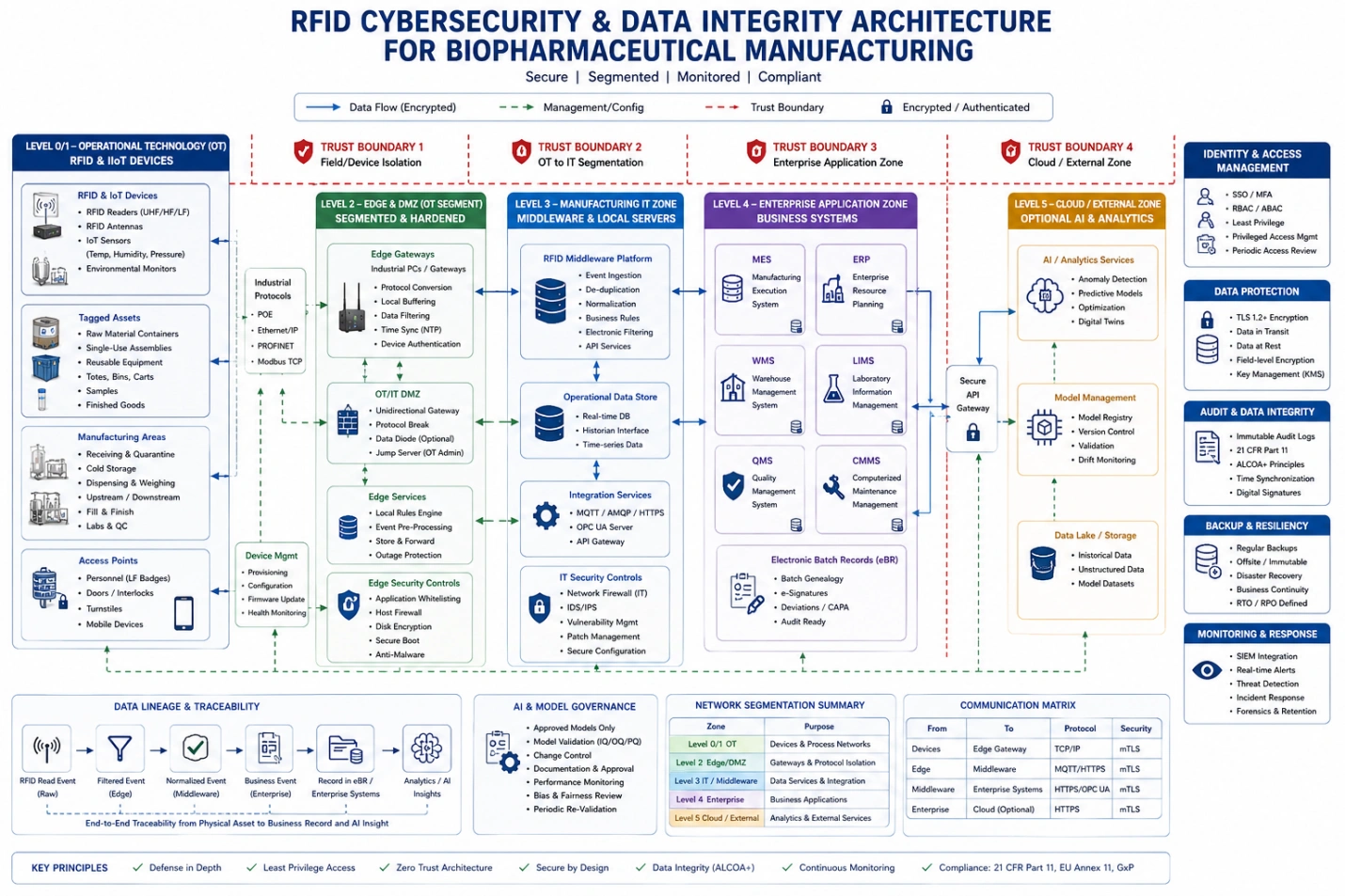
Network segmentation can separate RFID devices and edge gateways from critical control systems and corporate networks. Access controls should restrict configuration changes to authorized personnel, while encrypted communication should be used where supported and appropriate.
Device inventories should identify readers, gateways, servers, network interfaces, and software components. Logging should record configuration changes, authentication activity, system errors, and important data-processing events.
AI introduces additional considerations. Model inputs should be traceable, model versions should be controlled, and changes to thresholds or algorithms should be documented according to the organization’s governance process.
Interoperability is equally important. A biopharmaceutical facility may already operate MES, ERP, WMS, LIMS, QMS, CMMS, SCADA, historians, laboratory instruments, and building-management systems. RFID should therefore use documented interfaces rather than creating a parallel information silo.
GAO’s experience supplying RFID, BLE, and IoT hardware products and systems can support integration projects where identification devices must operate alongside established enterprise and industrial systems.
RFID Cybersecurity and Data Integrity Architecture for Biopharmaceutical Manufacturing
Measuring AI and RFID Performance in Biopharmaceutical Manufacturing
Performance should be measured through operational and quality-related KPIs rather than RFID read counts alone.
Relevant metrics can include:
- Material identification accuracy
- RFID read success rate
- False-read rate
- Material reconciliation time
- Inventory record accuracy
- Batch genealogy completeness
- Manual data-entry reduction
- Material search time
- Dispensing verification exceptions
- Material dwell time
- Sample-transfer turnaround time
- Equipment utilization
- Preventive-maintenance compliance
- Asset location accuracy
- Inventory stockout frequency
- Expired-material incidents
- Production interruption frequency
- Investigation response time
- Electronic-record completeness
- System availability
- Reader and gateway fault rate
- AI anomaly precision
- AI alert false-positive rate
- Forecast accuracy
- Time required to reconcile production movement records
The most useful baseline is established before deployment. A manufacturer can then compare operational performance after commissioning and determine whether the system is actually improving traceability, inventory control, production efficiency, and investigation workflows.
Deployment Roadmap for AI and RFID in Biopharmaceutical Manufacturing
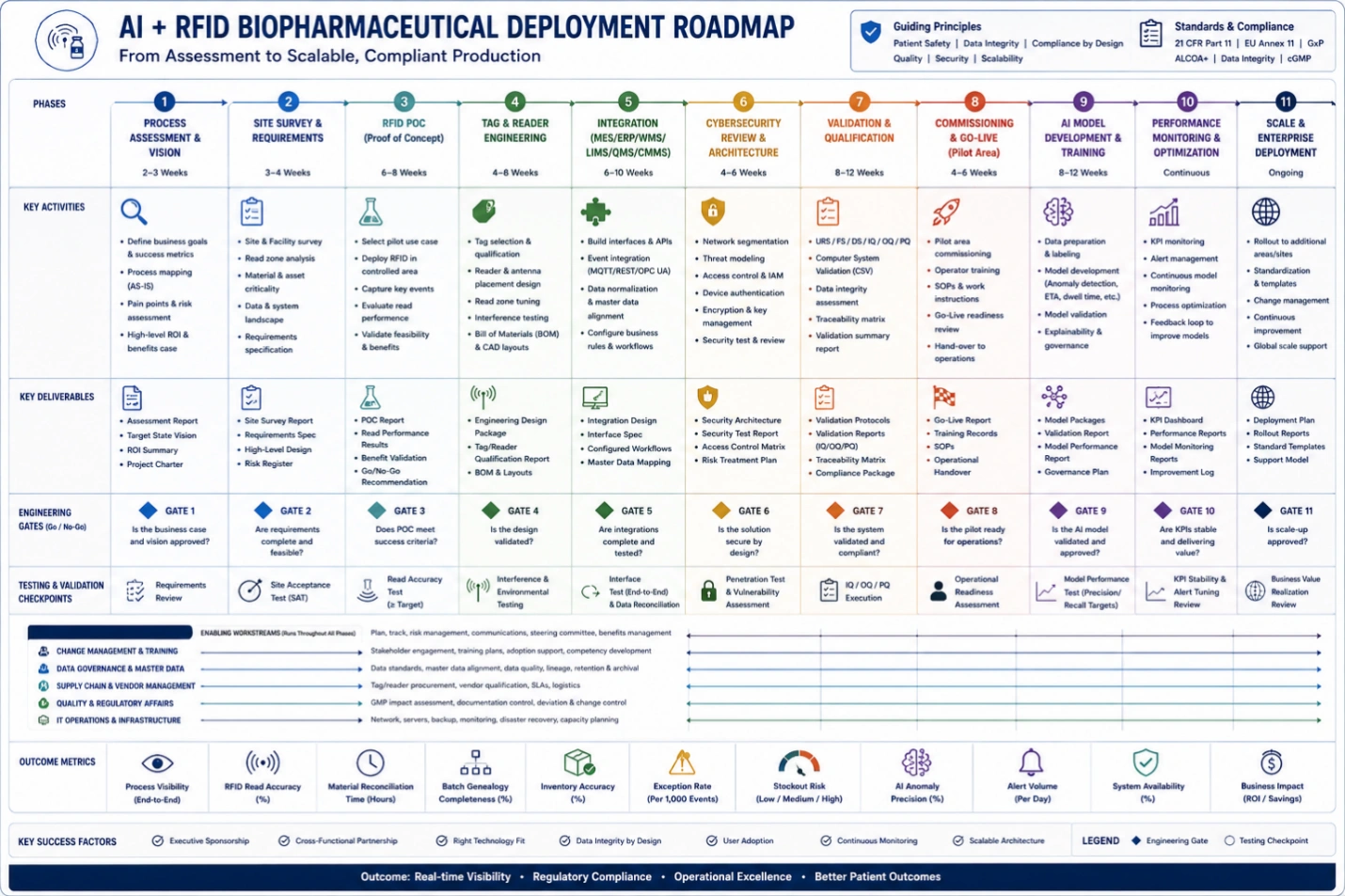
A successful deployment normally begins with a narrowly defined operational problem rather than a facility-wide RFID rollout.
Process Assessment and Site Survey
The initial assessment should map material flows, cleanroom boundaries, storage locations, production stages, controlled transfers, existing identification methods, and enterprise-system interfaces.
Engineers should document where manual identification occurs and identify the events that would provide meaningful operational value if captured automatically.
RFID Proof of Concept
A proof of concept should use actual containers, materials, equipment, and environmental conditions. Testing should measure read performance, unintended reads, tag durability, operator workflow, and system integration.
The objective is not simply to demonstrate that a reader can detect a tag. It is to prove that the captured event is operationally meaningful.
Integration and Commissioning
After the RFID hardware is selected, the system should be integrated with the appropriate MES, ERP, WMS, LIMS, QMS, CMMS, or other applications.
Commissioning should verify reader configuration, network connectivity, event processing, database records, API behavior, exception handling, and user permissions.
AI Model Development and Optimization
AI models should be trained using representative manufacturing data. Historical production events can help establish normal patterns, while subject-matter experts should review abnormal-event classifications.
Model performance should be monitored after deployment because production schedules, material types, equipment layouts, and operational practices can change over time.
Scale-Up Across Production Areas
Once the first use case demonstrates measurable value, the same technical foundation can be extended to additional material flows, laboratories, warehouses, equipment groups, or manufacturing suites.
A phased rollout reduces operational disruption and allows engineering teams to refine tag selection, reader placement, event rules, integration interfaces, cybersecurity controls, and user workflows before wider deployment.
AI and RFID Biopharmaceutical Manufacturing Deployment Roadmap
Practical Benefits for Biopharmaceutical Manufacturers
Combining AI with RFID-based identification can improve biopharmaceutical operations when the system is designed around specific manufacturing workflows.
- Stronger material traceability: Automated identity and location events can reduce reliance on manual movement records and support more complete material genealogy.
- Better inventory accuracy: AI can correlate RFID observations with consumption and production schedules to identify discrepancies and forecast requirements.
- Faster investigations: Searchable event histories can help quality and manufacturing teams reconstruct material movement without manually reviewing disconnected records.
- Improved cleanroom workflow visibility: Controlled RFID read points can provide additional evidence of material and asset movement through defined production zones.
- Reduced manual identification: Automated reads can reduce repetitive scanning and transcription activity where process conditions permit.
- Earlier anomaly detection: AI can identify unusual material routes, dwell times, consumption patterns, and asset movements before they become larger operational issues.
- More effective equipment utilization: Asset histories can reveal where reusable equipment is located, how frequently it is used, and when maintenance activity may be required.
- Scalable multi-site reporting: Centralized analytics can compare operational patterns across facilities when governance and connectivity requirements permit.
- Improved operational resilience: Local edge processing can maintain selected identification workflows when connectivity to centralized systems is temporarily unavailable.
- Better data context: Linking RFID events with production, quality, laboratory, equipment, and environmental information creates a richer basis for operational analysis.
The measurable value depends on the process selected, RFID read performance, data quality, integration depth, AI model accuracy, and adoption by manufacturing personnel.
Key Technical Takeaways for AI and RFID in Biopharmaceutical Manufacturing
AI and RFID are most effective when deployed as part of a controlled manufacturing information flow rather than as standalone tracking technology. RFID provides reliable physical identification events, while AI can transform those events into anomaly detection, forecasting, workflow analysis, and decision support.
Biopharmaceutical manufacturers should prioritize use cases where physical traceability directly affects production efficiency, material control, batch genealogy, laboratory workflows, equipment readiness, or investigation effort. Site-specific RFID engineering is essential because stainless steel, liquids, cleanroom layouts, cold storage, controlled transfers, and dense equipment can materially affect RF performance.
A practical implementation should establish measurable KPIs, test failure modes, integrate with existing MES, ERP, WMS, LIMS, QMS, and CMMS systems, and apply appropriate cybersecurity and data-integrity controls. GAO can support these initiatives through RFID, BLE, and IoT hardware products and systems together with technical assistance for deployment and integration.
RFID-Enabled Material Transfer in Biopharmaceutical Cleanroom Manufacturing
GAO Experience Supporting Biopharmaceutical Technology Deployment
Headquartered in New York City and Toronto, Canada, GAO is recognized among the leading B2B and B2G suppliers of RFID and BLE technologies. GAO and its sister companies, GAO Research and GAO Tek, form GAO Group, with operations based in New York City and Toronto.
For three decades, GAO Group has served organizations across the United States and Canada, including Fortune 500 companies, leading research and development organizations, prestigious universities, and U.S. and Canadian government agencies. This experience includes supplying hardware products and systems for identification, sensing, wireless connectivity, and industrial IoT applications.
GAO has invested substantially in product and system R&D and maintains stringent quality assurance processes. Remote and onsite technical support can help organizations evaluate device selection, deployment requirements, integration considerations, and operational implementation.
Building the Future of Industrial AI and IoT with Aperture Venture Studio and GAO RFID Inc.
For more than three decades, GAO Group of Companies has invested heavily in R&D covering industrial RFID, BLE, and IoT. As generative AI became increasingly useful for industrial applications, we expanded our work across AI and IoT technologies and founded Aperture Venture Studio to develop AI and IoT companies addressing practical industry requirements such as biopharmaceutical manufacturing traceability and operational visibility.
Aperture brings together AI and IoT technical experts, entrepreneurial and operational executives, investors, and leading companies. Through the Aperture Ventures Summit and TekSummit, advanced AI and IoT topics are also explored with technical communities.
We welcome you to participate as:
- Advisors, co-founders, or employees
- Investors
- Customers