
AI and RFID for Museums
How AI-Driven RFID Systems Are Transforming Museum Operations
AI and RFID for museums combine automated identification with artificial intelligence to improve how museums locate, manage, protect, study, and account for collections. RFID supplies reliable identification events for objects, containers, equipment, library materials, exhibit assets, and other tagged resources, while AI interprets those events alongside collection records, movement history, exhibition schedules, environmental context, and operational rules.
For museums, the value extends beyond knowing whether an artifact has been scanned. AI can identify unusual movement patterns, predict inventory discrepancies, prioritize collection audits, improve object-location confidence, support exhibition logistics, and reduce the manual effort required for large-scale inventories. UHF RFID, HF RFID, and LF RFID can be selected according to object characteristics, reading distance, tag placement, materials, and handling requirements.
AIoT, commonly called AI and IoT, combines artificial intelligence with connected devices, identification technologies, equipment, and operational systems. In museum environments, AIoT may also incorporate Edge AI, machine learning, computer vision, and other analytical methods to convert identification events into operational decisions. GAO helps organizations deploy RFID hardware products and systems that support collection accountability, museum asset tracking, and data-driven operational improvement.
AI-Powered RFID Museum Collection Tracking and Asset Management
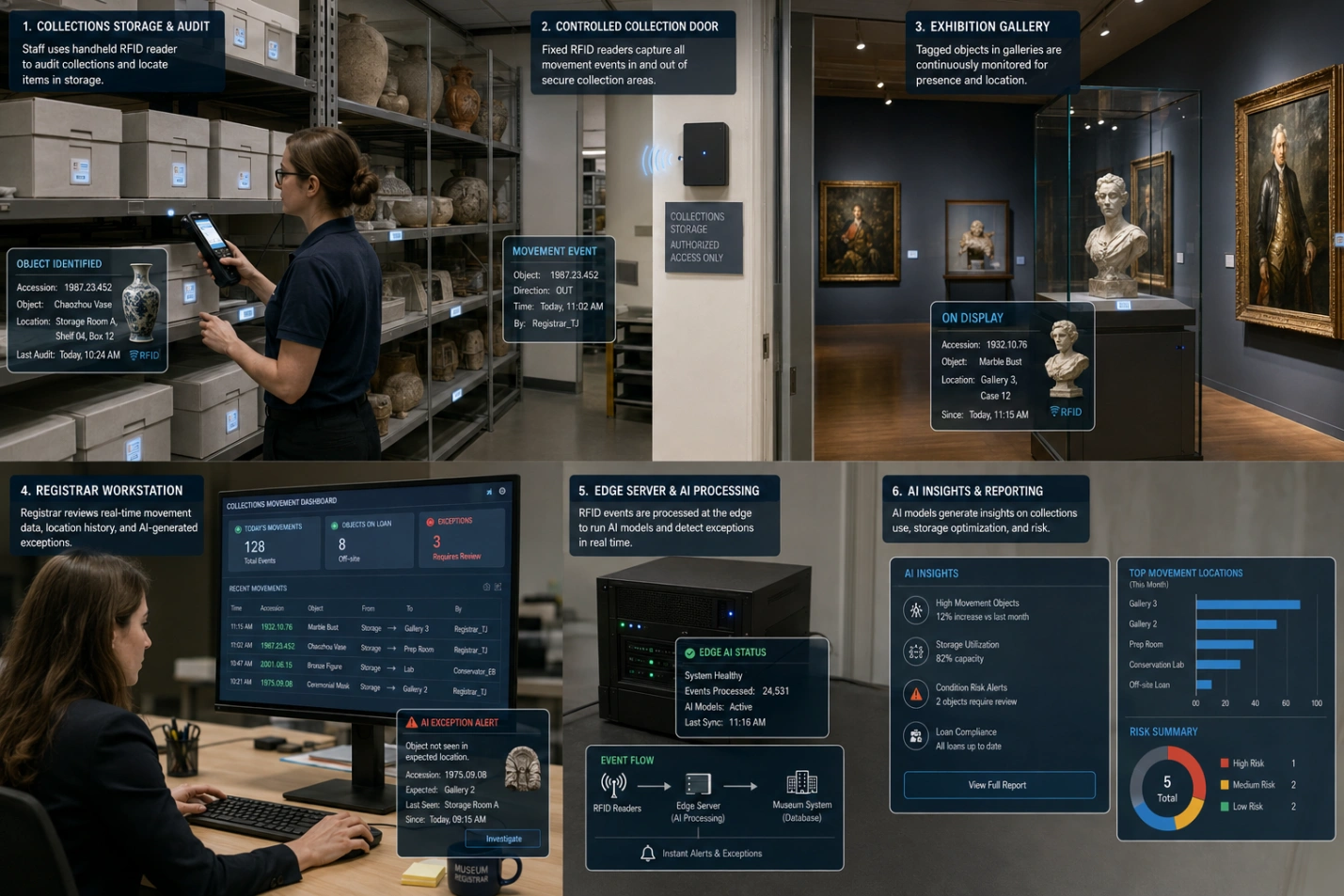
Why Museum Collection Management Needs AI-Driven Identification
Museum collections are operationally complex because objects move through controlled workflows rather than remaining permanently in a single storage location. A painting may move from collection storage to a conservation laboratory, photography studio, quarantine area, temporary exhibition staging room, gallery, loan preparation area, transport crate, or outbound loading location. Archaeological collections, natural history specimens, archives, books, audiovisual materials, exhibit equipment, and handling collections can each follow different custody and documentation procedures.
Traditional barcode processes often depend on line-of-sight scanning and deliberate staff action. RFID can automate many identification events, but raw reads alone do not solve museum operational problems. Readers may capture repeated observations, overlapping read zones, incomplete reads, or movements that require interpretation against collection-management rules.
AI improves the usefulness of RFID data by answering questions such as:
- Is an object moving according to an approved exhibition or loan workflow?
- Does the observed location agree with the collection management system?
- Which storage areas should be audited first based on discrepancy probability?
- Is an object appearing in an unexpected sequence of locations?
- Does an unusually long dwell time indicate a workflow delay?
- Are recurring discrepancies associated with a particular collection area, handling process, or temporary storage zone?
- Which inventory records require registrar review rather than another manual scan?
This distinction is important. The goal is not simply RFID tagging. The operational objective is AI-driven collection tracking and museum inventory management, with RFID acting as an identification layer that supplies structured evidence about where tagged resources are observed.
GAO has supplied RFID and related IoT hardware products and systems for organizations requiring reliable identification, tracking, and operational data capture. For museum projects, hardware selection should begin with the collection workflow, object characteristics, read-zone requirements, conservation restrictions, and integration requirements rather than selecting tags solely by frequency or read range.
Fundamental Concepts Behind AI and RFID for Museum Collections
Museum RFID deployments work most effectively when identification technology, collection records, operational workflows, and AI analysis are treated as connected components of a collection-management solution.
RFID Establishes Object Identity
RFID assigns a machine-readable identity to a tagged object, container, archival folder, equipment item, or other managed resource. Depending on the use case, the tag identifier can be associated with:
- Accession numbers
- Object IDs
- Catalog records
- Container IDs
- Shelf or location identifiers
- Exhibition asset records
- Loan transaction records
- Conservation work orders
- Crate and transport records
- Equipment maintenance records
The RFID identifier should not automatically become the museum’s authoritative object identifier. A more robust implementation maps the tag’s unique identifier to the authoritative record maintained by the museum’s collection management software. This approach supports tag replacement, reassignment controls, auditability, and preservation of established cataloging practices.
AI Converts Identification Events into Operational Context
An RFID event may indicate that a tagged object was detected by a handheld reader or fixed reader at a particular time and location. AI and rules-based analytics can evaluate that event against historical and current operational context.
For example, a tagged sculpture detected near an exhibition preparation area may be expected if the exhibition installation schedule shows the object as scheduled for movement. The same detection may require investigation if the collection management system identifies the object as secured in off-site storage.
AI models can support:
- Movement anomaly detection
- Object-location confidence scoring
- Inventory discrepancy prioritization
- Workflow sequence analysis
- Predictive audit planning
- Dwell-time analysis
- Duplicate or inconsistent identification record detection
- Forecasting of collection processing bottlenecks
- Natural-language querying of authorized collection and operational data
Machine learning should supplement, rather than replace, established museum procedures. Provenance, accession records, condition documentation, registrar approvals, and chain-of-custody controls remain authoritative operational elements.
Museum Workflows Provide the Context AI Requires
AI results are only as meaningful as the operational context provided to the system. A well-designed deployment should define physical and logical zones such as collection storage rooms, quarantine areas, conservation laboratories, photography studios, staging areas, galleries, loading docks, and secure transport locations.
The solution can then associate RFID observations with workflow states, including:
- Received
- Pending accession
- Quarantined
- Cataloging
- Undergoing conservation
- Scheduled for exhibition
- Installed
- On loan
- Returned
- Pending inventory reconciliation
- In long-term storage
This model allows AI to distinguish normal movement from events that deserve review.
Museum Object Lifecycle and RFID-Enabled AI Workflow
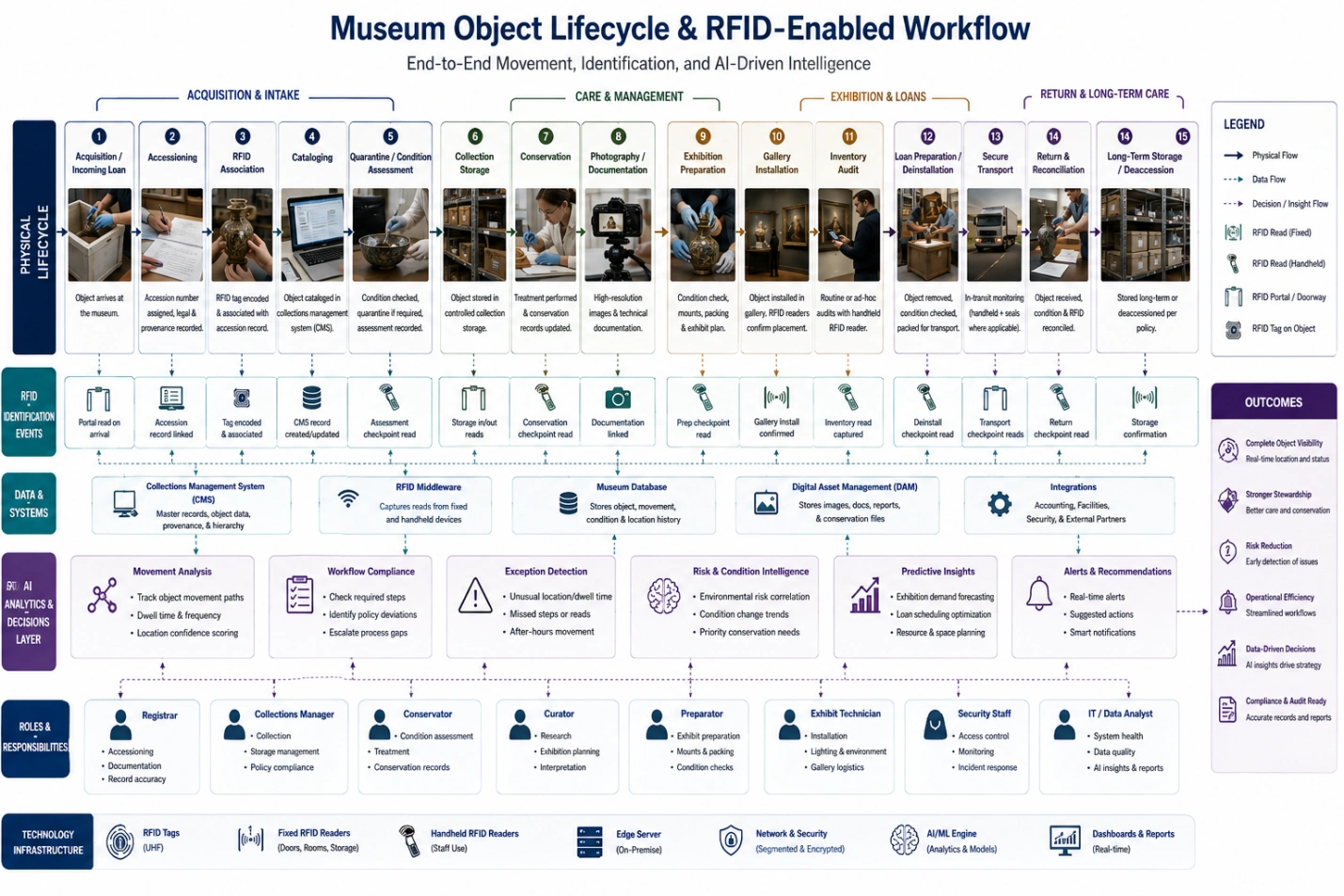
Museum Applications for AI-Driven RFID Tracking
Museum RFID applications vary according to collection type, institutional scale, public access requirements, storage density, and the level of integration with collection management and security processes. The following applications typically provide the strongest operational value.
AI Collection Inventory Management
Large museum collections can contain objects that are rarely handled, frequently moved, temporarily staged, or distributed across multiple storage rooms and facilities. Manual inventories may require staff to visually locate objects, verify accession information, and reconcile discrepancies.
Handheld RFID readers can accelerate the data-capture process by identifying multiple tagged items during a structured inventory pass. AI can then prioritize discrepancies instead of treating every missing or unexpected record as equally urgent.
A practical workflow can classify discrepancies according to factors such as:
- Time since the object’s last confirmed observation
- Historical movement frequency
- Current exhibition or loan status
- Storage-zone confidence
- Recent handling records
- Known inventory exceptions
- Reader coverage and read reliability
- Object risk classification
This approach allows collection managers to focus investigation on the records most likely to represent a genuine operational discrepancy.
Object Movement and Chain-of-Custody Monitoring
High-value, fragile, or frequently transported museum objects require documented movement controls. Fixed RFID read points can create automatic observations at selected transition points, while handheld devices can support staff-controlled verification.
AI can evaluate movement sequences against approved workflows. A collection object moving from storage to conservation may be consistent with a scheduled treatment. An observation indicating movement toward an unauthorized area may create an exception requiring staff review.
The system should record the distinction between:
- RFID observation
- Confirmed object movement
- Authorized transfer
- Exception requiring review
- Staff-confirmed reconciliation
This prevents raw reader data from being incorrectly interpreted as definitive chain-of-custody evidence.
Exhibition Installation and Deinstallation Control
Temporary exhibitions can involve hundreds or thousands of objects, display components, mounts, crates, labels, audiovisual equipment, and handling materials. Installation schedules are time-sensitive, and missing or misplaced components can delay gallery readiness.
AI-driven RFID tracking can compare observed objects and exhibition assets with:
- Exhibition checklists
- Gallery allocation records
- Installation schedules
- Object handling requirements
- Case assignments
- Loan documentation
- Packing lists
The system can identify incomplete staging sets, unexpected objects in a gallery, or objects that have not yet reached their assigned preparation zone.
GAO can support these deployments with RFID readers, antennas, tags, and related identification hardware selected for museum-specific reading conditions.
Collection Storage Optimization
Collection storage areas often change over time as cabinets, compact shelving, racks, pallets, archival boxes, and storage locations are reorganized. Location records can become inaccurate when temporary moves are not fully documented.
AI can analyze historical RFID observations and collection movement patterns to identify:
- Frequently accessed collections
- Storage zones with recurring discrepancies
- Objects with unusually high movement rates
- Temporary locations that become persistent storage locations
- Areas where inventory reconciliation requires excessive labor
These insights can help collections managers redesign storage processes without relying solely on periodic manual audits.
The Museum Data-to-Decision Workflow
A reliable AI-driven museum tracking solution requires more than readers and tags. The complete workflow begins when a physical object is identified and ends when museum personnel or connected systems take an appropriate action.
Data Capture at the Object and Location Level
Collection objects and related assets are associated with RFID tags according to conservation requirements, object material, expected handling, and reading conditions. Tags may be attached to approved secondary packaging, archival containers, labels, mounts, transport crates, or other suitable carriers when direct attachment to an object is inappropriate.
UHF RFID may be appropriate where longer read distances and rapid multi-item inventory are useful. HF RFID can be suitable for closer-range identification and applications involving books, archival materials, and controlled handling. LF RFID may be relevant to specialized legacy or close-proximity identification requirements.
The appropriate technology choice depends on the museum workflow, not simply the maximum advertised read range.
Communication and Event Processing
Fixed readers, handheld readers, and mobile devices generate identification events containing information such as tag ID, reader identity, antenna or read point, timestamp, and signal characteristics where available.
These events can move through:
- Secure Ethernet or Wi-Fi connections
- Reader management software
- Edge processing services
- Message brokers using protocols such as MQTT where appropriate
- HTTPS-based application interfaces
- Middleware responsible for normalization and integration
Edge processing is particularly useful when a museum requires local operation during temporary connectivity loss, rapid event filtering, or reduced transmission of repetitive reads.
Event Normalization and Collection Context
Middleware converts device-specific events into standardized records that software can interpret consistently. A normalized event may be enriched with:
- Object record reference
- Collection
- Storage location
- Reader zone
- Staff workflow context
- Exhibition status
- Loan status
- Risk classification
- Timestamp and confidence information
The enriched record can then be evaluated using rules, machine learning models, or a combination of both.
AI Analysis and Exception Management
AI processing can group repeated reads, estimate probable object presence, identify unusual sequences, and rank discrepancies. Rules remain important because museums often have explicit procedural requirements that should not be delegated entirely to probabilistic models.
A practical decision process may operate as follows:
- RFID hardware captures an identification event.
- Edge or server software removes redundant or invalid reads.
- Middleware associates the event with the relevant collection record.
- Workflow software checks the expected status and approved movement context.
- AI models calculate anomaly or discrepancy probability.
- High-confidence exceptions are sent to the appropriate museum role.
- A registrar, collections manager, conservator, or security professional reviews the event.
- The final action is recorded in the appropriate authoritative system.
This human-in-the-loop approach is particularly important for cultural heritage collections where an automated alert should not independently alter provenance records, accession data, or legally significant loan documentation.
AI and RFID Data Flow for Smart Museum Collection Management
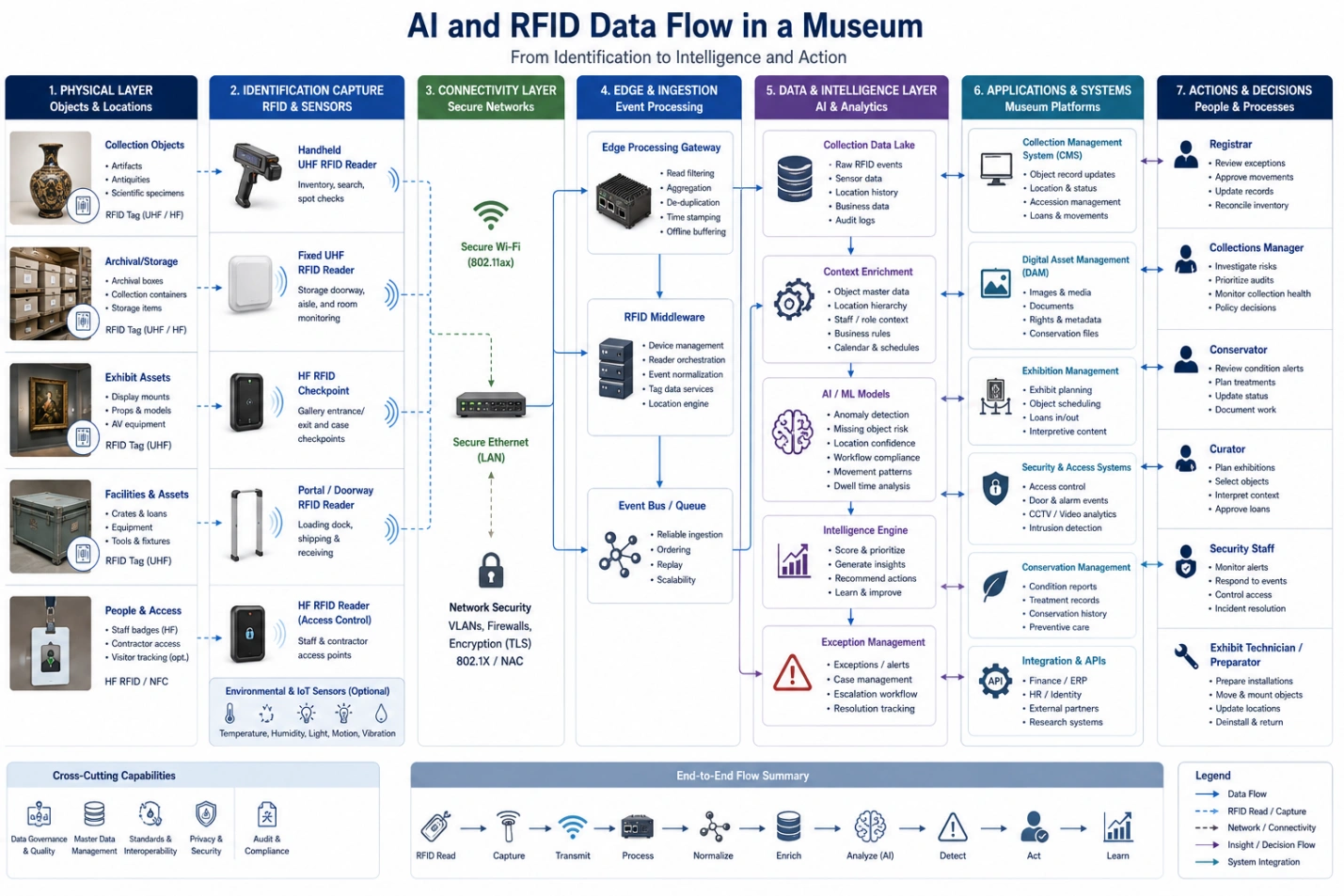
RFID, AI, Software, and Deployment Components for Museums
A museum AI-driven RFID solution should be designed as a coordinated set of physical identification, data-processing, integration, and operational components. Technology choices should reflect collection sensitivity, facility layout, collection-management practices, cybersecurity requirements, and available technical resources.
RFID Hardware and Identification Layers
UHF RFID readers and antennas can support rapid inventory of storage racks, transport containers, staging areas, and other situations where multi-item identification is required. Handheld readers provide flexibility for collection audits and exception investigation. HF RFID can support close-range identification workflows, particularly where controlled item-by-item handling is appropriate. LF RFID may support specialized identification requirements or compatibility with existing systems.
Tag selection requires particular care. Metal content, liquids, dense storage, object geometry, display-case construction, archival materials, adhesives, and conservation restrictions can affect both read performance and acceptable tag placement.
AI Models and Analytical Methods
Museum deployments can combine deterministic rules with machine learning rather than attempting to use a single AI model for every decision. Useful methods may include anomaly detection, classification, time-series analysis, clustering, probabilistic location estimation, and retrieval-augmented AI for querying approved operational documentation.
Computer vision can complement RFID in selected workflows, such as verifying that a gallery installation visually corresponds to an approved layout. RFID and computer vision should produce separate evidence streams that are reconciled according to defined confidence rules.
Integration and Deployment Software
The solution may connect with collection management software, digital asset management systems, library systems, archives management software, exhibition scheduling tools, facilities management software, security systems, identity and access management, and business reporting tools.
Common integration mechanisms include:
- REST or HTTPS APIs
- MQTT for selected device and event workflows
- Message queues
- Secure database connectors
- File-based reconciliation processes for legacy collection systems
- Single sign-on and role-based access controls
GAO can provide RFID and IoT hardware products and systems that form the identification layer of these integrated museum solutions.
Cloud Version and Server Version
A Cloud Version places RFID management, middleware, analytics, and AI software within cloud-hosted infrastructure. This model can simplify multi-site access, centralized software maintenance, and consolidated reporting for museums operating several collection facilities. Appropriate security controls should include encryption in transit and at rest, identity management, role-based permissions, audit logging, backup procedures, and data retention controls.
A Server Version deploys software on edge servers, customer-managed servers, private data centers, or other privately hosted infrastructure. This model can be appropriate where museums require tighter control over collection data, must support local processing during connectivity interruptions, or operate within existing private IT environments.
A hybrid approach can also be effective. Local servers can process reader events and maintain essential operations, while selected aggregated data supports centralized analytics and AI processing.
The next section continues with detailed deployment design, museum-specific AI capabilities, performance and security considerations, implementation recommendations, and business outcomes.
Designing the Right AI and RFID Deployment for Museum Environments
Successful museum deployments begin with collection workflows and operational requirements rather than with reader specifications. A museum may need rapid collection inventories, controlled object movement verification, exhibition staging accountability, loan tracking, or improved reconciliation across several collection facilities. Each requirement can produce a different RFID design.
A practical planning process should evaluate:
- Collection categories, including paintings, sculptures, archaeological objects, natural history specimens, archival collections, books, audiovisual materials, and handling collections
- Object materials, dimensions, packaging, and conservation restrictions
- Existing accession numbers and catalog identifiers
- Storage density, shelving materials, cabinets, compact storage systems, and transport containers
- Expected read distance and read-zone boundaries
- Object movement frequency and custody requirements
- Exhibition installation and deinstallation procedures
- Loan, packing, shipping, and return workflows
- Existing collection management and digital asset management software
- Network availability in storage areas, galleries, conservation laboratories, and off-site facilities
- Cybersecurity and identity management requirements
A recurring engineering lesson is that museum RFID projects should begin with a site survey and workflow study. Metal shelving, dense archival storage, display cases, reflective surfaces, and closely packed tagged objects can affect read behavior. A pilot deployment should therefore test representative objects and locations before large-scale procurement.
GAO can help organizations evaluate RFID hardware products and systems according to the actual museum operating environment, allowing technical teams to validate reader placement, antenna orientation, tag selection, read reliability, and integration requirements before expanding the deployment.
RFID Museum Deployment Decision Tree: Choosing the Right RFID Technology
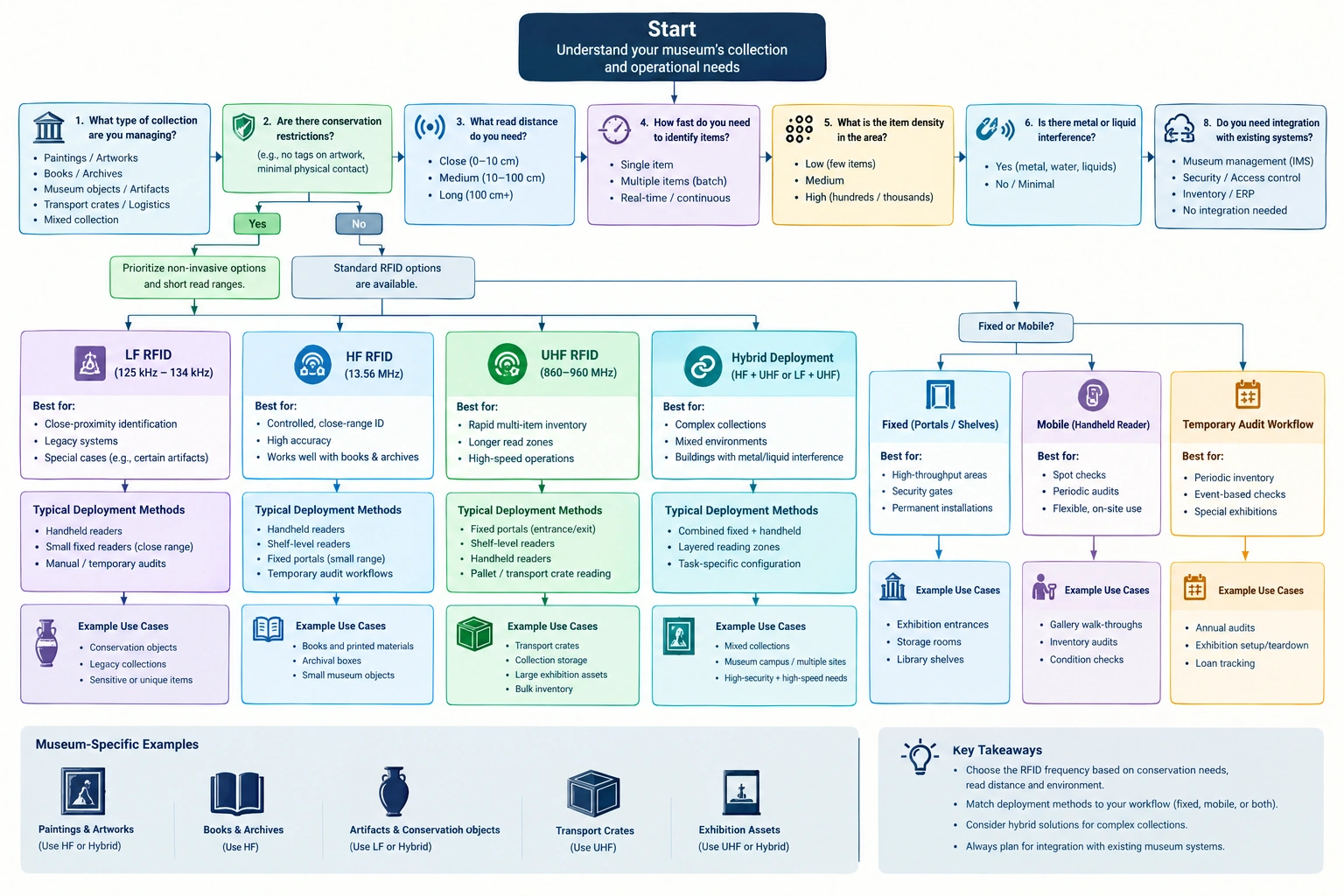
Key AI-Driven Capabilities for Museum Collection Management
AI creates practical value when it improves a specific museum decision or reduces the effort required to complete a collection-management task. RFID provides structured identification evidence, while AI evaluates that evidence against museum records, movement patterns, and operational rules.
Location Confidence and Probable Object Presence
Museum RFID systems should avoid assuming that a single read always represents a precise physical location. Reader geometry, antenna coverage, object orientation, tag placement, and surrounding materials can influence observations.
AI-assisted analysis can combine multiple factors to estimate location confidence:
- Number and timing of identification events
- Reader and antenna location
- Signal characteristics when available
- Historical object movement patterns
- Nearby collection zones
- Expected workflow state
- Previous confirmed observations
The result can be more useful than a simple “found” or “not found” status. A collections manager may see that an object has a high probability of being in a particular storage bay but requires verification before the official location record is changed.
Movement Anomaly Detection
Museum collections do not move randomly. Objects usually follow recognizable processes involving registrars, collections managers, conservators, preparators, curators, exhibition staff, or authorized logistics personnel.
AI can establish normal patterns and identify events requiring attention, such as:
- An object appearing in an unexpected gallery or staging area
- A collection item leaving a controlled zone outside its scheduled workflow
- Repeated movement between temporary storage locations
- A transport crate missing expected tagged contents
- An object remaining in a processing area longer than typical
- A sequence inconsistent with an approved loan or exhibition workflow
The appropriate response should normally be an alert, review task, or investigation request rather than automatic alteration of the authoritative collection record.
Intelligent Inventory Reconciliation
Traditional inventory reconciliation often treats every discrepancy as an individual manual investigation. AI can rank exceptions based on probable importance and likely root cause.
A discrepancy scoring process may consider:
- Object value or risk classification
- Collection sensitivity
- Last confirmed inventory date
- Number of previous discrepancies
- Current loan or exhibition status
- Reader coverage quality
- Recent collection activity
- Expected movement schedule
- Historical reconciliation results
This enables staff to investigate the most meaningful discrepancies first, which can reduce the operational burden of large collection inventories.
Predictive Audit Planning
Museums frequently have limited staff time for comprehensive collection audits. AI can recommend audit priorities by identifying storage zones or collection categories with higher probabilities of record discrepancies.
Examples include:
- Storage rooms undergoing recent reorganization
- Collections with frequent exhibition turnover
- Areas with repeated incomplete inventory records
- Temporary holding locations
- Collections that have experienced frequent loan activity
Predictive auditing does not replace formal inventory policies. Instead, it provides a data-driven method for allocating interim verification effort between scheduled inventories.
AI-Assisted Operational Search
Authorized museum personnel may need answers that require information from several systems. AI can support natural-language queries against approved and access-controlled data.
Examples include:
- “Which objects scheduled for Gallery B have not been confirmed in staging?”
- “Show high-priority inventory discrepancies from the archaeology collection.”
- “Which loan crates are missing an expected collection item?”
- “What collection objects have remained in conservation beyond the planned completion date?”
Access controls remain essential. AI search functions should respect staff roles, collection sensitivity, donor restrictions, security classifications, and other access policies.
Operational Improvements and Business Value
The combination of AI-assisted analysis and RFID identification can improve museum operations because collection staff receive more structured evidence and prioritized information. The resulting value depends on workflow quality, tag coverage, reader performance, software integration, and staff adoption.
| Museum Area | AI and RFID Improvement | Practical Value |
|---|---|---|
| Collection inventory | Faster multi-item identification and AI-ranked discrepancies | Less time spent locating and reconciling objects |
| Object movement | Automated observations at selected transition points | Improved movement visibility and investigation capability |
| Exhibition operations | Comparison of observed assets with installation records | Earlier identification of missing or misplaced items |
| Collection storage | Analysis of movement and discrepancy patterns | Better audit planning and storage process improvement |
| Loan preparation | Verification of tagged objects and containers | Reduced packing and reconciliation errors |
| Conservation workflows | Monitoring of object progression through approved work areas | Better visibility into treatment and handling status |
| Security operations | Identification events analyzed against expected movement rules | Faster investigation of unusual movement patterns |
| Multi-site collections | Consolidated analysis across authorized locations | Improved reporting and inventory coordination |
The primary benefit is not that every museum activity becomes automated. Museum work involves conservation judgment, curatorial decisions, registrar controls, and professional accountability that should remain under human authority.
The stronger implementation model is to automate repetitive identification and data processing while directing professional attention toward exceptions, uncertainty, and decisions that require expertise.
GAO’s role in these projects can include supplying RFID readers, antennas, tags, handheld devices, and related hardware products and systems that support dependable identification throughout collection storage, exhibition preparation, and museum inventory workflows.
AI-Assisted RFID in Museums: Before and After Operations Comparison
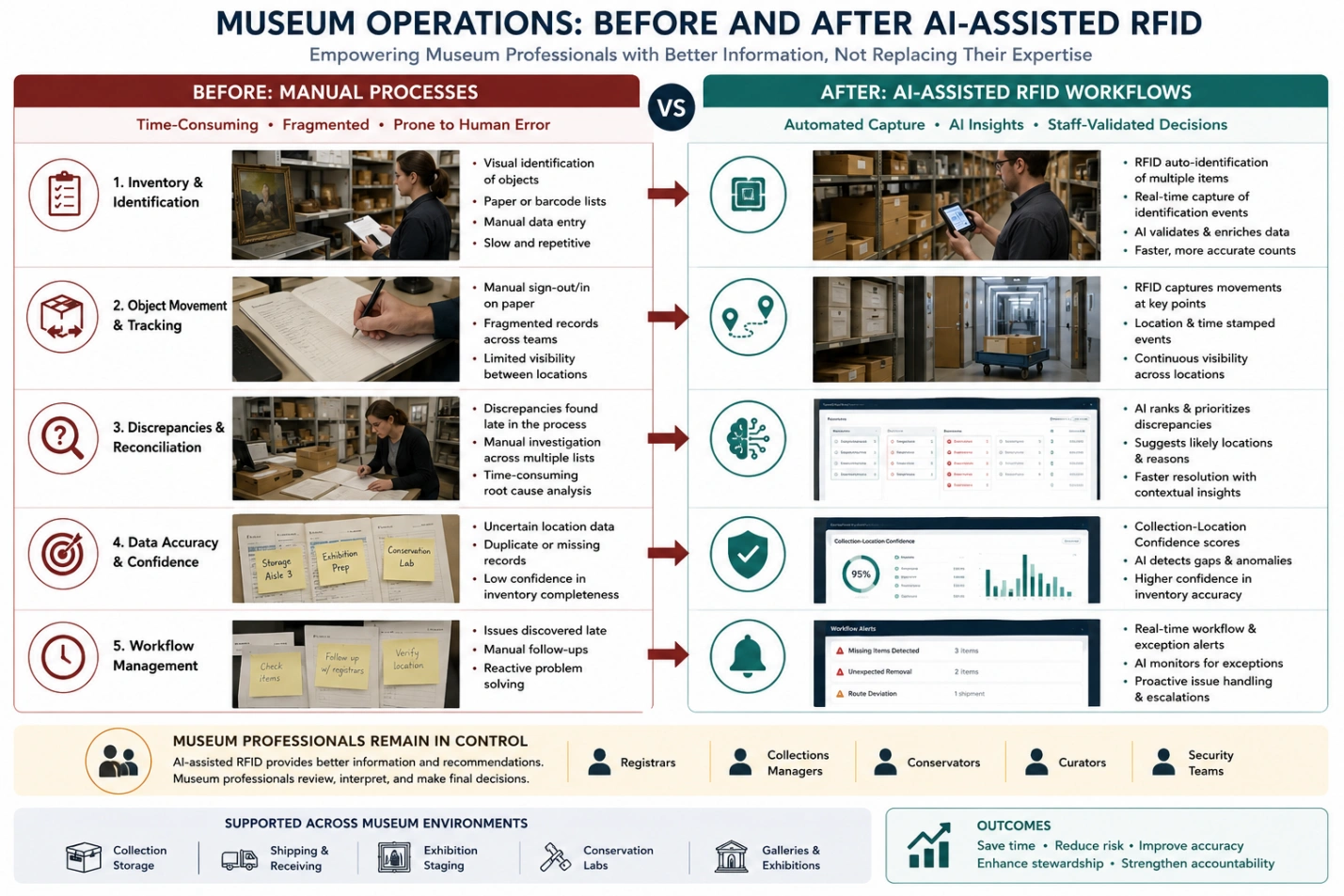
Scalability, Interoperability, and Performance Engineering
A museum RFID deployment should be designed for growth without requiring all collections to be tagged simultaneously. A phased approach often produces better operational results.
A practical expansion sequence can begin with a high-value collection, frequently moved exhibition assets, a specific storage facility, or a recurring inventory problem. Lessons from the pilot can then guide larger deployments.
Important scalability considerations include:
- Stable tag-to-object association processes
- Consistent location naming and zone definitions
- Reader configuration standards
- Centralized device management where appropriate
- Event schemas that support future integrations
- Data retention and audit requirements
- API capacity for collection management software
- Multi-site identity and access controls
- Offline operation and synchronization procedures
Performance testing should measure more than maximum RFID read rate. Museum teams should evaluate:
- Inventory completion time
- Object identification accuracy
- Read reliability under representative storage conditions
- False exception rates
- Location-confidence accuracy
- Time required to reconcile discrepancies
- Reader uptime
- Staff intervention requirements
- Integration latency
- Recovery behavior after network interruption
A technically successful RFID installation can still fail operationally if reader alerts generate excessive noise. AI thresholds and business rules should therefore be tuned using actual museum workflows rather than laboratory assumptions.
Security, Privacy, and Collection Data Protection
Museum RFID deployments can involve sensitive information about valuable collections, storage locations, movement history, donor restrictions, loans, and internal security procedures. Security should therefore be designed into the solution from commissioning through long-term operation.
Key controls can include:
- Encryption for communications between readers, edge servers, applications, and cloud services
- Role-based access control for collection, inventory, and security functions
- Multi-factor authentication where appropriate
- Segmentation of reader networks from general office networks
- Secure API authentication
- Device credential management
- Software patching and vulnerability management
- Immutable or protected audit records where required
- Backup and recovery testing
- Logging and monitoring of administrative actions
RFID tag data should also be designed carefully. Storing extensive sensitive collection information directly on a tag can create unnecessary exposure. A common approach is to store a limited identifier and resolve detailed information through authenticated software.
GAO has served organizations across the United States and Canada for three decades, including Fortune 500 companies, leading research and development organizations, prestigious universities, and U.S. and Canadian government agencies. Experience with diverse deployment environments reinforces the importance of matching identification hardware and system controls to the customer’s operational and security requirements.
Implementation Recommendations for AI and RFID Museum Projects
Museum teams should approach AI-driven RFID as an operational transformation project rather than a hardware-only installation.
Start with a Defined Collection Problem
The strongest starting point is a measurable operational issue, such as:
- Excessive time required for collection inventories
- Repeated location discrepancies
- Limited visibility during exhibition preparation
- Difficulty reconciling loan shipments
- Frequent temporary-storage errors
- Inefficient manual tracking of collection movement
A specific problem creates measurable success criteria and prevents the deployment from becoming a general technology experiment.
Conduct Representative RFID Testing
Testing should include actual collection materials, storage furniture, containers, packaging, and operating conditions. A tag that performs well on an empty test bench may behave differently when placed inside a dense archival box or near metal shelving.
The pilot should evaluate multiple tag positions and orientations where permitted by conservation procedures.
Define the Authoritative Data Sources
Before AI models or middleware are configured, the museum should establish which system owns:
- Object identity
- Accession information
- Official location
- Loan status
- Exhibition assignment
- Conservation status
- Inventory history
RFID software should integrate with these authoritative sources rather than creating uncontrolled duplicate records.
Keep AI Decisions Explainable
Museum personnel need to understand why an event was flagged. AI output should therefore include useful context such as the observed read location, expected location, anomaly factors, previous confirmed observation, and relevant workflow status.
A simple, explainable anomaly score may be operationally preferable to a complex model that cannot be interpreted by collection staff.
Commission, Train, and Optimize
Commissioning should include reader validation, network testing, integration testing, exception workflow testing, and staff acceptance testing. Training should be tailored to registrars, collections managers, conservators, preparators, security personnel, and IT teams because each group interacts with the solution differently.
Ongoing optimization should review:
- Missed reads
- False alerts
- Tag damage or loss
- Changes to storage layouts
- Reader configuration drift
- Software updates
- AI model performance
- Workflow changes caused by new exhibitions or collection policies
GAO supports customers through stringent quality assurance processes and technical support that can be provided remotely or onsite, helping organizations address practical deployment and operational requirements.
Museum RFID Implementation Lifecycle: AI-Assisted Project Roadmap
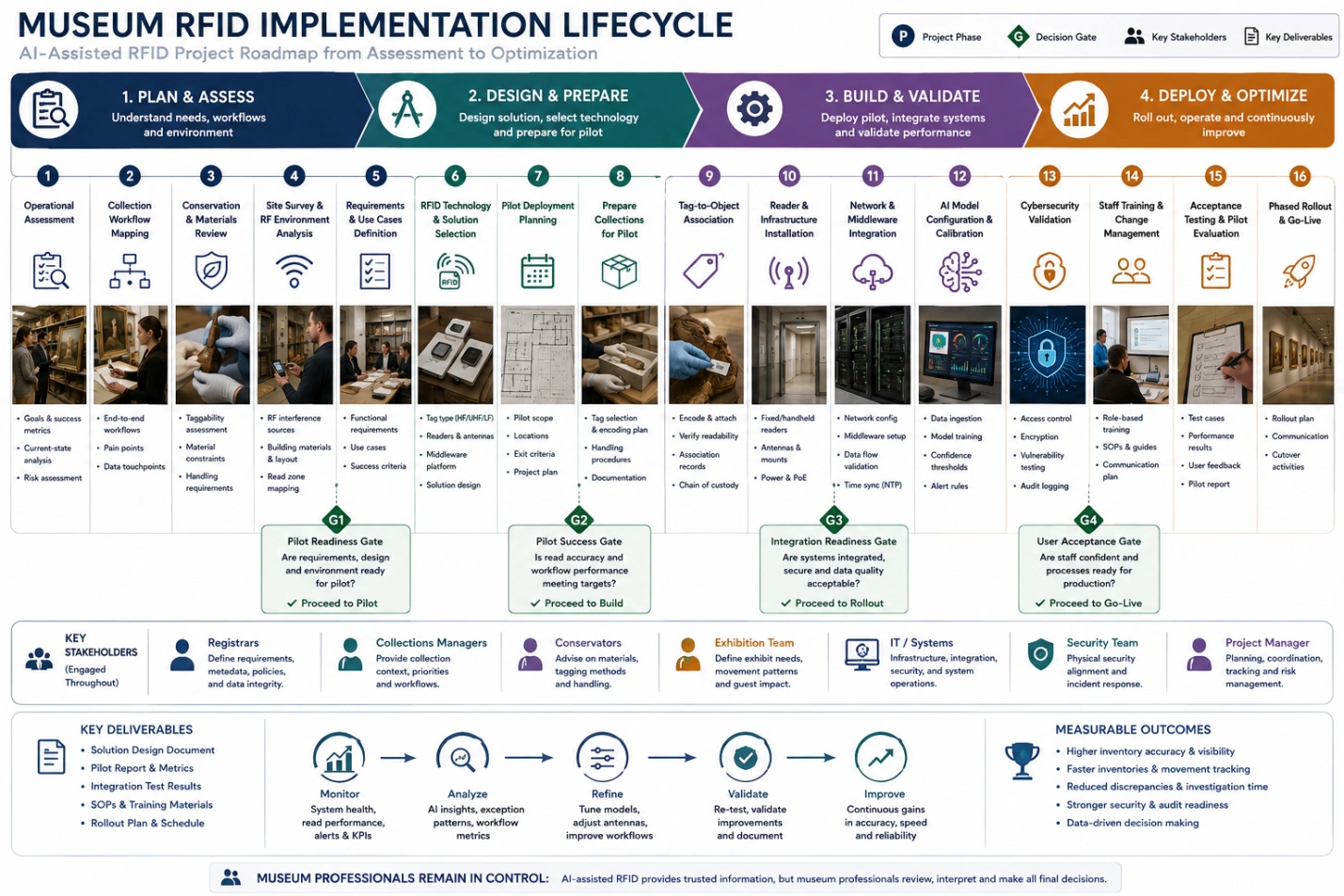
Measuring Success with Museum-Specific KPIs
Technical teams should establish baseline measurements before deployment so that improvements can be demonstrated using operational evidence rather than assumptions.
Relevant KPIs can include:
- Collection inventory completion time
- Percentage of objects successfully reconciled during an audit
- Number of unresolved location discrepancies
- Average time to locate a requested collection object
- Reader and device availability
- RFID read reliability in representative collection environments
- False-positive exception rate
- Average discrepancy investigation time
- Exhibition asset verification time
- Loan packing verification accuracy
- Percentage of movements associated with an approved workflow
- Number of recurring discrepancies by storage zone
- Staff hours spent on manual inventory reconciliation
- Time required to restore operations after connectivity loss
KPIs should be reviewed by collection and technical teams together. A high RFID read count, for example, is not necessarily a meaningful business result if staff still spend the same amount of time resolving inventory discrepancies.
Practical Technical Insights for Museum AI and RFID Deployments
Several implementation lessons consistently affect the usefulness of museum identification systems.
Treat collection locations as controlled data. Storage room names, cabinet identifiers, shelf positions, galleries, staging zones, and temporary locations should follow a consistent location hierarchy. AI analysis becomes unreliable when multiple names refer to the same physical location.
Do not attach RFID tags without conservation review. Adhesives, tag materials, encapsulation, placement, and removal procedures must be evaluated according to object sensitivity and institutional conservation policies.
Design for uncertainty. RFID observations are evidence, not always proof of precise object position. Systems should communicate confidence and allow staff confirmation.
Avoid excessive fixed-reader coverage. More readers do not automatically produce better location accuracy. Overlapping read zones can increase ambiguity and unnecessary event volume.
Preserve offline workflows. Handheld inventory processes and edge software should support controlled operation during network interruptions where museum procedures require continuity.
Separate identification from authorization. Detecting a tagged object is different from confirming that its movement was authorized. The software should maintain this distinction.
Use AI to prioritize, not obscure. The strongest museum AI applications help professionals decide where to investigate first and why.
The Future of AI-Driven Collection Tracking in Museums
AI-driven museum collection management will increasingly combine RFID identification with other sources of operational evidence. Computer vision may help verify exhibition layouts, while machine learning can improve discrepancy prioritization and operational forecasting. Edge AI can support faster local processing when immediate analysis is required near collection storage or secure movement zones.
Future systems may also provide more natural interaction with authorized museum data. Collection staff could use AI-assisted search to investigate inventory exceptions, exhibition readiness, object movement histories, and unresolved reconciliation tasks while respecting established access controls.
These developments should be adopted carefully. Museums manage cultural heritage, scientific specimens, historical records, and other resources that require professional stewardship. AI can improve the efficiency and consistency of data analysis, but provenance, curatorial interpretation, conservation judgment, and collection accountability remain human responsibilities.
GAO, headquartered in New York City and Toronto, is ranked among the top 10 leading B2B and B2G suppliers of BLE and RFID technologies worldwide, with additional support for selected B2B2C and B2D requirements. Our experience supplying RFID hardware products and systems helps museums and related organizations evaluate identification technologies based on real operational conditions.
Key Takeaways for AI and RFID in Museums
AI-driven RFID systems can help museums move beyond periodic, labor-intensive identification processes toward more continuous collection visibility and prioritized operational decision-making.
Key implementation priorities include:
- Begin with a clearly defined collection-management or inventory problem.
- Select UHF RFID, HF RFID, LF RFID, or a hybrid approach based on museum workflow and physical conditions.
- Test tags and readers using representative objects, containers, shelving, and collection environments.
- Integrate RFID events with authoritative collection management records.
- Use AI for anomaly detection, discrepancy prioritization, audit planning, and operational search.
- Maintain human review for collection records, provenance, custody decisions, and sensitive exceptions.
- Apply cybersecurity, access control, and audit logging throughout the deployment.
- Measure success using inventory, reconciliation, workflow, and staff-efficiency KPIs.
For museums evaluating RFID-based collection tracking or AI-assisted inventory management, GAO can provide technical guidance and RFID hardware products and systems suited to collection storage, exhibition operations, object movement, and inventory workflows. Learn more about our RFID technologies and engineering support to evaluate an approach that aligns with your collection-management requirements.
Building the Future of Industrial AI and IoT with Aperture Venture Studio and GAO RFID Inc.
For more than three decades, GAO Group of Companies has invested heavily in research and development involving industrial RFID, BLE, and IoT technologies. As generative AI demonstrated practical value for identification, tracking, and operational applications, we expanded our work in AI and IoT technologies, including RFID and BLE. We founded Aperture Venture Studio to help advance AI and IoT solutions for applications such as museum collection management, object tracking, and operational automation.
Aperture has attracted experienced AI and IoT technical specialists, entrepreneurial and operational executives, influential investors, and leading organizations. We have also developed successful Aperture Ventures Summit and TekSummit programs to explore advanced AI and IoT topics and strengthen technical communities.
We welcome participation from:
- Advisors, co-founders, and employees
- Investors
- Customers