
AI and RFID for Convention Centers
AI-Powered RFID Operations in Convention Centers
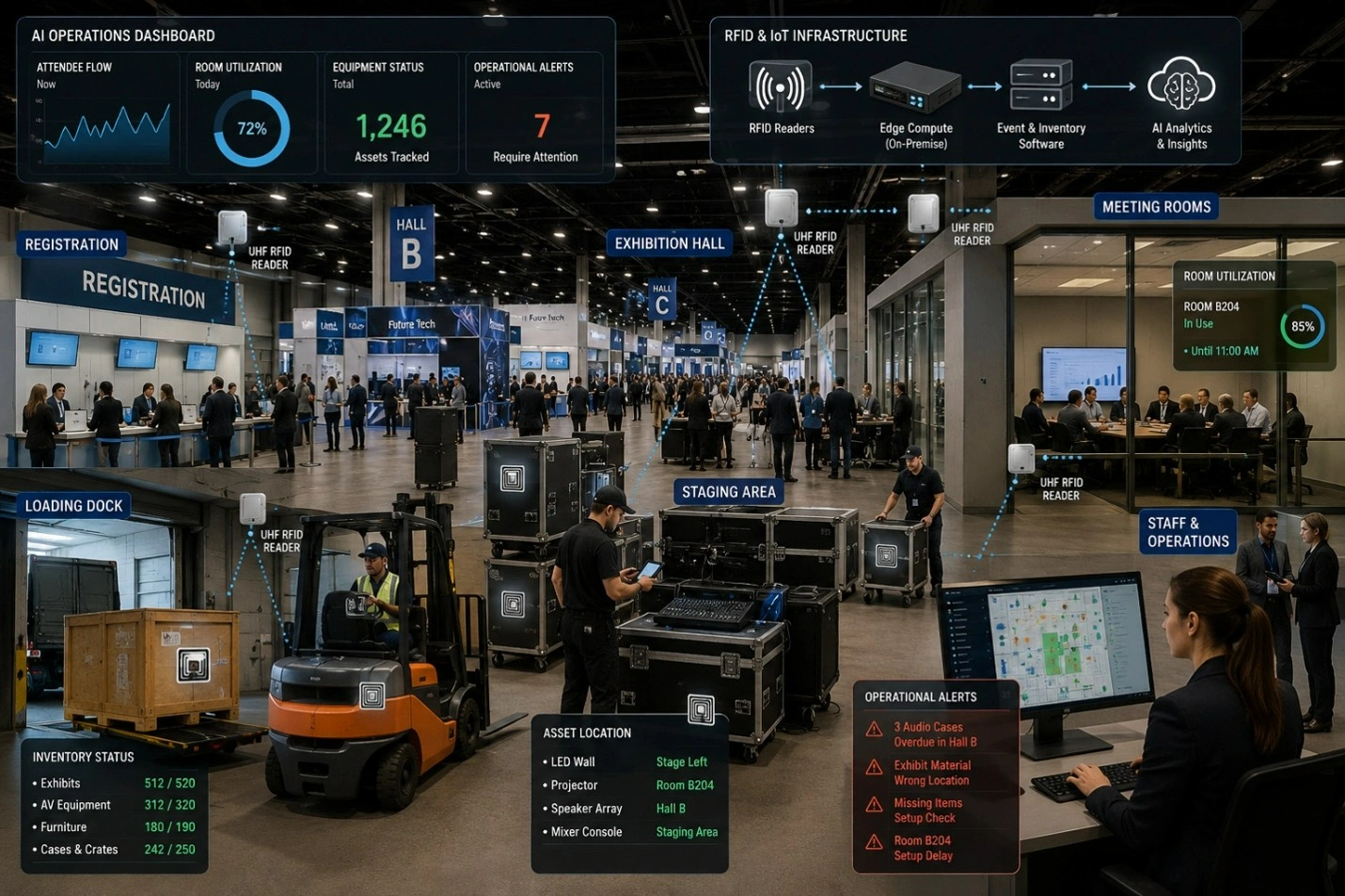
This visual illustrates a realistic convention center deployment where UHF RFID readers track event equipment, inventory, and assets across registration, exhibition, loading, staging, and meeting areas. AI analytics combine RFID and IoT data to provide asset visibility, room utilization insights, inventory status, and operational alerts.
How AI Improves Convention Center Operations
Convention centers operate as highly dynamic facilities where multiple events, exhibitors, contractors, vendors, venue staff, and visitors interact within changing physical spaces. A single convention may involve thousands of tagged assets, temporary exhibit structures, audiovisual devices, furniture items, shipping containers, credentials, and consumable supplies moving between loading docks, storage areas, exhibition halls, meeting rooms, service corridors, and staging zones.
AI becomes valuable when operational data from these activities can be collected continuously and analyzed against expected workflows.
From RFID Identification to Operational Intelligence
RFID identifies tagged objects without requiring every item to be manually scanned. UHF RFID is particularly useful for longer-range identification of equipment and inventory moving through loading docks, storage areas, exhibit halls, and controlled transition points. HF RFID can support shorter-range identification scenarios such as credentialing, controlled interactions, and specific asset or document workflows. LF RFID can be considered where lower-frequency identification characteristics are appropriate for specialized access or identification requirements.
AI software can process RFID events together with data from other convention center systems. Relevant data sources can include:
- RFID readers and antennas
- RFID-tagged audiovisual equipment
- Exhibition and booth inventory
- Loading dock transactions
- Event registration systems
- Access-control systems
- Building management systems
- Room scheduling software
- Computer vision systems
- BLE location data
- Maintenance management software
- Inventory and procurement records
- Event-management applications
The resulting information can support operational decisions rather than simply recording where an asset was last detected.
Convention Center Workflows Supported by AI
AI-enabled systems can be applied to several convention center workflows:
- Event setup: Determine whether required staging equipment, displays, furniture, lighting equipment, and audiovisual assets have reached their assigned event areas.
- Exhibition inventory: Track exhibit materials and equipment as they move between receiving areas, storage rooms, exhibition halls, and outbound shipping zones.
- Audiovisual operations: Improve visibility into microphones, projectors, displays, speakers, control equipment, and other mobile event technology.
- Loading dock coordination: Correlate RFID identification events with scheduled deliveries, dock assignments, and event setup requirements.
- Teardown and return: Identify equipment that has been collected, returned to storage, transferred to another event, or prepared for shipment.
- Room operations: Combine occupancy and scheduling information with equipment availability to support meeting-room preparation.
- Maintenance: Detect repeated movement patterns or missing equipment that may indicate maintenance, replacement, or inspection requirements.
- Inventory control: Compare expected and observed equipment quantities and identify discrepancies before an event begins.
- Security operations: Support controlled movement monitoring for selected high-value equipment and restricted operational areas.
- Event logistics: Provide operational teams with data about the status and location of resources required for multiple concurrent events.
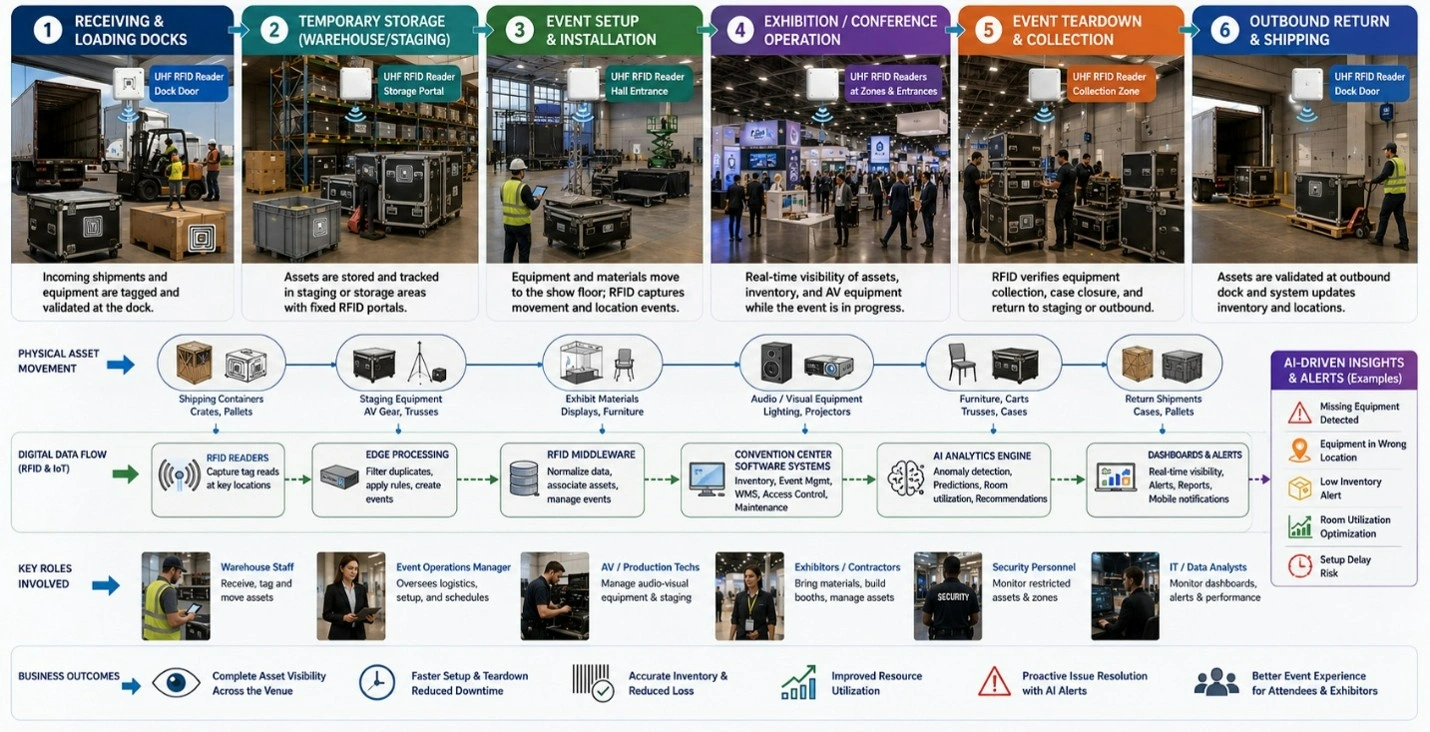
AI-Enabled RFID Workflow for Convention Center Event Operations
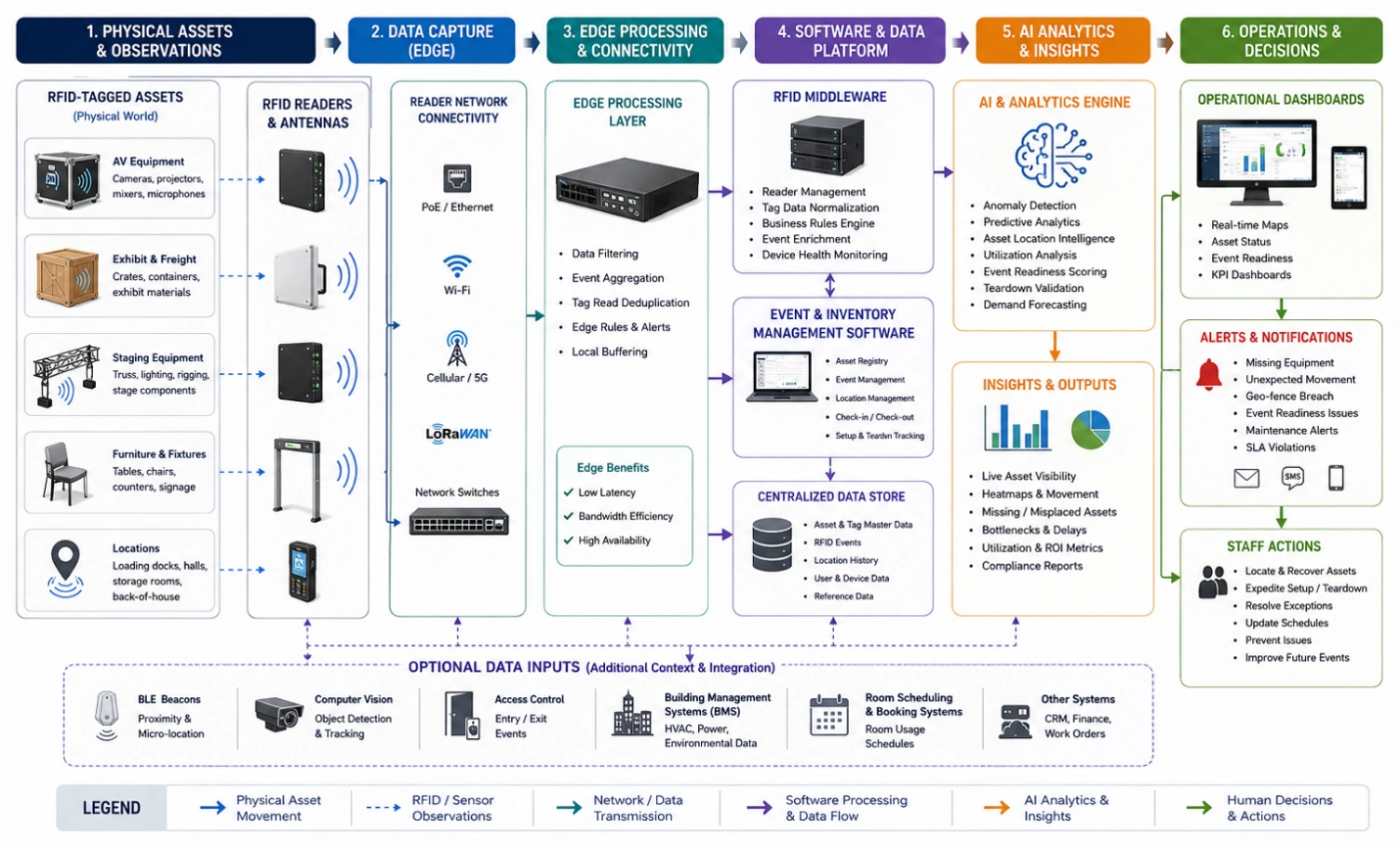
The completed workflow illustrates how RFID-tagged assets move through six convention center stages, from receiving and temporary storage through event setup, live operation, teardown, and outbound shipping. It also shows the supporting digital flow from RFID readers and edge processing through middleware, convention center software, AI analytics, dashboards, and operational alerts.
Convention Center Applications for AI-Enabled RFID
The strongest applications are those where physical assets and operational events must be reconciled with scheduled activities. Convention centers frequently experience short setup windows, rapid asset movement, simultaneous events, temporary storage requirements, and frequent handoffs between venue teams, contractors, exhibitors, and service providers.
AI Asset Tracking for Convention Center Equipment
Mobile convention center equipment can be difficult to track through manual spreadsheets and periodic inventory checks. RFID provides machine-readable identification while AI can analyze movement records to identify abnormal or unexpected conditions.
For example, an AI system could compare the equipment assigned to a ballroom event with RFID observations from nearby storage and staging areas. If several required items have not appeared within the expected preparation window, the system could generate an operational exception for the event team.
This approach shifts asset management from periodic manual verification toward event-driven operational monitoring.
AI Inventory Management for Exhibition Operations
Exhibition operations involve large quantities of temporary materials that may arrive days before an event and move repeatedly during installation. RFID can provide item-level or container-level identification, while AI can compare observed inventory with expected quantities.
Potential applications include:
- Detecting missing exhibit equipment
- Identifying unexpected inventory movement
- Matching received materials with event requirements
- Monitoring staging-area inventory
- Supporting faster post-event reconciliation
- Identifying frequently misplaced equipment
- Forecasting equipment requirements from historical event data
The value comes from connecting physical inventory observations with event schedules and operational requirements.
AI-Powered Equipment Availability
Convention center teams often need to know whether a particular piece of equipment is available, deployed, in storage, undergoing maintenance, or assigned to another event.
An RFID-enabled equipment record can be combined with maintenance history, event schedules, and historical movement patterns. AI can then help determine whether equipment is likely to be available for an upcoming event and flag conflicts before staff discover them manually.
This is particularly useful for shared audiovisual equipment, staging components, portable displays, specialty furniture, technical equipment, and other mobile resources.
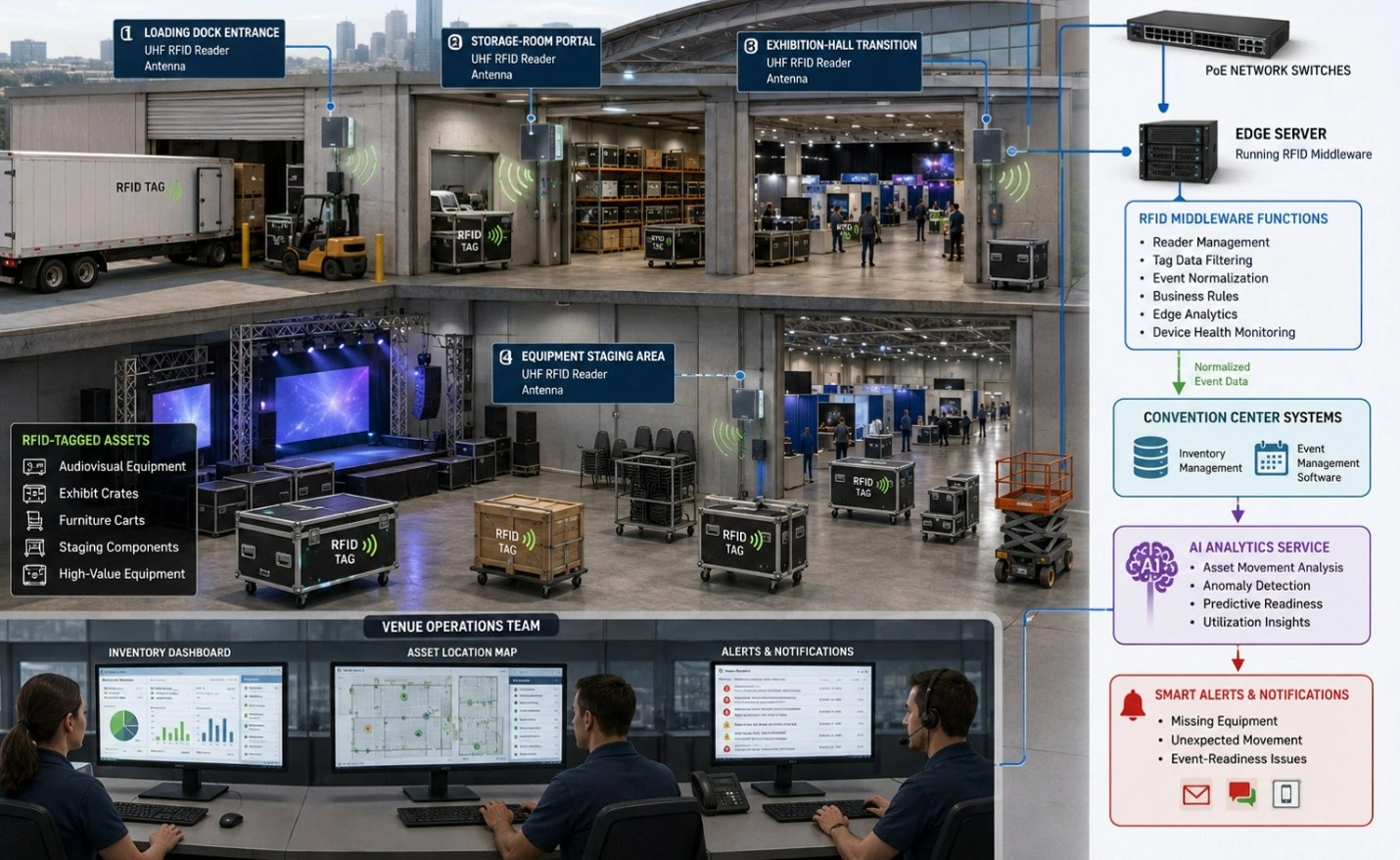
RFID Deployment and AI Asset Management in a Convention Center
A realistic convention center cutaway showing RFID readers, tagged equipment, edge middleware, inventory systems, AI analytics, and operations staff monitoring asset movement and event-readiness alerts.
Convention Center Operational Challenges AI Can Address
Convention center operations involve challenges that are difficult to resolve through isolated manual processes. AI and RFID can address these problems when deployed around clearly defined operational requirements.
Convention Center Challenge AI and RFID Response Operational Outcome
Equipment difficult to locate RFID movement visibility with AI exception detection Less search time
Incomplete event setup Compare required and observed equipment Earlier readiness alerts
Inventory discrepancies Automated identification and reconciliation Better inventory accuracy
Rapid asset movement Continuous event capture at defined locations Improved chain of custody
Multiple simultaneous events Correlate assets with schedules and assignments Better resource coordination
Manual teardown reconciliation RFID-based return identification Faster post-event reconciliation
Unauthorized equipment movement Rules and AI-based anomaly detection Improved operational control
Underused equipment Historical movement and utilization analysis Better resource planning
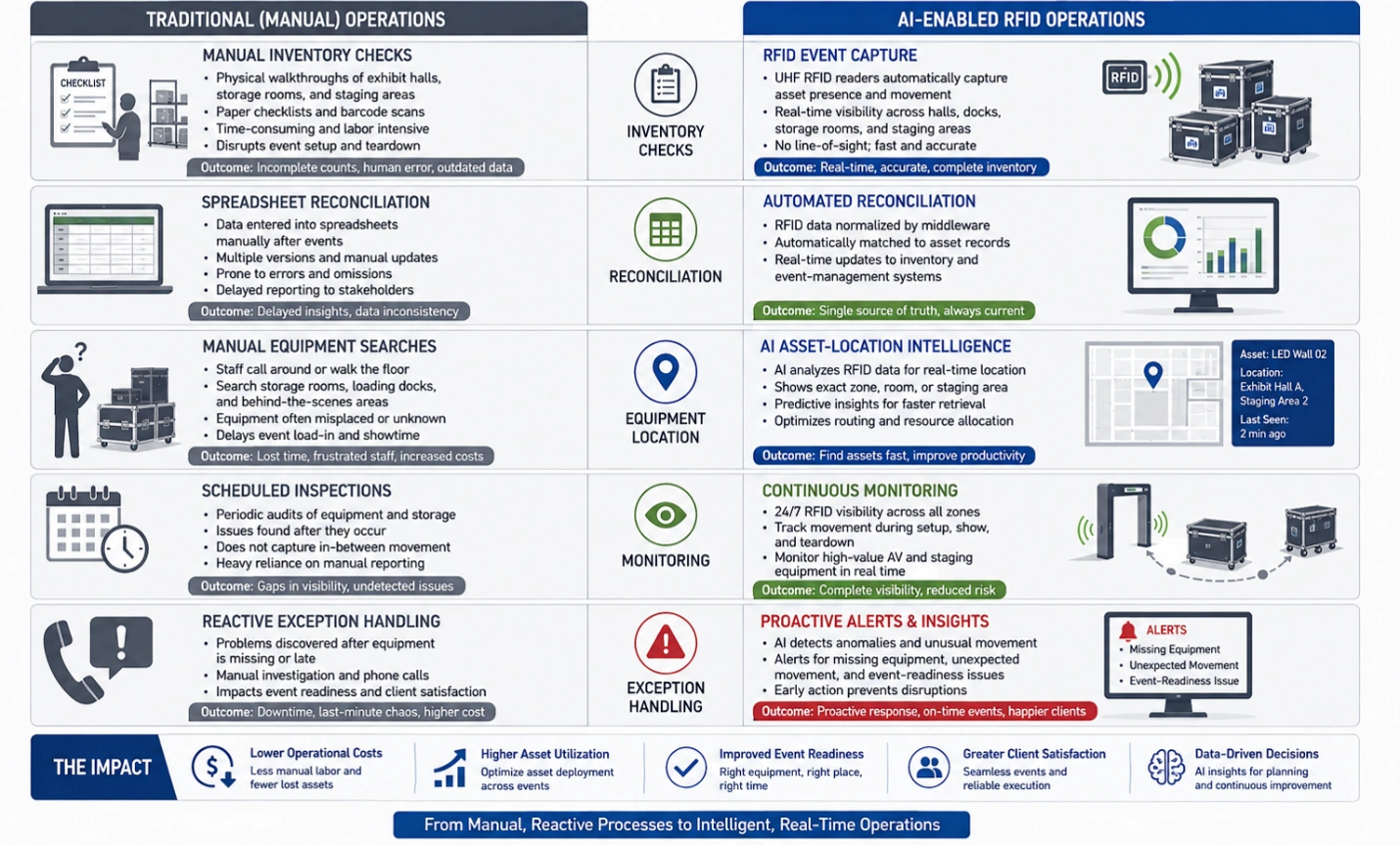
Manual vs. AI-Enabled RFID Operations for Convention Centers
A professional comparison infographic showing traditional manual asset operations alongside AI-enabled RFID workflows for inventory, reconciliation, equipment location, monitoring, and exception handling.
AI, RFID and the Convention Center Data Flow
A practical deployment begins with physical data capture. RFID readers detect tagged assets at defined locations, while other IoT devices can contribute environmental, occupancy, location, or equipment data. Edge systems can filter duplicate reads, apply local rules, and forward relevant events to centralized software.
A typical operational data flow is:
- RFID tags identify convention center equipment, containers, exhibit materials, or other selected assets.
- Fixed or mobile RFID readers capture identification events at strategically selected points.
- Reader networks transmit events through the convention center’s wired or wireless infrastructure.
- Edge processing filters duplicate reads and applies site-specific business rules.
- RFID middleware normalizes reader data into usable asset events.
- Event-management, inventory, maintenance, and access-control software receives relevant information.
- AI models analyze historical and real-time operational data.
- Analytics identify anomalies, predict requirements, or prioritize operational exceptions.
- Convention center personnel receive alerts, dashboards, or recommended actions.
- Staff validate the operational condition and take the appropriate physical action.
- Confirmed actions generate new data that can improve future planning and analytics.
The quality of the resulting AI decisions depends heavily on the quality of the underlying event data. Reader placement, antenna orientation, tag selection, read-zone design, interference management, asset hierarchy, timestamp accuracy, and integration logic therefore require engineering attention before AI models are deployed.
AI-Powered Convention Center Operations: RFID Data Flow
A technical block diagram showing how RFID observations move from tagged assets and readers through edge processing, middleware, software, centralized data, AI analytics, dashboards, alerts, and staff actions.
Engineering Considerations for Convention Center RFID Deployment
RFID deployment should be designed around the physical characteristics of each convention center rather than assuming identical reader performance across all areas. Exhibition halls, loading docks, storage rooms, service corridors, registration areas, and meeting-room environments have different RF conditions and operational requirements.
Important engineering considerations include:
- Read-zone definition: Determine exactly where an RFID event should be generated and what physical transition the event represents.
- Tag selection: Select tags according to the material, size, mounting position, required read range, and environmental conditions of the asset.
- Antenna placement: Position antennas to provide the required coverage while minimizing unintended reads from adjacent storage areas or traffic lanes.
- Reader density: Avoid unnecessary reader deployment. Excessive coverage can create ambiguous asset-location events and increase infrastructure cost.
- Metal and liquid effects: Equipment cases, metal staging components, racks, electronics, and other materials can affect RF performance and require appropriate tag and antenna selection.
- Event filtering: Middleware should distinguish meaningful movement events from repeated reads generated while an asset remains within a read zone.
- Integration: Asset identifiers should map consistently to inventory records, event assignments, maintenance records, and other operational systems.
- Cybersecurity: Network segmentation, authentication, access control, encryption, logging, software patching, and controlled administrative privileges should be incorporated into the deployment.
- Commissioning: Reader coverage and event logic should be tested under realistic operating conditions, including crowded halls, stacked equipment, moving carts, and concurrent event setup activities.
GAO’s experience supplying RFID and IoT hardware products and systems can support organizations evaluating these physical and software integration requirements for convention center environments.
Choosing RFID Frequencies for Convention Center Applications
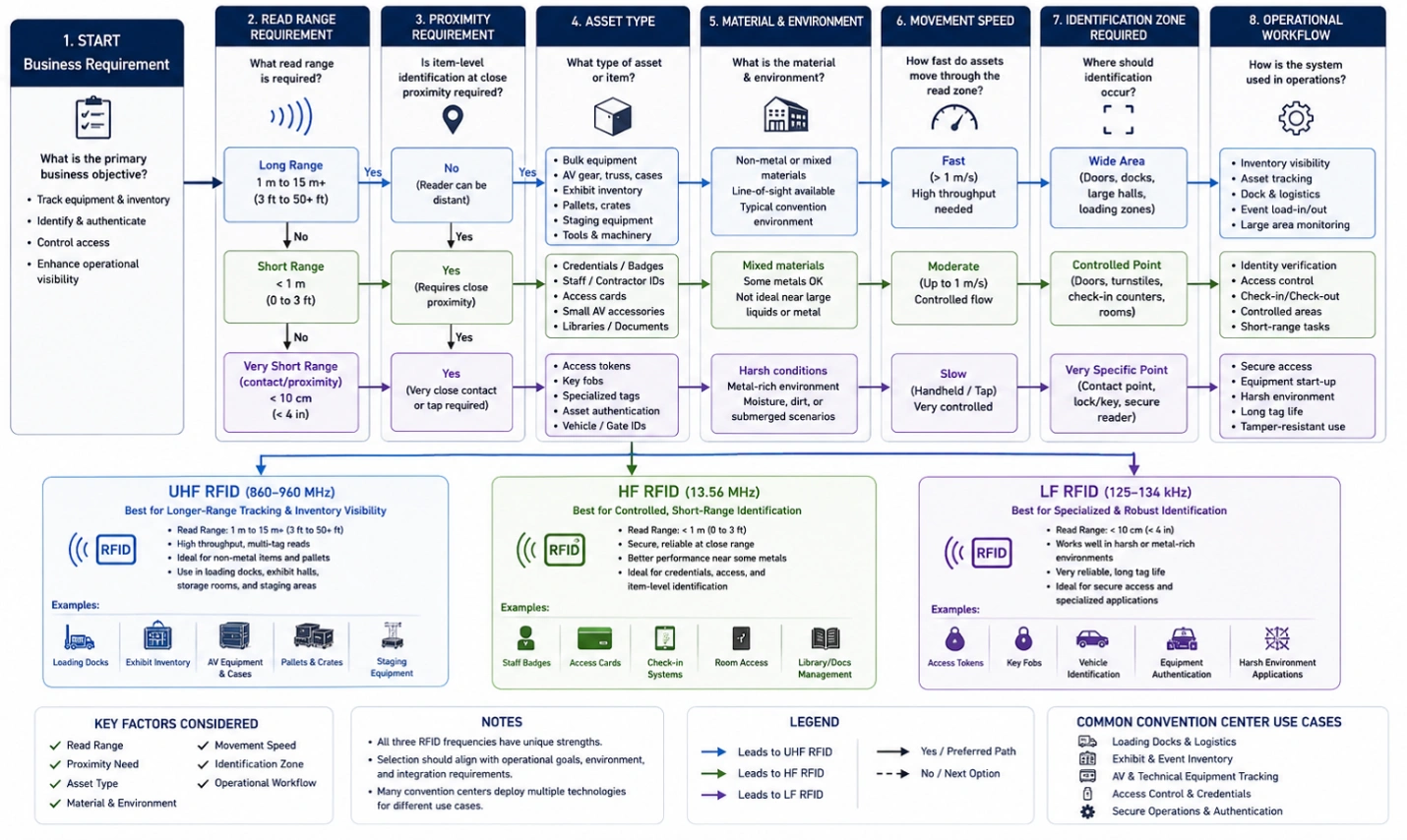
The appropriate RFID frequency depends on the physical workflow and identification requirement.
- UHF RFID: Well suited to longer-range identification of equipment, inventory, exhibit materials, carts, cases, and assets moving through defined areas such as loading docks and storage transitions.
- HF RFID: Appropriate for shorter-range identification and controlled interactions where proximity-based reads are desirable.
- LF RFID: Can be considered for specialized identification and access scenarios where its frequency characteristics meet the application requirements.
Frequency selection should follow the operational problem rather than the technology label. A convention center may use more than one RFID frequency where different workflows have substantially different identification requirements.
RFID Frequency Selection Decision Tree for Convention Centers
A professional decision tree guiding convention center teams in selecting UHF, HF, or LF RFID based on read range, proximity, asset type, environment, movement speed, identification zone, and workflow.
Convention Center Deployment Planning
Successful implementation should begin with the operational workflow rather than with a decision to install RFID readers. The deployment team should first identify where asset visibility creates measurable operational value.
A practical planning process evaluates:
- Which convention center assets require continuous or event-based visibility
- Which assets have sufficient value or operational importance to justify tagging
- Which physical transitions generate meaningful business events
- Which existing event-management and inventory systems must receive RFID data
- Which staff members need alerts or operational dashboards
- Which workflows require real-time responses versus historical analytics
- Which locations require fixed readers and which can use handheld RFID equipment
- What cybersecurity and network controls apply to connected RFID infrastructure
- Which KPIs will demonstrate improvement after deployment
The initial deployment should focus on measurable workflows such as event setup readiness, audiovisual equipment tracking, loading dock receiving, exhibition inventory reconciliation, or teardown recovery. Expanding into additional workflows becomes easier once tag identification, reader coverage, middleware processing, software integration, and operational ownership have been validated.
AI Models for Convention Center Decision Support
AI does not replace RFID identification. It adds analytical capabilities to the operational data produced by RFID readers and other connected systems. The appropriate model depends on the decision the convention center needs to make.
Anomaly Detection
Anomaly detection can identify asset movements or operational events that differ from established patterns. For example, an equipment case detected in a service corridor outside its expected event workflow could generate an exception for venue operations.
Potential signals include:
- Unexpected movement between zones
- Equipment appearing in an incorrect event area
- Missing assets during event setup
- Abnormally long equipment dwell times
- Repeated movement of the same asset
- Inventory quantities inconsistent with expected event requirements
Rules-based detection can handle straightforward conditions, while machine learning can identify more complex patterns when sufficient historical data exists.
Predictive Planning
Historical RFID movement records can help AI models estimate equipment demand, storage requirements, setup workloads, and recurring operational patterns.
For example, historical records may reveal that certain types of conferences consistently require additional audiovisual equipment, staging components, or furniture. Combined with event schedules and historical usage, these observations can help operations teams plan resources before setup begins.
Predictions should remain decision-support tools. Event managers should be able to review the underlying information and override recommendations when unusual event requirements or operational constraints exist.
Computer Vision and Multimodal AI
RFID identifies tagged objects, while computer vision can provide visual information about spaces, equipment conditions, queues, and physical activities. Combining the two can improve situational awareness.
A convention center could, for example, use RFID to determine whether required equipment has entered an exhibition area while computer vision verifies whether the relevant staging zone appears prepared. These technologies provide different types of evidence and should not be treated as interchangeable.
Multimodal AI can potentially correlate:
- RFID asset events
- Camera-derived observations
- Event schedules
- Room assignments
- Access-control events
- Maintenance records
- Inventory records
- Staff-entered operational information
The resulting system can provide a more complete operational view than any single sensing technology.
Convention Center Systems and Integration
AI-enabled RFID operations become useful when identification data can move into the software already used by convention center personnel.
Relevant systems may include:
- Event-management software
- Venue-management systems
- Inventory-management software
- Warehouse-management systems
- Computerized maintenance management systems
- Enterprise resource planning systems
- Procurement systems
- Access-control software
- Building management systems
- Room scheduling software
- Security management systems
- Business intelligence and analytics applications
Integration can be implemented through APIs, web services, message brokers, database interfaces, middleware connectors, or other supported integration mechanisms.
A key engineering requirement is maintaining a consistent asset identity across systems. An RFID tag identifier should map to a meaningful asset record rather than becoming an isolated identifier that cannot be associated with the equipment’s owner, category, event assignment, maintenance status, or location history.
RFID Middleware
RFID middleware acts as the operational translation layer between RFID readers and business applications. It can receive raw reader events, remove duplicate reads, apply filtering rules, associate reads with physical zones, and generate meaningful business events.
For a convention center, a raw reader observation might indicate that a particular tag was detected repeatedly near an exhibition-hall entrance. Middleware can transform those repeated observations into a higher-level event such as:
Asset entered Exhibition Hall A.
AI and business applications can then work with that normalized event instead of processing every raw reader response.
Cloud and Server Deployment for Convention Centers
The appropriate software deployment model depends on connectivity requirements, cybersecurity policies, existing IT infrastructure, data governance, event scale, and the degree of local processing required.
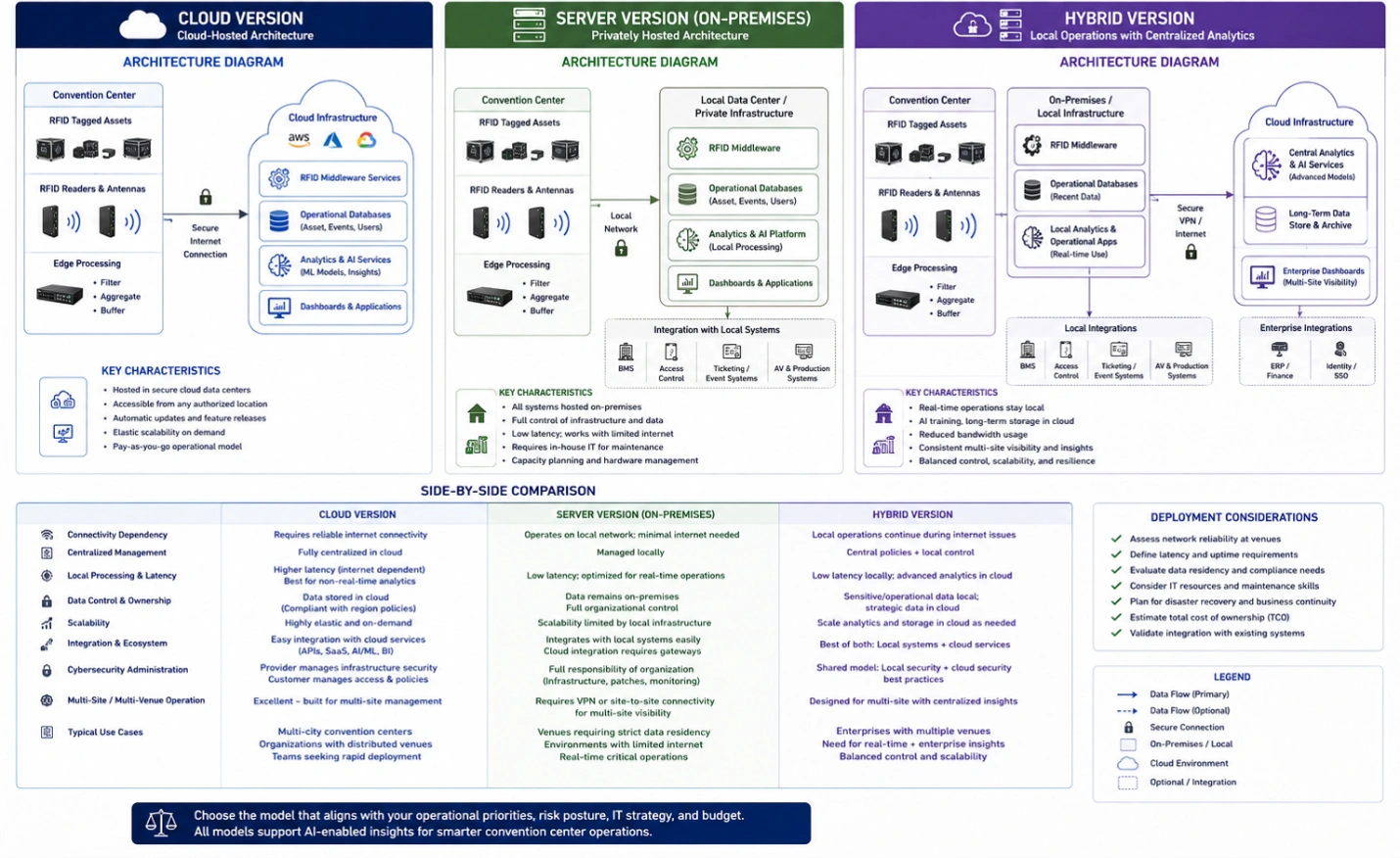
Cloud Version
A cloud-hosted SaaS deployment can centralize RFID events, analytics, dashboards, and AI services across one or multiple convention facilities.
Cloud deployment can be appropriate when:
- Multiple facilities need centralized visibility
- Event data must be accessed by authorized teams from different locations
- Centralized analytics and reporting are important
- The organization prefers managed cloud infrastructure
- AI processing requires scalable computing resources
- Software updates need to be centrally administered
Edge processing can still be used to filter or temporarily process RFID events before forwarding relevant information to cloud services.
Server Version
A Server Version can operate on customer-managed edge servers, private enterprise servers, private data centers, or other privately hosted infrastructure.
This model can be useful when convention center operators require greater control over data location, network connectivity, software integration, or local processing.
A local deployment may also reduce dependency on continuous external connectivity for operational functions that must continue during an event.
A hybrid configuration is also possible. RFID data can be processed locally for immediate operational decisions while selected historical data is synchronized with centralized analytics or cloud services.
Cloud vs. Server Deployment for AI-Enabled RFID Convention Center Operations
A technical comparison of cloud, on-premises server, and hybrid deployment models for AI-enabled RFID, covering connectivity, processing, data control, scalability, security, integration, and multi-site operations.
Cybersecurity for AI and RFID Convention Center Systems
Connected convention center equipment creates additional cybersecurity considerations because RFID readers, edge computers, servers, networks, and business applications can become part of the venue’s operational IT environment.
Security controls should be applied across the entire data path.
Important measures include:
- Network segmentation between RFID infrastructure and unrelated systems
- Strong authentication for administrators and applications
- Role-based access control
- Encryption for data transmitted between components
- Secure API authentication
- Device inventory and configuration management
- Regular firmware and software updates
- Audit logging for administrative and operational actions
- Monitoring for unusual device or network behavior
- Controlled remote access
- Backup and recovery procedures
- Protection of operational dashboards and APIs
AI systems introduce additional considerations. Training and operational data should be governed appropriately, model access should be controlled, and anomalous AI recommendations should not automatically trigger high-impact physical actions without suitable validation.
For convention centers, cybersecurity planning should also consider temporary contractors, exhibitors, event vendors, guest networks, and third-party service providers. Operational RFID infrastructure should not automatically inherit the same trust level as visitor-facing or temporary event networks.
Measuring AI and RFID Performance in Convention Centers
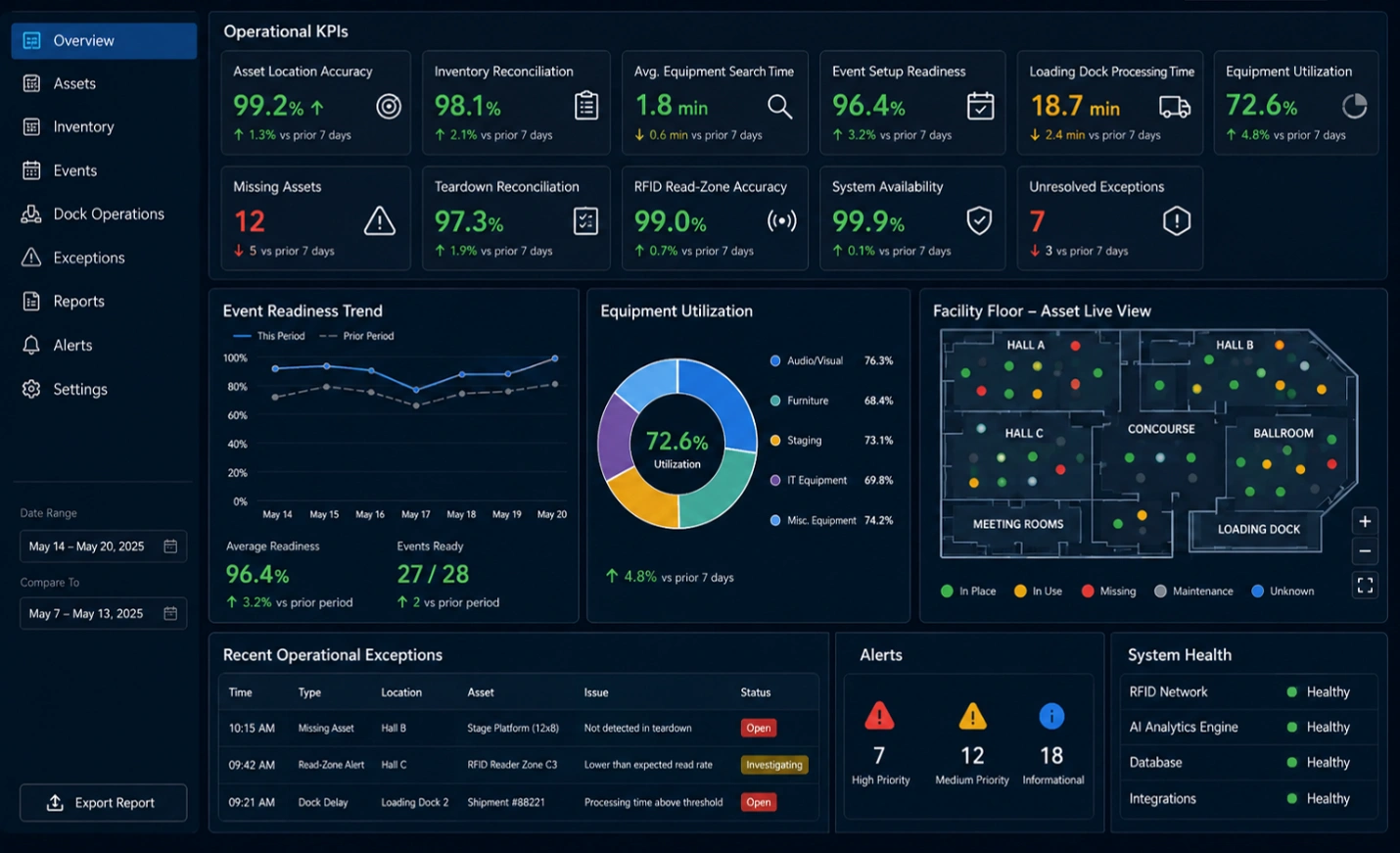
A deployment should be evaluated using operational KPIs rather than technology metrics alone. RFID read performance matters, but the ultimate objective is better convention center operations.
Useful KPIs can include:
- Asset location accuracy
- Inventory reconciliation accuracy
- Equipment search time
- Event setup completion time
- Percentage of required equipment available before setup deadlines
- Missing-equipment incidents
- Equipment utilization
- Average asset dwell time
- Loading dock processing time
- Teardown reconciliation time
- Equipment recovery rate
- Maintenance response time
- Unauthorized movement alerts
- RFID read-zone accuracy
- False-positive and false-negative event rates
- System availability
- Mean time to resolve operational exceptions
A baseline should be established before deployment. The same measurements can then be collected after implementation to determine whether the solution is delivering measurable operational improvement.
AI + RFID Convention Center Operations KPI Dashboard
A realistic enterprise dashboard showing how AI and RFID help convention center managers monitor asset visibility, inventory accuracy, event readiness, equipment utilization, loading dock performance, operational exceptions, and system health in real time.
Implementation, Testing and Commissioning
A convention center RFID project should progress from a controlled operational use case toward broader deployment.
Pilot Deployment
A pilot can focus on one operational workflow, such as audiovisual equipment tracking or loading dock receiving.
The pilot should establish:
- Asset categories and tagging rules
- Reader locations
- Antenna orientation
- RFID read zones
- Middleware event rules
- Software integration requirements
- User roles
- Security controls
- Baseline KPIs
- Acceptance criteria
The physical environment should be tested under realistic event conditions rather than under empty-building conditions alone.
Testing Under Real Operating Conditions
Convention center RF environments can change substantially during event setup. Metal exhibit structures, equipment cases, temporary walls, people, carts, and densely packed inventory can affect RFID behavior.
Testing should therefore include:
- Empty and populated storage areas
- Loaded equipment carts
- Stacked equipment cases
- High-traffic loading docks
- Exhibition-hall setup
- Simultaneous asset movement
- Adjacent read zones
- Normal and abnormal movement paths
- Network interruptions
- Reader failures
- Temporary event configurations
Acceptance testing should measure both technical performance and business-event accuracy.
Optimization After Commissioning
Post-deployment optimization can include adjusting antenna positions, changing tag placement, refining read-power settings, modifying middleware filters, improving asset master data, and tuning AI thresholds.
AI models should also be monitored over time. Changes in event types, floor layouts, asset inventories, or operational procedures can change the data distribution on which models depend.
Scaling AI and RFID Across Convention Center Operations
Once an initial use case demonstrates measurable value, additional workflows can be connected.
A staged expansion may move from equipment tracking into:
- Exhibition inventory
- Loading dock management
- Storage management
- Event setup verification
- Teardown and returns
- Maintenance operations
- Controlled equipment movement
- Room preparation
- Multi-event resource planning
Scaling should preserve common asset identifiers and integration standards. Otherwise, each new application can become a separate data silo.
Multi-site convention operators can also standardize tag data structures, event definitions, security controls, and integration interfaces while allowing reader configurations to reflect each facility’s physical characteristics.
AI-Enabled RFID Implementation Roadmap for Convention Centers
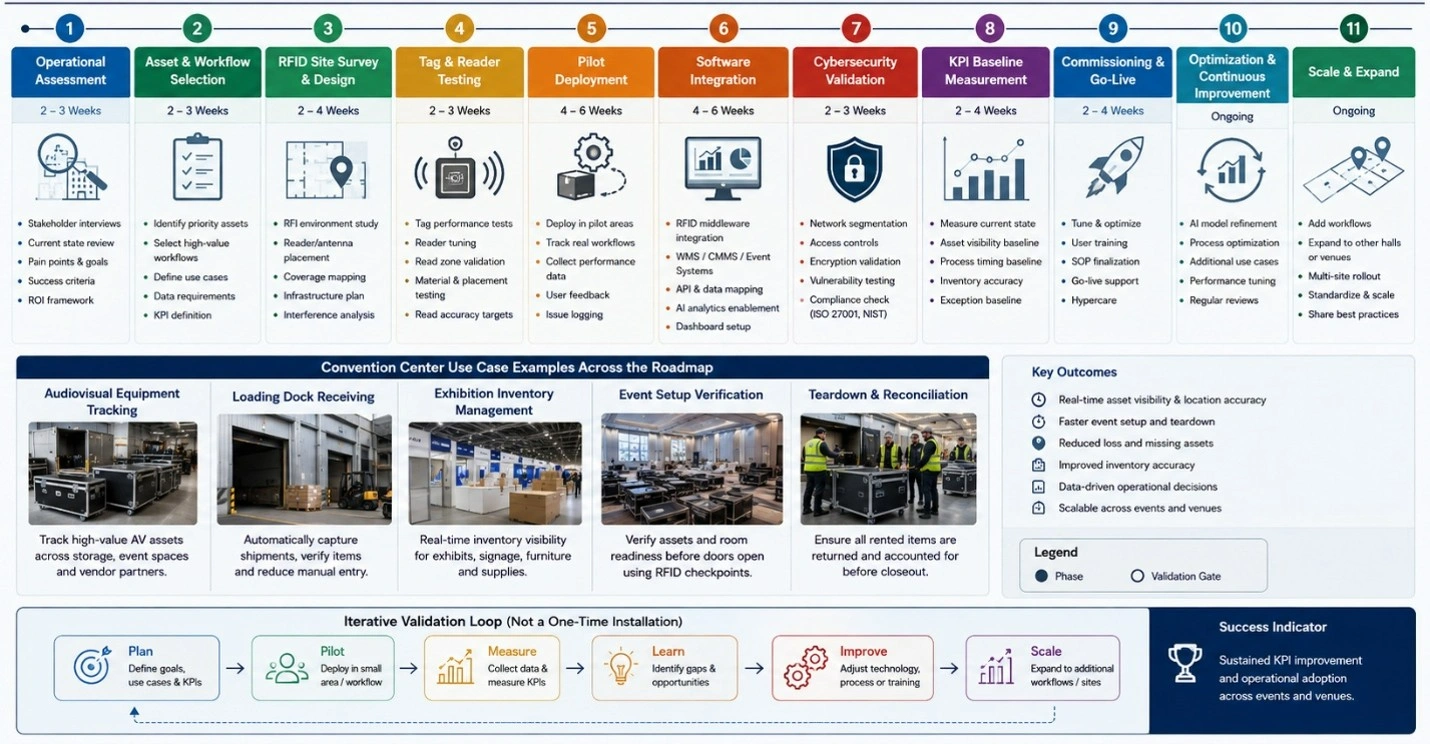
A professional 11-phase roadmap illustrates the progression from operational assessment and RFID testing through pilot deployment, software integration, cybersecurity validation, KPI measurement, commissioning, optimization, and multi-site expansion, with real convention center use cases and an iterative Plan–Pilot–Measure–Learn–Improve–Scale cycle.
Practical Recommendations for Convention Center Operators
Convention center operators considering AI-enabled RFID should prioritize operational clarity over technology complexity.
- Start with a measurable operational problem such as equipment search, inventory discrepancy, setup readiness, or teardown reconciliation.
- Define the physical events that need to be detected before selecting reader locations.
- Tag assets according to operational value, not simply because tagging every object is technically possible.
- Test RFID performance with real equipment, cases, carts, metal structures, and event configurations.
- Integrate RFID identifiers with existing asset and event records.
- Use edge processing where immediate local event handling is operationally important.
- Select cloud, server, or hybrid deployment according to connectivity, data governance, integration, and IT requirements.
- Treat AI as decision support and validate high-impact recommendations.
- Establish cybersecurity controls before connecting RFID infrastructure to operational networks.
- Measure business outcomes using predefined KPIs.
- Expand only after the pilot demonstrates reliable technical and operational performance.
GAO can support convention center organizations evaluating RFID readers, tags, IoT connectivity, and related hardware and systems for asset visibility and operational applications. Our experience serving organizations in the U.S. and Canada includes supplying technology products and systems to demanding technical environments.
Key Takeaways for AI-Powered Convention Center Operations
AI and RFID can provide convention centers with a practical method for connecting physical asset activity to digital operational decision-making. RFID supplies reliable identification events for selected equipment, inventory, and materials, while AI can detect exceptions, identify patterns, support forecasting, and help operations teams prioritize actions.
The most effective deployments are built around specific workflows such as event setup, exhibition inventory, loading dock receiving, equipment availability, maintenance, and teardown reconciliation. Engineering success depends on accurate asset data, appropriate tag selection, properly designed read zones, reliable software integration, cybersecurity controls, and realistic commissioning.
GAO provides RFID, BLE, IoT hardware products and systems that can help organizations build these connected operational solutions. With headquarters in New York City and Toronto, Canada, GAO is ranked among the top 10 leading B2B and B2G BLE and RFID suppliers in the world. GAO, GAO Research, and GAO Tek form the GAO Group, serving organizations across the U.S. and Canada for three decades, including Fortune 500 companies, leading R&D organizations, universities, and government agencies.
Building the Future of Industrial AI and IoT with Aperture Venture Studio and GAO RFID Inc.
For more than three decades, GAO Group of Companies has invested heavily in R&D involving industrial RFID, BLE, and IoT. As generative AI has become useful for industrial applications, we have continued developing AI and IoT technologies that can support connected operations such as convention center asset management, event logistics, and intelligent equipment tracking. We have also founded Aperture Venture Studio to help advance AI and IoT solutions relevant to operational environments.
Aperture has attracted AI and IoT technical experts, entrepreneurial and operational executives, influential investors, and leading companies.
We have also developed the Aperture Ventures Summit and TekSummit to discuss advanced AI and IoT topics and build technical communities around these technologies.
We welcome you to join us as:
- Advisors, Co-founders, or Employees
- Investors
- Customers