
AI and BLE for Heavy Machinery Production
AI-Driven Production Intelligence for Heavy Machinery Manufacturing
AI and BLE for heavy machinery production combines Industrial AI, machine learning, edge computing, connected sensors, BLE beacons, BLE gateways, and manufacturing software to improve visibility across production operations. BLE can identify the location and movement of tooling, work-in-process assemblies, components, mobile equipment, and maintenance assets, while AI analyzes the resulting operational data to identify patterns, predict events, and support production decisions.
For heavy machinery manufacturers, the value is not simply knowing where an asset is. The objective is to connect asset identity, location, condition, production status, operator activity, maintenance information, and manufacturing workflows so that production teams can make better decisions. AI can use BLE-generated data alongside machine data, ERP records, MES events, quality information, and other industrial inputs to improve production scheduling, material flow, equipment utilization, maintenance planning, and traceability.
GAO supplies BLE, RFID, and IoT hardware products and systems that can support these connected manufacturing requirements. Our experience serving organizations in the U.S. and Canada includes applications where reliable identification, sensing, wireless communication, and integration with operational software are important to industrial workflows.
AI-Powered BLE Architecture for Heavy Machinery Manufacturing
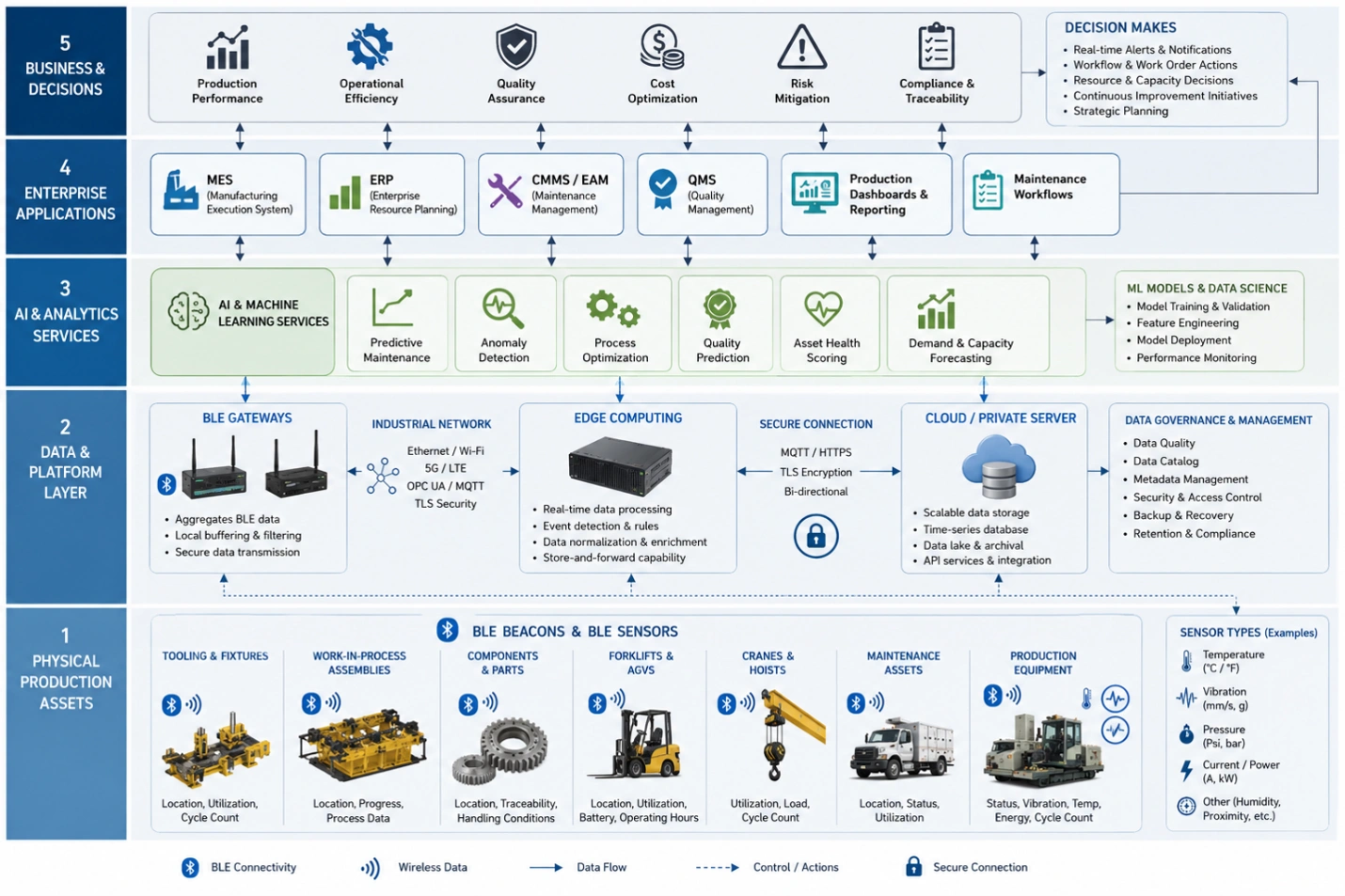
This enterprise architecture diagram shows how BLE beacons and sensors capture data from tooling, assemblies, components, forklifts, cranes, maintenance assets, and production equipment. Data flows through BLE gateways, industrial networks, edge computing, and cloud/private servers into AI/ML services and enterprise systems such as MES, ERP, CMMS/EAM, and QMS. The key takeaway is how connected production data enables predictive maintenance, process optimization, quality assurance, operational efficiency, and data-driven business decisions.
Why AI Matters in Heavy Machinery Production
Heavy machinery manufacturing produces large volumes of operational data, but data alone does not improve production performance. AI becomes valuable when it converts data into predictions, classifications, anomaly detection, recommendations, or automated actions.
Heavy equipment production can involve long manufacturing cycles and many production stages. A single machine may pass through cutting, machining, welding, painting, subassembly, final assembly, testing, inspection, rework, and shipping. Components can also move between work centers, staging areas, warehouses, inspection zones, and production cells.
AI can help production teams interpret this operational complexity.
AI-based anomaly detection can identify unusual movement, dwell time, or process behavior associated with production delays.
Machine learning models can analyze historical production data to identify conditions associated with equipment downtime or maintenance requirements.
AI-assisted production analytics can identify bottlenecks by correlating work-in-process location, process duration, machine utilization, and production schedules.
Computer vision can support inspection of welds, machined surfaces, assemblies, labels, and other production characteristics where visual inspection is technically appropriate.
AI forecasting can support demand planning, material requirements, production scheduling, and maintenance resource planning.
Edge AI can process selected industrial data close to production equipment when low latency, network resilience, or data-control requirements make local processing preferable.
Generative AI can assist engineers and maintenance personnel with natural-language access to approved production documentation, maintenance procedures, equipment records, and operational data.
BLE provides one useful data source within this larger AI and IoT solution. Its role is particularly relevant when manufacturers need practical wireless identification, location awareness, proximity detection, or sensor telemetry without installing wired connections throughout production areas.
Heavy Machinery Production Processes That Benefit from AI
Work-in-Process and Assembly Tracking
Heavy machinery production frequently involves large assemblies that cannot be treated like conventional small-part inventory. Chassis, frames, engine assemblies, hydraulic systems, transmissions, cabs, booms, buckets, axles, and other major assemblies may move between specialized production areas.
A BLE identifier can associate a physical assembly with a digital production record. BLE gateways positioned around production zones can provide location observations that help determine where an assembly was last detected and how long it remained within a particular area.
AI can then analyze movement histories against planned production sequences. For example, unusually long dwell times around welding, machining, paint, inspection, or final assembly may indicate a bottleneck that requires investigation.
The engineering objective is not to treat BLE location as an exact measurement in every environment. Metal structures, machinery, racks, vehicles, walls, and electromagnetic conditions can affect radio performance. A production solution should therefore be designed around the required location accuracy and operational decision rather than assuming that every BLE observation represents precise coordinates.
Tooling and Production Equipment Utilization
Heavy machinery plants use specialized tooling, fixtures, torque tools, lifting devices, welding equipment, gauges, dies, molds, and other production resources. Poor visibility into these assets can create unnecessary search time, duplicate purchases, delayed changeovers, and inefficient equipment utilization.
BLE tags can provide identification and location information for selected mobile tooling and production assets. Gateways installed at strategic production zones can detect tagged equipment as it moves through the facility.
AI can analyze historical location and usage patterns to identify underutilized tooling, recurring search events, unusual movement, or congestion around production cells. These insights can support decisions about tool placement, replenishment, maintenance, and production-cell design.
For high-value tooling, the BLE system should also be integrated with asset records so that the wireless identifier corresponds to a controlled asset ID rather than functioning as an isolated tag.
Material Flow and Line-Side Logistics
Material movement is a major operational concern in heavy machinery production because components can be large, heavy, expensive, and difficult to reposition. Engines, transmissions, hydraulic components, fabricated frames, tires, counterweights, and other assemblies may require dedicated material-handling processes.
BLE-enabled location events can provide additional visibility into movement between warehouses, staging areas, kitting zones, supermarkets, production cells, and assembly lines.
AI can use this information with ERP and MES data to identify recurring material-flow delays. A model may detect that particular components consistently spend excessive time in staging before reaching an assembly area, or that specific production cells experience repeated shortages.
The resulting action could involve changing replenishment rules, adjusting staging locations, modifying material routes, or revising production sequencing.
AI and BLE Use Cases Across Heavy Machinery Production
AI-Assisted Asset Tracking
Asset tracking is one of the most practical entry points for AI-enabled industrial IoT because location data can be connected to asset identity and operational history.
Relevant assets include:
- Welding fixtures and fabrication tooling
- Torque tools and calibration equipment
- Inspection instruments
- Mobile carts and material-handling equipment
- Production jigs and fixtures
- Dies, molds, and specialized tooling
- Work-in-process assemblies
- Hydraulic and powertrain components
- Maintenance equipment
- High-value spare parts
AI can identify abnormal movement patterns, prolonged inactivity, repeated transfers, and utilization trends. Production managers can use these findings to improve asset allocation and reduce avoidable production interruptions.
Predictive Maintenance for Heavy Machinery Production Equipment
Production plants depend on CNC machines, welding systems, presses, paint systems, conveyors, compressors, cranes, test equipment, and other industrial machinery. Predictive maintenance normally requires machine condition data such as vibration, temperature, current, pressure, runtime, or fault codes.
BLE sensors can provide selected wireless measurements where installing additional wired instrumentation is impractical. BLE data can be combined with PLC signals, machine historians, SCADA data, vibration monitoring, and maintenance records.
AI models can then identify relationships between equipment conditions and historical failures or maintenance events.
BLE is not a replacement for dedicated industrial machine interfaces when those interfaces already provide higher-quality machine data. Instead, it can complement existing instrumentation where wireless sensing provides a practical deployment option.
Production Bottleneck Detection
A heavy machinery production line can develop bottlenecks around machining, welding, painting, inspection, assembly, testing, or material handling.
BLE location events can provide timestamps associated with asset movement between production zones. When these events are combined with MES production orders and process timestamps, AI models can analyze cycle-time variation and identify abnormal dwell periods.
For example, a production analytics system could compare planned process duration with observed movement patterns and flag work-in-process that remains unusually long in a staging or inspection area.
This approach gives production engineers an additional source of evidence when investigating throughput problems rather than relying exclusively on manual observations.
Quality and Traceability
Traceability is particularly important when heavy machinery contains major assemblies, safety-relevant components, serialized parts, inspection records, and rework histories.
BLE identification can associate physical assets or containers with digital records as they move through production. RFID, barcode systems, machine data, and quality systems can complement BLE where different identification requirements exist.
AI can analyze traceability records to detect missing process events, unusual routing, repeated rework, or relationships between production conditions and quality outcomes.
A practical deployment should preserve authoritative production records in the appropriate manufacturing or quality system. AI should provide analysis and decision support rather than silently altering controlled production records.
Heavy Machinery Production Workflow from Data Capture to AI Decision
A production AI solution should be designed as a complete operational workflow rather than as a collection of wireless devices.
Data Acquisition
The process begins with physical production activity. BLE beacons can identify tagged equipment, assemblies, tools, carts, or other assets. BLE sensors can collect selected parameters such as temperature, motion, or other supported measurements.
Other industrial data sources can include:
- PLC and machine-controller data
- CNC machine data
- SCADA systems
- Industrial sensors
- Computer vision systems
- Barcode and RFID identification
- MES production events
- ERP transactions
- CMMS or EAM maintenance records
- Quality inspection systems
- Operator inputs
The most useful AI solutions combine multiple data sources because no single sensor technology provides a complete representation of heavy machinery production.
BLE Communication and Gateway Processing
BLE gateways receive wireless advertisements or sensor data from devices within their radio coverage. Gateway placement should be determined through a site survey that considers production-cell geometry, metal structures, machinery, mounting locations, interference, required coverage, and desired location accuracy.
Gateway software can filter duplicate observations, normalize timestamps, associate device identifiers with asset records, and forward relevant events to upstream systems.
For battery-powered devices, engineering teams should also consider advertising interval, transmission power, sensor sampling rate, battery chemistry, environmental conditions, and maintenance accessibility.
Edge Processing
Edge computing can process selected data close to the production floor. This is useful when production operations require local responsiveness or continued operation during WAN or cloud connectivity interruptions.
An edge service can perform data validation, buffering, filtering, local rules, protocol conversion, and selected AI inference before forwarding information to centralized software.
For heavy machinery plants, edge processing can also reduce unnecessary network traffic by sending events or model outputs rather than every raw observation.
Server or Cloud Processing
Centralized processing can support historical analytics, AI model training, cross-production-site reporting, asset histories, dashboards, and enterprise integration.
A private server deployment may be appropriate when production data must remain within customer-controlled infrastructure or when plant systems require integration with existing private networks.
A cloud deployment can be useful for organizations operating multiple manufacturing facilities that require centralized analytics and remote administration.
The choice should be based on latency, connectivity, cybersecurity requirements, data governance, existing IT standards, integration requirements, and operational support capabilities.
AI Analysis and Operational Decision
After data is normalized, AI models can generate predictions, classifications, anomaly scores, forecasts, or recommendations.
The output must then connect to a real production action.
Examples include:
- Alerting a maintenance engineer about an abnormal equipment condition
- Flagging an assembly that has remained too long in a staging zone
- Recommending a different tooling allocation
- Identifying a material-flow bottleneck
- Prioritizing an inspection
- Predicting production delays
- Detecting an unusual asset movement pattern
- Triggering a workflow in maintenance or production software
The strongest deployments define these actions before selecting the AI model. This prevents the project from becoming a data collection exercise without measurable operational value.
Eight-Stage BLE, AI, and Cloud Workflow for Heavy Machinery Manufacturing
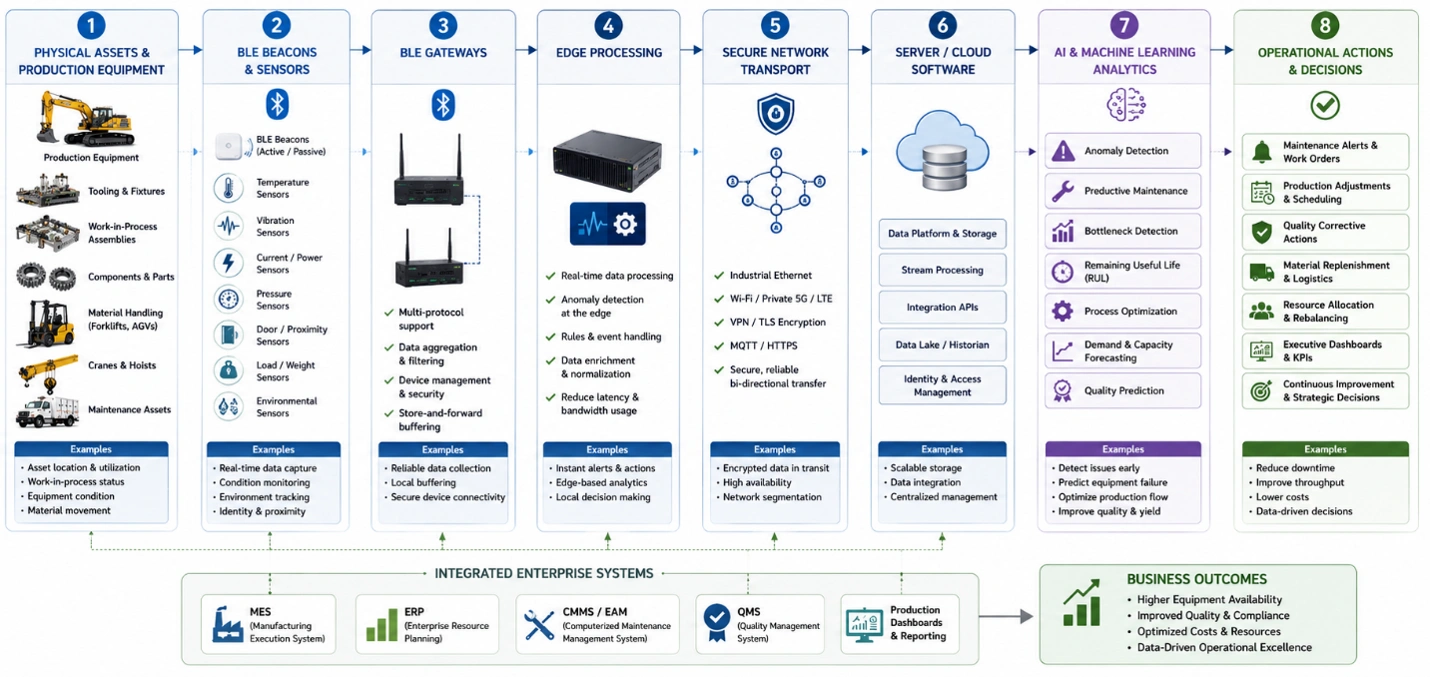
This industrial workflow diagram illustrates how production data moves from heavy machinery, tooling, work-in-process assemblies, material-handling equipment, and maintenance assets through BLE sensors, gateways, edge processing, secure networks, cloud software, and AI/ML analytics. It shows how MES, ERP, CMMS/EAM, QMS, and production dashboards support actions such as predictive maintenance, anomaly detection, bottleneck identification, quality improvement, and production adjustments. The key takeaway is a connected data-to-decision workflow that improves equipment availability, quality, resource efficiency, and operational performance.
Engineering Considerations for BLE in Heavy Machinery Plants
BLE deployment in heavy machinery production requires more than placing beacons around a factory. Industrial environments introduce practical challenges that affect wireless performance and data quality.
Metal, Machinery, and RF Propagation
Heavy equipment plants contain substantial amounts of steel, machinery, pipes, racks, vehicles, frames, tanks, and other conductive materials. These can influence RF propagation and create multipath effects.
A location solution should therefore be tested under real operating conditions. Testing only in an empty production area can produce misleading results because the RF environment changes when equipment, inventory, vehicles, and assemblies occupy the space.
Location Accuracy
Different applications require different levels of location precision.
A production manager may only need to know that a component is in the machining department rather than the assembly department. A tool-control application may require more precise zone identification. A worker-safety or automated-positioning application may require another level of accuracy and validation.
BLE deployment should therefore define the required accuracy, observation frequency, acceptable latency, and operational consequence before selecting gateway density or positioning methods.
Battery and Environmental Requirements
Production environments can expose devices to vibration, dust, temperature variation, moisture, impacts, chemicals, welding activity, and mechanical handling.
Device selection should consider:
- Operating temperature
- Enclosure requirements
- Battery life
- Mounting method
- Sensor sampling frequency
- Vibration exposure
- Cleaning procedures
- Maintenance access
- Replacement intervals
- Required ingress protection
For assets exposed to harsh conditions, the physical installation method can be as important as the wireless specification.
Integrating AI, BLE, and Manufacturing Software
BLE data becomes substantially more useful when it is connected to existing manufacturing systems.
MES can provide production-order and process context. ERP can provide material, purchasing, inventory, and business transaction information. CMMS and EAM systems can provide maintenance history and asset records. Quality systems can provide inspection and nonconformance information.
Middleware can normalize device data and translate it into events that enterprise software can consume.
GAO can support organizations evaluating BLE and RFID hardware requirements as part of broader IoT deployments. A practical integration strategy should establish device identity, asset identity, event formats, data ownership, system interfaces, authentication, and operational responsibilities before large-scale deployment.
The objective is to create a reliable chain:
Physical production activity → identified asset or sensor event → validated data → contextualized manufacturing record → AI analysis → human or automated action.
This chain is particularly important in heavy machinery production because decisions often involve expensive equipment, long production cycles, complex assemblies, and multiple specialized work centers.
AI-Enabled BLE Data Integration Architecture for Heavy Machinery Manufacturing
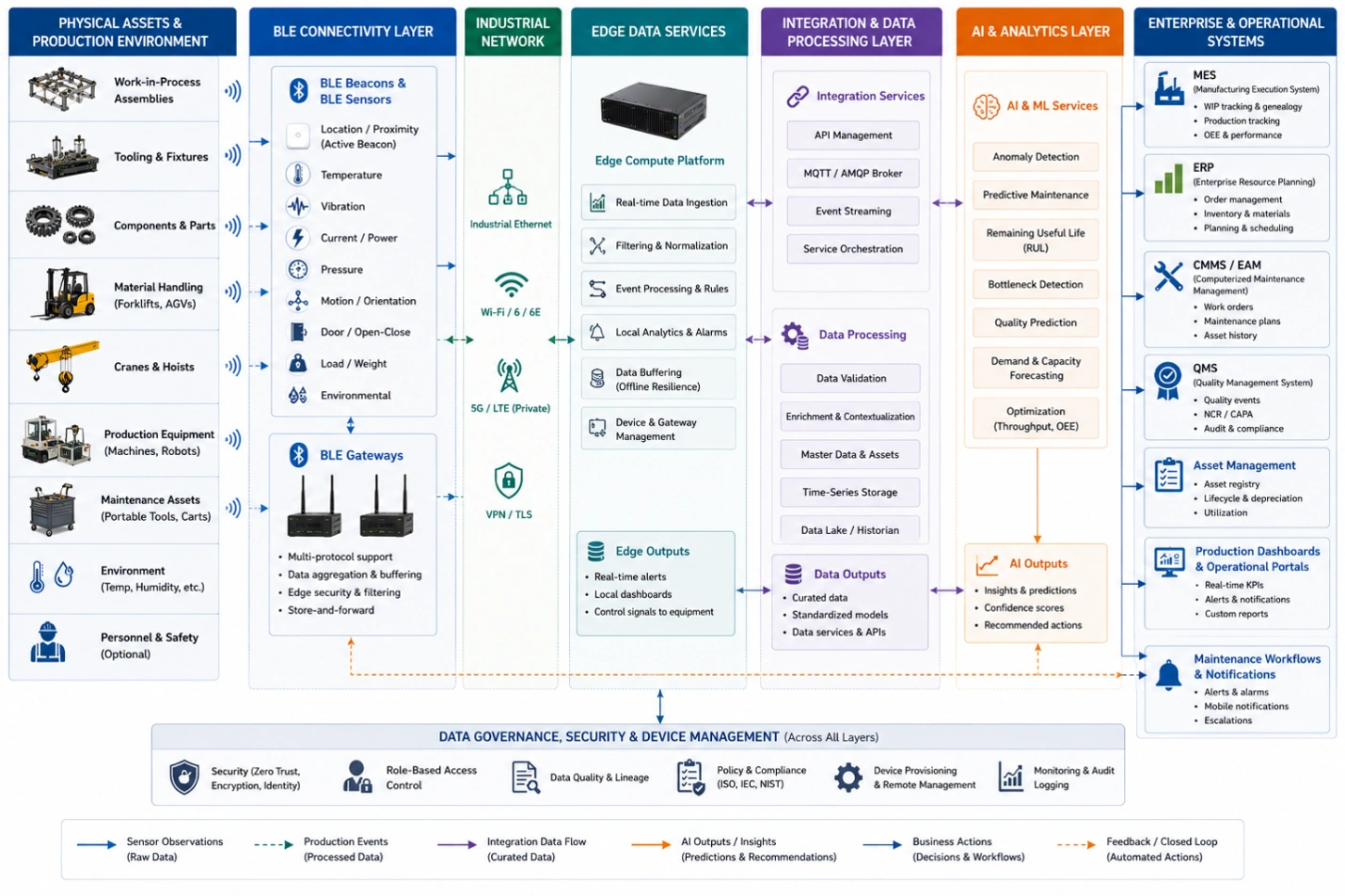
This technical block diagram shows how BLE beacons, sensors, and gateways connect production assets to industrial networks, edge services, integration platforms, and AI analytics. It illustrates data flows into MES, ERP, CMMS/EAM, QMS, asset management, production dashboards, and maintenance workflows, highlighting how sensor observations become AI insights and operational actions.
Planning an AI and BLE Deployment for Heavy Machinery Production
A successful AI and BLE deployment should begin with a clearly defined production problem rather than with hardware selection. Heavy machinery manufacturers can start by identifying an operational process where better data can produce a measurable improvement, such as work-in-process visibility, tooling utilization, production bottlenecks, equipment maintenance, material movement, or traceability.
Define the Production Objective
The initial assessment should establish the operational question that the solution must answer.
Where is a specific work-in-process assembly?
How long does an assembly remain within each production zone?
Which tooling is available, in use, or idle?
Where are material-handling delays occurring?
Which production assets show abnormal operating behavior?
Which maintenance events are associated with recurring production interruptions?
Which process stages contribute most to cycle-time variation?
Defining the question first helps engineers determine what data is actually required and prevents unnecessary sensor deployment.
Select the Right Data Sources
BLE should be evaluated alongside existing industrial data sources rather than treated as a standalone solution. A heavy machinery plant may already have PLCs, CNC controllers, SCADA, MES, ERP, CMMS, EAM, QMS, barcode systems, RFID readers, industrial sensors, and machine historians.
BLE is particularly useful where wireless asset identification, zone-level location, proximity detection, or supplementary sensor data can fill an operational visibility gap.
GAO provides BLE, RFID, and IoT hardware products and systems that can be evaluated for these types of manufacturing requirements.
Design a Controlled Pilot
A pilot should represent an actual production workflow and include real operating conditions. Engineers should test the selected BLE devices around machinery, metal assemblies, racks, vehicles, production cells, and other environmental factors that can influence wireless performance.
Pilot measurements can include:
- Asset detection reliability
- Location-event consistency
- Data latency
- Battery consumption
- Gateway coverage
- False or duplicate observations
- Sensor-data quality
- Integration reliability
- AI alert precision
- Operator response time
- Maintenance workload
The pilot should establish a baseline before AI-based recommendations are introduced. This makes it possible to determine whether the resulting system actually improves production performance.
AI Models and Analytics for Heavy Machinery Production
The appropriate AI method depends on the production problem and the available data. A complex model is not automatically better than a simpler analytical method.
Anomaly Detection
Anomaly detection can identify behavior that differs from established production patterns.
For example, an AI model can evaluate asset movement, equipment-condition measurements, process duration, or production events and identify observations that deviate significantly from normal operating behavior.
This can help engineers investigate unusual dwell times, unexpected asset movement, abnormal equipment conditions, or production sequences that require attention.
Predictive Maintenance Models
Predictive maintenance models can estimate the likelihood of equipment failure or degradation based on historical maintenance events and condition data.
Useful inputs may include:
- Vibration
- Temperature
- Motor current
- Pressure
- Runtime
- Machine alarms
- Operating cycles
- Maintenance history
- Production load
- Environmental conditions
BLE sensors can contribute wireless condition measurements in selected applications, while machine-native interfaces should remain the preferred source when they provide authoritative high-quality equipment data.
Production Forecasting
Machine learning can analyze historical production records to estimate future cycle times, resource requirements, production delays, or maintenance demand.
For heavy machinery manufacturing, forecasting can become more useful when production schedules are connected with work-in-process status, machine availability, material availability, and historical process performance.
Computer Vision
Computer vision can complement BLE and other IoT technologies by analyzing visual information from production areas.
Potential applications include inspection of assemblies, welds, machined components, labels, safety conditions, and material positioning. Vision systems should be validated against defined quality criteria and operating conditions before being used for production decisions.
Cloud Version and Server Version for Heavy Machinery Production
The software deployment model should match the manufacturer’s IT, cybersecurity, connectivity, data-governance, and operational requirements.
Cloud Version
A cloud-hosted SaaS deployment can centralize data collection, analytics, dashboards, AI services, and device management. This approach can be useful for manufacturers operating multiple production facilities that need centralized reporting and cross-site analytics.
Cloud deployment can also simplify centralized software maintenance and make aggregated production information accessible to authorized engineering, operations, and management teams.
However, cloud connectivity should not be assumed to be continuously available. Critical production workflows should have appropriate local buffering, edge processing, or fallback mechanisms when network connectivity is interrupted.
Server Version
A Server Version can run on customer-managed servers, factory servers, private data centers, edge servers, or other privately hosted enterprise infrastructure.
This model can be appropriate when manufacturing organizations require greater control over data location, network connectivity, system integration, or internal cybersecurity policies.
Private deployment can also simplify integration with manufacturing systems that are intentionally isolated from public networks.
The decision between cloud and server deployment should consider:
- Production-network connectivity
- Cybersecurity requirements
- Data-retention policies
- Integration with MES, ERP, CMMS, and QMS
- Multi-site reporting requirements
- IT support capabilities
- AI model deployment requirements
- Edge-processing requirements
- Disaster recovery
- System availability requirements
A hybrid arrangement can also be appropriate when real-time processing occurs locally while selected operational data is synchronized with centralized software.
Cybersecurity and Reliability for Connected Heavy Machinery Production
Connecting production assets to wireless and AI systems introduces additional cybersecurity and operational considerations. Security should cover the entire data path from BLE devices and gateways to edge services, servers, cloud services, and enterprise applications.
Device and Gateway Security
BLE devices and gateways should be inventoried and assigned controlled identities. Gateway access should use strong authentication, appropriate credential management, secure software configuration, and controlled administrative privileges.
Where supported by the selected hardware and software, communications should use encryption and authenticated connections appropriate to the deployment.
Network Segmentation
Production networks should be designed so that connected IoT devices do not automatically receive unrestricted access to critical control systems.
Segmentation, firewall rules, access controls, secure gateways, monitoring, and controlled interfaces can limit unnecessary communication between IoT infrastructure and production-control environments.
The BLE system should not be allowed to directly influence safety-critical machinery merely because it can exchange data with the manufacturing network. Any automated control action requires appropriate engineering validation, safety analysis, and integration with the plant’s established control architecture.
Data Integrity and AI Governance
AI decisions are only as reliable as the data used to generate them. Missing BLE observations, incorrect device associations, clock synchronization problems, duplicated events, sensor drift, and incorrectly mapped asset IDs can produce misleading analytical results.
Production systems should therefore maintain data-quality checks and preserve appropriate event histories.
AI recommendations should also have clearly defined ownership. Production engineering, maintenance, quality, or operations personnel should understand what an AI output means, what evidence supports it, and what action is expected.
KPIs for AI-Enabled Heavy Machinery Production
A deployment should be evaluated against measurable manufacturing outcomes rather than device counts or the number of connected assets.
Relevant KPIs include:
- Overall equipment effectiveness
- Production cycle time
- Manufacturing lead time
- Work-in-process dwell time
- Production throughput
- Unplanned downtime
- Mean time between failures
- Mean time to repair
- Tool utilization
- Asset utilization
- Material handling time
- Line-side material availability
- First-pass yield
- Rework rate
- Inspection cycle time
- Production schedule adherence
- Maintenance response time
- Inventory accuracy
- Asset-location accuracy
- Production bottleneck frequency
The most useful KPI depends on the original production problem. For example, a tooling-tracking deployment should not be evaluated primarily through production throughput unless the project is specifically designed to influence throughput.
Implementation Lessons for Heavy Machinery Manufacturers
Several engineering principles can improve the probability of a successful deployment.
- Start with a measurable production problem instead of beginning with a general IoT installation.
- Establish authoritative asset IDs before connecting BLE identifiers to manufacturing records.
- Conduct RF testing under normal production conditions, including the presence of heavy steel assemblies and operating machinery.
- Select BLE gateway locations according to the required coverage and location accuracy.
- Use edge buffering when temporary network interruptions could otherwise cause important production events to be lost.
- Integrate BLE events with MES, ERP, CMMS, EAM, or QMS where those systems provide the operational context required by AI.
- Avoid using BLE as a substitute for higher-quality machine-control data when PLC, CNC, or industrial protocols already provide the required information.
- Validate AI models against historical and live production data before allowing recommendations to influence operational workflows.
- Establish cybersecurity controls before scaling from a pilot to production-wide deployment.
- Define maintenance procedures for batteries, sensors, gateways, mounting hardware, and device inventories.
- Establish data-quality monitoring so that missing observations and incorrectly associated assets do not silently affect AI results.
- Scale the system based on measurable operational improvements rather than the number of deployed devices.
GAO Support for AI and IoT in Heavy Machinery Production
GAO supports organizations evaluating connected production requirements with BLE, RFID, and IoT hardware products and systems. Our role can include helping customers identify appropriate device categories, wireless identification methods, sensing requirements, gateway requirements, and deployment considerations for industrial environments.
Headquartered in New York City and Toronto, Canada, GAO is ranked among the top 10 leading B2B and B2G BLE and RFID suppliers globally. GAO and its sister companies, GAO Research Inc. and GAO Tek Inc., form GAO Group, with operations based in New York City and Toronto.
For three decades, GAO Group has served customers across the U.S. and Canada, including Fortune 500 companies, leading R&D organizations, prestigious universities, and U.S. and Canadian government agencies. The group has invested substantially in R&D, maintains stringent quality assurance processes, and provides expert technical support remotely or onsite.
For heavy machinery manufacturers, this experience is relevant when connected-production projects require hardware selection, deployment planning, integration support, troubleshooting, or expansion from a focused production application to broader IoT deployments.
AI-Driven Heavy Machinery Production Workflow: BLE, IoT & AI Analytics
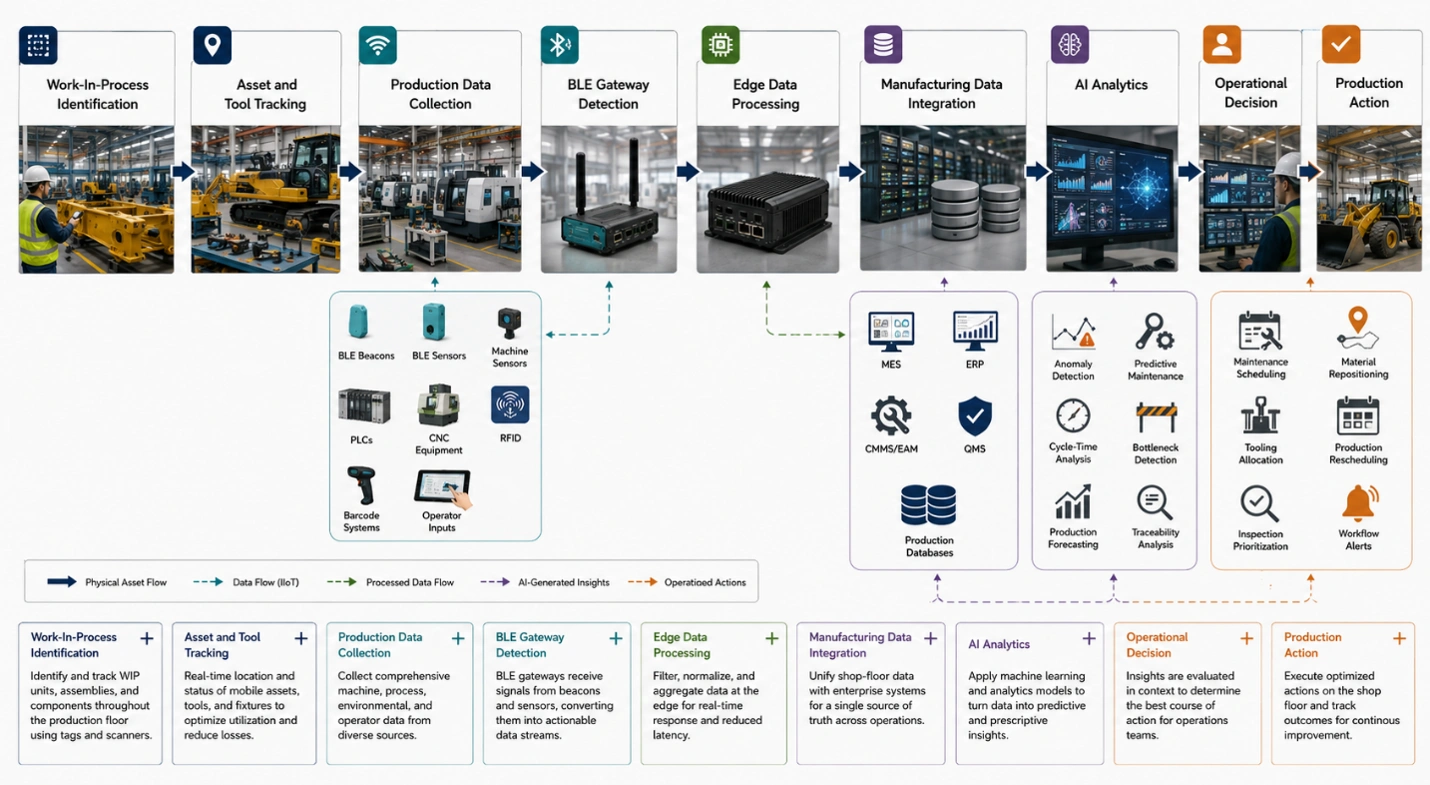
This industrial workflow visual shows how production data moves from heavy machinery manufacturing through BLE detection, edge processing, system integration, and AI analytics to actionable operational decisions. It highlights BLE as a data-acquisition layer within a broader industrial IoT and AI ecosystem.
From Production Visibility to AI-Driven Manufacturing Decisions
The practical objective of AI and BLE for heavy machinery production is to establish a reliable connection between physical production activity and informed operational decisions. BLE can provide asset identity, location, proximity, and selected sensor data, while AI can convert this information and other manufacturing data into predictions, anomaly detection, forecasts, and recommendations.
Manufacturers should begin with a defined production problem, validate the wireless and data-collection layer in a representative environment, integrate reliable operational context, and measure the result against production KPIs. This approach provides a controlled path from pilot deployment to scalable manufacturing intelligence.
GAO can help organizations explore BLE, RFID, and IoT hardware products and systems for these requirements, including technical considerations for industrial deployment. Manufacturers can learn more about applicable technologies, discuss their production requirements with our technical team, and evaluate an appropriate approach for their heavy machinery production environment.
Building the Future of Industrial AI and IoT with Aperture Venture Studio and GAO RFID Inc.
For more than three decades, GAO Group of Companies has invested heavily in R&D of industrial BLE, RFID, and IoT. As generative AI has become useful in industrial applications, we have been developing AI and IoT technologies, including BLE and RFID, and we have founded Aperture Venture Studio to build, launch, and scale next-generation AI and IoT companies focused on practical industrial applications such as heavy machinery production.
Aperture has attracted AI and IoT technical experts, entrepreneurial and operational executives, influential investors, and leading companies. We have also developed Aperture Ventures Summit and TekSummit to discuss advanced AI and IoT topics. These activities have helped build diversified technical communities around AI and IoT.
We welcome you to join us as:
- Advisors, co-founders, or employees
- Investors
- Customers