
AI and RFID for Cosmetics
AI-Powered RFID for Cosmetics Manufacturing
AI and RFID are increasingly useful for cosmetics manufacturers that need accurate visibility across raw materials, packaging components, work-in-process batches, finished products, warehouses, and distribution operations. AI analyzes data from RFID reads, production systems, sensors, quality records, and inventory transactions, while UHF, HF, and LF RFID provide identification and location-related data at appropriate process points. For cosmetics manufacturing, this combination can help connect lot and batch information with physical materials as they move through dispensing, compounding, filling, labeling, packaging, quarantine, release, storage, and shipment. AI can identify inventory anomalies, predict material requirements, detect unusual movement patterns, support batch genealogy, and prioritize operational exceptions. GAO supplies RFID readers, tags, antennas, gateways, sensors, and related IoT hardware that can provide the physical data capture layer for these applications.
AI and RFID in Cosmetics Manufacturing: End-to-End Deployment Scenario
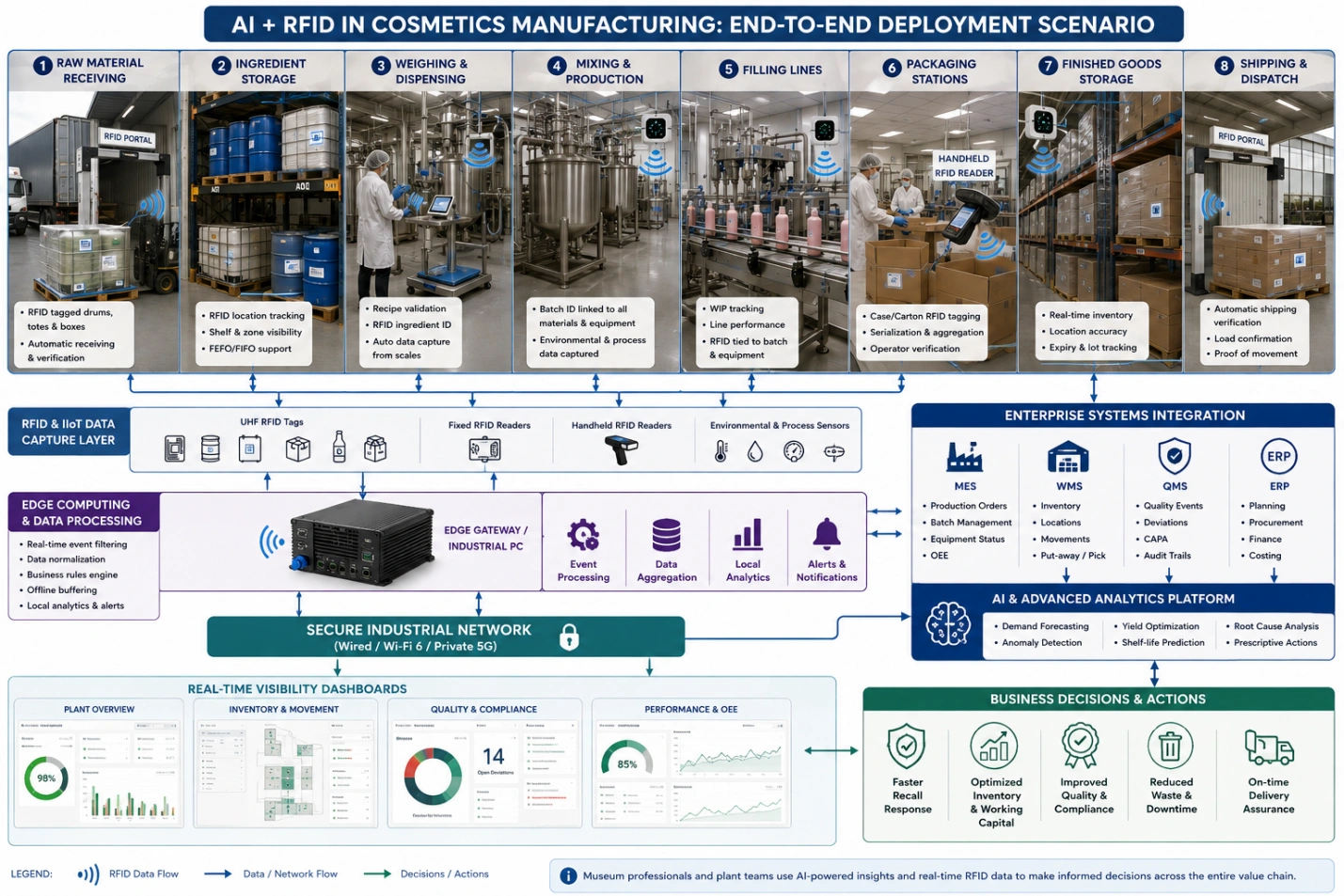
What AI and RFID Mean for Cosmetics Operations
Cosmetics manufacturing involves high SKU counts, frequent product introductions, multiple packaging configurations, batch-controlled materials, expiration considerations, and strict requirements for product identity and quality. A single finished product may depend on numerous ingredients, containers, closures, labels, cartons, inserts, and production records.
RFID creates machine-readable identity events around these physical objects. AI converts those events into operational information that can support decisions.
For example, an RFID event can establish that a tagged container entered a controlled raw-material area. AI can combine that event with ERP inventory records, material status, batch information, storage conditions, production schedules, and historical consumption to determine whether the material is available for a scheduled formulation run.
The relationship is therefore complementary:
- RFID: Identifies tagged materials, containers, totes, cases, pallets, tools, and products at defined read points.
- IoT sensors: Capture temperature, humidity, vibration, equipment condition, and environmental information where required.
- Edge computing: Filters, validates, timestamps, and correlates local RFID and sensor events before transmitting relevant information.
- AI and machine learning: Detect patterns, predict requirements, classify exceptions, and identify deviations.
- MES: Connects production execution, work orders, recipes, batch records, and manufacturing events.
- ERP: Maintains purchasing, inventory, financial, material, supplier, and order information.
- WMS: Coordinates warehouse locations, replenishment, picking, staging, and shipping activities.
- QMS: Associates quality inspections, deviations, holds, release decisions, and nonconformance records with materials and batches.
GAO can support these deployments with RFID and IoT hardware selected around read range, tag mounting surfaces, environmental conditions, throughput, and installation constraints rather than treating every cosmetics operation as a generic RFID application.
Where AI Improves RFID-Based Cosmetics Processes
AI delivers the greatest value when RFID events are connected to a defined operational decision. Simply increasing the number of RFID reads does not automatically improve manufacturing performance.
Raw Material and Ingredient Inventory
Cosmetics plants may handle oils, botanical extracts, fragrances, surfactants, emulsifiers, pigments, preservatives, active ingredients, powders, and other formulation materials. Containers can move between receiving, quarantine, approved storage, dispensing, staging, and production.
AI can compare RFID movement with inventory transactions and production plans to identify:
- Unexpected movement of quarantined or unreleased material
- Consumption rates that differ from formulation and production expectations
- Ingredients approaching replenishment thresholds
- Repeated stock discrepancies associated with particular storage zones
- Materials physically present but missing from expected warehouse records
- Containers remaining in staging longer than the normal production cycle
This is particularly useful when material handling involves many short movements that are difficult to document manually.
Batch Genealogy and Production Traceability
A cosmetics batch can involve raw materials from multiple suppliers and internal lots. RFID can associate physical containers with batch-related events while AI analyzes the resulting genealogy.
A traceability solution can correlate:
- Supplier and raw-material lot
- Container or tote identity
- Dispensing event
- Weighing station
- Manufacturing order
- Mixing vessel
- Formulation or recipe
- Intermediate bulk
- Filling line
- Packaging operation
- Finished-goods lot
- Warehouse location
- Shipment or customer order
AI can then identify missing genealogy relationships or unusual process sequences. For example, if a production record indicates that a material was consumed but RFID events show that its container never entered the expected dispensing zone, the system can create an exception for investigation.
Packaging Line and Finished-Goods Control
Cosmetics packaging creates another important use case because visually similar SKUs can have different shades, sizes, fragrances, formulas, labels, markets, or regulatory requirements.
RFID can identify cases, totes, pallets, and selected production assets as they pass through packaging and logistics areas. AI can compare physical movement against the scheduled production order.
Potential exception conditions include:
- Wrong SKU entering a packaging or staging area
- Finished cases routed to an incorrect warehouse zone
- Unexpected product movement before quality release
- Duplicate or missing handling events
- Abnormally long dwell time between packaging and warehouse receipt
- Shipment quantities that differ from expected RFID counts
Computer vision can complement RFID where visual verification of labels, caps, seals, print quality, color, or package presentation is required.
Equipment and Maintenance Visibility
Cosmetics production depends on equipment such as mixing vessels, agitators, homogenizers, filling machines, capping machines, labeling machines, conveyors, pumps, clean-in-place systems, and packaging equipment.
RFID can identify mobile tooling, containers, changeover equipment, or maintenance assets, while condition sensors can provide equipment measurements. AI can correlate maintenance history, operating patterns, production schedules, and equipment conditions to identify maintenance priorities.
This approach can be valuable for changeover-intensive plants where equipment availability directly affects production scheduling.
AI Use-Case Matrix for Cosmetics Manufacturing with RFID
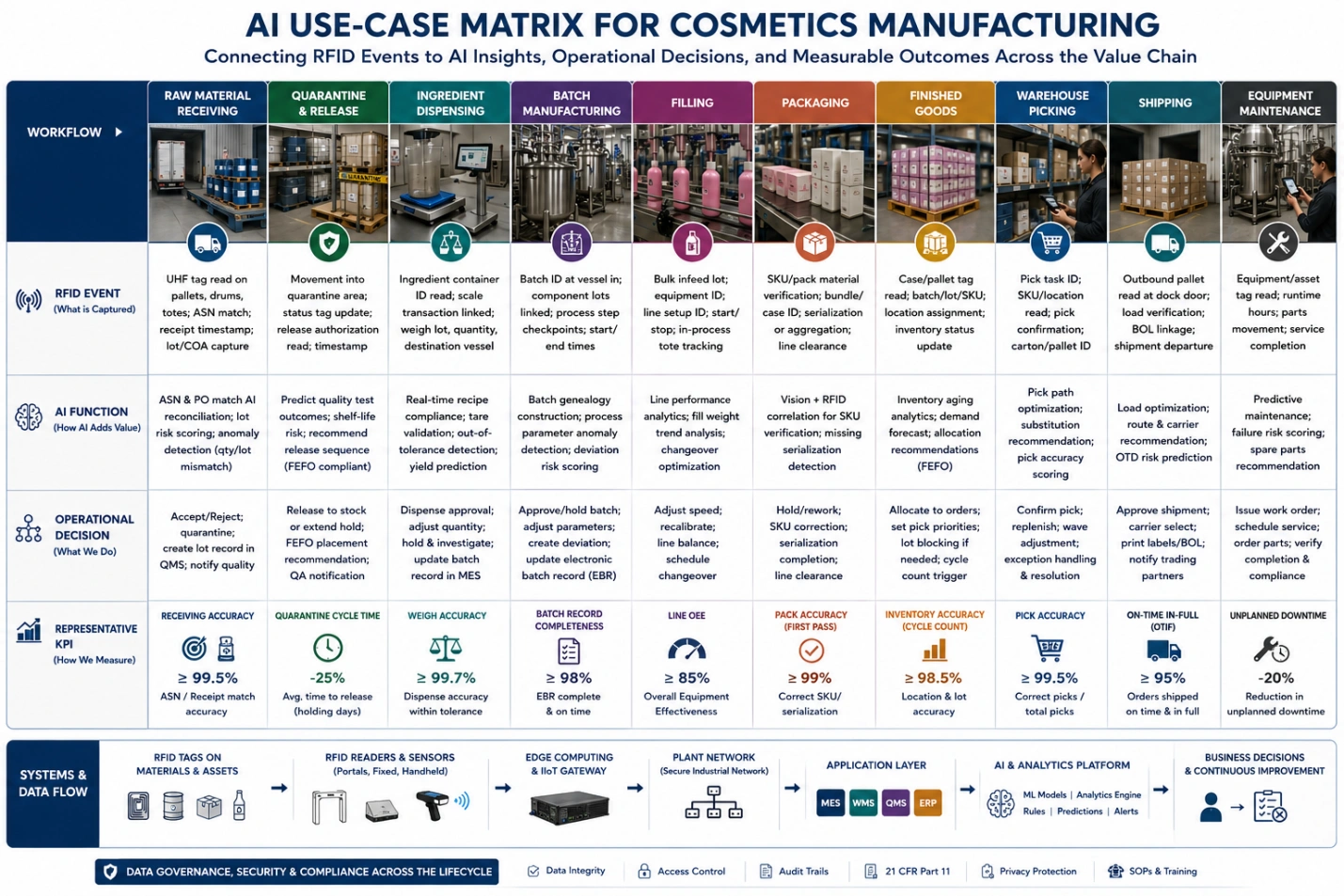
Cosmetics Manufacturing Workflow from RFID Capture to AI Decision
A practical deployment begins with physical identification and ends with an operational action. The complete data path normally includes several stages.
Physical Data Capture
RFID readers capture tag identifiers at locations where an event has operational meaning. UHF RFID is generally appropriate for longer-range identification of cases, cartons, pallets, totes, and selected containers. HF RFID can be useful for shorter-range identification and controlled point-of-interaction applications. LF RFID can serve specialized short-range identification requirements where its physical characteristics are appropriate.
Tag selection requires testing against the actual cosmetics environment. Liquids, metallic packaging, foil components, glass containers, high-density products, and closely packed cartons can influence RF performance. A tag that performs well on an empty cardboard carton may behave differently when mounted on a liquid-filled cosmetic product.
Reader and Edge Processing
Fixed readers, antennas, handheld readers, and RFID gateways transmit read events to local computing equipment or directly to software services. Edge processing can remove duplicate reads, apply zone rules, associate timestamps with reader locations, and distinguish meaningful transitions from incidental RF detections.
A cosmetics facility may define rules such as:
- A tagged raw-material container entering the quarantine zone creates a receiving event.
- Movement from quarantine to approved storage requires a corresponding quality-release status.
- Movement into dispensing should correspond with an authorized production order.
- Finished goods entering a shipping staging zone should match an active shipment.
- A tagged maintenance asset leaving a controlled area can trigger an equipment-location update.
Enterprise Integration
The normalized events can be transferred through APIs, MQTT, HTTPS, OPC UA, database interfaces, or middleware into systems such as ERP, MES, WMS, and QMS.
The integration design should establish a clear system of record. RFID software should not independently overwrite authoritative ERP inventory data without defined reconciliation rules. Instead, RFID events can provide physical evidence that supports inventory transactions, exception handling, and cycle-count reconciliation.
AI Analytics and Operational Actions
AI models can consume historical RFID events together with production, inventory, quality, and sensor data. Depending on the use case, the system may use anomaly detection, classification, forecasting, clustering, time-series analysis, or predictive models.
The resulting output should be actionable rather than merely descriptive. Examples include creating an inventory exception, recommending replenishment, flagging a potential batch genealogy gap, prioritizing a material investigation, or notifying a warehouse supervisor about an unexpected shipment discrepancy.
RFID, AI, Hardware and Software for Cosmetics
The technical design should be driven by the cosmetics process rather than by RFID specifications alone. Read distance, tag orientation, material composition, conveyor speed, container density, liquid content, metal interference, and required transaction accuracy all affect hardware selection.
UHF, HF and LF RFID Selection
UHF RFID is commonly suited to logistics-oriented cosmetics applications where cases, cartons, pallets, totes, or containers must be identified without close-range manual scanning. It can support receiving portals, warehouse transitions, production staging, and shipping verification.
HF RFID is better suited to shorter-range controlled interactions where the reader and tagged item can be intentionally brought into proximity. It can support selected operator, workstation, product, or authentication processes.
LF RFID provides short-range identification and can be appropriate for specialized applications where its operating characteristics align with the physical environment and read requirements.
The appropriate frequency should be validated through a site survey and proof-of-concept using actual cosmetic containers and packaging materials.
RFID Tags, Readers and Antennas
Tag construction should account for the mounting surface and product composition. Cosmetics packaging can include glass bottles, plastic containers, aluminum components, metallicized films, and liquid-filled vessels, creating different RF conditions.
Reader placement should focus on controlled event points rather than simply maximizing read coverage. Excessive read zones can produce ambiguous location data, while insufficient antenna coverage can create missed transitions.
GAO provides RFID hardware that can be evaluated for fixed, handheld, and embedded deployment requirements, allowing the equipment selection to follow the physical workflow.
Cloud Version and Server Version
A Cloud Version can be appropriate for cosmetics manufacturers operating multiple facilities that need centralized analytics, cross-site inventory visibility, remote monitoring, and managed software infrastructure. It can simplify centralized AI model management and consolidated reporting when connectivity and corporate IT policies permit cloud processing.
A Server Version can be deployed on factory servers, privately managed data centers, edge servers, or other customer-controlled infrastructure. This model can be preferable where production systems require local processing, stricter data-control policies, limited external connectivity, or integration with manufacturing systems that are intentionally isolated from public cloud services.
A hybrid deployment can retain time-sensitive RFID processing at the facility while forwarding selected historical data to centralized analytics.
Engineering Considerations for Cosmetics RFID Deployment
A successful deployment requires more than attaching tags to inventory. Cosmetics manufacturers should validate RF performance under actual operating conditions, including filled containers, dense pallet configurations, metallicized packaging, refrigerated or controlled storage where applicable, production-line speeds, and operator handling patterns.
Site engineering should consider:
- RF interference and reader-to-reader coordination
- Antenna orientation and polarization
- Tag placement consistency
- Read-zone containment
- Conveyor and portal geometry
- Liquid and metal effects
- Reader power configuration
- Duplicate-read filtering
- Network segmentation
- Edge-server capacity
- API and middleware reliability
- ERP, MES, WMS, and QMS transaction timing
- RFID event retention and auditability
- Cybersecurity controls for connected readers and gateways
- Failover procedures during network or software outages
- Manual exception procedures when RFID reads are unavailable
The commissioning process should include controlled tests with representative cosmetic products and packaging. Performance should be measured using actual read accuracy, false-positive rates, event latency, transaction reconciliation, and exception-handling results rather than relying only on nominal reader specifications.
GAO’s experience supplying RFID, BLE, and IoT hardware to organizations across the United States and Canada supports a practical approach in which hardware selection, installation conditions, software integration, and operational requirements are considered together. GAO is headquartered in New York City and Toronto, Canada, and is recognized among leading B2B and B2G suppliers of BLE and RFID technologies.
RFID Site Commissioning Decision Tree for Cosmetics Manufacturing
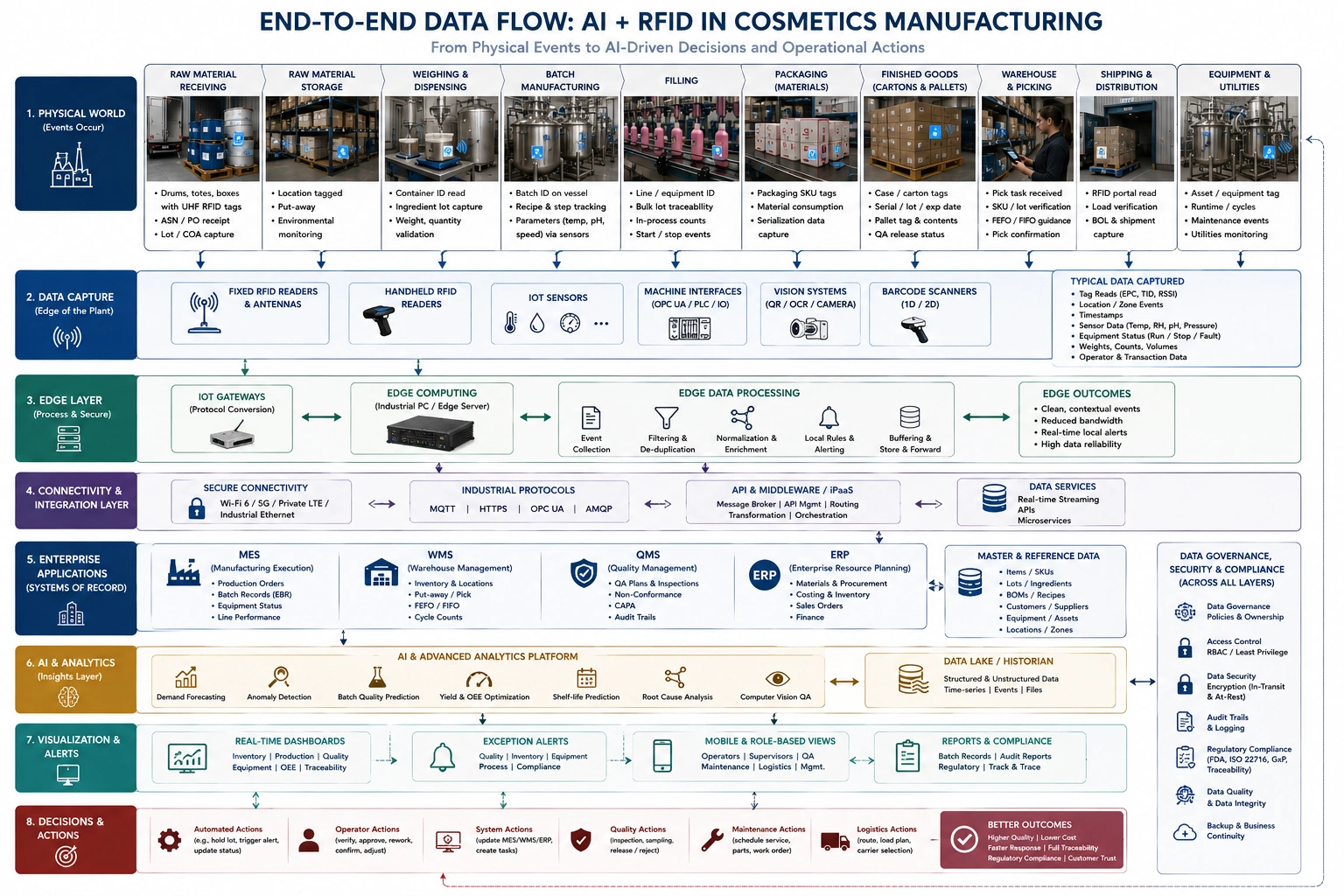
AI and RFID Technology Stack for Cosmetics
The next design layer connects the physical identification system with AI-enabled operational software. A robust solution typically combines RFID hardware, IoT gateways, industrial networking, edge processing, enterprise integration, and analytics. The exact configuration depends on whether the priority is batch genealogy, ingredient inventory, packaging verification, warehouse control, finished-goods traceability, or a combination of these processes.
AI Models and Analytics for Cosmetics Manufacturing
AI should be selected according to the decision the cosmetics manufacturer needs to improve. Different manufacturing and supply chain problems require different analytical methods.
- Demand forecasting models can estimate future requirements for ingredients, bottles, jars, pumps, closures, labels, cartons, and finished SKUs by analyzing historical consumption, production schedules, seasonality, promotions, and order patterns.
- Anomaly detection models can identify RFID movement patterns that differ from established production or warehouse behavior, such as unexpected material transfers or unusual dwell times.
- Classification models can categorize inventory and production exceptions according to operational severity, process area, material type, or likely cause.
- Time-series models can analyze material consumption, equipment measurements, production throughput, and inventory changes over time.
- Computer vision can complement RFID for cosmetic label verification, package appearance, fill-level inspection, cap or closure inspection, print verification, and other visual quality tasks.
- Predictive maintenance models can combine equipment sensor data with maintenance history and operating conditions to identify emerging problems in filling, mixing, pumping, conveying, or packaging equipment.
- Process-mining techniques can analyze RFID event sequences to reveal bottlenecks, excessive material movement, extended staging periods, or deviations from expected manufacturing workflows.
AI outputs should remain traceable to the underlying operational data. For regulated or quality-sensitive decisions, manufacturers should retain the source RFID events, relevant transaction records, model version, decision timestamp, and user action associated with an exception.
Communication and Integration Infrastructure
RFID readers and IoT devices require reliable communication with the software that consumes their events. Ethernet is commonly suitable for fixed readers and industrial gateways, while Wi-Fi can support selected mobile or handheld workflows. BLE can complement RFID when short-range device connectivity or personnel and equipment sensing is needed.
Common application interfaces include:
- MQTT for lightweight IoT messaging
- HTTPS and REST APIs for software integration
- OPC UA for industrial equipment and manufacturing-system connectivity
- Modbus TCP for compatible industrial devices
- Ethernet-based networking for fixed RFID infrastructure
- Cellular IoT for selected remote or distributed logistics applications
Network segmentation is important because RFID readers, edge gateways, manufacturing equipment, business systems, and user devices can have different security requirements. Firewalls, VLANs, certificate-based authentication, encrypted communications, controlled device credentials, access management, logging, and regular firmware maintenance should be incorporated into the design.
GAO can provide RFID, BLE, and IoT hardware that forms part of this connected environment, while system integrators can connect the devices to existing manufacturing and business software according to the customer’s integration requirements.
AI and RFID Technology Stack for Cosmetics Manufacturing
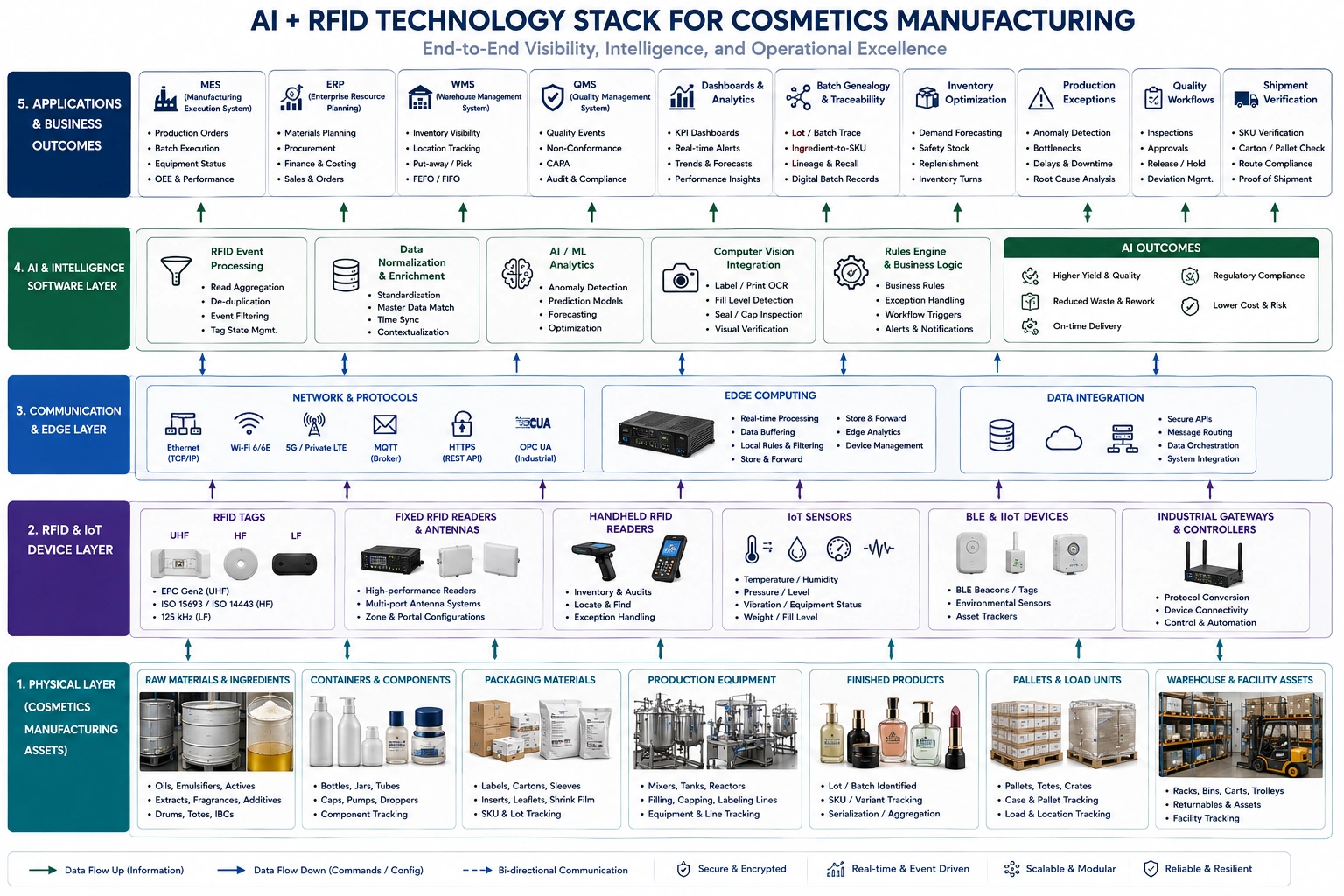
Technical Capabilities and Operational Improvements
Combining AI with RFID-derived events can improve cosmetics operations because physical material movement becomes measurable and analyzable. The greatest gains generally occur when the resulting information is connected to existing production and inventory processes.
More Accurate Inventory Visibility
Manual inventory records can become inaccurate when ingredients, packaging components, or finished products move frequently between locations. RFID provides additional physical evidence, while AI can reconcile movement patterns against expected inventory behavior.
Potential improvements include:
- More accurate counts of tagged containers, cases, totes, and pallets
- Faster identification of inventory discrepancies
- Better visibility into staging and quarantine locations
- Improved replenishment planning
- Reduced dependence on repeated manual scans
- Earlier detection of unusual consumption patterns
Inventory accuracy should still be validated against the organization’s authoritative transaction system. RFID is most valuable when physical observations and business transactions are reconciled systematically.
Stronger Batch and Lot Traceability
Batch genealogy becomes more useful when physical movement is connected to manufacturing records. RFID can associate a tagged ingredient or container with a production location and timestamp, while AI can analyze whether expected relationships are present.
This can help quality and manufacturing teams investigate:
- Which material containers entered a production area
- Which lots were associated with a manufacturing order
- Which intermediate materials moved to filling
- Which finished-goods cases originated from a particular production batch
- Whether a material movement occurred before or after a quality-status change
- Where a potentially affected lot was stored or shipped
Such visibility can reduce the time required to reconstruct events during quality investigations or product-related inquiries.
Better Production Scheduling
AI can use RFID-derived material availability together with production schedules to identify potential constraints before a manufacturing order reaches the line.
For example, an AI model can identify that a scheduled formulation requires a specific ingredient and packaging configuration, while RFID and inventory records indicate that the required quantity is still in an unexpected staging location.
Production planners can then investigate the exception before the planned run is affected.
Reduced Material and Product Search Time
Operators can lose time searching for ingredients, packaging components, tooling, work-in-process containers, or finished products. RFID location events can narrow the search area, while AI can prioritize likely locations based on recent movement and normal process patterns.
The resulting benefit is not simply faster searching. It can also reduce production interruptions caused by unavailable or incorrectly staged materials.
Improved Warehouse and Shipping Accuracy
Finished cosmetics often move through multiple warehouse locations before shipment. AI can compare RFID observations with WMS orders, shipment records, customer requirements, and expected pallet composition.
Potential controls include:
- Shipment staging verification
- Pallet identity confirmation
- Case-count reconciliation
- Wrong-zone detection
- Missing-case alerts
- Unexpected product movement detection
- FEFO-oriented inventory analysis where expiration or shelf-life rules apply
These controls can be particularly useful for high-SKU cosmetics operations where visually similar packages increase the risk of manual identification errors.
Key KPIs for AI-Enabled Cosmetics RFID Systems
Performance measurement should be defined before deployment. The selected KPIs should connect directly to the business problem being addressed.
| KPI | What It Measures | Why It Matters in Cosmetics |
|---|---|---|
| RFID Read Accuracy | Percentage of expected tag events captured correctly | Indicates whether material movement is being recorded reliably |
| Inventory Accuracy | Agreement between physical and system inventory | Supports ingredient and packaging availability |
| Batch Traceability Completeness | Percentage of required genealogy relationships captured | Supports quality investigations and production records |
| Material Search Time | Time required to locate ingredients or packaging | Indicates productivity improvement |
| Inventory Discrepancy Rate | Frequency of physical-system mismatches | Identifies process-control problems |
| Production Material Availability | Availability of required materials at scheduled production time | Helps prevent manufacturing delays |
| Shipment Accuracy | Correctness of products and quantities staged for shipment | Reduces logistics errors |
| Exception Resolution Time | Time from anomaly detection to corrective action | Measures operational responsiveness |
| Production Downtime | Time lost because of material or equipment constraints | Connects RFID and AI improvements to throughput |
| Equipment Availability | Percentage of scheduled time equipment is available | Supports maintenance and production planning |
AI-specific KPIs can include forecast error, anomaly precision, false-positive rate, model response time, and percentage of AI-generated exceptions that result in validated operational findings.
Security, Reliability and Data Governance
Connected manufacturing equipment introduces cybersecurity requirements that should be addressed during system design rather than after deployment.
RFID readers, gateways, edge servers, APIs, databases, and user interfaces should be protected through appropriate controls such as:
- Unique device identities and controlled credentials
- Role-based access control
- Network segmentation
- Encrypted communications
- Secure API authentication
- Firewall rules between production and business networks
- Centralized event logging
- Firmware and software patch management
- Backup and recovery procedures
- Controlled administrative access
- Monitoring for abnormal device behavior
- Defined retention policies for RFID and production event data
AI introduces additional governance considerations. Model outputs should be distinguishable from source facts, especially where AI-generated recommendations influence quality investigations, production decisions, or inventory transactions.
A practical implementation should maintain an auditable chain from the original RFID or sensor event through data processing, AI analysis, alert generation, human review, and final action.
System reliability also requires an offline or degraded-operation strategy. If network connectivity is interrupted, local edge equipment may need to buffer RFID events and synchronize them when communications are restored. Manual procedures should remain available for critical production and quality operations.
Implementation Strategy for Cosmetics Manufacturers
A phased deployment is generally more manageable than attempting to instrument every process simultaneously. The initial use case should have measurable operational value and a clearly defined data flow.
Define the Process and Business Problem
The first step is to select a specific cosmetics workflow, such as ingredient receiving, quarantine movement, dispensing, batch genealogy, packaging verification, finished-goods warehouse control, or shipment staging.
The team should document:
- Physical material flow
- Existing identification methods
- Required read points
- Current transaction systems
- Exception conditions
- Personnel responsibilities
- Existing KPIs
- Data-retention requirements
- Quality and regulatory requirements
Characterize Products and Packaging
RF performance should be tested with actual cosmetic products. Bottles, jars, tubes, liquid-filled containers, metallic closures, foil liners, labels, cartons, and shrink packaging can produce different RF behavior.
Representative test samples should include the actual product density, packaging configuration, palletization method, and operating environment.
Conduct a Site Survey
The survey should identify potential RF interference, reader placement constraints, antenna mounting locations, network availability, power requirements, metal structures, conveyor geometry, and read-zone boundaries.
A controlled read zone is usually more valuable than broad uncontrolled coverage because business applications depend on knowing where an event occurred.
Build and Test the Integration
The RFID solution should be connected to the appropriate ERP, MES, WMS, QMS, or other software using defined interfaces and data ownership rules.
Testing should cover both normal and abnormal scenarios, including missed reads, duplicate reads, unexpected movement, network outages, invalid transactions, damaged tags, and software-interface failures.
Establish Acceptance Criteria
Production commissioning should require measurable acceptance thresholds for read accuracy, event latency, transaction reconciliation, exception detection, and system availability.
AI models should also undergo validation using representative historical or pilot data. Model performance should be monitored after deployment because production patterns, SKUs, suppliers, packaging, and operational practices can change.
AI-Enabled RFID Implementation Lifecycle for Cosmetics Manufacturing
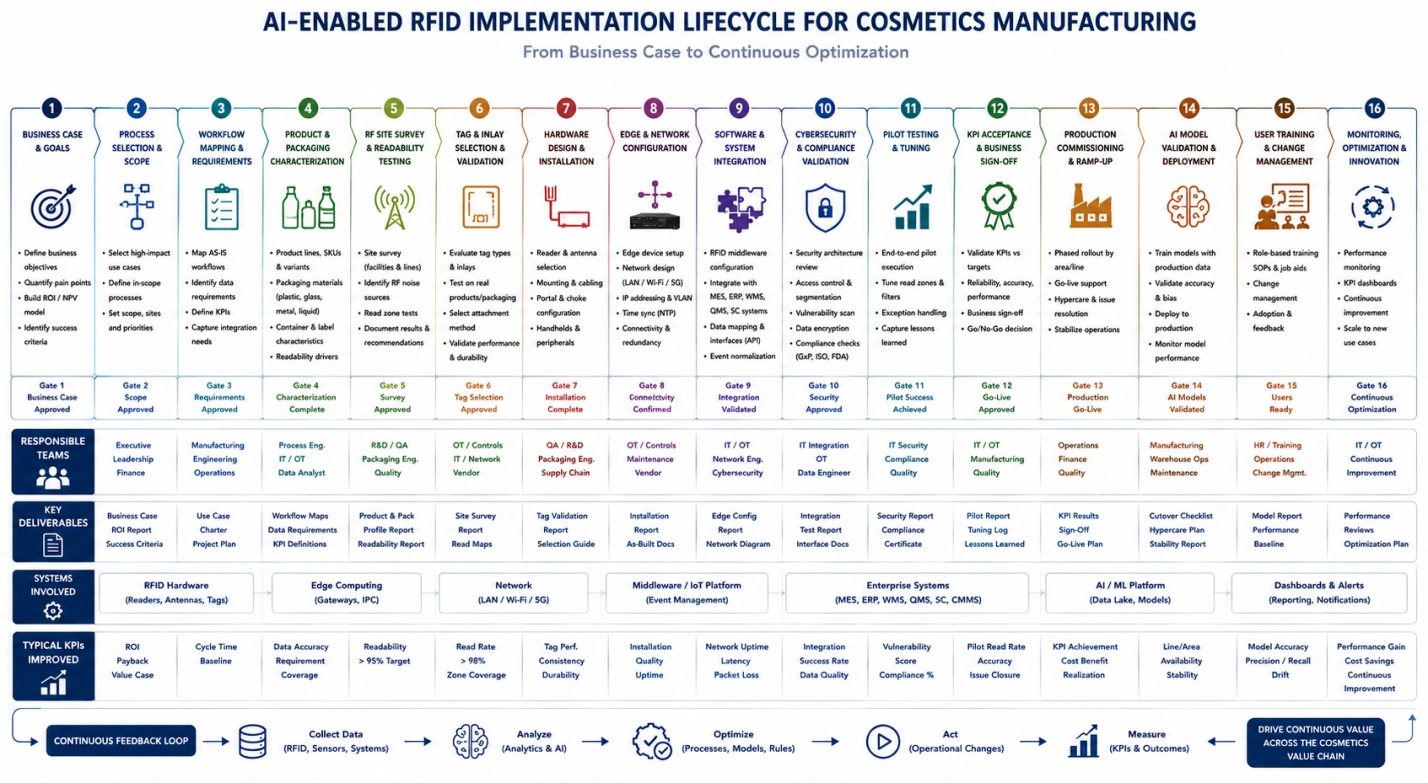
Scalability Across Cosmetics Manufacturing Sites
A successful pilot should establish reusable standards rather than a one-off installation. Multi-site cosmetics manufacturers can standardize tag data structures, event definitions, reader configuration principles, integration interfaces, cybersecurity policies, and KPI definitions while adapting physical installations to each plant.
A common data model can allow comparable information from manufacturing plants, distribution centers, and warehouses without requiring identical hardware layouts.
Scalability considerations include:
- Number of RFID readers and connected devices
- Concurrent RFID events
- Edge processing capacity
- Historical event storage
- AI inference workload
- Number of production lines
- Number of warehouses
- SKU and batch volumes
- ERP and MES transaction rates
- Multi-site user access
- Model deployment and monitoring
- Backup and disaster recovery
Cloud deployments can simplify centralized multi-site analytics, while Server Version deployments can keep sensitive production processing under customer-controlled infrastructure. Hybrid designs can combine local operational resilience with centralized analytics.
Practical Trade-Offs When Deploying RFID in Cosmetics
RFID is not automatically the correct solution for every object or process. Engineering teams should choose the identification method according to the required read behavior and operating environment.
- UHF RFID is attractive for cases, cartons, pallets, totes, and selected longer-range container identification, but liquid-heavy or metallic configurations require careful tag and antenna validation.
- HF RFID can be appropriate for controlled short-range interactions, but it does not provide the same longer-range logistics capability expected from UHF.
- LF RFID can support specialized short-range identification applications, but its characteristics should be evaluated against the required read distance and data requirements.
- Barcodes and QR codes can remain useful where direct line-of-sight scanning is acceptable or where existing packaging already contains machine-readable symbols.
- Computer vision is complementary when the process requires visual confirmation rather than identity alone.
- BLE can complement RFID where continuous or periodic location information for selected equipment or personnel-related devices is required.
- IoT sensors are preferable when the business problem requires environmental or condition measurements rather than simple identification.
The strongest cosmetics deployments therefore use RFID as part of a broader identification and data-capture strategy instead of forcing every operational requirement into one technology.
GAO Engineering and Technology Support for Cosmetics Applications
GAO supplies RFID, BLE, and IoT hardware products and systems that can support material identification, asset visibility, inventory processes, production traceability, and connected operational workflows. Hardware selection can be matched to the physical characteristics of cosmetics products and the required read environment.
GAO’s broader organization includes GAO Research Inc. and GAO Tek Inc., forming GAO Group with operations based in New York City and Toronto, Canada. For three decades, GAO Group has served organizations in the United States and Canada, including Fortune 500 companies, major R&D organizations, universities, and government agencies.
The company’s product and system development has been supported by substantial R&D investment and stringent quality assurance processes. Technical support can be provided remotely or onsite depending on project requirements, which is particularly useful when RFID performance depends on physical installation, RF testing, network integration, and commissioning.
Implementing AI and RFID for Smarter Cosmetics Manufacturing
AI and RFID can give cosmetics manufacturers a more measurable connection between physical materials and digital manufacturing records. RFID provides reliable identification events for appropriately selected products, containers, totes, cases, pallets, and assets, while AI can analyze those events with production, inventory, quality, and sensor data.
The most valuable applications include AI inventory management, batch and lot traceability, production material readiness, packaging verification, warehouse control, shipment accuracy, and predictive maintenance.
Successful implementation depends on product-specific RF testing, controlled read zones, disciplined data integration, cybersecurity, measurable KPIs, and validated AI models. Manufacturers should begin with a clearly defined workflow, establish acceptance criteria, and expand after the pilot demonstrates measurable operational value.
GAO’s RFID, BLE, and IoT hardware products and systems can provide the physical data-capture foundation for these applications. Organizations evaluating AI-enabled cosmetics manufacturing can learn more about GAO’s technologies, engineering capabilities, and technical support to determine which identification and connected-system approach best fits their production and supply chain requirements.
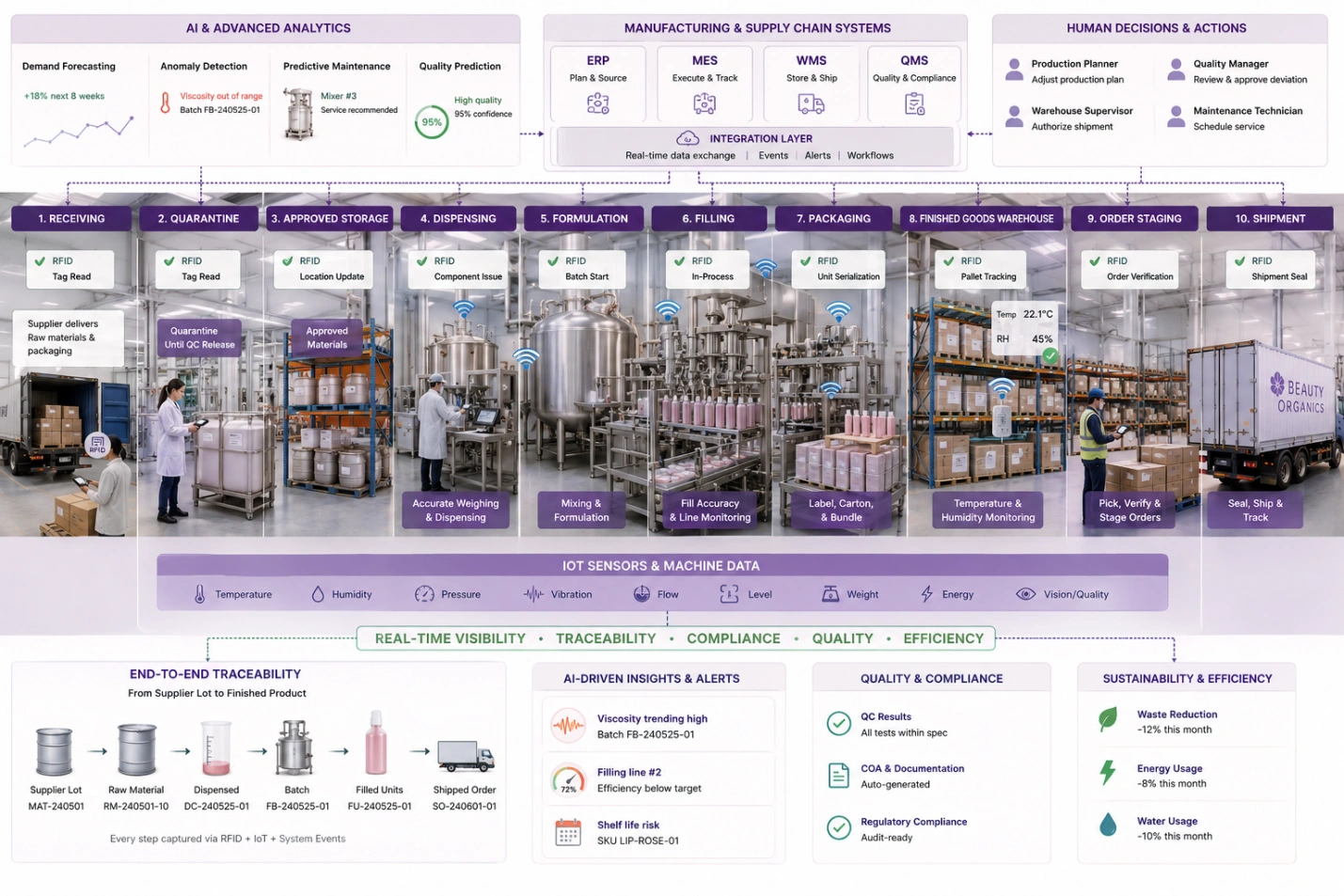
AI-Enabled Cosmetics Manufacturing
Building the Future of Industrial AI and IoT with Aperture Venture Studio and GAO RFID Inc.
For more than three decades, GAO Group has invested heavily in R&D for industrial RFID, BLE, and IoT. As AI became increasingly useful in industrial applications, we expanded our work in AI and IoT technologies and founded Aperture Venture Studio to build, launch, and scale AI and IoT companies addressing practical industry needs, including connected manufacturing and traceability.
Aperture has attracted AI and IoT technical experts, entrepreneurial and operational executives, investors, and leading companies. Its Aperture Ventures Summit and TekSummit bring professionals together to discuss advanced AI and IoT topics. We welcome customers, investors, advisors, co-founders, and employees interested in advancing practical AI and IoT applications.