
AI and RFID for Paint & Coatings
How AI-Driven RFID Is Improving Paint and Coatings Operations
AI and RFID for Paint & Coatings combines artificial intelligence with RFID-based identification to improve the visibility, traceability, control, and optimization of materials, batches, containers, production assets, and operational activities. In paint and coatings manufacturing, RFID can provide the identification events needed to understand where raw materials, intermediates, finished products, returnable containers, and mobile equipment are located and how they move through receiving, storage, batching, dispersion, let-down, filling, quality control, warehousing, and shipment.
AI changes the value of these identification events by analyzing movement patterns, material genealogy, batch history, inventory conditions, and operational exceptions. The result can support AI inventory management, batch traceability, production coordination, asset tracking, quality investigation, and more accurate material availability decisions. For paint and coatings manufacturers managing pigments, resins, solvents, additives, hazardous materials, tint bases, packaged products, and reusable containers, GAO can provide RFID hardware products and systems that support reliable identification across demanding manufacturing and warehouse workflows.
Realistic Industrial Deployment Image / Enterprise Infographic
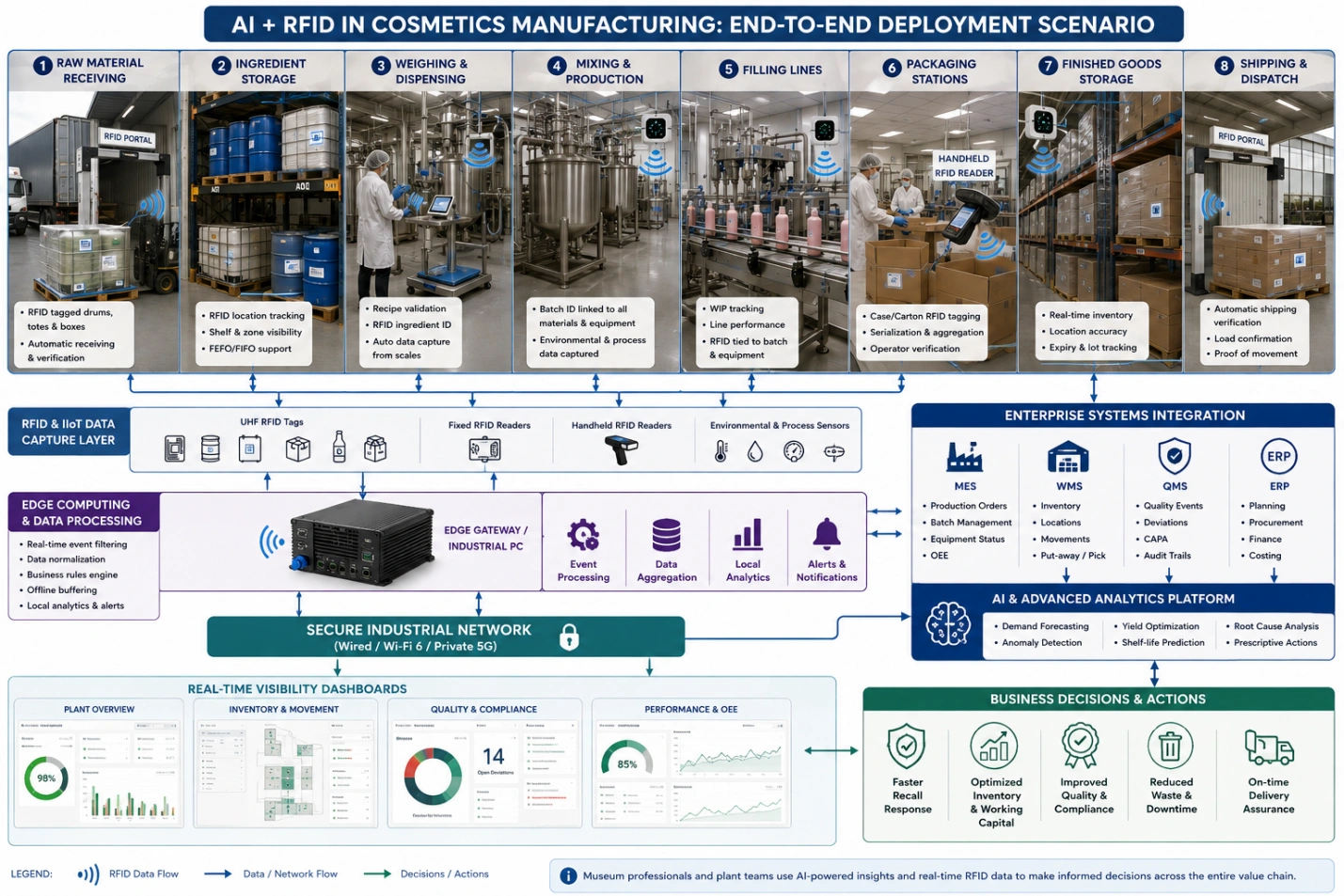
The Role of AI, RFID, and Material Identity in Paint Manufacturing
Paint and coatings production depends on maintaining the correct relationship between formulation requirements and physical materials. A batch may require a specific resin grade, pigment lot, solvent, dispersant, defoamer, rheology modifier, biocide, catalyst, or other additive. Material substitution, incorrect lot selection, incomplete consumption records, or movement of a container into the wrong production area can create downstream quality, compliance, inventory, and investigation problems.
RFID provides a machine-readable identity layer for selected physical objects. UHF RFID is generally suited to longer-range identification of pallets, drums, totes, returnable containers, and tagged production assets. HF RFID may be appropriate for controlled close-range identification tasks, reusable tools, or applications requiring deliberate read interactions. LF RFID can be useful where short read distances, specific material interactions, or legacy identification requirements make it appropriate.
The objective, however, is not simply to deploy more readers. Paint and coatings facilities need to determine which physical events have operational value. Useful events may include:
- Raw material received against a purchase order
- Pigment drum assigned to a production order
- Resin tote moved from quarantine to released inventory
- Additive container issued to a batching station
- Intermediate batch transferred between process stages
- Mobile mixing or handling equipment entering a maintenance area
- Finished batch released after laboratory approval
- Pallet transferred from filling to finished-goods storage
- Customer order staged for shipment
- Returnable IBC or reusable container returned for inspection
AI can correlate these events with production orders, batch records, laboratory results, material master data, warehouse transactions, and historical process behavior. This shifts RFID from isolated identification toward a source of operational context.
GAO has helped organizations deploy RFID and related IoT hardware products and systems where reliable identification must connect physical operations with digital records. For paint and coatings environments, successful deployments begin with a process map rather than a reader map. The engineering team should first identify critical control points, material movement paths, metal structures, liquid products, dust exposure, washdown requirements, hazardous areas, and the consequences of missed or duplicate reads.
Why AI Is Becoming Important for Paint and Coatings Traceability
Traditional material tracking often relies on barcode scans, manual batch paperwork, warehouse transactions, and operator confirmation. These methods can remain appropriate for many steps, but they may create information gaps when high volumes of containers, pallets, and production assets move between storage, staging, production, quality, and shipping areas.
AI-driven analysis can address problems that become difficult to manage through fixed rules alone. A paint manufacturer may generate thousands of identification and transaction events involving raw materials, work-in-process containers, finished products, and reusable assets. Machine learning and AI models can analyze patterns within this event history to identify exceptions and predict operational outcomes.
Examples include:
- Detecting an unusual movement sequence for a pigment or resin lot
- Identifying materials staged for a production order but not subsequently consumed
- Predicting potential shortages before a scheduled batch reaches the mixing area
- Finding abnormal dwell time for containers awaiting quality release
- Detecting discrepancies between physical RFID movement and ERP or MES records
- Grouping recurring material-handling exceptions by formulation, production line, shift, or storage zone
- Supporting root-cause investigations after a quality deviation or customer complaint
- Forecasting returnable tote availability based on historical circulation patterns
Artificial Intelligence of Things, commonly called AIoT or AI and IoT, combines artificial intelligence with IoT devices, sensors, connected equipment and industrial systems. AIoT solutions may also use Industrial AI, Edge AI, machine learning, computer vision and, in autonomous applications, Physical AI. Within paint and coatings operations, RFID can provide one important source of physical identity and movement data while other manufacturing systems contribute formulation, quality, production, and inventory context.
The strongest AI use cases usually emerge where RFID events can answer a question that existing software cannot answer reliably by itself: Where did the material physically move? Was the correct container present? How long did it remain in a restricted state? Did its movement sequence match the expected production workflow?
Paint and Coatings Workflows Where AI-Driven RFID Delivers Practical Value
Raw Material Receiving and Lot Verification
Receiving operations handle pigments, resins, solvents, fillers, additives, packaging components, and other formulation inputs arriving as drums, bags, pails, bulk containers, or IBC totes. RFID identification can supplement receiving records by associating physical containers with supplier lot numbers, internal material IDs, certificates of analysis, quarantine status, and storage assignments.
AI can analyze discrepancies between expected receipts and observed movement patterns. If a shipment is received but a tagged container appears in an unauthorized staging area before release, the system can flag the exception for review. Where hazardous materials are involved, the solution should integrate with established chemical inventory and safety procedures rather than attempting to replace them.
Formula-Specific Material Staging
Material staging is particularly sensitive because paint and coatings formulations depend on correct ingredients, grades, and quantities. An RFID-enabled staging zone can help verify that containers selected for a production order correspond to approved material requirements.
AI can compare observed material identities and movement sequences with expected production requirements. The goal is not necessarily automatic approval. A well-designed system can present an operator or supervisor with a clear exception when:
- A wrong material grade enters the staging area
- A restricted or quarantined lot is detected
- A required ingredient has not arrived
- A container remains staged for an unusually long period
- A material appears to be associated with multiple active production orders
- Physical movement conflicts with the material issue transaction
This approach is particularly valuable when facilities produce many formulations, specialty coatings, color variants, or customer-specific products.
RFID & AI-Driven Material Control – Formula-Specific Workflow
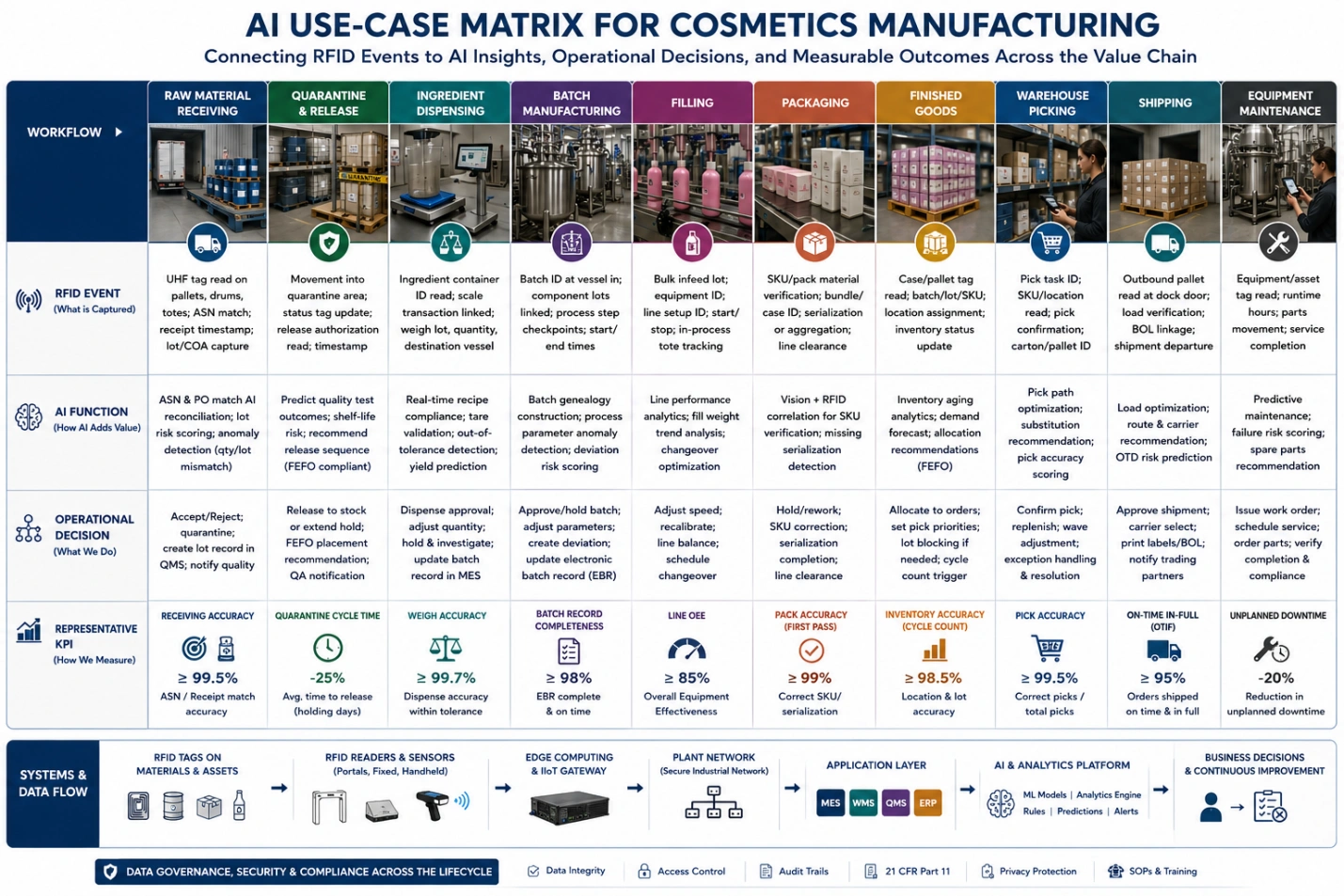
Batch Genealogy and Work-in-Process Traceability
A coatings batch may progress through premixing, high-speed dispersion, grinding or milling where applicable, let-down, adjustment, filtration, laboratory testing, and filling. Material genealogy becomes increasingly valuable when manufacturers need to investigate a viscosity deviation, color mismatch, gloss variation, contamination event, or customer complaint.
RFID events can establish supporting evidence about which identified containers and assets entered specific production zones. Middleware can associate those events with batch IDs and timestamps. AI can then search historical records for patterns across batches, material lots, equipment assignments, laboratory results, and movement histories.
This does not eliminate the need for validated batch records or laboratory controls. Instead, it can provide an additional physical traceability layer that helps reconstruct operational history more efficiently.
Returnable Container and Mobile Asset Management
Paint and coatings manufacturers often manage reusable IBC totes, intermediate containers, forklifts, mobile pumps, transfer equipment, laboratory devices, maintenance tools, and other assets that move across large facilities.
AI asset tracking supported by RFID can identify:
- Containers accumulating in unexpected areas
- Excessive circulation time between filling and return
- Underutilized reusable assets
- Repeated delays associated with specific production zones
- Assets approaching inspection or maintenance requirements
- Movement patterns that suggest congestion or inefficient material handling
GAO can provide UHF, HF, and LF RFID products selected according to the specific object, reading distance, mounting surface, environmental conditions, and workflow. For metal drums, liquid-filled containers, and dense storage locations, antenna selection, tag placement, reader power, polarization, and physical test conditions require particular attention.
A Paint and Coatings RFID Data Flow from Physical Event to AI Decision
The effectiveness of AI inventory management or AI traceability depends on the quality and context of the underlying event stream. A practical deployment generally follows a sequence from physical identification to operational action.
Data Capture at the Process Edge
RFID tags are attached, embedded, or otherwise associated with the selected objects. Fixed readers may monitor dock doors, warehouse transitions, production entrances, staging lanes, filling lines, or returnable-container collection areas. Handheld readers support exception handling, cycle counts, maintenance verification, and controlled material confirmation.
Read events should contain more than a tag identifier whenever possible. Middleware can enrich each event with reader location, timestamp, direction, zone, confidence indicators, and the associated business object.
Communication and Edge Processing
Readers and gateways can communicate through Ethernet, Wi-Fi, serial connections, or other facility-appropriate networks. Industrial deployments may use MQTT, HTTPS, OPC UA, REST APIs, or other interfaces depending on the connected software and equipment.
Edge software can filter duplicate reads, manage reader health, normalize events, and apply local rules where response time or network resilience is important. This is particularly useful near production areas where transmitting every raw read to a remote service would create unnecessary traffic and noise.
A practical edge-processing design might convert hundreds of low-level reads into a smaller number of meaningful events, such as:
- Pigment lot entered staging zone
- Resin tote exited released-material storage
- Batch container transferred to quality hold
- Finished pallet entered shipping lane
AI models generally perform better when supplied with these contextual events rather than an unfiltered stream of radio-frequency observations.
Middleware and Manufacturing System Integration
The middleware layer connects RFID events with business systems. Depending on the facility, these may include ERP software, MES, WMS, LIMS, computerized maintenance management systems, environmental health and safety software, transportation systems, and custom production databases.
For example, when an RFID event identifies a container at a batching area, the software can retrieve relevant contextual information such as:
- Internal material number
- Supplier lot and internal lot
- Release or quarantine status
- Production order association
- Approved storage and handling requirements
- Remaining inventory
- Expiration or retest date
- Related certificate and quality records
The AI layer can then analyze the enriched information to identify anomalies, predict shortages, prioritize investigations, or recommend operational actions.
RFID & AI Architecture for Paint & Coatings Manufacturing
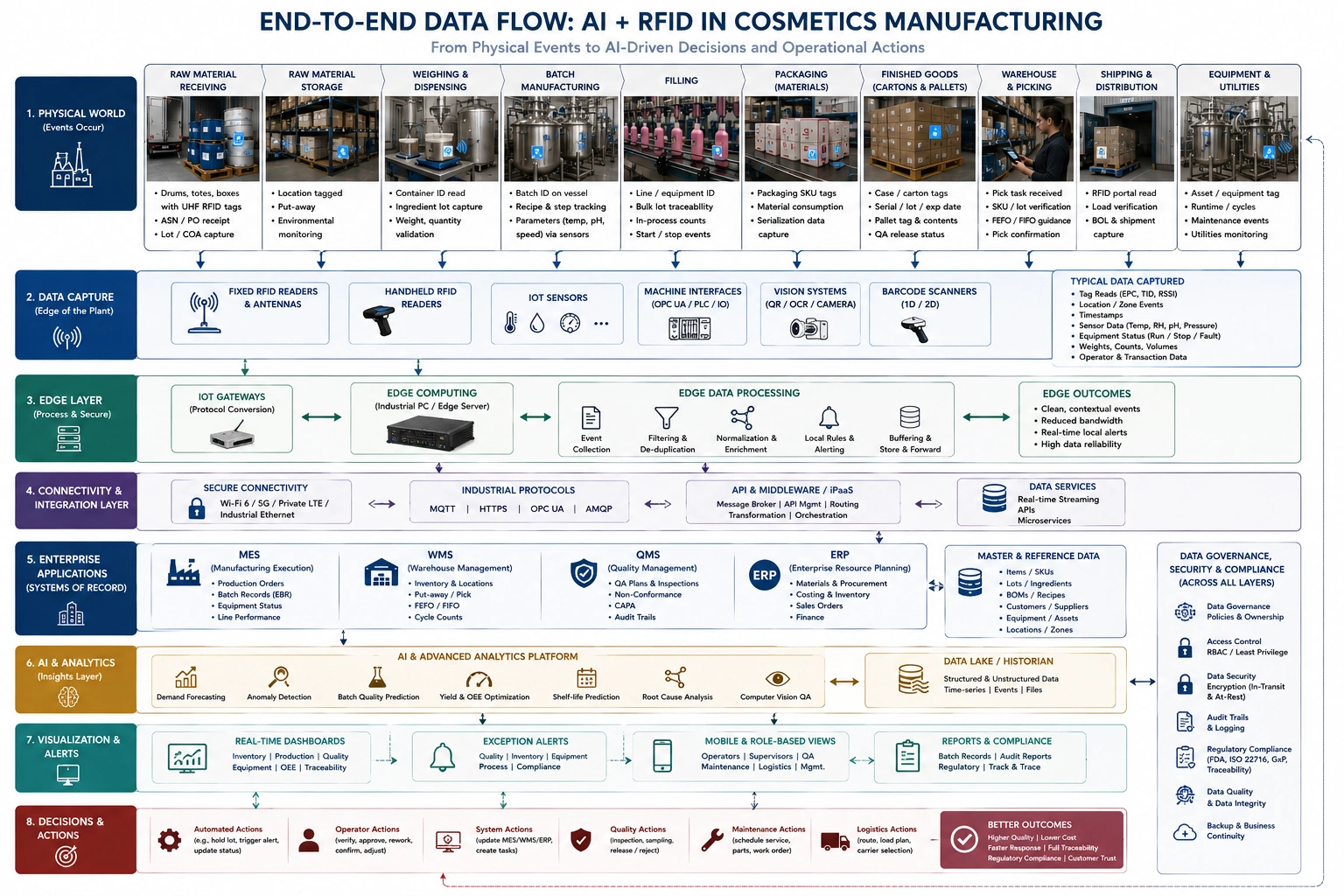
RFID, AI Software, and Deployment Components for Paint and Coatings
A complete AI and RFID solution for paint and coatings should be designed as an interconnected set of identification, communication, processing, integration, and decision components rather than as a collection of independent devices.
RFID Identification Hardware
UHF RFID is commonly considered for pallet portals, warehouse transitions, tagged drums, IBC totes, returnable containers, and selected mobile assets where greater read distance is required. HF RFID can support close-range controlled identification, while LF RFID may be selected for specialized short-range or environmental requirements.
Chemical compatibility is a major design consideration. Tags may be exposed to solvents, abrasion, temperature variation, metal surfaces, moisture, dust, cleaning processes, and repeated handling. GAO can help organizations evaluate RFID tags, readers, antennas, handheld devices, and supporting hardware against actual paint and coatings operating conditions rather than relying solely on laboratory read-range specifications.
AI and Analytics Software
AI software can process RFID-derived events together with production, inventory, quality, and maintenance records. Appropriate methods may include anomaly detection, classification, forecasting, time-series analysis, clustering, graph-based relationship analysis, and generative AI interfaces for querying operational records.
The model should be selected according to the business problem. A forecasting model for resin availability is not the same as an anomaly-detection model used to identify unusual container movement. Combining multiple AI methods without a clear decision requirement can increase operational complexity without improving results.
Cloud Version and Server Version
A Cloud Version can centralize multi-site RFID event processing, analytics, software updates, and reporting within cloud-hosted infrastructure. This model can be useful for coatings manufacturers operating multiple plants, distribution centers, or contract manufacturing locations that need shared data and centralized AI model management.
A Server Version can run on customer-managed servers, private data centers, edge servers, factory servers, or other privately hosted infrastructure. This approach can be appropriate when production networks require local processing, data residency policies limit external hosting, connectivity is constrained, or integration with existing plant systems requires tighter local control.
The deployment decision should consider latency, cybersecurity policies, network availability, IT support capacity, plant segmentation, model-update procedures, disaster recovery, and the sensitivity of formulation and batch data.
Security and Operational Resilience
RFID identifiers should not be treated as the only security mechanism. Production-grade systems require identity management, role-based access, encrypted communications where supported, network segmentation, API authentication, audit logging, backup procedures, and monitoring of reader and gateway health.
Formulation data and quality records may represent valuable intellectual property. Integration rules should therefore minimize unnecessary data exposure. The RFID layer may only need to transmit an identifier and event context while sensitive formulation details remain within authorized ERP, MES, or laboratory systems.
Engineering Considerations Before Deploying AI-Driven RFID
Paint and coatings facilities present physical and process conditions that should be validated during site engineering. Metal vessels, steel racking, liquid-filled containers, dense pallet storage, pigment dust, solvent exposure, and overlapping read zones can all affect RFID performance.
A practical commissioning process should include:
- Mapping material and asset flows before selecting reader locations
- Testing candidate tags on actual drums, pails, IBCs, pallets, and metal assets
- Measuring read performance during realistic forklift movement and container orientation
- Identifying reflective surfaces and overlapping antenna fields
- Establishing acceptable read confidence and false-read thresholds
- Defining exception workflows before enabling automated business actions
- Testing integration failure, reader outage, network interruption, and duplicate-event scenarios
- Validating operator procedures for unreadable or damaged tags
- Documenting tag replacement and asset reassociation processes
GAO’s experience supplying RFID and related IoT products and systems can support the practical hardware selection and engineering discussions required before scaling a pilot into broader paint and coatings operations. Hardware testing should represent actual container geometry, chemical exposure, storage density, and process movement because performance observed on an empty test bench may not represent a production floor.
AI-Driven RFID Applications Across Paint and Coatings Operations
AI Inventory Management for Raw Materials and Packaging
Raw material inventory is more complex than simply counting containers. A production planner may need to know whether specific pigment lots, resin grades, additives, solvents, lids, cans, labels, or packaging components are physically available, released, and accessible for scheduled production.
AI can combine RFID movement data with inventory balances, production schedules, purchase orders, consumption history, and lead times to improve material availability forecasting. The result can support earlier identification of shortage risks and reduce emergency material searches.
AI Batch Traceability and Quality Investigation
When a coating batch experiences a deviation, investigators may need to examine formulation execution, raw-material lots, equipment history, laboratory results, operator records, and physical movement events.
AI-assisted batch genealogy can help organize these relationships and identify historical similarities. RFID contributes evidence about physical material and container movement, while MES and LIMS records contribute production and quality context.
AI Asset Tracking for Reusable Containers
Reusable IBC totes and other returnable containers can represent a significant operational asset base. RFID-supported AI analysis can estimate circulation time, identify containers that remain outside expected return loops, and support inspection scheduling.
Warehouse and Finished-Goods Movement Analysis
Finished paint, coatings, primers, sealants, and related products may move through quarantine, release, finished-goods storage, order staging, and shipment. RFID events can provide movement visibility that AI uses to identify dwell-time anomalies, staging congestion, and inconsistencies between physical location and warehouse records.
AI-Driven RFID End-to-End Lifecycle for Paint & Coatings Manufacturing
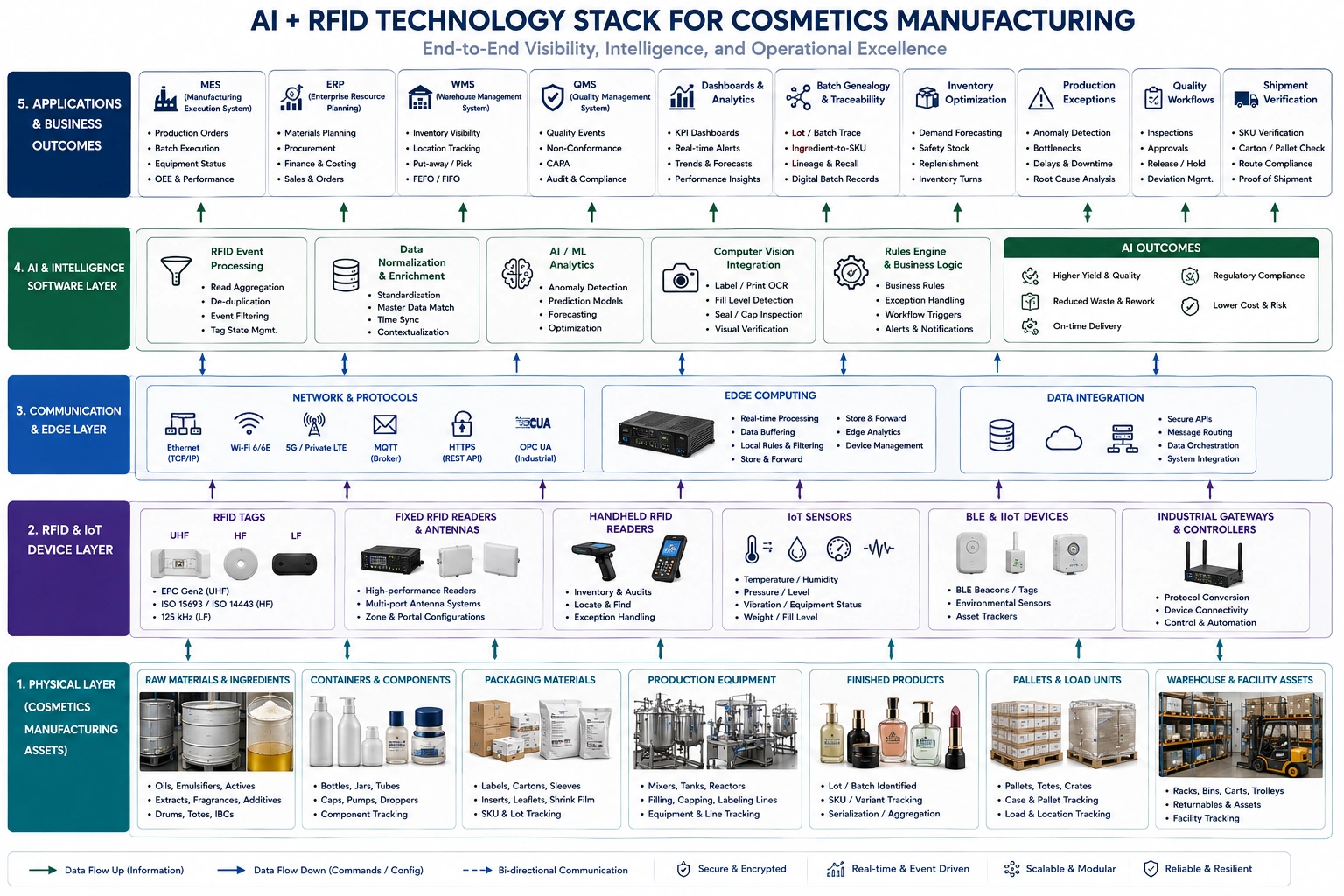
Measuring Performance and Business Outcomes
The value of AI-driven RFID should be measured against operational baselines established before deployment. Paint and coatings manufacturers can evaluate technical performance and business outcomes using KPIs that reflect actual production constraints.
Useful measures may include:
- RFID read accuracy by process zone and asset type
- Inventory record accuracy
- Raw-material search time
- Material staging exceptions
- Time required to reconstruct batch genealogy
- Returnable container cycle time
- Production delays caused by material availability
- Dwell time in quarantine or quality-hold areas
- Frequency of physical-to-system inventory discrepancies
- Manual identification transactions per production order
- Asset utilization rates
- Investigation time for quality deviations
- Reader and gateway availability
The next stage is determining how these measurements should be converted into operational rules, AI recommendations, and controlled automation without creating new risks in batch production, quality management, or chemical handling.
Converting RFID Events into Controlled AI Decisions
An AI-driven RFID deployment in paint and coatings manufacturing should not move directly from a tag read to an uncontrolled production action. Physical identification events can be affected by tag orientation, simultaneous movement of multiple containers, temporary network interruptions, damaged tags, or changes in material-handling procedures. A reliable solution therefore uses validation, contextualization, confidence assessment, and controlled business rules before initiating an operational response.
A practical decision sequence can include:
- Capturing the RFID event and validating the reader, antenna, timestamp, and location
- Filtering duplicate or low-confidence observations
- Associating the RFID identifier with the correct material, asset, container, pallet, or batch object
- Retrieving relevant ERP, MES, WMS, LIMS, or maintenance information
- Comparing the observed event with expected production, inventory, or material-handling conditions
- Applying AI models to detect anomalies, predict shortages, classify the event, or identify related historical patterns
- Presenting exceptions to authorized operators when human confirmation is required
- Recording the decision, action, and supporting evidence for auditability
This approach is particularly important for formulation-controlled operations. An AI model may identify that a pigment drum has entered an unexpected zone, but the operational response should depend on the material’s status, production order, quality disposition, and applicable site procedures.
Human-in-the-loop controls are often preferable for high-consequence actions such as preventing material issue, changing batch status, or initiating a quality hold. Lower-risk applications, such as inventory reconciliation suggestions or asset-location updates, may support a higher degree of automation.
Improving Material Control from Receiving Through Shipment
Paint and coatings operations contain numerous handoffs between procurement, receiving, warehouse teams, production planning, batch operators, laboratory personnel, maintenance teams, and shipping staff. Each handoff can create a gap between the physical state of an object and the digital record describing it.
AI-driven RFID can reduce these gaps by establishing a continuous sequence of meaningful identification events.
Receiving and Quarantine Control
A raw-material shipment may arrive with supplier documentation, lot information, and purchase-order references. Containers can be associated with RFID identities during receiving or through pre-tagged supplier workflows where appropriate.
The system can then distinguish among conditions such as:
- Received but awaiting inspection
- Quarantined
- Released for production
- Reserved for a specific production order
- Issued to production
- Partially consumed
- Returned to storage
- Rejected or awaiting disposition
AI can detect situations where physical movement appears inconsistent with the expected status. For example, a resin tote detected near an active batching area while still carrying a quarantine status can trigger an exception for review.
Warehouse Slotting and Material Availability
Paint and coatings warehouses often store materials with different handling requirements. Flammable solvents, pigments, resins, additives, and packaging components may occupy separate areas according to product characteristics and facility procedures.
RFID location events can provide additional physical evidence about container movement. AI can analyze travel history, dwell time, retrieval frequency, and production demand to support better slotting recommendations.
The objective is not to let an algorithm independently rearrange chemical storage. Recommendations must operate within established safety rules, compatibility requirements, approved storage zones, and site-specific operating procedures.
Production Material Issue
Material issue is one of the highest-value identification points because the relationship between the physical ingredient and the production order directly affects batch traceability.
A properly integrated system can compare an observed RFID identity against:
- Approved bill of materials or formula requirements
- Material grade
- Lot status
- Retest or expiration information
- Production order requirements
- Inventory availability
- Previous issue records
- Restricted or blocked material status
AI can prioritize unusual situations for review rather than requiring operators to manually investigate every normal event.
Finished Product and Shipment Traceability
Following filling and packaging, finished paint and coatings products may be associated with batch records, production dates, quality release status, pallet identities, warehouse locations, and customer orders.
RFID-supported movement events can strengthen the relationship between finished-goods records and physical movement. AI can identify unusual staging patterns, extended dwell time, repeated warehouse transfers, or discrepancies between expected and observed shipment preparation.
GAO has supplied RFID hardware products and systems that organizations can use to improve identification and tracking workflows. The most appropriate implementation depends on whether the operational objective is pallet-level visibility, reusable-container tracking, controlled material verification, asset identification, or a combination of these use cases.
Measurable Value of AI-Driven RFID in Paint & Coatings Manufacturing
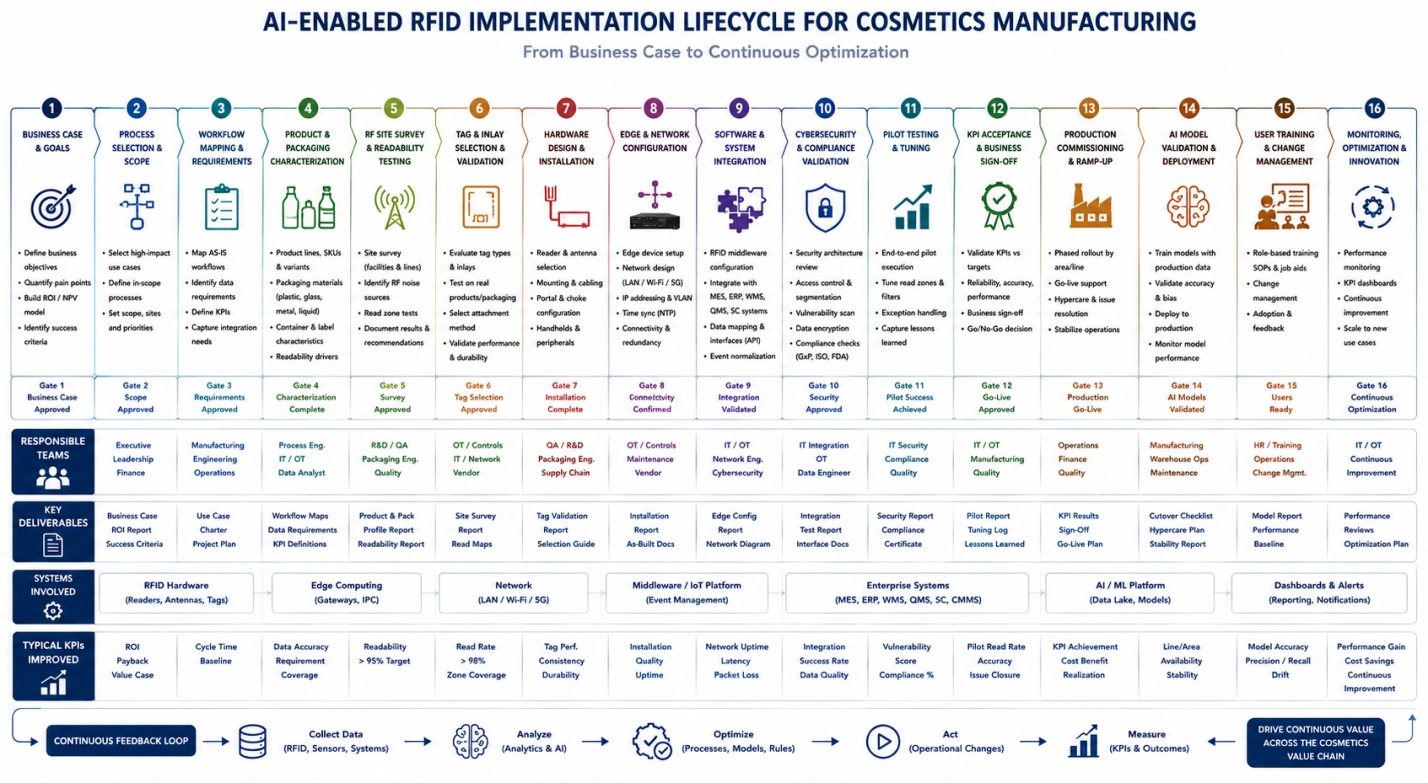
AI Methods That Provide Value in Paint and Coatings RFID Systems
Different operational problems require different analytical methods. A common implementation mistake is to treat AI as a single capability rather than selecting a method based on the available data and desired decision.
Anomaly Detection
Anomaly detection can identify movement sequences, dwell times, material assignments, or asset behavior that differ from established operational patterns.
Examples include a tagged IBC entering an unexpected production zone, a finished-goods pallet remaining in staging beyond normal time, or a frequently used pigment container following an unusual route.
Unsupervised methods can be useful when historical exception labels are limited. Supervised models may become appropriate when facilities have accumulated validated examples of known deviations.
Demand and Availability Forecasting
Forecasting models can combine historical consumption, production schedules, purchase orders, supplier lead times, and physical RFID activity to estimate future material availability.
For paint manufacturers, forecasting should account for formulation changes, seasonality, customer-specific production, product mix, and promotions where relevant. A simple historical average may produce poor results when specialty coatings have irregular demand.
Classification and Exception Prioritization
Classification models can help categorize events according to likely operational conditions. A system may classify an inventory discrepancy as likely caused by delayed transaction posting, abnormal physical movement, repeated read behavior, or a potential process exception.
This can reduce the effort required to investigate large volumes of RFID-generated events.
Graph and Relationship Analysis
Batch genealogy naturally contains relationships among raw-material lots, intermediate batches, equipment, production orders, laboratory tests, finished goods, and shipment records.
Graph-based analysis can help investigators identify connected records during quality investigations. For example, a complaint involving a finished coating lot can be traced through related production batches and associated raw-material lots, subject to the completeness of the underlying manufacturing records.
Generative AI for Technical Querying
Generative AI can provide a natural-language interface for authorized users to explore operational information. A production manager might ask why a specific batch was delayed, while a quality engineer might request the identified material movement history associated with a batch investigation.
The underlying records should remain authoritative. Generative AI should retrieve and summarize approved data rather than inventing production events or making uncontrolled quality decisions.
Interoperability with Paint and Coatings Software
AI-driven RFID produces greater operational value when integrated with the systems already responsible for inventory, production, quality, and maintenance records.
Relevant software categories can include:
- Enterprise resource planning systems for procurement, material master data, inventory, and financial transactions
- Manufacturing execution systems for production orders, batch execution, work instructions, and process records
- Warehouse management systems for locations, replenishment, picking, staging, and shipping
- Laboratory information management systems for sample records, test results, specifications, and quality disposition
- Computerized maintenance management systems for mobile equipment, inspection, calibration, and maintenance history
- Product lifecycle and formulation management software for coating formulations, revisions, and controlled specifications
- Environmental health and safety systems for chemical inventories, hazardous-material procedures, and compliance documentation
- Transportation and shipping software for order staging and outbound traceability
Integration should use well-defined identifiers and ownership rules. If an ERP system is authoritative for material master data, the RFID middleware should not create conflicting material definitions. If the MES controls batch execution, RFID-derived observations should supplement the MES workflow rather than silently overriding validated production records.
Common integration mechanisms include REST APIs, HTTPS, message queues, MQTT, OPC UA, database interfaces, and file-based exchange where required by legacy systems.
A useful engineering practice is to define an event model before connecting readers to business software. The event model should specify object identity, event type, timestamp, location, confidence, source device, associated transaction, and exception state.
Scaling an AI-Driven RFID Deployment Across Paint and Coatings Sites
A pilot should demonstrate more than basic tag readability. The pilot needs to validate the complete operating model, including hardware performance, workflow adoption, integration, exception handling, cybersecurity, maintenance, and measurable business outcomes.
A scalable implementation can progress through defined technical stages.
Process and Site Assessment
The initial assessment should document:
- Material flow from receiving through production and shipping
- Container types and physical characteristics
- Production zones and critical control points
- Existing barcode and manual identification procedures
- Network coverage and industrial connectivity
- Reader mounting constraints
- Hazardous-area requirements where applicable
- Existing ERP, MES, WMS, and LIMS interfaces
- Data ownership and cybersecurity policies
Hardware and Read-Performance Validation
Testing should use representative drums, pails, IBCs, pallets, and mobile assets. The engineering team should test different tag positions and orientations under actual handling conditions.
Read zones need to be designed around operational intent. A doorway portal intended to detect a container leaving quarantine should not unintentionally read containers stored several meters away.
Pilot and Exception Workflow Validation
The pilot should include normal and abnormal scenarios. Teams should deliberately test:
- Incorrect material presented at a staging location
- Missing required material
- Damaged or unreadable tag
- Duplicate reads
- Simultaneous movement of multiple tagged objects
- Network interruption
- Reader failure
- Incorrect business-system association
- Container reassignment
- Material returned to storage
Successful commissioning depends on how the system handles these conditions, not only on performance during ideal demonstrations.
Multi-Site Standardization
Once validated, organizations can standardize tag specifications, reader configurations, event definitions, integration patterns, cybersecurity controls, and performance KPIs across facilities.
Some parameters should remain site-specific. Storage layouts, chemical handling procedures, product mix, network topology, and production processes can vary substantially between architectural coatings, automotive coatings, industrial coatings, powder coatings, marine coatings, protective coatings, and specialty chemical products.
GAO can support organizations with RFID products and technical assistance as deployments move from evaluation and pilot testing toward broader implementation.
Security, Data Integrity, and Formula Protection
Paint and coatings formulations, raw-material relationships, batch records, and quality information can represent commercially sensitive information. An AI-driven RFID solution should therefore apply security controls across devices, communications, software, integrations, and user access.
Important practices include:
- Role-based access for operational and technical users
- Strong authentication for APIs and administrative interfaces
- Encryption for supported data communications
- Network segmentation between identification devices and critical production systems
- Device inventory and controlled configuration management
- Audit logs for configuration changes and high-impact business actions
- Monitoring of reader, gateway, server, and integration health
- Backup and recovery procedures
- Validation of AI model inputs and outputs
- Retention policies appropriate to batch, quality, and traceability requirements
Data integrity also requires attention to RFID event quality. An inaccurate event should not become accepted as a permanent operational fact simply because it originated from an automated device. Event confidence, reconciliation rules, and human review should be incorporated where the business consequence of an error is significant.
Practical Implementation Lessons for Paint and Coatings Manufacturers
The highest-value projects usually begin with a narrowly defined operational problem. Attempting to tag every object throughout a plant can generate unnecessary cost and data without improving decision-making.
Practical priorities include:
- Start with materials or assets that create measurable delays, traceability gaps, or inventory uncertainty
- Select tag and reader combinations based on actual drums, IBCs, pallets, and environmental conditions
- Define the required business event before selecting each RFID read point
- Use edge filtering to reduce duplicate and low-value data
- Keep the authoritative source for formulas, quality status, and batch execution within the appropriate manufacturing systems
- Introduce AI only where historical data and operational decisions justify it
- Keep high-consequence decisions subject to appropriate human review
- Measure baseline KPIs before deployment
- Test exception handling as thoroughly as normal workflows
- Establish maintenance procedures for tags, readers, antennas, gateways, and integration services
A recurring engineering lesson is that physical identification accuracy and data-model quality are equally important. An advanced AI model cannot reliably compensate for poorly defined material identities, inconsistent location names, duplicate container records, or unclear ownership between business systems.
Key Technical and Business Benefits of AI-Driven RFID for Paint and Coatings
Combining AI with RFID can improve operations because RFID contributes physical identity and movement evidence while AI analyzes patterns and relationships that would be difficult to evaluate manually across large volumes of events.
More Reliable Material Visibility
RFID can supplement inventory transactions with evidence of physical movement. AI can compare those observations with expected inventory and production activity to prioritize discrepancies.
Faster Batch and Lot Investigation
Associating physical identification events with batch records can provide additional context during investigations. AI can organize related material, equipment, location, and timing information to reduce the effort required to identify potentially relevant records.
Reduced Material Search and Handling Delays
Identified containers and assets can be located more efficiently when the deployment is designed around meaningful operational zones. AI can further identify recurring search patterns and congestion points.
Better Returnable Asset Utilization
Reusable IBCs and other circulating containers can be tracked through their operating cycle. AI analysis can identify abnormal dwell time and potential circulation bottlenecks.
Improved Inventory and Production Coordination
AI forecasting can combine material consumption and RFID activity with production schedules and supply information to identify potential shortages earlier.
Controlled Scalability
Standardized event definitions, integration patterns, and hardware specifications can allow validated deployments to expand across multiple paint and coatings facilities while preserving local workflow requirements.
AI-Driven RFID Decision Tree for Paint & Coatings Manufacturers
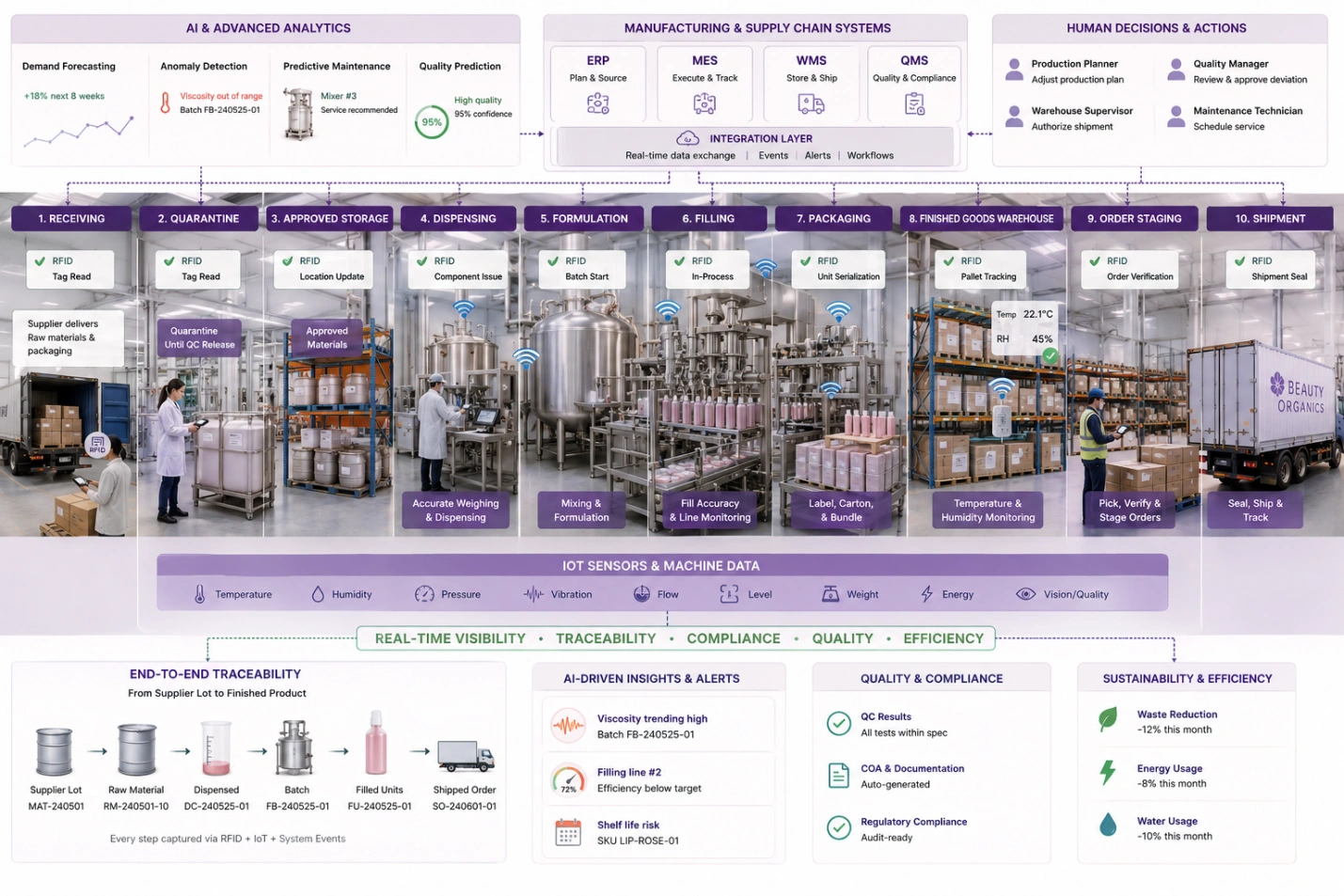
Implementation Recommendations for AI and RFID in Paint & Coatings
Paint and coatings manufacturers considering AI-driven RFID should begin by connecting the technical design to a specific operational objective. Material staging errors, incomplete batch genealogy, inaccurate reusable-container visibility, and warehouse discrepancies are different problems and require different combinations of hardware, integration, and AI analysis.
A practical implementation strategy should focus on the following:
- Identify the highest-cost traceability, inventory, or asset-management gaps
- Map physical workflows and digital transactions before installing readers
- Test UHF, HF, or LF RFID under actual chemical manufacturing conditions
- Define clear event models and system ownership
- Integrate RFID data with the relevant ERP, MES, WMS, LIMS, or maintenance software
- Establish confidence thresholds and exception workflows
- Apply AI models to defined decisions rather than deploying AI as a generic analytics layer
- Protect formulation, batch, and quality information through appropriate security controls
- Establish baseline KPIs and evaluate improvements against measurable operational results
- Scale only after the pilot demonstrates reliable read performance, workflow adoption, and business value
For organizations evaluating RFID hardware, AI-enabled tracking, or identification solutions for paint and coatings manufacturing, GAO can provide technical products, systems, and engineering support for assessing deployment requirements and selecting appropriate RFID technologies.
Building More Connected Paint and Coatings Operations with GAO
AI-driven RFID can provide practical value when it connects physical material movement with production, inventory, quality, and asset records. The strongest implementations focus on specific problems such as raw-material verification, formula-specific staging, batch genealogy, reusable-container circulation, warehouse visibility, and investigation efficiency.
GAO is headquartered in New York City and Toronto, Canada, and has supported organizations through RFID, BLE, and other IoT hardware products and systems. GAO and its sister companies have served customers across the United States and Canada for three decades, including Fortune 500 companies, leading R&D organizations, prestigious universities, and U.S. and Canadian government agencies.
Our work has included substantial investment in R&D, stringent quality assurance processes, and technical support delivered remotely or onsite. Organizations planning an AI-driven RFID project for paint and coatings can work with us to evaluate identification requirements, hardware selection, integration approaches, pilot testing, and scalable implementation.
Building the Future of Industrial AI and IoT with Aperture Venture Studio and GAO
For more than three decades, GAO Group of Companies has invested heavily in the R&D of industrial RFID, BLE, and IoT technologies. As generative AI demonstrated practical value for industrial applications such as material traceability, production analysis, and connected operations, we expanded our work in AI and IoT, including RFID and BLE. We established Aperture Venture Studio to advance AI and IoT initiatives relevant to industrial sectors such as paint and coatings and other specialized manufacturing domains.
Aperture has attracted leading AI and IoT technical experts, entrepreneurial and operational executives, influential investors, and established companies. We have also developed the Aperture Ventures Summit and TekSummit to explore advanced AI and IoT topics and strengthen technical communities.
We welcome participation from:
- Advisors, co-founders, or employees
- Investors
- Customers