
AI and RFID for Steel Mills
AI-Driven Steel Mill Operations Powered by RFID Data Intelligence
Steel mills operate some of the world’s most demanding manufacturing environments where molten steel, continuous casting, rolling mills, heat treatment, warehouses, scrap yards, and logistics systems must operate as one coordinated production system. Artificial Intelligence combined with RFID-enabled data collection allows steel manufacturers to transform production visibility, automate material identification, improve traceability, optimize maintenance, and enhance operational decision-making across every production stage.
Rather than simply identifying assets, RFID provides trusted operational data that AI systems analyze to optimize slab movement, billet tracking, coil genealogy, ladle management, inventory control, predictive maintenance, production scheduling, and quality assurance. AI continuously learns from production events, sensor information, historical manufacturing records, and RFID-generated location data to recommend operational improvements that reduce bottlenecks, improve yield, and increase Overall Equipment Effectiveness (OEE).
For steel producers seeking higher productivity, better quality consistency, lower operating costs, and stronger supply chain visibility, AI-enabled RFID systems have become an important component of Industrial AI and AIoT initiatives. GAO has supported organizations throughout North America by supplying industrial RFID hardware, IoT devices, and technical expertise that help manufacturers implement reliable identification and data collection systems in harsh industrial environments.
Understanding AI and RFID in Modern Steel Mills
Steel manufacturing differs significantly from most discrete manufacturing industries because production involves extremely high temperatures, continuous material flow, heavy industrial equipment, and strict quality requirements. Every slab, bloom, billet, coil, plate, pipe, structural section, or finished steel product carries production history that directly affects downstream processing.
Artificial Intelligence improves these operations by analyzing large volumes of operational data generated throughout the production lifecycle.
RFID contributes reliable identification and movement information that enables AI software to understand:
- Material genealogy
- Production sequencing
- Work-in-progress movement
- Equipment utilization
- Warehouse inventory
- Maintenance activities
- Logistics operations
- Finished goods traceability
Instead of relying solely on manual barcode scanning or operator input, RFID automatically captures production events while AI software identifies production inefficiencies, predicts equipment failures, recommends scheduling improvements, and detects process abnormalities before they affect product quality.
Steel mills increasingly deploy AIoT solutions combining RFID, industrial sensors, machine vision, vibration monitoring, temperature sensing, edge computing, machine learning, and industrial analytics software to improve operational intelligence throughout the facility.
GAO provides industrial RFID readers, rugged RFID tags, antennas, handheld readers, and supporting IoT technologies that enable reliable data acquisition across demanding steel manufacturing environments.
AI-Enabled RFID Architecture for Integrated Steel Mills and Intelligent Production Management
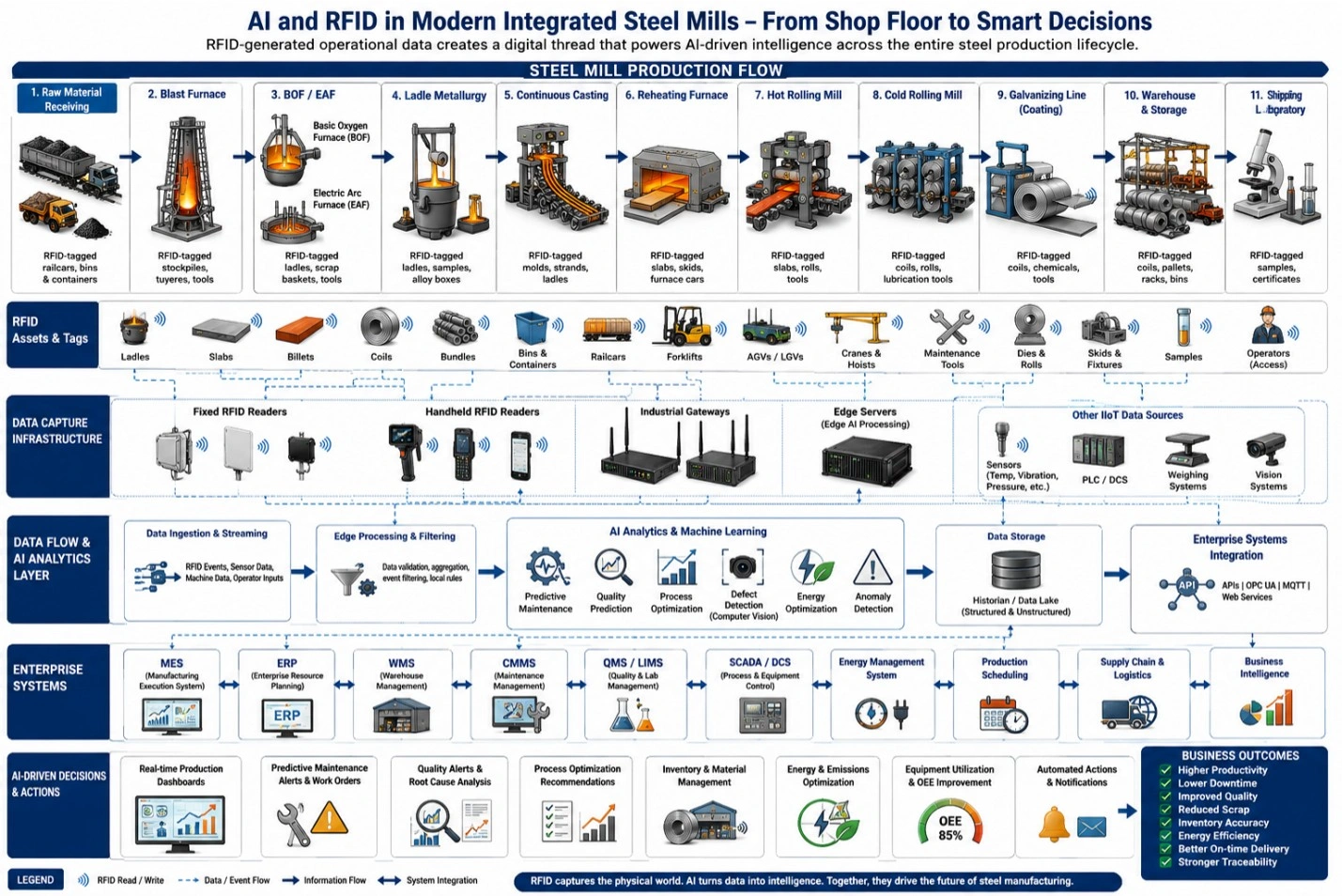
Why AI Is Transforming Steel Mill Operations
Steel manufacturing facilities generate enormous amounts of operational information from furnaces, rolling mills, cranes, conveyors, cooling beds, inspection systems, warehouses, and logistics operations. Historically, much of this information remained isolated across different production systems.
AI integrates these operational datasets to improve decision-making across the entire manufacturing process.
Major AI applications within steel mills include:
- Production scheduling optimization
- Slab sequencing optimization
- Coil genealogy analysis
- Yield improvement
- Predictive maintenance
- Surface defect detection
- Energy optimization
- Scrap classification
- Quality prediction
- Warehouse optimization
- Finished goods inventory optimization
- Automated dispatch planning
- Ladle lifecycle management
- Industrial safety monitoring
- Supply chain forecasting
Machine learning models identify relationships that engineers may not easily detect manually. For example, AI can correlate furnace temperatures, chemical composition, rolling force, equipment vibration, RFID material movement, maintenance history, and production schedules to predict product quality deviations before downstream processing occurs.
Computer vision systems inspect steel surfaces while RFID confirms product identity, allowing AI software to associate detected defects with specific production batches, operators, process parameters, and equipment conditions.
These capabilities significantly improve manufacturing consistency while reducing costly rework and production delays.
AI Applications Across Steel Mill Production
Raw Material Management
AI analyzes incoming shipments of iron ore, scrap steel, ferroalloys, limestone, coke, and flux materials.
RFID automatically identifies:
- Raw material containers
- Railcars
- Trucks
- Bulk storage bins
- Scrap handling equipment
- Inventory locations
AI predicts optimal inventory levels while reducing material shortages and excessive storage costs.
Blast Furnace and Electric Arc Furnace Operations
Production stability depends on accurate charging sequences and process consistency.
AI evaluates:
- Charge mix optimization
- Energy consumption
- Oxygen injection
- Furnace efficiency
- Electrode consumption
- Tap scheduling
- Production throughput
RFID identifies refractory assets, maintenance equipment, consumables, and mobile assets supporting furnace operations.
Continuous Casting
Continuous casting requires accurate slab identification throughout production.
AI monitors:
- Casting speed
- Mold performance
- Cooling rates
- Surface quality
- Internal defect prediction
- Strand productivity
RFID enables reliable tracking of:
- Slabs
- Casting molds
- Maintenance tools
- Transfer cars
- Production lots
Rolling Mill Optimization
Rolling mills generate extensive production data suitable for AI optimization.
AI evaluates:
- Roll wear
- Thickness control
- Width control
- Shape control
- Mill utilization
- Coil scheduling
- Downtime prediction
- Production balancing
RFID identifies rolls, tooling, maintenance assets, and work-in-progress coils moving between production stages.
Warehouse and Logistics
Steel warehouses often contain thousands of finished coils, plates, billets, pipes, structural beams, and fabricated products.
AI optimizes:
- Storage allocation
- Crane scheduling
- Shipment sequencing
- Inventory accuracy
- Customer order fulfillment
- Vehicle loading
RFID provides continuous visibility of inventory movement without requiring manual identification.
Maintenance Operations
Predictive maintenance has become one of the highest-value Industrial AI applications.
AI analyzes:
- Motor vibration
- Bearing temperature
- Lubrication history
- Maintenance records
- RFID asset movement
- Spare parts availability
- Equipment utilization
Maintenance planners receive recommendations before failures interrupt production.
AI-Enabled RFID Workflow for Steel Manufacturing from Raw Materials to Customer Delivery
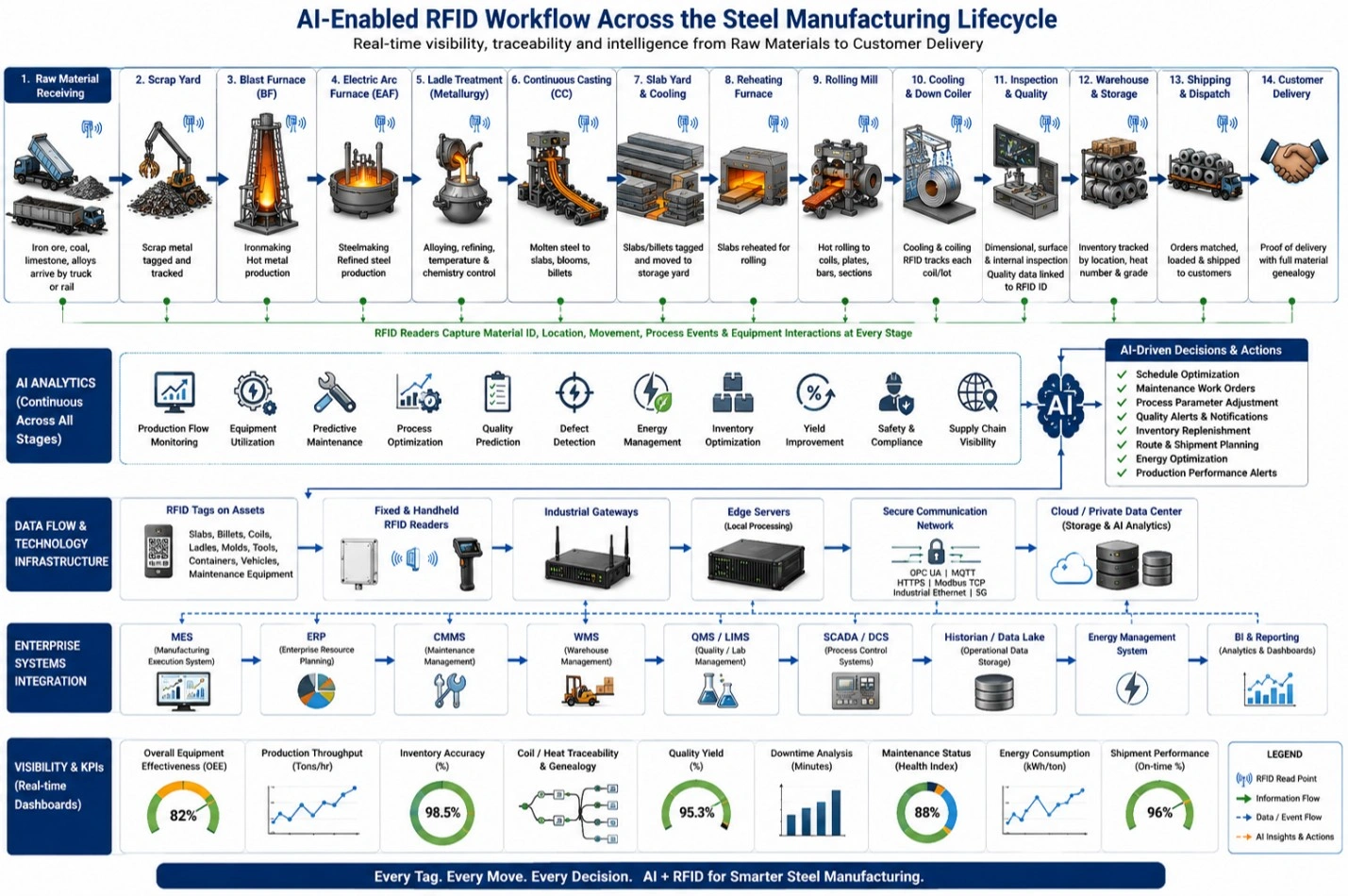
Complete Operational Workflow for AI-Enabled Steel Mills
Successful AI deployment begins with accurate operational data. RFID supplies dependable identification events that complement industrial sensors, programmable logic controllers (PLCs), distributed control systems (DCS), machine vision systems, and manufacturing software.
The operational workflow typically includes:
Production Data Acquisition
Operational data originates from multiple sources:
- RFID readers
- PLCs
- Industrial sensors
- Laser measurement systems
- Machine vision cameras
- Crane control systems
- Weigh scales
- Laboratory systems
- Operator terminals
- Energy monitoring systems
RFID captures the identity and movement of critical manufacturing assets including slabs, billets, coils, ladles, maintenance tools, transport vehicles, reusable containers, and finished products.
Industrial Communication
Collected information is transmitted through industrial communication networks such as:
- Industrial Ethernet
- OPC UA
- Modbus TCP
- PROFINET
- EtherNet/IP
- MQTT
- HTTPS
- REST APIs
Industrial gateways aggregate operational data before forwarding it to edge servers or privately hosted server software.
Edge Processing
Edge computing reduces latency by processing production information close to manufacturing equipment.
Typical edge functions include:
- RFID filtering
- Event validation
- Data normalization
- Local AI inference
- Alarm generation
- Temporary data storage
- Equipment health calculations
Edge AI enables immediate operational decisions even if external network connectivity becomes unavailable.
Enterprise Software Integration
Validated operational information is exchanged with manufacturing software including:
- Manufacturing Execution Systems (MES)
- Enterprise Resource Planning (ERP)
- Computerized Maintenance Management Systems (CMMS)
- Warehouse Management Systems (WMS)
- Laboratory Information Management Systems (LIMS)
- Quality Management Systems (QMS)
- Industrial historian databases
This integration creates a consistent operational record supporting AI-driven analytics, production planning, maintenance scheduling, inventory management, and business reporting.
AI-Enabled RFID Deployment in a Modern Steel Mill for Real-Time Production Visibility and Traceability
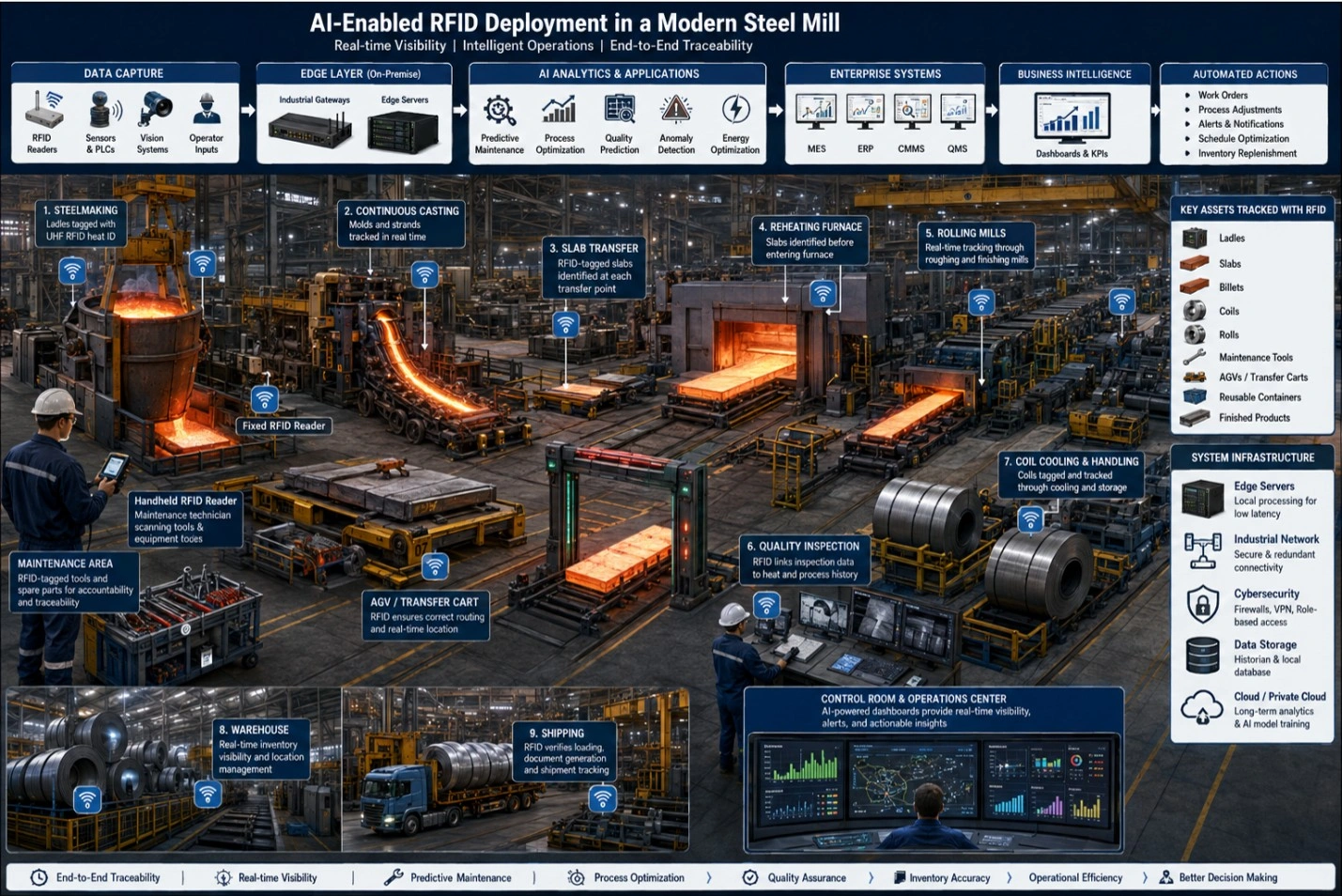
Hardware, Software, AI Models, Communication Infrastructure, and Deployment Considerations
Reliable AI-enabled steel mill operations depend on coordinated hardware, industrial software, communication infrastructure, and secure data management rather than any single technology. Every component contributes to continuous production visibility, accurate material traceability, operational intelligence, and automated decision support throughout steel manufacturing.
RFID Hardware and Supporting Equipment
Steel mills require rugged identification equipment designed to withstand extreme heat, dust, vibration, moisture, electromagnetic interference, and heavy mechanical impacts.
Common hardware includes:
- UHF RFID readers for long-range identification of slabs, billets, coils, containers, railcars, and warehouse inventory
- HF RFID readers for production stations requiring shorter read distances and higher immunity to metallic interference
- LF RFID readers for specialized maintenance assets, tooling, and access management
- Heat-resistant RFID tags for ladles, transfer cars, reusable containers, steel coils, and production tooling
- Industrial antennas optimized for conveyor systems, crane operations, storage yards, and loading docks
- Handheld RFID readers for inventory verification, maintenance inspections, and quality audits
- Industrial gateways that aggregate RFID events and sensor information before forwarding validated data to enterprise software
- Edge computing devices that perform local processing and support real-time AI inference
- Operator HMIs for production supervisors and maintenance personnel
GAO supplies industrial RFID readers, antennas, tags, handheld devices, and supporting IoT hardware engineered for demanding industrial environments where equipment reliability and consistent identification accuracy are essential.
AI Software and Industrial Applications
Artificial intelligence software transforms operational data into actionable manufacturing intelligence.
Common AI methods include:
- Machine learning for production forecasting and process optimization
- Deep learning for surface defect recognition and quality prediction
- Predictive analytics for maintenance scheduling
- Reinforcement learning for production sequencing optimization
- Time-series analysis for equipment health monitoring
- Computer vision for automated inspection of slabs, billets, plates, and coils
- Natural language processing to analyze maintenance reports and operator logs
- Anomaly detection for identifying abnormal furnace behavior, rolling mill performance, and material handling issues
These analytical methods continuously evaluate operational information while improving production decisions over time.
Industrial Software Integration
Steel manufacturers commonly integrate AI-enabled operational data with existing business software, including:
- Manufacturing Execution Systems (MES)
- Enterprise Resource Planning (ERP)
- Warehouse Management Systems (WMS)
- Computerized Maintenance Management Systems (CMMS)
- Supervisory Control and Data Acquisition (SCADA)
- Distributed Control Systems (DCS)
- Laboratory Information Management Systems (LIMS)
- Quality Management Systems (QMS)
- Industrial historian databases
- Production scheduling software
- Asset management software
- Energy management software
Integration allows operational information collected throughout production to support planning, maintenance, quality assurance, inventory control, and executive reporting without requiring duplicate data entry.
Communication Infrastructure
Reliable communications ensure production information moves securely between operational equipment and business software.
Common communication technologies include:
- Industrial Ethernet
- OPC UA
- MQTT
- Modbus TCP
- PROFINET
- EtherNet/IP
- HTTPS
- REST APIs
- Virtual Private Networks (VPNs)
- Secure wireless industrial networks where appropriate
These communication methods support dependable information exchange across production areas while maintaining compatibility with existing manufacturing systems.
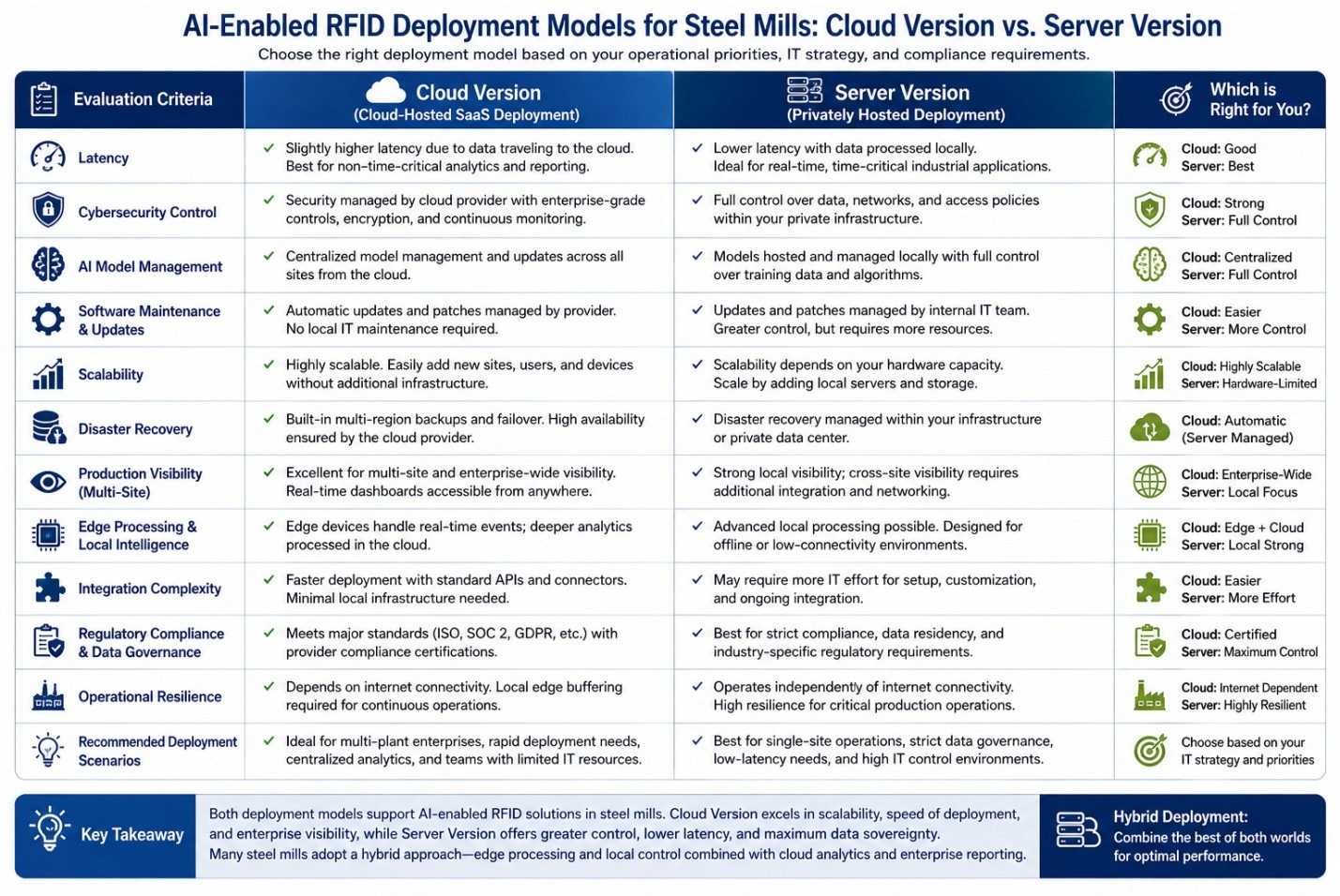
Cloud Version and Server Version Deployments
A Cloud Version is well suited for steel producers operating multiple manufacturing facilities that require centralized reporting, remote collaboration, software updates managed within cloud infrastructure, long-term analytics, and enterprise-wide production visibility. Cloud-hosted software simplifies multi-site benchmarking, centralized AI model management, and scalable data storage while reducing local infrastructure administration.
A Server Version is appropriate for facilities requiring greater control over operational data, lower communication latency, compliance with internal cybersecurity policies, or integration with privately hosted manufacturing software. Server deployments may operate on edge servers, customer-managed servers, factory servers, private data centers, or other privately hosted enterprise infrastructure. These environments allow production-critical AI functions to continue operating even when external connectivity is limited.
Many steel manufacturers implement hybrid deployments that combine local AI processing with centralized reporting and historical analysis, allowing time-sensitive operational decisions to remain close to production while supporting long-term optimization across multiple facilities.
For more than three decades, GAO has assisted customers throughout the United States and Canada, including Fortune 500 manufacturers, research organizations, universities, and government agencies by providing industrial RFID and IoT hardware supported by rigorous quality assurance and expert remote or onsite technical assistance.
Cloud vs. Server Version Deployment Comparison for AI-Enabled RFID in Steel Mills
Technical Capabilities and Operational Improvements for Steel Mills
Combining Industrial AI with RFID-supported operational data enables steel manufacturers to improve both production efficiency and business performance. These improvements result from continuous analysis of trusted operational information rather than isolated production events.
Production Visibility
AI continuously monitors production flow across steelmaking, casting, rolling, finishing, storage, and shipping.
Benefits include:
- Improved work-in-progress visibility
- Accurate production status
- Reduced search time for materials
- Faster response to production interruptions
- Better coordination between production departments
Quality Traceability
Steel quality depends on maintaining complete production history throughout manufacturing.
AI associates RFID-generated identification data with:
- Heat numbers
- Chemical composition
- Casting parameters
- Rolling schedules
- Inspection results
- Laboratory analysis
- Operator actions
- Maintenance history
Comprehensive genealogy supports quality investigations, customer documentation, and regulatory compliance.
Predictive Maintenance
Production equipment such as rolling mills, continuous casters, cranes, conveyors, pumps, motors, gearboxes, and cooling systems represent significant capital investments.
AI evaluates operational trends to identify:
- Bearing degradation
- Abnormal vibration
- Lubrication issues
- Temperature anomalies
- Component wear
- Maintenance priorities
Maintenance teams can schedule repairs before unexpected failures interrupt production.
Inventory Optimization
RFID-supported inventory information enables AI to recommend:
- Storage optimization
- Material replenishment
- Finished goods allocation
- Spare parts planning
- Scrap inventory management
- Coil yard organization
These improvements reduce unnecessary inventory movement while increasing warehouse efficiency.
Energy and Process Efficiency
Steel production consumes substantial electrical power, fuel, compressed air, and cooling resources.
AI identifies opportunities to:
- Improve furnace utilization
- Optimize rolling schedules
- Reduce idle equipment
- Balance production loads
- Minimize energy consumption
- Increase production yield
Operational Scalability
As production expands, AI systems can analyze increasing volumes of operational information without proportionally increasing manual monitoring activities. Consistent RFID identification across production areas also simplifies expansion into additional warehouses, production lines, and distribution centers.
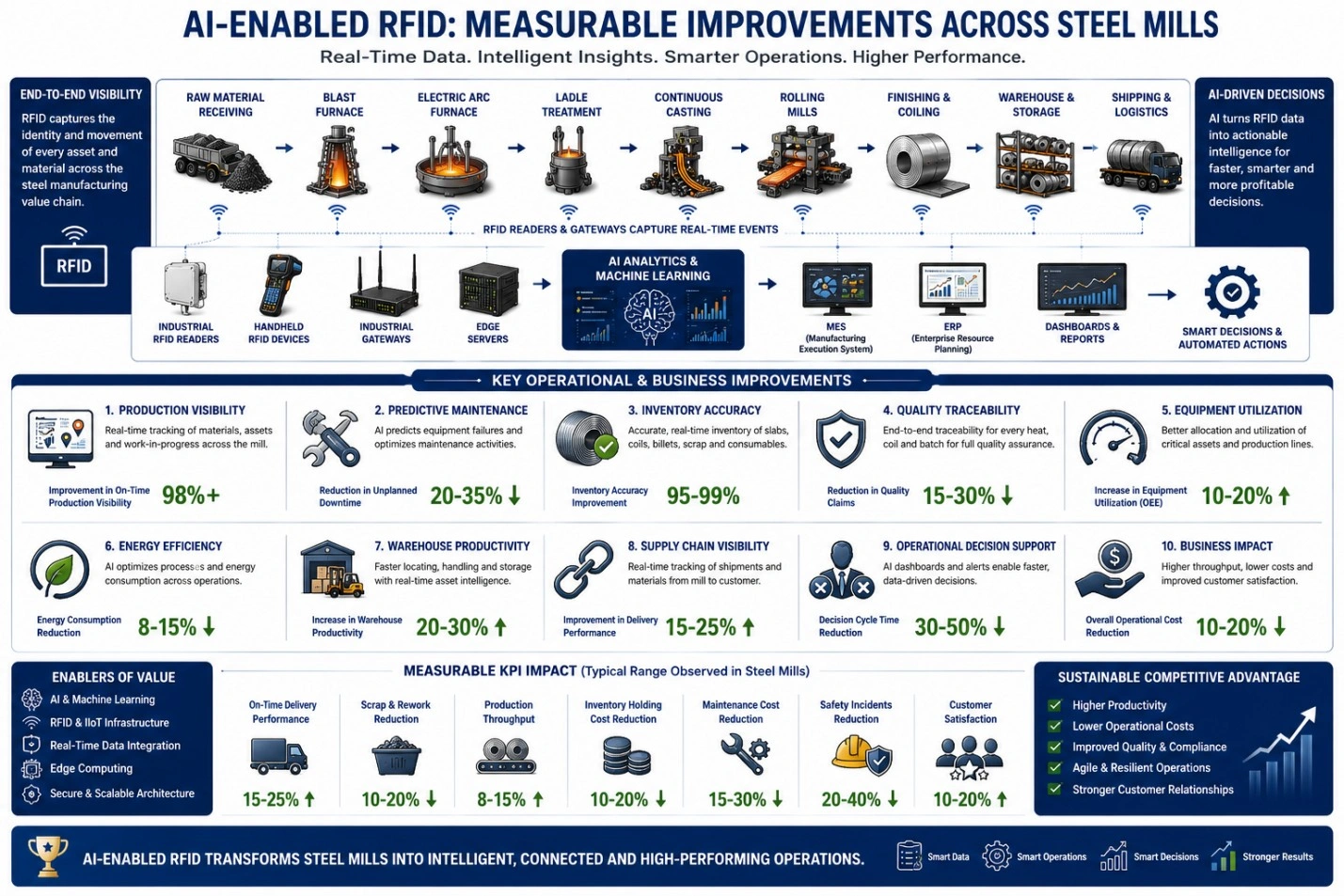
AI-Enabled RFID Benefits for Steel Mills: Operational Improvements and Business KPI Impact
Cybersecurity and Engineering Best Practices
Industrial AI solutions handling production information should follow established cybersecurity and engineering practices throughout deployment and ongoing operation.
Recommended practices include:
- Segment operational technology (OT) and information technology (IT) networks.
- Use role-based access control for production software and administrative functions.
- Encrypt communications between RFID readers, gateways, edge servers, and business systems.
- Apply secure authentication for operators, maintenance personnel, and system administrators.
- Maintain software updates using validated change management procedures.
- Monitor network traffic to detect unauthorized activity.
- Implement routine backup and disaster recovery procedures.
- Validate RFID read accuracy during commissioning and after production changes.
- Design redundancy for critical readers, gateways, and edge computing devices.
- Conduct periodic cybersecurity assessments aligned with recognized industrial security frameworks.
Engineering teams should also perform RF site surveys, evaluate metal interference, confirm antenna placement, and test read performance under normal production conditions before full deployment. These activities improve long-term reliability and reduce commissioning risks in challenging steel mill environments.
Expected Business Outcomes and Implementation Recommendations
Organizations implementing AI-supported RFID solutions within steel mills commonly pursue measurable operational objectives, including:
- Higher Overall Equipment Effectiveness (OEE)
- Improved production throughput
- Reduced unplanned downtime
- Increased inventory accuracy
- Better material traceability
- Faster order fulfillment
- Lower maintenance costs
- Reduced scrap generation
- Improved yield
- Enhanced production scheduling
- Stronger quality consistency
- Better workforce productivity
- Improved customer delivery performance
Successful implementation typically begins with a focused assessment of production bottlenecks, critical assets, and operational data requirements. Pilot deployments should validate read performance, software integration, and AI model accuracy before expanding across additional production areas. Continuous monitoring, periodic model refinement, and collaboration between production, maintenance, quality, and information technology teams help sustain long-term performance improvements.
Headquartered in New York City and Toronto, Canada, GAO is recognized among the world’s leading B2B and public-sector suppliers of RFID and BLE technologies. Working alongside its sister companies, GAO Research and GAO Tek, we continue investing in industrial IoT research and practical engineering solutions that support demanding manufacturing applications.
Advancing AI-Enabled Steel Mill Operations with GAO
Artificial Intelligence supported by reliable RFID data collection is reshaping how steel mills monitor production, optimize equipment utilization, improve quality traceability, and strengthen operational decision-making. By combining Industrial AI, AIoT technologies, industrial communications, and enterprise software integration, manufacturers gain actionable insight throughout the steel production lifecycle while improving productivity, safety, and resource utilization.
GAO helps organizations evaluate, deploy, and support industrial RFID hardware and related IoT solutions that address the practical requirements of steel manufacturing. Our experience supplying identification technologies, backed by extensive research, quality assurance, and technical support, enables customers to build dependable data collection systems that serve as the foundation for AI-driven operational improvement.
Building the Future of Industrial AI and IoT with Aperture Venture Studio and GAO RFID Inc.
For more than three decades, GAO Group of Companies has invested extensively in research and development of industrial RFID, BLE, and IoT technologies. As generative AI demonstrated significant value in industrial manufacturing, we expanded our focus on AI-enabled IoT solutions for steel mills and the broader metals manufacturing sector, and established Aperture Venture Studio to accelerate the development and growth of advanced Industrial AI and IoT solutions that address real-world manufacturing challenges.
Aperture has attracted leading AI and IoT technical experts, experienced business and operational leaders, invisual recofluential investors, and major industry participants. Through initiatives such as the Aperture Ventures Summit and TekSummit, we foster technical collaboration on advanced AI and IoT topics while strengthening diverse technical communities. We welcome participation as:
- Advisors, co-founders, or employees
- Investors
- Customers
This collaboration supports continued innovation in Industrial AI, RFID, and connected manufacturing technologies for the future of steel production.