
AI and RFID for Industrial Gases
AI-Powered Industrial Gas Tracking and Operations
AI and RFID for Industrial Gases combines automated identification with AI-driven analysis to improve the control of gas cylinders, bundles, tube trailers, cryogenic vessels, and other returnable assets throughout filling, storage, distribution, customer use, and recovery. Rather than relying on manual cylinder counts, handwritten records, barcode scans, or periodic audits, RFID captures asset identity and movement events as industrial gas containers pass through filling plants, cylinder yards, loading bays, distribution depots, customer sites, and maintenance areas.
AI converts these RFID events into operational insight. It can identify missing cylinders, detect abnormal dwell times, estimate asset availability, improve cylinder turnaround, prioritize recovery activities, reconcile inventory, and support predictive maintenance decisions. For industrial gas suppliers handling oxygen, nitrogen, argon, carbon dioxide, hydrogen, helium, acetylene, specialty gases, and medical gases, this capability addresses a persistent operational problem: the gas product may be consumed, but the high-value container remains a reusable asset that must be recovered, inspected, maintained, and returned to circulation.
GAO supports organizations with RFID hardware products and systems that can provide the identification layer required for these AI-driven industrial gas tracking solutions.
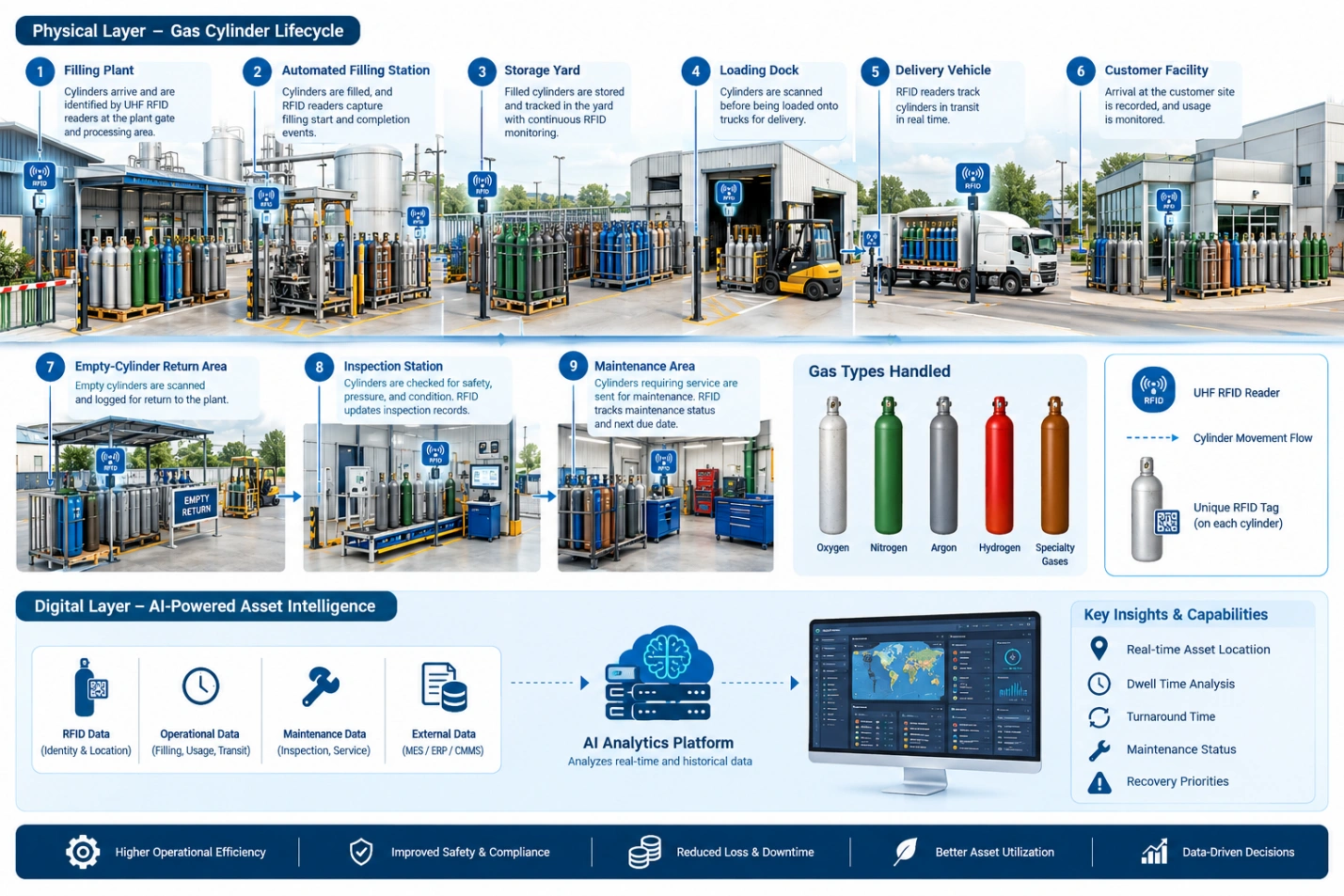
AI-Powered RFID Gas Cylinder Lifecycle Tracking
Why Industrial Gas Operations Need AI-Driven Asset Visibility
Industrial gas operations depend on a closed-loop circulation of reusable pressure vessels and associated equipment. A cylinder can be filled at one facility, transferred through several distribution locations, remain at a fabrication plant or hospital for an extended period, return empty through a separate logistics process, and then undergo inspection before being returned to service. The operational difficulty is not simply determining how many cylinders exist. The more important questions concern which specific assets are available, where they were last identified, what gas service they support, whether they are empty or full, how long they have remained at a location, and whether inspection or maintenance is required.
Manual reconciliation becomes increasingly unreliable when organizations manage large cylinder populations across multiple filling plants, depots, distributors, customer sites, and field service routes. A cylinder may physically exist while being digitally recorded in the wrong inventory location. Another may remain at a customer facility beyond the expected rental period. Empty cylinders may accumulate at a remote location while the filling plant experiences an apparent shortage.
AI improves this environment by evaluating RFID event histories together with operational data from industrial gas management systems, ERP software, maintenance records, dispatch systems, customer accounts, and production processes. Instead of treating every read as an isolated transaction, AI can evaluate sequences and patterns.
Examples include:
- Detecting cylinders that have exceeded expected customer dwell time.
- Identifying probable loss or unauthorized movement when expected RFID events are missing.
- Estimating the likelihood that a cylinder remains at a customer site despite an outdated inventory record.
- Forecasting future cylinder shortages by analyzing demand, turnaround time, and return patterns.
- Prioritizing recovery activities based on asset value, dwell duration, customer location, and predicted recovery probability.
- Detecting unusual movement patterns that may indicate incorrect loading, cross-depot transfers, or process exceptions.
- Identifying maintenance candidates based on service history, inspection schedules, utilization cycles, and asset condition data.
- Improving cylinder fleet balancing among filling plants, distribution centers, and customer territories.
Artificial Intelligence of Things, commonly called AIoT or AI and IoT, combines artificial intelligence with IoT devices, sensors, connected equipment and industrial systems. Within industrial gas operations, RFID provides a particularly useful identification and movement-data layer, while Industrial AI, Edge AI, machine learning, and related analytics convert operational events into decisions and actions.
GAO has helped organizations obtain RFID hardware products and systems for identification and tracking applications where dependable asset identity is essential to operational visibility.
The Industrial Gas Asset Lifecycle Behind RFID Data
A practical industrial gas RFID solution should be designed around the actual lifecycle of cylinders and other returnable containers. Deployments that focus only on reader installation without mapping operational transitions often produce large quantities of identification data but limited business value.
A typical industrial gas asset workflow includes several connected stages.
Cylinder Identification and Commissioning
Each cylinder, bundle frame, microbulk vessel, tube trailer component, or other tracked asset receives a persistent digital identity. The identifier should be linked to relevant master data, such as:
- Asset serial number.
- RFID tag identifier.
- Cylinder type and water capacity.
- Working pressure and design specification.
- Gas service compatibility.
- Valve configuration.
- Ownership or fleet assignment.
- Inspection and test history.
- Maintenance status.
- Customer or distribution territory.
- Regulatory and certification information.
Tag commissioning should include verification that the identifier can be reliably associated with the physical asset. Duplicate identifiers, incorrect master-data associations, and undocumented replacement tags can create persistent data-quality problems later in the deployment.
Filling and Production Operations
Industrial gas cylinders enter filling operations after receiving, inspection, preparation, and scheduling. RFID events can establish when an identified cylinder enters the filling workflow, moves through staging, and exits as a completed production asset.
AI can compare production schedules with observed asset flow. If a cylinder population required for a particular gas service is not reaching the filling area at the expected rate, the system can flag a potential availability constraint before it disrupts production planning.
The value of this approach is particularly relevant where cylinders must be segregated by gas service, valve type, pressure rating, cleanliness requirements, or specialty-gas handling procedures. AI analysis can help identify unusual process sequences that may require operator review.
Full Cylinder Yard and Depot Management
After filling, cylinders may move into staging areas, storage racks, cage systems, distribution yards, or loading lanes. RFID readers installed at controlled transition points can capture movements between operational zones.
AI-driven inventory management can then evaluate:
- Full-cylinder availability by gas type and depot.
- Aging inventory and prolonged storage.
- Asset accumulation in incorrect zones.
- Differences between expected and observed inventory.
- Repeated internal movement with no corresponding shipment.
- Cylinder shortages affecting planned deliveries.
Industrial gas facilities often experience a distinction between accounting inventory and operationally usable inventory. A cylinder recorded in a database is not necessarily available for immediate dispatch. It may be awaiting inspection, positioned in the wrong yard, reserved for a production order, undergoing maintenance, or physically inaccessible within a storage configuration. AI models can combine RFID movement history with operational status to estimate usable inventory more accurately.
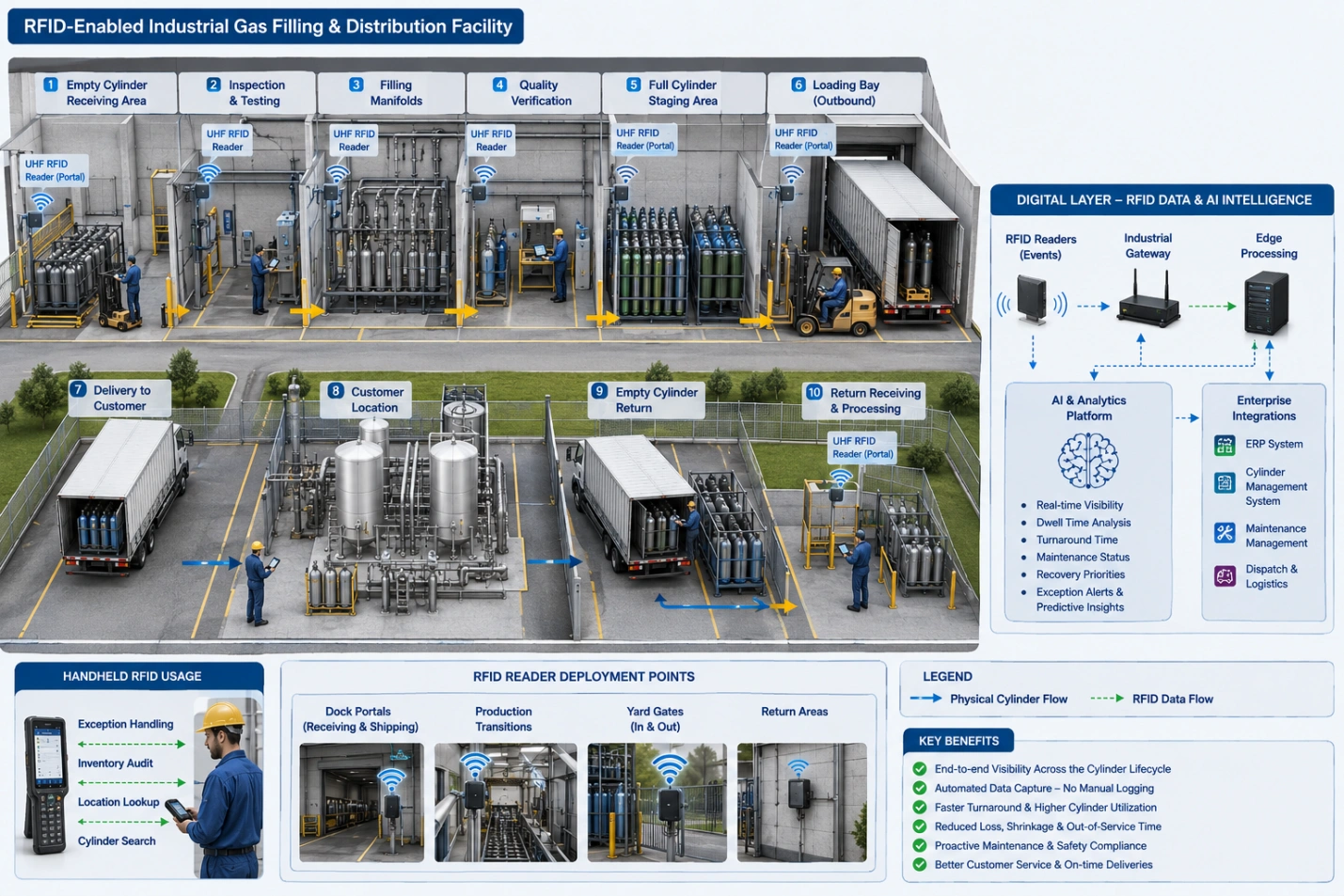
RFID-Enabled Industrial Gas Filling & Distribution Facility
AI Applications for Cylinder Tracking and Industrial Gas Asset Management
The most valuable AI applications begin with specific industrial gas operating problems rather than with the RFID hardware itself. RFID provides the identity and event history required to support AI models, but the business outcome depends on how those events are interpreted within the cylinder circulation process.
AI Asset Location and Last-Known-Position Analysis
A fixed reader does not necessarily provide continuous real-time location. Industrial gas deployments should distinguish between precise location, zone-level presence, transition detection, and last-known position.
AI can analyze sequential RFID reads to determine the most probable current operational zone for a cylinder. For example, a cylinder read at a filling exit, followed by a staging-area event and then a loading-bay event, can be assigned a high probability of being in the outbound distribution workflow. If the expected loading confirmation never occurs, the cylinder can be classified as an exception requiring investigation.
This probabilistic approach is useful in large cylinder yards where full real-time location infrastructure may not be economically justified for every asset.
AI Cylinder Dwell-Time Management
Long dwell times are a major indicator of inefficient asset circulation. AI can establish expected dwell-time patterns by customer type, gas category, delivery territory, seasonality, contract conditions, and historical consumption.
The system can identify:
- Customer locations retaining cylinders longer than expected.
- Empty cylinders awaiting collection.
- Full cylinders aging in depot inventory.
- Cylinders stalled between inspection and filling.
- Assets repeatedly circulating through internal locations without productive utilization.
Rather than generating the same alert for every delayed cylinder, AI can prioritize exceptions according to business impact. A high-value specialty-gas cylinder or a constrained cylinder type may receive a higher recovery priority than a common asset with adequate fleet availability.
AI-Based Loss and Shrinkage Detection
Cylinder loss is often difficult to identify immediately because the last RFID event may have occurred days, weeks, or months before the asset is formally classified as missing.
Machine learning models can analyze historical recovery patterns and determine when an asset’s movement history deviates from normal circulation. Factors may include:
- Time since last confirmed RFID event.
- Expected return cycle for the customer.
- Previous movement frequency.
- Customer location and delivery history.
- Asset type and replacement cost.
- Contract or rental status.
- Known inventory discrepancies.
- Similar movement patterns associated with previously recovered or unrecovered cylinders.
The resulting output should be treated as a risk score rather than proof of loss. This distinction is important because RFID coverage gaps, missed reads, manual process exceptions, and delayed system updates can all produce incomplete histories.
AI Fleet Balancing for Cylinders and Bundles
Industrial gas suppliers often redistribute cylinders between filling plants, depots, distributors, and customer regions. Imbalances can result in unnecessary emergency transfers, delayed production, or excessive capital expenditure on additional containers.
AI forecasting can combine historical RFID circulation with demand forecasts, production schedules, seasonal consumption, planned maintenance, and transportation constraints. The system can recommend repositioning actions before shortages occur.
Useful decision outputs may include:
- Expected cylinder surplus or shortage by location.
- Recommended inter-depot transfers.
- Priority cylinder classes for recovery.
- Predicted turnaround constraints.
- Production capacity affected by container availability.
- Required safety-stock adjustments.
AI Maintenance and Inspection Prioritization
RFID should not replace mandatory inspection records or statutory test documentation. Its role is to improve the association between physical asset identity and maintenance processes.
AI can help maintenance teams prioritize assets by combining RFID-based circulation history with:
- Inspection due dates.
- Hydrostatic test schedules where applicable.
- Valve maintenance records.
- Repair history.
- Utilization cycles.
- Asset age.
- Failure or rejection patterns.
- Operational criticality.
This approach helps maintenance personnel focus attention on the containers most likely to create availability or compliance problems.
GAO can supply RFID identification hardware suitable for linking physical industrial gas assets with maintenance, inspection, and asset-management workflows.
Industrial Gas Applications Where AI and RFID Deliver Practical Value
Industrial gas operations contain several distinct environments. Each requires different read ranges, tag placement approaches, workflow logic, and AI objectives.
High-Pressure Gas Cylinder Circulation
High-pressure cylinders used for oxygen, nitrogen, argon, carbon dioxide, hydrogen, helium, and other compressed gases frequently move through a closed-loop distribution cycle.
RFID-supported AI can improve:
- Cylinder ownership and custody visibility.
- Filling-plant inventory reconciliation.
- Depot-level asset balancing.
- Customer dwell-time analysis.
- Empty-cylinder recovery.
- Lost-cylinder investigation.
- Utilization measurement.
- Maintenance workflow coordination.
Metal cylinders require careful RFID engineering because the metal body can affect antenna performance. Tag location, polarization, mounting method, reader geometry, and surrounding cylinder density should be tested under realistic operating conditions rather than selected solely from laboratory read-range specifications.
Acetylene and Specialty Gas Operations
Acetylene cylinders and specialty-gas containers may involve additional handling requirements, specialized asset classes, segregation rules, and higher individual asset value. Specialty gases can also involve smaller but more valuable container populations where identification errors have a disproportionate operational effect.
AI can help monitor:
- Asset circulation by specialty gas family.
- Customer retention of high-value containers.
- Long-duration custody.
- Maintenance and inspection status.
- Cylinder availability for scheduled orders.
- Abnormal transfer patterns.
The solution should maintain clear separation between RFID asset identity and authoritative product-quality records. RFID events may support traceability, but product certification, analytical data, and quality-release decisions should remain connected to validated quality-management processes.
Cryogenic Containers and Microbulk Assets
Industrial gas companies also manage cryogenic liquid containers, portable vessels, dewars, and microbulk equipment. These assets may have different circulation cycles and operating environments than conventional compressed-gas cylinders.
AI can combine asset identity with delivery, service, inspection, and utilization information to improve:
- Container availability.
- Customer equipment utilization.
- Return scheduling.
- Maintenance planning.
- Asset deployment optimization.
- Exception identification.
RFID hardware selection for cryogenic environments must account for temperature exposure, condensation, mechanical handling, enclosure design, and the physical characteristics of the tagged asset.
Tube Trailers and Bulk Gas Distribution Equipment
Tube trailers and related transport equipment represent higher-value assets with complex custody and maintenance requirements. RFID can supplement existing vehicle telematics, GPS, transportation systems, and inspection records by providing identity verification at facility gates, loading areas, maintenance zones, and customer handoff points.
AI can identify inconsistencies between expected and observed movement, improve equipment utilization analysis, and support maintenance scheduling. GPS may provide geographic movement while RFID verifies asset identity at controlled operational transitions. Combining both data sources can produce more reliable logistics records than either source used alone.
AI-Driven RFID Use Case Matrix for Industrial Gas Asset Management
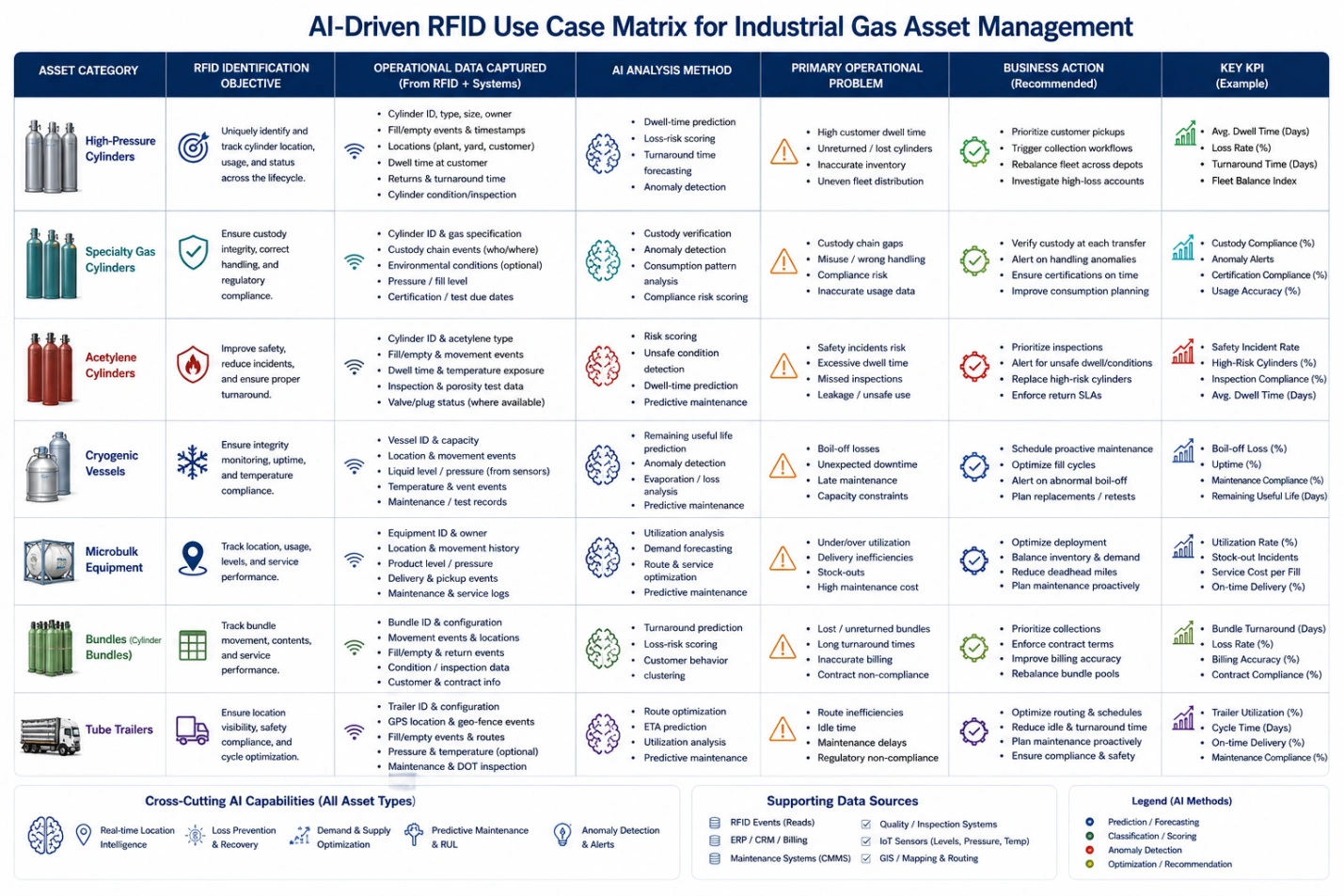
From RFID Event Capture to AI-Driven Industrial Gas Decisions
A reliable industrial gas solution follows a complete data path. The objective is not to collect the maximum possible number of RFID reads. The objective is to capture trustworthy operational events and convert them into actions that improve cylinder circulation, asset availability, safety, compliance, and utilization.
Data Acquisition at Industrial Gas Process Points
RFID events can be captured at locations such as:
- Empty-cylinder receiving stations.
- Inspection and quarantine areas.
- Cylinder filling lines.
- Full-cylinder staging zones.
- Warehouse or cage exits.
- Loading docks.
- Distribution yard gates.
- Vehicle loading and unloading points.
- Customer custody-transfer locations.
- Return processing areas.
- Maintenance and valve service stations.
UHF RFID is generally useful where automated portal or zone-level reading of multiple industrial gas assets is required. HF RFID can be appropriate for closer-range identification processes, while LF RFID may be considered for specialized short-range applications where environmental or material conditions favor its operating characteristics. The selection should be driven by the actual cylinder material, read distance, process speed, reader geometry, tag survivability, and required identification reliability.
Communication and Edge Processing
RFID readers typically communicate with local computing resources through Ethernet, Wi-Fi, serial interfaces, or other industrial communication methods. Reader data can be normalized by middleware or edge software before being transmitted to central systems.
Edge processing is particularly useful when industrial gas facilities require:
- Low-latency event filtering.
- Local operation during temporary network interruptions.
- Duplicate-read suppression.
- Reader health monitoring.
- Local integration with production equipment.
- Reduced transmission of unnecessary raw read data.
An edge system can convert thousands of repeated tag reads into a smaller set of meaningful events such as “Cylinder entered filling,” “Cylinder exited staging,” or “Cylinder loaded for dispatch.”
AI Processing and Operational Analytics
AI models can run in cloud-hosted environments, private servers, factory servers, or hybrid deployments. Typical analytical methods include anomaly detection, classification, time-series forecasting, probabilistic location estimation, optimization, and machine learning-based risk scoring.
The AI layer may answer operational questions such as:
- Which cylinder populations are likely to become constrained?
- Which customer sites contain overdue returnable assets?
- Which depot will experience a shortage of a specific cylinder class?
- Which assets exhibit abnormal movement histories?
- Which maintenance activities should be prioritized to protect fleet availability?
AI outputs should be linked to defined operational actions. A loss-risk score without a recovery workflow, for example, has limited value.
Middleware and Enterprise System Integration
The RFID and AI solution can exchange information with:
- ERP systems.
- Industrial gas cylinder management software.
- Asset management systems.
- Computerized maintenance management systems.
- Quality management software.
- Laboratory information management systems where specialty gas analysis is relevant.
- Warehouse management systems.
- Transportation and dispatch software.
- Customer relationship and contract-management systems.
- Manufacturing execution systems.
- Business analytics and reporting software.
Integration should use controlled APIs, message brokers, database connectors, or established enterprise interfaces. MQTT can support event-oriented communication between distributed systems, while HTTPS-based APIs may be appropriate for business-system integration. OPC UA or industrial interfaces may be used where RFID events interact with production or automation environments.
The authoritative system for each data domain should be clearly defined. Asset master data, maintenance status, customer ownership, production status, and RFID observations should not be allowed to overwrite one another without governance rules.
RFID, AI Software, and Deployment Models for Industrial Gases
A complete AI-powered industrial gas tracking solution requires coordinated identification hardware, event-processing software, AI models, integration services, communication infrastructure, and cybersecurity controls. Each component should be selected according to cylinder circulation patterns, facility conditions, asset value, and required business outcomes.
UHF, HF, and LF RFID Hardware
UHF RFID can support automated identification of multiple tagged cylinders or bundles at portals, dock doors, yard transitions, and other controlled process points. UHF deployments require particular attention to metal interference, liquid or cryogenic conditions, tag orientation, reader antenna placement, and dense asset populations.
HF RFID can support closer-range identification where controlled interaction with individual industrial gas assets is preferred. LF RFID may be appropriate for specific short-range identification requirements and specialized environments. The correct technology should be established through site testing rather than assuming that the longest advertised read range will produce the best operational result.
GAO provides RFID hardware products that can support industrial identification and asset-tracking requirements, including deployments where tag durability and reader configuration must be evaluated against demanding field conditions.
RFID Middleware and Event Management
Middleware converts raw reader output into usable industrial gas events. Its functions may include device management, tag filtering, duplicate suppression, zone assignment, event sequencing, data validation, buffering, and integration routing.
A well-designed event model is essential. For example, repeated reads of a cylinder inside a portal zone should not automatically be interpreted as multiple operational transfers. The software should determine when an actual transition occurred.
Cloud Version
A Cloud Version can centralize RFID event management, AI analytics, reporting, and integration across geographically distributed filling plants and depots. This model is appropriate when an industrial gas organization needs centralized visibility across multiple locations and can support secure network connectivity.
Potential advantages include:
- Centralized AI model management.
- Cross-facility cylinder utilization analysis.
- Simplified software updates.
- Consolidated reporting.
- Easier scaling to additional depots and customer service territories.
Cloud deployment requires secure identity management, encrypted communications, access controls, API security, backup procedures, and appropriate data-governance policies.
Server Version
A Server Version deploys RFID and AI software on customer-managed servers, edge servers, private data centers, factory servers, or other privately hosted infrastructure. This approach can be appropriate where industrial gas facilities require stronger control over operational data, local processing, limited external connectivity, or integration with internally managed production systems.
A Server Version can also support hybrid operation, where RFID events are processed locally and selected data is synchronized with centralized AI or reporting systems.
The deployment choice should be based on operational connectivity, cybersecurity policy, integration requirements, latency, geographic distribution, and internal IT governance rather than on a general preference for cloud or private infrastructure.
Security and Operational Reliability
Industrial gas RFID systems should apply security controls across devices, networks, software, and integrations. Practical measures include authenticated device access, encrypted communications where supported, network segmentation, role-based permissions, audit logging, secure API management, software patching, backup and recovery procedures, and monitoring for abnormal device behavior.
Operational reliability also requires reader-health monitoring and fallback procedures. A failed portal reader should not silently create a false impression that no cylinders moved through the process. Exception workflows should distinguish between “no asset movement detected” and “reader unavailable or communication interrupted.”
This distinction becomes particularly important when AI models use RFID event absence as an input for loss detection or operational anomaly analysis. Data-quality monitoring must therefore be treated as part of the AI solution itself, not as a separate IT concern.
Engineering Considerations for Reliable Industrial Gas RFID Deployment
RFID performance in industrial gas operations depends heavily on physical deployment conditions. Cylinders are commonly metallic, closely packed, moved on carts or pallets, stored in racks, and handled through environments containing structural steel, vehicles, loading equipment, and changing inventory density. These conditions can alter read behavior significantly.
A deployment should begin with a site survey and process study that examines the actual movement path of representative cylinder populations. Engineering teams should test tags on different cylinder sizes, materials, surface conditions, orientations, and rack configurations.
Important design considerations include:
- Tag mounting location and mechanical protection.
- Exposure to impact, abrasion, moisture, cleaning, and temperature variation.
- Read reliability for single cylinders and dense cylinder groups.
- Antenna polarization and orientation.
- Reader placement relative to forklifts, carts, conveyors, and loading equipment.
- Cross-read prevention between adjacent process zones.
- Portal speed and asset movement direction.
- Metal reflection and multipath effects.
- Power and network availability.
- Maintenance access to readers and antennas.
- Procedures for damaged or replaced tags.
Commissioning should include acceptance testing based on defined operational scenarios rather than only checking whether tags can be read. A meaningful test might verify whether a mixed batch of full and empty cylinders moving through a loading lane can be identified at the required process speed without unacceptable cross-zone reads.
Practical KPIs for AI-Powered Industrial Gas Asset Management
Industrial gas RFID projects should establish measurable baselines before deployment. The most useful KPIs are directly connected to asset circulation, availability, process reliability, and financial exposure.
Examples include:
- Cylinder turnaround time.
- Average customer dwell time.
- Empty-cylinder recovery time.
- Full-cylinder inventory aging.
- Asset utilization rate.
- Cylinder loss or shrinkage rate.
- Inventory reconciliation accuracy.
- Read-event accuracy at critical transitions.
- Percentage of assets with current inspection status.
- Maintenance backlog affecting available cylinder capacity.
- Cylinder availability by gas service.
- Inter-depot transfer frequency.
- Emergency cylinder procurement or transfer events.
- Production delays caused by container shortages.
- Cost per recovered returnable asset.
- Customer-site asset recovery success rate.
AI models should be evaluated against operational outcomes, not only model accuracy. A highly accurate prediction that does not change dispatch, recovery, maintenance, or production decisions may provide less value than a simpler model that consistently improves cylinder turnaround.
Operational Improvements and Business Value from AI-Driven RFID
Combining AI with RFID-based identification changes industrial gas asset management from periodic reconciliation toward continuous operational decision support. The most important gains come from improving the quality and usefulness of cylinder movement data, then connecting that information to filling, distribution, maintenance, customer service, and recovery workflows.
Higher Asset Utilization
Industrial gas suppliers can operate more effectively with the same cylinder population when unnecessary dwell time and avoidable losses are reduced. AI can identify assets that remain inactive, accumulate at specific customer locations, or circulate inefficiently between depots.
Improved utilization can reduce pressure to purchase additional cylinders solely because existing assets cannot be located or returned quickly enough. The operational value depends on whether recovery teams, dispatch personnel, and account managers receive actionable priorities rather than raw lists of overdue assets.
Better Cylinder Availability for Production and Distribution
A cylinder shortage can affect filling schedules even when the organization owns a large total fleet. The actual problem may be that usable containers are concentrated in the wrong territory, awaiting return, undergoing maintenance, or sitting unprocessed in a depot.
AI forecasting supported by RFID movement history can improve visibility into expected availability. Production and logistics teams can use predicted shortages to adjust recovery schedules, reposition assets, modify safety-stock levels, or coordinate inter-depot transfers.
More Accurate Inventory Reconciliation
Traditional inventory processes may depend on manual counts that interrupt operations and provide only periodic snapshots. RFID can automate identification at selected process points, while AI can identify discrepancies that deserve investigation.
The objective is not simply to produce a larger volume of data. A useful system can distinguish among:
- A probable physical inventory discrepancy.
- A delayed system transaction.
- A missed RFID event.
- A cylinder located in an unexpected operational zone.
- A temporary process exception.
- A reader or network availability problem.
This distinction helps industrial gas teams avoid treating every mismatch as an asset-loss event.
Faster Recovery of Returnable Assets
Recovery operations benefit from prioritization. A simple overdue list may contain thousands of cylinders with very different business importance.
AI can rank recovery opportunities using factors such as:
- Duration since the last confirmed movement.
- Asset replacement value.
- Cylinder class and current fleet availability.
- Customer location.
- Historical return behavior.
- Contract status.
- Delivery-route proximity.
- Probability of successful recovery.
This enables field teams to focus collection activities on assets where intervention is likely to provide the greatest operational or financial benefit.
Improved Maintenance Planning
Cylinder availability depends on more than fleet size. Inspection, hydrostatic testing where applicable, valve repair, cleaning, recertification, and other maintenance activities can temporarily remove containers from service.
RFID event histories can help establish actual asset circulation and identify where containers are physically entering or leaving maintenance processes. AI can combine this information with maintenance records to improve prioritization and reduce unexpected availability constraints.
GAO provides RFID products and technical support that can help organizations establish dependable identification at the physical points where maintenance and asset circulation intersect.
Scaling Industrial Gas RFID from Pilot to Multi-Site Operations
A successful pilot should validate both technical performance and operational value. Installing readers at a single door or conducting a one-time inventory demonstration does not establish that a solution will perform reliably across filling plants, depots, distribution fleets, and customer return processes.
A practical implementation sequence can include:
- Mapping the cylinder lifecycle and identifying high-value transition points.
- Establishing baseline KPIs for turnaround, loss, inventory accuracy, and recovery.
- Selecting representative cylinder types, tags, and operating environments.
- Performing on-site read testing with realistic cylinder density and movement.
- Defining authoritative data sources and master-data ownership.
- Deploying a limited pilot at a process point with measurable business impact.
- Validating RFID event accuracy and exception handling.
- Integrating event data with the relevant cylinder, maintenance, production, or business software.
- Training operators, maintenance teams, warehouse personnel, and supervisors.
- Measuring operational improvements against the pre-deployment baseline.
- Expanding to additional facilities after confirming repeatable engineering practices.
Pilot Selection Matters
The best pilot location is not necessarily the easiest place to install RFID. A highly controlled doorway may demonstrate excellent read performance while producing little operational value.
Industrial gas organizations should consider pilot processes where existing problems can be measured clearly. Examples may include empty-cylinder receiving, full-cylinder dispatch verification, high-value specialty gas asset recovery, depot inventory reconciliation, or maintenance-process identification.
The pilot should answer several questions:
- Can the selected tag survive the expected handling conditions?
- Does the read zone identify the intended cylinder population without excessive cross-reads?
- Can operational personnel handle exceptions without creating manual workarounds that defeat automation?
- Does the resulting data improve a specific business decision?
- Can the design be replicated at other sites without major redesign?
Data Quality Before AI Model Expansion
AI cannot compensate indefinitely for incorrect asset master data or inconsistent operational events. Industrial gas projects should establish data-governance procedures before deploying more advanced forecasting or optimization models.
Important controls include:
- One authoritative identifier for each physical asset.
- Controlled procedures for RFID tag replacement.
- Validation of asset-to-tag associations.
- Consistent definitions for full, empty, maintenance, quarantine, and retired status.
- Monitoring of reader uptime and communication failures.
- Detection of duplicate or improbable events.
- Audit trails for manual corrections.
- Periodic comparison between system records and physical conditions.
A useful implementation lesson is that event confidence should accompany AI analysis. If a predicted asset location is based on incomplete RFID coverage, the software should indicate the confidence level rather than presenting the result as a confirmed physical fact.
AI-Powered RFID Deployment Decision Tree for Industrial Gas Operations
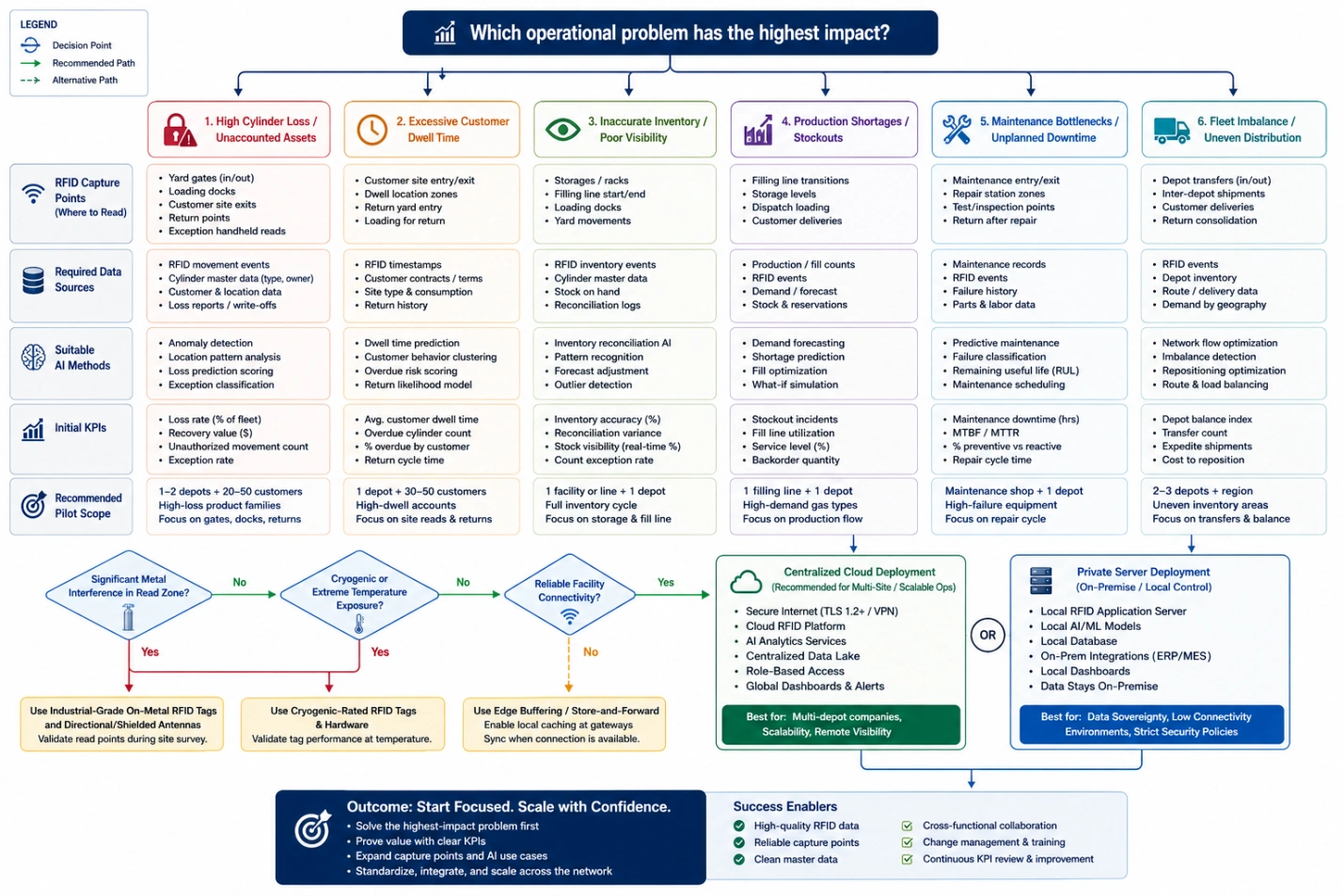
Integration with Industrial Gas Software and Business Processes
AI-driven RFID produces the greatest value when it participates in existing industrial gas workflows instead of becoming an isolated tracking application.
A cylinder identification event may need to trigger or validate a process within several different systems. For example, a cylinder leaving a filling area may require production confirmation, inventory status changes, quality-release verification, dispatch preparation, and maintenance-status validation.
Integration planning should therefore define what each system owns.
ERP and Financial Systems
ERP software may maintain customer records, material information, inventory values, purchasing, invoicing, and financial controls. RFID events can supplement these records with physical asset observations.
Integration rules should prevent automated RFID events from incorrectly changing financial or contractual records without the appropriate business validation.
Cylinder and Asset Management Software
Specialized industrial gas software may maintain cylinder ownership, customer custody, rental status, asset classification, and service history. This software is often a logical destination for validated RFID movement events.
AI can analyze historical information from these records to calculate:
- Expected turnaround periods.
- Customer retention patterns.
- Asset utilization.
- Recovery priorities.
- Fleet availability risks.
Maintenance and Inspection Systems
Computerized maintenance management systems and related applications can store inspection requirements, work orders, repair histories, and maintenance status.
RFID can associate the physical asset with its maintenance workflow. AI can then help prioritize work based on fleet constraints and asset utilization.
Production and Filling Operations
Production scheduling and filling systems can benefit from visibility into available cylinder populations. RFID event data can help verify that the expected container classes are entering and leaving designated process areas.
AI can identify patterns that suggest an emerging container shortage or process bottleneck. Such findings should support human operational decisions rather than automatically override safety procedures or qualified operator controls.
Transportation and Distribution Software
Dispatch systems, fleet-management software, and route planning applications can use validated asset movement information to improve delivery and collection planning.
A combined data model may associate:
- Cylinder identity.
- Gas service.
- Depot.
- Customer.
- Delivery route.
- Vehicle.
- Last confirmed operational event.
- Return status.
- Recovery priority.
This information can support better decisions about which assets should be collected during a scheduled delivery route.
AI Methods Used in Industrial Gas RFID Systems
AI methods should match the operational problem and available data. Complex models are not always preferable. A transparent forecasting or anomaly-detection model may provide greater operational trust than a difficult-to-explain model with marginally higher technical accuracy.
Anomaly Detection
Anomaly detection can identify movement sequences that differ from established industrial gas workflows.
Examples include:
- A cylinder appearing at a loading zone without a preceding production or inventory event.
- An unexpected depot transfer.
- A specialty gas container entering an inappropriate operational workflow.
- Repeated movement between two zones without a productive process outcome.
- A prolonged absence of expected return events.
Demand and Availability Forecasting
Time-series models and machine learning can forecast cylinder demand and available fleet capacity using historical consumption, production schedules, seasonal trends, customer behavior, maintenance schedules, and RFID-based turnaround information.
Forecasting can help identify future constraints before they affect scheduled deliveries.
Optimization
Optimization models can evaluate competing options for repositioning cylinders, assigning recovery priorities, or balancing assets among locations.
The model can consider:
- Transportation distance.
- Available cylinder populations.
- Customer demand.
- Production capacity.
- Asset criticality.
- Recovery probability.
- Maintenance requirements.
Human-defined operational constraints should remain part of the optimization process, particularly where safety, regulated handling, or contractual obligations are involved.
Probabilistic Classification
Some industrial gas RFID data represents uncertainty. A missed read does not always mean that a cylinder failed to move, and a last-known location is not always a confirmed current location.
Probabilistic models can estimate likely asset states such as:
- Probably at customer location.
- Likely awaiting return.
- Likely in depot storage.
- Possible inventory discrepancy.
- Requires manual verification.
This approach can improve exception management by helping operators focus on the most credible problems first.
Generative AI for Operational Knowledge Access
Generative AI can support authorized personnel by retrieving and summarizing approved information from industrial gas procedures, asset records, maintenance documentation, RFID event histories, and operational reports.
Potential uses include:
- Explaining why a cylinder was flagged for recovery.
- Summarizing an asset’s recent movement history.
- Assisting supervisors with investigation of inventory discrepancies.
- Retrieving approved maintenance procedures.
- Generating structured operational summaries.
Generative AI should use controlled access, role-based permissions, approved data sources, and human review for decisions involving safety, regulatory compliance, or product quality.
Safety, Compliance, and Data Governance Considerations
Industrial gas operations involve pressurized containers, hazardous materials, cryogenic fluids, specialized gases, and regulated handling procedures. AI and RFID systems should support safety and compliance processes without being presented as substitutes for required inspections, pressure-vessel testing, operator qualifications, or emergency procedures.
Relevant operational requirements may involve applicable rules and standards from organizations and authorities such as:
- U.S. Department of Transportation requirements for hazardous materials transportation.
- Occupational Safety and Health Administration workplace requirements.
- Pipeline and Hazardous Materials Safety Administration regulations.
- Compressed Gas Association guidance and industry standards.
- Occupational and facility safety requirements applicable to compressed and cryogenic gases.
- Pressure-vessel inspection and testing requirements.
- Applicable National Fire Protection Association codes.
- International or local dangerous-goods requirements for cross-border distribution.
- Quality and traceability requirements for specialty and medical gases where applicable.
The exact regulatory requirements depend on gas type, container design, geography, transportation mode, customer application, and facility operations. Organizations should validate their RFID and AI workflows against the requirements that govern their specific operations.
Data Governance for Physical Asset Identity
A critical rule is that the digital identity must remain reliably associated with the physical cylinder.
Organizations should define:
- Who is authorized to commission or replace a tag.
- How damaged tags are recorded.
- How duplicate identifiers are prevented.
- Which software system owns the master asset record.
- How retired cylinders are removed from active circulation.
- How temporary process exceptions are documented.
- How RFID event history is retained and audited.
GAO can assist with the RFID identification layer while customers and their engineering, operations, IT, cybersecurity, and compliance teams define the policies governing operational data and business decisions.
Common Deployment Mistakes and How to Avoid Them
Several recurring engineering and operational mistakes can reduce the value of industrial gas RFID projects.
Selecting RFID Hardware Before Understanding Cylinder Movement
A reader and tag combination should not be selected solely from a specification sheet. Industrial gas cylinders may be transported in racks, densely grouped, rotated during handling, and exposed to complex metal environments.
The better approach is to test representative assets under realistic conditions.
Treating Every RFID Read as a Business Transaction
Raw reader output may contain repeated observations and temporary read fluctuations. Without event processing, a stationary cylinder can generate a large number of records that do not represent meaningful operational activity.
Middleware should convert raw observations into validated events.
Assuming RFID Provides Complete Location Coverage
A controlled RFID deployment may provide transition-based visibility rather than continuous location tracking. The system should clearly distinguish between confirmed reads, inferred positions, and unknown locations.
AI can estimate likely location, but estimated location should not be represented as confirmed physical evidence.
Building AI Before Establishing Operational Baselines
Without baseline measurements, it becomes difficult to determine whether AI has improved turnaround, recovery, inventory accuracy, or maintenance efficiency.
Organizations should establish current KPI values before deployment and continue measurement after implementation.
Ignoring Operator Workflows
A technically successful RFID installation can fail operationally if workers must perform excessive manual corrections or do not understand how to resolve exceptions.
Operators, warehouse personnel, filling teams, drivers, maintenance staff, and supervisors should participate in workflow design and acceptance testing.
Expanding Before the Data Model Is Stable
Multi-site expansion can multiply inconsistent asset identifiers, local process differences, and integration problems.
A repeatable data model, tag-commissioning process, event taxonomy, and site-acceptance procedure should be established before large-scale deployment.
Implementation Recommendations for Industrial Gas Organizations
Industrial gas organizations evaluating AI-powered RFID should begin with a defined operational problem and a measurable improvement target.
A practical implementation program should focus on the following principles:
- Start with cylinder circulation, recovery, inventory, maintenance, or availability problems that have measurable operational impact.
- Map the complete physical and digital workflow before selecting readers or tags.
- Test UHF RFID, HF RFID, or LF RFID according to the actual process requirements rather than assuming one frequency is universally suitable.
- Validate tag durability on representative cylinders, bundles, cryogenic containers, and other tracked assets.
- Use controlled read zones to create meaningful operational events.
- Process raw RFID data before applying AI models.
- Define authoritative data ownership across cylinder management, ERP, maintenance, production, and dispatch systems.
- Establish KPI baselines before deployment.
- Begin AI with transparent use cases such as dwell-time analysis, anomaly detection, availability forecasting, or recovery prioritization.
- Monitor reader health and data quality continuously.
- Distinguish confirmed observations from AI-generated estimates.
- Keep qualified personnel responsible for safety-critical and compliance decisions.
- Create repeatable engineering and commissioning procedures before scaling to multiple facilities.
GAO can support industrial gas organizations by supplying RFID hardware and systems for identification, tracking, and AIoT-enabled operational applications. Our experience serving customers across the U.S. and Canada, including Fortune 500 companies, R&D organizations, universities, and government agencies, provides a broad technical foundation for projects requiring dependable identification technologies and practical engineering support.
Key Takeaways for AI-Powered RFID in Industrial Gases
AI-powered RFID can help industrial gas organizations address one of their most persistent operational challenges: maintaining reliable visibility and control over reusable cylinders and other high-value assets as they move through filling, distribution, customer use, recovery, inspection, and maintenance.
The strongest results occur when RFID is deployed as part of a complete operational system. Physical identification must be linked to well-defined workflows, validated event processing, trustworthy master data, AI models, enterprise software integration, cybersecurity controls, and measurable business actions.
For industrial gas suppliers, the practical opportunity extends beyond automated identification. AI can transform RFID movement histories into cylinder availability forecasts, dwell-time analysis, recovery priorities, anomaly detection, maintenance planning, and fleet-balancing recommendations.
Organizations planning an industrial gas tracking project should focus first on the operational decision they need to improve, then design the RFID capture points and AI models required to support that decision. GAO provides RFID hardware products, systems, engineering expertise, and technical support to help organizations evaluate and implement solutions suited to real industrial gas environments.
Building the Future of Industrial AI and IoT with Aperture Venture Studio and GAO RFID Inc.
For more than three decades, GAO Group of Companies has invested heavily in R&D involving industrial RFID, BLE, and IoT. As generative AI demonstrated practical value for industrial applications, we expanded our work in AI and IoT, including technologies that support industrial gas tracking and other identification-driven operations. We founded Aperture Venture Studio to advance and scale AI and IoT solutions for evolving industrial requirements.
Aperture brings together AI and IoT technical experts, experienced executives, investors, and leading organizations. Through Aperture Ventures Summit and TekSummit, we also support discussion of advanced AI and IoT topics and the growth of active technical communities.
We welcome collaboration with:
- Advisors, co-founders, or employees.
- Investors.
- Customers.