
AI and BLE for Pharmacy Networks
AI-Driven Pharmacy Network Operations with BLE
AI and BLE for Pharmacy Networks combines artificial intelligence with BLE beacons, gateways, and sensors to improve medication inventory visibility, cold-chain control, asset utilization, workflow coordination, and pharmacy safety. AIoT systems collect location, temperature, humidity, equipment, and operational data from pharmacies, distribution points, medication storage areas, vaccine refrigerators, controlled-drug storage, automated dispensing systems, and mobile assets. Machine learning and analytics can then identify abnormal conditions, forecast equipment problems, prioritize replenishment, and support operational decisions. BLE provides a practical wireless sensing layer because low-power devices can be deployed around shelving, refrigerators, carts, medication storage areas, and other pharmacy assets without extensive cabling. For pharmacy networks, the combination is particularly valuable where many locations must maintain consistent operating procedures while continuously monitoring medication conditions, inventory movement, and critical equipment.
AI-Enabled BLE Architecture for Smart Pharmacy Networks
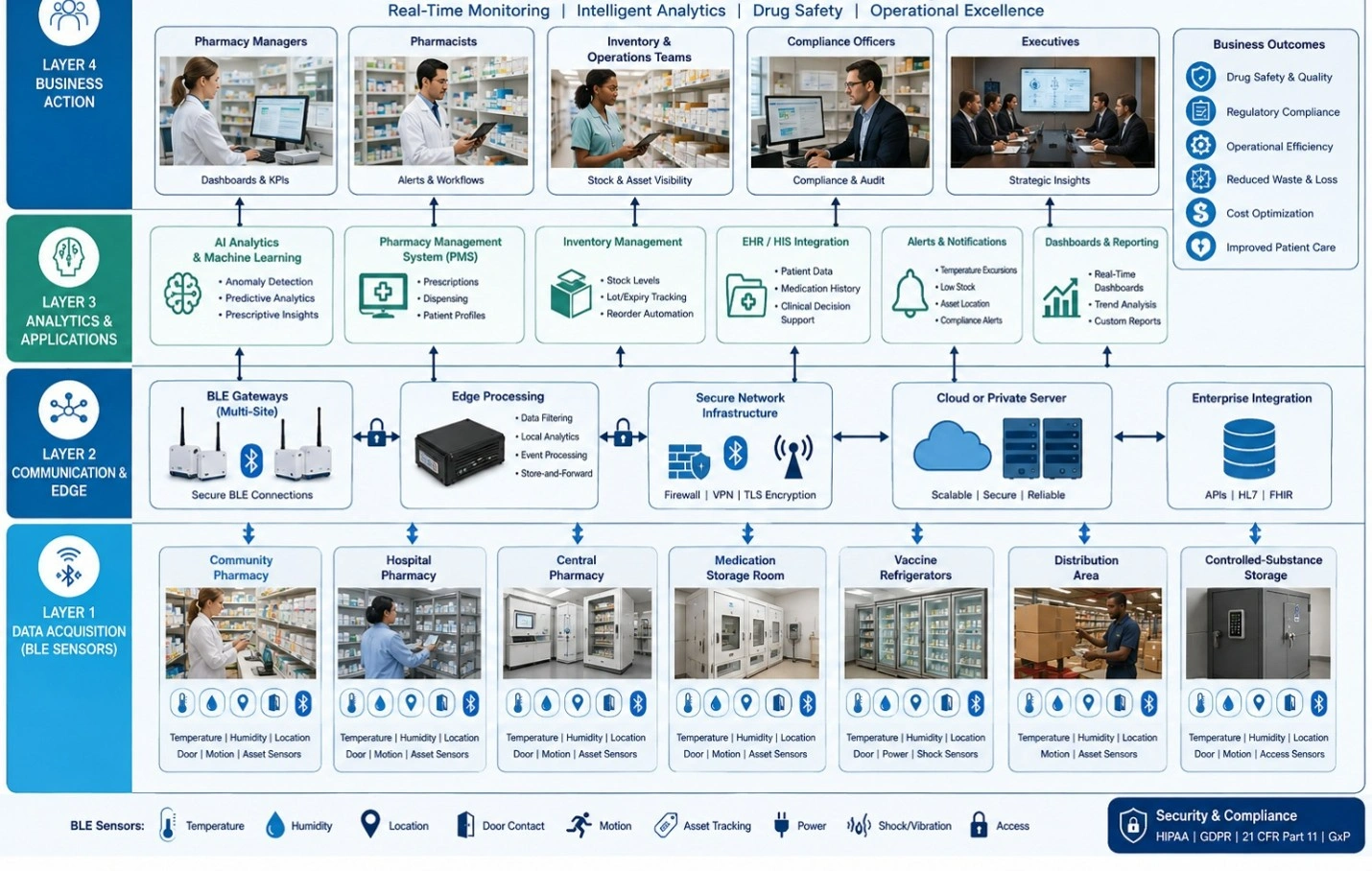
This enterprise architecture diagram illustrates how BLE sensors across community, hospital, and central pharmacies, medication storage, vaccine refrigerators, distribution areas, and controlled-substance storage connect through BLE gateways, edge processing, secure networks, AI analytics, pharmacy and inventory systems, and enterprise integrations. It shows how real-time monitoring supports alerts, dashboards, compliance, inventory visibility, operational decisions, and improved drug safety across a distributed pharmacy network.
What AI Means for Modern Pharmacy Networks
AI-enabled pharmacy operations are not limited to a dashboard or an alerting application. A useful system connects physical pharmacy conditions with operational records and uses historical and real-time data to determine when an intervention is required.
For pharmacy networks, relevant AI methods include:
- Machine learning for medication demand forecasting, replenishment planning, equipment failure prediction, and anomaly detection
- Time-series models for refrigerator and freezer temperature behavior, environmental drift, and equipment performance
- Predictive analytics for identifying assets or storage equipment approaching abnormal operating conditions
- Computer vision where appropriate for medication shelf monitoring, package recognition, counting, and workflow verification
- Natural language processing for extracting operational information from pharmacy records, maintenance notes, incident reports, and other authorized data sources
- Edge AI for local detection of critical environmental or equipment events when connectivity to centralized systems is unavailable
- AI-assisted decision support for prioritizing alerts, replenishment actions, maintenance work orders, and investigation of medication excursions
AIoT describes the combination of artificial intelligence with connected sensors, equipment, and physical systems. Within a pharmacy network, BLE devices provide localized observations while AI converts those observations into operational intelligence. The resulting system can move pharmacy teams from periodic manual inspection toward continuous condition monitoring and risk-based intervention.
The distinction is important. BLE does not independently determine whether medication inventory is at risk. A BLE sensor can report that a vaccine refrigerator has exceeded a configured temperature threshold. AI can analyze the temperature trend, door-opening behavior, ambient conditions, historical patterns, and equipment state to determine whether the event resembles a temporary excursion or an emerging refrigeration problem.
That distinction also influences system design. Pharmacy networks should preserve deterministic rules for safety-critical thresholds while using AI to supplement those rules with prediction, correlation, prioritization, and anomaly detection.
Pharmacy Network Applications for AI-Enabled Operations
Medication Inventory and Stock Visibility
Pharmacy networks manage large numbers of medication SKUs, lot numbers, expiration dates, storage requirements, and replenishment events. Inventory discrepancies can arise from dispensing, receiving, returns, transfers between locations, damaged products, recalls, cycle-count errors, and delayed system updates.
BLE-enabled location and sensing can provide additional operational observations around medication storage areas, carts, totes, refrigerators, and other mobile or fixed assets. AI can combine these observations with pharmacy inventory records to identify unusual movement patterns, potential stock discrepancies, slow-moving inventory, and replenishment priorities.
The most useful deployment does not attempt to replace the pharmacy management system. Instead, BLE and AI provide additional physical-world data that can be correlated with inventory transactions.
Pharmaceutical Cold-Chain Monitoring
Temperature-sensitive medications and vaccines require controlled storage conditions. Pharmacy refrigerators, freezers, and temperature-controlled cabinets can therefore become high-value AI monitoring targets.
BLE temperature sensors can capture readings at configurable intervals and transmit them through gateways to local or centralized software. AI can evaluate:
- Temperature trends rather than isolated readings
- Repeated excursions at particular times of day
- Refrigerator recovery time after door openings
- Differences between storage units
- Sensor patterns associated with equipment degradation
- Environmental conditions surrounding the refrigerator
- Frequency and duration of abnormal events
A predictive model may identify deterioration before a refrigerator produces a major excursion. Pharmacy personnel can then investigate the equipment, maintenance status, door seals, loading conditions, or environmental factors before medication is exposed to prolonged unsuitable conditions.
Pharmacy Asset and Equipment Tracking
Pharmacy networks use medication carts, transport containers, mobile workstations, infusion-related equipment, refrigeration equipment, automated dispensing equipment, scales, and other operational assets. Asset location is often difficult to maintain when equipment moves between rooms, departments, pharmacies, or facilities.
BLE beacons attached to approved assets can provide location observations through fixed gateways. AI can analyze movement histories and utilization patterns to identify underused equipment, frequently misplaced assets, bottlenecks, and unusual movement.
For a distributed pharmacy network, this information can support equipment allocation decisions without relying exclusively on manual asset inventories.
Controlled Medication and High-Value Inventory Monitoring
Controlled substances and high-value medications require stronger operational controls than ordinary inventory. AI should not be treated as a substitute for established access controls, documentation, chain-of-custody procedures, or regulatory requirements.
Instead, AI can assist authorized personnel by detecting unusual patterns such as unexpected movement, abnormal access timing, discrepancies between physical observations and authorized transactions, or repeated exceptions requiring investigation.
BLE location information can provide an additional physical observation layer, while pharmacy information systems remain authoritative for authorized medication transactions.
Pharmacy Refrigerator and Equipment Predictive Maintenance
Unplanned failure of refrigeration, automated dispensing, environmental monitoring, or other pharmacy equipment can affect medication availability and operational continuity.
Predictive maintenance models can evaluate equipment telemetry, temperature recovery patterns, alarm frequency, power-related events where available, maintenance history, and environmental conditions. The output can be converted into maintenance priorities rather than simply displaying raw sensor readings.
This approach is especially valuable for pharmacy networks with many geographically distributed facilities because maintenance teams can prioritize equipment based on measured risk rather than relying exclusively on fixed service intervals.
Workflow and Staff Efficiency
Pharmacy operations involve receiving, put-away, storage, picking, dispensing, verification, medication transfer, replenishment, returns, cycle counting, and exception handling. AI can identify process bottlenecks by correlating timestamps, location observations, inventory transactions, equipment utilization, and operational events.
BLE can contribute location context without requiring every workflow event to be manually entered. This can help pharmacy managers understand where delays occur, which equipment is underutilized, and where additional process controls may be justified.
From Pharmacy Sensor Data to AI-Driven Decisions
A production pharmacy network requires a complete data path rather than isolated BLE devices. The operational workflow typically begins with physical conditions and ends with an authorized pharmacy employee, technician, pharmacist, facilities team, or IT team taking an action.
Data Acquisition
BLE sensors and beacons can collect or communicate information associated with:
- Medication storage temperature
- Freezer temperature
- Humidity where relevant
- Asset location
- Equipment status where supported
- Door or cabinet activity through compatible sensing arrangements
- Environmental conditions around pharmacy storage
- Movement of approved mobile assets
- Presence or proximity observations
Sensor placement is critical. A temperature sensor positioned incorrectly inside a refrigerator can produce technically accurate readings that do not represent the medication storage environment. Calibration, sensor placement, battery management, and sampling intervals therefore need to be defined during commissioning.
BLE Communication and Gateway Processing
BLE gateways receive observations from nearby devices and forward relevant data through Ethernet, Wi-Fi, cellular, or other approved network connections. Gateway placement should consider radio coverage, building materials, refrigeration equipment, interference, device density, and network availability.
Edge processing can filter duplicate observations, validate payloads, timestamp events, buffer data during connectivity interruptions, and apply immediate threshold rules.
For critical pharmacy environments, local buffering is particularly important. A temporary network outage should not automatically result in loss of temperature history or an inability to trigger local alarms.
AI Analytics and Decision Support
Validated data can then reach centralized software, a private server, or a cloud-hosted service. AI models analyze current observations alongside historical records and authorized pharmacy data.
Typical outputs include:
- Temperature excursion risk
- Equipment anomaly scores
- Predicted maintenance requirements
- Inventory demand forecasts
- Asset utilization patterns
- Unusual movement alerts
- Operational bottleneck indicators
- Prioritized exceptions requiring human review
AI recommendations should remain traceable. Pharmacy personnel need to understand what triggered an alert, which data contributed to it, and what action the system recommends.
Operational Action and Feedback
The final stage is operational. A temperature alert may result in medication inspection and quarantine procedures. A predicted refrigeration problem may create a maintenance work order. An inventory forecast may influence replenishment. An asset-location exception may prompt a search or reassignment.
The outcome of the action should ideally return to the software as feedback. This creates a continuous improvement loop in which pharmacy network data becomes more useful over time.
AI-Enabled Pharmacy Operational Workflow: From BLE Sensing to Intelligent Action
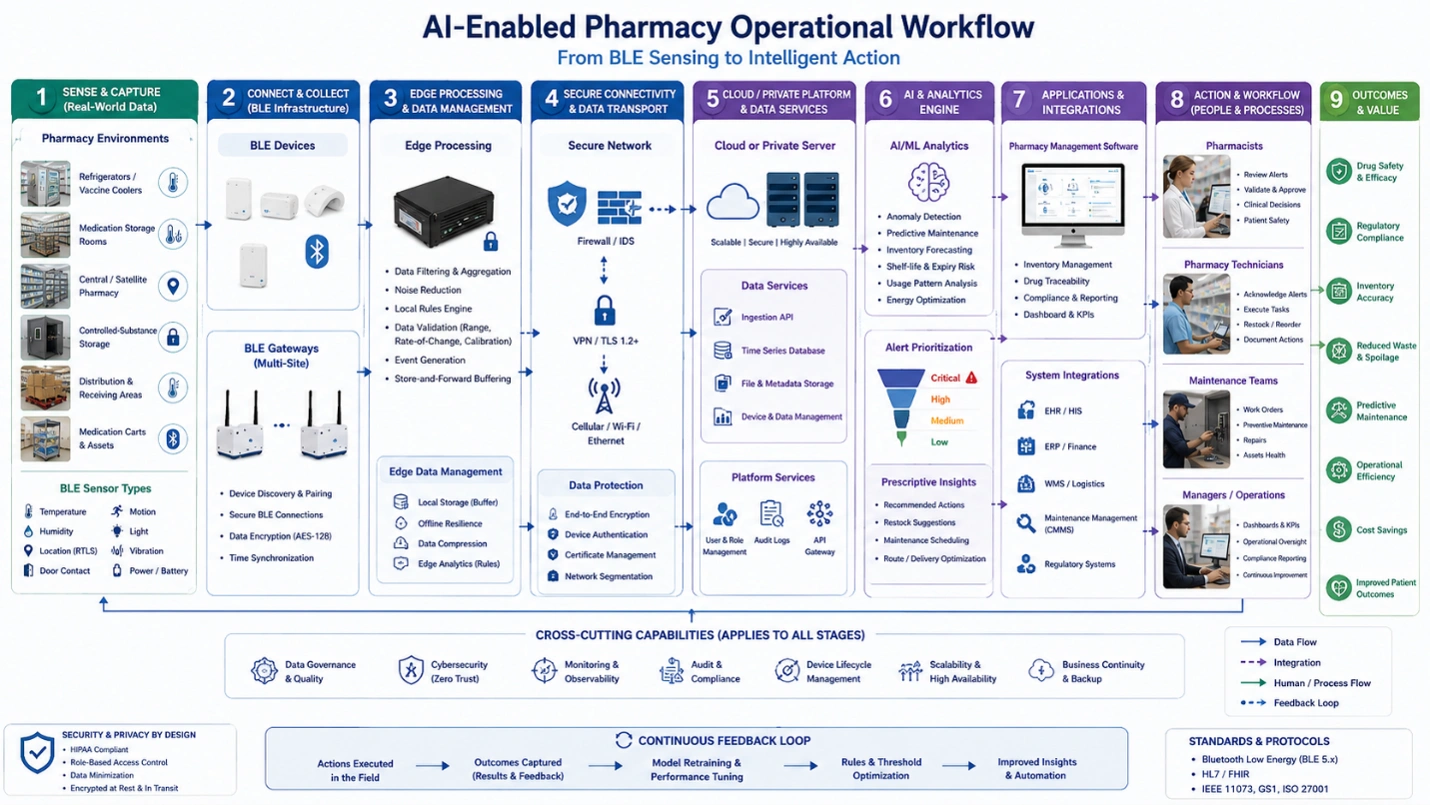
This workflow diagram shows the complete AI-enabled pharmacy data journey, from BLE temperature, humidity, location, motion, and asset sensing through gateways, edge validation and buffering, secure connectivity, cloud or private-server processing, and AI analytics. It connects anomaly detection, predictive maintenance, inventory forecasting, and alert prioritization with pharmacy management, EHR/HIS, maintenance, pharmacist, technician, and operations workflows, while incorporating cybersecurity, data governance, compliance, and continuous feedback.
Technical System Components for AI-Enabled Pharmacy Networks
BLE Sensors, Beacons, and Gateways
BLE sensors provide measurements such as temperature or humidity, while BLE beacons can identify or associate physical assets with location observations. BLE gateways collect these signals and forward data to pharmacy software.
The correct device depends on the application. Refrigerated medication storage requires sensors designed for the expected temperature range and appropriate calibration requirements. Asset tracking requires beacon placement that provides reliable identification while supporting battery-life requirements. Gateway selection must account for the physical layout of pharmacy sites and the expected density of BLE devices.
Edge Processing and Network Connectivity
Edge computing can perform local validation, filtering, buffering, threshold evaluation, and selected AI inference. This reduces unnecessary data transmission and provides resilience when a pharmacy temporarily loses external connectivity.
Gateway connectivity may use Ethernet, Wi-Fi, cellular networks, or other approved infrastructure. Network segmentation should separate IoT traffic from systems handling sensitive pharmacy and patient information wherever practical.
Cloud Version and Server Version
A Cloud Version can host centralized pharmacy monitoring, analytics, device management, dashboards, alerting, and AI services within managed cloud infrastructure. This model is useful for pharmacy networks with many locations because software updates, centralized analytics, and multi-site visibility can be managed from a common environment.
A Server Version can run on customer-managed edge servers, private data centers, healthcare IT servers, or other privately hosted infrastructure. This approach may be preferable when pharmacy organizations require greater control over data location, network routing, integration boundaries, or internal IT governance.
A hybrid deployment is also possible. Local gateways can retain critical data and perform immediate processing while selected information is transmitted to centralized cloud or private server software for broader analytics.
Pharmacy Software Integration
AI and BLE systems should integrate with existing pharmacy software rather than create another isolated source of operational truth. Relevant integration points can include:
- Pharmacy management systems
- Inventory management and warehouse systems
- Electronic health record systems where appropriate
- Automated dispensing cabinet systems
- Computerized maintenance management systems
- Building management and facilities systems
- Identity and access management
- Notification and incident management software
- Business intelligence and reporting systems
- HL7 or FHIR-based healthcare integrations where applicable
GAO supplies BLE, RFID, and IoT hardware products and systems that can serve as the physical data-acquisition layer for these types of pharmacy deployments. Engineering design should determine which data belongs in the BLE/IoT system and which system remains authoritative for medication, patient, inventory, or maintenance records.
AI-Enabled Pharmacy Network Deployment: Cloud, Server, and Hybrid Comparison
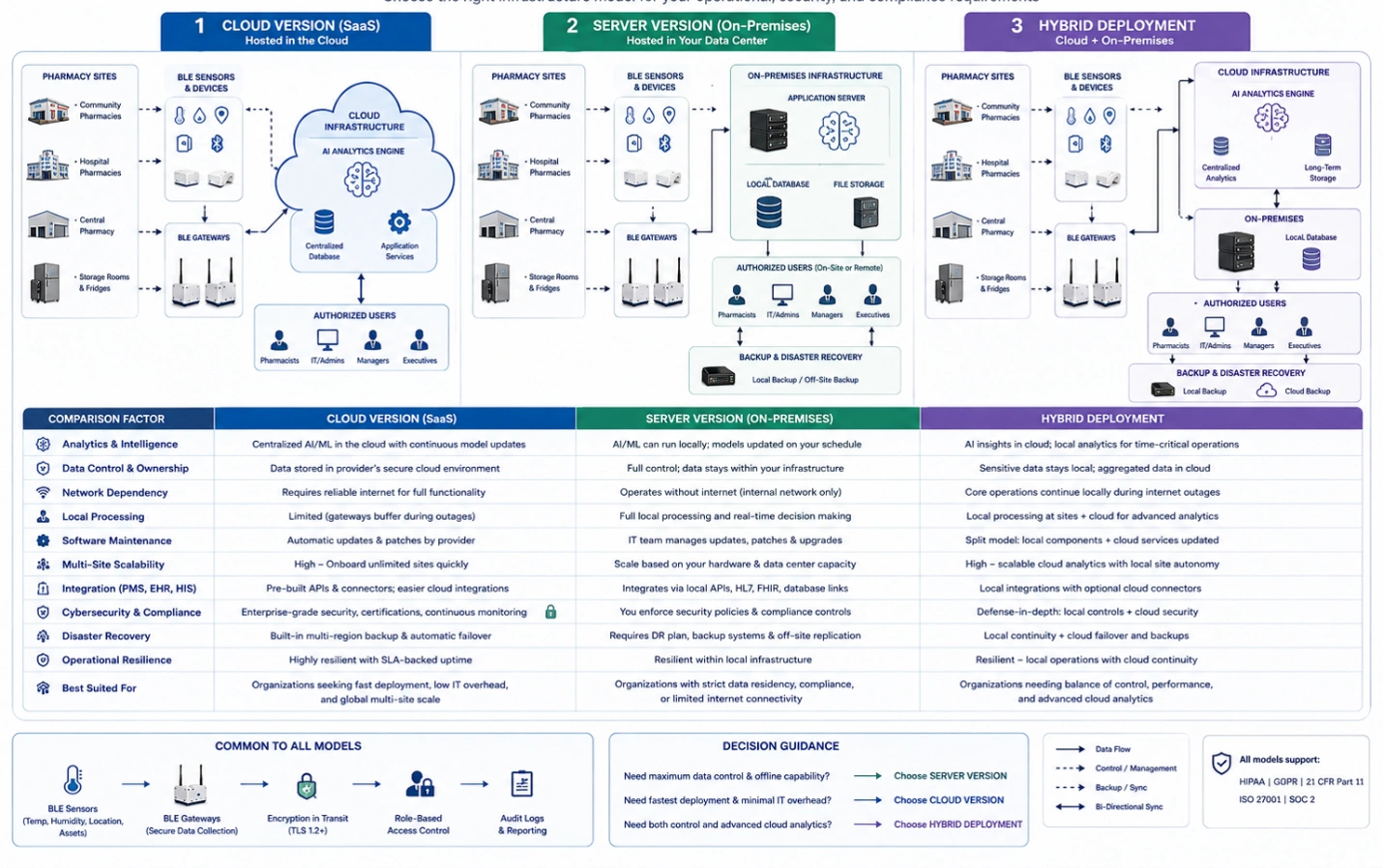
This comparison visual evaluates Cloud, On-Premises Server, and Hybrid deployment models for AI-enabled pharmacy networks. It contrasts analytics, data ownership, connectivity, local processing, maintenance, scalability, integrations, cybersecurity, disaster recovery, and operational resilience while showing how BLE-enabled pharmacy sites connect to each architecture.
AI Models, Data Quality, and Model Governance
AI performance depends on data quality. Pharmacy networks should establish timestamp synchronization, sensor identity management, calibration records, missing-data handling, duplicate-event filtering, threshold validation, and historical data retention before relying heavily on predictive models.
A model that predicts refrigerator failure from temperature behavior should also account for maintenance events and known operational changes. Otherwise, normal servicing or refrigerator replacement can appear to the model as an unexplained anomaly.
Model outputs should therefore be monitored for false positives, false negatives, drift, and changing pharmacy operating conditions. Safety-sensitive decisions should retain human oversight and established pharmacy procedures.
Cybersecurity for Pharmacy IoT
Cybersecurity must cover sensors, gateways, networks, servers, cloud services, APIs, user accounts, and administrative interfaces.
Relevant controls include:
- Unique device identities
- Secure device onboarding
- Role-based access control
- Encryption in transit and at rest where applicable
- Network segmentation
- Certificate or key management
- Secure gateway configuration
- Firmware and software update processes
- Audit logging
- Vulnerability management
- Backup and disaster recovery procedures
- Monitoring for unauthorized device behavior
- Alignment with applicable healthcare privacy and security requirements
GAO’s engineering support can be incorporated into deployment planning, device selection, integration, commissioning, and technical troubleshooting. GAO Group companies are headquartered in New York City and Toronto, Canada, and have served organizations across the United States and Canada, including Fortune 500 companies, research organizations, universities, and government agencies. Their work includes substantial R&D investment in BLE, RFID, and IoT products and systems, supported by quality assurance processes and remote or onsite technical support.
Pharmacy IoT Cybersecurity Architecture: End-to-End Protection
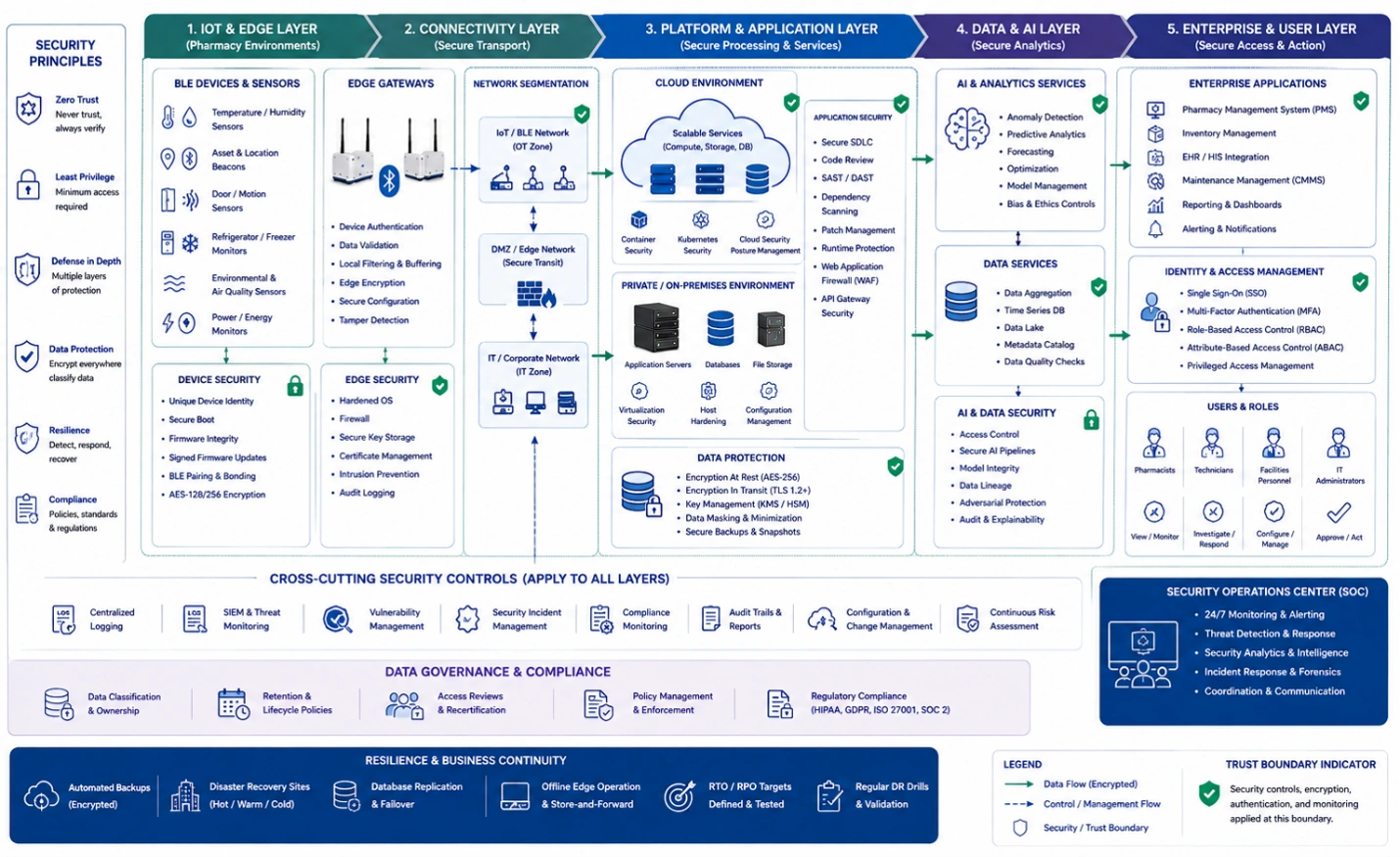
This architecture visual maps cybersecurity controls across a distributed pharmacy IoT environment, from BLE sensors and edge gateways through segmented networks, cloud or private infrastructure, AI services, enterprise applications, and authorized users. It highlights device authentication, encryption, access management, vulnerability monitoring, audit logging, security operations, compliance, backup, disaster recovery, and business continuity.
Engineering Considerations Before Pharmacy Network Deployment
A successful AI-enabled pharmacy deployment depends more on engineering discipline than on the number of sensors installed. Site surveys should establish BLE coverage, refrigerator and freezer locations, storage-room dimensions, gateway positions, network availability, environmental conditions, and sources of radio attenuation.
Pharmacy operations should also define the authoritative source for medication inventory, lot information, expiration dates, controlled-substance records, maintenance events, and patient-related information. The BLE and AI system should add useful physical-world observations without creating conflicting records.
GAO’s experience supplying hardware products and IoT systems to organizations provides a practical basis for evaluating device specifications, gateway placement, integration requirements, and deployment constraints before a pharmacy network moves from pilot testing to multi-site rollout.
AI Capabilities That Improve Pharmacy Network Performance
AI creates the greatest operational value when it converts pharmacy data into prioritized actions. Rather than treating every sensor event as an independent alarm, pharmacy networks can use AI to distinguish normal operational variation from conditions that require investigation.
Predictive Inventory Management
Medication demand varies by prescription volume, seasonality, geography, disease patterns, formulary changes, promotional programs, hospital discharge activity, and local prescribing behavior. Traditional reorder rules may not adequately account for these variables.
AI-based forecasting can combine historical dispensing transactions with approved inventory data to estimate future demand and identify replenishment requirements. Pharmacy managers can use these forecasts to reduce stockouts while avoiding unnecessary inventory accumulation.
Useful model inputs can include:
- Historical dispensing volumes
- Medication SKU and product hierarchy
- Seasonal demand patterns
- Lead times
- Supplier performance
- Current inventory position
- Reorder thresholds
- Expiration dates
- Inter-pharmacy transfer history
- Product substitution patterns
BLE observations can provide additional physical context, particularly where asset movement, storage conditions, or equipment availability affects pharmacy operations.
Temperature Excursion Prediction
A conventional monitoring system may notify pharmacy personnel after a refrigerator exceeds a defined temperature threshold. AI can provide earlier warning by identifying abnormal temperature trajectories.
For example, a refrigerator that normally returns rapidly to its target range after door openings may gradually begin recovering more slowly. A time-series model can recognize that deterioration and produce a maintenance recommendation before a major excursion occurs.
The resulting workflow can move from:
Threshold alarm → investigation
toward:
Trend detection → risk assessment → prioritized investigation → preventive action
This does not eliminate established temperature thresholds. Those thresholds remain important controls for medication safety and compliance.
Intelligent Alert Prioritization
Large pharmacy networks can generate substantial numbers of alarms. Excessive notifications can lead to alert fatigue, particularly when multiple events are caused by the same underlying problem.
AI can correlate events across devices and locations to prioritize alerts. Several temperature warnings from sensors associated with one refrigeration unit, for example, may be treated as one equipment-level incident rather than multiple unrelated notifications.
Priority scoring can consider:
- Duration of the abnormal condition
- Magnitude of deviation
- Medication sensitivity
- Historical equipment behavior
- Time of day
- Repeated incidents
- Equipment maintenance status
- Site criticality
- Availability of redundant storage
- Confidence of the AI model
Pharmacy personnel can then focus on high-risk events while lower-risk anomalies remain available for review.
Predictive Maintenance for Pharmacy Equipment
Maintenance planning can become more proactive when AI combines equipment telemetry with maintenance history. Refrigerators, freezers, automated dispensing equipment, environmental monitoring devices, and other critical pharmacy equipment can be evaluated according to observed performance rather than calendar schedules alone.
A predictive maintenance system may identify:
- Increasing temperature recovery time
- Repeated compressor-related abnormalities where suitable telemetry is available
- Increasing alarm frequency
- Abnormal operating cycles
- Repeated communication failures
- Sensor deterioration
- Battery depletion
- Environmental conditions associated with equipment stress
Maintenance teams can use these predictions to schedule inspections before equipment failure affects medication storage or pharmacy operations.
Pharmacy Asset Utilization Analytics
Asset tracking becomes more useful when location history is analyzed rather than simply displayed.
AI can identify equipment that remains idle for extended periods, assets frequently moved between locations, bottlenecks involving shared equipment, or repeated searches for particular pharmacy assets.
This information can support decisions such as:
- Reallocating mobile medication carts
- Adjusting equipment quantities by pharmacy
- Locating frequently misplaced assets
- Establishing better storage locations
- Prioritizing maintenance resources
- Evaluating whether equipment purchases are justified
The objective is not simply to know where an asset is. The objective is to understand how asset utilization affects pharmacy operations.
Pharmacy Network KPIs and Measurable Outcomes
AI deployment should be evaluated against pharmacy performance indicators rather than sensor counts. The most meaningful KPIs connect technology performance to medication availability, storage quality, labor efficiency, equipment reliability, and operational risk.
| KPI | AI and BLE contribution | Operational relevance |
|---|---|---|
| Temperature excursion rate | Detects and predicts abnormal storage conditions | Protects temperature-sensitive inventory |
| Excursion duration | Provides continuous condition history | Supports investigation and corrective action |
| Refrigerator recovery time | Identifies changes in equipment behavior | Supports predictive maintenance |
| Stockout frequency | Improves demand forecasting and replenishment | Supports medication availability |
| Inventory accuracy | Adds physical observations to inventory records | Helps identify discrepancies |
| Inventory carrying cost | Improves demand and replenishment analysis | Reduces unnecessary inventory |
| Medication expiration loss | Supports expiration-aware inventory decisions | Reduces avoidable waste |
| Asset utilization | Analyzes movement and usage history | Improves equipment allocation |
| Asset search time | Provides location visibility | Reduces non-value-added staff time |
| Maintenance response time | Prioritizes equipment-related events | Improves operational continuity |
| Mean time between failures | Supports predictive maintenance | Measures equipment reliability |
| False alarm rate | Measures alert quality | Helps control alert fatigue |
| Critical alert response time | Prioritizes high-risk conditions | Improves intervention speed |
| BLE device availability | Monitors sensor and gateway health | Measures sensing reliability |
| Gateway uptime | Tracks communication infrastructure | Supports data continuity |
| Data completeness | Identifies missing observations | Improves AI model reliability |
| AI prediction accuracy | Measures model performance | Supports model governance |
| Exception resolution time | Tracks operational response | Measures workflow effectiveness |
| Refrigeration maintenance incidents | Identifies emerging problems | Supports preventive maintenance |
| Medication waste associated with storage | Correlates environmental events with losses | Supports cost control |
The KPI baseline should be established before deployment. A pharmacy network can then compare pre-deployment and post-deployment performance instead of relying on subjective perceptions of improvement.
AI-Enabled Pharmacy Network KPI Dashboard
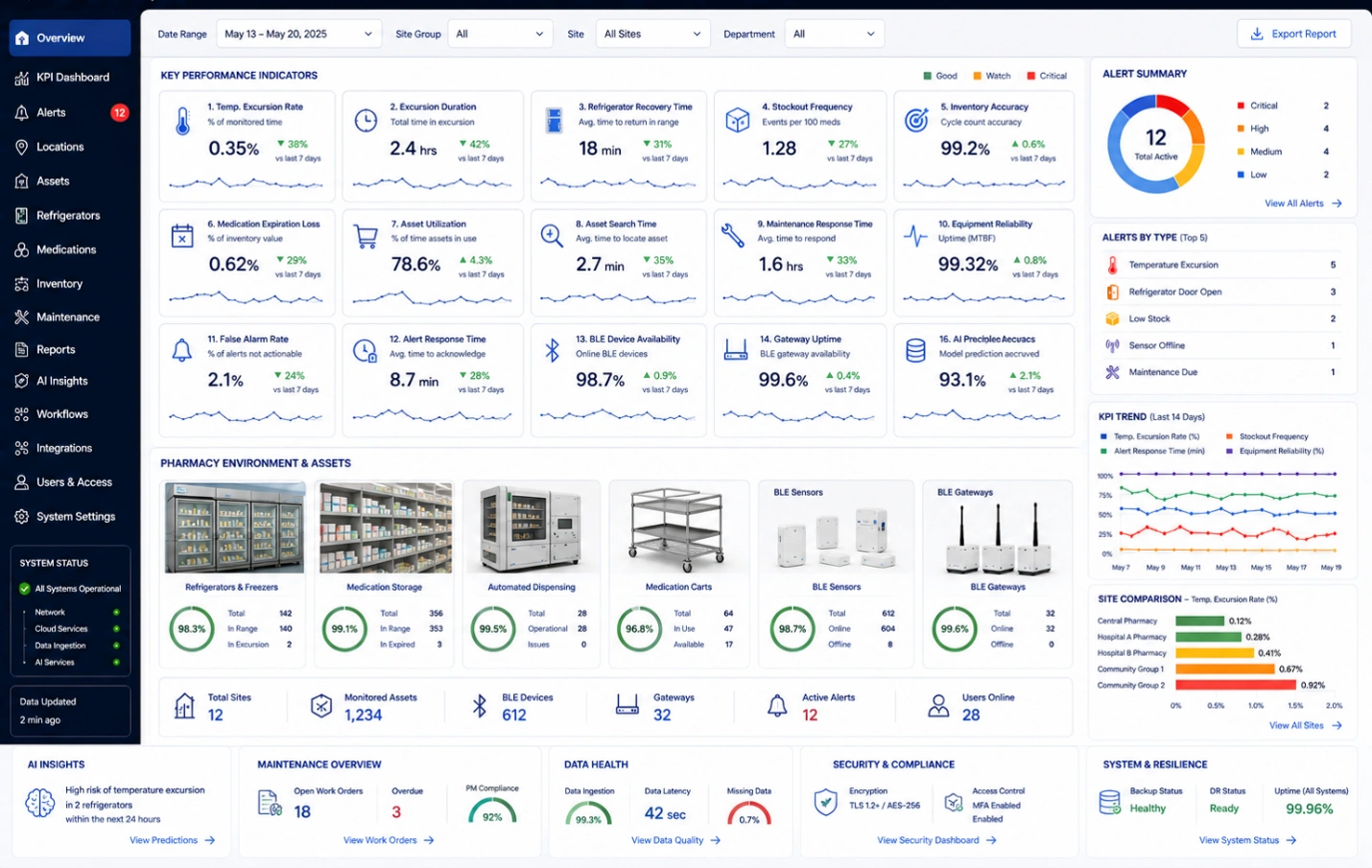
This executive dashboard visualizes measurable pharmacy performance across environmental monitoring, inventory, assets, maintenance, BLE infrastructure, alerts, AI insights, data quality, security, and system resilience. KPI cards, trend charts, site comparisons, equipment status, and operational panels provide a unified view for pharmacy executives, operations managers, IT teams, and facilities personnel.
Pharmacy Network Implementation Lifecycle
A pharmacy network should generally begin with a controlled pilot rather than immediately deploying thousands of sensors across every site. The pilot should represent actual pharmacy conditions, including refrigeration, medication storage, network limitations, staff workflows, and existing software integrations.
Planning and Site Assessment
Planning should document:
- Pharmacy locations and operational differences
- Medication storage requirements
- Refrigerator and freezer inventory
- Critical equipment
- Asset categories requiring location visibility
- Existing network infrastructure
- Wi-Fi, Ethernet, and cellular availability
- IT security requirements
- Pharmacy management software
- Maintenance software
- Existing monitoring systems
- Data retention requirements
- User roles and escalation procedures
A radio survey should be performed where BLE coverage is critical. Refrigeration equipment and dense shelving can affect radio propagation, while walls, metal cabinets, and equipment enclosures can create coverage gaps.
Hardware Selection
Hardware selection should be based on the actual pharmacy environment.
Temperature monitoring requires attention to measurement range, accuracy, calibration, sampling interval, battery life, physical enclosure, sensor placement, and environmental exposure.
Asset tracking requires attention to beacon dimensions, mounting method, battery replacement requirements, transmission behavior, location accuracy, and gateway density.
Gateways should be evaluated according to BLE capacity, communication interfaces, local storage, processing capabilities, cybersecurity features, network compatibility, and environmental requirements.
GAO can support organizations with BLE, RFID, and IoT hardware selection for applications involving sensing, identification, location monitoring, and connected equipment.
System Integration
Integration should define which system owns each data element. For example, a pharmacy management system may remain authoritative for medication inventory while the IoT system provides temperature observations and physical asset-location information.
APIs, database interfaces, messaging systems, or healthcare interoperability mechanisms can be used according to the existing IT environment.
Where healthcare information is involved, integration design should minimize unnecessary movement of sensitive data. A temperature event may require only the storage-unit identifier, timestamp, measured condition, and relevant medication-storage classification rather than patient information.
Commissioning and Testing
Commissioning should verify the entire data path rather than only checking whether individual sensors appear online.
Testing should cover:
- Sensor identification
- Sensor calibration status
- BLE radio coverage
- Gateway reception
- Network connectivity
- Timestamp accuracy
- Data transmission
- Local buffering
- Cloud or server ingestion
- Database storage
- Alert generation
- AI model execution
- Dashboard presentation
- API integration
- User notifications
- Role-based permissions
- Failure recovery
- Battery monitoring
- Firmware update procedures
Temperature systems should also be tested using controlled conditions and documented acceptance criteria. A technically connected sensor is not automatically a validated pharmacy monitoring solution.
Staff Acceptance and Operational Validation
Pharmacists, pharmacy technicians, facilities personnel, quality teams, IT administrators, and other affected users should participate in workflow validation.
The most technically sophisticated system can underperform if alerts do not reach the right person or if the recommended response is unclear.
Operational procedures should specify who receives a critical alert, who investigates the condition, who documents the response, and when an incident must be escalated.
Interoperability, Scalability, and Multi-Site Pharmacy Operations
Pharmacy networks often contain locations with different building layouts, equipment, network configurations, software versions, and operating procedures. A scalable deployment therefore needs standardized device onboarding and configuration while allowing site-specific parameters.
A central software environment can maintain device identities, gateway associations, sensor configurations, alarm thresholds, user permissions, and site information. Local edge processing can preserve resilience when external connectivity is interrupted.
Scalability considerations include:
- Number of pharmacies
- BLE device density per site
- Gateway capacity
- Data sampling frequency
- Historical data retention
- API transaction volume
- AI model inference requirements
- Network bandwidth
- Battery replacement cycles
- Software update processes
- User and role management
- Disaster recovery requirements
The engineering objective is not to maximize the number of connected devices. It is to maintain reliable data quality and useful operational performance as the pharmacy network grows.
Regulatory, Privacy, and Security Considerations
Pharmacy deployments may intersect with healthcare privacy, medication handling, controlled-substance management, medical device requirements, environmental monitoring procedures, cybersecurity obligations, and organizational quality systems. Exact requirements depend on jurisdiction, pharmacy type, medication category, system function, and whether protected health information is processed.
Relevant regulatory and standards considerations may include:
- HIPAA and the HIPAA Security Rule where applicable in the United States
- FDA requirements relevant to applicable pharmaceutical and medical products
- 21 CFR Part 11 where electronic records and signatures fall within its scope
- USP storage and handling requirements applicable to the medications and pharmacy operation
- State pharmacy-board requirements
- Controlled-substance requirements applicable to the operation
- NIST cybersecurity guidance
- NIST AI Risk Management Framework as a useful AI governance reference
- HL7 and FHIR interoperability standards where healthcare-system integration requires them
- Organizational retention, audit, quality, and incident-management policies
These should not be treated as a generic compliance checklist. Pharmacy organizations should determine which requirements apply to their specific deployment and document validation accordingly.
AI should also be governed according to its risk. A model used to forecast inventory demand presents a different risk profile from an AI function that influences medication-related decisions. Human review, model validation, auditability, and clearly defined escalation procedures should increase with operational impact.
Practical Deployment Recommendations for Pharmacy Networks
The following engineering practices can reduce deployment risk:
- Start with one or several representative pharmacy sites rather than assuming every location has identical requirements.
- Establish baseline KPIs before installing the new system.
- Perform BLE coverage testing before final gateway placement.
- Use calibrated and application-appropriate environmental sensors.
- Define sensor placement procedures for refrigerators and freezers.
- Separate critical deterministic alarms from predictive AI recommendations.
- Maintain local data buffering for temporary network outages.
- Define authoritative systems for inventory, medication, maintenance, and other records.
- Minimize unnecessary transmission of sensitive healthcare information.
- Use unique device identities and controlled administrative access.
- Test alarm escalation with real pharmacy personnel.
- Validate AI models against historical pharmacy conditions before operational use.
- Monitor false positives and false negatives after deployment.
- Establish battery replacement and device-health procedures.
- Document firmware, software, gateway, and sensor configurations.
- Design for multi-site device onboarding from the beginning.
- Test failure conditions rather than only normal operation.
- Use phased deployment gates before expanding to additional pharmacies.
- Retain human approval for safety-sensitive operational decisions.
- Review model performance periodically for data drift and changes in pharmacy workflows.
Where GAO Fits in Pharmacy IoT Deployment
GAO provides BLE, RFID, and IoT hardware products and systems that can support pharmacy applications such as environmental monitoring, asset identification, location visibility, and connected sensing. The appropriate product mix depends on the pharmacy workflow, physical environment, required measurement accuracy, communication requirements, and integration objectives.
GAO’s broader technical organization has invested in product and system R&D for approximately three decades. Its customer base across the United States and Canada includes Fortune 500 organizations, leading research and development firms, universities, and government agencies. Quality assurance and technical support are important considerations for deployments where connected devices become part of ongoing pharmacy operations.
For pharmacy networks, the most appropriate approach is to treat GAO hardware as one component of a complete engineered solution. Site assessment, sensor selection, gateway placement, software integration, cybersecurity, commissioning, operational validation, and long-term device management should be considered together.
AI-Enabled Pharmacy Network Deployment Roadmap
Short Description:
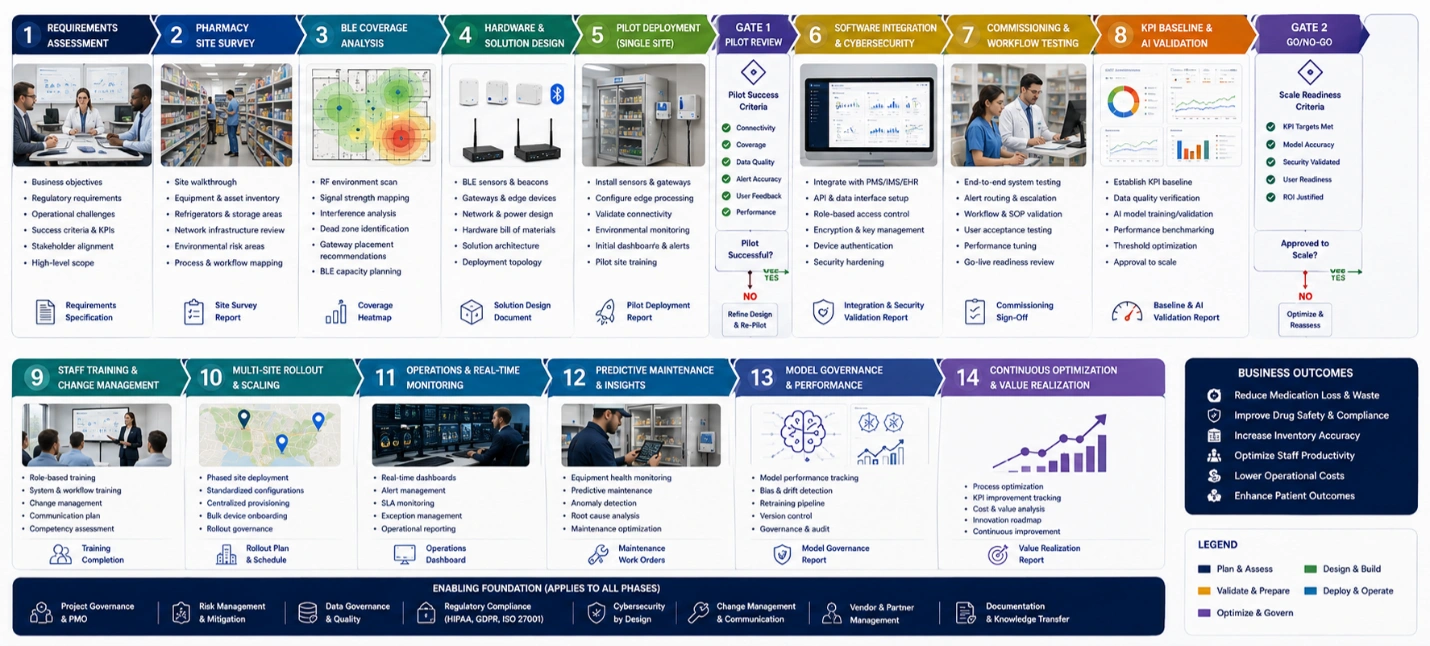
This enterprise roadmap illustrates the complete implementation lifecycle for an AI-enabled pharmacy network, from requirements assessment and site surveys through BLE coverage analysis, hardware design, pilot deployment, integration, cybersecurity validation, commissioning, KPI and AI validation, staff training, multi-site rollout, and continuous optimization. Clearly defined decision gates separate pilot review and scale approval while governance, compliance, cybersecurity, and data quality support every phase.
Key Takeaways for AI and BLE in Pharmacy Networks
AI can help pharmacy networks move from reactive monitoring toward predictive, data-driven operations. The greatest value comes from connecting physical pharmacy conditions with inventory, maintenance, asset, and workflow information and then applying analytics to prioritize action.
BLE sensors, beacons, and gateways provide a practical data-acquisition layer for environmental monitoring and asset visibility, but their effectiveness depends on proper site surveys, device placement, network design, calibration, cybersecurity, and software integration.
For pharmacy organizations, priority applications include medication cold-chain monitoring, inventory forecasting, asset tracking, refrigerator predictive maintenance, intelligent alert prioritization, controlled-inventory monitoring, and workflow analytics.
A phased implementation is generally preferable. Establish measurable objectives, validate the sensing system, integrate with existing pharmacy software, test operational workflows, and then expand after the pilot demonstrates reliable performance.
GAO can help organizations evaluate BLE, RFID, and IoT hardware and system requirements for pharmacy monitoring and asset-management applications. Readers evaluating AI-enabled pharmacy network solutions can explore GAO’s technology capabilities, product options, and technical support to determine which sensing and connectivity approach fits their operational requirements.
Building the Future of AI and IoT in Pharmacy Networks with Aperture Venture Studio and GAO
For more than three decades, GAO Group of Companies has invested heavily in R&D for industrial BLE, RFID, and IoT technologies. As AI has become increasingly useful for real-world operational applications, we have continued developing AIoT solutions that combine AI with connected sensing technologies for pharmacy networks and other demanding environments. We have also established Aperture Venture Studio to advance AI and IoT solutions relevant to applications such as pharmacy inventory, cold-chain monitoring, asset visibility, and predictive maintenance.
Aperture brings together AI and IoT technical experts, experienced operational leaders, investors, and technology organizations. Through initiatives including the Aperture Ventures Summit and TekSummit, advanced AI and IoT topics can be explored with technical communities and industry participants.
We welcome you to engage with us as:
- Advisors, co-founders, or employees
- Investors
- Customers