
AI-Powered BLE Solutions for Metal Casting Operations
Understanding AI-Powered BLE Solutions in Metal Casting
Metal casting is one of the most process-sensitive manufacturing disciplines within the broader metal processing industries. Slight variations in mold temperature, furnace performance, alloy composition, cooling rate, vibration, humidity, equipment condition, or material handling can significantly affect casting quality.
Artificial Intelligence of Things (AIoT) combines Artificial Intelligence with connected industrial devices, BLE sensing technologies, industrial communication systems, and operational software. Rather than relying solely on operator experience or scheduled inspections, AI continuously evaluates production data to recommend optimal actions before production quality deteriorates.
BLE technologies provide low-power wireless communication suitable for:
- Equipment monitoring
- Mobile asset identification
- Tool tracking
- Environmental sensing
- Personnel location awareness
- Production status monitoring
- Work-in-progress visibility
- Condition monitoring of auxiliary equipment
AI transforms these continuous data streams into predictive insights using machine learning, anomaly detection, statistical modeling, and industrial analytics.
For modern metal casting facilities, this combination enables faster operational decisions, reduced process variability, and better utilization of expensive production assets.
GAO has worked with organizations requiring industrial BLE hardware capable of operating in demanding manufacturing environments where high temperatures, metallic structures, electromagnetic interference, dust, and vibration present unique engineering challenges.
AI-Powered BLE Monitoring System for Smart Metal Casting Operations
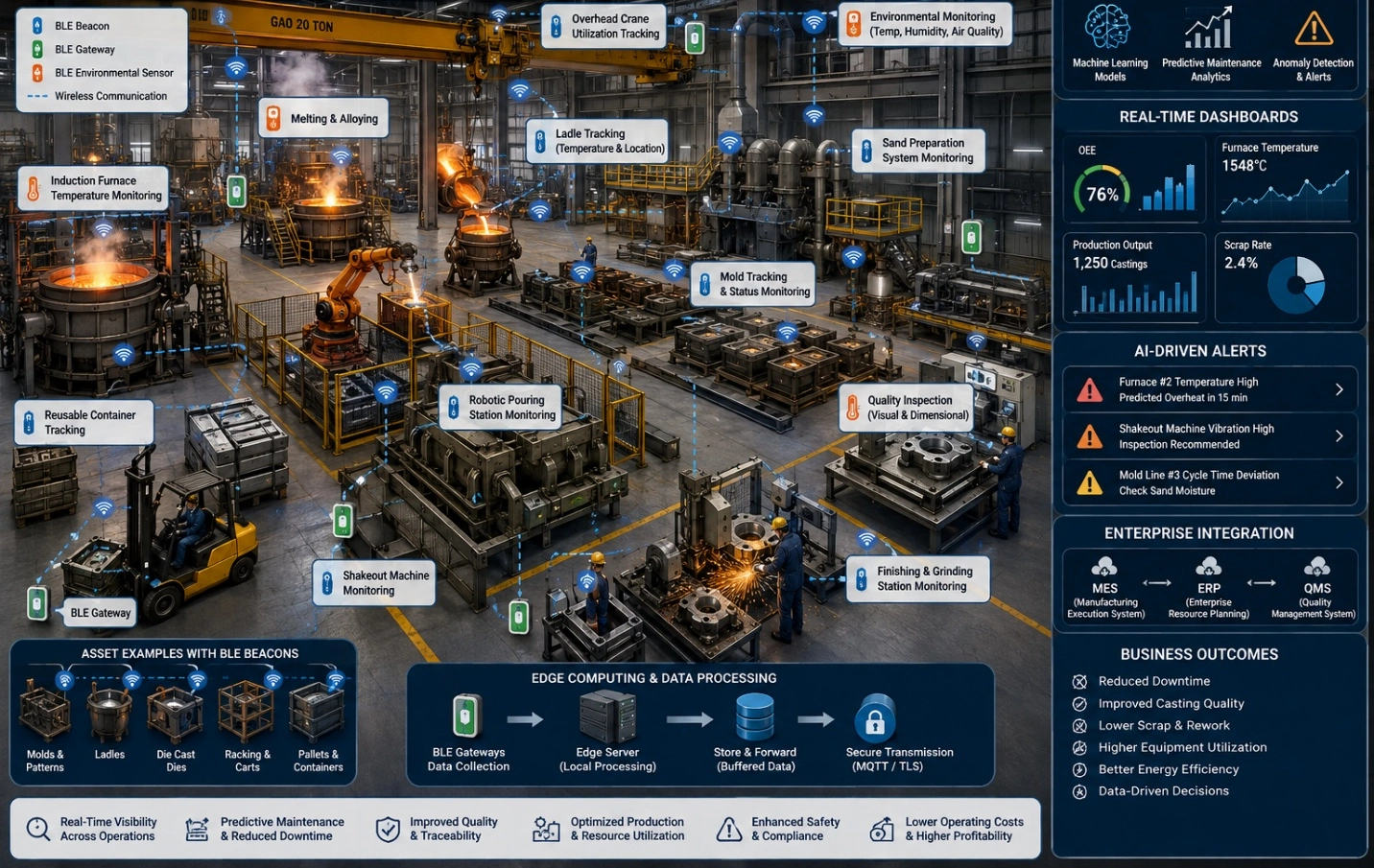
This illustration depicts a digitally connected metal casting facility where BLE beacons, BLE gateways, and BLE environmental sensors collect operational data from furnaces, molds, ladles, robotic pouring stations, and production equipment. AI analyzes the data through edge computing and integrated manufacturing software to support predictive maintenance, quality control, asset tracking, real-time monitoring, and production optimization, improving efficiency, traceability, and operational decision-making.
Why AI is Transforming Metal Casting Operations
Metal casting operations involve hundreds of interacting production variables that influence final product quality. Traditional monitoring methods often identify issues after defective castings have already been produced.
AI significantly changes this approach by learning relationships between operational parameters and production outcomes.
Examples include:
- Predicting furnace refractory degradation before failure
- Detecting abnormal mold cooling behavior
- Forecasting sand moisture deviations
- Optimizing pouring temperatures
- Predicting production bottlenecks
- Monitoring ladle utilization
- Detecting equipment vibration abnormalities
- Forecasting maintenance requirements
- Optimizing crane utilization
- Improving mold turnaround times
- Identifying quality risks before solidification
- Reducing scrap generation
Rather than replacing operators, AI assists metallurgists, process engineers, production supervisors, maintenance planners, and quality engineers with continuous analytical support.
Because foundries often operate around the clock, AI also helps reduce operator fatigue by continuously monitoring thousands of operational variables simultaneously.
Metal Casting Applications Benefiting from AI-Enabled BLE Solutions
Different casting processes present different operational requirements. AI-enabled BLE deployments should therefore be designed around each production workflow.
Sand Casting
Typical AI applications include:
- Mold tracking
- Flask identification
- Pattern management
- Sand condition monitoring
- Shakeout scheduling
- Cooling time optimization
- Work-in-progress visibility
Operational benefits include:
- Reduced mold losses
- Improved scheduling
- Better traceability
- Lower scrap
Investment Casting
Relevant AI applications include:
- Wax pattern tracking
- Shell drying optimization
- Furnace scheduling
- Casting batch management
- Environmental monitoring
- Dimensional quality prediction
AI helps identify subtle process variations that influence dimensional accuracy and surface finish.
Die Casting
AI-assisted BLE deployments commonly monitor:
- Die utilization
- Hydraulic equipment health
- Cooling circuits
- Lubrication systems
- Robot cycle timing
- Mold temperature consistency
These insights improve production repeatability while extending die life.
Permanent Mold Casting
Useful AI applications include:
- Mold temperature balancing
- Cooling optimization
- Maintenance scheduling
- Tool utilization
- Production sequencing
- Energy consumption monitoring
Continuous Casting Support Operations
Although continuous casting differs from discrete foundry production, BLE-enabled AI systems assist with:
- Equipment monitoring
- Material logistics
- Maintenance planning
- Spare parts tracking
- Operational visibility
- Personnel safety
Comparison of AI-Enabled BLE Applications Across Metal Casting Processes
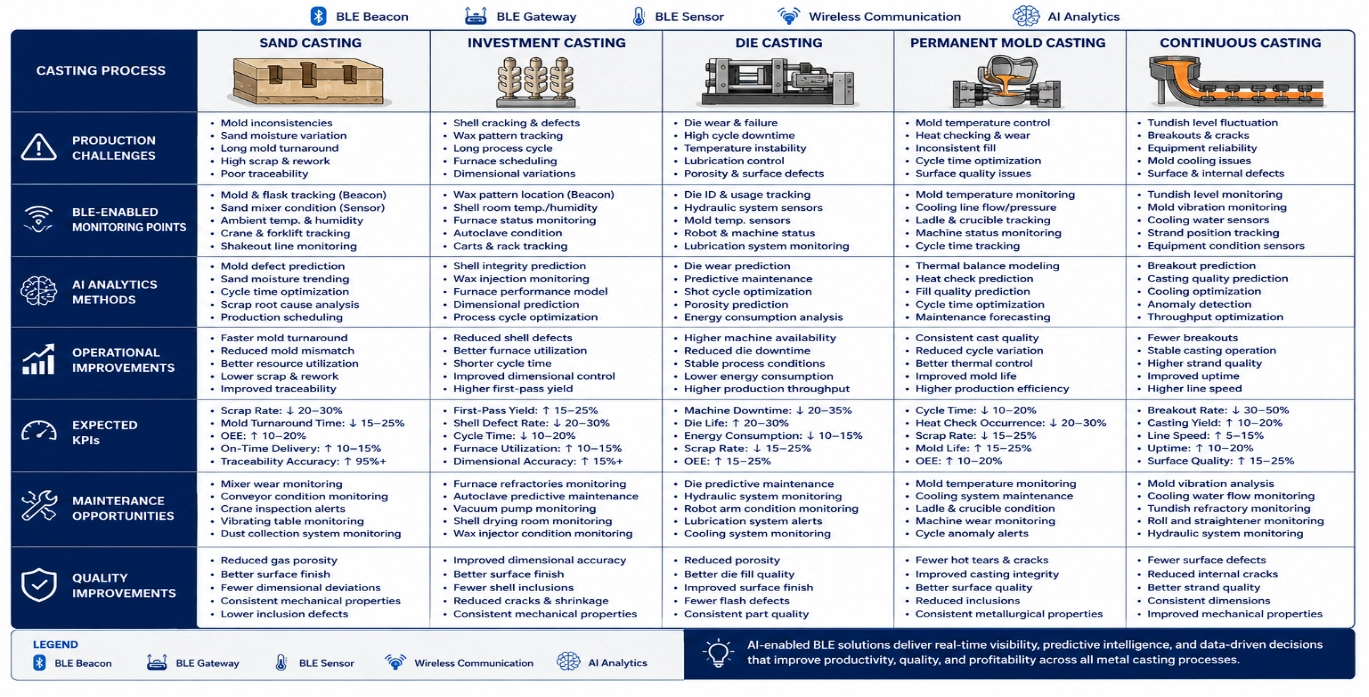
This comparison table evaluates how AI-enabled BLE solutions are applied across sand casting, investment casting, die casting, permanent mold casting, and continuous casting operations. It highlights production challenges, BLE monitoring points, AI analytics methods, expected operational improvements, key performance indicators (KPIs), maintenance opportunities, and quality enhancements, helping manufacturers identify the most suitable deployment strategy for each casting process.
Operational Workflow for AI-Driven Metal Casting Intelligence
Modern foundries generate large volumes of operational information across melting, mold preparation, pouring, cooling, finishing, inspection, and logistics. AI-supported BLE systems transform these distributed data sources into coordinated operational intelligence.
Data Acquisition
BLE sensors continuously collect information from production environments, including:
- Ambient temperature
- Humidity
- Equipment vibration
- Machine operating status
- Production asset location
- Mold movement
- Tool availability
- Energy consumption
- Personnel movement
- Material transport
Production equipment generating complementary operational data includes:
- Induction furnaces
- Electric arc furnaces
- Holding furnaces
- Sand mixers
- Molding lines
- Core making machines
- Shot blasting systems
- Heat treatment furnaces
- CNC finishing centers
- Industrial robots
Wireless Communication
BLE beacons communicate with strategically deployed BLE gateways positioned throughout production buildings.
Gateway placement normally considers:
- Large metallic structures
- Furnace interference
- Crane movement
- Building layout
- Production zones
- Network redundancy
- Maintenance accessibility
Industrial networking often combines BLE with:
- Industrial Ethernet
- Wi-Fi
- OPC UA
- MQTT
- Modbus TCP
- REST APIs
Edge Processing
Many operational decisions require low latency.
Edge servers positioned within production facilities commonly perform:
- Data filtering
- Sensor validation
- Local anomaly detection
- Alarm generation
- Temporary buffering
- Local dashboards
- Equipment health calculations
This reduces unnecessary cloud communication while maintaining operational continuity during external network interruptions.
Enterprise Software Integration
AI solutions become considerably more valuable after integration with existing manufacturing software.
Common integrations include:
- Manufacturing Execution Systems (MES)
- Enterprise Resource Planning (ERP)
- Computerized Maintenance Management Systems (CMMS)
- Manufacturing Operations Management (MOM)
- Supervisory Control and Data Acquisition (SCADA)
- Laboratory Information Management Systems (LIMS)
- Quality Management Systems (QMS)
- Warehouse Management Systems (WMS)
These integrations enable production events captured through BLE infrastructure to influence maintenance planning, production scheduling, inventory management, quality reporting, and operational analytics.
GAO supports organizations deploying industrial BLE hardware that integrates with widely used manufacturing software while minimizing disruption to existing production environments.
AI-Enabled BLE Operational Workflow for Intelligent Metal Casting Facilities
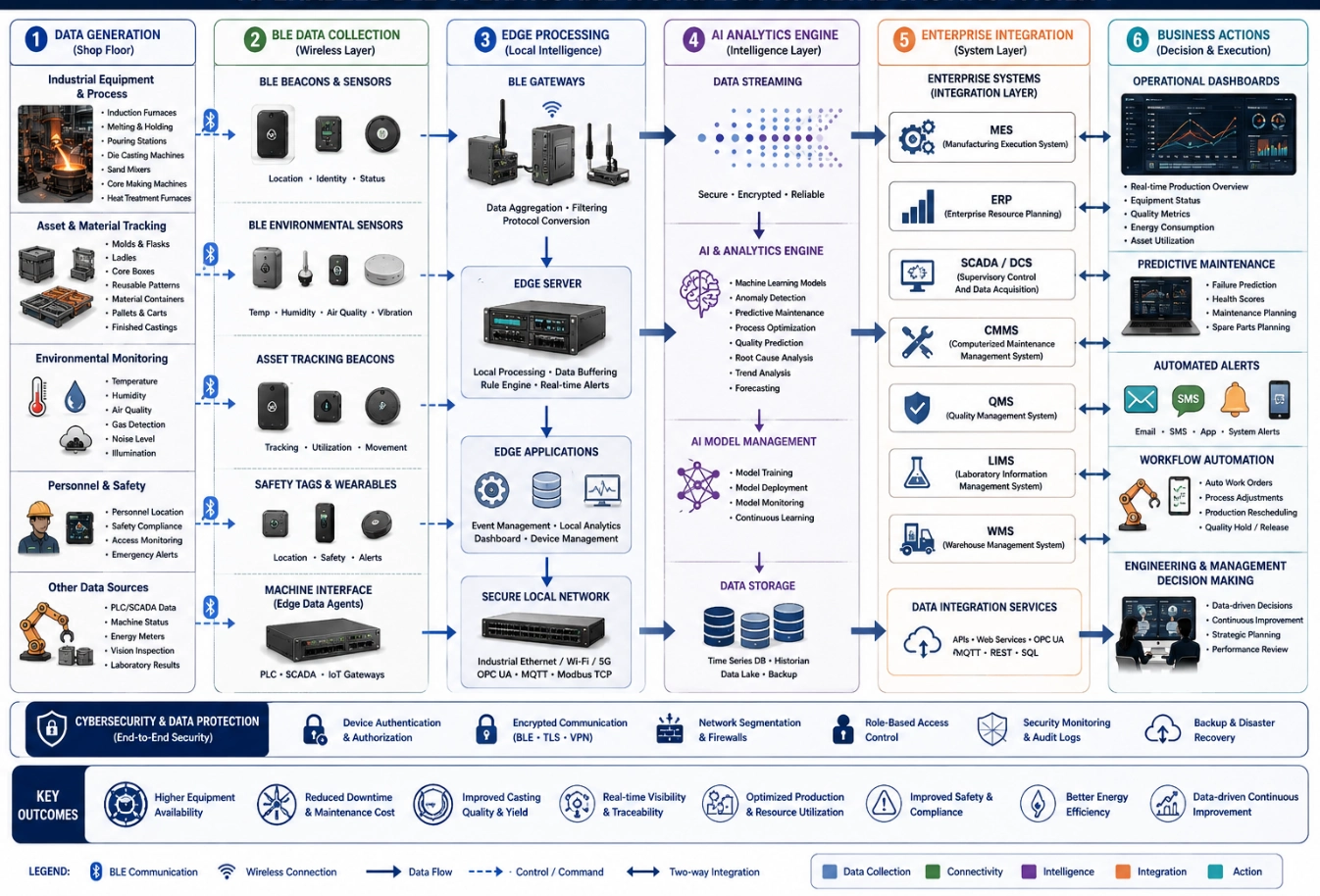
This workflow diagram illustrates the complete AI-enabled BLE data flow within a metal casting facility, beginning with BLE sensors, BLE beacons, industrial equipment, environmental monitoring, and asset tracking. It shows how data moves through BLE gateways, edge servers, AI analytics engines, and integrated enterprise software such as MES, ERP, SCADA, CMMS, and QMS before supporting operational dashboards, predictive maintenance, automated alerts, and engineering decision-making. The visual demonstrates how AI and BLE improve production visibility, equipment reliability, casting quality, traceability, and operational efficiency.
BLE Infrastructure, AI Software, and Deployment Models for Metal Casting
Successful AI-enabled metal casting solutions depend on selecting appropriate sensing technologies, communication infrastructure, industrial software, and deployment strategies that align with foundry operating conditions.
Rather than treating BLE as an isolated wireless technology, modern foundries deploy BLE gateways, BLE beacons, and BLE sensors as components of a larger industrial monitoring system that supports predictive analytics, production optimization, quality assurance, and maintenance intelligence.
BLE Hardware Components
Industrial BLE deployments in metal casting environments typically include several complementary hardware elements.
BLE Beacons provide location awareness for reusable molds, ladles, material containers, tooling, forklifts, overhead crane attachments, inspection fixtures, returnable transport racks, and work-in-progress assets. Ruggedized beacon enclosures are selected to withstand vibration, dust, and challenging foundry conditions.
BLE Sensors continuously monitor variables such as ambient temperature, humidity, vibration, equipment operating state, and environmental conditions surrounding production cells. Sensor data helps AI identify abnormal operating patterns that may influence casting quality or equipment reliability.
BLE Gateways collect wireless data from nearby beacons and sensors before forwarding information to local servers or cloud-hosted software using industrial networking protocols. Proper gateway placement is essential to maintain reliable coverage despite dense metallic structures, moving cranes, and electromagnetic interference common in metal casting facilities.
Industrial Software Supporting AI-Driven Metal Casting
Industrial software converts operational data collected from BLE infrastructure into actionable intelligence for production, maintenance, quality assurance, and plant management. Rather than operating as isolated applications, these software systems exchange information throughout the production lifecycle to support informed engineering decisions.
Common software components include:
- Manufacturing Execution Systems (MES) for production scheduling, work order management, and production traceability
- Enterprise Resource Planning (ERP) software for inventory management, procurement, production costing, and material planning
- Computerized Maintenance Management Systems (CMMS) for predictive maintenance planning, spare parts management, and work order generation
- Supervisory Control and Data Acquisition (SCADA) software for monitoring industrial equipment and production processes
- Quality Management Systems (QMS) for inspection records, nonconformance tracking, statistical process control, and compliance reporting
- Laboratory Information Management Systems (LIMS) supporting metallurgical analysis, alloy verification, and laboratory testing
- Industrial historians for storing long-term operational data used in AI model training and trend analysis
- Visualization dashboards that provide engineers with real-time operational status, production KPIs, maintenance alerts, and quality metrics
AI software continuously correlates information across these systems, enabling foundries to detect relationships that are difficult to identify using conventional reporting methods.
Artificial Intelligence Methods Used in Metal Casting
AI solutions within metal casting employ several analytical techniques depending on production objectives.
Machine Learning
Machine learning identifies relationships between production parameters and casting quality.
Typical applications include:
- Scrap prediction
- Yield optimization
- Furnace efficiency analysis
- Production forecasting
- Energy optimization
- Equipment reliability assessment
Predictive Maintenance
Predictive maintenance models evaluate equipment health by analyzing vibration, operating cycles, utilization rates, environmental conditions, and historical maintenance records.
Typical monitored assets include:
- Induction furnaces
- Die casting machines
- Hydraulic systems
- Shot blasting equipment
- Sand preparation equipment
- Air compressors
- Dust collection systems
- Cooling pumps
- Conveyors
- Overhead cranes
Computer Vision
Computer vision systems assist with:
- Surface defect inspection
- Flash detection
- Crack identification
- Porosity indication
- Mold verification
- Core alignment inspection
- Dimensional verification
- Robotic inspection guidance
Anomaly Detection
Anomaly detection algorithms identify unusual operating conditions before they become production problems.
Examples include:
- Unexpected temperature fluctuations
- Irregular vibration signatures
- Abnormal production cycle durations
- Excessive energy consumption
- Unusual material movement
- Production bottlenecks
- Unexpected equipment idle periods
Optimization Algorithms
Optimization models recommend improved operating parameters such as:
- Pouring schedules
- Furnace loading
- Cooling durations
- Production sequencing
- Maintenance timing
- Material handling routes
- Workforce allocation
Layered AI-Enabled BLE System Diagram for Intelligent Metal Casting Operations
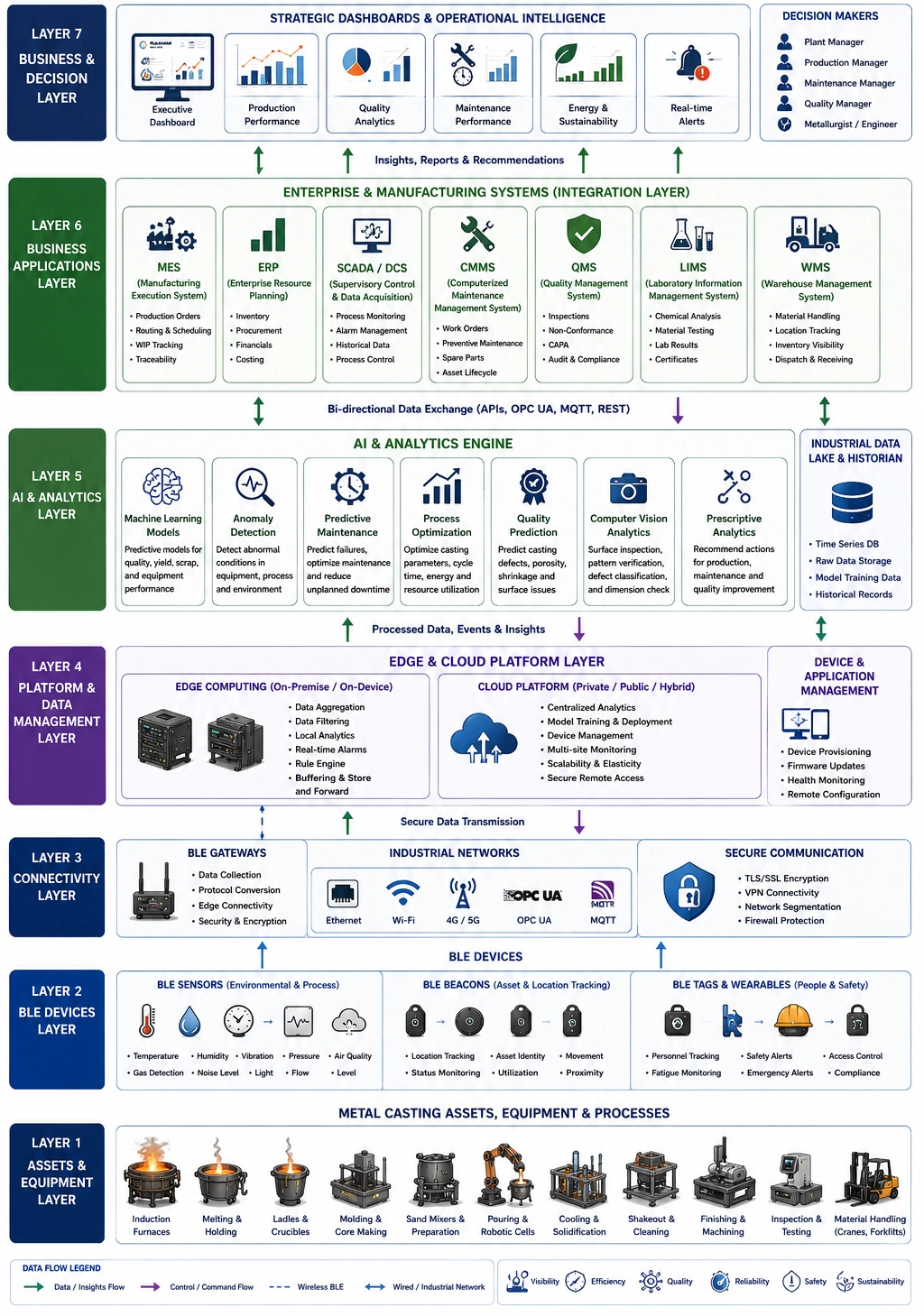
This layered block diagram illustrates how BLE sensors, BLE beacons, industrial equipment, BLE gateways, edge computing, cloud software, AI analytics, industrial databases, and enterprise systems interact throughout a metal casting facility. It demonstrates the end-to-end flow of operational data from shop floor assets through AI processing and enterprise software, enabling predictive maintenance, quality management, production optimization, and data-driven engineering decisions.
Cloud Software and Server Software Deployment
Selecting the appropriate deployment model depends on production scale, cybersecurity policies, operational continuity requirements, regulatory obligations, and available IT resources.
Cloud Version
Cloud-hosted software is appropriate for organizations operating multiple foundries, geographically distributed production facilities, or centralized manufacturing management teams.
Advantages include:
- Centralized monitoring across multiple plants
- Simplified software updates
- Elastic computing resources for AI model training
- Enterprise-wide production reporting
- Remote engineering collaboration
- Disaster recovery support
- Lower infrastructure management requirements
Cloud deployments are commonly selected when facilities require corporate-level production visibility and long-term operational analytics.
Server Version
Privately hosted server software is often preferred by foundries requiring local processing, strict cybersecurity controls, or uninterrupted production during internet outages.
Typical deployment environments include:
- Factory edge servers
- Customer-managed server rooms
- Private data centers
- Industrial computing clusters
- Regional manufacturing servers
Advantages include:
- Lower operational latency
- Local AI inference
- Greater control over sensitive production data
- Support for restricted manufacturing environments
- Integration with existing industrial software
- Continuous operation without external network dependency
Many large metal casting organizations implement hybrid deployments where edge servers perform real-time operational analytics while cloud software supports enterprise reporting, historical analysis, and AI model refinement.
Industrial Communication Infrastructure
Reliable communication is essential because foundries contain dense metallic equipment, elevated temperatures, heavy machinery, and continuously moving assets.
Typical communication technologies include:
- Bluetooth Low Energy (BLE)
- Industrial Ethernet
- Wi-Fi
- OPC UA
- MQTT
- Modbus TCP
- EtherNet/IP
- PROFINET
- REST APIs
Network design considerations include:
- RF propagation around large metal structures
- Redundant gateway coverage
- Low-latency communication
- Secure remote access
- Industrial network segmentation
- Equipment mobility
- Expansion planning
Proper wireless site surveys and commissioning activities significantly improve long-term communication reliability.
Cybersecurity Considerations
Protecting production systems is essential as AI-driven monitoring becomes increasingly connected.
Recommended security measures include:
- Role-based access control
- Multi-factor authentication
- Secure firmware management
- Device authentication
- Encrypted BLE communications
- TLS encryption for network traffic
- Network segmentation
- Secure API authentication
- Continuous vulnerability monitoring
- Security event logging
- Backup and disaster recovery procedures
Organizations also benefit from routine firmware updates, penetration testing, and cybersecurity assessments to maintain resilient industrial operations.
GAO provides industrial BLE hardware designed to support secure deployment within demanding manufacturing environments while aligning with customer cybersecurity requirements and existing operational practices.
Secure AI-Enabled BLE Communication Flow for Metal Casting Facilities
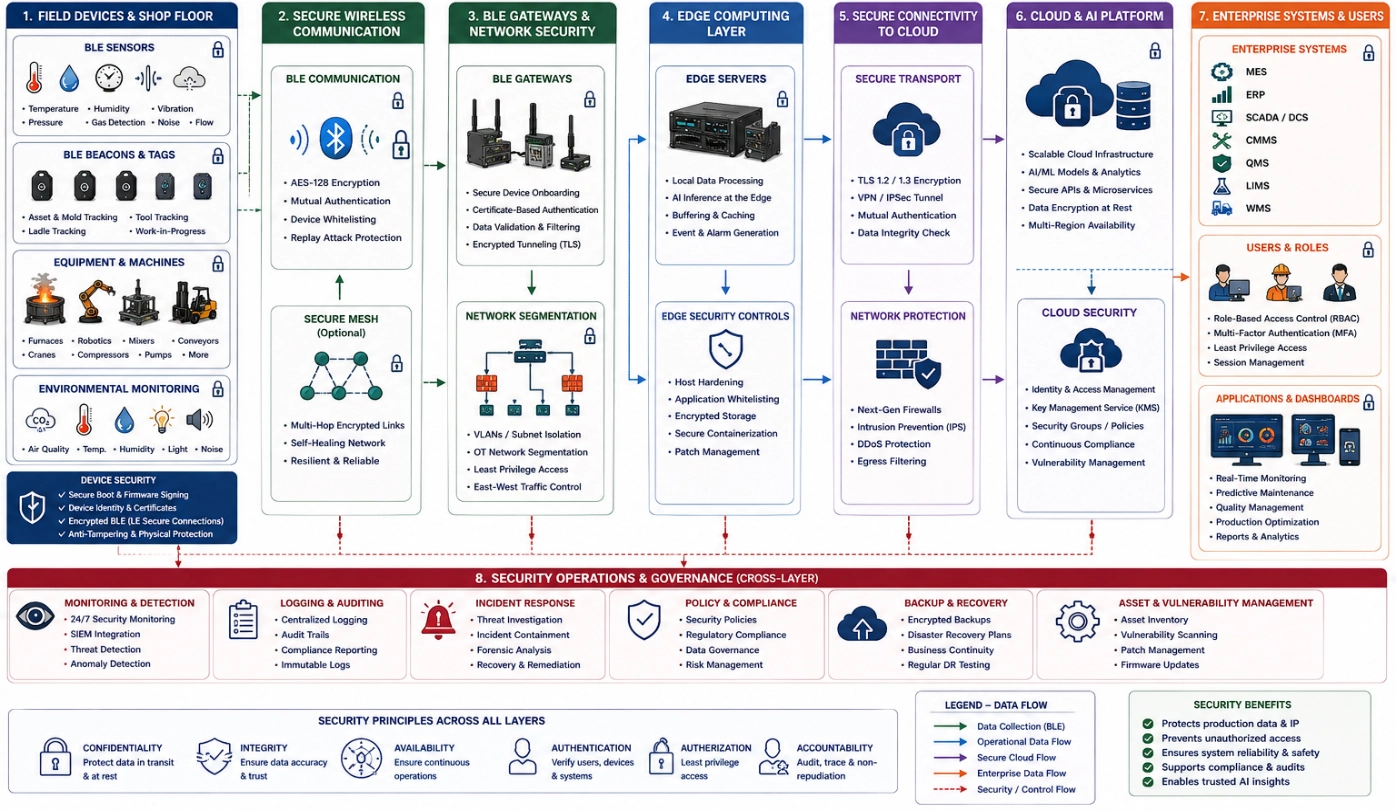
This security flow diagram illustrates how cybersecurity controls protect AI-enabled BLE communications throughout a metal casting facility. It shows secure data movement from BLE sensors, BLE beacons, and industrial equipment through BLE gateways, encrypted wireless networks, edge servers, cloud software, AI analytics, and enterprise systems using authentication, encryption, firewalls, network segmentation, continuous monitoring, and security operations to safeguard production data and industrial processes.
Technical Capabilities and Operational Benefits
Combining AI with BLE-supported operational visibility enables foundries to improve production consistency, equipment utilization, maintenance planning, and overall manufacturing performance.
Key technical capabilities include:
- Continuous monitoring of production assets
- Real-time equipment condition assessment
- Automated work-in-progress tracking
- Predictive maintenance recommendations
- Environmental monitoring for process stability
- Production bottleneck identification
- AI-assisted production scheduling
- Intelligent inventory visibility
- Automated operational alerts
- Historical production analytics
Business and operational improvements include:
- Reduced unplanned equipment downtime
- Lower scrap and rework rates
- Improved overall equipment effectiveness (OEE)
- Higher casting yield
- Better furnace utilization
- Increased mold and die availability
- Faster maintenance response
- Improved energy efficiency
- Enhanced production traceability
- Reduced inventory search time
- Greater workforce productivity
- Improved operational safety
- Better production forecasting
- More consistent product quality
- Increased customer delivery reliability
These improvements result from continuous monitoring and AI-driven recommendations rather than reactive responses after production issues occur.
GAO has helped organizations deploy industrial BLE products supporting operational visibility, predictive maintenance initiatives, and intelligent manufacturing solutions across demanding industrial environments.
Enterprise AI-Enabled BLE Benefits Infographic for Metal Casting Operations
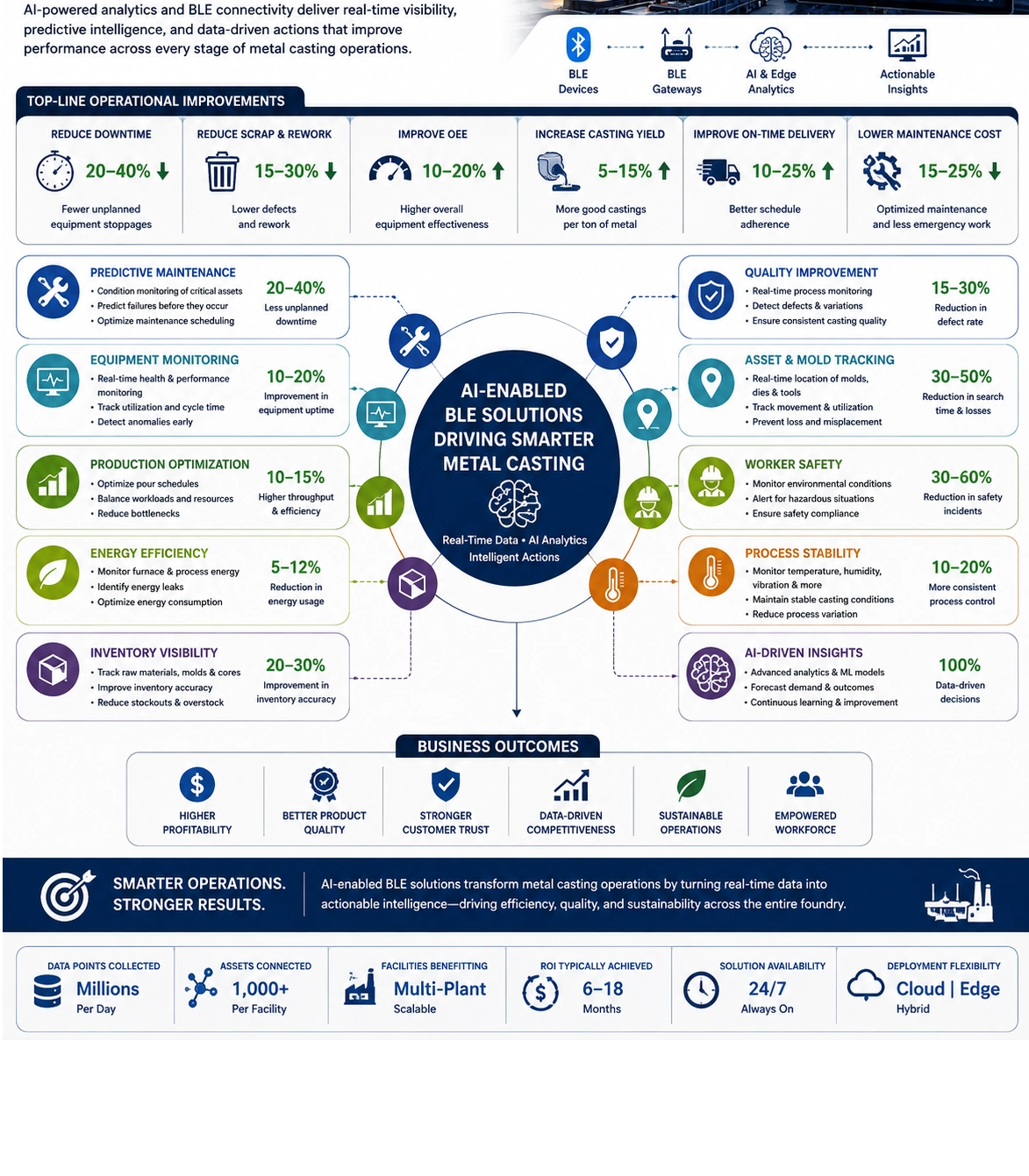
This executive infographic summarizes the measurable operational improvements achieved by implementing AI-enabled BLE solutions in metal casting facilities. It highlights predictive maintenance, quality improvement, reduced scrap and rework, equipment monitoring, production optimization, asset tracking, energy efficiency, worker safety, inventory visibility, AI-driven analytics, and key business outcomes using KPI indicators and process-focused visuals.
Engineering Best Practices and Implementation Recommendations
Successful deployments begin with clearly defined operational objectives rather than technology selection alone.
Recommended engineering practices include:
- Identify high-value production challenges before deployment
- Conduct wireless site surveys across production areas
- Select industrial-grade BLE hardware suitable for foundry environments
- Integrate operational data with existing manufacturing software
- Establish data quality validation procedures
- Define measurable KPIs before implementation
- Pilot AI models using historical production data
- Train maintenance, quality, and production teams on AI-assisted workflows
- Periodically recalibrate sensors and validate beacon locations
- Review cybersecurity controls throughout the deployment lifecycle
- Continuously evaluate AI model performance as production conditions evolve
Organizations adopting phased implementations often achieve faster operational acceptance while minimizing production disruption.
Advancing Intelligent Metal Casting with AI-Enabled BLE Solutions
AI-supported BLE solutions are reshaping metal casting by providing continuous operational visibility, predictive intelligence, and data-driven decision support across every stage of production. From monitoring furnaces and tracking molds to optimizing maintenance schedules and improving quality assurance, AI transforms operational data into practical actions that reduce variability and strengthen manufacturing performance.
Successful implementation depends on reliable sensing, robust industrial communications, thoughtful software integration, strong cybersecurity, and ongoing optimization. Organizations that combine these engineering principles with experienced deployment partners can improve productivity, reduce operational risk, and enhance long-term competitiveness. Headquartered in New York City and Toronto, Canada, GAO is recognized among the world’s leading B2B suppliers of BLE and RFID solutions. For more than three decades, we have supported Fortune 500 companies, research institutions, and government agencies across the United States and Canada through extensive R&D, rigorous quality assurance, and expert technical support delivered remotely and onsite.
Building the Future of Industrial AI and IoT with Aperture Venture Studio and GAO
For more than three decades, GAO Group of Companies has invested extensively in research and development of industrial BLE, RFID, and IoT technologies. As generative AI has demonstrated measurable value in manufacturing, we have expanded our work in AIoT solutions that help organizations modernize metal casting operations through intelligent sensing, predictive analytics, and connected industrial systems. To further accelerate innovation in industrial AI and IoT, we founded Aperture Venture Studio to help build, launch, and scale advanced AI and IoT initiatives serving a wide range of industrial sectors.
Aperture has attracted leading AI and IoT technical experts, experienced operational executives, influential investors, and established technology companies. Through the Aperture Ventures Summit and TekSummit, we foster technical collaboration on emerging AI and IoT topics while strengthening diverse technical communities. We welcome participation as:
- Advisors, co-founders, or employees
- Investors
- Customers seeking advanced AI and IoT solutions for industrial operations