
AI and RFID for Personal Care Products
AI-Driven Inventory and Traceability for Personal Care Products
AI and RFID are increasingly used together to improve how personal care products are manufactured, inspected, stored, distributed, and replenished. For cosmetics, skincare, haircare, fragrances, grooming products, and hygiene products, AI converts product identification and operational data into decisions about inventory, quality, fulfillment, production, and supply chain exceptions. RFID provides the machine-readable identity layer, while AI analyzes RFID events alongside ERP, WMS, MES, machine vision, order, sales, and environmental data. The result is more accurate item and case visibility across manufacturing plants, distribution centers, warehouses, retail backrooms, and store operations. UHF RFID is particularly useful for high-volume item and case identification, while HF and LF RFID can address more specialized proximity or identification requirements. GAO provides RFID, BLE, and IoT hardware and systems that can support these connected workflows for organizations managing complex personal care product operations.
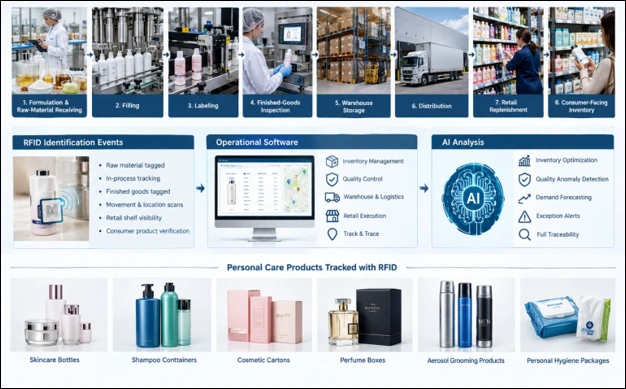
AI-Powered RFID Product Visibility Across the Personal Care Supply Chain
This infographic illustrates how RFID tracking and AI analytics work together across the personal care product lifecycle, from raw-material receiving and manufacturing to warehouse storage, distribution, retail replenishment, and consumer inventory. It highlights how connected RFID events support inventory optimization, quality control, demand forecasting, exception alerts, and end-to-end traceability.
What AI Means for Personal Care Product Operations
AI for personal care products is not simply a chatbot or predictive analytics application. It is a combination of machine learning, computer vision, anomaly detection, forecasting, optimization, natural-language interfaces, and, where appropriate, Edge AI operating against production and supply-chain data.
The most useful AI applications begin with a specific operational problem:
- AI inventory management identifies discrepancies between expected and physically observed personal care product quantities.
- AI warehouse management detects misplaced cartons, incomplete picks, unexpected movements, and inventory aging.
- AI demand forecasting predicts SKU-level demand for seasonal skincare, fragrance, grooming, and promotional products.
- AI quality inspection detects packaging defects, missing labels, incorrect caps, fill-level anomalies, color differences, and damaged cartons when computer vision is integrated with production inspection.
- AI traceability links product identity, lot information, production events, warehouse movements, and distribution events for faster investigation.
- AI production analytics identifies abnormal machine conditions, process drift, recurring downtime, and quality correlations.
- AI fulfillment optimization prioritizes orders according to demand, inventory availability, service commitments, lot constraints, and warehouse conditions.
- AI exception management identifies unusual RFID movement patterns that require human investigation.
RFID supplies a particularly useful source of operational evidence because a tagged product, carton, tote, or pallet can generate an identity event without requiring line-of-sight scanning. GS1’s current EPC Gen2 UHF RFID specification defines operation in the 860 to 930 MHz range, while GS1 identifies RAIN RFID as a technology commonly used for fast item identification, inventory, and tracking.
The value for personal care manufacturers comes from combining those identification events with context. A reader event by itself says that an RFID identifier was detected. A useful AI system can determine whether that event is consistent with a production transfer, warehouse movement, shipment, replenishment operation, or an unexpected product movement.
GAO’s role in these deployments can include supplying RFID readers, antennas, tags, gateways, handheld equipment, BLE devices, and associated IoT hardware and systems that provide the physical data acquisition layer.
Personal Care Product Use Cases for AI and RFID
Smart Production and Finished-Goods Control
Personal care manufacturing contains multiple points where product identity and process state must remain synchronized. A typical production sequence can involve raw-material staging, batching, compounding, filling, capping, labeling, coding, inspection, cartoning, case packing, palletization, quarantine, quality release, and finished-goods storage.
AI can compare production records with identification events to detect deviations. For example, if a pallet is physically detected leaving a production area before the associated quality-release status is available in the manufacturing system, software can flag the movement rather than allowing it to become an unnoticed downstream inventory problem.
Computer vision can complement RFID by examining cosmetic packaging and finished products for:
- Missing or incorrectly positioned labels
- Incorrect SKU artwork
- Damaged cartons
- Cap and closure defects
- Print and date-code anomalies
- Fill-level abnormalities
- Container deformation
- Color or appearance deviations
- Foreign objects or visible contamination indicators
- Packaging configuration errors
RFID does not replace quality inspection. It provides reliable product identity and movement context, while machine vision supplies visual evidence. AI can correlate both data sources.
AI Inventory Management for Cosmetics and Personal Care SKUs
Personal care inventories can contain thousands of visually similar SKUs differentiated by fragrance, color, formulation, size, package configuration, market, or promotional version. Manual barcode counting can become labor-intensive when large quantities of cartons and individual items must be reconciled.
RFID-enabled cycle counting can capture multiple tagged items in a reading zone, reducing the need for individual line-of-sight scans. AI can then reconcile observed inventory with ERP or WMS expectations and prioritize discrepancies.
Useful AI decisions include:
- Which SKU discrepancies require immediate investigation
- Which inventory locations exhibit recurring count errors
- Whether unexplained inventory loss is concentrated around specific processes
- Which slow-moving personal care products are approaching an inventory-aging threshold
- Whether promotional demand is likely to create a replenishment shortage
- Which warehouse zones require a targeted cycle count
The engineering objective is not simply a higher RFID read count. It is a more reliable inventory state that can be trusted by planning, purchasing, manufacturing, fulfillment, and finance.
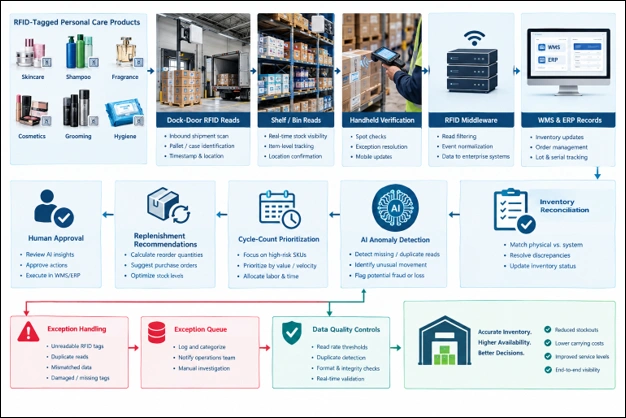
AI-Powered RFID Inventory Management Workflow for Personal Care Products
This workflow diagram shows how RFID observations from tagged personal care products flow through warehouse systems into AI-assisted inventory decisions. It highlights RFID middleware, WMS/ERP integration, inventory reconciliation, anomaly detection, cycle-count prioritization, replenishment recommendations, human approval, and exception handling.
AI-Assisted Warehouse and Distribution Operations
Distribution centers handling personal care products must coordinate receiving, putaway, storage, picking, packing, staging, shipping, returns, and inventory reconciliation.
RFID can identify products as cases or pallets pass through dock doors and controlled reading zones. AI can analyze movement histories and order requirements to identify exceptions such as:
- A pallet routed to the wrong shipping lane
- A case associated with an unexpected customer order
- A shipment containing an incorrect SKU mix
- A product movement that does not match the warehouse task
- A repeated discrepancy between physical and WMS inventory
- Unusual dwell time in a staging location
- Returned merchandise with an inconsistent identity history
This is especially useful where personal care manufacturers operate multiple package sizes and variants that appear visually similar.
A practical implementation should preserve the underlying event history. AI recommendations should remain traceable to source events so that warehouse supervisors can understand why a shipment or inventory location was flagged.
Demand Forecasting and Replenishment
Personal care products frequently experience demand variation caused by promotions, holidays, seasonal routines, product launches, regional preferences, and retailer-specific programs.
AI demand models can combine:
- Historical sales
- Retailer orders
- Inventory positions
- RFID-derived inventory observations
- Promotions
- Product launches
- Seasonal demand
- Regional sales patterns
- Lead times
- Production capacity
- Supplier constraints
- Returns and cancellations
The result can be a more useful forecast than a model relying only on historical sales. RFID contributes physical inventory evidence, helping AI distinguish a genuine demand increase from an inventory-record problem.
Operational Challenges That AI and RFID Address
Personal care product manufacturers should approach these technologies around measurable operational constraints rather than technology adoption alone.
Personal Care Challenge AI Contribution RFID Contribution Operational Outcome
SKU-level inventory discrepancies Detects abnormal variance patterns Captures physical product identity Faster reconciliation
Similar-looking product variants Classifies and correlates product data Provides unique item or case identity Fewer picking errors
Warehouse misplacement Identifies unusual movement patterns Records location transitions Faster exception resolution
Packaging defects Detects visual anomalies Associates defects with product identity Better quality traceability
Demand volatility Forecasts SKU-level demand Improves physical inventory visibility Better replenishment
Shipment errors Validates order and product relationships Captures case and pallet movement More accurate fulfillment
Returns processing Identifies unusual return patterns Supports product identity verification Faster disposition
Product investigations Correlates production and movement records Provides event evidence Faster root-cause analysis
Inventory aging Predicts risk from movement and demand Supplies location and movement history Better stock rotation
Counterfeit or diversion risk Detects anomalous movement behavior Provides serialized identity Stronger product authentication
The precise business case depends on tagging level, read-zone design, SKU characteristics, process discipline, and integration quality. RFID performance should therefore be validated using representative personal care packaging before broad deployment.
End-to-End AIoT Workflow for Personal Care Products
AIoT, or Artificial Intelligence of Things, combines artificial intelligence with connected devices, sensors, RFID equipment, BLE devices, connected equipment, and operational systems. For personal care products, the workflow begins with physical data acquisition and ends with an operational action.
Data Acquisition
RFID readers, antennas, handheld readers, fixed gateways, barcode scanners, machine-vision cameras, PLCs, environmental sensors, and BLE devices can provide different forms of operational evidence.
RFID tag selection should reflect the actual package material. Personal care products may include glass fragrance bottles, liquid-filled containers, metallic cosmetic packaging, foil-lined packages, dense cartons, and mixed cases. Liquids and metal can affect UHF RFID performance, so antenna placement, tag orientation, reader power, and packaging configuration must be tested rather than assumed.
HF RFID may be preferable for shorter-range controlled interactions, while UHF RFID is generally more suitable for higher-throughput inventory and logistics workflows. LF RFID is typically reserved for specialized short-range identification requirements rather than broad personal care inventory visibility. GS1 notes that HF systems commonly operate at 13.56 MHz, while passive UHF RFID operates in the 860 to 930 MHz range.
Edge Processing and Communication
Readers transmit observations to edge gateways or software through interfaces such as Ethernet, Wi-Fi, cellular connectivity, serial communications, or reader-specific protocols.
A robust deployment should filter duplicate reads and apply business rules close to the point of capture when latency or network reliability matters. Reader middleware can normalize identifiers, apply event logic, monitor reader health, and forward meaningful events to enterprise software.
GS1 identifies Low Level Reader Protocol as a standardized interface between RFID software and readers and EPCIS as a mechanism for sharing visibility event data between applications.
Enterprise Software and AI Processing
Processed events can be associated with ERP, WMS, MES, QMS, TMS, order management, manufacturing planning, maintenance, and analytics systems.
AI models can operate in cloud infrastructure, private servers, or edge computing environments depending on latency, data governance, connectivity, and workload requirements.
A practical data chain can therefore be represented as:
RFID / Sensors / Vision → Edge Gateway → Event Processing → Operational Database → ERP/WMS/MES/QMS → AI Models → Decision Rules → Human or Automated Action
The important engineering principle is that AI should consume normalized, time-stamped, context-rich events rather than raw reader noise.
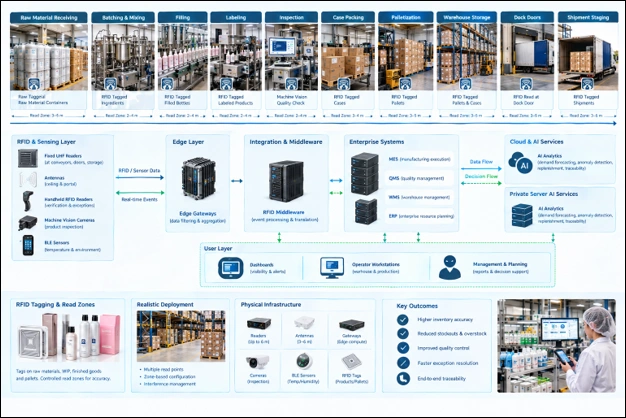
RFID and AI Deployment Architecture for Personal Care Manufacturing
This architecture diagram illustrates a realistic RFID and AI deployment across a personal care manufacturing and distribution operation. It connects RFID readers, sensors, edge gateways, middleware, MES/QMS/WMS/ERP platforms, AI services, dashboards, and operator workstations to support traceability, inventory accuracy, quality control, and faster decision-making.
RFID Selection for Personal Care Products
RFID selection should be driven by the product form factor and process objective.
UHF RFID for High-Volume Product Visibility
UHF RFID is generally the primary candidate for pallet, case, carton, and item-level personal care inventory because it can support fast multi-tag identification over practical warehouse and logistics distances.
Applications can include:
- Finished-goods pallet verification
- Case-level shipment validation
- Distribution-center inventory
- Retail replenishment
- Cycle counting
- Dock-door movement capture
- Carton aggregation
- Serialized item identification
GS1’s current EPC Gen2 UHF standard is Release 3.0.1, ratified in February 2026.
HF RFID for Controlled Proximity Applications
HF RFID operates at 13.56 MHz and is generally suited to shorter-range interactions. In personal care operations, it can be considered for controlled identification points, specialized authentication workflows, equipment interaction, or applications where close-range reads are desirable.
LF RFID for Specialized Identification
LF RFID is generally less suitable for broad product inventory because of its shorter reading range and lower throughput. It can nevertheless have value in specialized equipment, controlled identification, or applications where the physical environment favors lower-frequency coupling.
Technology selection should therefore be based on read distance, tag density, packaging materials, throughput, antenna geometry, interference, security requirements, and the desired business event.
Cloud and Server Deployment for AI and RFID
Personal care manufacturers typically have two practical software deployment choices.
Cloud Version
A cloud-hosted deployment is appropriate when multiple manufacturing sites, distribution centers, suppliers, and retail operations need shared access to inventory events, analytics, dashboards, and AI services. Cloud deployment can simplify centralized model management and provide elastic computing resources for forecasting and analytics.
Server Version
A privately hosted deployment can run on factory servers, edge servers, customer-managed infrastructure, private data centers, or other controlled enterprise environments. This approach can be appropriate where production connectivity is limited, operational latency is important, data must remain within controlled infrastructure, or internal IT policies restrict external processing.
A hybrid approach is often technically practical. Time-sensitive RFID event processing can occur locally, while aggregated data and AI workloads can be synchronized with centralized infrastructure.
GAO can support organizations evaluating RFID readers, antennas, tags, handheld equipment, BLE devices, gateways, and related hardware requirements as part of a broader personal care product tracking solution.
Engineering Priorities for AI-Enabled Personal Care Operations
Deploying AI-enabled product visibility in personal care manufacturing requires more than attaching RFID tags to finished goods. The system must produce reliable events at the physical points where products change state, and those events must remain synchronized with manufacturing, quality, warehouse, and order records.
Tag and Reader Engineering
RFID tag selection should be validated against the actual personal care package rather than selected solely from nominal read-range specifications. Glass bottles, liquid-filled containers, metallized cosmetic packaging, foil-containing packages, dense cartons, and mixed pallets can produce substantially different RF behavior.
Engineering validation should examine:
- UHF RFID tag placement on bottles, cartons, cases, and pallets
- Liquid and metal effects on tag performance
- Antenna polarization and orientation
- Reader transmit power
- Read-zone dimensions
- Conveyor speed
- Pallet and case density
- Reader-to-reader interference
- Missed-read and false-read rates
- Tag attachment consistency
- Environmental exposure during manufacturing and warehousing
A pilot should measure read performance under actual operating conditions, including forklift movement, conveyor throughput, pallet wrapping, carton orientation, and normal operator behavior.
RFID Event Quality and AI Data Preparation
AI performance depends heavily on event quality. A reader may detect the same tag multiple times while a pallet passes through a portal. Those observations need to be transformed into meaningful business events such as “case entered finished-goods warehouse” or “pallet assigned to outbound shipment.”
Useful preprocessing functions include:
- Duplicate-read suppression
- Reader health monitoring
- Antenna-zone identification
- Timestamp normalization
- Tag-to-SKU association
- Parent-child aggregation between item, case, and pallet
- Location association
- Movement-state detection
- Event confidence scoring
- Exception classification
EPCIS-based event models can be useful when personal care manufacturers need interoperable visibility information across internal systems, logistics partners, and supply-chain applications. GS1 describes EPCIS as a standard for capturing and sharing visibility event data across organizations and applications.
AI Model Selection
Different personal care workflows require different AI techniques. A single model should not be applied indiscriminately across inventory, quality, forecasting, and maintenance.
Appropriate methods can include:
- Time-series forecasting for SKU demand
- Gradient-boosting or other supervised models for inventory discrepancy prediction
- Classification models for shipment and process exceptions
- Clustering for unusual warehouse movement patterns
- Computer vision models for packaging inspection
- Anomaly-detection models for production equipment and RFID event streams
- Optimization models for replenishment and production scheduling
- Natural-language interfaces for querying operational records
- Edge AI for low-latency inspection or local event classification
Model outputs should be accompanied by sufficient evidence for operators to validate important decisions. For example, an AI system identifying an inventory discrepancy should provide the affected SKU, expected quantity, observed quantity, locations, relevant RFID events, previous discrepancy history, and confidence level.
AI-Enabled Quality and Compliance Control
Quality control is particularly important for personal care products because finished goods may contain formulation, packaging, labeling, lot, batch, and market-specific requirements.
AI can help quality teams identify relationships that are difficult to detect through manual review. For example, repeated packaging defects may correlate with a particular filling line, capping machine, shift, packaging material supplier, temperature condition, or production batch.
A connected quality workflow can associate:
Product identity → Batch/Lot → Production Line → Equipment State → Inspection Result → Quality Decision → Warehouse Location → Shipment
RFID contributes identity and movement evidence, while AI helps detect patterns across those records.
For U.S. cosmetics operations, regulatory requirements can include the Federal Food, Drug, and Cosmetic Act and the Modernization of Cosmetics Regulation Act of 2022, depending on the products and activities involved. FDA also maintains requirements and guidance covering cosmetic product facilities, registration, product listing, safety substantiation, labeling, and adverse-event reporting. The precise regulatory obligations should be evaluated against the organization’s products and markets rather than inferred from RFID implementation alone.
RFID does not itself establish regulatory compliance. It can, however, strengthen the underlying traceability and recordkeeping process when identification events are correctly associated with validated manufacturing and quality records.
Product Traceability Across Personal Care Supply Chains
Traceability becomes more valuable when personal care products move through multiple facilities, contract manufacturers, distributors, retailers, and returns channels.
A serialized RFID identity can support relationships among:
- Raw-material or component records
- Production batch or lot
- Finished SKU
- Case
- Pallet
- Distribution order
- Shipping event
- Receiving event
- Warehouse location
- Retail replenishment event
- Return
- Disposition decision
This information can support investigations when a quality issue, labeling problem, shipment discrepancy, or suspected diversion event occurs.
For organizations operating across the United States and Canada, data retention, privacy, cybersecurity, product regulations, and customer-specific requirements should be incorporated into the system design from the beginning. Personal care product traceability should be treated as an operational data problem as well as an identification problem.
AI for Personal Care Product Demand and Inventory Optimization
AI-based demand planning becomes more useful when physical inventory observations are combined with commercial data.
A forecasting system can ingest:
- SKU-level sales history
- Retailer purchase orders
- Current physical inventory
- Warehouse inventory
- In-transit quantities
- Promotional calendars
- Seasonal demand
- Product launch schedules
- Regional demand
- Lead times
- Production capacity
- Supplier performance
- Returns
- Stockout history
RFID-derived inventory can help reduce the uncertainty between book inventory and physical inventory. That distinction matters because an AI forecast based on an inaccurate inventory position can recommend production or replenishment that does not address the real problem.
For example, if a skincare SKU appears unavailable in the ERP but RFID observations show cases sitting in an incorrect warehouse location, the appropriate action may be inventory relocation rather than additional production.
This is one reason AI and RFID should be designed as a connected operational process rather than independent technology projects.
Cybersecurity for Connected Personal Care Operations
RFID systems increasingly connect physical manufacturing and warehouse processes to enterprise software. Security controls should therefore extend beyond the RFID reader itself.
A production deployment should consider:
- Unique device credentials
- Role-based access control
- Encrypted network communications
- Secure device configuration
- Network segmentation
- Reader and gateway firmware management
- API authentication
- Audit logging
- Secure software updates
- Backup and recovery
- Database access controls
- AI model access controls
- Data retention policies
- Monitoring of abnormal device behavior
Segmentation can isolate RFID readers, edge gateways, cameras, PLC-connected equipment, warehouse systems, and corporate IT networks according to operational risk.
AI systems introduce additional concerns. Training data, model versions, inference results, configuration files, and operational prompts should be governed according to their sensitivity. Human approval should remain part of workflows where an incorrect AI decision could release product, block a shipment, alter production, or trigger a costly inventory action.
Interoperability with Personal Care Manufacturing Systems
An RFID and AI solution should not create another isolated database that operators must manually reconcile.
Common integration targets include:
- ERP systems for item masters, purchasing, production, inventory, and financial records
- MES for production orders, work-in-process, equipment states, and manufacturing history
- WMS for locations, inventory, picking, receiving, and shipping
- QMS for inspection, nonconformance, corrective action, and release decisions
- TMS for transportation and shipment status
- CMMS or EAM software for maintenance records
- Order management systems
- Retailer and customer systems
- Data warehouses and analytics software
API integration, event messaging, database interfaces, middleware, and standardized visibility-event models can all be appropriate depending on the existing IT environment.
The item master deserves special attention. RFID data becomes difficult to use when EPCs, SKUs, GTINs, lot numbers, serial numbers, case IDs, and pallet IDs are not consistently mapped. A well-designed master-data process is therefore as important as the physical RFID installation.
GAO’s experience supplying RFID, BLE, and IoT hardware and systems can support this physical-to-digital integration effort, particularly when reader selection, antennas, tags, gateways, and connected devices must be matched to the customer’s operating environment.
Measuring AI and RFID Performance in Personal Care Products
A deployment should establish baseline measurements before installation and compare them against post-deployment performance.
Relevant KPIs include:
KPI What It Measures Why It Matters
Inventory accuracy Physical versus system quantity Indicates reliability of inventory records
RFID read rate Successful tag observations Measures identification performance
False-read rate Incorrect location or movement events Indicates event-quality problems
Cycle-count time Time required to verify inventory Measures counting efficiency
Pick accuracy Correct SKU and quantity shipped Measures fulfillment quality
Shipment verification rate Orders validated before dispatch Reduces shipping errors
Inventory discrepancy resolution time Time to investigate exceptions Measures operational responsiveness
Stockout rate Frequency of unavailable SKUs Connects inventory visibility to service
Inventory aging Duration products remain in stock Supports better stock rotation
Forecast accuracy Predicted versus actual demand Measures AI planning performance
Packaging defect rate Defects detected per production volume Measures quality performance
First-pass yield Products meeting requirements without rework Measures production quality
Unplanned downtime Production time lost to equipment failure Measures equipment reliability
Return processing time Time from receipt to disposition Measures reverse-logistics efficiency
Traceability retrieval time Time to locate relevant product history Measures investigation effectiveness
Read rate should not be treated as the only RFID KPI. A system that reads every tag but associates events with the wrong warehouse location can be operationally worse than a system with a slightly lower raw read rate but much better event accuracy.
Scaling from Pilot to Multi-Site Deployment
A controlled pilot is normally preferable to immediate deployment across every personal care manufacturing and distribution location.
The pilot should represent real operating conditions and include difficult products rather than only easy-to-read packaging.
A practical rollout sequence can include:
- Define the business problem and baseline KPI
- Select representative personal care SKUs
- Characterize packaging materials
- Test UHF, HF, or LF RFID where appropriate
- Design reader and antenna locations
- Configure event-processing rules
- Integrate with the relevant WMS, MES, ERP, or QMS
- Establish cybersecurity controls
- Conduct read-performance testing
- Run operational acceptance testing
- Train warehouse, production, quality, and IT personnel
- Measure KPI changes
- Correct physical and software exceptions
- Expand to additional lines, SKUs, warehouses, or facilities
The commissioning stage should include negative testing. Engineers should deliberately introduce incorrect SKU placement, duplicate reads, missing tags, unexpected movements, network interruptions, reader failures, and incomplete shipment configurations to verify that the system responds correctly.
This is particularly important for AI. Testing should evaluate false positives and false negatives, not simply whether the model produces an output.
Engineering Trade-Offs for Personal Care RFID Deployments
Personal care packaging creates several engineering trade-offs that should be addressed before procurement.
Item-level versus case-level tagging: Item-level serialization provides greater visibility but increases tag quantity, encoding, application, and data-management requirements. Case-level identification can reduce implementation complexity while still supporting distribution-center workflows.
Fixed readers versus handheld readers: Fixed readers provide continuous automated event capture at controlled locations. Handheld readers are flexible for cycle counting, exception investigation, and locations where permanent infrastructure is difficult to justify.
Edge versus cloud AI: Edge processing reduces latency and dependency on wide-area connectivity. Cloud processing can simplify centralized analytics and model management across multiple facilities.
High read sensitivity versus event precision: Increasing reader sensitivity does not automatically improve business results. Excessive read zones can capture products from adjacent processes, producing ambiguous movement events.
Automation versus human review: AI can prioritize exceptions, but quality release, shipment holds, and other high-impact decisions may require explicit human authorization.
These trade-offs should be resolved using measured operating data rather than generic specifications.
GAO Support for Personal Care RFID and AIoT Deployments
GAO supplies RFID, BLE, and IoT hardware products and systems used by organizations requiring connected identification, sensing, tracking, and data acquisition. Depending on the personal care application, the hardware layer can include UHF, HF, or LF RFID readers and tags, antennas, handheld devices, gateways, BLE equipment, and associated connected components.
GAO’s headquarters and operations are based in New York City and Toronto, Canada. GAO is ranked among the top 10 leading B2B and B2G RFID and BLE suppliers globally, with B2B2C and B2D activities also forming part of its broader market presence.
GAO, together with sister companies GAO Research and GAO Tek, forms GAO Group. For three decades, the group has served organizations across the United States and Canada, including Fortune 500 companies, leading research and development organizations, universities, and government agencies.
The practical value of a supplier in these projects is not limited to hardware specifications. Reader placement, tag selection, antenna configuration, environmental testing, integration requirements, and operational acceptance all influence the final result. GAO maintains R&D investment and stringent quality assurance processes and provides technical support remotely or onsite, which can be relevant when personal care manufacturers require assistance during deployment or troubleshooting.
Engineering Priorities for a Reliable Personal Care Solution
Successful AI-enabled RFID deployments in personal care products share several characteristics:
- The business problem is defined before selecting hardware.
- SKU, case, pallet, lot, and serial relationships are clearly modeled.
- RFID tags are tested against actual product packaging.
- Reader locations are engineered around physical process flows.
- Middleware converts raw reads into meaningful operational events.
- AI models use trusted operational and identification data.
- WMS, MES, ERP, QMS, and related systems remain synchronized.
- Cybersecurity is designed into readers, gateways, APIs, databases, and AI services.
- Edge and cloud processing are selected according to latency, connectivity, and data-governance requirements.
- Pilot KPIs are established before deployment.
- Commissioning includes failure and exception testing.
- Operators, warehouse personnel, quality teams, and IT teams participate in acceptance testing.
- Scaling decisions are based on measured read performance and business outcomes.
The strongest deployments treat AI as the decision layer and RFID as one of several physical data sources. Machine vision, BLE, environmental sensing, PLC data, ERP transactions, warehouse events, and production records can add context that a single identification technology cannot provide.
For personal care manufacturers, the objective is therefore not simply to “RFID-enable” products. The objective is to establish a reliable chain from physical product identity to operational evidence, AI analysis, and controlled business action.
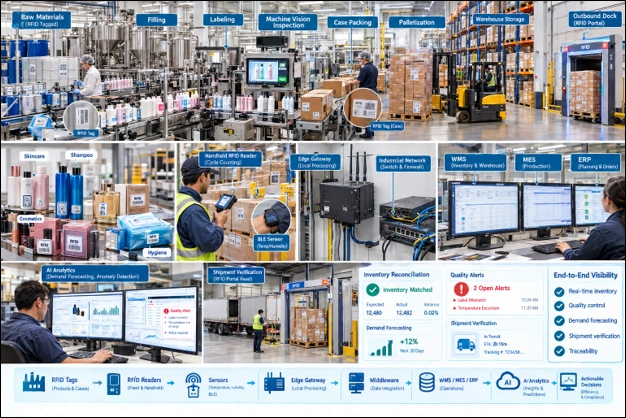
Realistic RFID and AI Deployment in Personal Care Manufacturing and Distribution
This visual illustrates a deployable RFID and AI solution operating across a personal care manufacturing and distribution facility. It connects production, packaging, warehouse, and shipment processes with RFID readers, sensors, edge computing, WMS/MES/ERP systems, and AI analytics for inventory reconciliation, quality alerts, demand forecasting, shipment verification, and traceability.
Building the Future of Industrial AI and IoT with Aperture Venture Studio and GAO RFID Inc.
For more than three decades, GAO Group of Companies has invested heavily in R&D for industrial RFID, BLE, and IoT. As generative AI became increasingly useful for industrial applications, we expanded our work across AI and IoT, including RFID and BLE, and founded Aperture Venture Studio to build, launch, and scale AI and IoT companies and solutions relevant to areas such as personal care manufacturing, product traceability, inventory intelligence, and connected operations.
Aperture has attracted AI and IoT technical experts, entrepreneurial and operational executives, influential investors, and leading companies. We have also developed Aperture Ventures Summit and TekSummit to discuss advanced AI and IoT topics. We welcome advisors, co-founders, employees, investors, and customers to participate in these activities.