
AI and BLE for Cold Storage Operations
AI-Driven Cold Storage Operations with BLE Visibility
Cold storage operations require precise control of inventory, temperature-sensitive products, material movement, labor activity, equipment, and order fulfillment. AI can analyze operational data from refrigerated warehouses, freezers, coolers, staging areas, loading docks, and storage zones to identify deviations, predict demand, prioritize work, and improve cold-chain execution. BLE beacons, BLE devices, and BLE gateways provide a practical data layer for identifying and locating mobile assets, monitoring movement, recording proximity events, and collecting environmental information.
AI-driven cold storage operations combine these data streams with warehouse management software, inventory records, transportation information, maintenance systems, and order data. The result is a more responsive operating process for receiving, put-away, replenishment, picking, staging, loading, and returns. GAO supplies BLE and other IoT hardware products and systems that can support these workflows, with deployment approaches suited to refrigerated distribution facilities and temperature-sensitive fulfillment environments.
AI-Driven Cold Storage Operations with BLE Tracking, Enterprise Systems, and Predictive Analytics
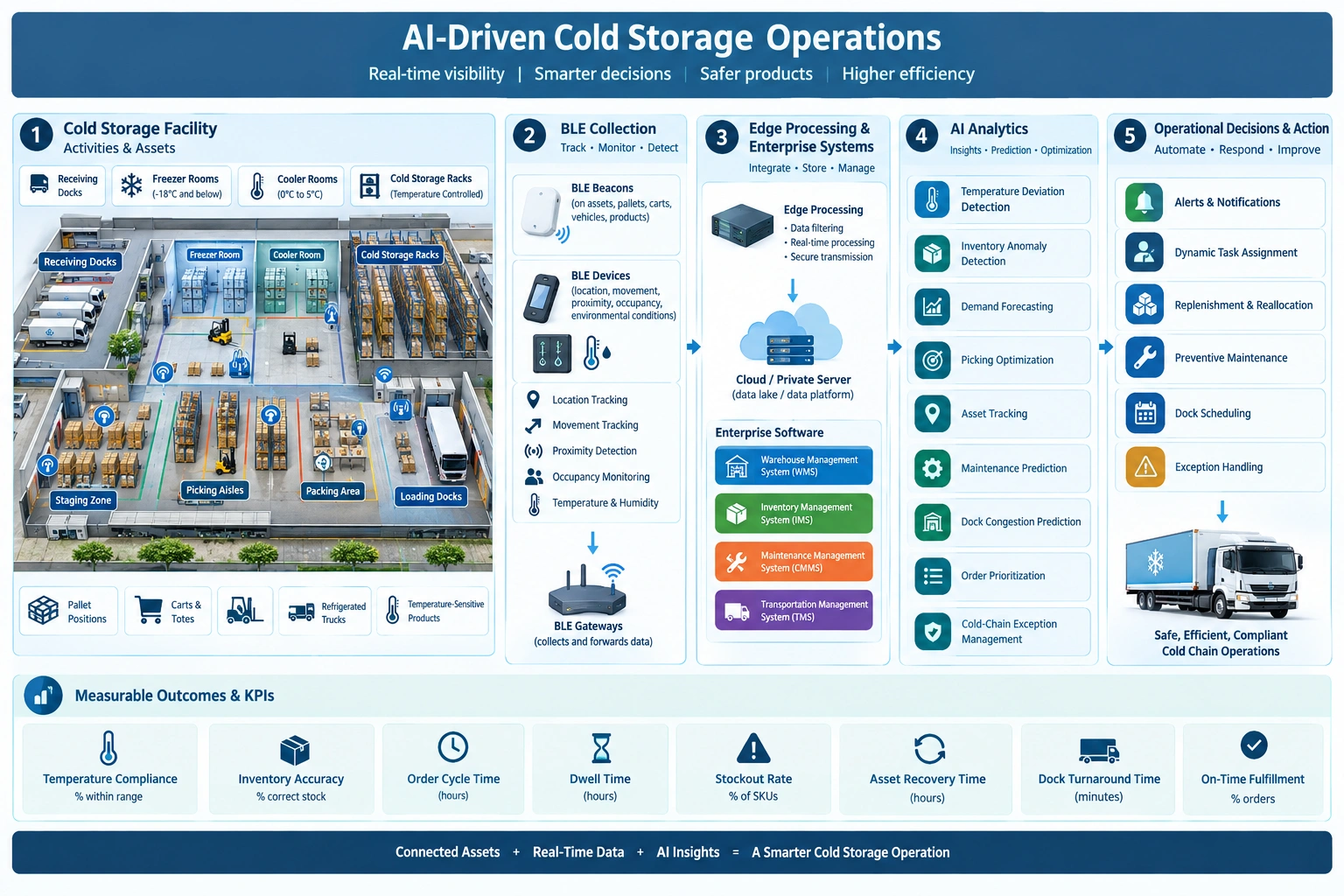
This visual illustrates how BLE-enabled cold storage facilities collect real-time operational, asset, and environmental data from refrigerated warehouses, freezer rooms, picking areas, and loading docks. Data flows through edge processing and enterprise software into AI analytics that support temperature compliance, inventory accuracy, demand forecasting, maintenance prediction, dock optimization, and cold-chain exception management.
How AI Improves Cold Storage Operations
AI for cold storage operations refers to the use of AI methods with operational data from refrigerated facilities, connected equipment, enterprise software, and IoT devices to support faster and more accurate decisions. The objective is not simply to collect more data. The objective is to turn information about products, storage conditions, movement, equipment, orders, and labor into actionable operating decisions.
Cold storage facilities have operational constraints that make timely data particularly important. Products may have defined temperature ranges, shelf-life limits, handling requirements, lot controls, and shipping windows. Inventory may move between ambient receiving areas, refrigerated staging zones, coolers, freezers, picking locations, and outbound docks. Delays during these transitions can affect product quality, energy consumption, labor productivity, and customer service.
AI can correlate multiple operational signals instead of treating each event independently. For example, an inventory system may show that a pallet is available while BLE location data indicates that the pallet has remained in a staging zone for an unusually long period. AI can classify the event as a potential fulfillment exception and direct an operator to investigate. Similar analysis can identify unusual dwell times, repeated movement patterns, misplaced pallets, abnormal equipment activity, or conditions that increase the probability of an order delay.
BLE provides the identification and location data needed for many of these applications. BLE beacons can be associated with pallets, carts, totes, forklifts, containers, or other mobile assets. BLE devices can provide information related to proximity, movement, occupancy, or environmental conditions. BLE gateways collect these signals and forward relevant information to software for processing.
GAO supports organizations implementing these types of IoT-based operating systems by supplying BLE hardware products and systems that can be integrated with facility software and data workflows. The appropriate deployment depends on facility layout, refrigeration zones, radio propagation, asset density, gateway placement, environmental conditions, and the operational precision required.
Cold Storage Workflows Supported by AI and BLE
AI and BLE applications become most valuable when they are tied to specific cold-storage workflows rather than deployed as isolated tracking projects. A refrigerated distribution center can use data from receiving through shipping to create a connected operational record for products, equipment, and work activities.
Receiving and Temperature-Sensitive Inbound Handling
Receiving operations create the first major control point for cold-chain inventory. Products arrive by refrigerated truck and may need inspection, identification, quantity verification, temperature verification, lot capture, and rapid movement into the appropriate storage zone.
BLE-enabled identification can help associate pallets, totes, carts, or other handling units with receiving events and locations. AI can compare arrival patterns, receiving volumes, product demand, storage capacity, and historical processing times to identify potential bottlenecks.
Operational applications include:
- Detecting unusual receiving dwell times
- Prioritizing temperature-sensitive inbound products
- Identifying staging congestion
- Matching inbound inventory with expected purchase orders
- Predicting receiving workload
- Identifying repeated delays at particular receiving areas
- Supporting dock scheduling decisions
Relevant KPIs include receiving cycle time, dock dwell time, put-away time, receiving accuracy, and temperature-exception rate.
Cold Storage Put-Away and Location Control
Put-away requires products to reach the correct storage location without unnecessary travel or extended exposure to unsuitable conditions. Freezer and cooler facilities may contain multiple temperature zones, rack levels, staging areas, and product-specific storage locations.
BLE location information can provide additional visibility when inventory moves beyond the precise events recorded by barcode or warehouse transactions. AI can compare expected inventory locations with observed movement and identify discrepancies.
AI-driven location analysis can support:
- Misplaced pallet detection
- Storage-zone verification
- Put-away prioritization
- Congestion identification
- Travel-path analysis
- Inventory reconciliation
- High-risk dwell-time alerts
These capabilities are particularly useful when product movements occur rapidly across refrigerated aisles and staging areas.
Inventory Management and Replenishment
Cold storage inventory management must account for quantity, location, lot information, expiration dates, storage conditions, and order requirements. Traditional inventory records can become inaccurate when physical movements are not captured promptly or when handling units are moved between temporary locations.
BLE data can provide an additional source of physical movement information. AI can compare this information with warehouse management records, cycle counts, order activity, replenishment requirements, and historical movement patterns.
AI can identify:
- Inventory discrepancies
- Unusual stock movement
- Potential stockouts
- Slow-moving refrigerated inventory
- Replenishment requirements
- Excess staging inventory
- Location inconsistencies
The resulting actions can include targeted cycle counts, inventory reconciliation, replenishment prioritization, and movement instructions.
Cold-Storage Picking and Order Fulfillment
Picking is one of the most labor-intensive cold storage workflows. Workers may operate in low-temperature environments while handling products under strict order, lot, quantity, and timing requirements. Excessive travel, misplaced inventory, congested aisles, and poorly sequenced work can increase labor costs and order cycle time.
AI can evaluate order priority, product locations, historical pick times, zone congestion, worker activity, and equipment availability to recommend more efficient picking sequences. BLE location information can provide additional context regarding carts, totes, forklifts, and other mobile resources.
Applications include:
- Dynamic pick-path optimization
- Pick-zone congestion analysis
- Cart and tote location tracking
- Order priority management
- Exception detection
- Labor allocation
- Pick-cycle analysis
Useful KPIs include pick cycle time, picks per labor hour, order accuracy, order cycle time, and fulfillment rate.
AI-Driven Cold Storage Workflow and Decision Flow for Refrigerated Distribution Operations
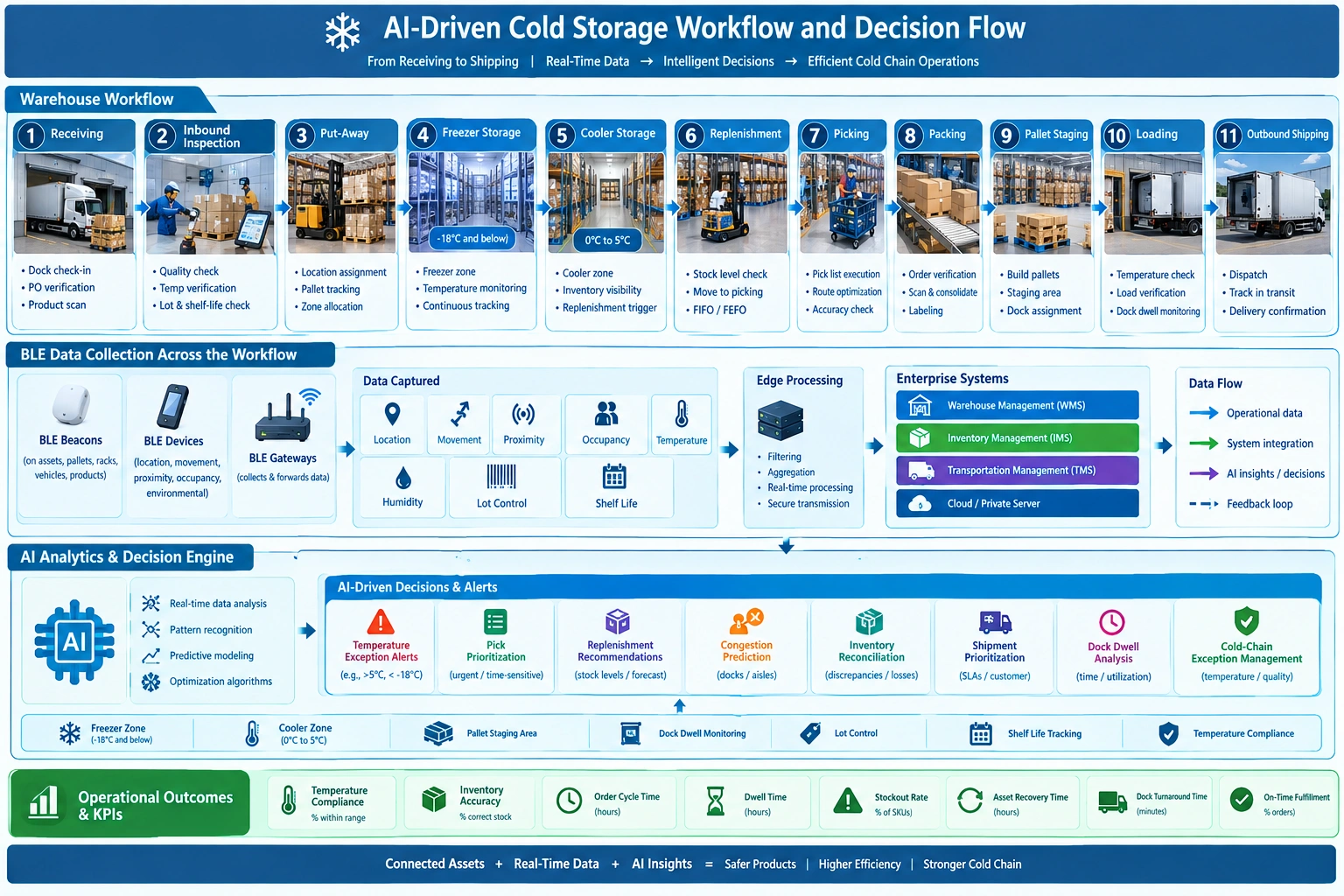
This workflow diagram illustrates how receiving, inspection, put-away, cold storage, replenishment, picking, packing, staging, loading, and outbound shipping are connected through BLE-enabled data collection, enterprise software integration, and AI-driven decision support for optimized cold-chain operations.
Staging, Loading, and Outbound Shipping
Outbound staging is a critical transition between refrigerated storage and transportation. Pallets and containers may wait in designated shipping zones before loading, creating potential dwell-time and temperature-control issues.
BLE location data can help determine where outbound handling units remain and whether they are moving according to the planned shipping workflow. AI can compare staging activity with scheduled departures, carrier information, order priorities, and historical dock performance.
AI-supported actions can include:
- Prioritizing loads approaching departure
- Identifying extended staging dwell
- Predicting dock congestion
- Matching pallets to outbound loads
- Detecting misplaced shipping units
- Supporting carrier and dock allocation
- Escalating delayed orders
Cold storage operators can track dock turnaround time, truck dwell time, staging dwell time, on-time shipping, order backlog, and fulfillment performance.
Returns and Temperature-Sensitive Exception Handling
Returns create additional complexity because returned products may require inspection, segregation, disposition decisions, and inventory updates. Temperature-sensitive products can require particularly careful handling when their storage history or condition is uncertain.
BLE data can help establish the location and movement history of returned handling units. AI can analyze return reason codes, processing times, product categories, historical disposition outcomes, and operational conditions to identify recurring causes of returns or processing delays.
Applications include:
- Return location tracking
- Processing-time analysis
- Exception classification
- Return volume forecasting
- Disposition prioritization
- Inventory reconciliation
- Identification of recurring operational failures
Operational Challenges in Cold Storage Operations
Cold storage operations face challenges that are different from those of conventional distribution warehouses. Low-temperature environments, refrigeration constraints, high product velocity, strict handling requirements, and time-sensitive fulfillment can make operational deviations costly.
Common challenges include:
- Inventory discrepancies between warehouse records and physical locations
- Misplaced pallets, totes, carts, and handling equipment
- Long dwell times in receiving and staging areas
- Pick delays caused by congestion or poor inventory location
- Replenishment shortages during high-demand periods
- Limited visibility into mobile assets
- Labor productivity constraints in freezer environments
- Dock congestion during peak shipping windows
- Unplanned equipment downtime
- Temperature-related exceptions
- Expiration and shelf-life management problems
- Returns processing delays
- Order backlogs caused by upstream disruptions
- Difficulty correlating physical movement with warehouse transactions
AI can help identify relationships among these problems. A repeated pick delay, for example, may not be caused solely by worker performance. It could result from misplaced inventory, replenishment delays, congestion, equipment availability, or an inefficient pick sequence. Combining BLE location information with warehouse transactions and AI analysis provides a broader operational view.
AI Applications for Cold Storage Performance
AI applications should be selected according to measurable cold-storage operating problems. A useful deployment connects each AI model or analytical method to a defined data source, decision, responsible role, and KPI.
Temperature and Environmental Exception Detection
AI can evaluate environmental readings alongside location and operational events to identify unusual conditions. A deviation may become more meaningful when correlated with a particular storage zone, pallet location, equipment condition, or extended dwell period.
Potential applications include:
- Detecting abnormal environmental patterns
- Identifying recurring problem zones
- Correlating environmental events with operational activity
- Prioritizing inspection tasks
- Supporting preventive corrective action
Environmental analysis should complement, rather than replace, validated refrigeration controls and required monitoring procedures.
Demand Forecasting and Inventory Planning
Demand forecasting can help cold storage operators prepare for seasonal demand, promotions, customer order patterns, and changing product velocity. AI models can analyze historical orders, inventory levels, replenishment activity, lead times, and product movement.
Forecast outputs can support:
- Reorder planning
- Safety-stock adjustment
- Labor planning
- Storage-capacity planning
- Picking-resource allocation
- Shipment preparation
Predictive Maintenance for Refrigeration and Material-Handling Equipment
Cold storage facilities depend on refrigeration systems, evaporators, compressors, conveyors, forklifts, pallet handling equipment, dock equipment, and other critical machinery. Unplanned downtime can affect both throughput and product handling conditions.
AI can analyze maintenance records, equipment activity, operating patterns, fault events, and usage data to identify potential maintenance priorities. BLE-enabled asset visibility can add information about equipment location and utilization.
GAO can supply IoT hardware products and systems that help organizations collect operational information from mobile and connected equipment, providing a practical data foundation for maintenance and asset-management applications.
Cold Storage Data Foundation for AI-Driven Decisions
Reliable AI decisions depend on reliable operational data. Cold storage facilities should establish clear relationships among physical assets, inventory records, locations, work activities, and digital events before deploying advanced analytics.
BLE data can provide a useful physical visibility layer for assets and handling units. A BLE beacon may represent a pallet, cart, tote, forklift, container, or other mobile object. BLE devices can provide proximity or environmental information, while BLE gateways aggregate wireless events and transfer them to downstream software.
The data pipeline can include:
- BLE beacons and BLE devices attached to selected assets or deployed in defined zones
- BLE gateways positioned to provide appropriate facility coverage
- Edge processing for filtering, normalization, buffering, and local event handling
- Middleware that converts device events into application-ready information
- Warehouse management software for inventory and workflow transactions
- Inventory and order systems for fulfillment context
- Maintenance software for equipment history and work orders
- Transportation systems for carrier, shipment, and dock information
- Cloud or privately hosted software for centralized analytics
- AI models for forecasting, anomaly detection, optimization, classification, and prediction
Data quality is particularly important when AI is used to make operational recommendations. Asset identifiers should remain consistent across BLE systems and enterprise applications. Gateway placement should account for refrigeration-room construction, rack density, metal equipment, doors, traffic patterns, and areas where wireless coverage may change.
Cold storage operators should also define event retention, timestamp synchronization, device battery-management procedures, gateway health monitoring, and exception-handling rules. These engineering details determine whether AI receives a reliable stream of operational events or fragmented data that produces false alerts.
BLE Technology for AI-Driven Cold Storage
BLE supports cold storage operations by providing wireless identification, location, proximity, movement, and environmental data that can be correlated with warehouse and fulfillment events. The core components include BLE beacons, BLE devices, and BLE gateways.
BLE beacons can be assigned to pallets, carts, totes, forklifts, containers, mobile equipment, or other assets. Fixed BLE beacons can also define zones or reference points throughout freezer rooms, cooler rooms, staging areas, and loading areas. The resulting signal patterns can help software determine whether an asset is moving, stationary, entering a zone, or remaining in an area longer than expected.
BLE devices can provide additional information depending on their design and deployment. For cold storage applications, relevant measurements can include proximity, motion, occupancy, temperature, humidity, and equipment status. Device selection should account for operating temperature, enclosure requirements, battery performance, mounting method, cleaning procedures, and the expected maintenance interval.
BLE gateways collect wireless events and transfer them to downstream software. Gateway placement should be engineered around rack geometry, refrigerated-room construction, doors, metal surfaces, equipment density, and required location accuracy. Gateway redundancy may be appropriate for high-value workflows where loss of a single gateway could create a significant visibility gap.
Edge processing can filter duplicate events, normalize timestamps, buffer data during temporary connectivity interruptions, and perform local rules before forwarding information to enterprise software. Middleware can then convert raw BLE events into business events such as “pallet entered freezer zone,” “cart remained in staging,” or “forklift moved into loading area.”
Cloud Version
A cloud-hosted deployment can centralize BLE data, warehouse events, AI models, dashboards, alerts, and historical analytics across multiple cold storage facilities. This approach is useful for organizations operating several refrigerated distribution centers that need centralized performance monitoring and common analytical models.
Cloud deployment can simplify centralized software maintenance and allow historical datasets from multiple facilities to support demand forecasting, anomaly detection, asset utilization analysis, and comparative KPI reporting. Connectivity design remains important because refrigerated facilities may contain areas where wireless or network availability is inconsistent.
Server Version
A Server Version can run on edge servers, customer-managed servers, private data centers, or other privately hosted enterprise infrastructure. This approach can be appropriate when organizations require greater control over data processing, local operation, network isolation, or integration with privately hosted warehouse systems.
A private server can process selected BLE events locally and continue supporting critical workflows during temporary external connectivity problems. Cold storage operators should determine which functions must remain available locally and which analytical workloads can be transferred to centralized infrastructure.
Both deployment models can support AI-driven cold storage operations. The appropriate choice depends on connectivity, data governance, latency requirements, IT policies, integration requirements, facility count, and the need for local processing.
Integration with Cold Storage Software and Equipment
AI and BLE solutions produce greater operational value when they are connected to existing cold storage software rather than operated as isolated monitoring applications.
Relevant systems can include:
- Warehouse management systems for receiving, put-away, inventory, picking, replenishment, staging, and shipping
- Enterprise resource planning software for purchasing, inventory, orders, and financial records
- Transportation management systems for carriers, appointments, routes, and shipment schedules
- Warehouse control systems for conveyors, sortation, automated storage, and material movement
- Maintenance management software for refrigeration equipment, forklifts, conveyors, dock equipment, and facility maintenance
- Order management systems for customer orders and fulfillment priorities
- Labor management software for work assignments, productivity, and staffing
- Quality and compliance systems for inspections, exceptions, and cold-chain records
Integration should use stable identifiers and clearly defined event relationships. A pallet identifier, for example, should remain associated with the appropriate inventory record while its physical location changes. The same principle applies to carts, totes, forklifts, refrigeration equipment, and other tracked resources.
APIs, message queues, database integration, event streams, or middleware can transfer information between systems. Engineers should define event schemas, timestamp behavior, retry handling, duplicate-event rules, and data ownership before commissioning the system.
BLE data should also be evaluated against existing barcode, RFID, PLC, building-control, and refrigeration monitoring data where those technologies are already deployed. The objective is to use the most appropriate identification or measurement method for each workflow rather than forcing one technology into every operating process.
Deployment Engineering for Refrigerated Facilities
Cold storage deployment requires more planning than simply installing BLE gateways and assigning tags. Refrigeration rooms can create challenging conditions for wireless coverage, battery operation, equipment mounting, and maintenance access.
A practical deployment process includes:
- Mapping freezer rooms, cooler rooms, receiving areas, staging zones, picking aisles, docks, equipment areas, and restricted locations
- Identifying high-value assets and critical inventory workflows
- Defining required location accuracy by application
- Selecting BLE beacons and devices according to temperature and enclosure requirements
- Performing wireless site surveys
- Modeling gateway coverage around racks, doors, metal structures, and equipment
- Establishing gateway mounting and power requirements
- Defining network connectivity and edge-processing requirements
- Mapping BLE identifiers to warehouse and asset records
- Configuring operational alerts and AI rules
- Integrating with warehouse and maintenance software
- Testing location events against known physical movements
- Establishing battery replacement and device inspection procedures
- Validating performance during normal peak operating conditions
Location accuracy should be matched to the business requirement. A system designed to determine whether a pallet is inside a freezer zone does not necessarily need the same precision as a system intended to distinguish adjacent rack positions