
AI and RFID for Automated Warehouses
AI Warehouse Management and RFID-Enabled Automation for Automated Warehouses
Automated warehouses are rapidly evolving from barcode-driven inventory facilities into intelligent fulfillment environments where AI-powered decision-making continuously optimizes inventory movement, storage allocation, labor utilization, robotic workflows, and order fulfillment. RFID technologies, particularly UHF RFID systems deployed across receiving docks, storage aisles, conveyor networks, sortation systems, and shipping zones, provide the real-time item visibility required for AI-driven warehouse operations.
AI warehouse management solutions use RFID-generated data streams to identify inventory locations, predict stock movement, optimize slotting strategies, reduce picking errors, detect operational bottlenecks, and improve fulfillment performance. Modern automated warehouses increasingly depend on this combination to support high-throughput distribution centers, omnichannel fulfillment facilities, e-commerce warehouses, third-party logistics operations, and micro-fulfillment centers.
For organizations operating automated warehouses, AI-enabled inventory intelligence supported by RFID transforms inventory visibility from a periodic reporting function into a continuous operational capability that improves accuracy, throughput, and responsiveness across warehouse operations.
AI Warehouse Management and RFID-Enabled Automation in Automated Warehouses
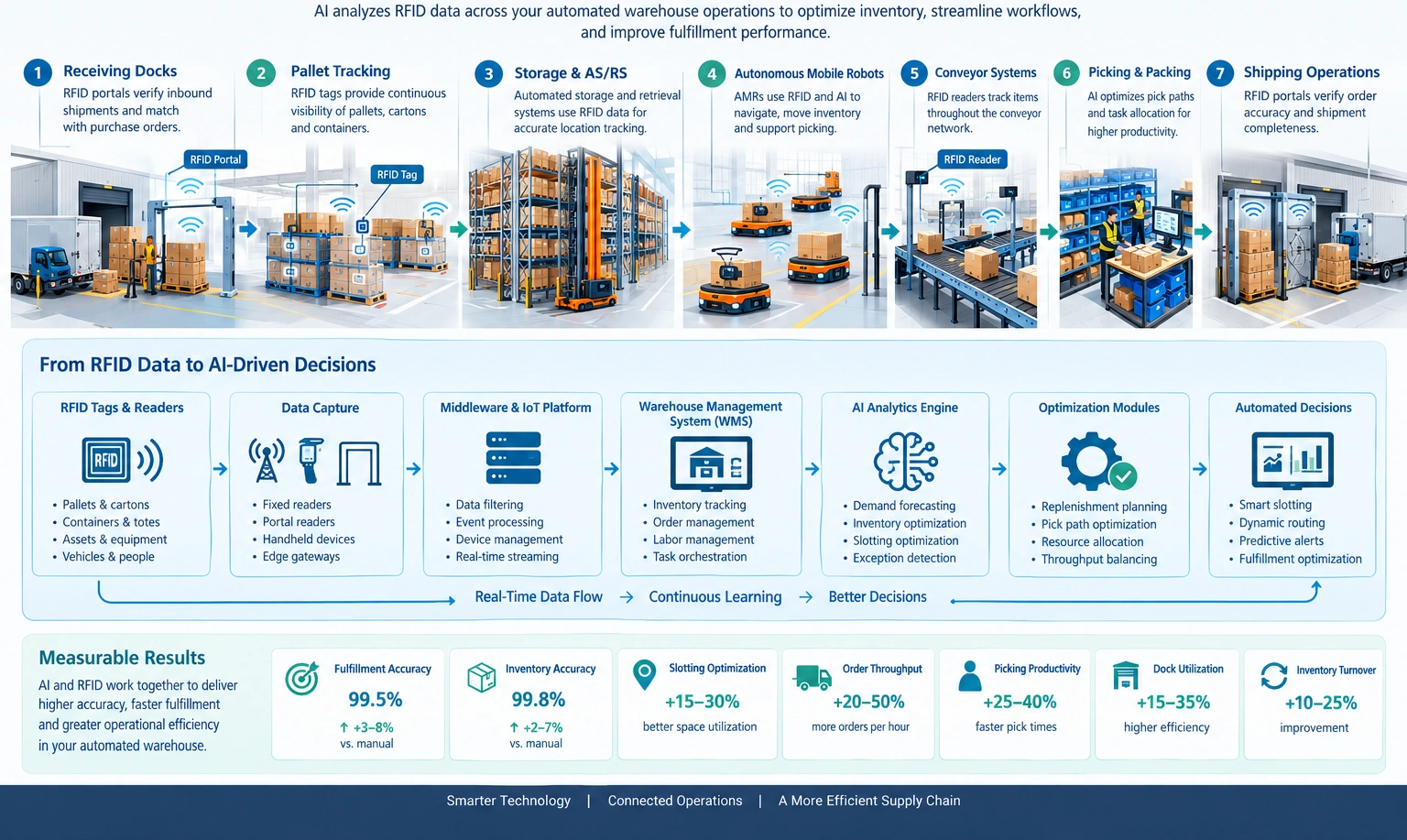
This infographic illustrates how RFID-generated operational data flows through warehouse systems into AI analytics engines to optimize inventory management, fulfillment operations, and warehouse automation. It highlights key warehouse processes including receiving, pallet tracking, storage, robotic material handling, conveyor operations, picking, and shipping while demonstrating measurable improvements in inventory accuracy, order throughput, and operational efficiency. The key takeaway is that AI-powered decision-making, enabled by real-time RFID visibility, transforms automated warehouses into more intelligent, responsive, and productive fulfillment environments.
How AI-Powered RFID Systems Transform Automated Warehouse Operations
Automated warehouses are designed to maximize inventory visibility, throughput, storage density, and fulfillment accuracy while minimizing manual intervention. These facilities commonly incorporate:
- Automated storage and retrieval systems (AS/RS)
- Autonomous mobile robots (AMRs)
- Automated guided vehicles (AGVs)
- Conveyor networks
- Sortation systems
- Goods-to-person picking stations
- Cross-docking operations
- High-bay storage facilities
- Pallet shuttle systems
- Warehouse execution systems (WES)
Although warehouse automation reduces labor-intensive activities, operational efficiency still depends on accurate and timely inventory information. AI systems require reliable operational data to make effective decisions. RFID technologies provide that data by automatically identifying inventory, pallets, totes, containers, returnable transport items, and material handling assets throughout warehouse workflows.
Unlike barcode scanning, RFID enables non-line-of-sight identification and bulk reading capabilities. AI applications then analyze RFID-generated operational data to support:
- Dynamic inventory optimization
- Demand forecasting
- Predictive replenishment
- Slotting optimization
- Warehouse congestion management
- Picking path optimization
- Asset utilization analysis
- Order fulfillment prioritization
- Labor forecasting
- Exception management
Warehouse operators gain continuous visibility into inventory movement without requiring manual scans at every process step.
GAO has supported organizations implementing RFID-based identification technologies that improve inventory visibility, warehouse tracking accuracy, and operational control throughout complex distribution environments.
Operational Challenges Facing Modern Automated Warehouses
Warehouse automation significantly improves operational performance, yet many facilities continue to experience challenges associated with inventory visibility, fulfillment accuracy, and operational coordination.
Common challenges include:
- Misplaced pallets within high-density storage areas
- Inventory record inaccuracies
- Order picking errors
- Dock-to-stock delays
- Inventory shrinkage
- Incomplete asset tracking
- AMR traffic congestion
- Poor slotting decisions
- Overstocking and stockouts
- Delayed exception detection
- Inaccurate cycle counts
- Labor scheduling inefficiencies
- Cross-docking visibility gaps
- Return processing complexity
- Throughput bottlenecks during peak demand periods
Large fulfillment centers often process hundreds of thousands of stock keeping units (SKUs) daily. Even small inventory discrepancies can create significant downstream disruptions affecting order accuracy, customer service levels, and transportation planning.
AI systems improve warehouse performance by continuously analyzing RFID-generated operational events and identifying patterns that are difficult to detect using traditional warehouse reporting systems.
Examples include:
- Predicting replenishment requirements before shortages occur
- Detecting abnormal inventory movement patterns
- Identifying underutilized storage locations
- Recommending slotting adjustments
- Forecasting congestion within picking zones
- Prioritizing urgent order fulfillment activities
- Detecting inventory discrepancies before shipment
These capabilities allow warehouse managers to shift from reactive problem resolution to proactive operational optimization.
AI-Driven RFID Applications Across Automated Warehouse Workflows
Receiving and Inbound Inventory Verification
Inbound receiving operations represent a critical control point in automated warehouses.
RFID-enabled receiving portals automatically identify arriving pallets, cartons, totes, and containers as they pass through dock doors. AI models compare inbound shipments against purchase orders, advance shipping notices, supplier history, and expected inventory records.
Key capabilities include:
- Automated receiving validation
- Shipment discrepancy detection
- Supplier compliance monitoring
- Dock scheduling optimization
- Exception identification
- Inbound inventory classification
Warehouse personnel can identify discrepancies immediately rather than discovering them later during fulfillment operations.
Intelligent Inventory Tracking and Storage Management
Storage operations require accurate inventory location information throughout warehouse zones.
RFID readers installed throughout storage aisles, AS/RS systems, pallet shuttle systems, and robotic handling equipment continuously monitor inventory movement.
AI algorithms analyze this data to:
- Determine optimal storage locations
- Reduce travel distances
- Improve inventory accessibility
- Balance storage utilization
- Minimize congestion
- Accelerate replenishment activities
Continuous inventory awareness improves inventory accuracy while reducing search time and operational delays.
AI-Assisted Picking Optimization
Order picking remains one of the most resource-intensive warehouse activities.
RFID-based location awareness combined with AI optimization enables:
- Dynamic pick path generation
- Multi-order batch optimization
- Pick sequence recommendations
- Real-time congestion avoidance
- Worker productivity analysis
- Robotic picking coordination
These capabilities improve order fulfillment speed while reducing travel distances across warehouse zones.
Automated Sortation and Order Consolidation
Sortation operations must process large volumes of inventory while maintaining shipment accuracy.
RFID-enabled sortation systems automatically identify inventory as it moves through conveyor networks.
AI systems support:
- Automated routing decisions
- Shipment consolidation
- Exception handling
- Carrier assignment optimization
- Throughput balancing
- Real-time workload distribution
This improves fulfillment efficiency during both normal operations and seasonal demand surges.
Shipping Verification and Outbound Accuracy
Outbound verification ensures the correct inventory leaves the warehouse.
RFID shipping portals automatically verify:
- Order completeness
- Pallet composition
- Carton accuracy
- Shipment destination
- Carrier assignments
AI systems analyze shipping data to identify recurring operational issues and continuously improve fulfillment performance.
AI-Powered RFID Warehouse Workflow: From Receiving to Shipping
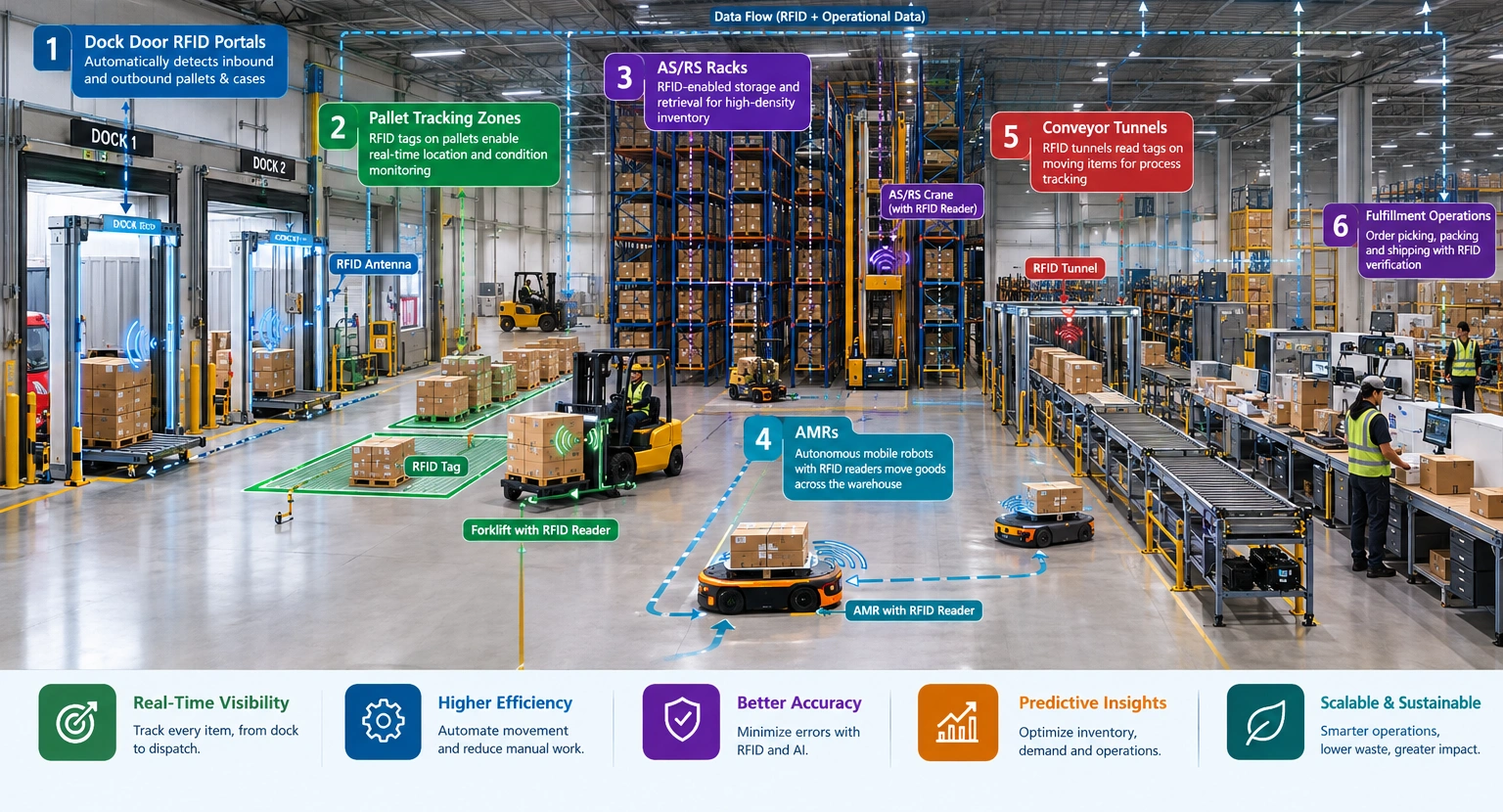
This workflow diagram illustrates how RFID, AI, warehouse management software, AS/RS systems, AMRs, picking, sortation, and shipping work together across the fulfillment lifecycle. It highlights the movement of goods, real-time data, and AI-driven decisions to improve warehouse accuracy, visibility, speed, and efficiency.
End-to-End Data Flow for AI Warehouse Intelligence
Successful AI warehouse management depends on a continuous flow of operational data from physical warehouse assets to business decision systems.
The workflow typically begins with RFID-tagged inventory, pallets, reusable containers, and material handling assets moving through warehouse processes.
Data Acquisition Layer
Operational data is captured through:
- Fixed RFID readers
- Dock door portals
- Conveyor-mounted readers
- Forklift-mounted readers
- Handheld RFID devices
- AS/RS integrated readers
- AMR-mounted readers
- Smart shelving systems
Captured data includes:
- Tag identifiers
- Timestamp events
- Location events
- Movement events
- Asset associations
- Inventory status updates
Communication and Processing Layer
RFID events are transmitted through:
- Ethernet networks
- Industrial Wi-Fi
- Private wireless networks
- Edge gateways
- Message brokers
- Event processing engines
Edge processing systems perform:
- Data filtering
- Duplicate removal
- Event aggregation
- Business rule validation
- Operational event generation
Warehouse Software Integration Layer
Processed RFID data integrates with:
- Warehouse Management Systems (WMS)
- Warehouse Execution Systems (WES)
- Warehouse Control Systems (WCS)
- Enterprise Resource Planning (ERP) software
- Transportation Management Systems (TMS)
- Inventory management software
- Order management software
AI models consume these integrated datasets to generate operational recommendations, forecasts, and automated decisions.
AI-Powered RFID Warehouse Deployment Architecture for Automated Inventory Tracking and Fulfillment
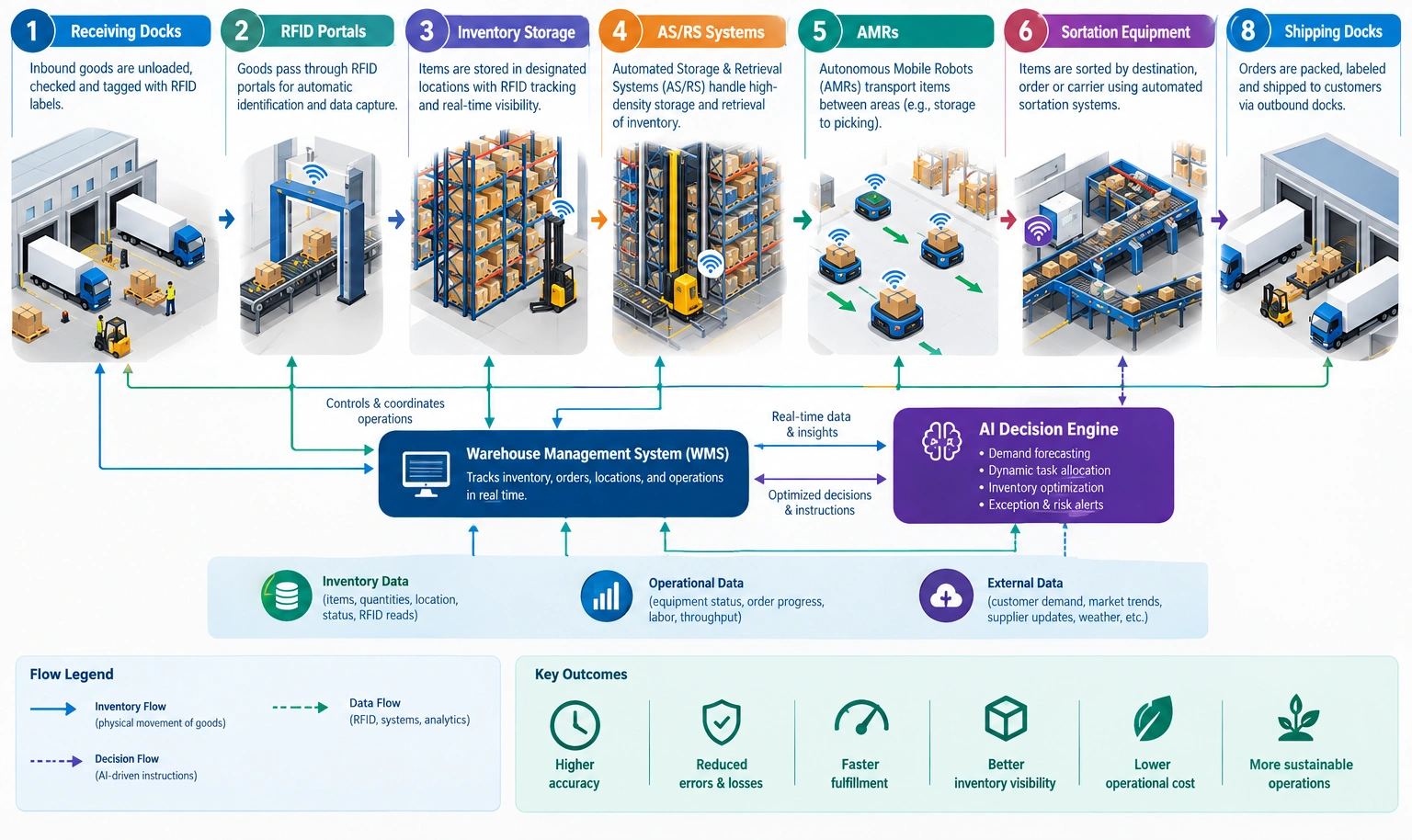
This visual illustrates a real-world RFID deployment within a modern automated warehouse, showing how dock door portals, pallet tracking zones, AS/RS systems, AMRs, forklifts, conveyor tunnels, and fulfillment stations interact with RFID infrastructure. It highlights the integration of edge computing, warehouse management software, AI analytics, and ERP systems to enable real-time inventory visibility, operational efficiency, predictive insights, and accurate order fulfillment.
Technology Components Supporting AI Warehouse Management and RFID-Enabled Automation
Successful AI warehouse management solutions depend on the coordinated operation of identification technologies, warehouse software, automation equipment, communications infrastructure, and AI analytics systems.
RFID Identification Infrastructure
Automated warehouses commonly deploy multiple RFID technologies based on operational requirements.
UHF RFID
UHF RFID is the primary technology used throughout automated warehouses because of its longer read range and ability to support bulk inventory identification.
Common applications include:
- Pallet tracking
- Carton identification
- Shipping verification
- Dock door monitoring
- Inventory location management
- Conveyor tracking
HF RFID
HF RFID is frequently used when shorter read distances and controlled identification zones are required.
Typical applications include:
- Returnable container tracking
- Workstation identification
- Secure inventory handling
- High-value asset management
LF RFID
LF RFID is generally deployed in specialized warehouse applications where operation around metal, liquids, or harsh industrial environments is required.
Applications may include:
- Equipment identification
- Industrial tool tracking
- Maintenance operations
Warehouse Automation Equipment
AI warehouse management systems often interact with:
- Automated Storage and Retrieval Systems (AS/RS)
- Autonomous Mobile Robots (AMRs)
- Automated Guided Vehicles (AGVs)
- Conveyor systems
- Sortation systems
- Pallet shuttle systems
- Robotic picking cells
- Automated packaging systems
- Dock automation equipment
- Smart shelving systems
RFID-generated operational data enables these systems to maintain inventory awareness and coordinate movement activities throughout warehouse operations.
AI Models Supporting Warehouse Intelligence
Several AI methodologies contribute to warehouse optimization.
Machine Learning
Machine learning models analyze historical warehouse activity to support:
- Demand forecasting
- Inventory optimization
- Replenishment planning
- Throughput forecasting
- Labor forecasting
Predictive Analytics
Predictive models identify future operational risks such as:
- Inventory shortages
- Fulfillment delays
- Storage capacity constraints
- Equipment utilization issues
Edge AI
Edge AI processes RFID events close to warehouse operations, reducing latency for:
- Real-time routing decisions
- Exception detection
- Conveyor control
- Robotic coordination
Computer Vision
Computer vision complements RFID by validating:
- Pallet conditions
- Inventory placement
- Packaging integrity
- Loading operations
Computer vision and RFID together provide stronger warehouse visibility than either technology independently.
Cloud and Server Deployment Models for Automated Warehouses
Warehouse operators frequently evaluate cloud-hosted deployments and privately managed server deployments based on operational requirements, security policies, and scalability objectives.
Cloud Deployment
Cloud-hosted AI warehouse management systems are typically selected when organizations require:
- Multi-site visibility
- Rapid scalability
- Centralized analytics
- Reduced infrastructure maintenance
- Faster software updates
Cloud deployments often support:
- Fleet-wide warehouse monitoring
- Regional distribution center coordination
- Global inventory visibility
- Cross-facility forecasting
Benefits include:
- Elastic computing capacity
- Simplified maintenance
- Faster deployment cycles
- Centralized reporting
Challenges include:
- Connectivity dependencies
- Data sovereignty requirements
- Regulatory considerations
- Network latency concerns
Server Deployment
Many large warehousing and distribution operations continue to deploy warehouse software on privately managed infrastructure.
Server-based deployments may reside within:
- Corporate data centers
- Regional hosting facilities
- Edge computing environments
- Dedicated warehouse servers
Organizations often choose server deployments when they require:
- Greater control over operational data
- Lower latency processing
- Private network operation
- Internal cybersecurity management
- Regulatory compliance requirements
Benefits include:
- Local operational control
- Reduced dependency on external networks
- Consistent response times
- Enhanced customization capabilities
Hybrid Deployment Approaches
Many modern warehouses adopt hybrid models.
Typical hybrid configurations include:
- Edge processing for RFID events
- Local warehouse control systems
- Cloud-based analytics
- Centralized AI model management
- Regional reporting systems
This approach balances scalability, responsiveness, and operational resilience.
Cybersecurity and Data Protection Considerations
Warehouse automation systems increasingly connect inventory systems, robotics, enterprise software, transportation systems, and supplier networks.
Cybersecurity therefore becomes a critical design consideration.
Important controls include:
- RFID device authentication
- Network segmentation
- Zero-trust access controls
- Secure API integration
- Data encryption
- Identity and access management
- Security information and event monitoring
- Multi-factor authentication
- Vulnerability management
- Continuous security assessment
Warehouse operators should also establish governance policies covering:
- Inventory data retention
- Supplier data access
- Third-party software integration
- AI model governance
- Incident response procedures
Organizations implementing AI warehouse management systems should evaluate both operational technology (OT) security and information technology (IT) security requirements.
GAO has assisted organizations by providing RFID hardware and identification systems that support secure and reliable warehouse operations across logistics and distribution environments.
Business Benefits of AI Warehouse Management Enabled by RFID
Organizations deploying AI-powered warehouse intelligence supported by RFID frequently achieve measurable operational improvements.
Inventory Accuracy Improvements
Continuous inventory visibility helps reduce discrepancies and improves inventory confidence.
Expected outcomes may include:
- Improved cycle count accuracy
- Reduced inventory adjustments
- Better stock availability
- Faster inventory reconciliation
Order Fulfillment Performance
AI-assisted fulfillment processes help improve:
- Order accuracy
- Picking productivity
- Shipment verification
- On-time fulfillment
Warehouse Throughput Optimization
AI identifies process bottlenecks and operational constraints that limit throughput.
Benefits include:
- Faster inventory movement
- Improved dock utilization
- Reduced congestion
- Better resource allocation
Labor Efficiency
Warehouse labor remains a significant operational expense.
AI-supported optimization helps:
- Balance workloads
- Reduce unnecessary travel
- Improve workforce scheduling
- Increase productivity
Asset Utilization
RFID visibility improves tracking of:
- Pallets
- Containers
- Forklifts
- Mobile equipment
- Returnable transport assets
Improved utilization reduces replacement costs and operational inefficiencies.
Supply Chain Visibility
Warehouse intelligence contributes to broader supply chain performance by supporting:
- Inventory transparency
- Transportation planning
- Demand forecasting
- Supplier coordination
- Customer service improvements
Implementation Recommendations for Automated Warehouses
Organizations planning AI warehouse management initiatives should focus on operational objectives before selecting technologies.
Recommended implementation practices include:
- Define measurable warehouse KPIs before deployment
- Establish inventory visibility requirements
- Evaluate warehouse workflows and bottlenecks
- Conduct RFID site surveys
- Assess read-zone performance requirements
- Validate integration requirements with WMS, ERP, WES, and TMS software
- Establish cybersecurity controls early in the project
- Deploy pilot programs before full-scale implementation
- Continuously monitor AI model performance
- Measure operational outcomes against baseline metrics
Successful projects typically begin with targeted operational objectives such as inventory accuracy improvement, fulfillment optimization, asset tracking, or throughput enhancement rather than attempting to automate every warehouse process simultaneously.
Practical deployment experience demonstrates that RFID read quality, warehouse process design, data governance, and integration planning often influence project success more significantly than AI model complexity.
AI Warehouse Management and RFID for Automated Warehouses: Key Takeaways
AI warehouse management supported by RFID provides the real-time operational intelligence required for modern automated warehouses. RFID technologies generate continuous inventory visibility across receiving, storage, picking, sortation, and shipping operations, while AI systems transform that operational data into actionable recommendations and automated decisions.
For warehousing and distribution organizations, this combination enables improved inventory accuracy, faster fulfillment, optimized warehouse capacity utilization, enhanced labor productivity, stronger asset visibility, and better supply chain responsiveness. Proper implementation requires careful attention to operational workflows, software integration, cybersecurity, data quality, and long-term scalability.
Organizations seeking to improve automated warehouse performance can benefit from evaluating how AI-driven inventory intelligence and RFID-enabled visibility align with their specific fulfillment, distribution, and warehouse management objectives. GAO continues to support organizations with RFID hardware, identification technologies, and technical expertise that help enable reliable warehouse automation initiatives.
Building the Future of Industrial AI and IoT with Aperture Venture Studio and GAO
For more than three decades, GAO Group of Companies has invested heavily in research and development involving industrial RFID, BLE, and IoT technologies. As AI warehouse management and intelligent warehouse automation continue to advance, we established Aperture Venture Studio to accelerate the development and growth of AI and IoT solutions that address real operational challenges across warehousing, distribution, logistics, and other industrial environments.
Headquartered in New York City and Toronto, GAO and its affiliated companies have served customers throughout the United States and Canada, including Fortune 500 organizations, leading research institutions, universities, and government agencies. Through extensive investment in RFID, IoT, and AI technologies, rigorous quality assurance processes, and expert technical support, we continue helping organizations deploy reliable identification, tracking, and automation solutions.
Aperture Venture Studio has attracted highly experienced AI specialists, IoT engineers, operational leaders, investors, and industry participants who contribute to advancing practical AI and IoT applications. Through initiatives such as Aperture Ventures Summit and TekSummit, we support ongoing discussions around industrial AI, warehouse automation, RFID innovation, and connected operational technologies.
We welcome participation from:
- Advisors, co-founders, and technical professionals
- Investors and strategic collaborators
- Customers seeking advanced AI and IoT solutions