
AI and RFID for Hotels
AI Asset Tracking and RFID Solutions for Hotel Operations
AI-driven asset tracking and RFID identification are transforming how hotels manage linen and laundry cycles, control guest room access, track high-value movable assets, monitor housekeeping workflows, and optimize food and beverage inventory across full-service, luxury, boutique, and extended-stay properties. By integrating machine learning with UHF RFID, HF RFID, and LF RFID identification, hotel operators gain real-time operational visibility across guest rooms, back-of-house laundry facilities, banquet and conference areas, spa and fitness centers, and food and beverage outlets that manual tracking and paper-based processes cannot reliably support.
GAO supplies RFID hardware products and systems that hotels deploy to automate linen identification, enforce room access compliance, track FF&E (furniture, fixtures, and equipment) movements, and feed operational data into AI-powered analytics engines. The connected hotel environment that results allows AI models to convert raw RFID event data into actionable operational intelligence, reducing linen loss rates, improving housekeeping productivity, tightening food and beverage inventory accuracy, and enhancing guest security across properties of all scales and brand affiliations.
AI and RFID Architecture for Smart Hotel Operations
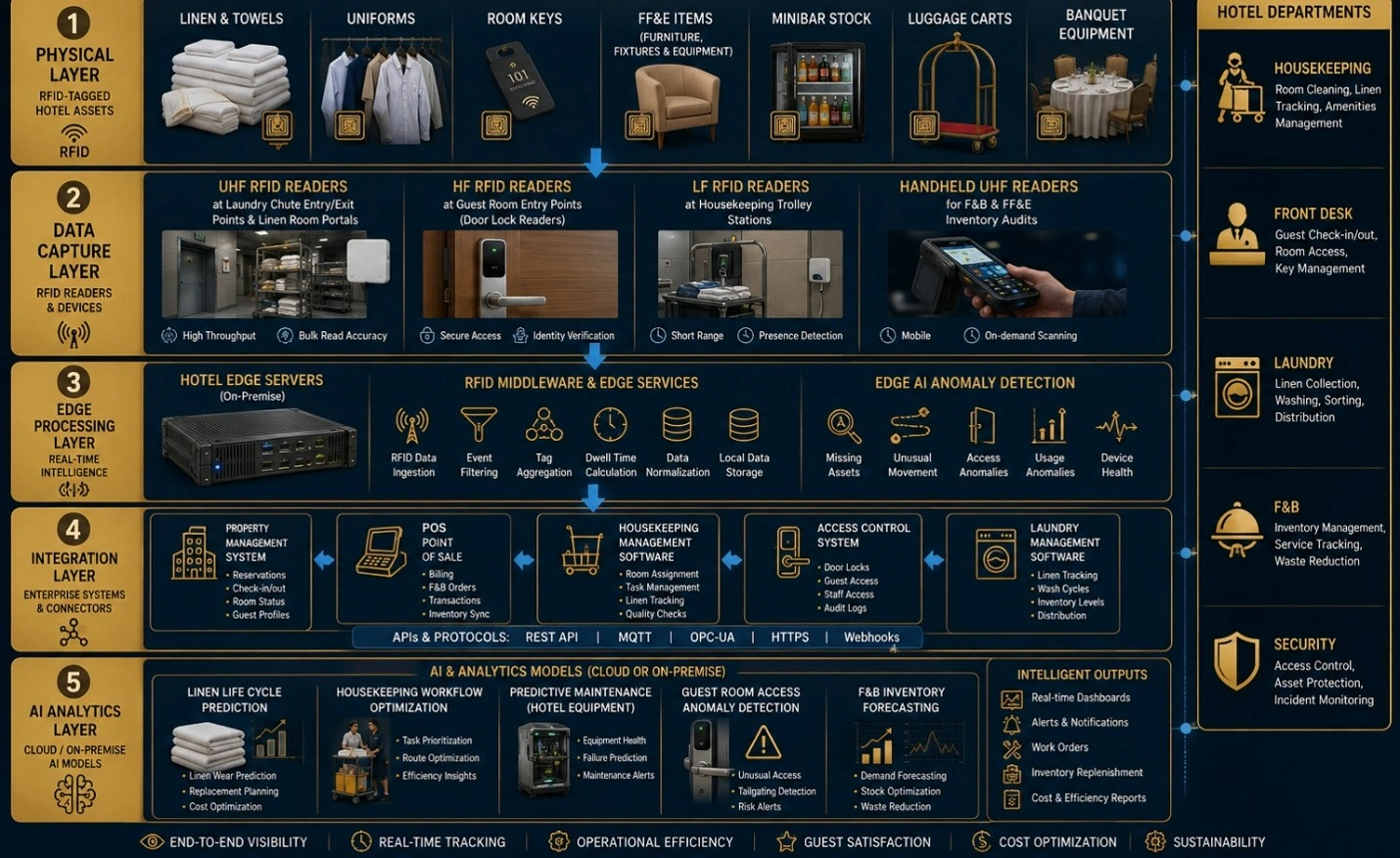
This layered architecture diagram shows how RFID-tagged hotel assets connect through UHF, HF, and LF readers, edge processing, middleware, enterprise systems, and AI analytics. It illustrates applications across housekeeping, front desk, laundry, F&B, and security, including linen lifecycle prediction, workflow optimization, predictive maintenance, access anomaly detection, and inventory forecasting.
RFID and AI Fundamentals in Hotel Operations
Hotels operate complex multi-department environments where the same physical assets, including guest linens, terry products, staff uniforms, banquet tablecloths, food and beverage inventory, and high-value FF&E items, cycle continuously between guest-facing areas, back-of-house processing facilities, external laundry contractors, and storage rooms. A mid-scale full-service hotel may manage between 5,000 and 30,000 individual linen pieces, hundreds of luggage carts and housekeeping trolleys, thousands of F&B inventory items across multiple outlets, and hundreds of access-controlled doors. Tracking these assets through manual par counts, visual inspection, and paper logs creates chronic inaccuracies that result in linen loss exceeding 15 to 25 percent annually at many properties, housekeeping productivity losses, and food and beverage shrinkage that reduces outlet profitability.
RFID assigns a unique digital identity to each trackable hotel asset. UHF RFID, operating under EPC Gen2 / ISO 18000-63 in the 860 to 960 MHz band, provides long-range, high-throughput identification of linen batches moving through laundry tunnel washers, linen carts transiting laundry room portals, and FF&E items during physical inventory audits across guestroom floors and banquet halls. HF RFID at 13.56 MHz, conforming to ISO 14443A and MIFARE or DESFire EV standards, is the technology underlying the majority of hotel electronic door lock systems, including keycard access to guest rooms, staff service corridors, fitness centers, pool areas, parking structures, and executive lounges. LF RFID at 125 to 134 kHz is used in access control applications requiring proximity card compatibility with legacy installed systems and in asset identification scenarios where HF proximity is appropriate.
AI models including supervised classification, anomaly detection, time-series forecasting, and reinforcement learning process the RFID event streams generated across hotel operations. Integrated with Property Management Systems (PMS) such as Oracle OPERA, Marriott MARSHA, Hilton OnQ, or Mews, Point of Sale software, housekeeping management tools such as HotSOS or Alice, laundry management software, and access control middleware, AI models detect linen loss patterns, predict housekeeping completion times to support accurate room readiness forecasting, identify unauthorized access attempts at guest room doors, optimize minibar and F&B restocking schedules, and forecast linen replacement procurement cycles.
The integration of AI with RFID across hotel operations represents a practical deployment of AIoT, or AI and IoT, in the hospitality industry. AIoT solutions in hotels incorporate Edge AI running on property-based servers for real-time housekeeping alerts and access control anomaly detection, machine vision for linen quality inspection at laundry processing stages, and computer vision-assisted check-in kiosks that complement RFID-based key encoding. RFID event data from laundry rooms, guest floors, F&B outlets, and security control points becomes the input for AI models that drive operational efficiency improvements across the entire guest stay life cycle from reservation through departure.
Hotel Applications and AI-RFID Deployment Scenarios
Linen and Laundry Life Cycle Management
Hotel linen management is one of the highest-value RFID applications in hospitality, where the inability to track individual pieces through washing cycles, guest room assignments, and external laundry contractor processes results in annual linen replacement costs that often exceed budget by 20 to 40 percent. UHF RFID tags sewn or heat-pressed into individual linen pieces, including bed sheets, pillowcases, duvet covers, bath towels, hand towels, bath mats, pool towels, and restaurant table linens, allow RFID portal readers installed at laundry tunnel washer entry and exit points, linen room dispatch stations, and housekeeping floor carts to automatically record each wash cycle, the department to which each piece was issued, and the return status at end of shift. AI linen life cycle models analyze wash count data accumulated through RFID readers to predict which individual pieces are approaching the end of their usable wash life based on fabric type and OEM wash count specifications, enabling proactive replacement procurement before guests encounter visibly worn linen.
GAO has supplied UHF RFID reader systems and linen-compatible tag products to hotel properties for laundry cycle tracking and linen loss reduction programs, replacing manual par count methods that consistently underestimated linen loss until quarterly physical inventories revealed significant shrinkage.
Guest Room Access Control and Key Card Management
Hotel electronic access control systems rely on HF RFID keycards conforming to ISO 14443A to grant and restrict guest entry to rooms, executive floors, fitness centers, swimming pool access gates, parking garages, and business centers. AI access control models integrated with PMS guest reservation data monitor HF RFID keycard read events at guest room door locks to detect anomalous access patterns, including repeated failed access attempts, access outside booked stay dates, and unauthorized use of staff master keycards during occupied room periods, generating security alerts to the front desk or loss prevention team in real time. Integration between the RFID access control middleware and PMS reservation data allows AI models to automatically deactivate expired keycards at checkout and flag instances where a keycard continues to generate door reader events after the recorded checkout time, reducing the risk of unauthorized room entry during room change or inspection periods.
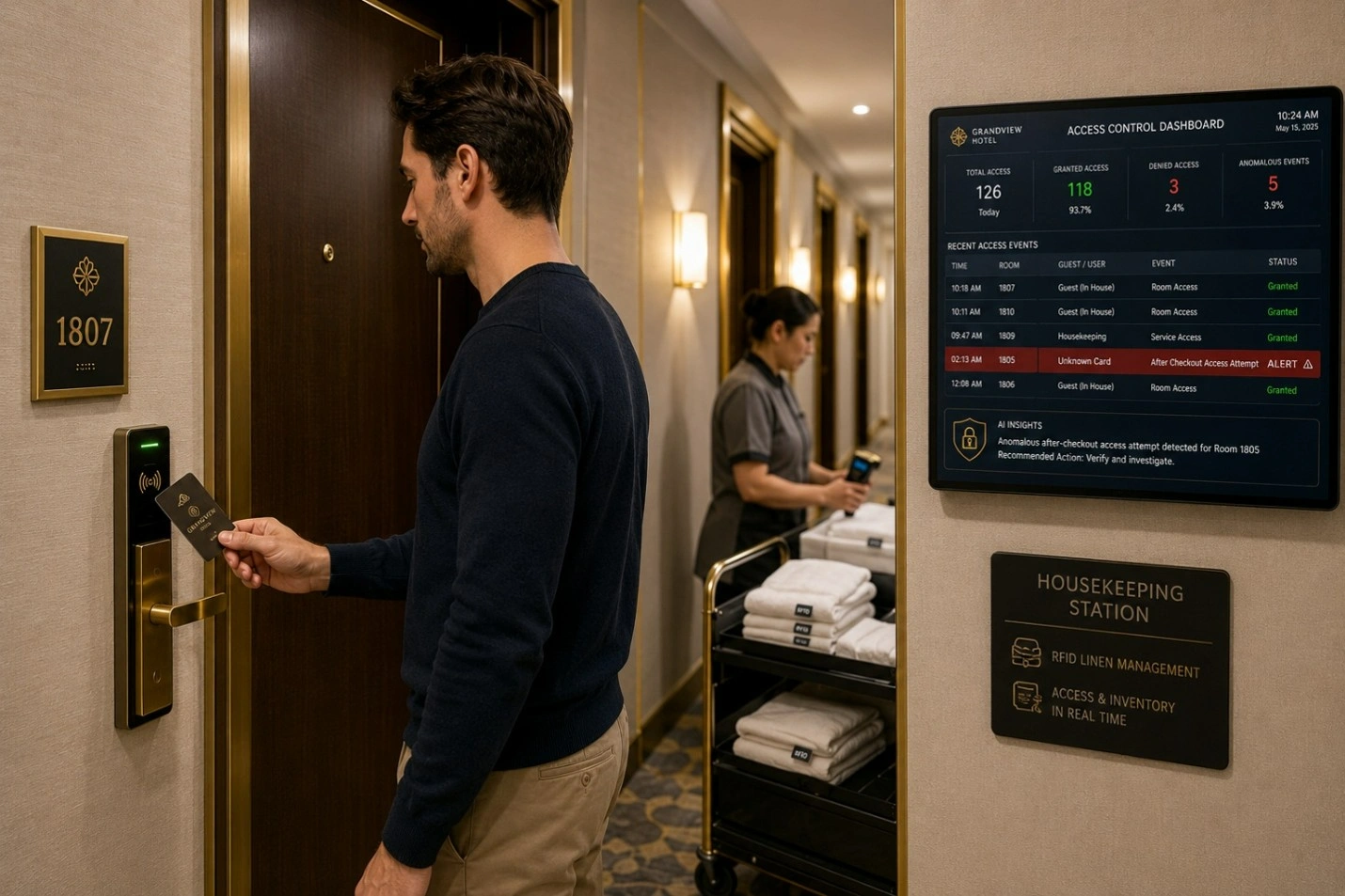
HF RFID Guest Room Access and AI Anomaly Detection
This photorealistic hotel corridor scene shows a guest using an HF RFID keycard to access a guest room while an adjacent dashboard monitors access events. The system highlights an after-checkout access attempt as an anomaly, demonstrating how RFID access control and AI analytics can improve hotel security and operational awareness.
Housekeeping Workflow Optimization and Room Readiness Tracking
Housekeeping productivity and room readiness accuracy are among the most operationally critical metrics in full-service hotel management, where front desk room assignment delays caused by incomplete or inaccurate room status information directly degrade guest check-in experience and RevPAR performance. RFID-tagged housekeeping trolleys equipped with UHF readers or associated with HF RFID staff badges allow housekeeping management software to automatically record when a room attendant begins and completes each room, which floor sections are actively being serviced, and when rooms transition from occupied to clean without manual status update phone calls. AI workflow optimization models analyze RFID-tracked housekeeping event data against the day’s departure and arrival reservation pattern from the PMS to predict room completion sequences, identify which floor sections are at risk of completion delay, and recommend task resequencing to room supervisors before check-in peak periods create front desk bottlenecks.
GAO RFID hardware products configured for housekeeping trolley identification and staff badge tracking provide the continuous event data that AI housekeeping optimization models require to generate accurate room readiness predictions during high-occupancy periods.
FF&E Tracking and Preventive Maintenance for Hotel Equipment
Hotels maintain large inventories of movable and semi-fixed assets including luggage carts, banquet chairs, banquet tables, audio-visual equipment, portable dance floors, room service carts, rollaway beds, cribs, pool loungers, and housekeeping trolleys that are frequently misplaced between departments or borrowed without authorization across large convention and resort properties. UHF RFID tags on individual asset items combined with fixed or handheld UHF readers allow asset management teams to conduct rapid physical inventory audits by walking asset storage areas and event setup zones, automatically updating asset location records in property management or asset tracking software without manual barcode scan-per-item procedures. AI predictive maintenance models integrated with RFID-tracked equipment utilization logs can identify FF&E items approaching service intervals based on actual use cycles, enabling preventive maintenance of luggage elevators, banquet cart wheels, and room service trolley mechanisms before guest-impacting failures occur.
Food and Beverage Inventory Control and Minibar Management
Hotel food and beverage operations face chronic inventory shrinkage across room minibars, outlet storage rooms, banquet pre-function areas, and receiving docks. UHF RFID tags on individual minibar items, beverage bottles, and high-value F&B stock allow automated inventory verification when housekeeping staff service minibar units, triggering AI-generated billing transactions in the PMS when consumed items are detected as absent, and generating restocking alerts when minibar stock falls below par levels. AI inventory forecasting models that analyze RFID-tracked consumption event data from multiple F&B outlets across the property can predict restocking requirements by day of week, event calendar, and seasonal occupancy patterns, enabling F&B purchasing teams to reduce over-ordering and spoilage while maintaining service levels during peak banquet and outlet periods.
Spa, Fitness, and Pool Towel Tracking
Luxury and resort hotel spa and pool operations experience disproportionate linen loss through pool towel removal by guests, inadequate tracking of towels issued versus returned at towel exchange stations, and commingling of spa terry products with general hotel linen during laundry processing. UHF RFID tags on individual spa and pool towels allow reader-equipped towel exchange kiosks or attendant stations to automatically record towel issuance and return per guest visit, maintaining a real-time count of towels in circulation versus in storage. AI models analyze RFID-tracked towel circulation data to identify peak issuance periods, flag individual guest transactions where towels were not returned, and predict daily towel par requirements based on reservation data and historical issuance patterns, reducing the unrecovered towel loss that represents a significant annual cost at resort properties.
End-to-End Operational Workflow: RFID Data Capture to AI-Driven Hotel Operations
The operational data pipeline in an AI-enabled hotel flows from physical asset identification through AI-driven decision output across housekeeping, laundry, security, F&B, and guest services functions throughout the hotel operating day.
Data Acquisition and RFID Event Capture
Fixed UHF RFID readers at laundry tunnel washer entry and exit portals, linen room dispatch stations, housekeeping floor service corridors, and FF&E storage areas continuously identify RFID-tagged linen, towels, uniforms, and movable assets without operator intervention. HF RFID readers embedded in electronic door lock assemblies at guest room doors, service corridor access points, pool gates, and executive lounge entries record keycard read events with guest and staff identity data in real time. Handheld UHF RFID readers allow housekeeping supervisors, F&B inventory managers, and loss prevention staff to conduct rapid asset audits across guest floors, banquet halls, and storage areas. LF RFID proximity readers at housekeeping trolley staging areas confirm trolley identity and associated room attendant assignment at shift start for workflow tracking purposes.
Edge Processing and Local Alert Generation
Hotel edge servers deployed within the property network aggregate raw RFID read events from laundry readers, door lock controllers, housekeeping trolley stations, and F&B inventory points, applying local event deduplication, zone assignment, and time-stamping before forwarding structured data to property management and analytics systems. Edge processing ensures that time-critical security alerts, such as an unauthorized keycard read at an occupied guest room during the post-checkout inspection window, or a linen batch exiting the property via a service entrance without a corresponding laundry contractor dispatch record, are generated with sub-second latency without requiring cloud connectivity. Edge AI models executing on property servers perform initial anomaly detection on door access event streams and linen movement data, ensuring security alerts reach loss prevention and front office teams even during internet connectivity interruptions.
Middleware Integration and PMS Connectivity
RFID middleware aggregates event data from laundry readers, access control door lock controllers, housekeeping tracking systems, and F&B inventory readers, mapping RFID identifiers to business objects within the PMS, housekeeping management software, access control middleware, laundry management software, and POS systems. Standard integration protocols including REST APIs, SOAP web services, MQTT, and direct database connectors synchronize RFID events with Oracle OPERA, Mews, Agilysys Visual One, Infor HMS, and other hotel PMS environments. Bi-directional PMS integration allows reservation check-in events to automatically authorize guest keycards for the assigned room and access zones, and checkout events to deactivate card permissions, without front desk agent manual steps in the access control system. Housekeeping software integration allows RFID-tracked room completion events to automatically update room status in the PMS, reducing the front desk hold time between physical room completion and system-confirmed room availability for assignment.
AI Analytics and Hotel Operations Decision Output
Structured RFID event data from middleware feeds AI analytics models deployed on cloud infrastructure or the hotel’s privately hosted server environment. Supervised classification models detect linen loss patterns by correlating RFID-tracked dispatch and return records with laundry contractor transaction logs. Time-series forecasting models predict housekeeping completion timing for individual floors based on staff RFID event data and the day’s departure and arrival mix from PMS. Anomaly detection models monitor door access event streams for unauthorized entry patterns and flag deviations from expected occupancy patterns for loss prevention review. F&B inventory forecasting models predict minibar restocking requirements and outlet stock replenishment timing based on occupancy forecasts and historical consumption patterns. AI outputs are delivered as housekeeping dashboards, security alert notifications, F&B purchase recommendations, and linen procurement forecasts within existing PMS and hotel operations software interfaces.
AI and RFID Data Pipeline Workflow for Hotel Operations
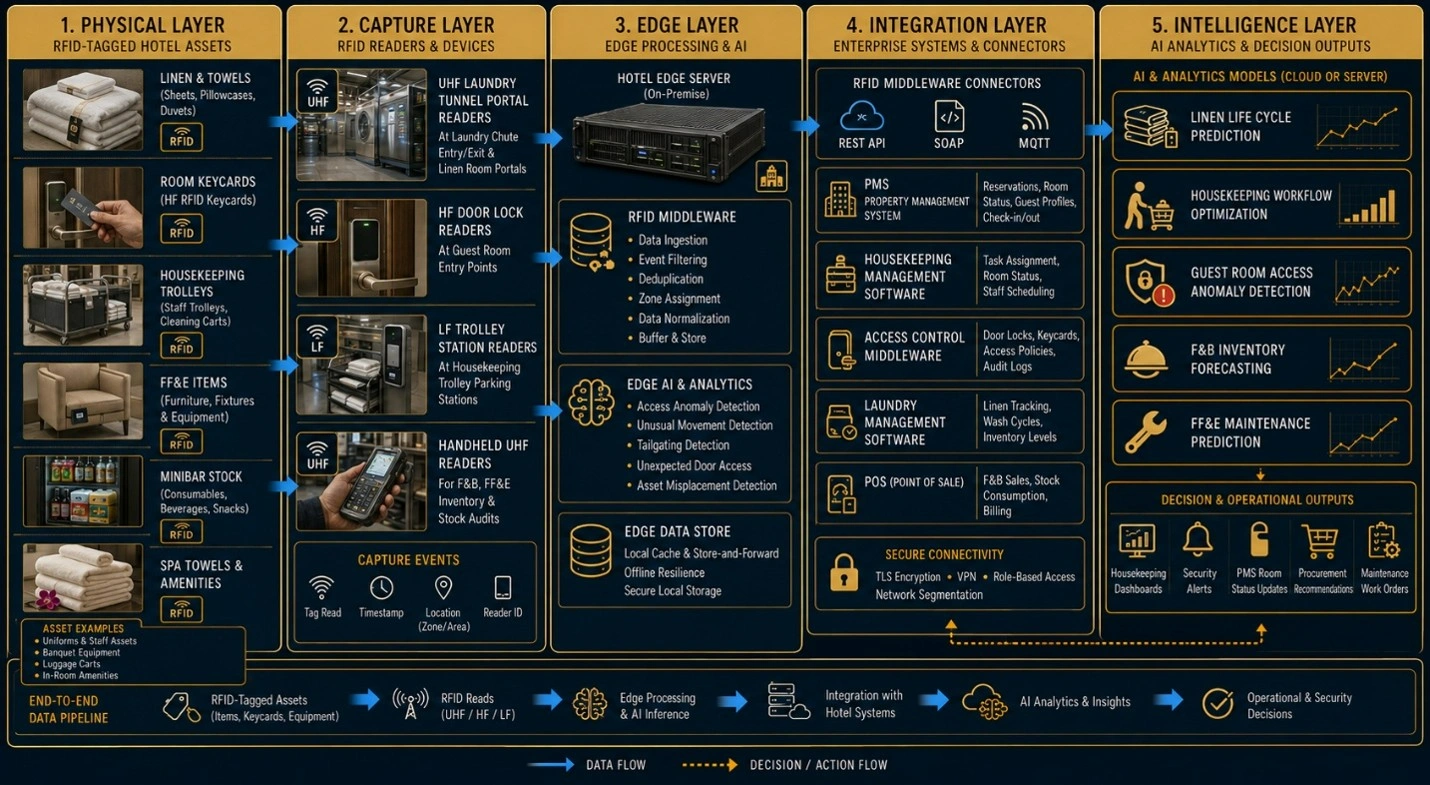
This workflow diagram illustrates the complete AI and RFID data pipeline across hotel operations, from RFID-tagged assets and departmental readers through edge processing, hotel system integration, and AI analytics. It shows how RFID events support linen lifecycle prediction, housekeeping optimization, access anomaly detection, F&B inventory forecasting, and FF&E maintenance alerts, with outputs delivered to operational and security teams.
RFID Hardware, AI Software, and Deployment Infrastructure for Hotels
A complete AI and RFID solution for hotel operations integrates purpose-selected hardware, layered software, communication protocols, and deployment models. Component selection is driven by the aesthetic and physical constraints of guest-facing hotel environments, the operational workflow requirements of housekeeping and laundry departments, data latency requirements for security-critical access control alerts, and the IT governance policies of the hotel ownership or management company.
RFID Hardware for Hotel Environments
Fixed UHF RFID readers operating under EPC Gen2 / ISO 18000-63 are deployed at laundry tunnel washer entry and exit portals, linen room dispatch gates, housekeeping service corridor checkpoints, and FF&E storage area entry points. UHF reader and antenna selection in hotel laundry environments must account for the high-moisture, high-temperature conditions of commercial laundry tunnel systems, where steam and water exposure requires IP65 or IP67-rated reader hardware and antenna assemblies. UHF RFID tags used in hotel linen applications must be specifically engineered for repeated high-temperature wash cycles, typically rated for 200 or more industrial wash cycles at temperatures up to 85 degrees Celsius, with silicone-encapsulated or woven inlay constructions that maintain read reliability through the thermal and mechanical stress of commercial tunnel washing, hydroextraction, and tumble drying. Portal antenna configurations at linen room dispatch stations typically use two to four antennas oriented to achieve full coverage of linen cart cross-sections without read suppression from the metal cart frames.
HF RFID readers conforming to ISO 14443A, embedded within electronic door lock assemblies from manufacturers including Dormakaba, ASSA ABLOY VingCard, SALTO Systems, and Allegion, handle guest room access, service corridor access, and amenity area entry across the majority of hotel properties. HF RFID keycards conforming to MIFARE Classic, MIFARE DESFire EV1, EV2, or EV3 standards provide the guest-facing access credential, with DESFire EV2 and EV3 offering AES-128 and AES-256 encryption that addresses the security vulnerabilities of legacy MIFARE Classic implementations subject to crypto-1 cipher attacks. Handheld UHF RFID readers allow housekeeping supervisors, loss prevention staff, and F&B inventory managers to conduct room-by-room or area-by-area asset audits without fixed reader infrastructure in every guest room. GAO supplies UHF RFID reader hardware, wash-rated linen tag products, and HF RFID keycard consumables for hotel operations, supporting properties from independent boutique hotels through large convention and resort facilities.
AI Models and Software for Hotel Operational Intelligence
AI models deployed in hotel operations include supervised classification models for linen loss pattern detection trained on RFID-linked dispatch and return event records correlated with laundry contractor transaction data, time-series forecasting models for housekeeping workflow completion prediction based on room attendant RFID event streams and PMS reservation departure patterns, anomaly detection algorithms for guest room door access security monitoring, F&B inventory demand forecasting models trained on RFID-tracked consumption data correlated with occupancy rates and event calendar data, linen life cycle prediction models that use wash count data accumulated through laundry portal readers to forecast individual piece replacement timing, and FF&E utilization models that identify maintenance scheduling requirements based on RFID-tracked asset use cycles. These models are trained on hotel-specific operational data, ensuring recommendations reflect the actual linen volumes, guest mix, occupancy seasonality, and F&B outlet configurations of the specific property or hotel portfolio rather than generic hospitality benchmarks.
Supporting AI software includes RFID event data normalization pipelines that reconcile linen tracking records across in-house laundry facilities and external laundry contractors, feature engineering modules that derive operational variables from raw RFID timestamps and zone events, model training environments with version control for seasonal retraining as annual occupancy patterns shift, and inference engines that deliver predictions within the PMS and housekeeping software interfaces that hotel operations teams already use daily.
Communication Protocols and Network Infrastructure
Fixed UHF RFID readers at laundry portals and linen room dispatch stations connect to hotel edge servers via wired Ethernet, providing reliable data transmission in the high-interference electrical environments of commercial laundry facilities where industrial washing and drying equipment generates significant electromagnetic noise. Handheld UHF readers used by housekeeping supervisors and loss prevention staff connect via the hotel’s existing Wi-Fi network infrastructure, typically conforming to IEEE 802.11ac or Wi-Fi 6 standards. HF RFID door lock controllers communicate with the access control middleware through the hotel’s property network using TCP/IP, with the access control middleware maintaining a local cache of authorized keycard credentials to ensure guest room access functions without dependency on network connectivity to the central access control server. MQTT protocol is used for RFID event streaming from edge servers to cloud analytics environments, while REST APIs provide the standard integration interface between RFID middleware and PMS, housekeeping management, and laundry management software systems.
Cloud and Server Deployment Models for Hotel AI Solutions
Hotel AI and RFID solutions are deployed in two primary models based on the hotel ownership structure, IT governance policies of the management company or brand, and network infrastructure available at the property.
The Cloud Version hosts AI analytics, linen lifecycle management, housekeeping workflow optimization, access anomaly detection, and F&B inventory forecasting within cloud provider infrastructure such as AWS, Microsoft Azure, or Google Cloud. Cloud deployment is well suited to hotel management companies and branded portfolio operators managing multiple properties, where consolidated cross-property linen analytics, shared AI model training on aggregated housekeeping and F&B consumption datasets from dozens or hundreds of properties, and multi-property loss prevention oversight deliver operational insights that single-property server deployments cannot achieve. Cloud-hosted AI models benefit from elastic compute for seasonal retraining as annual occupancy patterns shift, and from built-in redundancy that ensures linen tracking and housekeeping analytics remain available even if the on-property edge server experiences a hardware issue during a high-occupancy weekend. TLS 1.3 encryption in transit and AES-256 encryption at rest, combined with role-based access control and integration with the management company’s Active Directory or identity provider, address cybersecurity requirements for cloud-hosted guest operational data.
The Server Version deploys AI analytics and RFID middleware on privately hosted server infrastructure managed by the hotel or its IT service provider. This includes on-property edge servers, hotel management company data center environments, and customer-managed virtual server deployments, and is not limited to on-property installations. Server deployment is preferred by independent luxury hotels and resort properties that manage guest data under strict privacy policies, by properties operating in jurisdictions with local data residency requirements for guest access and stay records, and by hotels whose brand standards require guest access control data to remain within property-controlled infrastructure. GAO supplies RFID hardware products and systems compatible with both cloud-connected and privately hosted server AI environments, supporting hotel operators at any scale from single boutique properties to large branded portfolios.
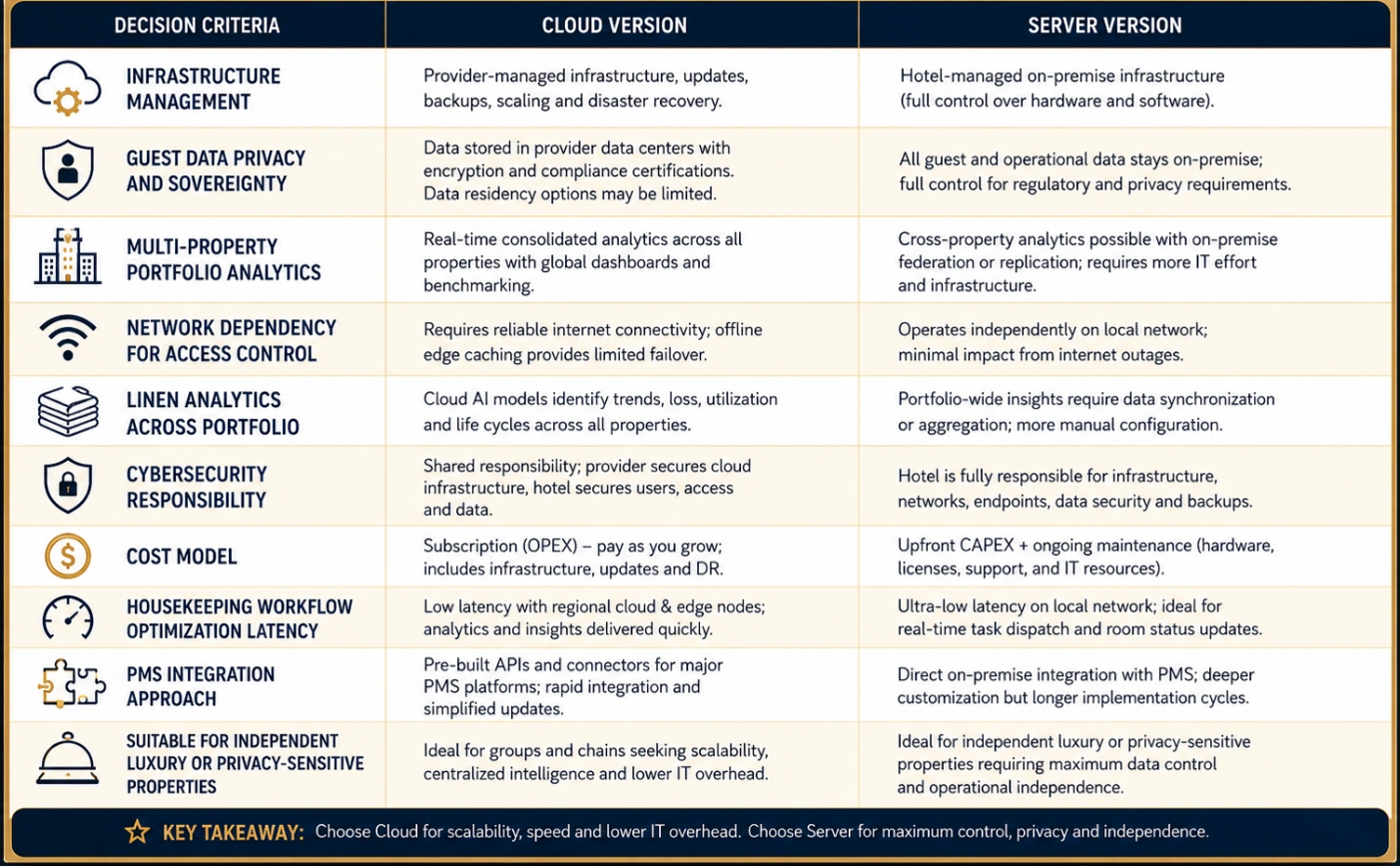
AI and RFID Deployment Models for Hotel Operations
This enterprise comparison table evaluates Cloud Version and Server Version deployment models for AI and RFID solutions in hotel operations. It compares infrastructure management, guest data privacy, multi-property analytics, access-control network dependency, linen analytics, cybersecurity responsibility, cost, housekeeping latency, PMS integration, and suitability for independent or privacy-sensitive properties.
Cybersecurity and Guest Data Protection
RFID networks in hotel operations handle guest keycard credentials, door access event logs, and linen and F&B tracking data that are subject to PCI DSS compliance requirements for payment-linked minibar billing, GDPR and CCPA guest data privacy obligations for access record retention, and brand standard audit requirements for key card security. Electronic door lock systems using MIFARE DESFire EV2 or EV3 keycards with AES-128 or AES-256 encryption provide strong cryptographic protection against keycard cloning attacks that affected older MIFARE Classic deployments. Network segmentation isolates the access control network from the hotel’s guest Wi-Fi network. Access to RFID middleware and AI analytics dashboards is governed through role-based authentication, with tamper-evident access event logs retained for loss prevention investigation and brand audit requirements.
Key Benefits of AI and RFID Integration in Hotel Operations
Combining AI with RFID identification across hotel linen, access control, housekeeping, F&B, and FF&E operations delivers measurable improvements in linen cost management, housekeeping productivity, guest security, food and beverage profitability, and operational accuracy. Each benefit reflects operational dynamics specific to hotel management rather than generic asset tracking outcomes.
Linen Loss Reduction and Laundry Cost Control
AI linen loss detection models that analyze RFID-tracked dispatch and return event records against laundry contractor transaction logs can identify the specific workflows, shift periods, and departure routes through which linen exits the property without authorization, enabling targeted operational controls that address the actual loss mechanism rather than applying blanket par count increases. Hotels implementing RFID-enabled linen tracking consistently report linen loss reductions of 15 to 30 percent compared with pre-implementation levels, directly reducing annual linen replacement expenditure that typically represents 1 to 3 percent of departmental revenue at full-service properties. AI wash count monitoring that predicts individual piece replacement timing prevents the guest service quality impacts caused by overaged linen that has exceeded its wash life remaining in service due to inaccurate manual par management.
Housekeeping Productivity and Room Readiness Accuracy
AI housekeeping workflow models that correlate RFID-tracked room attendant event data with PMS departure and arrival patterns can predict floor completion timing with accuracy sufficient to allow front desk teams to proactively manage room assignment queues, reduce guest wait times at check-in during peak afternoon arrival periods, and deploy housekeeping supervisor resources to floors at risk of completion delay before the delay impacts the front desk queue. Hotels using AI-enabled housekeeping workflow visibility report improvements in early check-in capability, reductions in front desk hold time during peak arrival periods, and improvements in housekeeping productivity measured as rooms cleaned per attendant shift through more efficient task sequencing.
Guest Room Security and Access Anomaly Detection
AI access anomaly detection models that monitor HF RFID door lock event streams against PMS reservation data can identify unauthorized entry attempts, post-checkout room access, and master keycard usage patterns that deviate from established staff workflow norms, generating real-time alerts to loss prevention and front desk teams before a security incident escalates. Proactive access anomaly alerts reduce the response time between an unauthorized entry event and loss prevention intervention from the typical 24 to 48 hour discovery lag in manual access log review processes to sub-minute alert delivery. Hotels operating high-occupancy convention and resort properties report that AI-driven access monitoring significantly reduces the volume of manual access log review required of loss prevention staff while improving the detection rate of genuine security events.
F&B Inventory Accuracy and Minibar Revenue Recovery
RFID-enabled minibar tracking that automatically detects consumed items and triggers PMS billing transactions eliminates the manual minibar check and charge process that housekeeping teams perform during room servicing, reducing the guest disputes caused by delayed or incorrect minibar charges applied hours after actual consumption. AI F&B inventory forecasting models that analyze RFID-tracked consumption patterns across multiple outlets and minibar units can predict restocking requirements by day of week and occupancy level, reducing the stockout events that result in lost minibar revenue and the over-ordering that increases spoilage costs in fresh F&B inventory. Hotels implementing RFID-enabled minibar management report improvements in minibar revenue capture rates and reductions in the housekeeping labor time previously allocated to manual minibar inventory checks.
FF&E Inventory Accuracy and Asset Loss Prevention
AI-driven FF&E tracking that uses RFID event data to maintain accurate location records for luggage carts, banquet equipment, AV systems, and housekeeping trolleys allows operations teams to locate assets within minutes rather than conducting property-wide manual searches that consume staff time during high-demand event setup periods. Hotels operating large convention facilities report that RFID-enabled FF&E tracking reduces the labor hours spent searching for misplaced banquet chairs, tables, and AV equipment before major events, and reduces the asset replacement expenditure caused by FF&E items exiting the property undetected through service entrances.
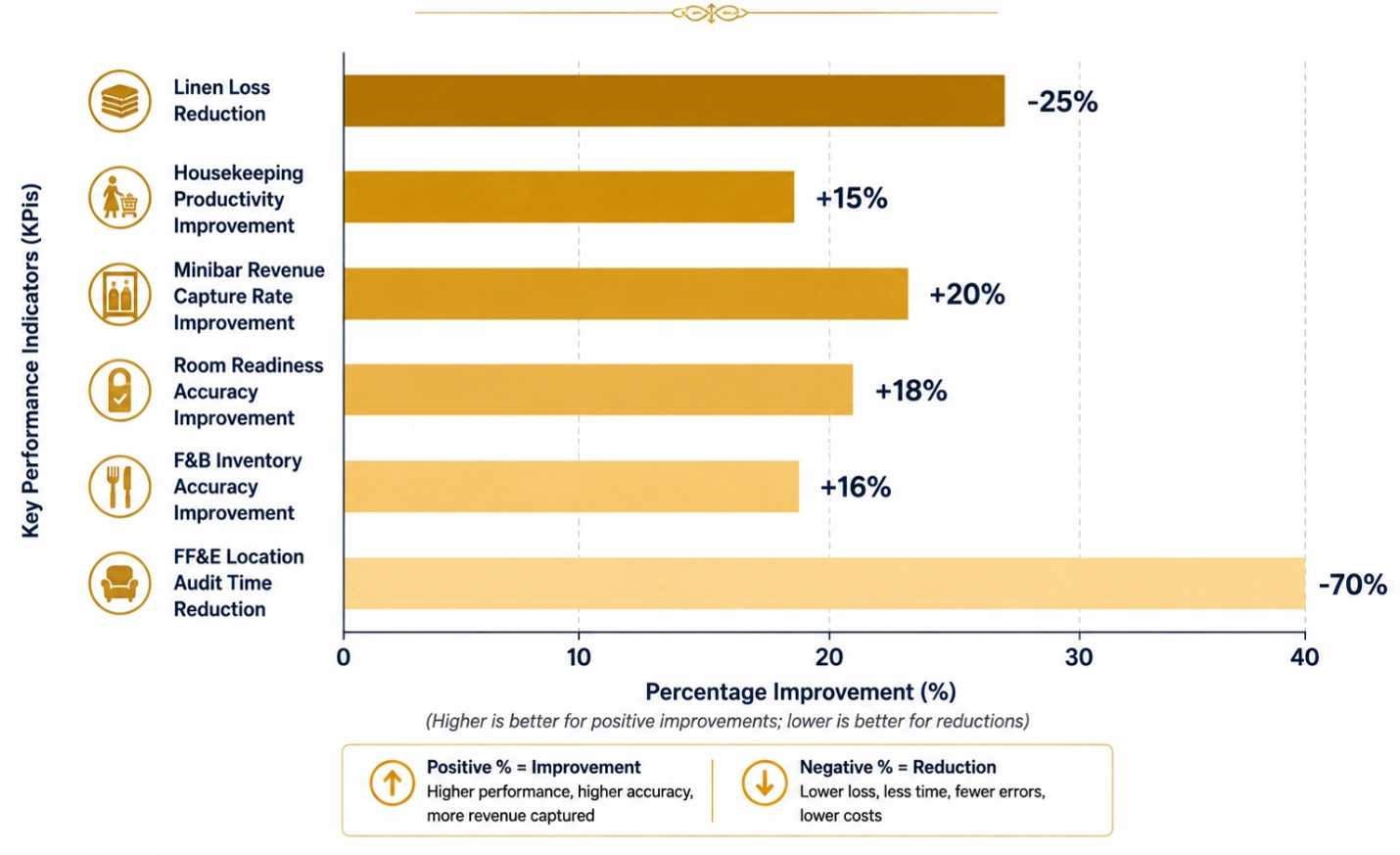
AI and RFID Performance Improvements in Hotel Operations
This horizontal bar chart highlights representative performance improvements achieved through AI and RFID deployment across hotel operations. It compares linen loss, housekeeping productivity, minibar revenue capture, room readiness, F&B inventory accuracy, and FF&E audit time, giving hotel decision-makers a quick view of potential operational gains and reductions.
Implementing AI and RFID in Hotel Operations: Technical Summary and Recommendations
AI and RFID solutions for hotel operations address linen loss, housekeeping workflow visibility, guest room security, F&B inventory shrinkage, and FF&E management challenges that manual par counts, paper logs, and visual inspection cannot resolve at the scale and operational tempo of a full-service hotel. The combination of UHF RFID linen tracking, HF RFID guest access management, and AI analytics creates a connected hotel operations layer that gives property and portfolio managers the data accuracy needed to reduce linen and FF&E replacement costs, improve housekeeping productivity, protect guest security, and recover F&B revenue that shrinkage and inaccurate billing currently erode.
Successful deployment begins with a linen tag selection process that validates wash cycle durability under the specific temperature, chemistry, and mechanical conditions of the property’s laundry operation, whether in-house or contractor-managed. UHF portal reader placement at laundry tunnel washer entry and exit points, and at linen room dispatch stations, should be confirmed through read-zone surveys before final antenna installation to account for metal cart interference and the steam-rich laundry environment. HF RFID door lock upgrades from MIFARE Classic to DESFire EV2 or EV3 should be prioritized at properties where legacy keycard security has been identified as a vulnerability in brand security audits. PMS integration through a certified middleware connector should be completed before go-live to ensure linen dispatch, housekeeping room status updates, minibar billing, and access control authorization events flow correctly into the PMS without manual reconciliation.
Hotel operators should establish KPIs before implementation, including target linen loss percentage reduction, housekeeping rooms-per-attendant-shift improvement, minibar revenue capture rate increase, and room readiness accuracy improvement targets. AI model training for housekeeping workflow prediction and F&B demand forecasting requires three to six months of RFID-linked operational data collection before recommendation accuracy is sufficient to support front desk room assignment and F&B purchasing decisions. Phased deployment starting with the laundry operation and linen tracking typically delivers the fastest measurable return on investment at most properties, as linen loss reduction generates immediate cost savings that are straightforward to quantify against pre-implementation annual replacement expenditure.
GAO supplies UHF and HF RFID hardware products and systems to hospitality operators across the U.S. and Canada, including hotel management companies, resort properties, and branded portfolio operators. With stringent quality assurance processes built over three decades of RFID product development, GAO provides hardware selection guidance, site survey support, and deployment engineering expertise both remotely and onsite. To learn more about RFID hardware products, wash-rated linen tag configurations, and technical support for hotel operations, contact GAO’s engineering team or explore the product catalog on gaorfid.com.
Building the Future of Hospitality AI and IoT with Aperture Venture Studio and GAO RFID Inc.
For more than three decades, GAO Group of Companies has invested heavily in R&D of industrial RFID, BLE, and IoT technologies, including the hardware products and systems that power AI linen tracking, guest access management, housekeeping workflow optimization, and operational intelligence solutions for hotel operations. Since generative AI was proven useful in hospitality and service industry applications, we have been developing AI and IoT (including RFID and BLE) technologies, and we have founded Aperture Venture Studio to build, launch, and scale next-generation AI and IoT companies for hotel operators and the broader hospitality industry.
Aperture has attracted top AI and IoT technical experts, entrepreneurial and operational executives, influential investors, and leading hospitality technology and hotel management companies. We have also developed the Aperture Ventures Summit and TekSummit to advance discussions on AI and IoT in hotel operations and guest experience management, building diversified technical communities for AI and IoT innovation across the hospitality industry.
We welcome you to join us as:
- Advisors, Co-founders, or Employees
- Investors, or
- Customers.