
AI-Driven Bakery Operations with BLE Data
AI-Driven Bakery Operations
AIoT, also called AI and IoT, combines artificial intelligence with connected devices, sensors, production equipment, and operational software. Within a bakery, AIoT converts data from the production floor into actionable recommendations, forecasts, alerts, and approved automated actions.
Bakery production is a time-sensitive process chain. Raw materials move through receiving, storage, scaling, mixing, resting, dividing, rounding, molding, sheeting, depositing, proofing, baking, cooling, slicing, packaging, case packing, freezer storage, and distribution. Variation introduced during one stage can affect later stages. Dough temperature, mixer energy, proof-box humidity, oven-zone recovery, cooling dwell time, and packaging-line speed all influence product texture, weight, color, shelf life, and customer acceptance.
BLE supports AI-driven bakery management by delivering location, proximity, environmental, and asset-state signals where fixed wiring is difficult or expensive. AI models combine BLE observations with PLC data, SCADA records, historians, recipe management software, laboratory information, quality checks, and production schedules. The result is an operational view that helps bakery teams understand why an event occurred and what action is appropriate.
AI-Powered BLE IoT Architecture for Commercial Bakery Operations
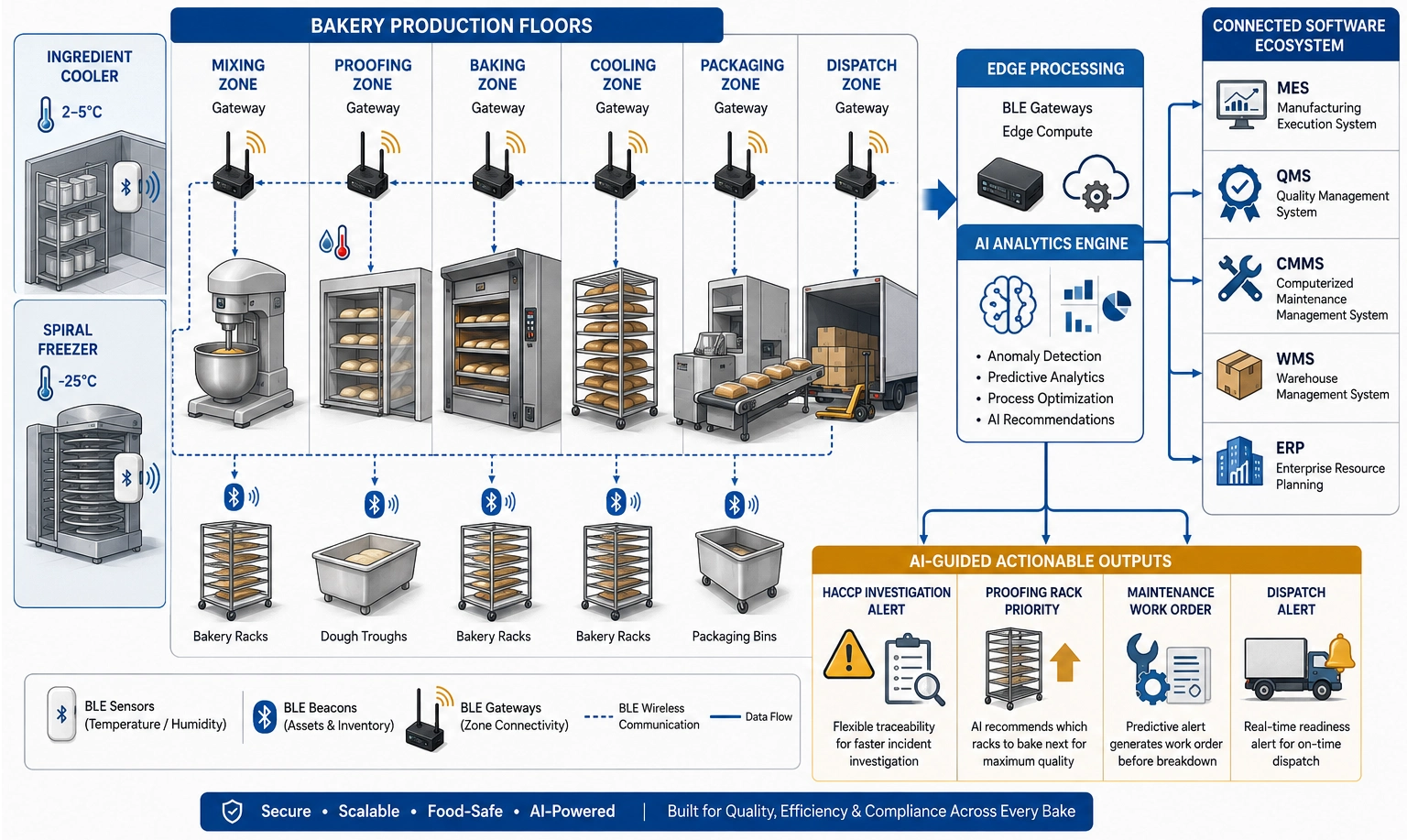
This architecture diagram illustrates how BLE sensors, asset beacons, and gateways collect operational data across a commercial bakery and transmit it through edge processing and AI analytics. The system integrates with MES, QMS, CMMS, WMS, and ERP platforms to automate food safety monitoring, production optimization, predictive maintenance, and intelligent dispatch decisions.
Why Bakery Operations Benefit from Contextual AI
Traditional bakery reports may show production volume, rejects, downtime, and finished-goods inventory after the shift ends. AI-enabled workflows improve the usefulness of that information by relating operational events to a batch, product family, shift, line, proofing rack, freezer zone, sanitation status, or maintenance condition.
Relevant bakery questions include:
- Which proofing racks are nearing their validated dwell-time limit before oven loading?
- Which ingredient cooler locations have recurring temperature excursions during replenishment?
- Is a spiral freezer accumulating product because of an upstream packaging issue or a conveyor-speed constraint?
- Which dough troughs, bakery racks, dollies, mobile scales, or sanitation carts are unavailable because they are in washdown, maintenance, staging, or another department?
- Does the combination of dough temperature, mixer cycle, ambient humidity, and proofing time predict a higher likelihood of weight, color, or texture defects?
- Are sanitation verification, allergen changeover, and line-clearance records complete before the scheduled product family begins?
GAO supplies hardware products and systems that support these workflows, with attention to washdown exposure, freezer conditions, battery service intervals, enclosure selection, mounting methods, and radio coverage around metal racks and industrial equipment.
AI Applications for Bakery Production and Quality
Proofing and Oven-Loading Optimization
Proofing performance depends on time, temperature, humidity, dough formulation, yeast activity, dough temperature, product size, and oven availability. A late or premature transfer to the oven can cause weak structure, poor volume, inconsistent crumb, uneven color, or excessive scrap.
BLE-tagged bakery racks can establish when each rack enters, moves through, and exits proofing zones. Environmental sensors can identify conditions near high-traffic doors, peripheral rack positions, and areas affected by airflow variation. AI evaluates rack location history with product code, target proof window, proofer conditions, oven queue, and downstream packaging capacity.
Production supervisors receive an action-oriented queue rather than a generic alarm. The system can highlight racks that should load next, racks that may require quality evaluation, and developing congestion that could delay the next production run. This supports more consistent bake results and reduces unplanned rework.
Cold-Chain and Ingredient-Room Risk Management
Bakery ingredient rooms may store yeast, dairy ingredients, eggs, butter, cream, chocolate, fillings, frozen fruit, par-baked products, frozen dough, and finished goods. Temperature control can vary near receiving doors, refrigeration evaporators, staging areas, high-turnover picking locations, and frequently opened freezer doors.
BLE temperature and humidity sensors add localized context to refrigeration alarms. AI combines those readings with product location, door-open duration, replenishment records, refrigeration equipment status, dwell time, and lot information. The system can help distinguish a short, low-risk door opening from a persistent thermal condition affecting temperature-sensitive ingredients or released finished goods.
Quality personnel can investigate the relevant lot, rack, pallet, or zone rather than applying a broad hold across all inventory in a room. This approach supports HACCP documentation, preventive controls, corrective-action records, and product-disposition decisions while preserving the authority of the quality team.
Evidence-Based Cold-Chain Escalation Workflow for Commercial Bakeries
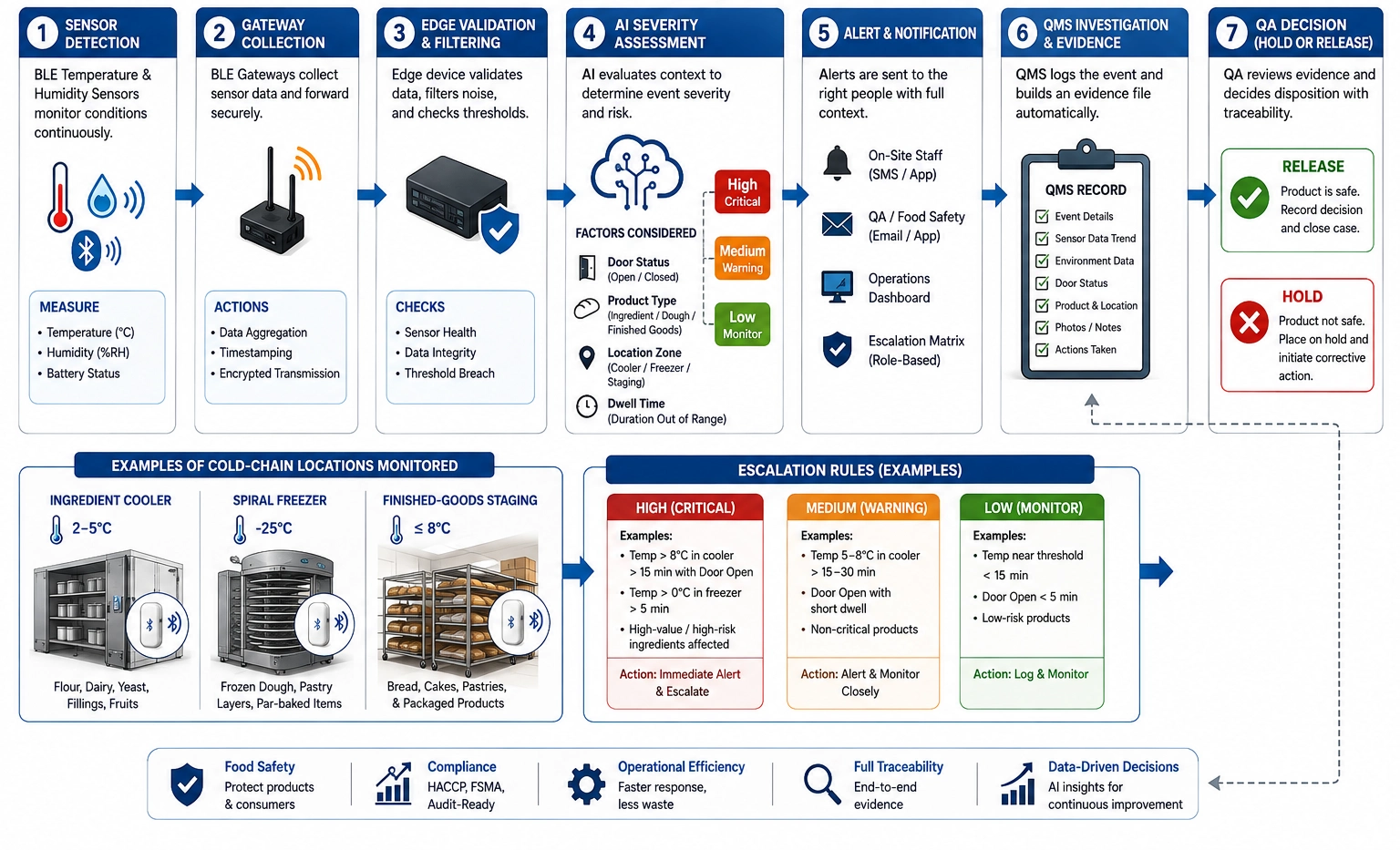
This workflow diagram illustrates how BLE temperature and humidity sensors monitor bakery cold-chain environments, with data collected through gateways and validated at the edge. AI evaluates event severity using contextual factors such as door status, product type, storage location, and dwell time before triggering QMS investigation and a QA hold-or-release decision for ingredient coolers, spiral freezers, and finished-goods staging areas.
Mobile Asset Tracking and Bakery Flow
Bakery throughput depends on shared mobile assets, including proofing racks, sheet-pan racks, cooling racks, bread baskets, dollies, dough troughs, ingredient bins, tote bins, sanitation carts, mobile scales, and pallet jacks. Searching for missing or unavailable assets slows changeovers and can create unsafe workarounds.
BLE beacons provide zone-level visibility for these assets. AI applies movement history, production orders, washdown status, maintenance condition, cleaning schedules, and queue time to forecast shortages. A bakery can identify whether a missing rack is awaiting sanitation, held for maintenance, staged at packaging, positioned in the freezer, or located in a different department.
RFID can complement BLE where serialized tooling, pallet-level shipment verification, reusable tote identification, or scan-confirmed product movement is required. BLE is often effective for continuous zone presence and asset-flow analysis, while RFID can strengthen specific identification and transaction-confirmation tasks.
Predictive Maintenance for Bakery Equipment
Mixers, proofers, ovens, spiral conveyors, slicers, packaging machines, compressors, refrigeration units, metal detectors, checkweighers, and case packers generate operational data that can reveal abnormal behavior before a failure occurs. AI models can use motor current, vibration, temperature, cycle counts, fault codes, reject rates, PLC states, and maintenance history.
A model may identify slow oven-zone temperature recovery after door opening, unusual vibration on a spiral conveyor drive, repeated minor stops at a bagger, or deteriorating refrigeration performance in a freezer. BLE-based environmental or proximity data can add context, such as unusual congestion around a machine or temperature conditions associated with recurring stoppages.
Predictive maintenance should produce an inspectable hypothesis and a prioritized maintenance task. Maintenance teams still confirm the cause through safety procedures, condition checks, OEM guidance, spare-parts availability, and work-order review.
Complete Data Workflow for Bakery AI Decisions
Data Acquisition and Site Commissioning
A successful bakery deployment begins with a workflow assessment and radio survey. The survey should account for metal racks, steel ovens, freezer walls, industrial refrigeration equipment, washdown zones, overhead conveyors, mezzanines, pallet staging, and high-traffic doorways. Coverage tests should use representative bakery racks, loaded dough troughs, ingredient bins, and finished-product loads rather than empty production areas.
Each sensor, beacon, gateway, asset, and zone requires a clear identifier and operational purpose. Asset records should define ownership, sanitation classification, product-contact risk, maintenance status, calibration requirements, and expected movement pattern. Sensor records should identify measurement range, calibration interval, acceptable accuracy, location, and alert thresholds.
GAO can supply BLE gateways, beacons, sensors, RFID products, and related IoT hardware for this stage. Bakery operations and quality teams should define acceptance criteria for coverage, data completeness, battery serviceability, washdown durability, and operational use.
Communication and Edge Processing
BLE gateways collect data from approved devices and forward it through Ethernet, Wi-Fi, cellular, or segmented industrial networks. Edge processing validates and buffers data before it reaches AI services or business software. This local processing is important when production continuity cannot depend on constant internet connectivity.
The edge service should perform several tasks:
- Remove duplicate observations and flag unexpected device behavior
- Monitor battery level, gateway availability, and sensor-health status
- Normalize timestamps, units of measure, and production-zone names
- Map device identifiers to racks, freezers, ingredient rooms, lines, and work areas
- Retain relevant data during communication outages and synchronize it after recovery
- Apply local alert rules for urgent temperature, dwell-time, or device-health events
Time synchronization is especially important. A rack movement, batch transition, door opening, temperature change, and QA observation must be recorded with reliable time relationships. Poor timestamps can make root-cause analysis and product-disposition review unreliable.
Integration with Bakery Software
Middleware connects device events with the operational systems that govern bakery work. Common integrations include MES, SCADA, historian software, ERP, WMS, QMS, LIMS, CMMS, recipe management, electronic batch records, and labor-management software.
Contextualization is the crucial step. A BLE observation becomes meaningful only when it is associated with a batch, SKU, recipe, line state, sanitation status, work order, product hold, shift, or loading schedule. A prolonged rack dwell may be normal during a planned allergen changeover but problematic during an active production run. A freezer temperature excursion may require different handling for raw frozen dough and released finished goods.
AI Analytics and Governed Actions
Bakery AI models should be selected for a specific operational problem:
- Time-series anomaly detection for proofers, ingredient rooms, coolers, freezers, ovens, and cooling areas
- Predictive models for equipment downtime, late-rack risk, freezer congestion, and packaging-line starvation
- Optimization models for rack sequencing, oven loading, labor allocation, and dispatch staging
- Computer vision for product color, pan occupancy, label presence, package integrity, and foreign-material inspection where cameras are appropriate
- Natural-language reporting that summarizes verified shift exceptions from MES, QMS, CMMS, and sensor records
High-consequence decisions must remain human governed. Product release, HACCP corrective actions, allergen control, disposal decisions, and validated process-limit changes require authorized quality and operations personnel. AI recommendations should expose their supporting evidence, confidence level, data-quality status, and suggested verification action.
AI Workflow: From Bakery-Floor Signals to Governed Operational Action
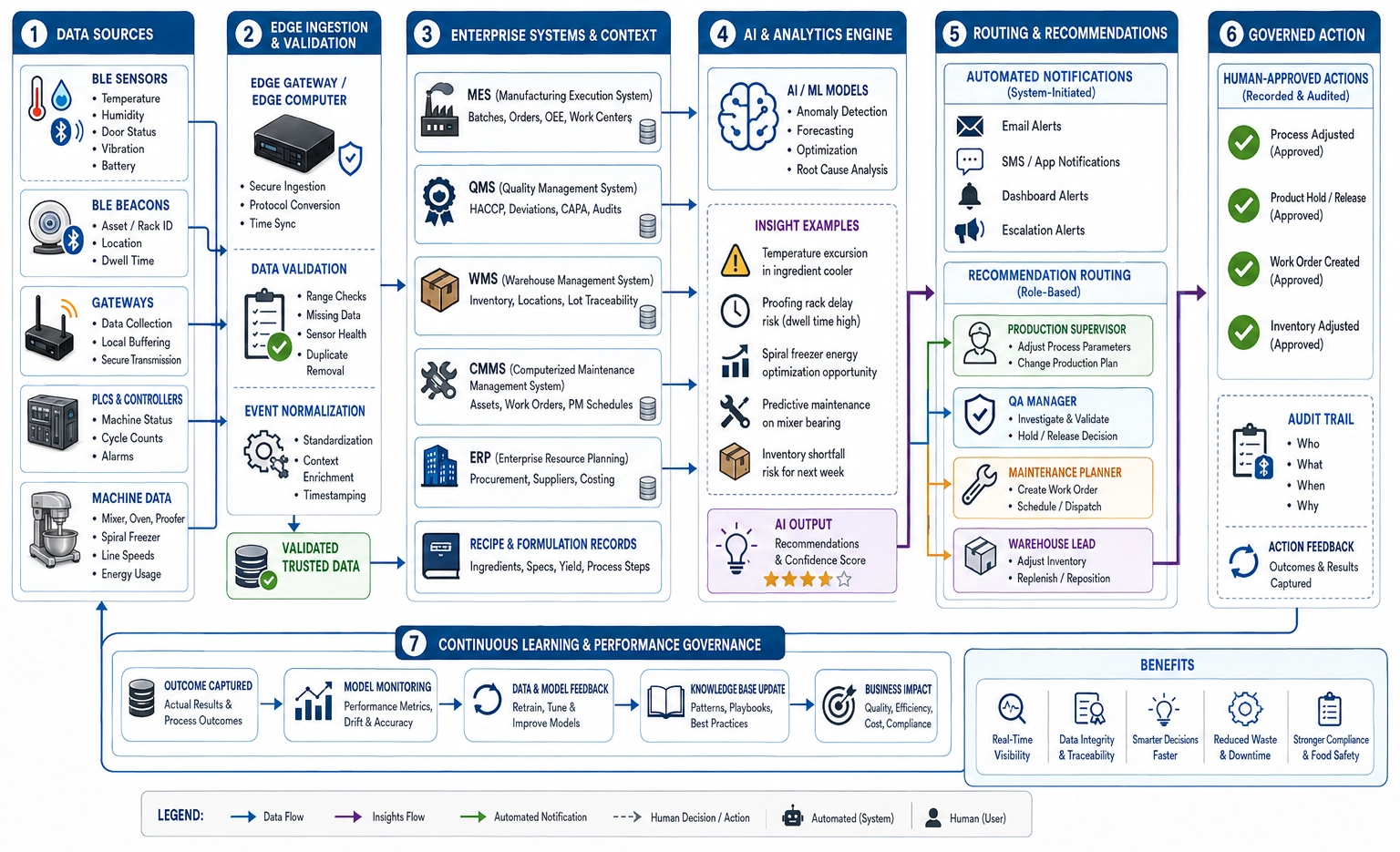
This workflow diagram illustrates how BLE sensors, beacons, gateways, PLCs, and machine data are validated at the edge before being enriched with MES, QMS, WMS, CMMS, ERP, and recipe information. AI models detect anomalies, generate forecasts, and identify optimization opportunities, routing recommendations to production, quality, maintenance, and warehouse teams while clearly distinguishing automated notifications from human-approved actions. Confirmed outcomes are captured to support continuous model monitoring and improvement.
Cloud Version and Server Version for Bakery AI Systems
Cloud Version software is suitable for bakery groups that need centralized visibility across multiple plants, distribution centers, contract manufacturing locations, and refrigerated storage sites. A cloud-hosted SaaS deployment can support consolidated reporting, multi-site KPI comparison, software updates, model monitoring, and controlled sharing with approved corporate stakeholders.
Cloud Version deployments still require local resilience. Gateways and edge services should continue collecting relevant data during an internet interruption and synchronize records after connectivity returns. Critical alerts should have locally defined escalation paths, especially for cold-chain conditions and production-critical asset flow.
Server Version software is suitable for bakeries that require customer-managed control of operational data, low-latency local processing, private network integration, or a controlled data boundary. Server Version software can operate on edge servers, privately hosted servers, customer-managed cloud infrastructure, factory servers, or data-center virtual machines.
High-volume bakeries with tightly coupled PLC systems, proprietary formulas, validated batch records, or strict cybersecurity policies often prefer Server Version deployments. A hybrid approach can also be appropriate: local edge processing protects production continuity, while approved aggregated data supports cross-site reporting and model management.
Cybersecurity and Data Reliability
Security and data quality are operational requirements, not optional add-ons. Bakery AI systems should include device identity management, encrypted communications, segmented operational networks, role-based access, secure credential rotation, signed software updates, backup procedures, and audit logs.
Sensor data must also be trustworthy. A temperature reading without calibration status, verified location, reliable timestamp, and known unit of measure should not drive a food-safety decision. Device health, sensor drift, battery state, missed observations, and gateway uptime should be monitored alongside production and quality KPIs.
Cloud vs. Server AI Deployment Models for Commercial Bakery Operations
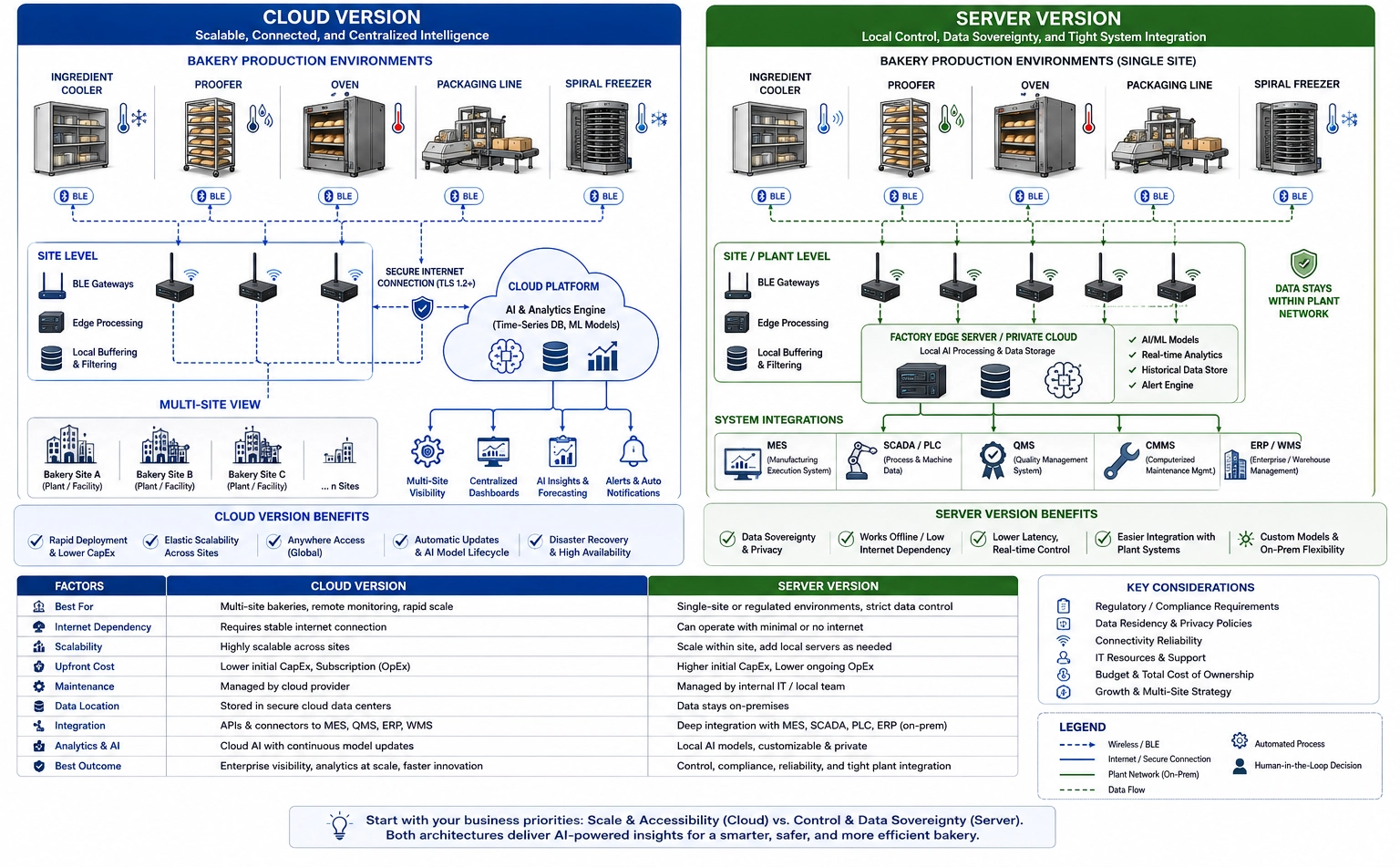
This comparison diagram contrasts cloud-based and server-based AI deployment architectures for commercial bakeries. It shows how BLE gateways and edge processing connect equipment such as ingredient coolers, proofers, ovens, packaging lines, and spiral freezers to either cloud analytics for centralized multi-site management or on-premises servers for local AI processing, MES/SCADA integration, and controlled data governance.
Measurable Improvements in Bakery Operations
AI and BLE data can improve bakery performance when they change an identified decision process. The most useful measures include:
- First-pass yield, scrap rate, rework rate, and product-quality compliance
- Proofing-rack dwell time and oven-loading punctuality
- Overall equipment effectiveness, minor-stop frequency, and unplanned downtime
- Cooling and freezer congestion duration
- Temperature-excursion investigation time and product-hold duration
- Asset search time, rack availability, and washdown turnaround time
- Mean time between failure, mean time to repair, and planned-maintenance ratio
- On-time, in-full dispatch and staging accuracy
- Sensor calibration compliance, device uptime, and alert acknowledgment time
The practical benefit is better operational control. Production teams can respond earlier to rack-flow issues. Quality teams can investigate relevant product and location evidence more precisely. Maintenance teams can schedule inspections based on developing conditions. Warehouse teams can locate mobile assets and staged orders without unnecessary searches.
Implementation Recommendations for Bakery Teams
Begin with a bounded workflow that has clear owners, measurable friction, and available source data. Proofing-rack dwell-time management, cold-room monitoring, mobile-asset visibility, freezer congestion, and packaging-line flow are suitable early projects.
Recommended practices include:
- Document the workflow from receiving through product release and dispatch
- Include production, QA, sanitation, maintenance, warehouse, IT, and food-safety representatives during requirements definition
- Test coverage under actual operating conditions, including loaded racks, moving equipment, open freezer doors, washdown conditions, and peak production traffic
- Define asset-state rules such as available, in use, in washdown, held, under maintenance, staged, or out of service
- Connect alerts to current MES, QMS, CMMS, WMS, and shift-management processes
- Validate predictive models against historical records and supervised operating periods
- Maintain human approval for product disposition, allergen management, and food-safety corrective actions
- Plan for battery replacement, sensor calibration, firmware maintenance, cybersecurity reviews, and model-performance monitoring
GAO has served customers across the United States and Canada for three decades, including Fortune 500 companies, research organizations, universities, and government agencies. As a supplier ranked among the top 10 leading B2B and B2G BLE and RFID suppliers worldwide, GAO can help bakery teams evaluate devices, coverage, system integration, and operational deployment requirements.
AI-Enabled Bakery Operations Implementation Timeline
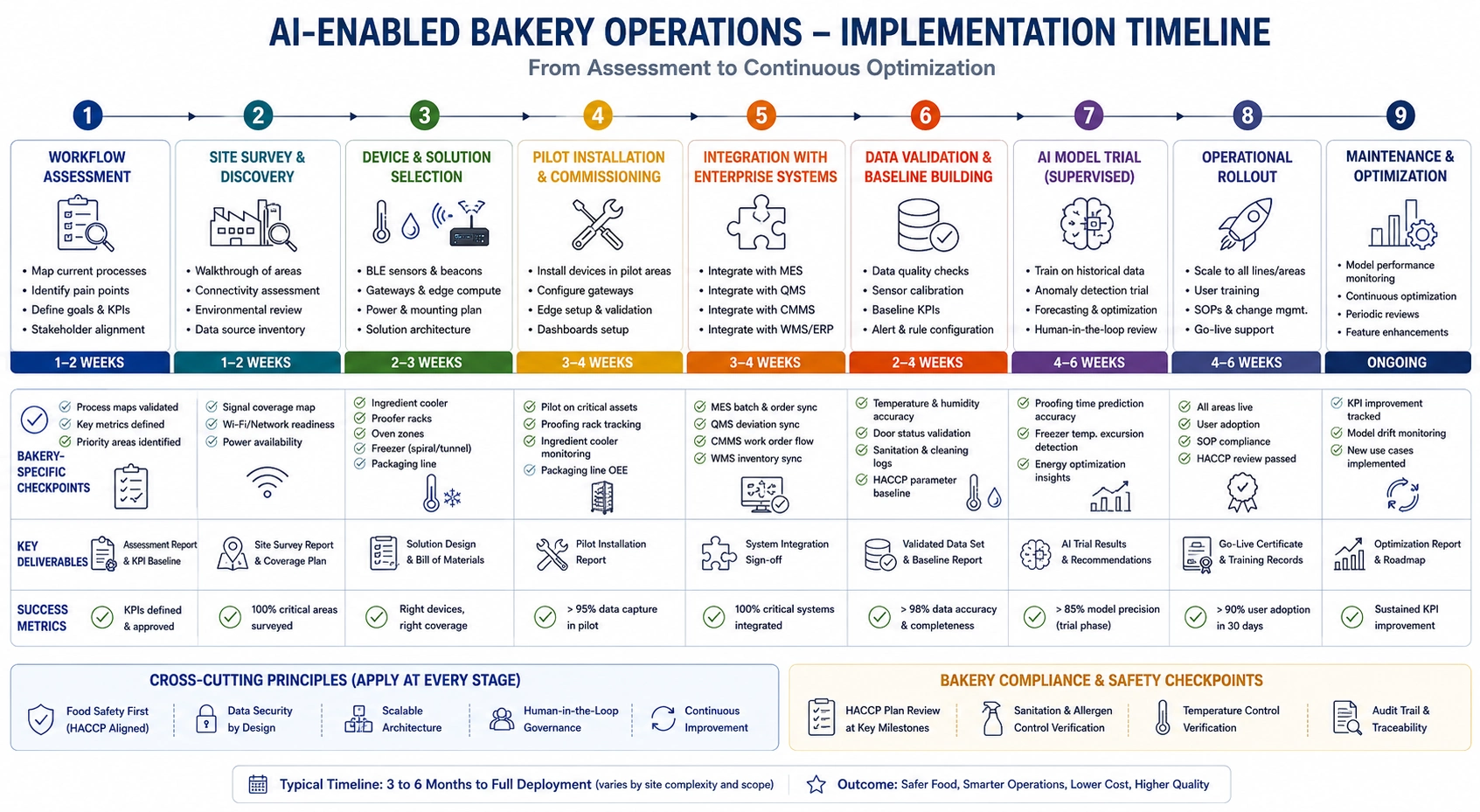
This implementation timeline outlines a practical deployment roadmap for AI-enabled bakery operations, beginning with workflow assessment and site surveys, followed by device selection, pilot installation, enterprise system integration, data validation, supervised AI model testing, operational rollout, and continuous optimization. Bakery-specific checkpoints include proofing racks, ingredient coolers, packaging lines, spiral freezers, sanitation verification, and HACCP compliance reviews.
Building Reliable AI-Enabled Bakery Operations with GAO
Reliable bakery AI depends on accurate operational data, governed decision-making, and practical deployment engineering. BLE gateways, beacons, and sensors can reveal the movement and condition of bakery racks, dough troughs, cooling lanes, ingredient rooms, freezers, and dispatch areas. AI creates value by relating those signals to batch records, equipment data, quality checks, maintenance status, and production schedules.
GAO, based in New York City and Toronto, Canada, provides BLE, RFID, and IoT hardware products and systems with rigorous quality assurance and technical support delivered remotely or onsite. Learn more about GAO’s engineering expertise, connected hardware, and technical support for bakery production, food safety, maintenance, and asset-flow applications.
Building the Future of Industrial AI and IoT with Aperture Venture Studio and GAO
For more than three decades, GAO and its affiliated companies have invested in industrial BLE, RFID, and IoT research and development. As generative AI has proven useful for bakery production control, cold-chain oversight, and asset-flow analysis, we have advanced practical AIoT initiatives through Aperture Venture Studio. Aperture brings together AI and IoT technical specialists, operational executives, investors, and leading organizations through Aperture Ventures Summit and TekSummit. These efforts strengthen technical communities focused on responsible industrial AI and IoT. We welcome participation from advisors, employees, investors, and customers.