
AI-Powered Shopping Plaza Operations Using BLE Technologies
Intelligent Shopping Plaza Operations with AI and BLE
Modern shopping plazas are evolving into intelligent commercial environments where operational efficiency, tenant satisfaction, visitor experience, safety, and sustainability are managed through continuous data-driven decision making. Artificial Intelligence of Things (AIoT) combines artificial intelligence with BLE gateways, BLE beacons, BLE sensors, connected equipment, and enterprise software to transform how shopping plazas monitor facilities, coordinate operations, optimize resources, and respond to changing business conditions.
Within shopping plaza operations, BLE serves as the sensing and location-awareness layer that continuously captures information about people, assets, equipment, environmental conditions, occupancy, and operational events. AI analyzes these large volumes of real-time data to identify patterns, predict operational issues, automate workflows, and support informed decision-making across facilities management, tenant operations, security, maintenance, energy management, and customer services.
GAO has supplied BLE hardware products and IoT systems for organizations throughout North America for decades, helping commercial facilities deploy reliable sensing infrastructure that supports AI-driven operational intelligence.
AI-Powered BLE Intelligence for Smart Shopping Plaza Operations
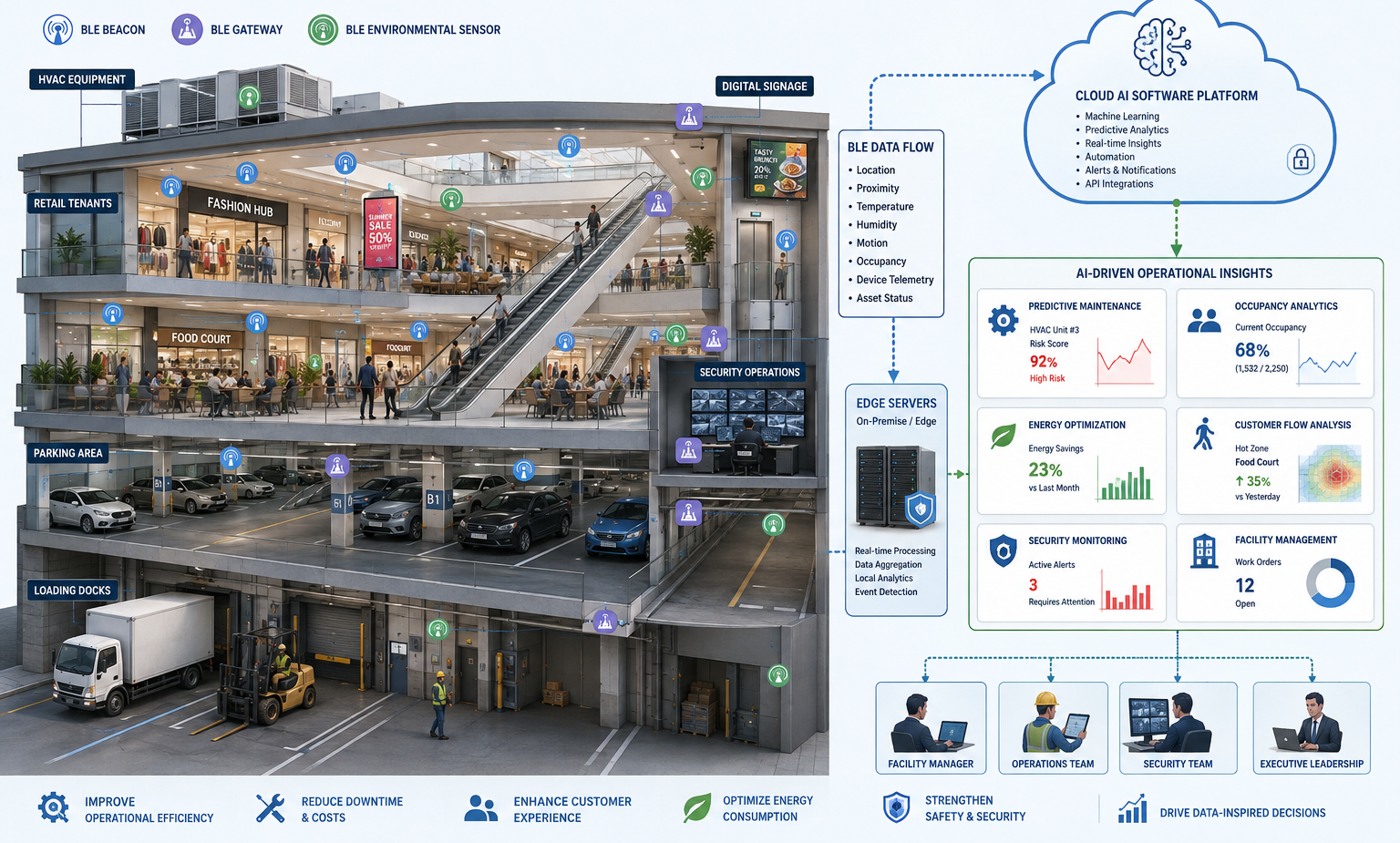
An AI-driven platform using BLE data to optimize HVAC, energy, security, and tenant operations in retail plazas with real-time insights and predictive analytics.
Fundamental Concepts of AI-Driven Shopping Plaza Operations
Shopping plaza operations involve coordinating numerous interconnected business functions that collectively deliver safe, efficient, profitable, and attractive commercial environments. Unlike traditional retail management that primarily focuses on individual stores, shopping plaza management oversees common areas, building infrastructure, parking facilities, utilities, tenant services, security operations, cleaning schedules, maintenance programs, emergency preparedness, and visitor experiences across an entire property.
AI transforms these operations by converting continuous operational data into actionable intelligence. Rather than relying on scheduled inspections or reactive responses, AI systems continuously evaluate conditions throughout the property and recommend operational actions before service disruptions occur.
BLE technologies provide critical contextual information because they support low-power sensing, indoor positioning, proximity detection, environmental monitoring, and asset identification where satellite positioning systems cannot provide sufficient accuracy.
Typical operational data sources include:
- BLE occupancy sensors
- BLE temperature sensors
- BLE humidity sensors
- BLE vibration sensors
- BLE asset tags
- BLE personnel badges
- Parking occupancy sensors
- Escalator monitoring systems
- Elevator diagnostics
- Energy meters
- Lighting controllers
- Building automation systems
- Video analytics systems
- Point-of-sale integrations
- Digital signage systems
- Visitor Wi-Fi analytics
- Security access systems
- Maintenance management software
- Tenant service request systems
AI combines these diverse information sources to generate operational recommendations that improve efficiency throughout shopping plaza operations instead of evaluating each system independently.
Unlike rule-based automation, machine learning continuously adapts to seasonal shopping behavior, holiday traffic, promotional events, tenant operating schedules, weather conditions, and long-term facility usage patterns.
GAO helps organizations implement dependable BLE sensing infrastructure that provides the high-quality operational data required for accurate AI analysis.
Why AI is Transforming Shopping Plaza Operations
Shopping plazas face increasing operational complexity resulting from changing consumer expectations, higher operating costs, sustainability objectives, labor shortages, and growing security requirements. Property managers require greater visibility across thousands of operational variables without proportionally increasing staffing levels.
AI addresses these challenges by improving operational awareness across multiple business functions simultaneously.
Examples include:
- Predicting HVAC failures before tenant comfort is affected.
- Identifying abnormal pedestrian traffic that may indicate security concerns.
- Optimizing janitorial schedules using actual foot traffic rather than fixed timetables.
- Forecasting parking demand during promotional events.
- Monitoring refrigerated storage conditions for food service tenants.
- Detecting abnormal vibration in escalators and elevators.
- Predicting maintenance priorities using historical equipment performance.
- Identifying underutilized common areas.
- Optimizing digital signage placement using visitor movement analytics.
- Improving emergency evacuation planning using occupancy models.
Shopping plazas also generate enormous quantities of operational information that cannot realistically be interpreted manually. AI continuously evaluates these datasets to prioritize operational responses according to business impact, safety requirements, and service-level objectives.
This intelligence improves collaboration among:
- Facilities managers
- Property managers
- Security teams
- Maintenance technicians
- Cleaning contractors
- Tenant coordinators
- Energy managers
- Leasing departments
- Parking operations
- Customer service personnel
Because BLE devices consume very little power, they can operate for years on battery power, enabling cost-effective deployment across expansive shopping centers without extensive wiring projects.
End-to-End BLE & AI Platform for Smart Plaza Operations
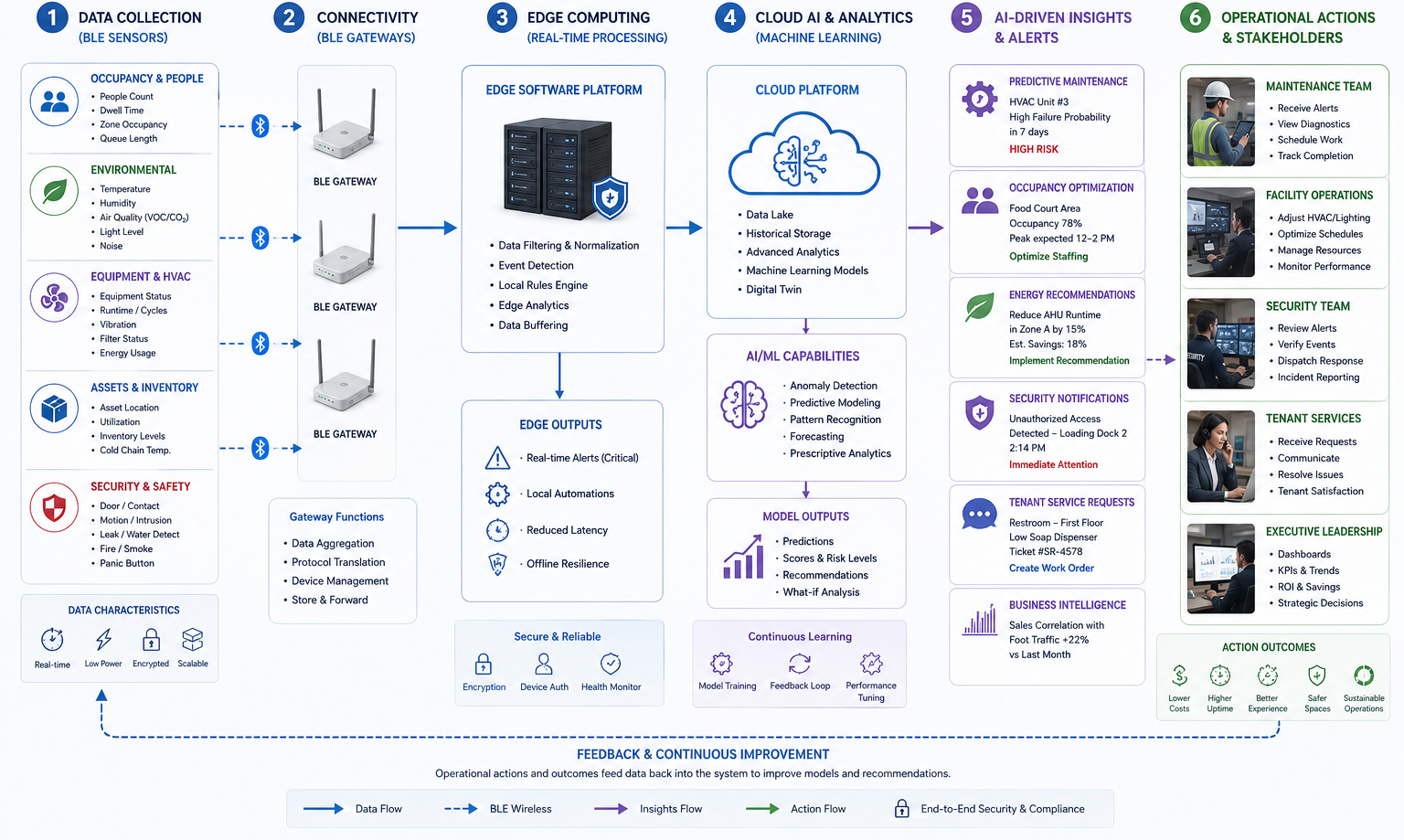
From BLE sensor data collection to edge processing and cloud AI, this platform delivers predictive maintenance, occupancy insights, energy savings, and security actions.
Shopping Plaza Operations That Benefit Most from AI and BLE
BLE-supported AI systems improve nearly every operational area within modern shopping plazas by providing continuous visibility into assets, facilities, infrastructure, visitors, and environmental conditions.
Visitor Flow Intelligence
Understanding pedestrian movement throughout shopping plazas enables managers to optimize storefront visibility, promotional displays, food court utilization, wayfinding, staffing, and event planning. BLE beacons combined with AI analytics identify high-traffic corridors, congestion points, dwell zones, and underutilized areas while preserving privacy through anonymized location analytics.
Smart Parking Management
BLE-enabled parking sensors and gateways provide real-time occupancy information that AI uses to forecast demand, guide drivers to available spaces, reduce vehicle circulation time, and improve traffic flow during peak shopping periods.
Asset Tracking
Maintenance equipment, cleaning carts, mobile POS devices, security tools, wheelchairs, promotional kiosks, and emergency response equipment frequently move throughout shopping plazas. BLE asset tags combined with AI analytics improve utilization, reduce search time, and detect misplaced or unauthorized asset movement.
End-to-End Operational Workflow for AI-Driven Shopping Plaza Operations
Shopping plaza operations involve thousands of interconnected activities occurring simultaneously across retail spaces, food courts, entertainment venues, parking facilities, loading docks, mechanical rooms, and public common areas. AI-powered operational intelligence built upon BLE technologies enables property managers to transition from reactive facility management to continuous, data-driven optimization.
The operational workflow begins with distributed BLE-enabled sensing devices that continuously collect operational data from critical business functions. Unlike conventional inspection-based management, AI continuously evaluates operational conditions and automatically identifies exceptions requiring attention.
Data Acquisition and BLE Sensing
BLE devices collect information from numerous operational environments throughout the shopping plaza.
Typical sensing points include:
- Customer traffic throughout corridors
- Occupancy of public seating areas
- Parking space availability
- Escalator operating conditions
- Elevator status
- HVAC equipment performance
- Mechanical room temperature
- Refrigeration monitoring for food tenants
- Lighting system status
- Restroom occupancy
- Waste collection levels
- Emergency equipment locations
- Cleaning equipment locations
- Security patrol positions
- Delivery vehicle movement
- Loading dock utilization
- Indoor environmental quality
- Air temperature
- Relative humidity
- Equipment vibration
- Door status
- Utility room access
BLE beacons provide location awareness, while BLE sensors continuously measure environmental and equipment conditions. BLE asset tags identify mobile resources throughout the property, enabling AI software to understand how operational assets are utilized.
Because shopping plazas often contain multiple floors, concrete walls, steel structures, and numerous retail units, BLE gateways are strategically installed to maximize coverage while minimizing communication blind spots.
Communication Infrastructure
BLE devices transmit operational data to nearby BLE gateways using Bluetooth Low Energy communication. The gateways aggregate information from hundreds or thousands of endpoints before securely forwarding the data to local edge servers or cloud-hosted software using standard IP networks.
Communication infrastructure typically includes:
- BLE 5.x communication
- Ethernet backbone
- Fiber uplinks
- Secure Wi-Fi
- VLAN segmentation
- MQTT messaging
- HTTPS APIs
- REST interfaces
- BACnet integration
- Modbus connectivity
- OPC UA where required
- SNMP monitoring
- Time synchronization services
Shopping plaza environments frequently experience changing radio conditions caused by visitors, seasonal decorations, temporary kiosks, and tenant renovations. Site surveys and radio-frequency planning are therefore essential to ensure consistent BLE performance.
GAO assists customers in selecting appropriate BLE gateways and deployment strategies that maintain reliable communications across large commercial properties.
Edge Processing
Many operational decisions require responses within seconds rather than waiting for cloud processing. Edge servers positioned within the shopping plaza perform local analytics that reduce latency and improve operational resilience.
Typical edge processing functions include:
- Sensor validation
- Duplicate filtering
- Location calculation
- Occupancy estimation
- Event correlation
- Temporary data storage
- Local dashboards
- Alert generation
- Equipment health scoring
- Initial anomaly detection
Edge processing is particularly valuable for:
- Fire safety events
- Elevator faults
- Escalator shutdowns
- Intrusion detection
- Emergency evacuations
- Mechanical alarms
- Utility failures
- Security incidents
Local processing also minimizes bandwidth consumption because only summarized operational information is transmitted to centralized AI software.
AI Analytics and Decision Support
Artificial intelligence continuously analyzes historical and real-time operational information collected throughout the shopping plaza.
Machine learning models identify relationships that are difficult for human operators to detect manually.
Examples include:
- Predicting HVAC failures several days before equipment breakdown
- Identifying unusual visitor movement patterns
- Forecasting parking demand using historical shopping behavior
- Estimating janitorial workload from actual foot traffic
- Predicting escalator maintenance intervals
- Optimizing lighting schedules
- Detecting energy anomalies
- Forecasting tenant utility consumption
- Identifying abnormal equipment vibration
- Predicting congestion before major promotional events
Rather than issuing alerts for every operational event, AI prioritizes recommendations according to business impact, customer safety, operational cost, and service continuity.
This prioritization helps facility managers focus on high-value operational activities rather than responding to thousands of low-priority notifications.
Enterprise Software Integration
AI-generated operational intelligence becomes significantly more valuable when integrated with existing shopping plaza management software.
Typical integrations include:
- Computerized Maintenance Management Systems (CMMS)
- Computer-Aided Facility Management (CAFM)
- Building Management Systems (BMS)
- Building Automation Systems (BAS)
- Integrated Workplace Management Systems (IWMS)
- Enterprise Resource Planning (ERP)
- Customer Relationship Management (CRM)
- Tenant management software
- Lease administration systems
- Energy management software
- Security Information Management systems
- Video Management Systems (VMS)
- Access control software
- Digital signage management
- Parking management systems
- Financial reporting software
- Business intelligence dashboards
Instead of replacing existing investments, AI enhances operational visibility by combining information across these software systems into a unified operational view.
GAO has supported organizations implementing BLE-based IoT hardware that integrates with existing commercial software investments while minimizing operational disruption.
Automated Business Actions
Once AI identifies operational opportunities, business actions can occur automatically or after operator approval.
Examples include:
- Creating maintenance work orders
- Dispatching cleaning personnel
- Adjusting HVAC schedules
- Optimizing lighting levels
- Sending tenant notifications
- Reserving loading docks
- Dispatching security officers
- Updating executive dashboards
- Triggering energy-saving routines
- Scheduling preventive maintenance
- Sending equipment inspection requests
- Reassigning parking guidance
- Updating occupancy displays
- Escalating emergency incidents
The objective is not complete automation but intelligent operational assistance that enables property managers to make faster, more informed decisions.
AI-Enabled Shopping Plaza Management – From Sensing to Action
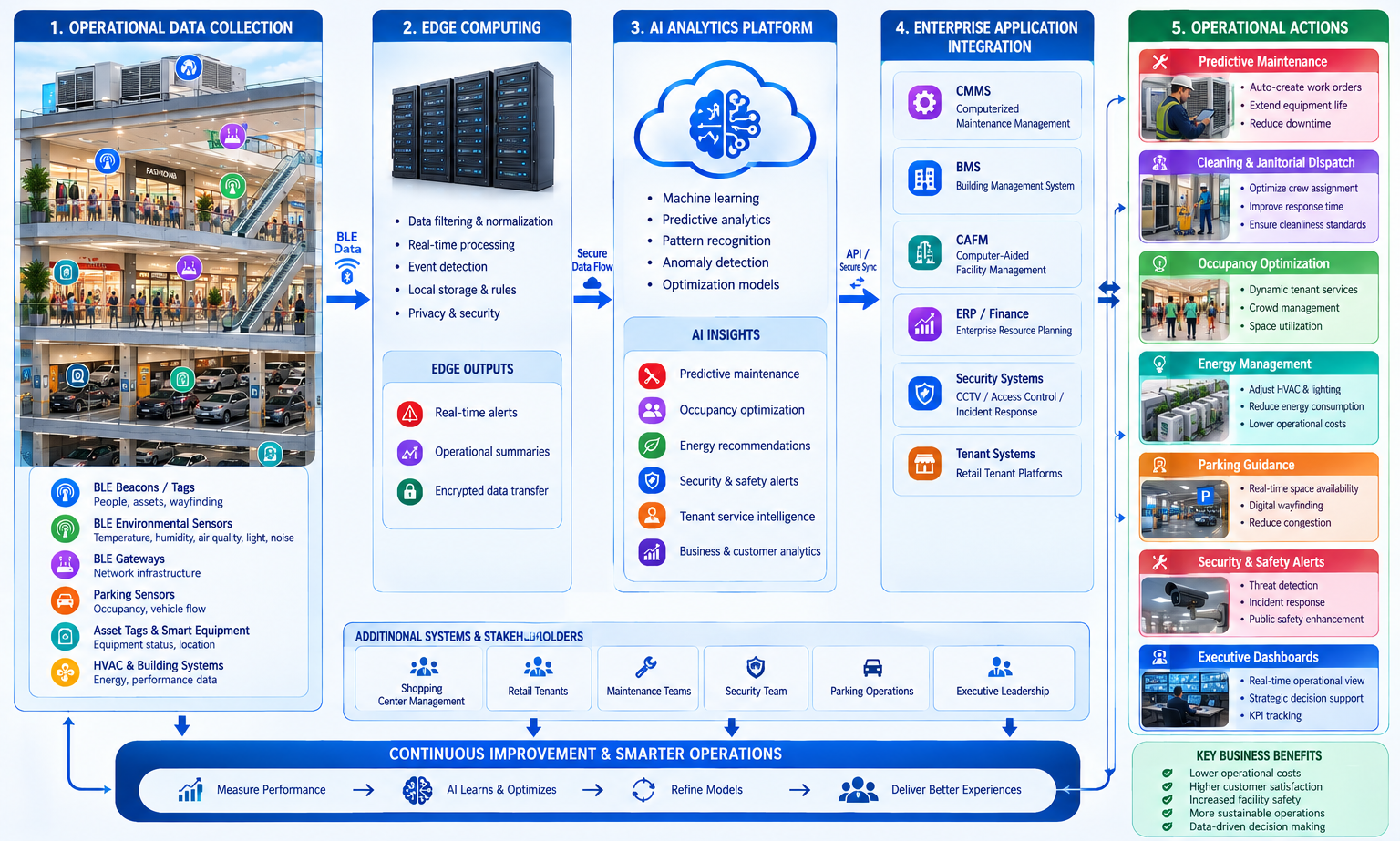
End-to-end lifecycle for smart plaza operations: BLE data collection, edge processing, AI analytics, enterprise integration, and actionable outcomes for maintenance, energy, security, and more.
BLE Technologies, AI Software, and Deployment Models for Shopping Plaza Operations
AI-driven shopping plaza operations depend on the coordinated interaction of BLE infrastructure, intelligent software, secure communications, and enterprise management systems. Rather than functioning as isolated technologies, these components collectively provide continuous operational awareness, predictive analytics, and automated decision support across retail common areas, parking facilities, food courts, entertainment venues, and back-of-house operations.
The objective is to deliver reliable, high-quality operational data while ensuring scalability, cybersecurity, and integration with existing commercial property management systems.
BLE Hardware Components
BLE hardware provides the physical sensing layer that enables AI software to understand conditions throughout the shopping plaza.
Typical hardware includes:
- BLE Gateways
oAggregate data from hundreds of BLE devices
oForward information to edge servers or cloud software
oSupport secure IP communications
oMonitor gateway health and connectivity
- BLE Beacons
oProvide indoor positioning
oSupport proximity marketing where appropriate
oEnable visitor navigation
oImprove asset localization
oAssist workforce positioning
- BLE Environmental Sensors
oTemperature monitoring
oHumidity monitoring
oIndoor air quality
oCarbon dioxide measurement
oWater leak detection
oLight intensity
oNoise level monitoring
- BLE Equipment Sensors
oVibration monitoring
oMotor temperature
oRuntime monitoring
oCurrent consumption
oMechanical health indicators
- BLE Asset Tags
oCleaning equipment
oMaintenance tools
oSecurity equipment
oMobile POS terminals
oMedical emergency equipment
oWheelchairs
oPromotional displays
oAudio-visual equipment
- BLE Personnel Badges
oMaintenance technicians
oSecurity officers
oCleaning contractors
oFacility engineers
oEmergency response personnel
GAO supplies BLE gateways, BLE beacons, BLE sensors, and complementary IoT hardware that support dependable location awareness and environmental monitoring for commercial property operations.
AI Software Components
The software layer transforms raw BLE telemetry into operational intelligence that supports shopping plaza management.
Core software capabilities include:
- Data ingestion
- Device management
- Asset location services
- Occupancy analytics
- Predictive maintenance
- Energy optimization
- Visitor flow analysis
- Indoor positioning
- AI model execution
- Dashboard visualization
- Event correlation
- Alert management
- Historical reporting
- KPI monitoring
- Workflow automation
- API management
- User authentication
- Audit logging
- Digital twin visualization where operationally justified
Property managers benefit from configurable dashboards tailored to different operational roles.
Examples include:
Facilities Management Dashboard
- Mechanical equipment health
- HVAC performance
- Energy consumption
- Maintenance backlog
- Utility alarms
Security Operations Dashboard
- Occupancy anomalies
- Emergency alerts
- Restricted area access
- Asset movement
- Security patrol visibility
Executive Dashboard
- Property utilization
- Tenant service performance
- Operational costs
- Sustainability metrics
- Visitor trends
- Maintenance KPIs
AI Models Supporting Shopping Plaza Operations
Different operational challenges require different AI techniques. A combination of models typically delivers the best operational performance.
Common AI methods include:
- Machine Learning
oEquipment failure prediction
oOccupancy forecasting
oVisitor behavior analysis
oEnergy consumption prediction
- Deep Learning
oComplex anomaly detection
oMulti-variable operational forecasting
oVideo analytics integration
- Computer Vision
Where integrated with camera systems, computer vision may assist with:
- Queue estimation
- Crowd density analysis
- Parking occupancy validation
- Safety monitoring
BLE complements computer vision by providing location-aware data without relying solely on image processing.
- Edge AI
Edge AI enables immediate operational decisions for:
- Escalator failures
- Elevator alarms
- Environmental hazards
- Mechanical equipment faults
- Emergency response
- Predictive Analytics
Supports forecasting for:
- Preventive maintenance
- Staffing requirements
- Parking demand
- Utility consumption
- Cleaning schedules
- Tenant traffic
These models continuously improve as additional operational data becomes available, enabling more accurate recommendations over time.
Cloud Deployment
Cloud-hosted AI software is well suited for shopping plaza organizations managing multiple properties across different geographic locations.
Typical advantages include:
- Centralized portfolio management
- Elastic computing resources
- Simplified software updates
- Multi-site reporting
- AI model improvements
- Disaster recovery
- Remote accessibility
- Lower local infrastructure requirements
Cloud deployment is particularly appropriate for:
- Real estate investment trusts
- Regional shopping center operators
- National retail property companies
- Multi-property management firms
Cloud solutions simplify enterprise-wide benchmarking by allowing operational KPIs from multiple shopping plazas to be compared using consistent analytics.
Server Deployment
Some organizations prefer privately managed server deployments to satisfy internal governance, cybersecurity, or latency requirements.
Server-based deployments may operate on:
- Private data centers
- Customer-managed servers
- Regional enterprise servers
- Edge computing servers
- Hybrid private cloud environments
Typical benefits include:
- Greater control over operational data
- Integration with existing IT infrastructure
- Reduced dependence on internet connectivity
- Lower latency for operational decisions
- Organization-specific security policies
- Customized software configurations
Server deployments are frequently selected when shopping plazas maintain strict internal IT governance or require localized operational processing for critical building systems.
Hybrid deployments are also common, where operational processing occurs locally while portfolio analytics are consolidated in cloud-hosted reporting software.
Cybersecurity and Operational Resilience
Because AI-enabled shopping plaza operations connect numerous building systems, cybersecurity must be incorporated throughout deployment and ongoing operation.
Key practices include:
- Encrypted BLE communications where supported
- TLS encryption for IP traffic
- Multi-factor authentication
- Role-based access control
- Device identity management
- Secure firmware updates
- Continuous vulnerability monitoring
- Network segmentation
- Security event logging
- Backup and disaster recovery procedures
- Routine penetration testing
- Zero Trust security principles where appropriate
Operational resilience should also include redundant gateways, backup power for critical infrastructure, health monitoring of BLE devices, and automated failover for edge servers supporting safety-related functions.
GAO’s experience supplying BLE and IoT technologies to Fortune 500 companies, research institutions, and government organizations in the United States and Canada informs deployment practices that emphasize reliability, quality assurance, and long-term operational support.
Cloud vs. Server Deployment for AI Shopping Plaza Operations
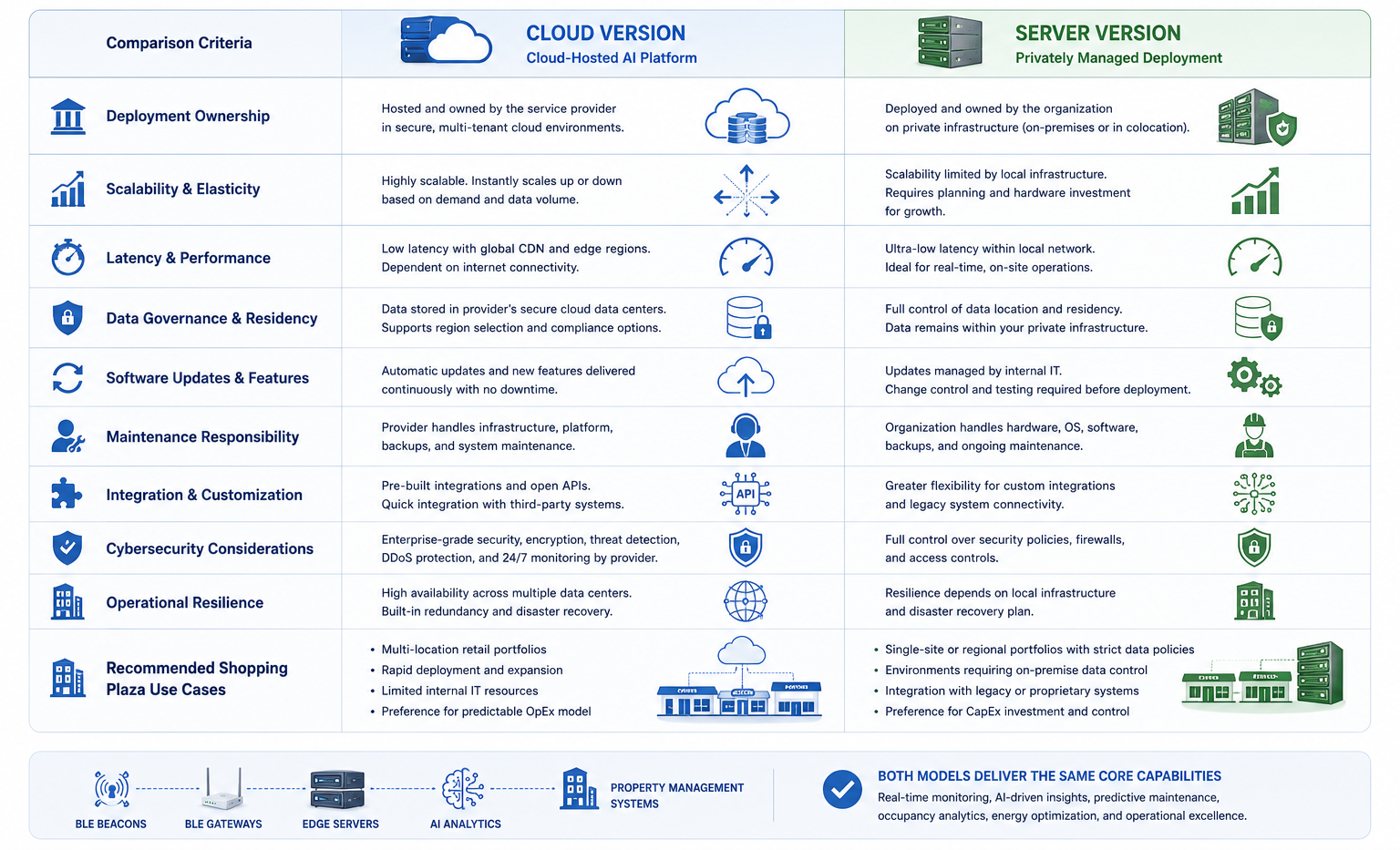
Side-by-side comparison of cloud and on-premise server deployment models for AI-enabled plaza management, covering scalability, latency, data control, security, and use cases.
Key Technical Capabilities and Operational Benefits of AI-Powered Shopping Plaza Operations
Successful shopping plaza management depends on balancing tenant satisfaction, visitor experience, operational efficiency, sustainability goals, and facility reliability. AI applications supported by BLE technologies provide continuous operational intelligence that enables property managers to optimize these objectives simultaneously. Rather than replacing facility personnel, AI augments operational decision-making by identifying patterns, prioritizing actions, and recommending responses based on real-time and historical operational data.
Intelligent Occupancy Management
Shopping plazas experience significant fluctuations in visitor traffic during weekdays, weekends, seasonal promotions, holidays, and special events. AI continuously analyzes BLE-derived occupancy information to understand how visitors move throughout the property.
Benefits include:
- Improved crowd distribution
- Reduced congestion
- Better tenant visibility
- Enhanced emergency preparedness
- Improved queue management
- More efficient public space utilization
- Optimized staffing schedules
- Better event planning
These insights help facility managers allocate resources according to actual demand rather than historical assumptions.
Predictive Maintenance
Traditional maintenance strategies often rely on fixed inspection schedules or reactive repairs following equipment failures. AI enables condition-based maintenance by continuously evaluating equipment health using BLE sensor data.
Common monitored assets include:
- Escalators
- Elevators
- HVAC systems
- Cooling towers
- Pumps
- Electrical switchgear
- Backup generators
- Ventilation systems
- Lighting infrastructure
- Automatic doors
Machine learning models analyze vibration, operating temperature, runtime, environmental conditions, and historical maintenance records to identify equipment degradation before failures occur.
Operational improvements include:
- Reduced unexpected downtime
- Lower maintenance costs
- Extended equipment life
- Improved tenant comfort
- Better maintenance planning
- Higher service reliability
Asset Visibility
Shopping plaza operations depend on numerous mobile assets that frequently move between maintenance rooms, common areas, retail spaces, and loading docks.
BLE asset tracking improves visibility for:
- Cleaning carts
- Maintenance tools
- Portable signage
- Audio equipment
- Wheelchairs
- Mobile kiosks
- Security equipment
- Emergency response kits
- Portable barriers
- Utility testing instruments
AI evaluates asset utilization patterns and identifies:
- Underutilized equipment
- Frequently misplaced assets
- High-demand resources
- Maintenance requirements
- Asset availability
- Unauthorized movement
These insights reduce operational delays while improving resource utilization.
Energy Optimization
Energy costs represent one of the largest operating expenses for shopping plaza owners.
AI combines information from:
- Occupancy sensors
- Environmental sensors
- HVAC equipment
- Lighting systems
- Utility meters
- Weather forecasts
- Historical consumption trends
This information enables dynamic optimization of:
- Heating
- Cooling
- Ventilation
- Lighting
- Common-area electricity usage
- Mechanical system scheduling
Rather than operating equipment according to fixed schedules, AI continuously adjusts building operations to reflect actual occupancy and environmental conditions.
Benefits include:
- Reduced electricity consumption
- Lower utility costs
- Improved sustainability
- Better indoor comfort
- Reduced equipment wear
Security and Safety Enhancement
BLE technologies improve operational awareness by providing location intelligence that complements existing security systems.
AI assists security personnel by identifying:
- Unusual occupancy patterns
- Unauthorized asset movement
- Restricted-area access
- Emergency equipment displacement
- Visitor congestion
- Evacuation progress
- Contractor location
- Security patrol coverage
When integrated with video management systems and access control software, AI provides operators with contextual information that improves incident response while reducing unnecessary investigations.
Improved Tenant Services
Tenant satisfaction directly influences shopping plaza occupancy rates and long-term revenue.
AI supports tenant operations through:
- Faster maintenance response
- Improved environmental comfort
- Better parking availability
- Reduced equipment downtime
- Enhanced common-area cleanliness
- Optimized loading dock scheduling
- Better visitor navigation
- Faster service request processing
These improvements contribute to a more attractive commercial environment for both tenants and visitors.
Scalability Across Property Portfolios
Shopping plaza operators often manage multiple properties with varying sizes, tenant mixes, and operational requirements.
BLE-enabled AI systems support scalable deployment by allowing organizations to:
- Standardize operational KPIs
- Compare property performance
- Share maintenance best practices
- Centralize reporting
- Benchmark energy consumption
- Optimize staffing across locations
- Improve capital planning
This scalability enables portfolio-wide operational consistency while accommodating the unique characteristics of individual shopping plazas.
Key Business Outcomes
Organizations implementing AI-supported BLE solutions for shopping plaza operations can achieve:
- Improved operational visibility
- Faster incident response
- Increased equipment availability
- Lower maintenance costs
- Reduced energy consumption
- Better asset utilization
- Enhanced visitor experiences
- Higher tenant satisfaction
- Improved workforce productivity
- More informed strategic planning
- Stronger sustainability performance
- Better operational resilience
GAO leverages decades of experience supplying BLE, RFID, and IoT hardware products and systems to commercial organizations across the United States and Canada. Supported by extensive research and development, rigorous quality assurance processes, and expert remote and onsite technical assistance, we help shopping plaza operators deploy reliable AI-enabled sensing solutions that integrate effectively with existing facility management systems.
Smarter, Safer, More Profitable Shopping Plaza Operations
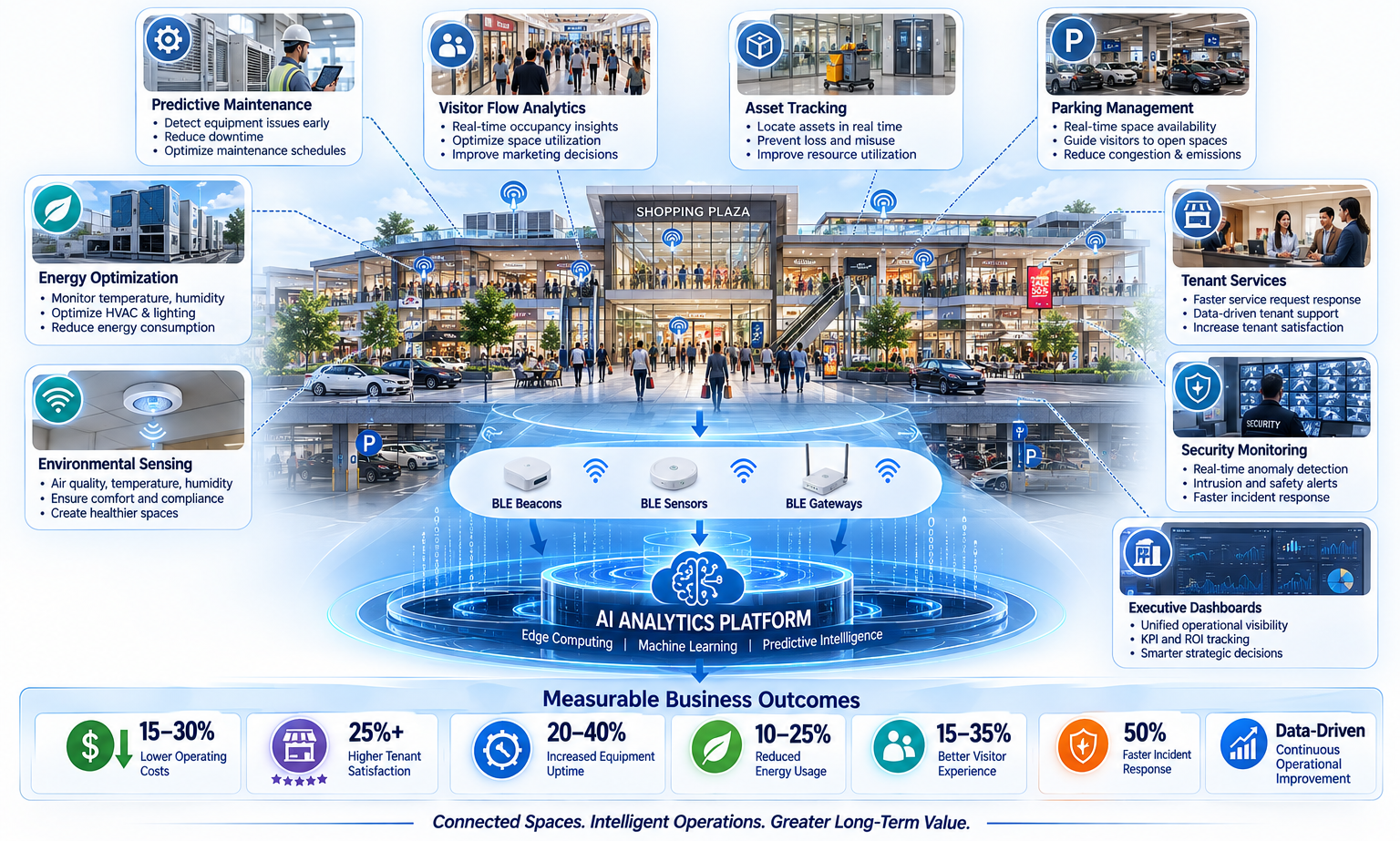
AI-powered BLE solution delivering predictive maintenance, visitor analytics, asset tracking, parking, energy optimization, tenant services, and security – with measurable ROI.
Implementation Considerations and Best Practices
Successful deployment of AI-enabled shopping plaza operations requires careful planning that aligns technology investments with operational objectives. While BLE devices provide valuable location and sensing data, long-term success depends on proper site assessment, system integration, cybersecurity, and continuous optimization.
Deployment Planning
Before installation, shopping plaza operators should evaluate:
- Building layout and floor plans
- Construction materials that may affect BLE signal propagation
- Existing network infrastructure
- Mechanical and electrical equipment locations
- Tenant operating hours
- Visitor traffic patterns
- Parking facilities
- Loading dock operations
- Utility rooms
- Security-sensitive areas
- Existing building automation systems
- Future expansion requirements
A comprehensive site survey helps determine the optimal placement of BLE gateways, beacons, and sensors to ensure reliable coverage while minimizing interference.
Integration Strategy
To maximize operational value, AI solutions should integrate with existing property management technologies rather than operate as isolated systems. Common integration points include:
- Building Management Systems (BMS)
- Computerized Maintenance Management Systems (CMMS)
- Computer-Aided Facility Management (CAFM)
- Enterprise Resource Planning (ERP)
- Security Information Management (SIM)
- Video Management Systems (VMS)
- Access control systems
- Energy management software
- Parking management systems
- Tenant service portals
Open APIs, standardized communication protocols, and middleware facilitate secure data exchange between these systems, enabling a unified operational view.
Performance Monitoring
Continuous monitoring ensures that AI models and BLE infrastructure maintain accuracy over time.
Key operational KPIs include:
- Equipment uptime
- Mean Time Between Failures (MTBF)
- Mean Time To Repair (MTTR)
- Energy consumption per square foot
- Visitor dwell time
- Parking occupancy rate
- Cleaning response time
- Maintenance work order completion rate
- Tenant service request resolution time
- Indoor environmental quality
- Asset utilization rate
- BLE gateway availability
Regular KPI reviews allow property managers to refine AI models, optimize operational workflows, and validate return on investment.
AI-Enabled Shopping Plaza Operations – Smarter. Connected. Profitable.
AI-Enabled Shopping Plaza Operations – Smarter. Connected. Profitable.
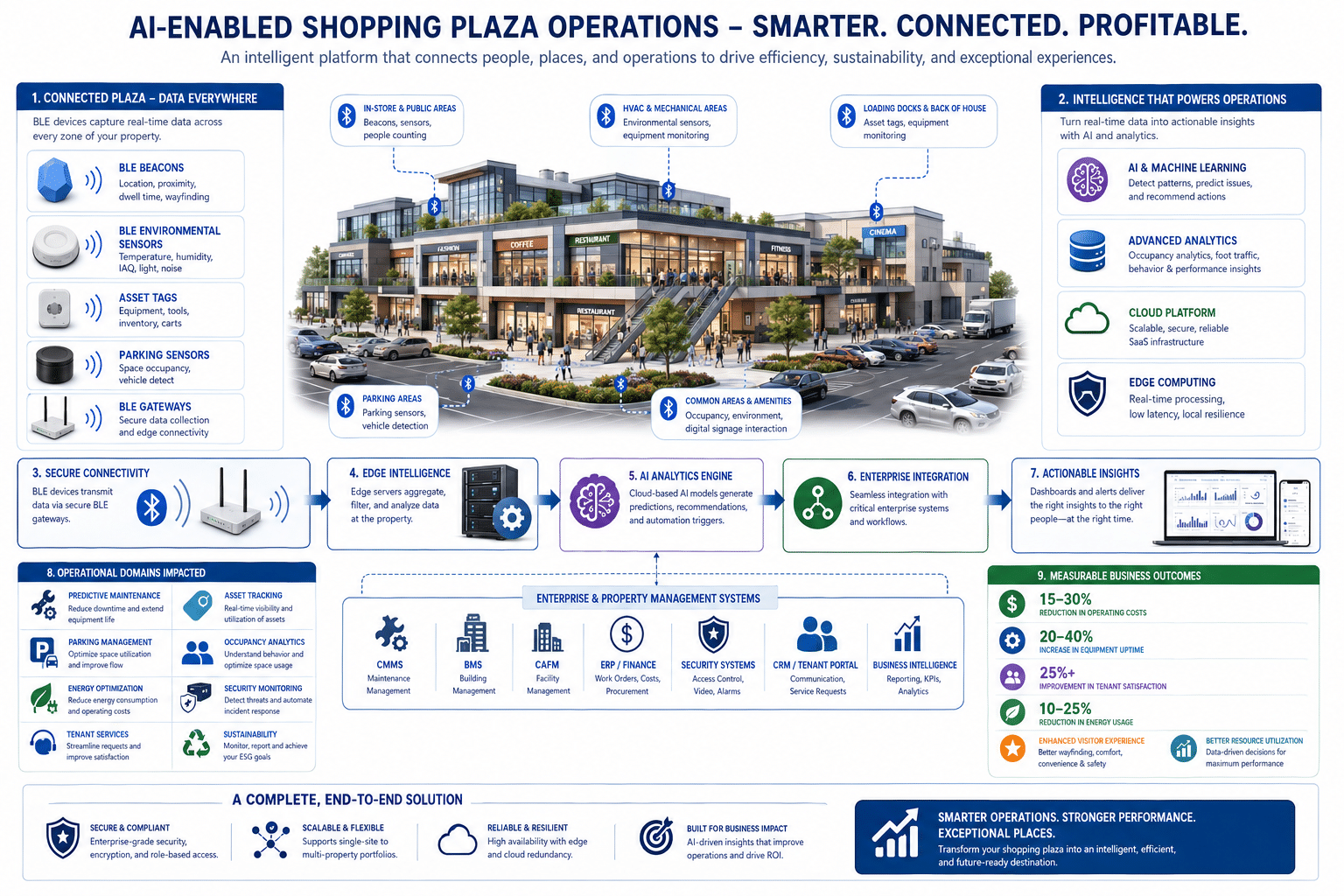
End-to-end AI-BLE platform connecting sensors, edge intelligence, and cloud analytics to deliver maintenance, security, occupancy, sustainability, and 15–30% cost savings.
Conclusion
AI-powered shopping plaza operations supported by BLE technologies provide property owners and facility managers with actionable insights that improve operational efficiency, tenant satisfaction, visitor experiences, and long-term asset performance. By combining location-aware BLE devices with artificial intelligence, organizations gain continuous visibility into facilities, equipment, environmental conditions, and operational workflows.
Rather than relying solely on periodic inspections or reactive maintenance, AI enables predictive decision-making that reduces downtime, optimizes resource allocation, enhances safety, and supports sustainability initiatives. Successful implementations depend on robust BLE infrastructure, secure communications, effective software integration, and well-defined operational processes.
GAO, headquartered in New York City and Toronto, Canada, has spent more than three decades supplying BLE, RFID, and IoT hardware products and systems to Fortune 500 companies, leading research organizations, universities, and government agencies throughout the United States and Canada. Our investments in research and development, stringent quality assurance processes, and expert remote and onsite technical support help shopping plaza operators deploy reliable AI-enabled solutions tailored to their operational requirements.
Whether organizations are modernizing a single shopping center or managing a nationwide portfolio of commercial properties, GAO provides the BLE technologies, engineering expertise, and implementation guidance needed to build intelligent, data-driven shopping plaza operations.
Building the Future of Industrial AI and IoT with Aperture Venture Studio and GAO RFID Inc.
For more than three decades, GAO Group of Companies has invested extensively in the research and development of industrial BLE, RFID, and IoT technologies. As generative AI demonstrated significant value in commercial property management and intelligent facility operations, we expanded our focus to developing integrated AI and IoT solutions that help organizations improve operational visibility, predictive maintenance, asset intelligence, and business decision-making. To further accelerate innovation in these areas, we founded Aperture Venture Studio to help build, launch, and scale advanced AI and IoT solutions serving retail commerce, shopping plaza operations, and other industry sectors.
Aperture Venture Studio has attracted leading AI researchers, IoT engineers, experienced operational executives, influential investors, and technology-focused organizations. Through initiatives such as the Aperture Ventures Summit and TekSummit, we foster collaboration on emerging AI, BLE, RFID, and IoT technologies while supporting vibrant technical communities. We welcome opportunities to collaborate with advisors, investors, customers, and technology professionals interested in advancing the future of intelligent commercial property operations.