
AI-Driven Industrial Coatings Powered by BLE for Intelligent Process Industries
How AI is Transforming Industrial Coatings with BLE Connectivity
Artificial intelligence is reshaping industrial coatings by enabling manufacturers to continuously monitor coating materials, production assets, environmental conditions, curing processes, equipment utilization, and finished product quality. Combined with Bluetooth Low Energy (BLE) sensors, beacons, and gateways, AI enables coating manufacturers to move beyond periodic inspections toward continuous operational intelligence that supports consistent product quality and optimized manufacturing performance.
Industrial coating production depends on tightly controlled formulations, accurate raw material handling, environmental stability, equipment reliability, and repeatable curing conditions. Small deviations in viscosity, mixing time, humidity, temperature, or line speed can significantly affect adhesion, corrosion resistance, chemical resistance, surface finish, and product durability. AI continuously analyzes operational data collected through BLE-connected devices to identify abnormal conditions before they impact production.
GAO has supplied industrial BLE hardware and intelligent IoT systems for organizations requiring reliable monitoring, asset visibility, and industrial data acquisition across demanding manufacturing environments.
AI-Enabled BLE Monitoring Across an Industrial Coatings Manufacturing Facility
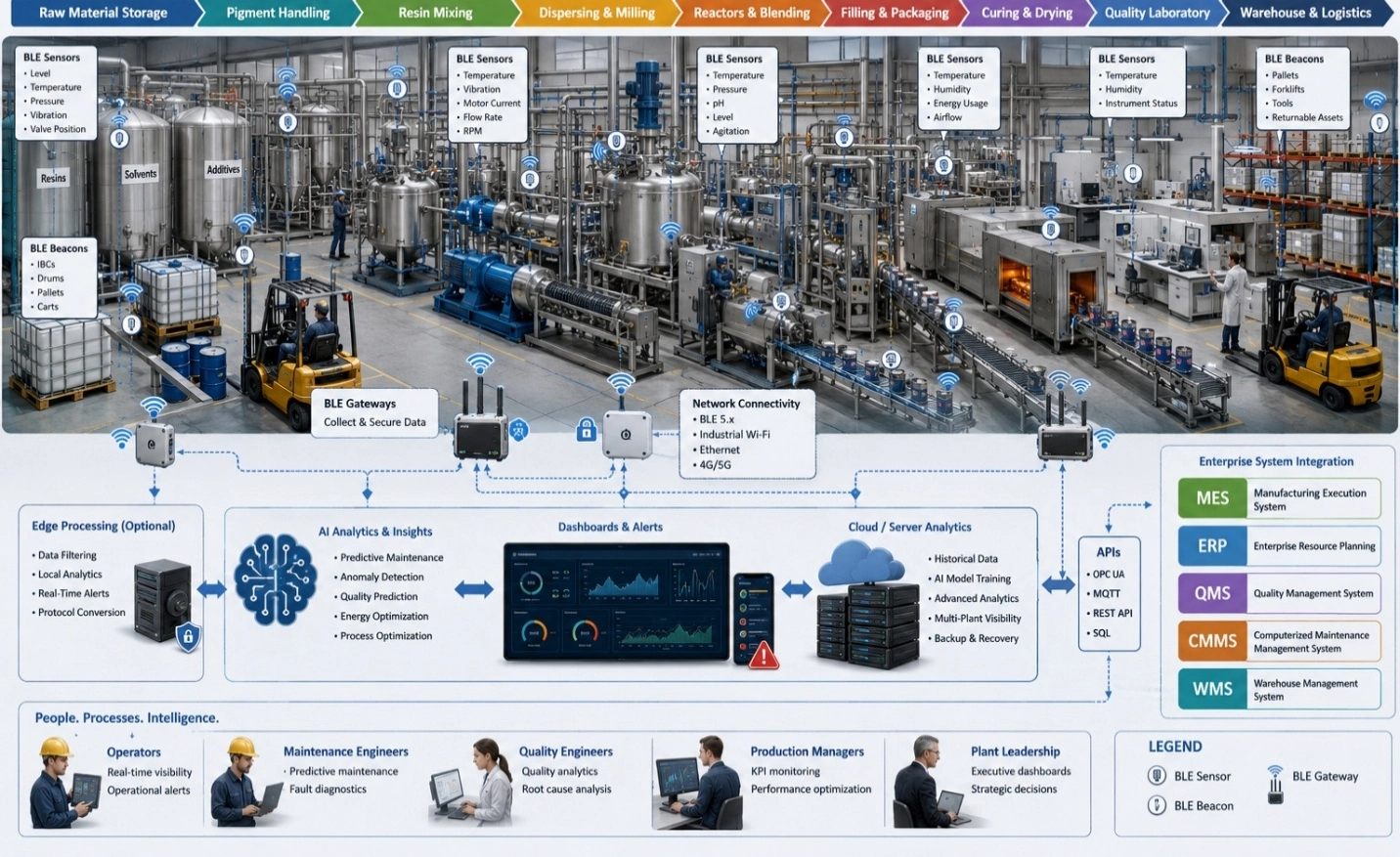
This illustration presents a complete industrial coatings manufacturing facility where BLE sensors, BLE beacons, and BLE gateways collect operational data across raw material storage, pigment handling, resin mixing, milling, blending, filling, curing, laboratory testing, and warehouse operations. AI analytics, edge processing, cloud or server software, and integration with MES, ERP, QMS, CMMS, and WMS enable predictive maintenance, quality optimization, real-time monitoring, and data-driven production management.
Understanding AI-Driven Industrial Coatings
Industrial coatings manufacturing involves the controlled formulation, processing, testing, packaging, and distribution of protective and decorative coatings used across automotive, aerospace, marine, heavy equipment, infrastructure, energy, electronics, and industrial manufacturing. Production commonly includes resin preparation, pigment dispersion, additive blending, viscosity adjustment, filtration, filling, curing, quality inspection, and warehouse operations.
AI improves coating production by learning from historical manufacturing data, laboratory measurements, equipment performance, operator actions, environmental conditions, and production outcomes. Instead of relying solely on predefined process limits, machine learning models identify hidden relationships among process variables that influence coating quality.
BLE technologies provide localized wireless communication between production assets and AI software. BLE sensors measure environmental and operational parameters, BLE beacons identify mobile assets, containers, pallets, and tools, while BLE gateways securely collect and forward information into manufacturing software for real-time analysis.
Together, AI and BLE enable continuous monitoring across coating production while minimizing wiring complexity and simplifying deployment inside large manufacturing plants.
Where AI and BLE Deliver Value Across Industrial Coatings Operations
Industrial coatings facilities contain numerous interconnected manufacturing stages where AI-supported BLE monitoring improves operational efficiency.
Raw Material Receiving
- Verify incoming resin, pigment, solvent, and additive deliveries.
- Monitor storage temperatures for sensitive chemicals.
- Track container movements throughout receiving operations.
- Detect material handling delays before production scheduling is affected.
Chemical Storage
- Monitor warehouse environmental conditions.
- Track inventory location.
- Detect improper storage conditions.
- Improve FIFO inventory management.
- Reduce expired material usage.
Batch Formulation
- Verify ingredient availability.
- Assist formulation accuracy.
- Monitor weighing operations.
- Detect abnormal ingredient consumption.
- Support digital batch records.
Pigment Dispersion
- Monitor disperser operating conditions.
- Analyze motor performance.
- Predict equipment degradation.
- Improve particle size consistency.
Mixing and Blending
- Optimize mixing cycles.
- Detect abnormal vibration.
- Monitor process temperatures.
- Improve formulation consistency.
- Reduce energy consumption.
Milling Operations
- Monitor bead mill operating performance.
- Detect bearing wear.
- Predict maintenance requirements.
- Improve production throughput.
Filling and Packaging
- Track filling equipment utilization.
- Monitor conveyor performance.
- Reduce packaging downtime.
- Improve production scheduling.
Finished Goods Warehouse
- Track pallets.
- Monitor environmental conditions.
- Improve inventory visibility.
- Accelerate shipping operations.
Maintenance Operations
- Track maintenance tools.
- Monitor spare parts.
- Predict equipment failures.
- Improve technician response times.
Quality Laboratories
- Correlate laboratory measurements with production conditions.
- Support root cause investigations.
- Improve process optimization.
- Reduce product variability.
GAO has supported industrial manufacturers by providing BLE devices that simplify equipment monitoring, mobile asset visibility, and industrial data collection within complex production environments.
AI-Enabled BLE Workflow for Industrial Coatings Manufacturing
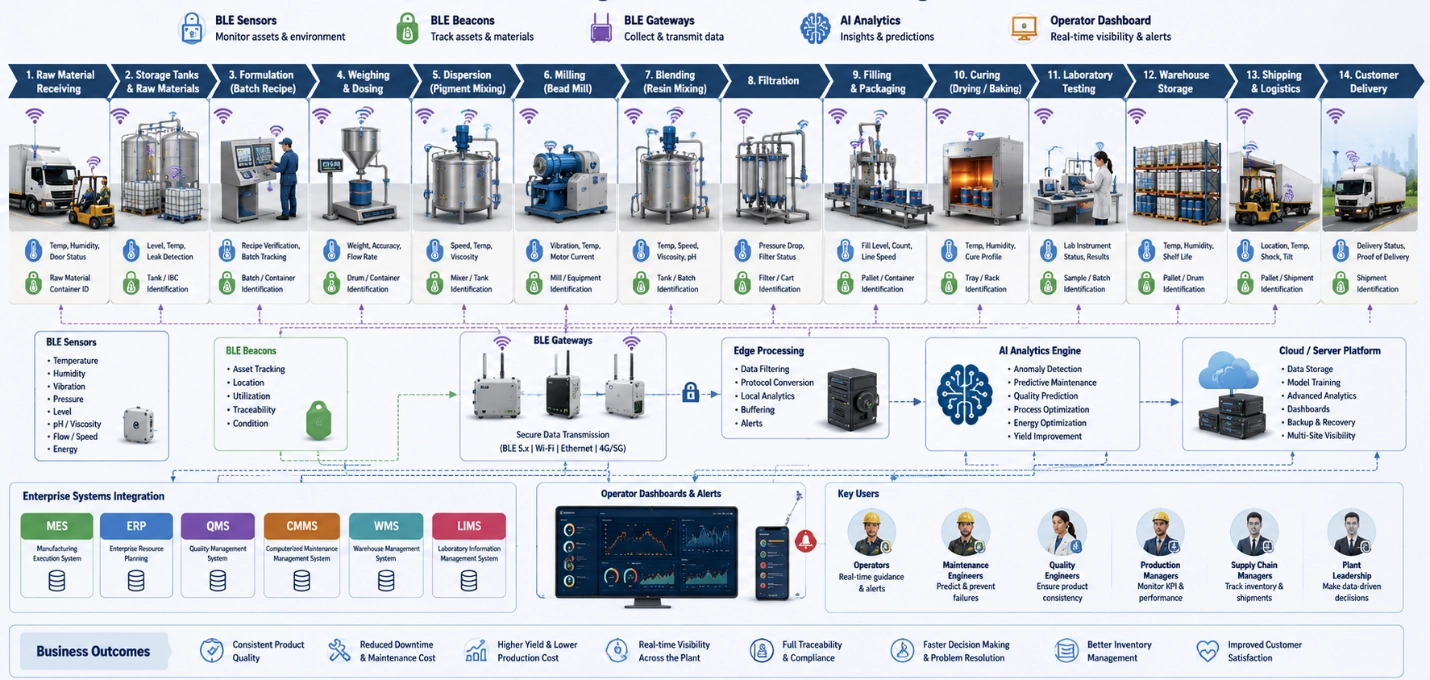
This workflow diagram illustrates the complete industrial coatings production process from raw material receiving to customer delivery, highlighting how BLE sensors, BLE beacons, and BLE gateways enable continuous data collection at every manufacturing stage. AI analytics, edge processing, cloud or server software, operator dashboards, and integration with MES, ERP, QMS, CMMS, WMS, and LIMS provide predictive maintenance, quality optimization, traceability, operational visibility, and improved production efficiency.
Operational Workflow for AI-Enabled Industrial Coatings
Successful AI implementation depends on reliable operational data collected throughout coating manufacturing. Modern production environments generate information from production equipment, laboratory instruments, environmental monitoring systems, warehouse operations, and maintenance activities.
The workflow begins with BLE sensors installed on mixers, reactors, dispersers, bead mills, curing systems, pumps, compressors, HVAC systems, chemical storage areas, and utility equipment. Sensors continuously measure temperature, humidity, vibration, operating hours, energy consumption, rotational speed, pressure, and environmental conditions.
BLE beacons identify mobile assets including pallets, chemical containers, forklifts, laboratory equipment, portable inspection instruments, maintenance carts, reusable totes, and production tools. This enables AI software to understand equipment location, material movement, and production flow without extensive manual data collection.
BLE gateways receive wireless data from sensors and beacons before securely transferring information through Ethernet, Wi-Fi, or industrial cellular networks to local servers or cloud-hosted software.
Edge computing performs initial filtering, data validation, timestamp synchronization, buffering, and protocol conversion before forwarding production data into manufacturing software.
Middleware integrates collected information with:
- Manufacturing Execution Systems (MES)
- Enterprise Resource Planning (ERP)
- Computerized Maintenance Management Systems (CMMS)
- Laboratory Information Management Systems (LIMS)
- Quality Management Systems (QMS)
- Warehouse Management Systems (WMS)
- Supervisory Control and Data Acquisition (SCADA)
- Distributed Control Systems (DCS)
- Historian databases
- Industrial dashboards
AI models continuously analyze historical production records together with live operational measurements to identify process deviations, equipment degradation, abnormal production behavior, quality risks, and optimization opportunities.
Production managers receive recommendations for process adjustments before coating quality deteriorates. Maintenance teams receive predictive work orders based on equipment health. Laboratory engineers obtain early warnings regarding batches likely to require additional testing. Warehouse managers gain improved inventory visibility while executives receive production KPIs supporting long-term operational improvements.
End-to-End AI Decision Flow for Industrial Coatings Using BLE Connectivity
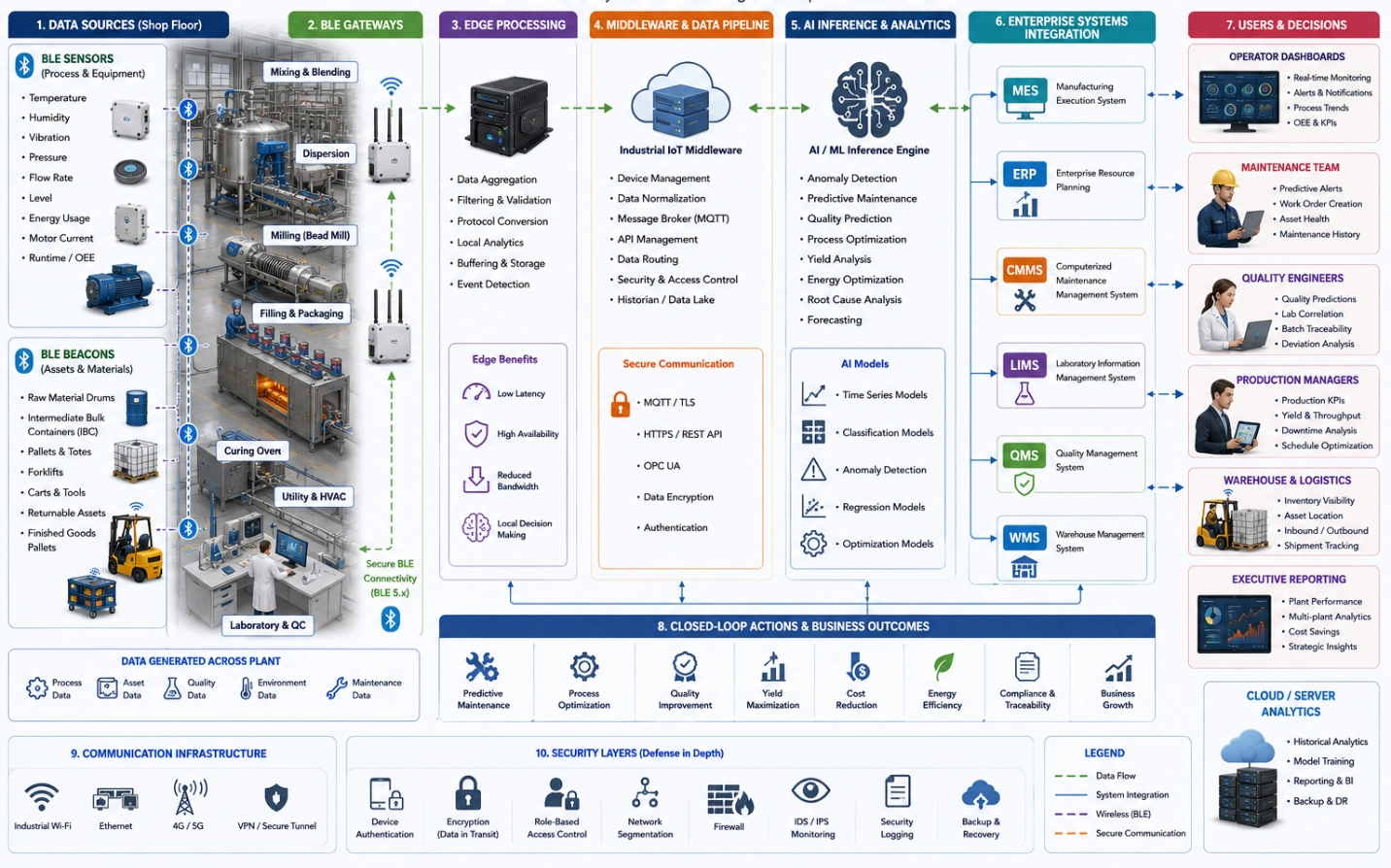
This solution flow diagram illustrates how BLE sensors, BLE beacons, and BLE gateways collect operational and asset data across an industrial coatings facility, with secure communication to edge processing, middleware, and AI inference engines. The processed data integrates with MES, ERP, CMMS, LIMS, and QMS software to provide predictive maintenance, quality optimization, production monitoring, warehouse visibility, executive reporting, and real-time decision support.
Core Technologies Supporting AI-Driven Industrial Coatings
Industrial AI solutions for coating manufacturing combine sensing hardware, wireless communication, industrial software, machine learning, cybersecurity, and production system integration. Each component contributes to reliable data collection and informed operational decisions.
BLE Sensors
BLE sensors provide low-power monitoring for critical manufacturing variables including:
- Ambient temperature
- Relative humidity
- Equipment vibration
- Surface temperature
- Motor operating hours
- Pressure
- Tank levels
- Chemical storage conditions
- Utility equipment performance
These sensors are particularly useful where wired instrumentation would be costly or difficult to install around mixers, storage vessels, conveyors, curing equipment, and warehouse areas.
BLE Beacons
BLE beacons provide location awareness for:
- Raw material containers
- Intermediate batches
- Finished goods pallets
- Portable laboratory instruments
- Forklifts
- Maintenance equipment
- Mobile production assets
- Safety equipment
AI software uses beacon data to analyze production flow, material movement efficiency, bottlenecks, and equipment utilization.
BLE Gateways
Industrial BLE gateways securely aggregate wireless communications from hundreds or thousands of nearby BLE devices. Gateways typically support Ethernet, Wi-Fi, industrial cellular, MQTT, OPC UA, HTTPS, and REST APIs for integration with existing manufacturing software.
Reliable gateway placement considers radio coverage, interference from steel structures, production layouts, hazardous locations, and required network redundancy. Proper commissioning includes signal validation, device enrollment, firmware management, and communication testing to ensure dependable long-term operation.
BLE Hardware and Industrial Software Integration for AI-Enabled Industrial Coatings
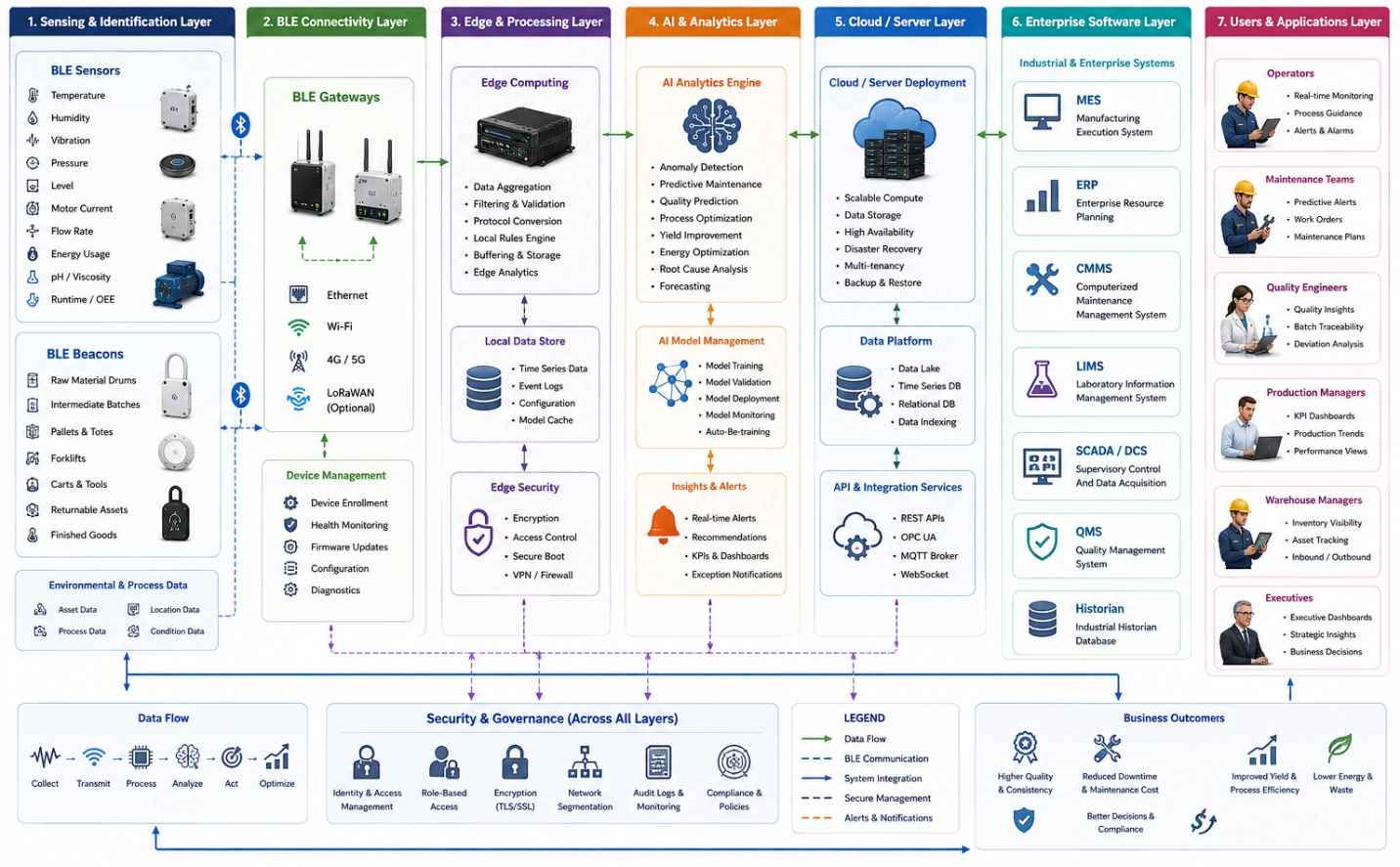
This layered block diagram shows how BLE sensors and BLE beacons collect operational and asset data that is transmitted through BLE gateways to edge computing devices and AI analytics software. The solution integrates with cloud or server deployments, MES, ERP, CMMS, LIMS, SCADA, historian databases, dashboards, and plant personnel to support predictive maintenance, quality control, production optimization, and real-time operational visibility.
AI Models Supporting Industrial Coatings Manufacturing
Industrial coating production generates high-dimensional data from formulation processes, laboratory testing, equipment performance, environmental monitoring, and production history. AI models transform these data streams into actionable operational intelligence.
Supervised Machine Learning
Supervised learning predicts measurable outcomes based on historical production data, including:
- Coating viscosity prediction
- Batch quality classification
- Cure time estimation
- Equipment failure prediction
- Production yield forecasting
- Energy consumption estimation
Unsupervised Machine Learning
Unsupervised learning identifies hidden operational patterns that traditional rule-based monitoring often misses.
Typical applications include:
- Batch clustering
- Process anomaly detection
- Production pattern recognition
- Equipment behavior analysis
- Raw material variation analysis
Time-Series Forecasting
Industrial coatings depend heavily on stable operating conditions. Time-series models forecast:
- Equipment degradation
- Utility demand
- Production throughput
- Environmental drift
- Preventive maintenance timing
Computer Vision
Where cameras are installed, computer vision can inspect:
- Surface defects
- Color consistency
- Gloss variation
- Packaging integrity
- Label verification
- Container damage
Reinforcement Learning
Certain advanced coating facilities employ reinforcement learning to recommend optimized process settings for:
- Mixing duration
- Agitation speed
- Curing profiles
- Production scheduling
- Energy optimization
Rather than replacing process engineers, these AI methods provide decision support that helps maintain product consistency while reducing unnecessary process variation.
GAO has supplied industrial IoT hardware that supports reliable operational data acquisition, enabling manufacturers to build intelligent AI applications on trusted production data.
Cloud and Server Deployment Options for AI-Enabled Industrial Coatings
Industrial coatings manufacturers have different operational requirements depending on production scale, cybersecurity policies, regulatory obligations, and existing IT infrastructure. AI software may therefore be deployed using cloud-hosted services or privately managed server installations.
Cloud Version
Cloud deployment is appropriate when organizations require centralized visibility across multiple manufacturing facilities with simplified software maintenance.
Typical characteristics include:
- Centralized AI model management
- Multi-site production monitoring
- Remote engineering access
- Automatic software updates
- Elastic computing resources
- Simplified disaster recovery
- Enterprise reporting
- Historical analytics across facilities
Cloud deployment is commonly selected by organizations operating geographically distributed coating plants that require consolidated operational reporting.
Server Version
Server deployment places AI software on customer-managed infrastructure such as factory servers, edge servers, private data centers, or other privately hosted computing environments.
Typical advantages include:
- Local processing with minimal latency
- Greater control over operational data
- Support for isolated production networks
- Integration with existing factory systems
- Compliance with strict cybersecurity policies
- Reduced dependency on external Internet connectivity
Manufacturers producing specialty coatings, aerospace coatings, defense coatings, marine coatings, and other regulated products frequently prefer server deployments because sensitive production information remains under internal operational control.
Hybrid Deployment
Many industrial coatings manufacturers combine both deployment models.
Typical hybrid implementations perform:
- Real-time AI inference locally
- Historical analytics centrally
- Multi-site reporting through cloud software
- Local production control
- Corporate KPI dashboards
This approach balances operational responsiveness with enterprise-wide visibility.
Cloud vs. Server vs. Hybrid Deployment Models for AI-Enabled Industrial Coatings
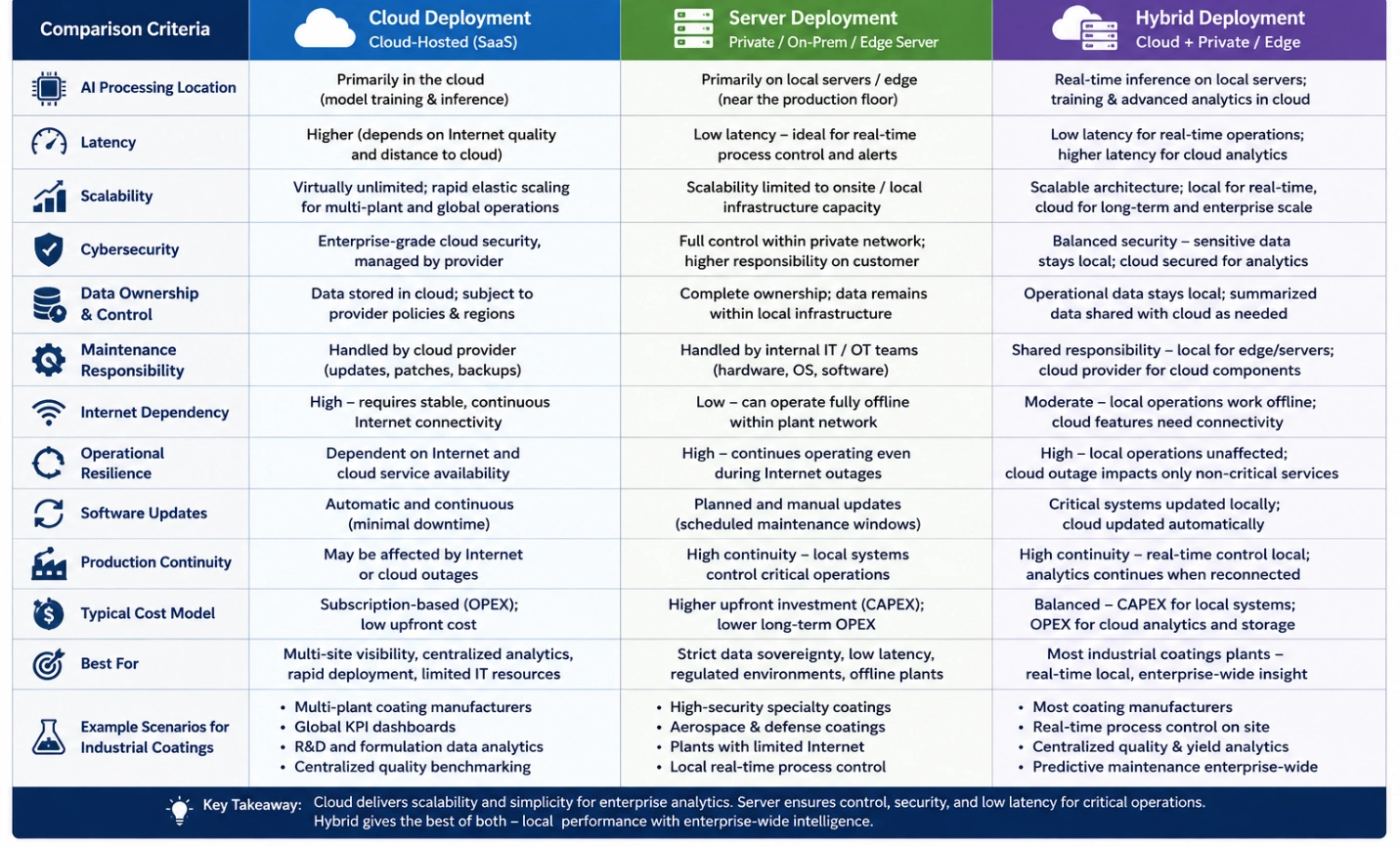
This comparison table evaluates Cloud, Server, and Hybrid deployment models for AI-enabled industrial coatings across key technical and operational criteria, including latency, scalability, cybersecurity, AI processing location, data ownership, software maintenance, Internet dependency, production continuity, and recommended deployment scenarios. It helps manufacturers select the most appropriate deployment strategy based on operational requirements, security policies, and manufacturing objectives.
Communication Infrastructure and Software Integration
Reliable communication is fundamental to AI-driven industrial coatings manufacturing. Wireless sensing alone does not deliver value unless production data can be securely integrated with operational software.
Common communication technologies include:
- Bluetooth Low Energy (BLE)
- Ethernet
- Industrial Wi-Fi
- 4G LTE
- 5G
- OPC UA
- MQTT
- Modbus TCP
- HTTPS
- REST APIs
These communication methods connect operational data with production software including:
- Manufacturing Execution Systems (MES)
- Enterprise Resource Planning (ERP)
- Computerized Maintenance Management Systems (CMMS)
- Laboratory Information Management Systems (LIMS)
- Quality Management Systems (QMS)
- Warehouse Management Systems (WMS)
- Distributed Control Systems (DCS)
- Supervisory Control and Data Acquisition (SCADA)
- Industrial historians
- Business Intelligence software
Integration enables AI to correlate production events across departments rather than evaluating individual machines independently. Engineers can associate laboratory measurements with production parameters, maintenance records, inventory movement, and customer quality outcomes to improve root cause analysis.
GAO has supported organizations requiring dependable BLE hardware integration with existing industrial software while minimizing operational disruption during deployment.
Cybersecurity Considerations for AI-Enabled Industrial Coatings
Industrial coatings facilities increasingly operate connected production systems that require robust cybersecurity throughout the AI deployment lifecycle.
Recommended security practices include:
- Strong device authentication
- Role-based access control
- Secure firmware updates
- Encrypted BLE communications
- Encrypted network transport
- Network segmentation
- Zero Trust security principles
- Multi-factor authentication
- Security event logging
- Continuous vulnerability assessment
- Certificate management
- Secure API authentication
- Backup and disaster recovery planning
Production environments should isolate operational technology networks from corporate IT systems while permitting controlled data exchange through secure gateways.
Regular firmware maintenance, asset inventories, software patch management, and penetration testing reduce operational cybersecurity risks while supporting long-term system reliability.
Layered Cybersecurity Framework for AI-Enabled BLE Solutions in Industrial Coatings
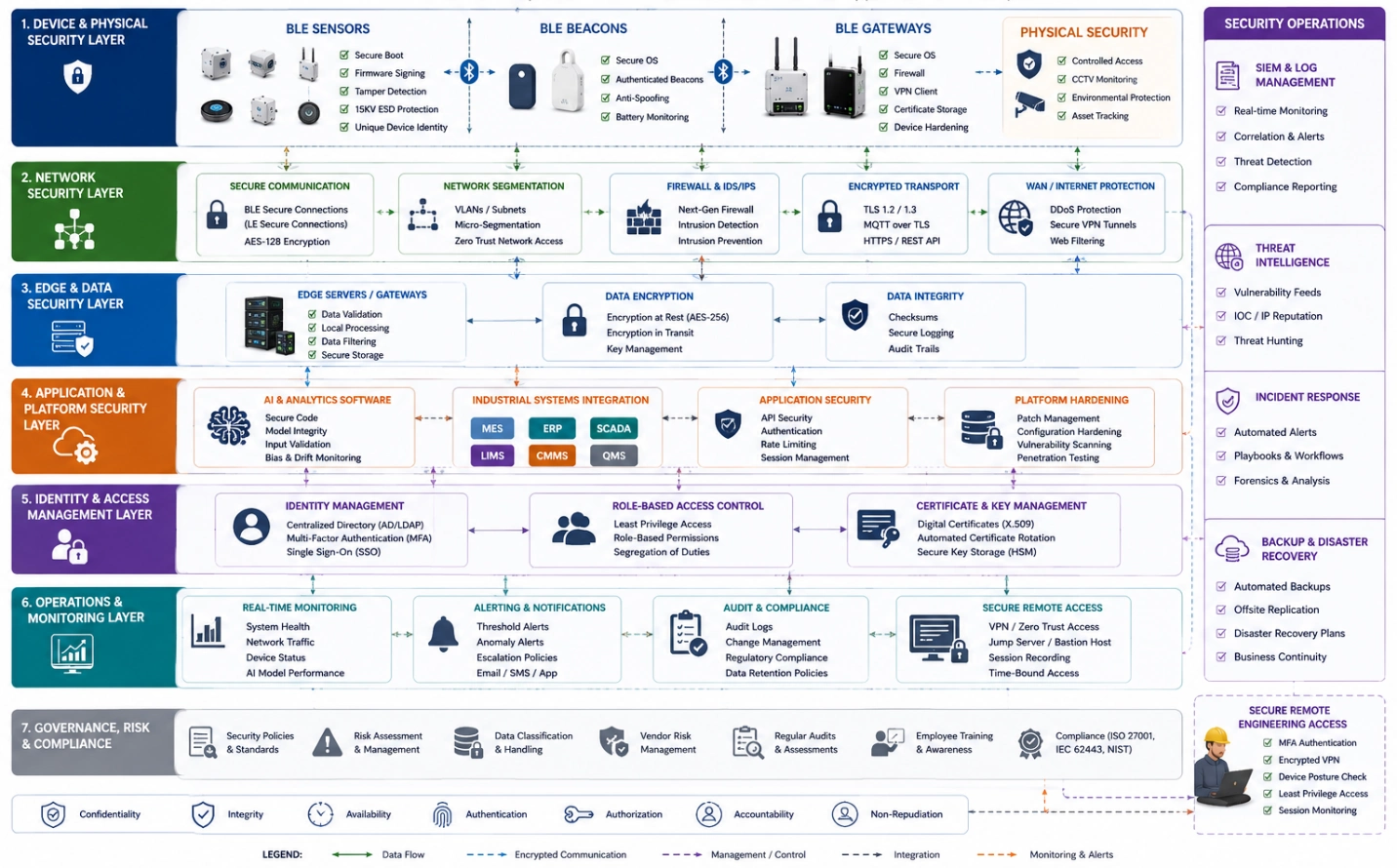
This security diagram illustrates a defense-in-depth approach for AI-enabled BLE solutions used in industrial coatings manufacturing. It shows how BLE sensors, BLE gateways, edge servers, encrypted communications, firewalls, identity and access management, certificate management, AI software, MES, ERP, SIEM monitoring, backup systems, and secure remote engineering access work together to protect operational technology, production data, and connected industrial systems.
Business and Technical Benefits of AI for Industrial Coatings
Applying AI supported by BLE-connected operational data provides measurable improvements across manufacturing, maintenance, quality assurance, logistics, and production planning.
Process Performance
- Improved formulation consistency
- Reduced batch variability
- Higher first-pass yield
- Better curing control
- Stable production conditions
Equipment Reliability
- Earlier fault detection
- Lower unplanned downtime
- Better maintenance scheduling
- Improved equipment utilization
- Longer equipment service life
Product Quality
- Improved coating consistency
- Reduced defects
- Better color repeatability
- Improved viscosity control
- Enhanced laboratory correlation
Inventory Management
- Improved raw material visibility
- Faster pallet identification
- Reduced material loss
- Better warehouse utilization
- Improved traceability
Operational Efficiency
- Lower production waste
- Reduced manual inspections
- Faster root cause analysis
- Improved production scheduling
- Better resource allocation
Sustainability
- Lower energy consumption
- Reduced solvent waste
- Improved environmental monitoring
- Better resource utilization
- Reduced production scrap
Executive Visibility
- Real-time KPI reporting
- Cross-site operational comparison
- Production forecasting
- Maintenance forecasting
- Improved investment planning
These improvements are achieved because AI continuously analyzes relationships among production variables that would be difficult to identify through manual analysis alone.
Engineering Considerations for Successful Implementation
Industrial coatings manufacturers should approach AI implementation as an operational improvement initiative rather than solely a technology deployment.
Recommended engineering practices include:
- Define measurable operational objectives before deployment.
- Select production areas with reliable historical data.
- Validate sensor placement through pilot testing.
- Establish data quality monitoring procedures.
- Integrate AI with existing production software.
- Develop cybersecurity requirements during project planning.
- Train operators, maintenance teams, and quality engineers.
- Continuously evaluate AI model performance.
- Establish governance for production data management.
- Scale deployments incrementally based on demonstrated operational value.
Successful projects generally begin with targeted applications such as predictive maintenance, environmental monitoring, or quality prediction before expanding across the complete manufacturing operation.
GAO has worked with organizations requiring dependable BLE hardware, industrial IoT devices, and engineering support for phased deployments that align with existing manufacturing processes.
Implementation Roadmap for AI-Enabled Industrial Coatings with BLE Integration
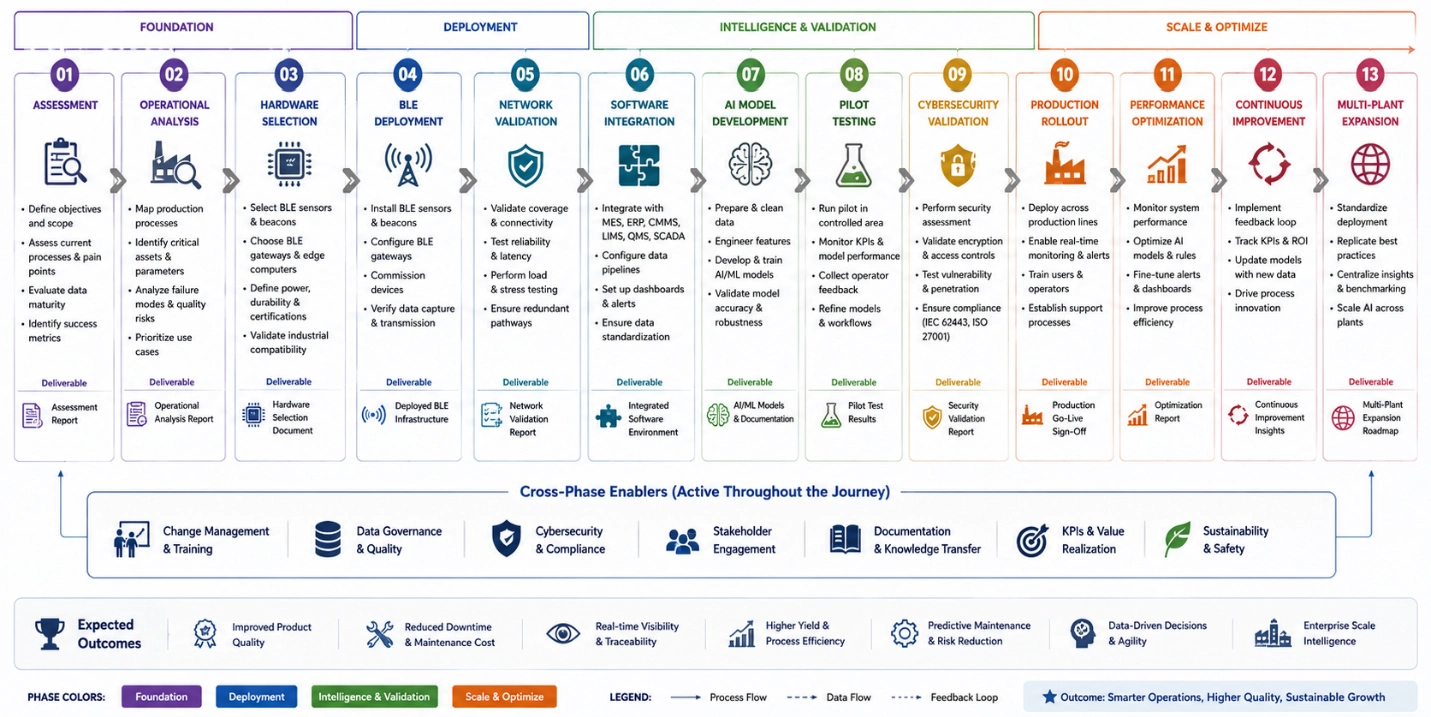
This implementation roadmap outlines the phased lifecycle for deploying AI-enabled BLE solutions in industrial coatings manufacturing, from initial assessment and operational analysis through hardware selection, BLE deployment, software integration, AI model development, cybersecurity validation, production rollout, continuous optimization, and multi-plant expansion. It highlights the key activities, deliverables, and outcomes required to achieve scalable, secure, and data-driven manufacturing operations.
Advancing Industrial Coatings Manufacturing with AI and BLE
Industrial coatings manufacturers are under constant pressure to improve product consistency, reduce waste, enhance traceability, strengthen quality control, and increase production efficiency. AI supported by BLE-enabled sensing and asset visibility enables manufacturers to convert operational data into timely decisions that improve production performance across formulation, mixing, milling, curing, packaging, warehousing, and maintenance.
Successful implementation depends on high-quality operational data, carefully planned deployment, secure software integration, and continuous optimization. Organizations that adopt AI as part of their manufacturing improvement strategy can achieve measurable gains in quality, equipment reliability, operational efficiency, and long-term competitiveness.
Headquartered in New York City and Toronto, Canada, GAO is recognized among the world’s leading B2B suppliers of BLE and RFID technologies. Together with its sister companies, GAO Research and GAO Tek, GAO has served Fortune 500 companies, leading research organizations, universities, and government agencies throughout the United States and Canada for more than three decades. Our continued investment in research, rigorous quality assurance, and experienced remote and onsite technical support enables us to help manufacturers deploy reliable AIoT solutions tailored to industrial coatings applications.
Building the Future of Industrial AI and IoT with Aperture Venture Studio and GAO
For more than three decades, GAO Group of Companies has invested extensively in research and development of industrial BLE, RFID, and IoT technologies. As generative AI demonstrated significant value for industrial coatings manufacturing and other process industries, we expanded our focus to develop advanced AIoT solutions that combine artificial intelligence with connected sensing technologies. To further accelerate innovation in industrial AI and IoT, we established Aperture Venture Studio to help advance and scale practical AI and IoT solutions for modern industries.
Aperture has attracted leading AI and IoT technical experts, experienced business and operational leaders, influential investors, and globally recognized organizations. Through initiatives such as the Aperture Ventures Summit and TekSummit, we continue to foster technical collaboration, share engineering knowledge, and promote innovation across industrial AI and IoT communities.
We welcome you to engage with us as:
- Advisors, co-founders, or employees
- Investors
- Customers seeking advanced AI and IoT solutions
By combining decades of industrial technology expertise with ongoing innovation, GAO remains committed to helping organizations modernize industrial coatings manufacturing through dependable BLE, RFID, AI, and IoT solutions.