
AI-Powered BLE Solutions for Medical Technology Manufacturing
Understanding AI-Driven BLE Solutions in Medical Technology Manufacturing
Artificial intelligence enhances manufacturing operations by analyzing production data, recognizing operational patterns, detecting anomalies, forecasting equipment failures, and recommending corrective actions before manufacturing disruptions occur. BLE technologies provide the reliable, energy-efficient communication layer that continuously collects information from production assets, environmental monitoring systems, operators, and mobile equipment throughout manufacturing facilities.
Within medical technology manufacturing, AI-driven BLE systems support:
- Intelligent equipment monitoring
- Manufacturing execution visibility
- Cleanroom environmental monitoring
- Production asset tracking
- Medical component traceability
- Tool utilization management
- Inventory visibility
- Predictive maintenance
- Worker safety monitoring
- Energy optimization
- Calibration management
- Regulatory compliance reporting
Unlike traditional monitoring approaches that rely on periodic inspections or isolated machine data, BLE-enabled AI solutions continuously monitor manufacturing operations and provide real-time operational intelligence for production managers, quality engineers, maintenance teams, and compliance officers.
Medical technology manufacturing presents unique operational challenges because every production process must maintain consistent quality while complying with standards such as FDA 21 CFR Part 820, ISO 13485, IEC 60601, ISO 14971, and Good Manufacturing Practice (GMP). AI enables manufacturers to detect deviations much earlier than manual inspection processes, reducing scrap, rework, production delays, and regulatory risks.
AI-Enabled BLE Architecture for Medical Technology Manufacturing: End-to-End Data Flow from Sensors to Intelligent Business Actions
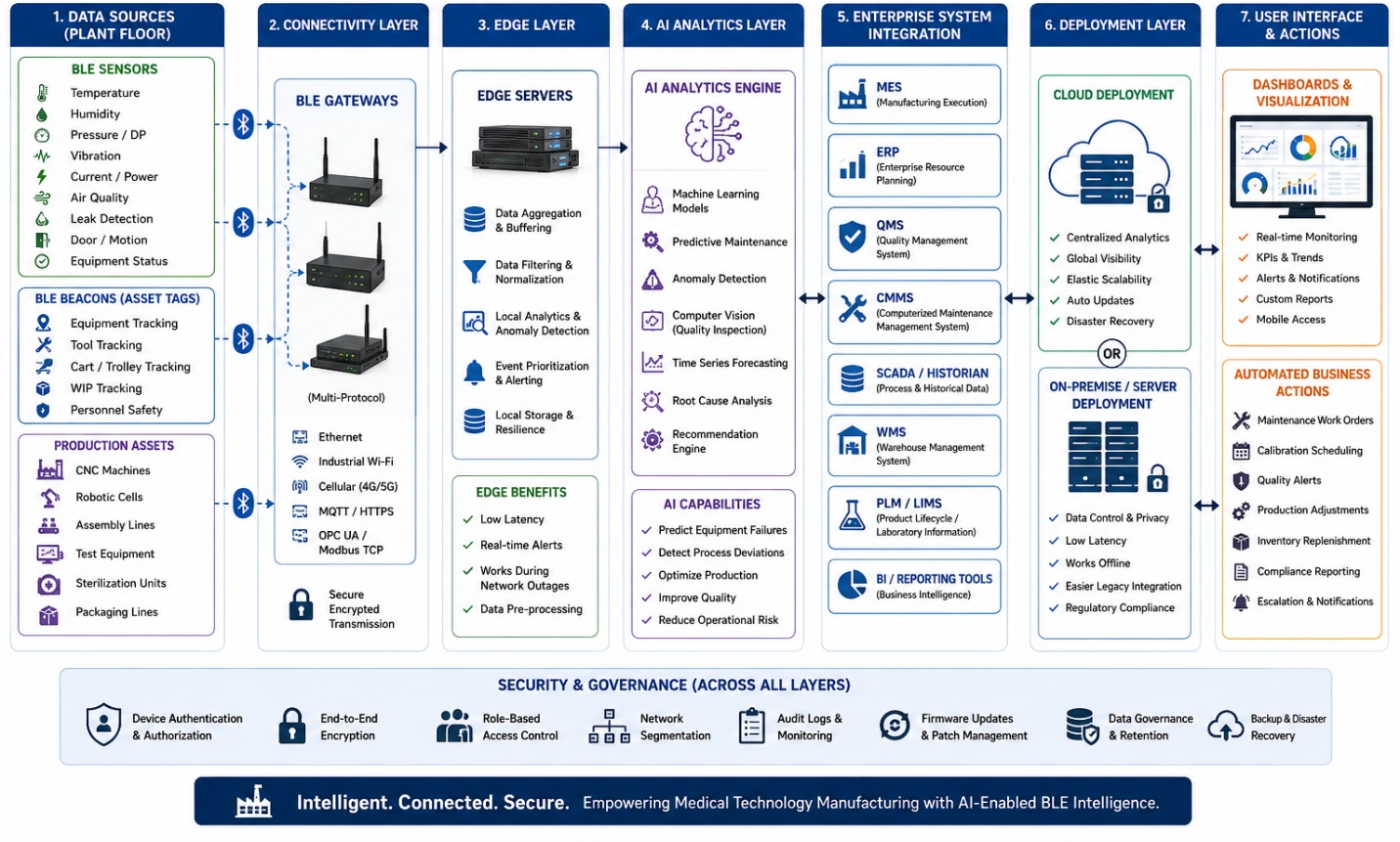
This architecture diagram illustrates how BLE sensors, BLE beacons, and BLE gateways collect operational data across a medical technology manufacturing facility and transmit it through edge servers to AI analytics. It also demonstrates integration with enterprise systems such as MES, ERP, QMS, CMMS, and cloud or server deployments, enabling predictive maintenance, quality monitoring, asset tracking, compliance reporting, and automated business actions.
Why AI Is Transforming Medical Technology Manufacturing
Medical device manufacturers increasingly rely on automation because production environments are becoming more complex. Products incorporate advanced electronics, embedded software, miniature mechanical components, wireless communication modules, and precision assemblies that require tight manufacturing tolerances.
Artificial intelligence supports manufacturers by enabling:
- Continuous process optimization
- Automated defect detection
- Intelligent production scheduling
- Predictive maintenance planning
- Equipment health analysis
- Material consumption optimization
- Digital quality inspection
- Supply chain forecasting
- Workforce productivity analysis
- Environmental compliance monitoring
BLE technologies complement AI by providing low-power wireless communication for sensors distributed throughout manufacturing facilities without requiring extensive wired infrastructure.
This combination enables intelligent manufacturing systems capable of continuously learning from production data while improving decision-making across engineering, operations, maintenance, logistics, and quality assurance teams.
Medical Technology Manufacturing Applications for AI-Powered BLE Solutions
Medical Device Assembly Monitoring
BLE sensors monitor assembly stations, torque tools, automated screwdrivers, robotic assembly cells, and testing equipment.
Artificial intelligence evaluates:
- Assembly cycle consistency
- Tool utilization
- Equipment utilization
- Production bottlenecks
- Process deviations
- Product quality indicators
Manufacturers gain improved production consistency while reducing assembly defects.
Cleanroom Environmental Monitoring
Medical device manufacturing frequently occurs inside ISO-classified cleanrooms where environmental conditions directly influence product quality.
BLE environmental sensors continuously monitor:
- Temperature
- Humidity
- Differential pressure
- Air quality
- Particulate concentration
- Vibration
- Door activity
Artificial intelligence detects environmental anomalies before regulatory thresholds are exceeded, allowing maintenance teams to respond proactively.
Medical Equipment Asset Tracking
BLE beacons attached to manufacturing equipment allow continuous location monitoring for:
- Calibration equipment
- Testing instruments
- Portable analyzers
- Inspection tools
- Sterilization equipment
- Maintenance carts
AI analyzes movement history to improve equipment utilization, reduce search times, and optimize preventive maintenance schedules.
Component Traceability
Medical device manufacturers require complete traceability for every critical component entering production.
BLE tracking enables continuous monitoring of:
- High-value components
- Production lots
- Subassemblies
- Finished products
- Quality inspection stations
- Packaging operations
Artificial intelligence identifies traceability gaps, predicts inventory shortages, and verifies production sequence integrity.
Predictive Maintenance
Manufacturing downtime can delay regulatory production schedules and significantly increase operating costs.
BLE vibration, temperature, and power sensors continuously monitor:
- CNC machines
- Injection molding systems
- Laser welding equipment
- Automated inspection systems
- Conveyor systems
- Industrial robots
AI predicts equipment degradation using historical operating patterns, allowing maintenance teams to replace components before unexpected failures occur.
Cold Storage Monitoring
Many biological materials, adhesives, chemicals, and temperature-sensitive medical components require controlled storage.
BLE temperature sensors continuously monitor:
- Refrigerators
- Cold rooms
- Freezers
- Material storage cabinets
- Distribution staging areas
Artificial intelligence predicts refrigeration failures and identifies temperature trends that may compromise product quality before materials become unusable.
Operational Challenges Addressed by AI and BLE
Medical technology manufacturers face a unique combination of engineering, operational, and regulatory challenges. AI-enabled BLE systems help address several critical issues:
- Limited visibility into equipment health
- Unplanned machine downtime
- Manual asset tracking
- Incomplete production traceability
- Cleanroom environmental deviations
- Calibration scheduling complexity
- High maintenance costs
- Production bottlenecks
- Excess inventory
- Variable production quality
- Compliance documentation burdens
- Workforce productivity constraints
Rather than relying solely on periodic inspections, continuous BLE data collection combined with AI analytics provides early detection of anomalies, enabling faster corrective actions and more consistent manufacturing performance.
Operational Workflow for AI-Enabled BLE Solutions in Medical Technology Manufacturing
Medical technology manufacturing requires a tightly controlled workflow that ensures every product meets stringent quality, safety, and regulatory requirements. AI-enabled BLE systems enhance every stage of this workflow by continuously collecting operational data, analyzing production conditions, and enabling intelligent decision-making.
Data Acquisition
The workflow begins with continuous data collection from BLE-enabled devices distributed throughout the manufacturing facility.
BLE devices include:
- BLE temperature sensors
- BLE humidity sensors
- BLE vibration sensors
- BLE pressure sensors
- BLE air quality sensors
- BLE proximity sensors
- BLE current and power sensors
- BLE beacons attached to mobile assets
- BLE gateways serving as communication hubs
These devices monitor:
- Production equipment
- CNC machining centers
- Robotic assembly cells
- Sterilization equipment
- Environmental monitoring stations
- Warehouses
- Cold storage rooms
- Calibration laboratories
- Cleanrooms
- Quality inspection stations
Because BLE devices consume minimal power, battery-operated sensors can operate for several years while continuously transmitting operational data.
BLE Communication Infrastructure
BLE gateways receive wireless data from hundreds or thousands of BLE devices deployed throughout the production facility.
Gateways securely aggregate information before forwarding data using industrial communication technologies such as:
- Ethernet
- Industrial Wi-Fi
- MQTT
- HTTPS
- OPC UA
- Modbus TCP
- REST APIs
This communication layer allows production data to reach manufacturing software with minimal latency while supporting secure and scalable deployment across multiple manufacturing buildings.
BLE beacons provide location awareness for mobile equipment, reusable manufacturing tools, transport carts, and production assets. By combining beacon signals with AI algorithms, manufacturers obtain near real-time visibility into equipment movement and utilization.
Edge Processing
Certain manufacturing decisions require immediate responses that cannot depend on cloud connectivity.
Edge servers positioned inside manufacturing facilities perform tasks such as:
- Sensor validation
- Data filtering
- Signal normalization
- Local anomaly detection
- Event prioritization
- Temporary data storage
- Low-latency equipment alerts
For example, if cleanroom humidity exceeds predefined limits or a laser welding machine begins operating outside acceptable vibration thresholds, the edge server can immediately notify operators without waiting for cloud-based analysis.
This approach reduces response time while ensuring production continuity during temporary network interruptions.
AI Analytics and Decision-Making
Once operational data has been processed, AI software evaluates both historical and real-time information using machine learning techniques appropriate for medical technology manufacturing.
Common AI methods include:
- Predictive analytics
- Time-series forecasting
- Computer vision for automated inspection
- Anomaly detection
- Classification models
- Regression analysis
- Reinforcement learning for process optimization
- Digital twin simulation
- Root cause analysis
These models continuously evaluate:
- Machine health
- Production throughput
- Product quality
- Equipment utilization
- Environmental stability
- Maintenance schedules
- Inventory movement
- Workforce productivity
Rather than simply reporting alarms, AI recommends corrective actions based on historical manufacturing performance and operational trends.
Enterprise Software Integration
Medical technology manufacturers rely on multiple software systems to manage production, quality, inventory, maintenance, and compliance.
AI-enabled BLE solutions commonly integrate with:
- Manufacturing Execution Systems (MES)
- Enterprise Resource Planning (ERP)
- Computerized Maintenance Management Systems (CMMS)
- Quality Management Systems (QMS)
- Laboratory Information Management Systems (LIMS)
- Warehouse Management Systems (WMS)
- Product Lifecycle Management (PLM)
- Supervisory Control and Data Acquisition (SCADA)
- Historian databases
- Business Intelligence software
These integrations eliminate manual data entry while ensuring production information is available across engineering, maintenance, quality assurance, procurement, and operations teams.
Drawing on decades of experience supplying BLE and IoT technologies, GAO supports organizations in integrating wireless sensing solutions with existing industrial software while minimizing disruption to manufacturing operations.
Automated Business Actions
After AI evaluates operational conditions, manufacturing software can automatically initiate predefined actions.
Examples include:
- Creating maintenance work orders
- Scheduling equipment calibration
- Sending compliance alerts
- Adjusting production schedules
- Reordering inventory
- Notifying quality engineers
- Initiating root cause investigations
- Triggering environmental alarms
- Escalating equipment failures
- Generating regulatory documentation
This automation reduces manual intervention while improving response time throughout manufacturing operations.
BLE Technology Components Supporting Intelligent Medical Technology Manufacturing
BLE technologies provide the wireless sensing foundation that enables AI-driven manufacturing intelligence. Each component contributes a specific function within the overall monitoring solution.
AI-Enabled BLE Workflow for Medical Technology Manufacturing: From Sensor Data Collection to Intelligent Manufacturing Actions
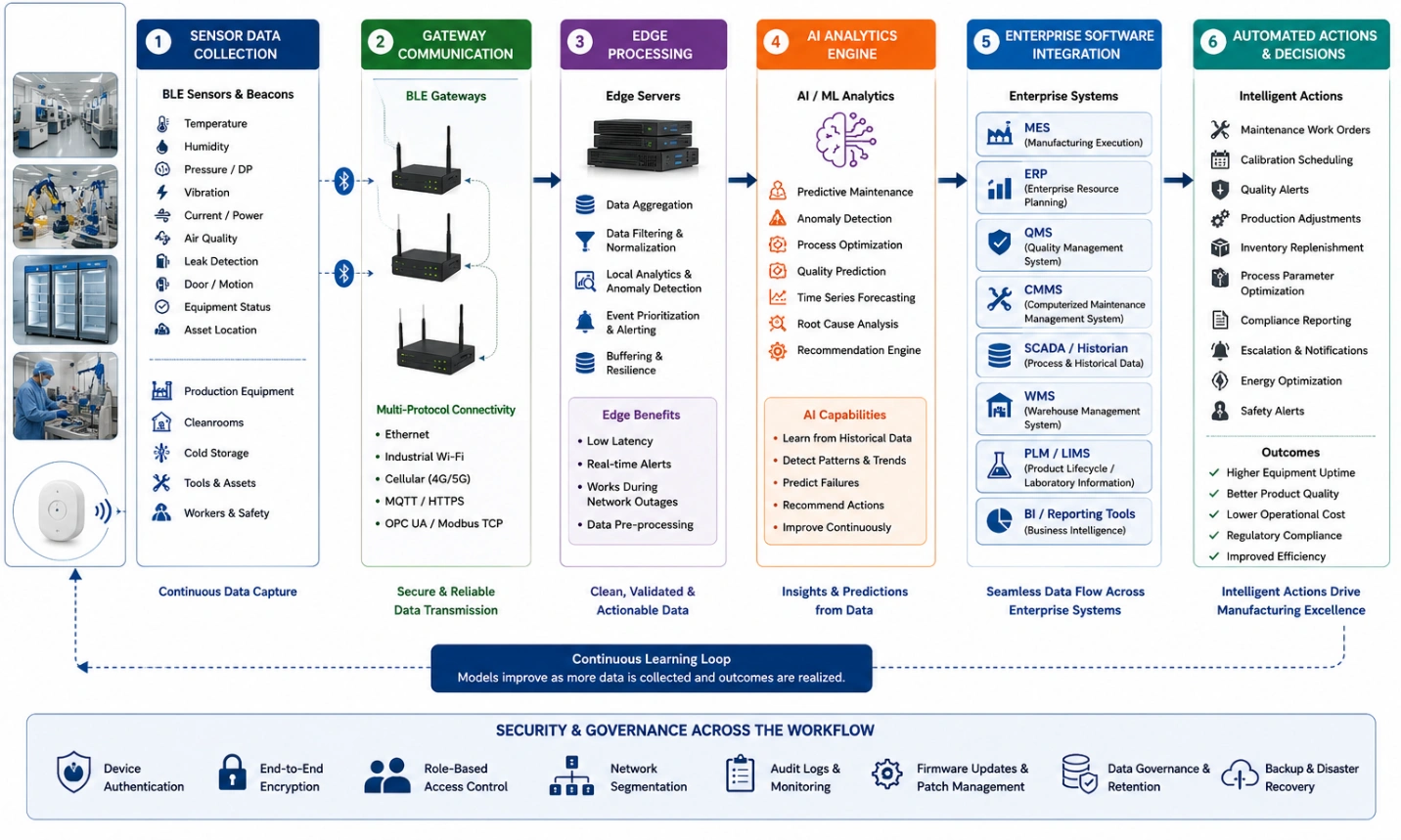
This workflow diagram illustrates the end-to-end lifecycle of operational data in a medical technology manufacturing facility. It shows how BLE sensors and beacons capture real-time data, which is transmitted through BLE gateways for edge processing and AI analytics before integrating with enterprise systems such as MES, ERP, QMS, and CMMS to drive predictive maintenance, quality monitoring, compliance reporting, and automated manufacturing actions.
BLE Sensors
BLE sensors collect operational data from manufacturing environments.
Typical sensor types include:
- Temperature sensors
- Humidity sensors
- Pressure sensors
- Vibration sensors
- Accelerometers
- Air quality sensors
- Current sensors
- Voltage sensors
- Motion sensors
- Magnetic contact sensors
- Liquid leakage sensors
- Differential pressure sensors
Medical technology manufacturers deploy these sensors to monitor environmental conditions, equipment performance, production assets, and storage facilities.
BLE Beacons
BLE beacons transmit unique identifiers that allow nearby gateways or mobile devices to determine asset proximity and location.
Applications include:
- Tool tracking
- Production cart tracking
- Mobile equipment monitoring
- Employee safety
- Material flow analysis
- Finished product movement
- Warehouse navigation
- Inventory visibility
Beacon deployments reduce equipment search time while improving production efficiency and traceability.
BLE Gateways
BLE gateways serve as communication bridges between wireless BLE devices and enterprise networks.
Key gateway capabilities include:
- Supporting thousands of BLE devices
- Local buffering
- Secure communication
- Protocol conversion
- Remote management
- Firmware updates
- Edge analytics
- Multi-radio communication
Gateways simplify deployment by allowing manufacturers to expand sensor coverage without extensive cabling.
AI Models Used in Medical Technology Manufacturing
Selecting appropriate AI models depends on operational objectives, production complexity, and available manufacturing data.
Frequently deployed models include:
- Supervised learning for quality classification
- Unsupervised learning for anomaly detection
- Neural networks for predictive maintenance
- Computer vision models for defect inspection
- Deep learning for image analysis
- Random Forest models for failure prediction
- Gradient Boosting algorithms for process optimization
- Natural Language Processing (NLP) for maintenance records and quality documentation
- Large Language Models (LLMs) for engineering knowledge retrieval and technical assistance
These models continuously improve as additional manufacturing data becomes available, enabling increasingly accurate predictions and operational recommendations.
Hardware, Software, Deployment Models, Communication Protocols, and Security for AI-Enabled BLE Solutions
Successful AI-powered BLE implementations in Medical Technology Manufacturing depend on carefully selecting hardware, communication technologies, AI software, deployment models, and cybersecurity controls that satisfy operational performance requirements while supporting strict regulatory obligations. Rather than functioning as isolated technologies, BLE gateways, BLE beacons, BLE sensors, AI analytics software, enterprise applications, and industrial communication infrastructure operate together as an integrated solution that continuously monitors production activities, analyzes operational conditions, and supports intelligent manufacturing decisions.
Cloud vs. Server Deployment for AI-Enabled BLE in Medical Technology Manufacturing: Enterprise Comparison Guide
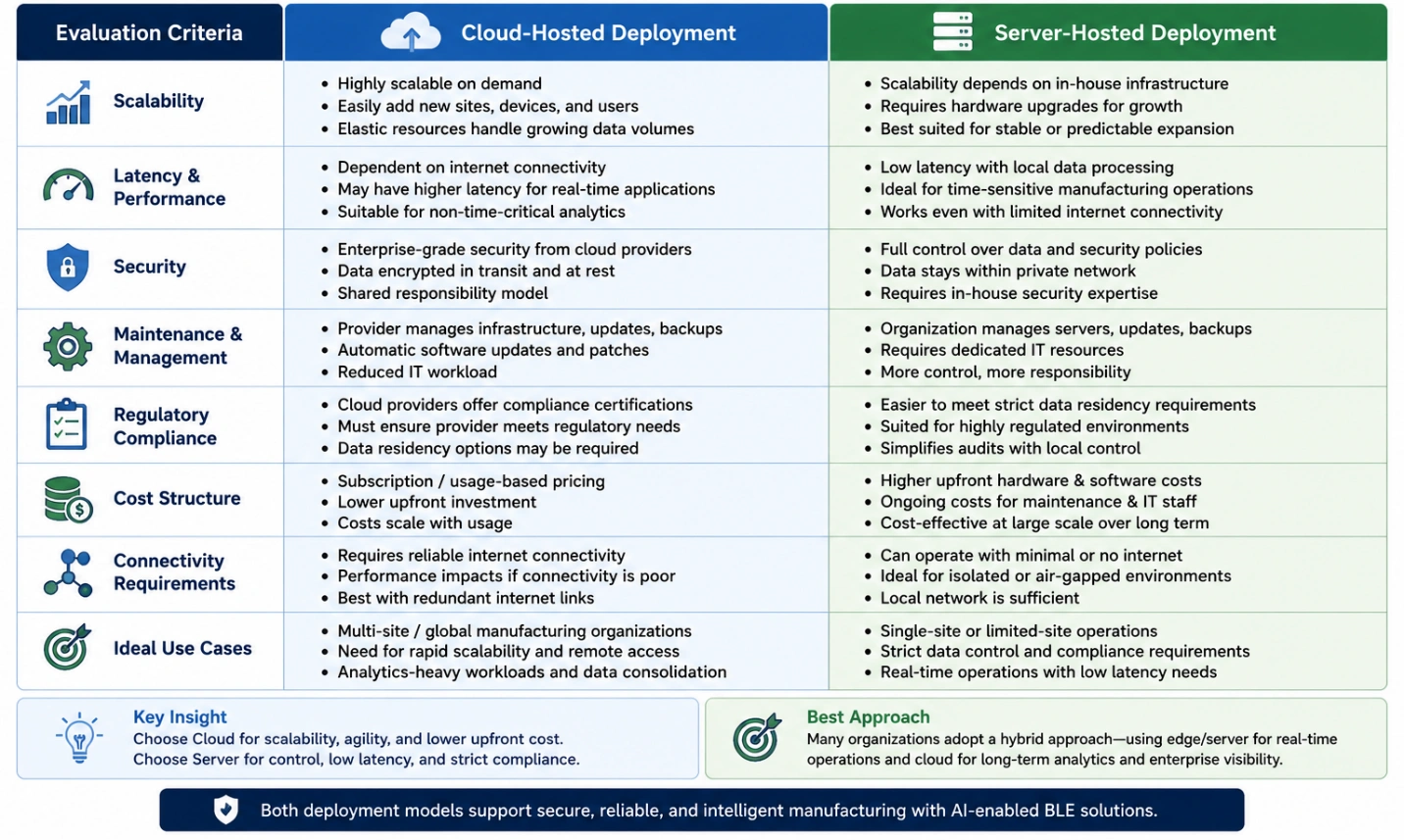
This comparison table evaluates cloud-hosted and server-hosted AI-enabled BLE deployments for medical technology manufacturing across key decision factors, including scalability, latency, security, maintenance, regulatory compliance, cost, connectivity requirements, and ideal use cases. It helps engineering, IT, and operations teams select the deployment model that best aligns with production objectives, compliance requirements, and infrastructure strategies.
Hardware Components
Medical technology manufacturing environments include cleanrooms, electronics assembly lines, precision machining centers, sterilization facilities, packaging operations, calibration laboratories, and temperature-controlled storage areas. Hardware selection should therefore prioritize reliability, accuracy, regulatory compliance, and long-term operational stability.
Key hardware components include:
- BLE environmental sensors
- BLE vibration sensors
- BLE temperature sensors
- BLE humidity sensors
- BLE differential pressure sensors
- BLE current and power monitors
- BLE proximity sensors
- BLE leak detection sensors
- BLE gateways
- BLE asset tracking beacons
- Industrial edge servers
- Industrial networking switches
- Wireless access points
- Industrial tablets
- Operator handheld devices
Environmental sensors continuously verify cleanroom conditions required for manufacturing medical devices, while vibration and power sensors monitor production equipment such as CNC machining centers, laser welding machines, injection molding systems, automated optical inspection equipment, and robotic assembly cells.
BLE gateways aggregate sensor data from throughout the facility before securely forwarding information to edge servers or enterprise software for AI analysis.
Software Components
AI-enabled BLE solutions rely on several layers of software that transform raw operational data into actionable manufacturing intelligence.
Typical software components include:
- Device management software
- BLE gateway management software
- AI analytics software
- Predictive maintenance applications
- Manufacturing intelligence dashboards
- Quality monitoring software
- Environmental monitoring software
- Alarm management systems
- Reporting software
- Asset management software
- Regulatory compliance reporting tools
- Digital twin software
- Business intelligence applications
These applications continuously process production data to identify abnormal equipment behavior, forecast maintenance requirements, optimize production scheduling, and support regulatory reporting.
Within medical technology manufacturing, AI software also assists quality engineers by detecting subtle production deviations that traditional threshold-based monitoring systems may overlook.
Artificial Intelligence Processing
AI transforms BLE sensor data into operational intelligence using several complementary techniques.
Common processing stages include:
- Data cleansing
- Feature extraction
- Sensor fusion
- Statistical analysis
- Predictive modeling
- Risk scoring
- Pattern recognition
- Root cause analysis
- Recommendation generation
- Continuous model improvement
Instead of evaluating each sensor independently, AI correlates information collected from multiple production assets simultaneously.
For example, slight increases in machine vibration combined with higher motor current, elevated operating temperature, and reduced production throughput may indicate bearing degradation several weeks before conventional maintenance inspections identify a problem.
Similarly, AI can correlate environmental conditions across multiple cleanrooms to identify airflow imbalances that could eventually affect manufacturing quality.
Communication Protocols
Reliable communication is essential for continuous manufacturing visibility.
BLE devices communicate with gateways using Bluetooth Low Energy, while gateways connect with enterprise infrastructure using protocols appropriate for industrial environments.
Common communication technologies include:
- Bluetooth Low Energy (BLE)
- Ethernet
- Industrial Wi-Fi
- MQTT
- OPC UA
- HTTPS
- REST APIs
- Modbus TCP
- SNMP
- TCP/IP
These communication methods allow sensor information to move securely between production equipment, gateways, edge servers, cloud services, and enterprise applications while maintaining interoperability with existing manufacturing infrastructure.
Protocol selection depends on latency requirements, production scale, cybersecurity policies, and integration with existing automation systems.
Cloud Version Deployment
Cloud-hosted deployments are well suited for organizations operating multiple manufacturing facilities that require centralized visibility, scalable analytics, and simplified software management.
Typical advantages include:
- Centralized monitoring across global production sites
- Rapid scalability as additional facilities are added
- Automatic software updates
- High-performance AI model training
- Long-term historical data storage
- Remote engineering access
- Enterprise-wide reporting
- Simplified disaster recovery
Cloud deployments are particularly valuable for manufacturers seeking consolidated quality metrics, production benchmarking, and corporate-level operational insights across geographically distributed facilities.
Server Version Deployment
Some medical technology manufacturers require production data to remain within privately managed infrastructure because of regulatory, cybersecurity, intellectual property, or operational requirements.
Server-based deployments place AI software on customer-managed servers located within factory environments, private data centers, or other enterprise-controlled computing environments.
Benefits include:
- Greater control over sensitive production data
- Reduced dependence on internet connectivity
- Lower latency for manufacturing operations
- Easier integration with legacy manufacturing systems
- Compliance with internal security policies
- Local processing for critical production workloads
This deployment model is often preferred where manufacturing operations demand deterministic performance and strict governance over operational data.
GAO has supported organizations implementing BLE and IoT hardware within both cloud-managed and privately hosted environments, enabling manufacturers to choose deployment strategies aligned with their operational and regulatory objectives.
Cybersecurity and Data Protection
Medical technology manufacturing environments process sensitive production information, intellectual property, equipment configurations, and quality records. As wireless connectivity expands across manufacturing facilities, cybersecurity becomes an essential design consideration.
Recommended security measures include:
- BLE device authentication
- Role-based access control
- Multi-factor authentication
- End-to-end encryption
- Secure firmware updates
- Digital certificate management
- Network segmentation
- Continuous security monitoring
- Security event logging
- Vulnerability management
- Backup and disaster recovery procedures
Manufacturers should also establish lifecycle management processes for BLE devices, ensuring that sensors, gateways, and associated software receive timely updates and security patches without disrupting production.
Engineering Deployment Considerations
Deploying AI-enabled BLE solutions within medical technology manufacturing requires careful planning beyond simply installing wireless devices. Engineers should evaluate radio coverage, cleanroom classifications, electromagnetic interference, equipment layouts, battery replacement strategies, gateway placement, scalability requirements, and validation procedures before commissioning the system.
Practical engineering considerations include:
- Conducting BLE site surveys to identify signal attenuation caused by stainless steel equipment, shielding, or dense machinery.
- Positioning gateways to maintain reliable coverage while minimizing communication overlap.
- Validating sensor accuracy against calibrated reference instruments before integrating data into quality workflows.
- Designing redundant communication paths for critical monitoring applications such as cleanroom environmental control and cold storage monitoring.
- Planning preventive maintenance schedules for battery-powered sensors to avoid data loss.
- Verifying interoperability with existing MES, ERP, SCADA, and QMS software before production rollout.
- Establishing documented commissioning, testing, and change-control procedures that align with medical device quality management requirements.
Careful engineering planning helps manufacturers achieve reliable long-term operation while supporting regulatory compliance and minimizing disruptions during implementation.
Key Technical Capabilities of AI-Enabled BLE Solutions for Medical Technology Manufacturing
Artificial intelligence supported by BLE technologies provides far more than wireless monitoring. Together, these technologies create intelligent manufacturing systems capable of continuously evaluating production conditions, identifying operational risks, and supporting data-driven decision-making throughout the medical technology manufacturing lifecycle.
AI-Powered BLE Solutions for Medical Technology Manufacturing: Operational and Business Benefits Infographic
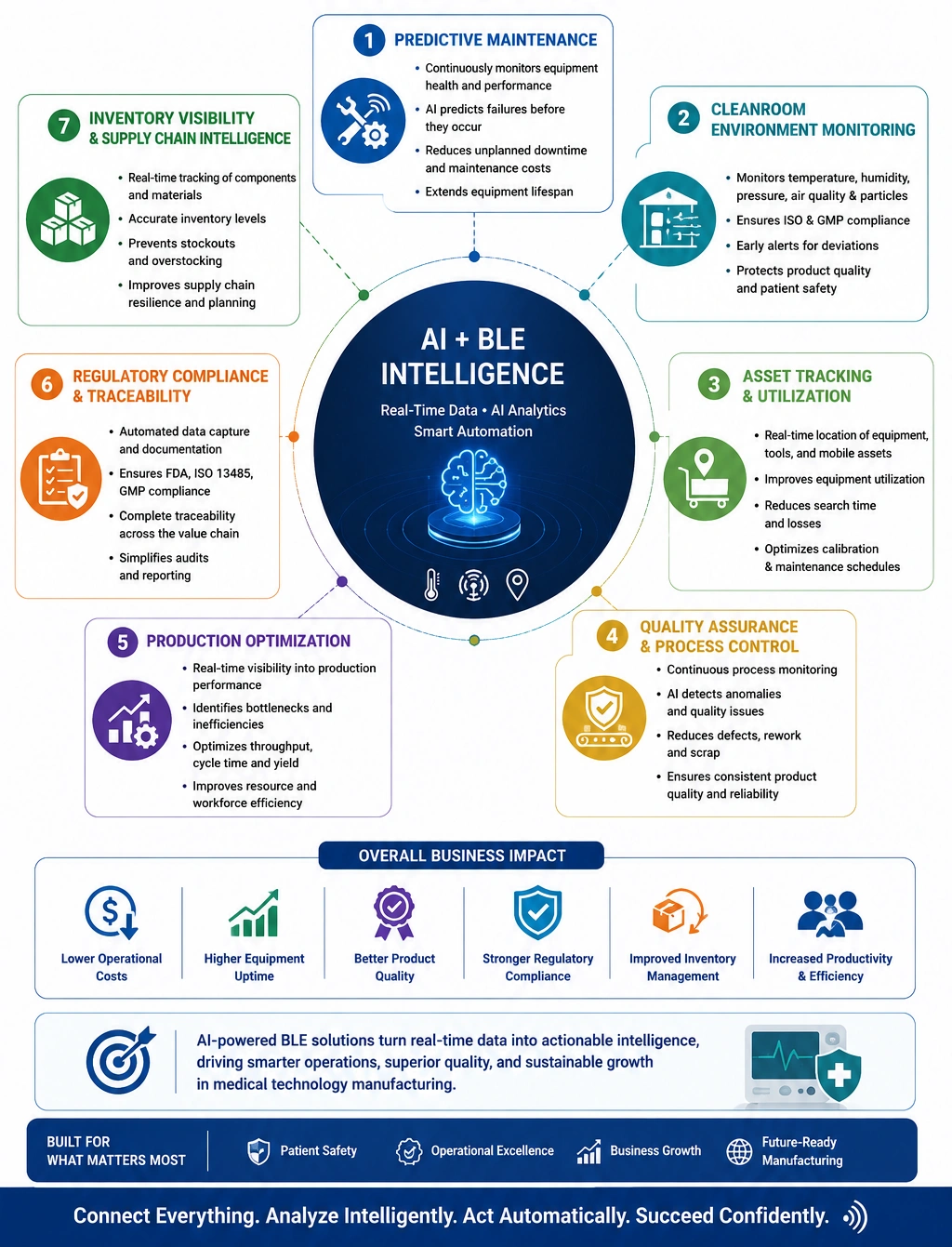
This infographic highlights the key operational and business improvements achieved through AI-supported BLE systems in medical technology manufacturing. It illustrates how predictive maintenance, cleanroom environmental monitoring, asset tracking, quality assurance, production optimization, regulatory compliance, and inventory visibility work together to improve equipment reliability, product quality, operational efficiency, and regulatory performance.
Intelligent Equipment Health Monitoring
BLE vibration, temperature, current, and power sensors continuously monitor production equipment operating across machining, assembly, sterilization, packaging, and testing processes.
Artificial intelligence analyzes equipment behavior by identifying subtle operational changes that often precede mechanical failures. Rather than relying solely on scheduled maintenance intervals, maintenance teams receive predictive insights that enable repairs to be performed before production disruptions occur.
Benefits include:
- Reduced unexpected equipment failures
- Improved equipment availability
- Lower maintenance costs
- Extended equipment lifespan
- Improved maintenance planning
- Reduced spare parts inventory
Automated Quality Monitoring
Medical device manufacturing requires exceptional quality consistency because even minor production deviations may affect product safety or regulatory compliance.
AI evaluates manufacturing variables collected through BLE sensors, including:
- Environmental conditions
- Equipment operating parameters
- Production cycle consistency
- Process stability
- Machine utilization
- Product inspection data
Continuous analysis enables manufacturers to detect quality deviations significantly earlier than traditional inspection methods, reducing scrap, rework, and production delays.
Real-Time Cleanroom Intelligence
BLE environmental sensors continuously monitor critical cleanroom conditions including temperature, humidity, pressure differentials, airborne particles, and air quality.
AI evaluates long-term environmental trends rather than isolated threshold violations.
Capabilities include:
- Early contamination risk detection
- HVAC performance monitoring
- Environmental trend forecasting
- Automated compliance alerts
- Predictive cleanroom maintenance
- Continuous environmental reporting
These capabilities help maintain production conditions required for regulated medical technology manufacturing.
Intelligent Asset Visibility
BLE beacons attached to production assets enable continuous location awareness across manufacturing facilities.
Artificial intelligence analyzes movement patterns to improve:
- Equipment utilization
- Material flow
- Warehouse efficiency
- Tool availability
- Calibration scheduling
- Inventory accuracy
Manufacturers reduce equipment search time while improving production scheduling and asset utilization.
Predictive Production Optimization
Artificial intelligence continuously evaluates production performance using operational data collected throughout manufacturing processes.
Optimization areas include:
- Production throughput
- Cycle time
- Machine utilization
- Workforce allocation
- Material movement
- Production scheduling
- Bottleneck identification
- Capacity planning
Rather than reacting to production delays after they occur, manufacturers receive recommendations before performance deteriorates.
Operational Improvements Delivered by AI-Enabled BLE Systems
Medical technology manufacturers implementing AI-supported BLE solutions commonly achieve measurable operational improvements across multiple departments.
Manufacturing Operations
Operational improvements include:
- Improved Overall Equipment Effectiveness (OEE)
- Reduced downtime
- Improved production scheduling
- Higher manufacturing throughput
- Better production visibility
- Faster response to equipment failures
Maintenance Operations
Maintenance organizations benefit from:
- Predictive maintenance planning
- Reduced emergency repairs
- Improved spare parts planning
- Better maintenance prioritization
- Lower maintenance labor costs
- Improved equipment reliability
Quality Assurance
Quality teams gain:
- Continuous quality monitoring
- Earlier defect identification
- Automated environmental reporting
- Improved process consistency
- Reduced product recalls
- Improved documentation accuracy
Supply Chain and Inventory
Operational visibility improves:
- Inventory accuracy
- Material availability
- Warehouse efficiency
- Production traceability
- Component tracking
- Procurement forecasting
GAO has supported organizations implementing BLE and IoT technologies that improve operational visibility while integrating with existing manufacturing systems, enabling customers to modernize production without replacing established infrastructure.
Layered AI-Enabled BLE System Diagram for Medical Technology Manufacturing
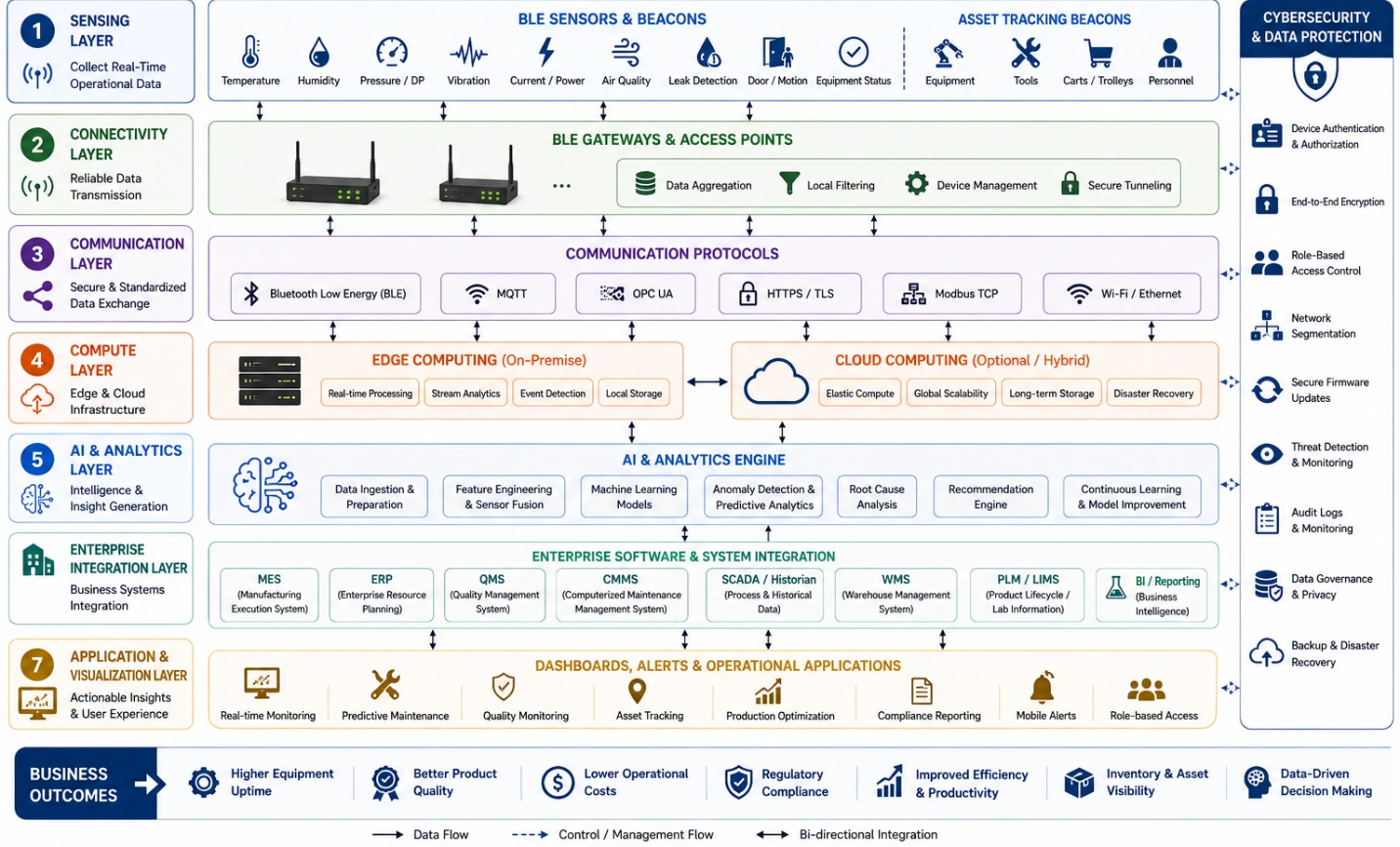
This layered block diagram illustrates the end-to-end relationship between BLE sensors and beacons, gateways, communication protocols, edge and cloud computing, AI analytics, enterprise software, cybersecurity controls, and operational dashboards supporting medical technology manufacturing. It demonstrates how data flows securely through each layer to enable predictive maintenance, quality assurance, asset tracking, production optimization, regulatory compliance, and real-time operational decision-making.
Business Benefits for Medical Technology Manufacturers
The combination of AI and BLE technologies provides measurable business value extending beyond technical monitoring capabilities.
Organizations benefit through:
- Improved regulatory compliance
- Higher manufacturing quality
- Reduced operational costs
- Better production planning
- Increased equipment utilization
- Reduced manufacturing risk
- Faster maintenance response
- Improved workforce productivity
- Reduced energy consumption
- Better inventory management
- Improved customer satisfaction
- Enhanced operational transparency
Medical technology manufacturers also gain improved business continuity because AI identifies operational risks before they affect production schedules or product quality.
Performance Enhancements
AI-supported BLE deployments contribute to measurable performance improvements across manufacturing operations.
Expected improvements include:
- Faster anomaly detection
- Improved predictive maintenance accuracy
- Lower equipment downtime
- Reduced production variability
- Higher manufacturing efficiency
- Improved production scheduling accuracy
- Better cleanroom environmental stability
- Reduced calibration delays
- Higher asset utilization
- Improved energy efficiency
Actual performance improvements depend on production complexity, equipment condition, manufacturing maturity, and implementation scope.
Scalability Advantages
BLE technology is inherently scalable because wireless devices can be added without extensive modifications to existing production infrastructure.
Manufacturers can gradually expand deployments from pilot projects to facility-wide implementations by adding:
- Additional BLE gateways
- Environmental sensors
- Asset tracking beacons
- Equipment monitoring sensors
- AI software modules
- Production dashboards
- Predictive maintenance capabilities
This phased deployment approach reduces implementation risk while allowing manufacturers to validate operational benefits before expanding across additional production facilities.
Security Improvements
Medical technology manufacturing requires protection of operational data, intellectual property, production recipes, calibration records, and quality documentation.
AI-enabled BLE solutions strengthen operational security through:
- Continuous device authentication
- Encrypted communications
- Secure gateway management
- Centralized access management
- Automated security monitoring
- Continuous device health verification
- Firmware integrity validation
- Security event logging
- Network segmentation
- Risk-based access controls
Regular security assessments, software updates, and lifecycle management further improve long-term system resilience.
Implementation Recommendations
Organizations planning AI-enabled BLE deployments should adopt a structured implementation strategy.
Recommended practices include:
- Define measurable operational objectives before deployment.
- Conduct comprehensive wireless site surveys.
- Identify critical production assets for initial monitoring.
- Validate sensor accuracy and communication reliability.
- Integrate BLE data with existing MES, ERP, QMS, and CMMS software.
- Establish cybersecurity policies for wireless devices.
- Develop data governance and retention policies.
- Train production, maintenance, and quality personnel.
- Perform pilot deployments before facility-wide expansion.
- Continuously evaluate AI model performance and update models using new operational data.
Following these engineering best practices improves deployment success while minimizing operational disruption.
Conclusion
AI-powered BLE solutions are transforming medical technology manufacturing by enabling continuous monitoring, predictive analytics, intelligent automation, and enhanced operational visibility. BLE gateways, beacons, and sensors provide the reliable data foundation that artificial intelligence requires to improve equipment reliability, manufacturing quality, environmental monitoring, and regulatory compliance.
As manufacturers continue to increase automation and digitalization, intelligent BLE-enabled monitoring will play an increasingly important role in supporting efficient, compliant, and data-driven production environments.
Headquartered in New York City and Toronto, GAO is recognized among the leading global suppliers of BLE and RFID technologies. Through decades of research, product development, and technical support, we have helped organizations across North America implement reliable IoT hardware and intelligent monitoring systems that address complex operational challenges in highly regulated industries. We invite organizations seeking advanced BLE and AI solutions for medical technology manufacturing to learn more about our products, engineering expertise, and technical support services.
Building the Future of Industrial AI and IoT with Aperture Venture Studio and GAO
For more than three decades, GAO Group of Companies has invested heavily in research and development of industrial BLE, RFID, and IoT technologies. As generative AI has demonstrated significant value in regulated manufacturing environments, we have expanded our focus to develop AI-enabled BLE and IoT solutions that help medical technology manufacturers improve operational intelligence, quality assurance, predictive maintenance, and regulatory compliance.
To further accelerate innovation in industrial AI and IoT, we founded Aperture Venture Studio to help develop and scale advanced AI and IoT technologies addressing the evolving needs of manufacturing and other industrial sectors. Aperture has attracted experienced AI researchers, IoT engineers, operational leaders, investors, and industry partners committed to advancing intelligent industrial solutions.
Through initiatives such as the Aperture Ventures Summit and TekSummit, we bring together technical experts and industry leaders to discuss emerging developments in AI, BLE, RFID, industrial connectivity, and digital manufacturing.
These collaborative efforts have fostered strong technical communities focused on advancing practical AI and IoT applications across modern industries.
We welcome you to join us as:
- Advisors, collaborators, or technical professionals
- Investors supporting industrial innovation
- Customers seeking reliable AI-enabled BLE and IoT solutions from GAO