
AI and BLE for Drug Manufacturing
AI-Driven Drug Manufacturing with BLE Connectivity for Intelligent Pharmaceutical Production
Artificial Intelligence (AI) combined with Bluetooth Low Energy (BLE) technologies is transforming modern drug manufacturing by improving process reliability, product quality, regulatory compliance, and production efficiency throughout pharmaceutical operations. BLE gateways, BLE sensors, and BLE beacons continuously collect operational data from production assets, environmental monitoring systems, cleanrooms, warehouses, laboratories, and personnel, enabling AI software to analyze manufacturing conditions in near real time. The resulting intelligence helps pharmaceutical manufacturers identify deviations before they affect product quality, optimize production scheduling, reduce equipment downtime, improve Overall Equipment Effectiveness (OEE), and strengthen Good Manufacturing Practice (GMP) compliance.
For more than three decades, GAO has supplied BLE, RFID, and industrial IoT hardware solutions to organizations throughout the United States and Canada. Our experience supporting Fortune 500 companies, research organizations, universities, and government agencies provides practical engineering insight into deploying reliable industrial sensing solutions for highly regulated manufacturing environments.
AI-Enabled BLE Monitoring Across the Pharmaceutical Drug Manufacturing Process
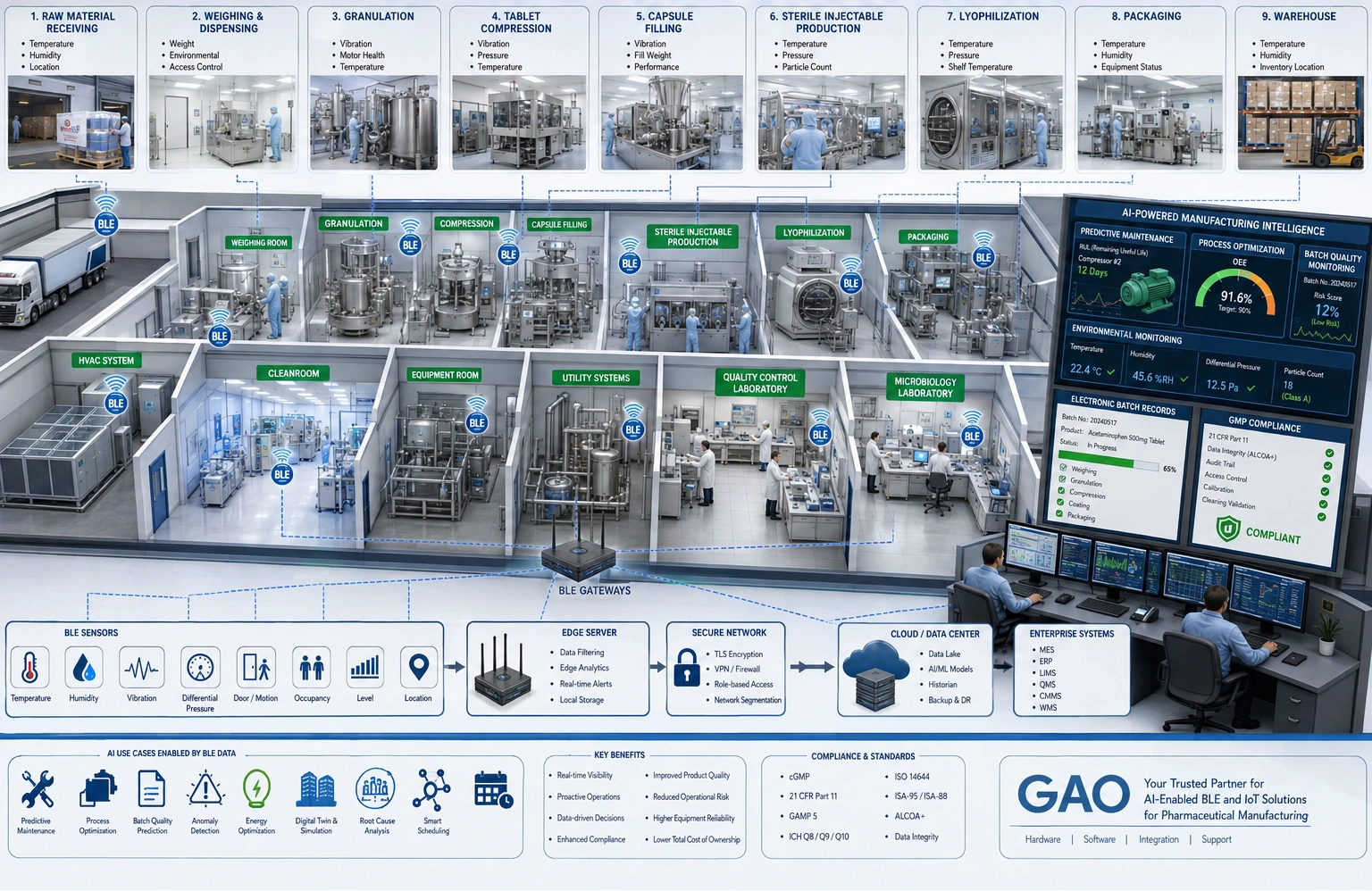
This illustration shows a pharmaceutical drug manufacturing facility where BLE sensors, BLE gateways, and AI analytics continuously monitor production, environmental conditions, equipment health, and quality control. It highlights how AI-driven insights support predictive maintenance, batch quality monitoring, electronic batch records, and GMP compliance throughout the manufacturing lifecycle.
Understanding AI and BLE in Modern Drug Manufacturing
Drug manufacturing is one of the most tightly regulated manufacturing sectors. Every production batch must satisfy stringent quality, safety, efficacy, traceability, and documentation requirements established by organizations such as the FDA, EMA, Health Canada, MHRA, WHO, and PIC/S. Even minor process deviations can result in batch rejection, product recalls, regulatory observations, or production shutdowns.
Traditional pharmaceutical manufacturing relies on programmable logic controllers (PLCs), Distributed Control Systems (DCS), Manufacturing Execution Systems (MES), Supervisory Control and Data Acquisition (SCADA), Laboratory Information Management Systems (LIMS), and historians to monitor production. However, many operational parameters remain underutilized because conventional systems often analyze historical rather than continuously contextualized data.
BLE extends operational visibility by deploying wireless sensing throughout manufacturing facilities without requiring extensive wiring. BLE sensors monitor environmental conditions, equipment health, utilities, storage conditions, personnel movement, and asset utilization. BLE gateways securely forward collected information to edge servers or cloud software where AI models evaluate operational trends, identify anomalies, predict failures, and recommend corrective actions.
Rather than replacing validated manufacturing systems, AI complements existing pharmaceutical automation by improving decision support while maintaining regulatory validation and data integrity requirements.
Drug manufacturers typically leverage AI to improve:
- Process Analytical Technology (PAT)
- Continuous Manufacturing
- Batch Manufacturing
- Electronic Batch Record review
- Environmental Monitoring
- Equipment Qualification
- Process Validation
- Predictive Maintenance
- Root Cause Analysis
- Quality Risk Management
- Corrective and Preventive Actions (CAPA)
- Deviation Investigation
- Inventory Optimization
- Cold Chain Monitoring
- Production Scheduling
BLE technologies support these capabilities through reliable, battery-powered sensing that minimizes installation complexity while maintaining flexibility for changing production environments.
Drug Manufacturing Operations That Benefit from AI and BLE Solutions
Drug manufacturing consists of numerous interconnected production and quality assurance processes where continuous monitoring directly influences regulatory compliance and product quality.
Active Pharmaceutical Ingredient (API) Manufacturing
API production requires tight control of reaction vessels, pressure reactors, solvent recovery systems, filtration equipment, crystallizers, centrifuges, and drying systems.
BLE sensors monitor:
- Reactor temperature
- Vessel vibration
- Agitator motor health
- Pressure stability
- Utility performance
- Steam distribution
- Chilled water systems
AI analyzes process variability, predicts equipment degradation, and optimizes reaction consistency to improve batch yield.
Oral Solid Dosage Manufacturing
Tablet and capsule manufacturing includes:
- Raw material dispensing
- Blending
- Wet granulation
- Dry granulation
- Fluid bed drying
- Milling
- Tablet compression
- Coating
- Capsule filling
- Packaging
BLE-enabled monitoring allows AI software to detect abnormal vibration in tablet presses, identify drying inconsistencies, optimize blending duration, and reduce process interruptions caused by unexpected equipment failures.
Sterile Injectable Manufacturing
Sterile manufacturing requires stringent environmental control throughout aseptic filling operations.
BLE monitoring supports:
- Cleanroom temperature
- Relative humidity
- Differential pressure
- HEPA filter performance
- Air handling units
- Filling machine status
- Isolator conditions
- Personnel movement
- Sterilization equipment
AI continuously evaluates contamination risk indicators while identifying environmental trends that may require preventive intervention before cleanroom conditions exceed validated limits.
Biopharmaceutical Manufacturing
Biological drug production involves bioreactors, fermenters, chromatography systems, purification skids, media preparation, buffer preparation, and cold storage.
BLE sensors collect operational information from:
- Fermentation vessels
- Incubators
- Refrigerators
- Freezers
- Cold rooms
- Cell culture laboratories
- CIP systems
- SIP systems
AI models predict process deviations affecting cell viability, protein yield, purification efficiency, and production consistency.
Pharmaceutical Packaging Operations
Packaging lines include serialization, labeling, blister packaging, bottle filling, inspection, palletizing, and warehouse preparation.
BLE beacons and gateways support:
- Asset tracking
- Packaging equipment monitoring
- Automated material movement
- Warehouse inventory visibility
- Finished goods traceability
AI improves packaging throughput while minimizing downtime caused by equipment bottlenecks.
AI and BLE Workflow for Pharmaceutical Drug Manufacturing Process
This workflow diagram illustrates how BLE sensors and BLE gateways collect operational data across every stage of pharmaceutical drug manufacturing, from raw material receiving to distribution. AI analytics transform this data into predictive maintenance, batch quality monitoring, process optimization, and GMP compliance insights while integrating with enterprise systems such as MES, LIMS, QMS, ERP, CMMS, and WMS.
Operational Workflow for AI-Enabled Drug Manufacturing Using BLE
Successful AI deployment depends on reliable operational data flowing throughout the manufacturing lifecycle. BLE technologies create a distributed sensing layer that supports continuous monitoring while integrating with existing pharmaceutical automation systems.
Data Acquisition
BLE sensors continuously capture operational parameters including:
- Equipment vibration
- Bearing temperature
- Motor current
- Compressed air pressure
- Differential pressure
- Temperature
- Relative humidity
- CO₂ concentration
- Particle counts
- Door status
- Utility consumption
- Tank levels
- Warehouse conditions
BLE beacons provide real-time location awareness for mobile equipment, validated assets, reusable containers, calibration tools, maintenance instruments, and production carts.
Wireless Communication Layer
BLE devices transmit information to strategically located BLE gateways throughout manufacturing buildings.
The communication layer typically includes:
- BLE 5.x
- Bluetooth Mesh
- Ethernet
- Industrial Wi-Fi
- OPC UA
- MQTT
- HTTPS
- TLS encryption
- VLAN segmentation
Gateways aggregate thousands of sensor readings before forwarding information to industrial servers or cloud-hosted software.
Edge Computing
Many pharmaceutical facilities perform preliminary analytics at edge servers located within validated manufacturing networks.
Edge processing supports:
- Sensor filtering
- Data normalization
- Local anomaly detection
- Event buffering
- Protocol conversion
- Temporary storage
- Network resilience
Processing information close to production equipment reduces latency while supporting validated manufacturing operations even during temporary internet interruptions.
Enterprise Software Integration
Operational information integrates with existing pharmaceutical software including:
- Manufacturing Execution Systems (MES)
- Enterprise Resource Planning (ERP)
- Quality Management Systems (QMS)
- Laboratory Information Management Systems (LIMS)
- Electronic Batch Record (EBR) systems
- Computerized Maintenance Management Systems (CMMS)
- SCADA
- Distributed Control Systems (DCS)
- Building Management Systems (BMS)
- Environmental Monitoring Systems (EMS)
- Warehouse Management Systems (WMS)
This integration enables AI software to correlate production events, equipment performance, laboratory results, maintenance history, operator actions, and environmental conditions within a unified decision-support workflow.
AI and BLE Solution Architecture for Pharmaceutical Drug Manufacturing
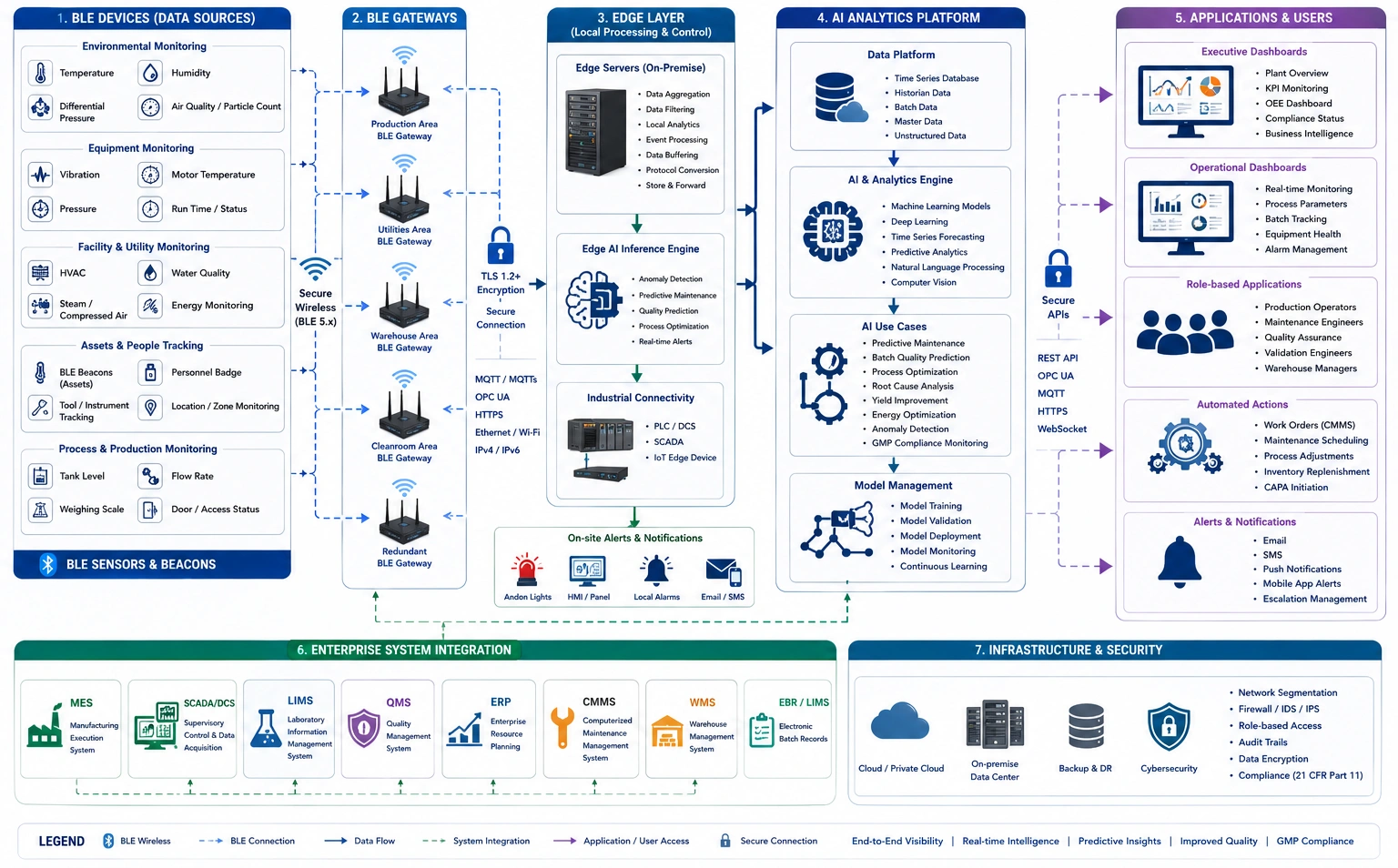
This solution architecture diagram illustrates the end-to-end flow of operational data from BLE sensors and BLE beacons through BLE gateways and edge servers to AI analytics and pharmaceutical enterprise systems. It demonstrates how AI supports predictive maintenance, batch quality prediction, GMP compliance monitoring, automated alerts, and executive decision-making by integrating with MES, SCADA, LIMS, QMS, ERP, and CMMS.
BLE Infrastructure, AI Technologies, and Deployment Considerations for Drug Manufacturing
Reliable AI-driven drug manufacturing depends on a carefully engineered BLE infrastructure that supports validated pharmaceutical operations while maintaining cybersecurity, regulatory compliance, and high system availability. BLE sensors, BLE gateways, and BLE beacons must operate alongside existing automation systems without disrupting validated production processes.
BLE Hardware Components
The BLE sensing layer typically consists of battery-powered wireless devices designed for pharmaceutical environments, including cleanrooms, formulation suites, utility areas, cold storage, and warehouses.
Common BLE-enabled hardware includes:
- Environmental monitoring sensors
- Temperature sensors
- Relative humidity sensors
- Differential pressure sensors
- Vibration sensors
- Air quality sensors
- Door and access sensors
- Asset tracking beacons
- Personnel location beacons
- Utility monitoring sensors
- Cold-chain monitoring devices
- BLE gateways with industrial Ethernet and Wi-Fi connectivity
These devices continuously transmit operational data with low power consumption, allowing long battery life while supporting flexible deployment in regulated production areas without extensive cabling.
AI Models Supporting Intelligent Drug Manufacturing
AI software transforms BLE sensor data into actionable operational intelligence across pharmaceutical production, quality assurance, engineering, validation, and maintenance. Rather than relying solely on threshold-based alarms, AI continuously learns from historical production data, equipment behavior, environmental conditions, laboratory results, and process variables to identify complex relationships that are difficult for traditional automation systems to detect.
Common AI models deployed in drug manufacturing include:
- Machine Learning for process optimization and equipment performance prediction
- Deep Learning for multivariable process analysis
- Time Series Forecasting for utility demand and production planning
- Anomaly Detection for environmental monitoring and equipment deviations
- Predictive Maintenance models for rotating equipment
- Computer Vision for packaging inspection, vial inspection, and label verification
- Reinforcement Learning for production scheduling optimization
- Natural Language Processing (NLP) for deviation reports, CAPA documentation, and batch record analysis
- Digital Twin models for production simulation and validation planning
- Generative AI for technical documentation assistance and engineering knowledge retrieval
Typical AI outputs include:
- Equipment health scores
- Batch quality predictions
- Remaining useful life estimates
- Process deviation alerts
- Energy consumption forecasts
- Utility optimization recommendations
- Maintenance scheduling recommendations
- Environmental compliance alerts
- Production bottleneck identification
- Inventory replenishment recommendations
BLE provides the continuous operational visibility required for these AI models by collecting reliable data from thousands of distributed sensing points throughout pharmaceutical manufacturing facilities.
Cloud and Server Deployment Models
Drug manufacturers typically choose between cloud-hosted software and privately managed server deployments based on regulatory requirements, cybersecurity policies, production criticality, latency requirements, and corporate IT strategies.
Cloud Version
Cloud-hosted deployments centralize AI analytics while reducing local infrastructure management.
Cloud deployments are appropriate for:
- Multi-site pharmaceutical organizations
- Global manufacturing visibility
- Enterprise reporting
- Fleet-wide predictive maintenance
- Corporate KPI dashboards
- Cross-site benchmarking
- Long-term historical analytics
- AI model training using aggregated production data
Typical cloud software integrates with:
- MES
- ERP
- LIMS
- QMS
- CMMS
- Business Intelligence software
- Data lakes
- Secure API services
Cloud deployments simplify software updates while supporting enterprise-wide visibility across multiple manufacturing plants.
Server Version
Many pharmaceutical facilities prefer privately hosted server deployments because production systems frequently operate within validated manufacturing networks that restrict external connectivity.
Server deployments are appropriate for:
- GMP-regulated manufacturing
- FDA-regulated production
- High-security pharmaceutical environments
- Low-latency production monitoring
- Air-gapped manufacturing networks
- Proprietary formulation protection
- Continuous manufacturing
- Critical utility monitoring
Server deployments often include:
- Industrial edge servers
- Private virtualization environments
- Redundant database servers
- Local AI inference servers
- Manufacturing historians
- High-availability storage
- Disaster recovery systems
Many manufacturers implement hybrid deployments where operational analytics execute locally while selected production metrics synchronize securely with centralized cloud software.
GAO has helped organizations deploy BLE hardware solutions compatible with both cloud-hosted software and privately managed industrial server environments, allowing customers to select deployment strategies aligned with their operational and regulatory requirements.
Communication Protocols Supporting BLE Drug Manufacturing Systems
Reliable communication is essential for pharmaceutical manufacturing because production decisions depend upon timely and accurate operational data.
Common communication technologies include:
- BLE 5.0
- BLE 5.1
- BLE 5.2
- Bluetooth Mesh
- MQTT
- OPC UA
- Modbus TCP
- EtherNet/IP
- PROFINET
- BACnet
- HTTPS
- REST APIs
- WebSockets
- SNMP
- Ethernet
- Industrial Wi-Fi
- IPv6
- DNS
- NTP
Protocol selection depends upon equipment compatibility, latency requirements, cybersecurity policies, validation strategy, and interoperability with existing automation systems.
Cybersecurity and Data Protection
Drug manufacturing facilities process highly sensitive production information, intellectual property, formulation data, and regulatory documentation. AI and BLE deployments should therefore follow a defense-in-depth cybersecurity strategy.
Recommended security mechanisms include:
- TLS encryption
- AES encryption
- Mutual authentication
- Secure device onboarding
- Digital certificates
- Role-based access control (RBAC)
- Multi-factor authentication (MFA)
- Network segmentation
- Zero Trust principles
- Security Information and Event Management (SIEM)
- Endpoint monitoring
- Secure firmware updates
- Audit logging
- Backup and disaster recovery procedures
Cybersecurity also supports compliance with regulatory expectations for data integrity and electronic records while reducing the risk of unauthorized system access.
Pharmaceutical Standards and Regulatory Compliance
Successful AI-enabled BLE deployments must support regulatory compliance rather than introducing unnecessary operational risk.
Common standards and regulations include:
- FDA 21 CFR Part 11
- Current Good Manufacturing Practice (cGMP)
- Good Manufacturing Practice (GMP)
- Good Automated Manufacturing Practice (GAMP 5)
- ICH Q8 Pharmaceutical Development
- ICH Q9 Quality Risk Management
- ICH Q10 Pharmaceutical Quality System
- ISO 9001
- ISO 13485 (where applicable)
- ISO 14644 Cleanrooms
- ISA-95
- ISA-88
- IEC 62443 Industrial Cybersecurity
- NIST Cybersecurity Framework
- ALCOA+ Data Integrity principles
Validation activities typically include Installation Qualification (IQ), Operational Qualification (OQ), Performance Qualification (PQ), software validation, sensor calibration, periodic verification, and audit trail review to maintain regulatory compliance throughout the system lifecycle.
Cloud vs. Server AI Deployment Comparison for Pharmaceutical Drug Manufacturing
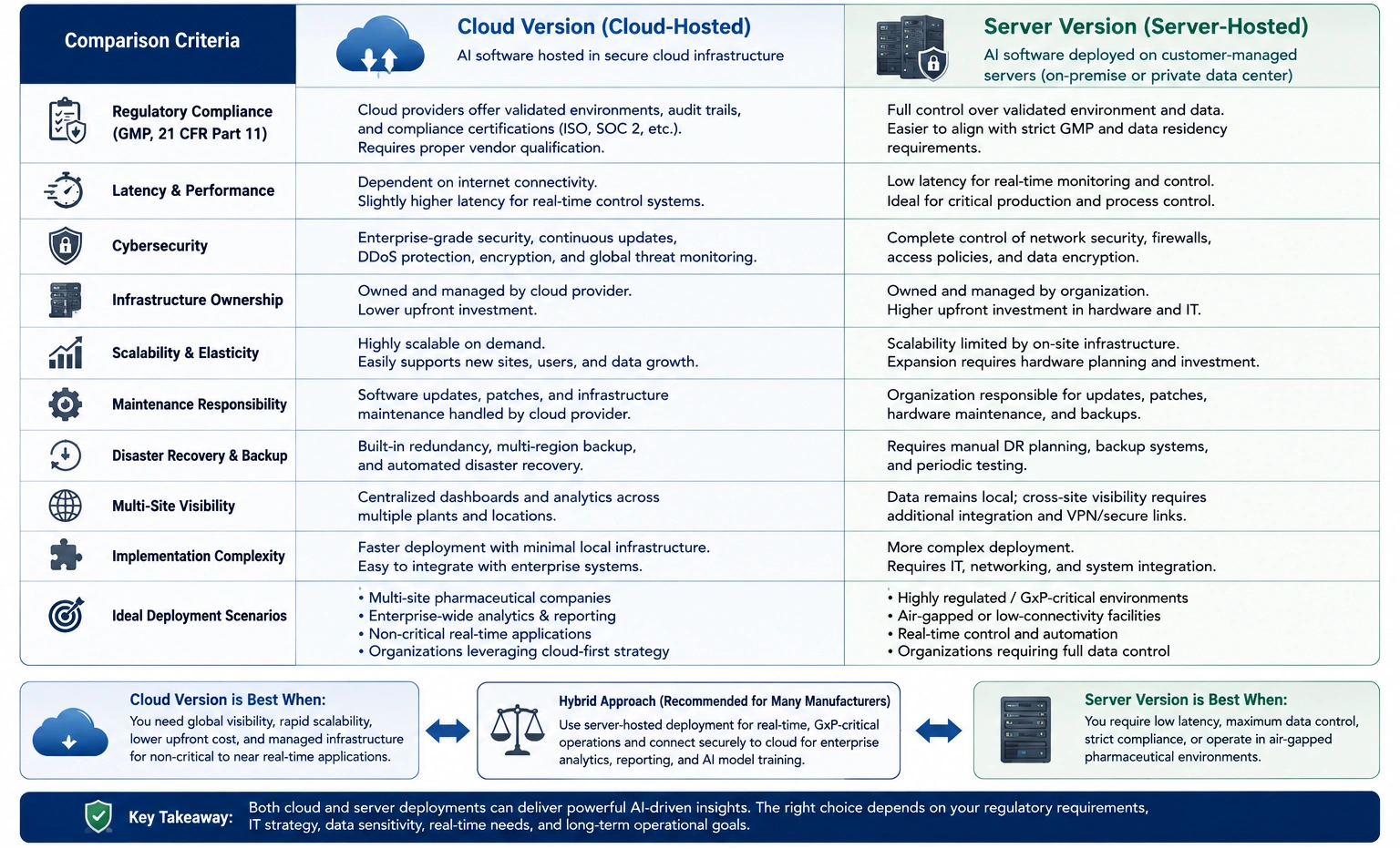
This comparison table evaluates cloud-hosted and server-hosted AI deployment models for pharmaceutical drug manufacturing across key criteria, including regulatory compliance, latency, cybersecurity, infrastructure ownership, scalability, maintenance, disaster recovery, and implementation complexity. It also highlights ideal deployment scenarios and explains why a hybrid approach is often the preferred choice for balancing real-time GMP operations with centralized AI analytics and enterprise reporting.
Technical Capabilities and Business Value of AI-Enabled BLE Drug Manufacturing
Integrating AI with BLE infrastructure delivers measurable improvements across pharmaceutical manufacturing by enabling continuous monitoring, predictive analytics, intelligent automation support, and data-driven operational decisions.
Key technical capabilities include:
- Continuous equipment condition monitoring
- Predictive maintenance of production assets
- Real-time environmental monitoring
- AI-assisted batch quality prediction
- Intelligent cleanroom monitoring
- Automated utility optimization
- Digital asset tracking
- Workforce location awareness
- Predictive cold chain monitoring
- Electronic batch record analysis
- Production scheduling optimization
- Root cause analysis
- Process anomaly detection
- Warehouse inventory visibility
- Compliance monitoring dashboards
Operational improvements include:
- Reduced unplanned equipment downtime
- Improved Overall Equipment Effectiveness (OEE)
- Lower maintenance costs
- Reduced batch rejection rates
- Higher first-pass yield
- Faster deviation investigations
- Improved cleanroom compliance
- Enhanced production scheduling
- Better asset utilization
- Increased inventory accuracy
- Lower energy consumption
- Reduced manual inspections
- Faster CAPA implementation
- Improved regulatory readiness
Business benefits include:
- Higher manufacturing throughput
- Improved product consistency
- Better regulatory compliance
- Reduced operational risk
- Lower operating expenses
- Improved return on capital equipment
- Enhanced production visibility
- Stronger supply chain resilience
- Faster product release cycles
- Improved executive decision-making
These benefits are achieved because AI continuously correlates production data collected through BLE devices, enabling proactive operational management rather than reactive troubleshooting.
AI-Enabled BLE Benefits for Pharmaceutical Drug Manufacturing
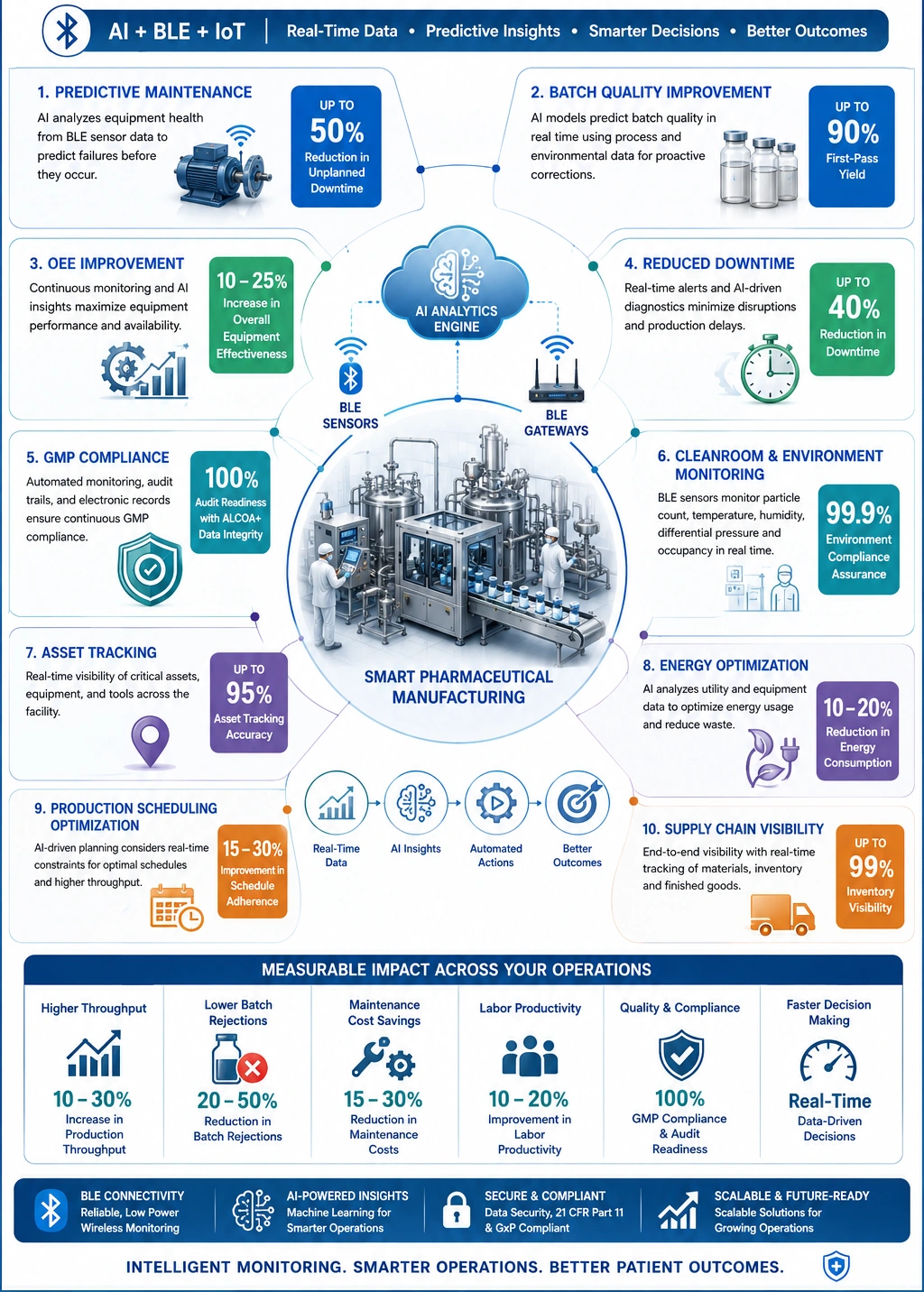
This infographic highlights the measurable operational and business improvements achieved by integrating AI with BLE technologies in pharmaceutical drug manufacturing. It illustrates benefits such as predictive maintenance, improved batch quality, increased Overall Equipment Effectiveness (OEE), reduced downtime, GMP compliance, cleanroom monitoring, asset tracking, energy optimization, production scheduling, and end-to-end supply chain visibility supported by real-time BLE data and AI analytics.
Engineering Best Practices for Successful AI and BLE Deployment
Organizations planning AI-enabled BLE solutions for drug manufacturing should adopt a phased implementation strategy that minimizes operational disruption while maintaining validation and compliance.
Recommended engineering practices include:
- Define measurable business objectives before deployment.
- Conduct wireless site surveys to determine BLE gateway placement.
- Select pharmaceutical-grade BLE sensors suitable for cleanroom and production environments.
- Validate sensor accuracy and calibration procedures.
- Integrate BLE data with existing MES, LIMS, ERP, CMMS, and QMS software.
- Establish cybersecurity policies before commissioning.
- Use edge processing for latency-sensitive manufacturing processes.
- Develop data governance procedures aligned with ALCOA+ principles.
- Continuously retrain AI models using validated production data.
- Monitor AI performance and periodically review prediction accuracy.
- Perform preventive maintenance on gateways and sensing devices.
- Maintain complete audit trails for software changes and system updates.
Organizations frequently begin with environmental monitoring or predictive maintenance projects before expanding AI capabilities across additional manufacturing operations. This phased approach simplifies validation activities while allowing engineering teams to gain operational experience.
GAO has supported organizations by supplying industrial BLE hardware products and IoT systems that integrate with existing pharmaceutical automation environments, helping engineering teams implement scalable monitoring solutions while preserving production continuity.
AI-Enabled BLE Deployment Roadmap for Pharmaceutical Drug Manufacturing
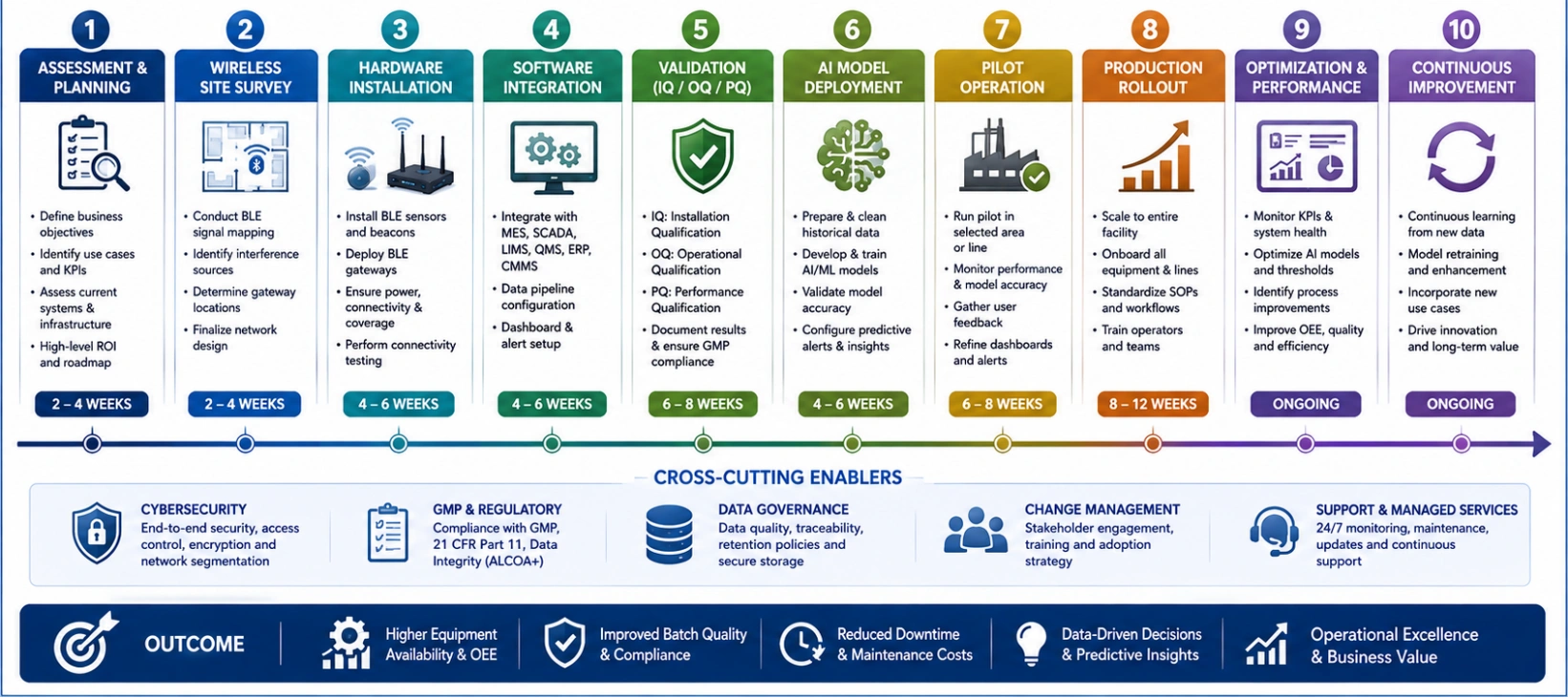
This deployment roadmap illustrates a phased implementation strategy for integrating AI and BLE technologies into pharmaceutical drug manufacturing. It covers assessment, wireless site survey, hardware installation, software integration, GMP validation (IQ/OQ/PQ), AI model deployment, pilot operation, production rollout, optimization, and continuous improvement to help organizations achieve reliable, compliant, and scalable digital manufacturing.
Advancing Intelligent Drug Manufacturing with AI and BLE
AI supported by BLE gateways, BLE sensors, and BLE beacons is enabling pharmaceutical manufacturers to improve production reliability, strengthen regulatory compliance, and enhance operational efficiency across the entire drug manufacturing lifecycle. From environmental monitoring and predictive maintenance to batch quality prediction and intelligent production planning, AI transforms continuously collected operational data into actionable insights that improve decision-making and reduce manufacturing risk.
Successful deployments require careful planning, validated system integration, cybersecurity, and adherence to pharmaceutical regulations. Organizations that combine AI with reliable BLE infrastructure are better positioned to increase production performance, reduce downtime, improve product quality, and maintain compliance in highly regulated manufacturing environments. Leveraging decades of experience in industrial BLE, RFID, and IoT technologies, GAO, headquartered in New York City and Toronto, Canada, continues to provide hardware products, engineering expertise, stringent quality assurance, and remote or onsite technical support to organizations seeking dependable AI-enabled monitoring solutions for pharmaceutical manufacturing.
Building the Future of Industrial AI and IoT with Aperture Venture Studio and GAO RFID Inc.
For more than three decades, GAO Group of Companies has invested heavily in research and development of industrial BLE, RFID, and IoT technologies that support demanding sectors such as drug manufacturing. As generative AI has demonstrated significant value in pharmaceutical production, quality assurance, predictive maintenance, and intelligent monitoring, we founded Aperture Venture Studio to help accelerate the development and adoption of advanced AI and IoT solutions for highly regulated industries, including life sciences and pharmaceutical manufacturing.
Aperture has attracted leading AI researchers, IoT specialists, experienced technology executives, influential investors, and globally recognized organizations focused on advancing intelligent industrial solutions. Together with successful initiatives such as the Aperture Ventures Summit and TekSummit, these efforts have fostered strong technical communities dedicated to AI, BLE, RFID, and industrial IoT innovation.
We welcome professionals and organizations to engage with us as:
- Advisors, co-founders, or employees
- Investors
- Customers seeking advanced AI and BLE technology solutions for drug manufacturing
This collaborative approach, combined with GAO Group’s long-standing commitment to innovation, helps accelerate the practical deployment of intelligent manufacturing technologies across the pharmaceutical industry.