
AI and BLE for Acute Care Hospitals
How AI Improves Acute Care Hospital Asset Tracking
AI and BLE can help acute care hospitals turn real-time equipment location and condition data into actionable operational decisions. BLE beacons, BLE sensors, and BLE gateways provide the underlying data from mobile assets such as infusion pumps, patient beds, wheelchairs, ventilators, portable monitors, mobile workstations, and other high-value equipment. AI software can then analyze location histories, utilization patterns, transport activity, equipment availability, and operational exceptions to support asset tracking and hospital workflow management.
The value extends beyond knowing where an asset is located. AI asset tracking can identify recurring equipment shortages near intensive care units, excessive time spent searching for pumps, abnormal movement patterns, underutilized equipment, bottlenecks in equipment transport, and potential maintenance-related disruptions. For acute care hospitals, these insights can support faster clinical response, improved equipment utilization, reduced avoidable transport activity, and better coordination between nursing, biomedical engineering, central supply, environmental services, and hospital operations.
GAO supplies BLE, RFID, and IoT hardware products and systems that can support these hospital tracking and sensing applications. Its experience serving organizations in the United States and Canada provides a practical foundation for deploying connected equipment systems in demanding operational environments.
AI and BLE Asset Tracking in Acute Care Hospitals
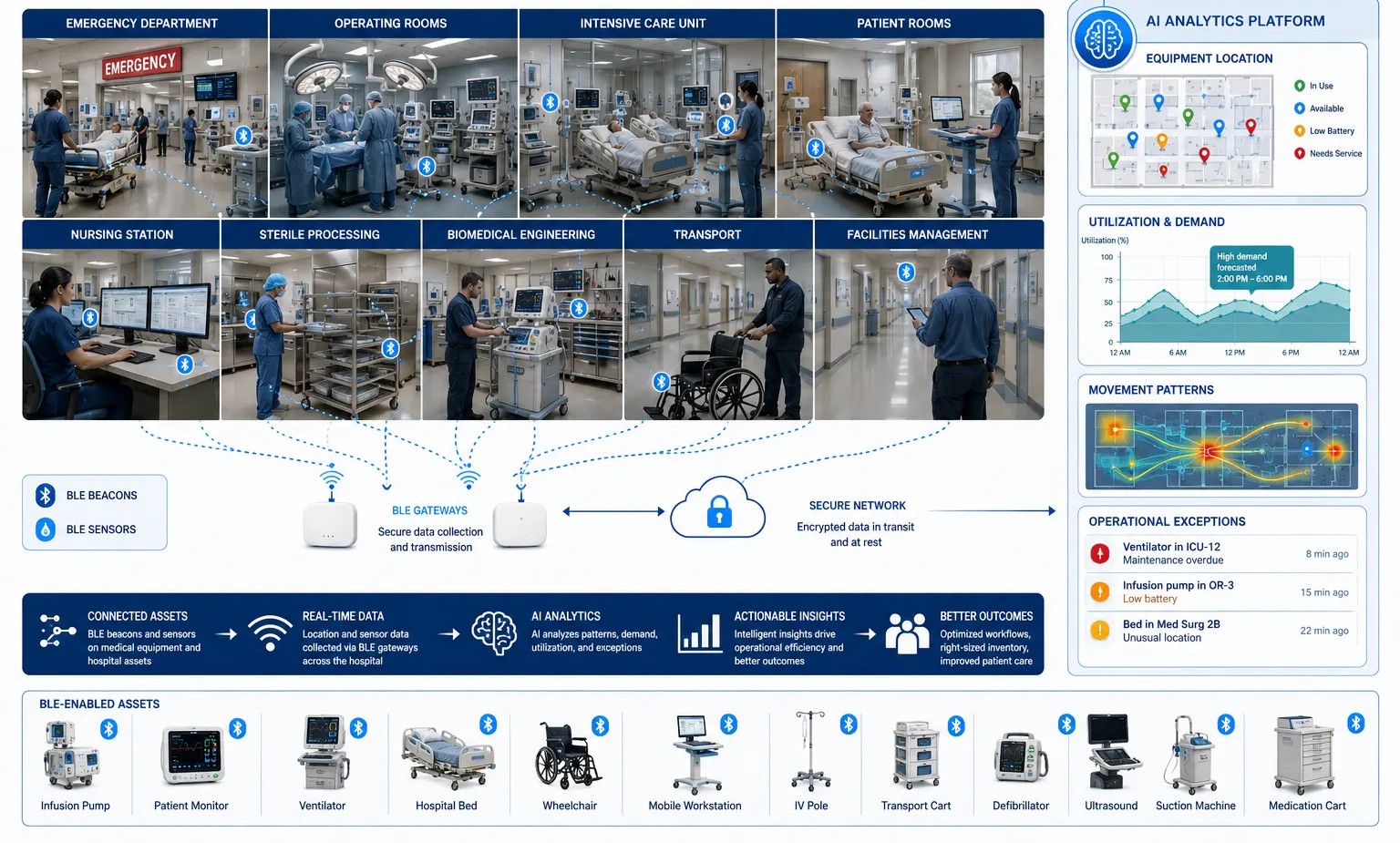
The visual shows how BLE-connected hospital assets generate operational data that AI can analyze for equipment location, utilization, workflow optimization, and exception management.
Why AI Asset Tracking Matters in Acute Care Hospitals
Acute care hospitals operate continuously across emergency departments, operating rooms, intensive care units, medical-surgical units, diagnostic areas, pharmacies, laboratories, sterile processing departments, and support services. Mobile equipment frequently crosses departmental and physical boundaries. A device may be assigned to one unit, temporarily moved to another, sent for cleaning or maintenance, and returned to clinical service without a centralized real-time record of its location and status.
Traditional asset inventories can confirm that equipment exists, but they often cannot explain how equipment moves through clinical operations. AI-enhanced asset tracking addresses this gap by combining location observations with operational data.
Relevant hospital applications include:
- AI medical equipment tracking: Determine the current and historical location of pumps, beds, wheelchairs, ventilators, monitors, mobile workstations, and other movable equipment.
- AI equipment utilization analysis: Identify assets that are heavily used, rarely used, frequently unavailable, or unevenly distributed across hospital units.
- AI equipment demand forecasting: Estimate future equipment requirements from historical utilization, unit activity, scheduled procedures, admissions, and other operational signals.
- AI workflow optimization: Analyze equipment movement and transport patterns to identify avoidable delays and inefficient routing.
- AI maintenance support: Combine equipment location, usage, sensor information, and maintenance records to identify assets requiring inspection or service.
- AI inventory management: Improve visibility into equipment pools and reduce uncertainty caused by inaccurate manual inventory records.
- AI hospital logistics: Analyze movement between clinical departments, storage rooms, biomedical engineering areas, sterile processing, and other locations.
- AI exception detection: Detect unusual equipment movement, unexpected dwell times, prolonged absence from assigned areas, or other deviations from normal operating patterns.
AI Asset Tracking Data Flow for Acute Care Hospitals
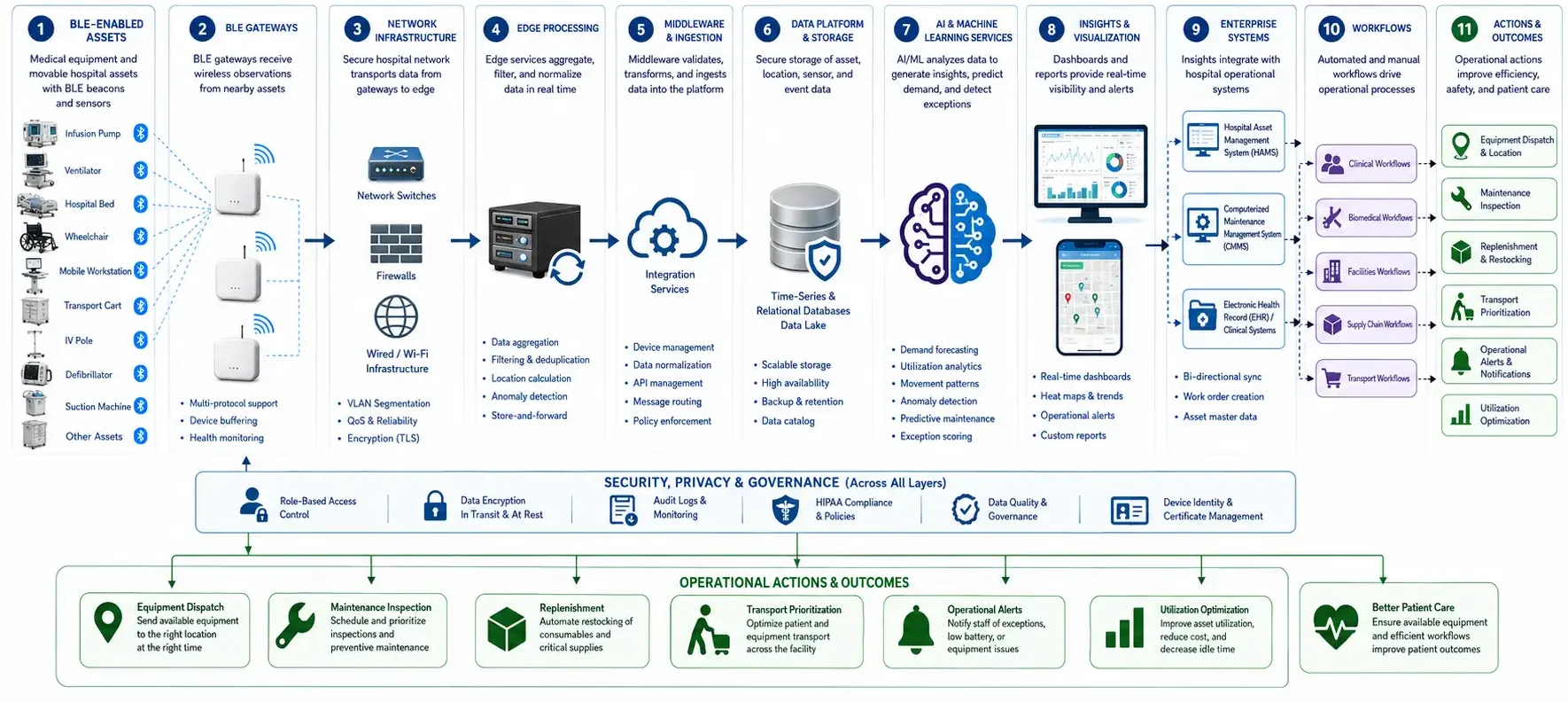
The completed diagram illustrates how BLE observations move through hospital connectivity, software, AI analytics, and operational systems before producing decisions and actions.
Acute Care Hospital Workflows Where AI Delivers Operational Value
AI asset tracking is most useful when it is connected to a specific hospital workflow rather than deployed simply as a location display. The strongest applications connect equipment observations to operational decisions.
Emergency Department Equipment Availability
Emergency departments can experience rapid changes in demand. Portable monitors, infusion pumps, wheelchairs, stretchers, mobile workstations, and other equipment may move quickly between treatment areas.
BLE location data can establish where equipment is physically located. AI can analyze historical demand and movement patterns to identify equipment availability problems and predict periods when specific equipment categories may become constrained. Operations personnel can use these insights to reposition equipment before a shortage affects patient flow.
Intensive Care Unit Equipment Allocation
ICUs require reliable access to high-value clinical equipment. Equipment may be assigned to individual rooms but later moved temporarily to another patient or treatment area.
AI can evaluate equipment location, utilization, movement frequency, and time spent outside designated areas. This can help hospital operations identify whether shortages are caused by insufficient inventory, poor distribution, delayed returns, maintenance downtime, or inefficient equipment circulation.
Operating Room and Perioperative Logistics
Operating rooms depend on coordinated movement of equipment and supplies. Portable devices may be moved between procedure rooms, storage areas, biomedical engineering, and other departments.
AI can analyze recurring movement sequences and dwell times to identify operational bottlenecks. Historical data can also help estimate equipment demand associated with scheduled procedures and recurring operating room activity.
Biomedical Engineering and Maintenance
Biomedical engineering teams need to locate equipment before inspection, preventive maintenance, calibration, repair, or service. A manual search can consume valuable technician time.
BLE-enabled asset tracking can provide the last known or current location of tagged equipment. AI can combine location history with utilization and maintenance information to identify patterns such as equipment repeatedly requiring service, unusually high utilization, or assets remaining unavailable longer than expected.
Patient Transport and Support Services
Wheelchairs, stretchers, patient transport equipment, mobile devices, and other shared assets can become distributed across large hospital facilities.
AI can analyze movement patterns and demand by location and time. This can support transport planning and help operations teams determine whether equipment should be repositioned closer to high-demand areas.
Environmental Services and Equipment Turnaround
Equipment frequently moves through cleaning, disinfection, storage, clinical use, and maintenance workflows. Location data alone does not establish whether equipment is ready for clinical use, so status information and operational workflow integration remain important.
A properly designed system can associate location observations with equipment status from hospital software or sensors. AI can then identify unusually long turnaround times and recurring process bottlenecks.
Acute Care Hospital AI and BLE Data Lifecycle
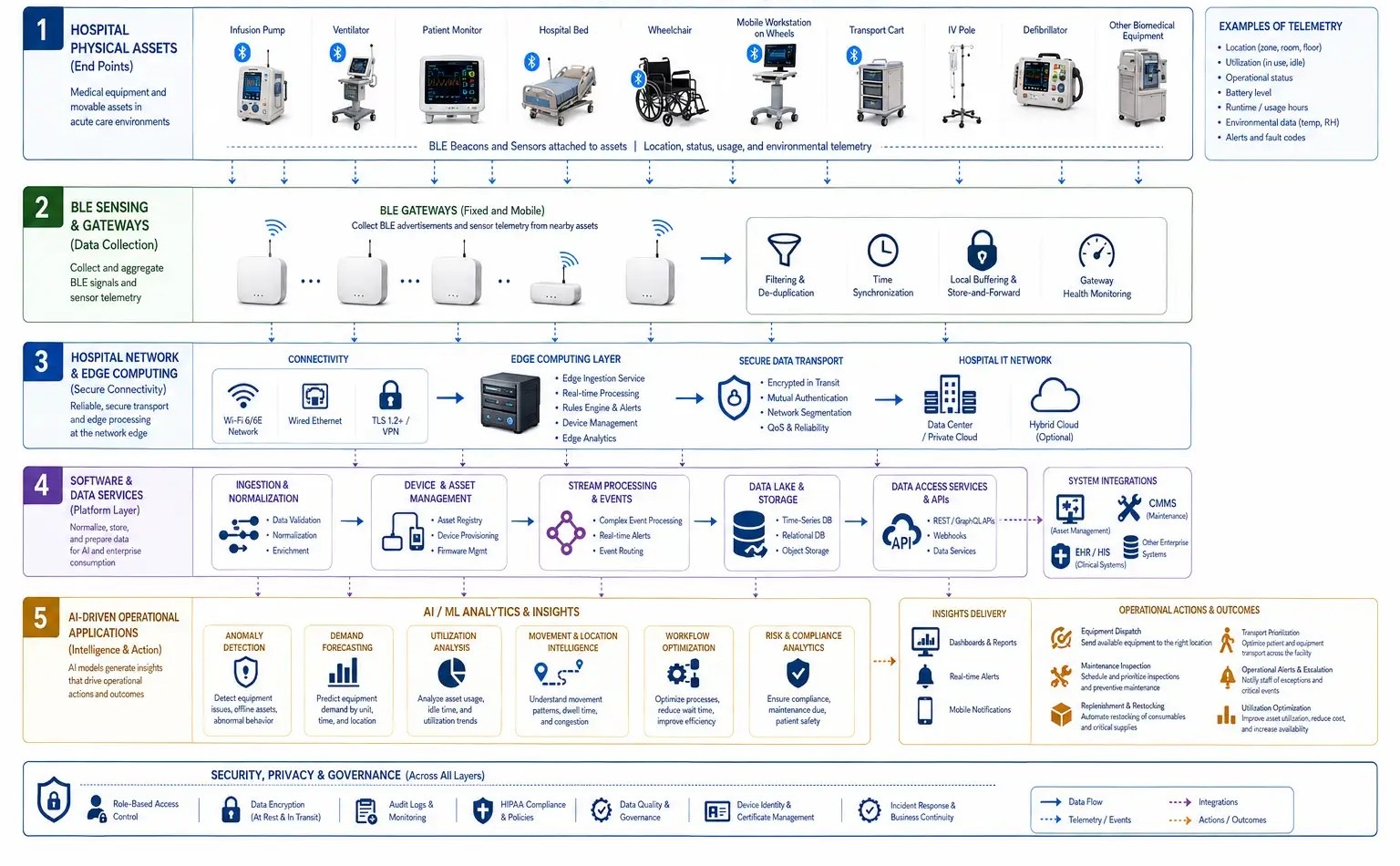
The visual maps physical hospital assets through BLE sensing, network infrastructure, data processing, AI analytics, and operational systems.
AI, BLE, and the Acute Care Hospital Data Lifecycle
A practical AI asset tracking solution begins with reliable data acquisition and ends with a defined operational action. The complete workflow commonly includes sensing, wireless communication, data processing, software integration, analytics, and human decision-making.
- Data acquisition: BLE beacons identify assets, while BLE sensors can provide information such as temperature, motion, or other measurable conditions where appropriate.
- BLE communication: Nearby BLE gateways receive beacon or sensor transmissions and forward relevant observations through the hospital network.
- Gateway processing: Gateways can filter or preprocess wireless observations before sending them to centralized software.
- Network transport: Hospital Ethernet, Wi-Fi, cellular connectivity, or other approved network infrastructure can carry data between gateways, servers, and software services.
- Edge processing: Local processing can reduce latency, filter data, and maintain selected functions when connectivity to centralized systems is interrupted.
- Middleware: Middleware normalizes device observations and converts raw wireless events into usable asset, location, and sensor records.
- Data storage: Historical records support asset history, utilization analysis, movement analysis, reporting, and machine learning.
- AI analytics: Machine learning models can identify patterns, predict demand, detect anomalies, classify operating conditions, and support optimization.
- Enterprise software integration: Relevant information can be connected with asset management, computerized maintenance management, inventory, facilities, clinical, scheduling, or other hospital information systems.
- Operational action: Staff can use alerts, dashboards, recommendations, work orders, or automated workflows to reposition equipment, initiate maintenance, investigate exceptions, or adjust inventory.
The critical engineering point is that AI should not operate independently from hospital workflows. A prediction has operational value only when a responsible team can interpret it and take an appropriate action.
Hospital Deployment Considerations for BLE and AI
Acute care hospitals present specific engineering constraints that should be considered before equipment tracking infrastructure is installed. Clinical areas may contain dense walls, medical equipment, people, carts, beds, and other objects that affect radio propagation. A location solution therefore requires site-specific testing rather than relying solely on theoretical coverage estimates.
Gateway placement should account for floor plans, clinical unit boundaries, equipment movement routes, radio interference, network availability, power requirements, and areas where location accuracy is particularly important. Emergency departments, operating rooms, ICUs, sterile processing areas, equipment storage rooms, and biomedical engineering departments may require different deployment priorities.
Tag and sensor selection should also reflect the asset. A beacon attached to a wheelchair has different physical and operational requirements from one attached to a ventilator or mobile infusion pump. Attachment method, battery life, cleaning procedures, enclosure characteristics, size, and maintenance requirements should be evaluated before deployment.
AI model performance depends heavily on the quality of the underlying location and utilization data. Hospitals should establish data-quality metrics such as gateway connectivity, observation frequency, missing events, battery status, duplicate asset identifiers, and discrepancies between digital records and physical equipment.
GAO’s BLE and IoT hardware products can serve as the sensing and connectivity components of these deployments, while system design should be adapted to the hospital’s physical environment, network controls, operational workflows, and integration requirements.
Cloud and Server Deployment for Acute Care Hospital AI
Acute care hospitals can use either a cloud-hosted software deployment or a privately hosted server deployment, depending on security requirements, network policies, integration constraints, operational preferences, and data governance.
Cloud Version
A cloud-hosted SaaS deployment can centralize BLE observations, asset records, analytics, dashboards, and AI processing in managed cloud infrastructure. This model can be appropriate when a hospital or healthcare organization wants centralized administration across multiple facilities and has approved connectivity and security controls for the required data flows.
Cloud deployment can simplify software scaling and support centralized analytics across hospital campuses. It can also make it easier to compare asset utilization between facilities when governance and integration requirements permit.
Server Version
A Server Version can run on customer-managed edge servers, hospital servers, private data centers, or other privately hosted infrastructure. This approach may be appropriate when hospital IT teams require tighter control over data location, network connectivity, software integration, or local processing.
A privately hosted deployment can also reduce dependence on external connectivity for selected operational functions. Edge servers may process gateway data locally before forwarding selected information to other hospital systems.
The choice should be made through a technical assessment rather than treating cloud or private hosting as universally superior. Factors include network reliability, cybersecurity controls, data governance, hospital IT capabilities, integration requirements, latency, software maintenance responsibilities, and the number of facilities participating in the deployment.
Cloud and Server Deployment Options for Hospital AI Asset Tracking
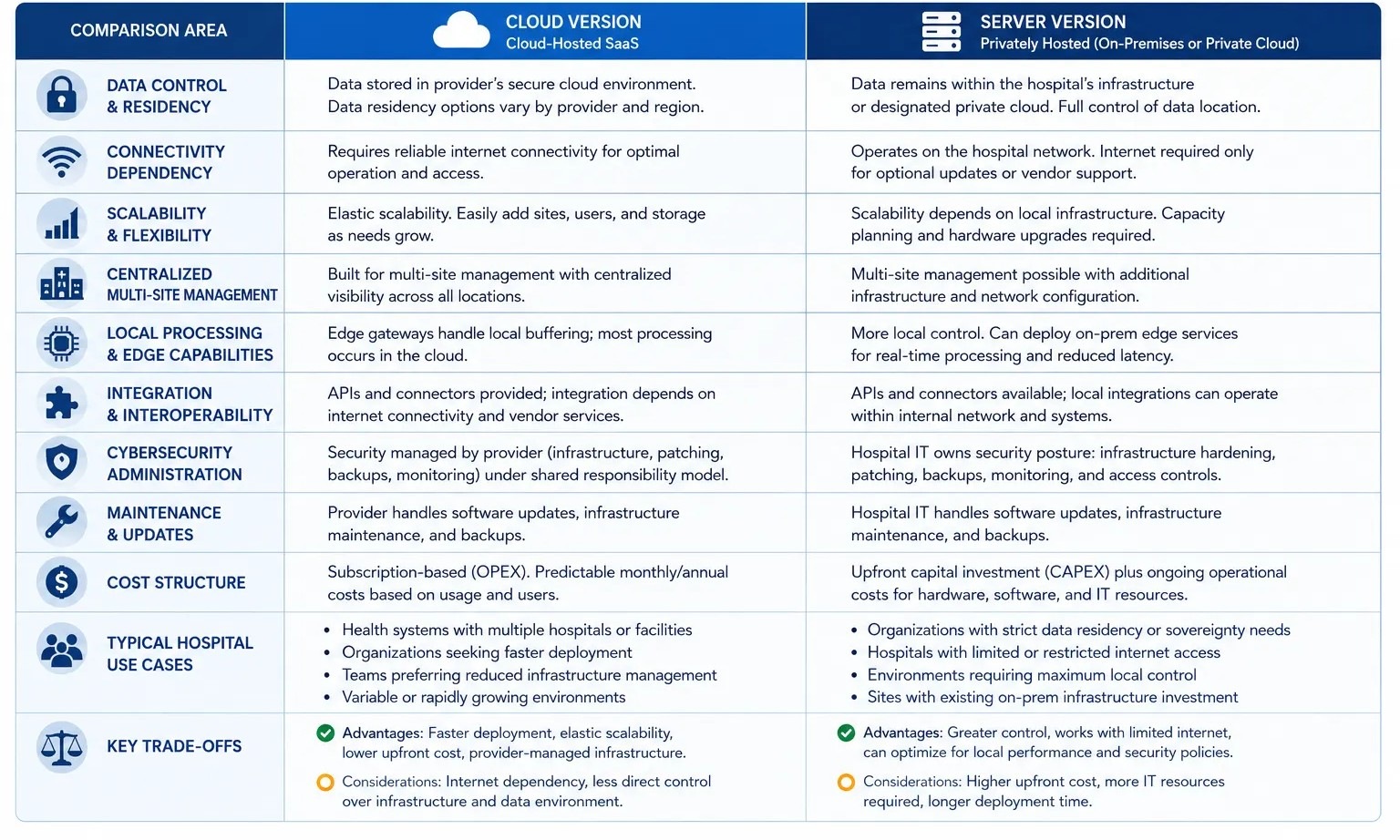
The comparison highlights the operational and technical trade-offs between cloud-hosted and privately hosted AI asset tracking software for acute care hospitals.
BLE Hardware, AI Software, and Supporting Technologies
A hospital AI asset tracking solution normally combines several technical components rather than relying on BLE alone.
- BLE beacons: Provide identifiable wireless transmissions associated with movable hospital assets.
- BLE sensors: Add telemetry such as motion or environmental measurements where required by the application.
- BLE gateways: Collect wireless observations and forward them to hospital software through available network infrastructure.
- Edge computing: Supports local filtering, event processing, buffering, and selected low-latency functions.
- Middleware: Converts device-level events into standardized records that downstream software can consume.
- Databases: Store asset identity, location observations, sensor measurements, maintenance information, and historical events.
- AI and machine learning: Support forecasting, anomaly detection, utilization analysis, classification, and operational recommendations.
- Dashboards: Give clinical engineering, nursing operations, facilities, transport, and management teams a practical interface for reviewing current conditions and trends.
- APIs: Allow tracking information to interact with hospital asset management, maintenance, inventory, and other software.
- Security controls: Should include authentication, authorization, encrypted communications, controlled device provisioning, network segmentation where appropriate, audit logging, software update procedures, and lifecycle management.
- Hospital network infrastructure: Provides the connectivity required to move gateway data to local or centralized software.
The engineering objective is not simply to collect more data. It is to produce trustworthy operational information with sufficient accuracy, availability, and context for hospital personnel to make decisions.
Engineering Priorities Before Hospital Deployment
A successful deployment should establish measurable requirements before hardware installation and AI model development.
- Define which hospital assets require tracking and why their location matters operationally.
- Identify the clinical and support workflows affected by equipment availability or movement.
- Establish required location accuracy by zone or workflow rather than assuming every asset needs identical precision.
- Test BLE radio performance in representative patient-care and support areas.
- Determine gateway density from measured site conditions and required observation reliability.
- Establish asset identification and naming conventions before onboarding equipment.
- Define ownership for battery replacement, beacon inspection, gateway maintenance, and data-quality monitoring.
- Determine how AI recommendations will be reviewed and who is responsible for acting on them.
- Establish integration requirements for hospital asset management and maintenance systems.
- Validate cybersecurity, network, authentication, access control, and software update requirements with hospital IT.
- Define baseline KPIs before deployment so operational improvements can be measured against existing performance.
- Commission the system in a controlled clinical area before scaling across additional departments.
These controls help prevent a common implementation problem: deploying wireless tracking infrastructure successfully but failing to connect its data to a workflow that produces measurable operational value.
Technical Capabilities and Operational Benefits of AI Asset Tracking
AI-enabled asset tracking becomes significantly more valuable when hospital location data is combined with operational context. A BLE observation can indicate where equipment was detected, but AI can determine whether that observation represents normal circulation, an emerging shortage, an unusual dwell time, or a workflow problem.
For acute care hospitals, the most important capabilities include:
- Real-time asset visibility:Staff can identify the current or most recently detected location of movable equipment without conducting a physical search.
- Historical movement analysis:Location histories reveal how equipment moves between patient-care units, storage areas, maintenance departments, and other hospital zones.
- Utilization analysis:AI can distinguish equipment that is heavily utilized from equipment that remains idle for extended periods.
- Demand forecasting:Machine learning can use historical demand, time of day, department activity, scheduled procedures, and other available variables to estimate future equipment requirements.
- Anomaly detection:AI can flag unusual movement, prolonged dwell times, unexpected department transfers, or other deviations from established operating patterns.
- Equipment availability analysis:Hospitals can identify whether an apparent shortage is related to insufficient inventory, uneven distribution, maintenance downtime, cleaning delays, or equipment being left in another department.
- Workflow optimization:Movement data can reveal repeated transport patterns, unnecessary trips, and bottlenecks between clinical and support departments.
- Maintenance intelligence:Equipment utilization and location history can complement preventive maintenance and repair records.
- Operational forecasting:Historical data can help hospital managers anticipate recurring equipment requirements associated with seasonal demand, scheduled procedures, or changes in patient volume.
- Exception-based management:Rather than manually reviewing thousands of location events, staff can focus on events that AI identifies as operationally significant.
The objective is not to automate every hospital decision. The practical objective is to reduce the amount of manual searching and data interpretation required before staff can make a sound operational decision.
AI Models for Acute Care Hospital Operations
Different hospital applications require different analytical methods. A single AI model should not be expected to solve every asset tracking or workflow problem.
Anomaly Detection
Anomaly detection can establish normal movement patterns for a class of hospital equipment and identify observations that differ significantly from those patterns.
For example, if infusion pumps normally circulate between an ICU, equipment storage area, and biomedical engineering department, an unusually long stay in an unrelated location could generate an operational exception for investigation.
Anomaly detection is particularly useful when the hospital does not have enough labeled historical data to train a highly specialized predictive model.
Demand Forecasting
Demand forecasting can estimate future equipment requirements based on historical utilization and available operational variables.
A hospital may analyze:
- Equipment demand by department
- Hourly and daily utilization
- Admission and discharge patterns
- Scheduled surgical procedures
- Emergency department activity
- Seasonal changes
- Equipment downtime
- Historical shortages
- Equipment redistribution patterns
Forecasting can help operations teams reposition shared equipment before demand increases rather than responding after a shortage occurs.
Utilization Classification
AI can classify assets according to operational behavior, such as high utilization, low utilization, frequent movement, long idle periods, or repeated maintenance events.
These classifications can support equipment fleet planning and help identify whether additional equipment is genuinely required or whether existing inventory is being distributed inefficiently.
Predictive Maintenance Support
Location and utilization data can provide additional context for predictive maintenance models. An asset that operates continuously in a high-demand clinical environment may experience a different usage profile from an identical device that remains in storage.
AI can combine equipment usage patterns with maintenance records and sensor data where available. The resulting analysis can help biomedical engineering teams prioritize inspections and investigate abnormal operating behavior.
AI Methods for Acute Care Hospital Asset Management
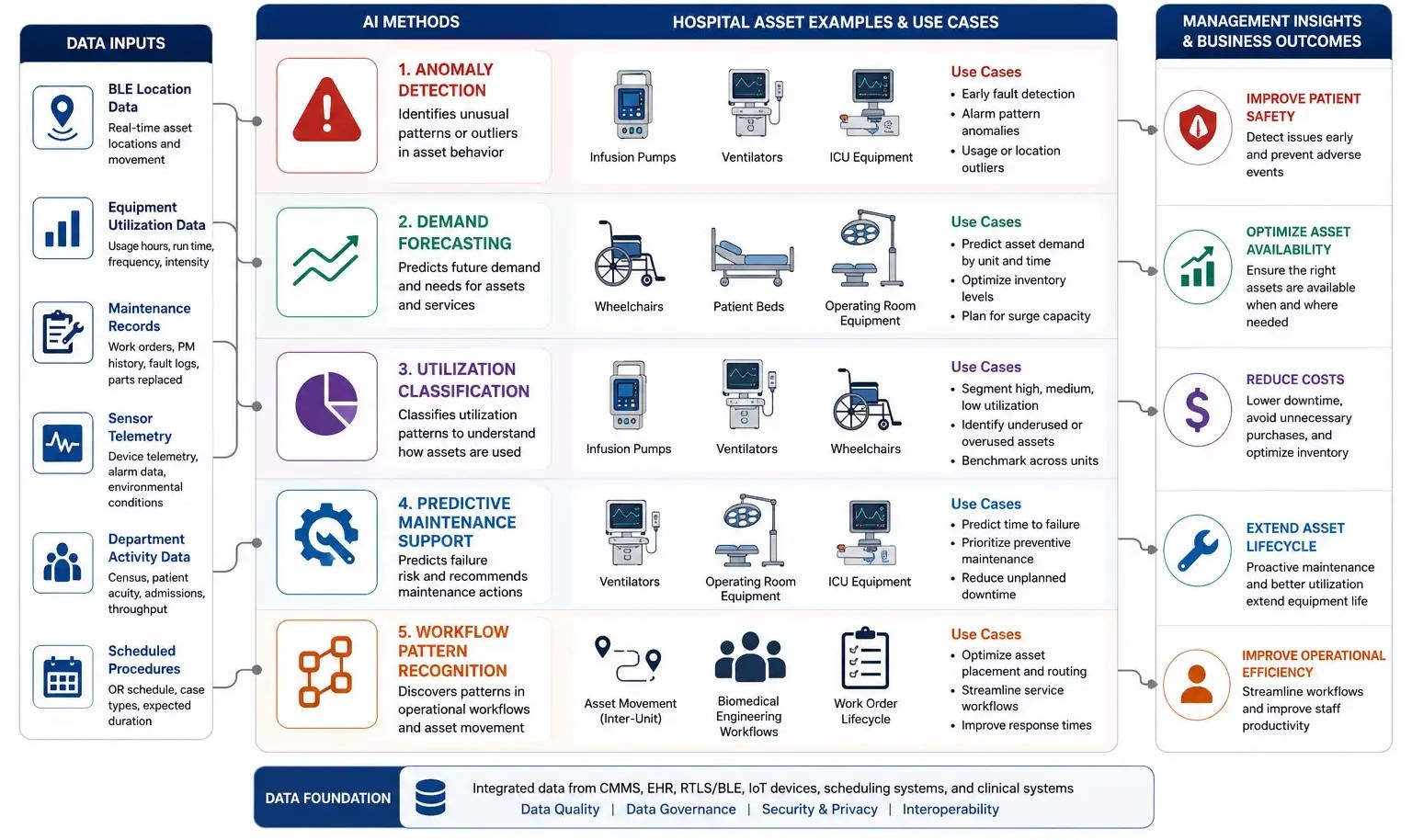
The infographic shows how different AI methods convert hospital asset, location, utilization, and operational data into specific management insights.
Hospital KPIs for AI-Driven Asset Tracking
AI asset tracking should be evaluated using measurable operational outcomes rather than the number of BLE devices installed or the volume of data collected.
Relevant KPIs for acute care hospitals include:
- Average equipment search time
- Equipment availability rate
- Equipment utilization rate
- Equipment idle time
- Equipment turnaround time
- Equipment transport time
- Equipment dwell time by department
- Percentage of equipment located within designated zones
- Missing or unlocated equipment rate
- Preventive maintenance compliance
- Mean time to locate equipment for maintenance
- Mean time to repair
- Equipment downtime
- Asset redistribution frequency
- Equipment shortage frequency
- Equipment surplus by department
- Emergency equipment retrieval time
- Operating room equipment availability
- ICU equipment availability
- Emergency department equipment availability
- Wheelchair and stretcher availability
- Biomedical engineering technician search time
- Asset inventory accuracy
- BLE gateway availability
- BLE observation success rate
- Beacon battery replacement frequency
- Location data completeness
- AI alert precision
- AI alert response time
- Operational exceptions resolved within target time
Hospitals should establish baseline measurements before deployment. For example, if biomedical engineering technicians currently spend substantial time locating devices for preventive maintenance, the baseline search time should be documented before introducing AI-assisted tracking.
Post-deployment performance can then be compared against the baseline. This provides a more meaningful evaluation than simply reporting the number of assets tagged.
Cybersecurity and Data Governance for Hospital BLE Systems
BLE tracking systems in acute care hospitals should be treated as part of the hospital’s broader connected-device environment. Security requirements should cover devices, gateways, networks, software, user accounts, APIs, data storage, and operational processes.
BLE itself should not be treated as the complete security mechanism. A secure implementation requires controls across the entire data path.
Important considerations include:
- Unique identification of BLE devices and gateways
- Controlled device provisioning
- Authentication between gateways and backend systems
- Encrypted communications where supported and appropriate
- Role-based access control
- Least-privilege access
- Secure API authentication
- Network segmentation where appropriate
- Firewall and network access controls
- Audit logging
- Security monitoring
- Controlled firmware and software updates
- Battery and device lifecycle management
- Removal of retired devices from authorized inventories
- Protection of historical location records
- Secure credential management
- Backup and recovery procedures
- Incident response procedures
- Vendor and third-party access controls
Hospitals should also distinguish between equipment tracking data and patient-identifiable clinical information. An asset location record does not automatically constitute patient data, but location information can become sensitive when combined with patient assignments, room information, staff identities, or clinical workflow records.
System design should therefore minimize unnecessary data collection and establish appropriate retention, access, and integration policies.
GAO’s role in such deployments can include supplying the BLE and IoT hardware components while hospital IT and clinical engineering teams establish the required cybersecurity, network, and governance controls for the complete implementation.
Interoperability with Hospital Information Systems
AI asset tracking produces the greatest operational value when it can exchange information with the software already used by hospital personnel.
Potential integration targets include:
- Computerized Maintenance Management Systems (CMMS)
- Enterprise Asset Management (EAM) software
- Biomedical equipment management systems
- Inventory management software
- Facilities management software
- Supply chain systems
- Hospital scheduling systems
- Workforce management systems
- Service management systems
- Business intelligence software
- Data warehouses
- Hospital dashboards
- Building management systems where relevant
Integration can occur through APIs, databases, middleware, message-based interfaces, or other approved mechanisms.
A useful integration pattern separates device-level communication from hospital application logic. BLE gateways should not need to understand every business rule used by the hospital. Instead, gateway observations can be delivered to middleware that normalizes the data and makes it available to downstream applications.
This separation improves maintainability because changes to an asset management system do not necessarily require changes to the BLE gateway layer.
Location Accuracy and BLE Deployment Engineering
Location accuracy is one of the most important engineering considerations in hospital asset tracking.
Hospitals should first define what “location” means for each workflow. An ICU equipment application may require reliable identification of the correct clinical zone, while another application may require room-level or more precise positioning.
Factors affecting BLE location performance include:
- Building construction
- Wall materials
- Floor layout
- Metal medical equipment
- Hospital beds
- Carts and cabinets
- Human occupancy
- Gateway placement
- Radio interference
- Beacon transmission settings
- Gateway density
- Antenna characteristics
- Asset orientation
- Asset movement
- Battery condition
- Network availability
A hospital should therefore conduct a radio survey and pilot deployment before finalizing gateway placement.
Testing should use actual representative equipment and typical operating conditions. A laboratory test with empty rooms may not accurately represent a crowded ICU, emergency department, or equipment storage area.
Deployment, Commissioning, and Testing
A disciplined commissioning process reduces deployment risk.
Planning and Site Assessment
The project should begin by identifying:
- Assets to be tracked
- Departments involved
- Required location granularity
- Operational workflows
- Existing asset identifiers
- Network availability
- Gateway mounting locations
- Power requirements
- Security requirements
- Integration requirements
- AI use cases
- Baseline KPIs
Hardware Selection
BLE beacons and sensors should be selected according to the asset and operating environment.
Important selection criteria include:
- Battery life
- Transmission configuration
- Physical dimensions
- Attachment method
- Enclosure characteristics
- Cleaning compatibility
- Sensor requirements
- Maintenance requirements
- Environmental conditions
- Gateway compatibility
Pilot Deployment
A pilot should cover a representative hospital environment rather than an isolated office or laboratory.
Useful pilot areas may include:
- ICU
- Emergency department
- Medical-surgical unit
- Operating room area
- Equipment storage
- Biomedical engineering
- Patient transport
- Sterile processing
Pilot results should be compared against predefined technical and operational acceptance criteria.
Commissioning
Commissioning should validate:
- BLE beacon detection
- Gateway connectivity
- Asset identity mapping
- Location zone configuration
- Data transmission
- Database records
- Dashboard visibility
- API integration
- Alert generation
- AI data quality
- Security controls
- Battery monitoring
- Failure recovery
Optimization
After commissioning, the system should be evaluated using actual operating data.
Gateway positions, beacon settings, alert thresholds, AI models, dashboards, and workflows may require adjustment based on observed hospital conditions.
Scaling AI Asset Tracking Across Hospital Facilities
Once a pilot has demonstrated measurable value, expansion should occur by workflow and operational priority rather than simply by adding more BLE devices.
A practical expansion sequence may begin with high-value movable equipment and then extend to additional asset classes.
Potential expansion areas include:
- Infusion pumps
- Patient beds
- Wheelchairs
- Stretchers
- Portable monitors
- Ventilators
- Mobile workstations
- Patient transport equipment
- Diagnostic equipment
- Biomedical equipment
- Emergency equipment
- Specialty equipment
Multi-facility healthcare organizations can also use centralized analytics to compare equipment utilization, availability, and movement between hospitals when data governance permits.
AI can identify differences between facilities and help determine whether equipment shortages are caused by actual fleet size or by differences in distribution and utilization.
GAO can support such expansion by supplying BLE and IoT hardware products and systems suited to the selected hospital applications.
Practical Implementation Lessons for Acute Care Hospitals
Several engineering lessons are particularly important.
- Start with an operational problem:Equipment tracking should solve a defined problem such as excessive search time, poor equipment utilization, or maintenance delays.
- Do not equate visibility with optimization:Knowing where equipment is located is useful, but AI is required to derive higher-level patterns and predictions.
- Measure before deployment:Baseline data is necessary to demonstrate measurable improvement.
- Test in real clinical environments:Radio behavior can differ substantially between controlled tests and active patient-care areas.
- Separate location from clinical status:An asset being physically present in a room does not necessarily mean it is clean, available, functional, or assigned to that workflow.
- Use workflow context:AI recommendations become more useful when equipment location is combined with operational information.
- Design for maintenance:Battery replacement, gateway maintenance, device inspection, and software updates should be included in the lifecycle plan.
- Protect data throughout the system:Security should cover devices, gateways, networks, software, APIs, and users.
- Avoid unnecessary data collection:Collect information needed for the defined hospital use case and establish appropriate retention policies.
- Scale from validated use cases:Expansion should follow demonstrated operational value rather than device-count targets.
Building Measurable Business Value from AI Hospital Asset Tracking
The business case for AI asset tracking should connect technical capabilities to measurable hospital outcomes.
Reduced equipment search time can return staff time to clinical and operational activities. Better utilization can potentially reduce the need to purchase additional equipment solely because existing inventory is difficult to locate. Improved maintenance visibility can help biomedical engineering teams find equipment more quickly and prioritize work.
More accurate demand forecasting can also support equipment distribution between departments. When utilization is analyzed across an entire facility, management can distinguish between a true shortage and an equipment allocation problem.
Operational benefits may therefore appear in several areas:
- More effective utilization of existing equipment
- Reduced manual asset searches
- Faster equipment retrieval
- Better biomedical engineering productivity
- Improved equipment availability
- More informed capital planning
- Reduced equipment duplication
- Better maintenance coordination
- Faster identification of operational exceptions
- Improved visibility into hospital logistics
The appropriate financial evaluation should use the hospital’s own baseline costs, staffing model, equipment inventory, maintenance workload, and procurement patterns.
GAO’s Role in AI and BLE Hospital Solutions
Headquartered in New York City and Toronto, Canada, GAO is among the leading B2B and B2G suppliers of BLE and RFID technologies. GAO, together with its sister companies GAO Research and GAO Tek, forms GAO Group, serving customers across the United States and Canada.
For three decades, GAO Group has supplied technology products and systems to organizations including Fortune 500 companies, research and development organizations, universities, and government agencies. Its product development approach emphasizes research and development, quality assurance, and technical support.
For acute care hospitals, that experience is relevant when BLE gateways, beacons, sensors, and related IoT hardware must operate as part of a larger technical system. GAO can provide hardware products and system components that integrators, hospital IT teams, biomedical engineering departments, and solution architects can incorporate into hospital asset tracking and sensing deployments.
The appropriate solution still depends on the hospital’s clinical workflows, physical environment, IT policies, security requirements, integration needs, and measurable operational objectives.
Recommended AI and BLE Use Cases by Hospital Department
| Hospital Area | AI Application | BLE Data Contribution | Potential Operational KPI |
| Emergency Department | Equipment demand forecasting | Equipment location and movement | Equipment retrieval time |
| ICU | Equipment utilization analysis | Room and zone observations | Equipment availability |
| Operating Rooms | Equipment workflow optimization | Movement and dwell time | Equipment turnaround time |
| Biomedical Engineering | Maintenance prioritization | Current and historical location | Technician search time |
| Patient Transport | Equipment allocation | Wheelchair and stretcher location | Transport response time |
| Medical-Surgical Units | Equipment availability analysis | Equipment distribution | Search time |
| Sterile Processing | Turnaround analysis | Equipment movement | Processing turnaround |
| Equipment Storage | Inventory optimization | Asset presence and movement | Inventory accuracy |
| Facilities | Exception monitoring | Equipment movement | Unlocated asset rate |
| Hospital Operations | Fleet optimization | Cross-department movement | Utilization rate |
AI Asset Tracking Applications Across Acute Care Hospital Departments
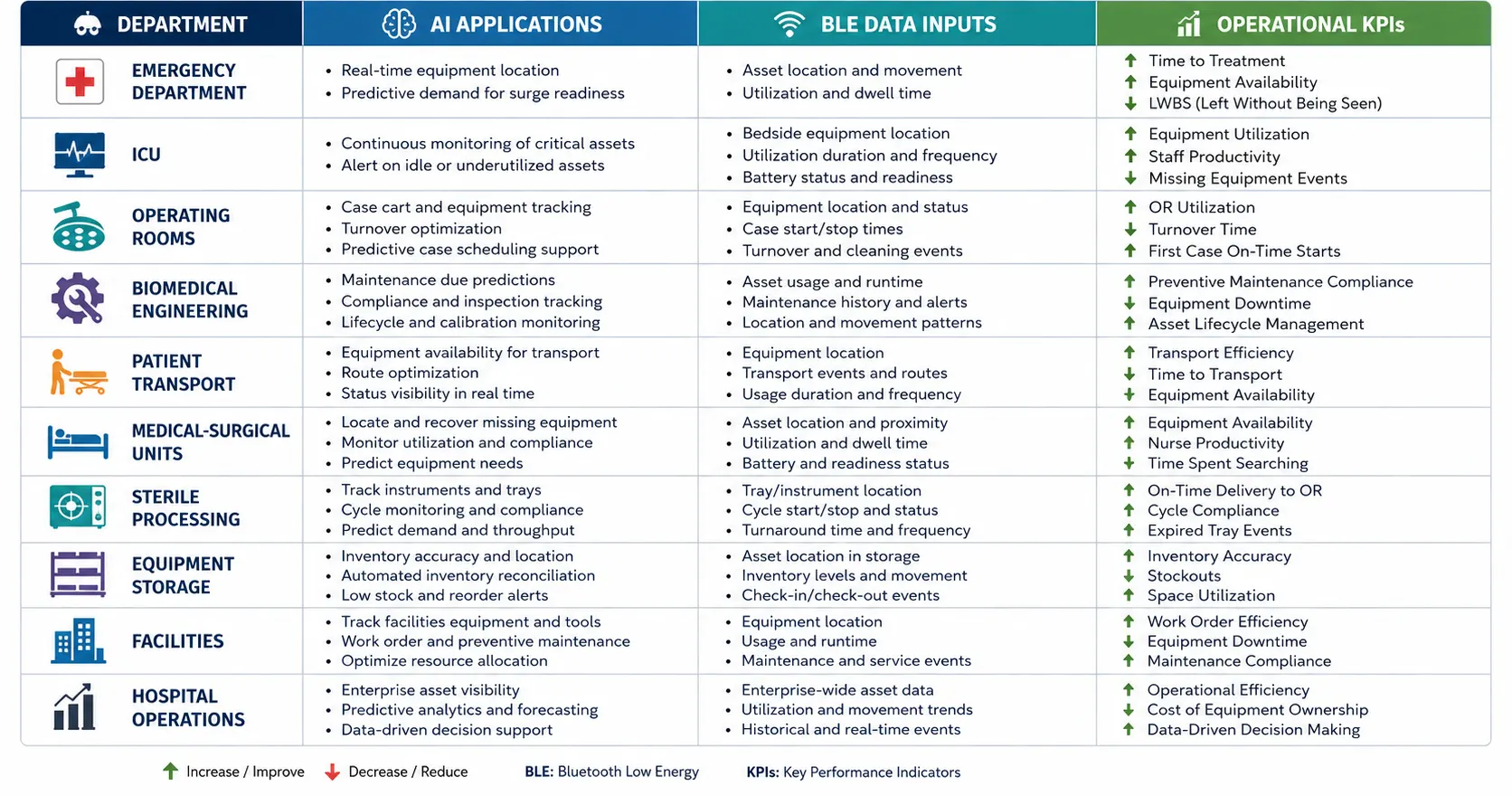
The matrix connects hospital departments with practical AI applications, BLE data sources, and measurable operational outcomes.
Key Takeaways for Acute Care Hospital AI Deployment
AI asset tracking can transform BLE location observations into operational intelligence for acute care hospitals. The strongest deployments do not treat location tracking as an isolated technology project. They connect equipment visibility with clinical support workflows, biomedical engineering, patient transport, inventory management, maintenance, and hospital operations.
The technical foundation consists of BLE beacons, BLE sensors, BLE gateways, hospital networking, edge or centralized processing, middleware, databases, AI models, dashboards, and enterprise software integration. The final value depends on data quality, location performance, cybersecurity, interoperability, and the ability of hospital personnel to act on AI-generated information.
Hospitals evaluating these systems should begin with measurable operational problems, establish baseline KPIs, conduct site-specific BLE testing, validate integrations, and deploy in controlled phases. Cloud and Server Version deployments should be selected according to hospital IT, security, governance, integration, and operational requirements.
GAO can support these initiatives with BLE, RFID, and IoT hardware products and systems, technical expertise, and remote or onsite support. Hospitals, system integrators, and engineering teams can learn more about GAO’s technology solutions and determine which hardware and software components best fit their acute care workflows.
Building the Future of Industrial AI and IoT with Aperture Venture Studio and GAO RFID Inc.
For more than three decades, GAO Group of Companies has invested heavily in R&D for industrial BLE, RFID, and IoT technologies. As AI has become increasingly useful for connected operational systems, we have continued developing AI and IoT solutions that can support applications such as acute care hospital asset tracking, equipment utilization, workflow analysis, and intelligent facility operations. We have also founded Aperture Venture Studio to help advance AI and IoT solutions relevant to healthcare and other demanding operational environments.
Aperture has attracted AI and IoT technical experts, entrepreneurial and operational executives, investors, and leading companies. We have also developed the Aperture Ventures Summit and TekSummit to facilitate discussion of advanced AI and IoT technologies.
These activities have contributed to technical communities focused on practical AI and IoT development. We welcome participation as:
- Advisors, co-founders, or employees
- Investors
- Customers