
AI and BLE for Aerospace Components
AI-Driven Visibility for Aerospace Components
AI for aerospace components uses connected sensing, machine learning, computer vision, and operational analytics to improve the identification, location, condition monitoring, traceability, and handling of components throughout engineering, manufacturing, inspection, storage, maintenance, and MRO operations. BLE beacons, BLE sensors, and BLE gateways provide a practical wireless data-acquisition layer for components, containers, tooling, work-in-process material, and controlled environments.
For aerospace component manufacturers, MRO organizations, aircraft suppliers, and engineering facilities, the value comes from connecting physical component activity with digital records. AI can correlate location, environmental conditions, handling events, inspection information, production status, and maintenance history to identify anomalies and support operational decisions. The resulting solution can help reduce search time, improve inventory accuracy, strengthen chain-of-custody records, identify abnormal environmental exposure, and prioritize maintenance or inspection activities.
GAO supplies BLE, RFID, sensing, and IoT hardware products and systems that can be incorporated into such deployments, with implementation choices determined by the component type, facility layout, required data latency, wireless environment, and existing aerospace software.
AI and BLE for Aerospace Component Operations
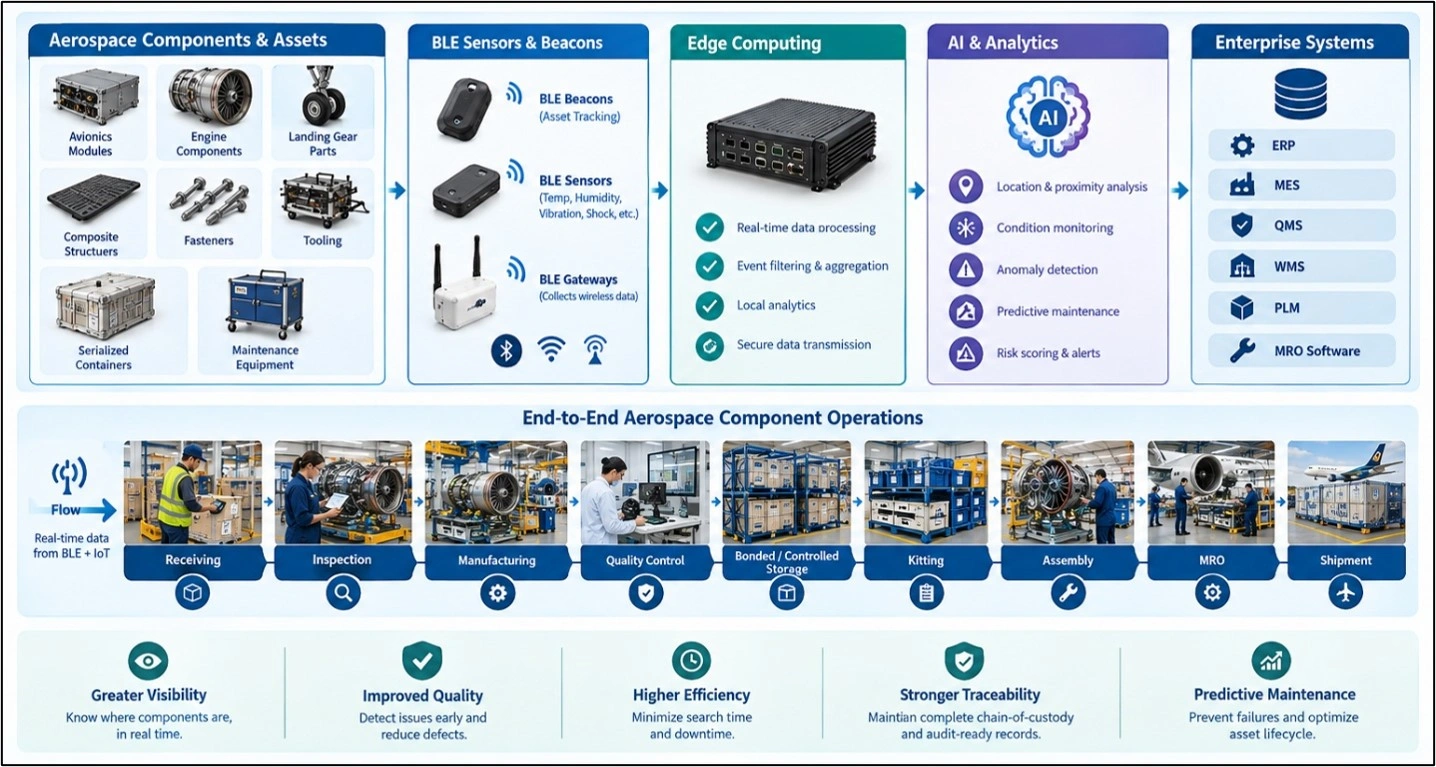
An enterprise infographic showing how BLE beacons and sensors capture aerospace component data, while gateways, edge computing, and AI analytics transform it into actionable insights across receiving, inspection, manufacturing, storage, assembly, MRO, and shipment. It highlights integration with ERP, MES, QMS, WMS, PLM, and MRO systems, along with visibility, quality, efficiency, traceability, and predictive maintenance benefits.
What AI Means for Aerospace Component Operations
Artificial Intelligence of Things, commonly called AIoT or AI and IoT, combines artificial intelligence with IoT devices, sensors, connected equipment, and industrial systems. For aerospace components, AIoT can turn continuously collected operational data into predictions, classifications, anomaly alerts, and recommended actions.
The central engineering objective is not simply to attach a wireless sensor to an aerospace component. The objective is to establish a reliable chain from physical evidence to an operational decision.
A typical implementation connects:
- Component identity and serialization
- BLE beacon or sensor data
- BLE gateway observations
- Location and proximity information
- Temperature, humidity, vibration, shock, or other condition measurements where applicable
- Production and inspection events
- Quality records
- Maintenance and service history
- Storage and handling records
- AI-generated anomaly or risk indicators
- Human approval and operational action
AI becomes particularly useful when aerospace component operations generate more observations than personnel can manually correlate. For example, an analytics system can compare environmental exposure against component-specific storage requirements, identify unusual movement patterns for high-value tooling, detect repeated handling delays, or prioritize components requiring review based on combined location, condition, and process data.
The AI result should remain traceable to its underlying observations. For regulated aerospace operations, explainability, auditability, data integrity, and controlled human decision-making are generally more important than an opaque prediction with no operational context.
Where AI Improves Aerospace Component Processes
Component Location and Search Optimization
Aerospace facilities frequently contain large inventories of serialized components, subassemblies, tooling, fixtures, containers, test equipment, and work-in-process items. A component can move between receiving, quarantine, inspection, machining, assembly, testing, storage, kitting, and shipment areas while its digital record remains dependent on manual updates.
AI-assisted location analytics can use BLE observations to establish movement histories and identify unexpected dwell times or routing patterns.
Relevant applications include:
- Locating serialized aerospace components and subassemblies
- Monitoring movement of aircraft tooling and fixtures
- Identifying components remaining too long in staging areas
- Detecting unexpected movement between controlled zones
- Supporting kitting and assembly preparation
- Finding high-value test equipment and maintenance tooling
- Reconstructing component movement histories
- Prioritizing searches according to production impact
The engineering challenge is that location accuracy depends on gateway placement, beacon characteristics, facility geometry, radio interference, mounting conditions, and the required spatial resolution. A deployment intended only to determine building or zone presence has different requirements from one intended to distinguish adjacent workstations.
Condition Monitoring and Environmental Compliance
Some aerospace components require controlled storage or handling conditions. Depending on the component specification and approved process, relevant parameters can include temperature, humidity, vibration, shock, or exposure duration.
BLE sensors can capture these observations while AI evaluates patterns against defined operating or storage thresholds.
Useful AI applications include:
- Detecting abnormal temperature excursions
- Identifying repeated humidity exposure
- Recognizing unusual vibration or shock events
- Estimating exposure duration
- Prioritizing components for inspection after an environmental event
- Correlating environmental conditions with handling locations
- Generating exception alerts for quality personnel
- Supporting evidence collection for component disposition
A critical implementation principle is to distinguish an AI-generated risk indicator from an authoritative engineering disposition. The system may identify a potentially affected component, but authorized quality, engineering, or maintenance personnel should determine whether inspection, quarantine, testing, or release is required according to the applicable procedure.
AI-Assisted Inventory and Kitting
Aerospace production often depends on accurate availability of serialized parts, kits, consumables, tooling, and subassemblies. A missing component can interrupt an assembly sequence even when the inventory database indicates that the item exists.
AI can combine inventory records with real-time or near-real-time observations to identify discrepancies between expected and observed component status.
Examples include:
- Detecting components recorded in inventory but not observed in their expected zone
- Identifying duplicate or inconsistent movement events
- Predicting likely kitting delays
- Prioritizing replenishment based on production schedules
- Identifying frequently misplaced tooling
- Detecting abnormal dwell times before assembly
- Supporting cycle-count prioritization
- Correlating component availability with manufacturing schedules
GAO hardware can provide the sensing and wireless observation layer, while existing inventory, manufacturing, quality, or maintenance software remains the authoritative source for controlled business records where required.
Predictive Maintenance for Tooling and Connected Equipment
AI-driven maintenance does not need to be restricted to aircraft components themselves. Aerospace component manufacturing and MRO operations depend on tooling, fixtures, test equipment, carts, lifting equipment, environmental monitoring devices, and production machinery.
BLE sensors can contribute operational measurements from suitable equipment, while AI models analyze trends for abnormal behavior.
Potential applications include:
- Tool usage monitoring
- Vibration-based anomaly detection
- Maintenance interval optimization
- Abnormal equipment utilization detection
- Test-equipment condition monitoring
- Fixture usage and lifecycle tracking
- Identification of repeated equipment failures
- Maintenance workload prioritization
For safety-critical equipment, AI should normally operate as decision support unless the associated control function has been separately validated and authorized for automated operation.
Aerospace Component Workflows from Data Capture to Action
An effective AI solution follows the actual physical workflow of aerospace components rather than treating wireless data as an isolated technology project.
Receiving, Identification, and Initial Inspection
The process begins when components, materials, tooling, or containers enter a facility. Existing identification methods may include serial numbers, part numbers, barcodes, RFID, documentation, and ERP or inventory records. BLE can add continuous or event-based location and condition observations.
The system can associate a BLE identifier with an existing component record without replacing the authoritative serial-number system.
AI can then evaluate:
- Expected versus observed receiving location
- Receiving-to-inspection dwell time
- Environmental exposure during receiving
- Routing to quarantine or inspection areas
- Missing or inconsistent operational events
Inspection, Quality, and Engineering Review
Inspection introduces additional information such as dimensional measurements, nonconformance records, test results, inspection status, and engineering dispositions.
A useful implementation keeps wireless telemetry separate from controlled quality records while providing the relevant context to authorized systems.
For example, an AI service can flag that a component experienced an unusual environmental event before inspection. The quality process can then determine whether that observation is relevant to the inspection or disposition decision.
Manufacturing and Work-in-Process Movement
During aerospace component manufacturing, parts can move through machining, surface treatment, cleaning, assembly, testing, inspection, and staging. BLE location observations can provide a digital representation of these movements.
AI can identify:
- Unexpected process dwell times
- Repeated movement between work areas
- Components entering incorrect zones
- Bottlenecks affecting production flow
- Unusual routing patterns
- Missing process transitions
- Equipment or tooling availability problems
Integration with MES or manufacturing software can provide the production context needed to distinguish a normal temporary staging event from an actual process delay.
Controlled Storage and Kitting
Storage requirements can vary according to component type, material, process status, and customer or engineering requirements. BLE sensors can provide environmental observations for suitable storage applications, while beacons can support location visibility.
AI can correlate component identity, storage zone, exposure history, and expected handling conditions.
The operational output may include an alert, inspection recommendation, inventory exception, or task for a responsible employee. The system should preserve the original sensor measurements and decision rationale so that an alert can be investigated later.
Assembly, Testing, and MRO
Assembly and MRO environments introduce complex interactions between components, tooling, technicians, test equipment, and work orders.
AI-supported BLE data can help establish relationships such as:
- Which component was present at a workstation
- Which tooling was nearby during a work operation
- How long a component remained in a work zone
- Whether required equipment was available
- Whether a component moved through expected process areas
- Whether environmental measurements remained within configured limits
- Whether an asset requires investigation before its next operation
These relationships become more valuable when combined with approved records from MRO, MES, QMS, ERP, or PLM software.
Deployment Considerations for Aerospace Component Facilities
Aerospace component facilities require more careful deployment planning than a simple wireless tracking installation. The first step is to identify the operational question that the system must answer.
Examples include:
- Where is a serialized component now?
- Which components entered a controlled storage area?
- Which tooling remains unavailable for a scheduled operation?
- Which assets experienced a temperature or humidity excursion?
- Which component has remained in a staging area beyond the expected process time?
- Which equipment shows an abnormal utilization or condition pattern?
- Which movement event requires investigation?
These questions determine the required sensing frequency, location accuracy, gateway density, data retention, AI model design, and integration approach.
Facility Survey and Radio Planning
Aerospace manufacturing facilities can contain metallic structures, aircraft assemblies, machinery, cabinets, racks, enclosed rooms, composite materials, test chambers, and other objects that influence radio propagation.
A practical survey should evaluate:
- Gateway mounting locations
- Expected BLE coverage
- Radio interference
- Metal obstructions
- Component and sensor mounting positions
- Battery replacement accessibility
- Required location resolution
- Network connectivity
- Edge-server placement
- Environmental conditions
- Areas requiring restricted wireless operation
A pilot installation should be tested under realistic operating conditions rather than only in an empty facility.
Component and Sensor Selection
Not every aerospace component should carry a sensor, and not every application requires continuous telemetry.
A beacon may be sufficient when the primary requirement is location or presence. A sensor is more appropriate when environmental or physical-condition data is required.
Selection should consider:
- Component material and surface geometry
- Attachment method
- Temperature range
- Humidity exposure
- Shock and vibration requirements
- Battery life
- Maintenance access
- Cleaning processes
- Chemical exposure
- Electromagnetic considerations
- Required measurement frequency
- Component value and operational criticality
The wireless device should never interfere with the component’s approved function, inspection process, maintenance procedure, or environmental requirements.
Data Governance and Traceability
Aerospace operations require clear ownership of operational data. The solution should define which system is authoritative for component identity, quality status, maintenance status, production status, and sensor telemetry.
A robust implementation separates:
- Raw sensor observations
- Normalized telemetry
- Location events
- AI-generated predictions
- Alerts
- Human decisions
- Controlled quality or maintenance records
This separation reduces the risk of treating a probabilistic AI result as if it were an approved engineering record.
AI Models and Decision Logic for Aerospace Components
Different aerospace component applications require different AI approaches. A single model should not be assumed to fit location analytics, environmental anomaly detection, maintenance prediction, and production optimization.
Relevant methods include:
- Classification models for identifying operational states or event categories
- Anomaly detection for unusual environmental, movement, or equipment behavior
- Time-series models for temperature, humidity, vibration, and utilization trends
- Predictive models for estimating maintenance or process risks
- Clustering for discovering recurring movement or operational patterns
- Computer vision for visual inspection when camera systems are appropriate
- Natural language processing for extracting information from maintenance or inspection records
- Rule-based logic for deterministic thresholds and safety-critical operational constraints
- Edge AI for low-latency analysis where sending all raw data to a remote service is undesirable
The strongest implementation often combines deterministic engineering rules with machine learning rather than replacing established process controls with AI.
For example, a temperature limit can remain a deterministic rule while AI identifies recurring patterns of exposure that occur below the formal threshold but correlate with process delays or inspection findings.
Model performance should be evaluated using aerospace-relevant operational metrics rather than generic AI accuracy alone. False positives can create unnecessary inspections or workflow interruptions, while false negatives can allow abnormal conditions to remain undetected.
Integration with Aerospace Software Systems
AI and BLE solutions become operationally useful when their observations are connected with existing aerospace information systems.
Potential integration points include:
- ERP for inventory, purchasing, and material records
- MES for production execution and work-in-process status
- QMS for inspections, nonconformances, corrective actions, and quality records
- WMS for storage and material movement
- PLM for product and engineering information
- MRO software for maintenance planning, work orders, and component history
- CMMS for equipment maintenance
- SCADA or industrial monitoring systems where equipment telemetry is relevant
- Data historians for time-series operational information
- Identity and access management systems for controlled user access
- API gateways and middleware for exchanging normalized events
REST APIs, MQTT, HTTPS, WebSockets, database connectors, and event-driven messaging can be used according to the integration requirements and cybersecurity policies of the facility.
The integration layer should normalize device identifiers, timestamps, locations, units of measurement, event types, and component references before AI processing. Poor data normalization can produce technically sophisticated AI models that make unreliable operational recommendations.
GAO can supply BLE and RFID hardware products and systems that provide the physical data collection layer, while system integrators and aerospace engineering teams can connect that data to the customer’s approved software environment.
Cloud and Privately Hosted Deployment Models
Aerospace component organizations may require different deployment models depending on data governance, connectivity, cybersecurity, latency, and IT policies.
The Cloud Version uses cloud-hosted software and infrastructure. It can be appropriate when distributed facilities need centralized analytics, remote monitoring, elastic computing resources, and centralized software management. It can also simplify access to computational resources for AI model training and large-scale analytics, subject to the customer’s security and data policies.
The Server Version places software on edge servers, customer-managed servers, private data centers, facility servers, or other privately hosted infrastructure. This approach can be preferable when organizations require greater control over data location, network connectivity, operational latency, or integration with private aerospace manufacturing systems.
A hybrid deployment can also be appropriate. Gateways may send selected events to an edge server for immediate processing while aggregated data or approved analytics are transferred to a cloud environment.
The deployment decision should be based on operational requirements rather than assuming that cloud or private hosting is universally superior.
Security Foundations for Aerospace Component Data
Cybersecurity should be considered from the device layer through the application and enterprise integration layers.
Relevant controls can include:
- Unique device identities
- Secure device provisioning
- Authentication and authorization
- Encrypted communications
- Network segmentation
- Least-privilege access
- API authentication
- Role-based access control
- Secure credential management
- Gateway hardening
- Server hardening
- Logging and audit trails
- Software patch management
- Firmware lifecycle management
- Data retention policies
- Monitoring for unusual device or network behavior
BLE security should also be considered in relation to the actual deployment model. A beacon transmitting an identifier for general location awareness has a different security profile from a sensor carrying sensitive operational data or controlling access to a restricted process.
Aerospace organizations should align the implementation with their applicable cybersecurity requirements, contractual obligations, information classification policies, and relevant standards. Depending on the organization and system scope, these may include NIST cybersecurity guidance, ISO/IEC 27001 practices, SAE aerospace cybersecurity standards, customer security requirements, and applicable aviation regulatory or quality requirements.
Security controls should be validated during commissioning rather than added after the wireless system has already been integrated into production workflows.
Engineering Validation Before Production Deployment
Aerospace component deployments should move through controlled validation stages.
A useful commissioning sequence includes:
- Define the operational problem and measurable success criteria
- Survey the facility and radio environment
- Select representative components and equipment
- Install a limited number of BLE devices and gateways
- Validate identification and association logic
- Measure actual location performance
- Validate sensor readings against calibrated or trusted references where applicable
- Test network reliability and data latency
- Verify gateway-to-server communication
- Validate API and enterprise software integration
- Test AI models using representative operational data
- Evaluate false-positive and false-negative behavior
- Validate cybersecurity controls
- Confirm alert ownership and escalation procedures
- Train responsible personnel
- Conduct acceptance testing
- Establish maintenance and battery-replacement procedures
- Expand deployment only after operational acceptance
A pilot should include normal production activity, metal-rich areas, crowded storage locations, equipment movement, environmental variation, and expected network disruptions. Testing only under ideal conditions can hide the operational issues that later affect aerospace component traceability.
The most important acceptance criterion is whether the system improves a defined aerospace process without creating unacceptable workflow disruption or data-quality problems.
BLE Hardware and Software for Aerospace Component AI Solutions
The BLE layer should be selected according to the aerospace component workflow rather than as a standalone wireless deployment. BLE beacons are useful when the primary requirement is identification, presence, proximity, or location. BLE sensors add measurements such as temperature, humidity, vibration, or shock when those parameters are relevant to the component, container, tooling, or equipment being monitored. BLE gateways collect observations from multiple devices and forward them to edge or server software.
The principal components can include:
- BLE beacons: Battery-powered identifiers attached to suitable components, containers, tooling, carts, or equipment. Beacon configuration should consider transmission interval, battery life, mounting method, and required detection range.
- BLE sensors: Devices that combine BLE communication with environmental or physical measurements. Sensor selection should match the measurement range, accuracy, sampling frequency, battery requirements, and operating environment.
- BLE gateways: Fixed receivers that collect beacon and sensor observations and transmit normalized events through an IP network. Gateway density should be established through radio surveys and location-accuracy testing.
- Edge computing: Local processing can filter duplicate observations, normalize telemetry, perform deterministic rules, and execute selected AI models before data is transferred to centralized software.
- Application software: Software stores component relationships, locations, telemetry, events, alerts, user actions, and AI outputs while exposing APIs for integration.
- Databases and data historians: Time-series telemetry and operational records can be retained separately or together according to data volume, retention requirements, and analytical needs.
- AI services: Machine-learning and anomaly-detection services transform historical and real-time observations into predictions, classifications, risk indicators, and operational recommendations.
- Enterprise interfaces: APIs and middleware connect the wireless solution with ERP, MES, QMS, WMS, PLM, MRO, CMMS, and other approved aerospace information systems.
- Identity and security services: Authentication, authorization, device identity, encryption, logging, and access control protect the movement of component and operational information.
Communication design should also account for BLE radio behavior and the IP network carrying gateway traffic. BLE is normally the local wireless link between devices and gateways, while Ethernet, Wi-Fi, cellular, or another approved network can provide gateway backhaul depending on the facility.
The engineering distinction between sensing and decision-making is important. BLE hardware produces observations. Software determines whether observations represent meaningful events, and AI evaluates patterns that may not be visible through fixed rules.
GAO provides BLE, RFID, and IoT hardware products and systems that can be incorporated into these aerospace component workflows, with device selection driven by the customer’s operational and environmental requirements.
Cloud and Server Software for Aerospace Component Operations
Cloud Version
The Cloud Version can centralize aerospace component telemetry and AI analytics across multiple facilities when organizational policies permit cloud processing.
Typical functions include:
- Centralized device and gateway management
- Component location and event dashboards
- Historical telemetry storage
- AI model execution
- Cross-facility analytics
- API integration
- Alert management
- Fleet-level reporting
- Remote software administration
- Centralized model monitoring
Cloud processing can be useful when a supplier operates multiple aerospace component manufacturing sites or when authorized engineering and operations personnel need a consolidated view. It can also provide scalable computing resources for model training and historical analytics.
Cloud deployment does not remove the need for local resilience. Gateways should have defined behavior during temporary network interruptions, including local buffering where required and controlled synchronization after connectivity returns.
Server Version
The Server Version can run on customer-managed servers, edge servers, private data centers, facility servers, or other privately hosted infrastructure.
It can be preferable when:
- Operational data must remain within controlled networks
- Internet connectivity is limited
- Low-latency processing is important
- Existing aerospace systems are privately hosted
- Customer cybersecurity policies restrict external processing
- Local operational continuity is a priority
- Data integration depends on internal databases or services
A private deployment should still be designed for redundancy, backup, patching, monitoring, access control, and disaster recovery.
Hybrid Processing
A hybrid design can place time-sensitive processing close to the aerospace component operation while using centralized infrastructure for longer-term analytics.
For example:
BLE sensor → BLE gateway → edge processing → local event validation → secure data transfer → centralized AI analytics → approved enterprise system
This approach can reduce unnecessary network traffic while retaining broader analytical capabilities.
Technical Capabilities Delivered by AI-Enabled Aerospace Component Monitoring
Combining AI with connected aerospace component data can improve operations because the system can analyze relationships across location, condition, process, and historical records.
More Accurate Operational Visibility
Continuous observations can reduce dependence on manually updated location records. AI can also distinguish meaningful patterns from large numbers of routine wireless observations.
The resulting information can support:
- Current or last-known component location
- Component movement history
- Zone-entry and zone-exit events
- Unexpected movement alerts
- Process dwell-time analysis
- Tooling availability
- Storage-condition monitoring
- Component search prioritization
Faster Exception Detection
A conventional threshold can identify a temperature excursion. AI can go further by analyzing recurring patterns, combinations of variables, and historical context.
For aerospace components, this can help identify:
- Repeated environmental excursions
- Abnormal movement sequences
- Unexpected process delays
- Equipment utilization anomalies
- Unusual component dwell times
- Repeated handling events
- Missing expected process transitions
This does not mean every anomaly represents a defect. AI should identify conditions for review, while qualified personnel determine the operational response.
Improved Traceability
Component traceability can be strengthened when wireless observations are associated with established identifiers and timestamped events.
A useful record can answer:
- Which component was observed?
- Where was it observed?
- When was it observed?
- Which gateway detected it?
- What condition was measured?
- Which process area was involved?
- What AI or rule generated an alert?
- Who reviewed the alert?
- What action followed?
Such records can support internal investigations, process improvement, inventory reconciliation, and quality workflows without replacing controlled aerospace records where those records are governed by formal procedures.
Reduced Search and Handling Time
Technicians and material personnel can spend substantial time searching for tooling, components, containers, and work-in-process material.
AI-assisted location analytics can prioritize likely locations using recent observations and movement patterns. This is particularly valuable for high-value tooling, serialized components, test equipment, and items needed for time-sensitive production or MRO work.
Better Production Flow
Dwell-time analysis can reveal where aerospace components spend excessive time between operations.
For example, AI can identify that a component repeatedly waits between inspection and machining, or that tooling availability delays a particular work center. Production managers can then investigate the actual constraint rather than relying only on manually reported delays.
Aerospace Component KPIs for AI and BLE Deployments
Performance should be measured against operational outcomes rather than the number of BLE devices installed.
Useful KPIs include:
- Component location accuracy
- Percentage of components with current location status
- Component search time
- Inventory record accuracy
- Kitting completion time
- Average process dwell time
- Time spent in quarantine
- Environmental excursion detection latency
- Percentage of valid sensor observations
- Gateway data availability
- BLE device battery life
- Gateway uptime
- Event-processing latency
- API success rate
- Duplicate-event rate
- Missing-event rate
- Alert precision
- Alert response time
- False-positive rate
- False-negative rate
- Maintenance response time
- Tool utilization
- Tool search frequency
- Production interruption time
- MRO turnaround time
- Component handling cycle time
- Percentage of automated event capture
- Percentage of exceptions resolved within target time
- AI model drift indicators
- User adoption of operational alerts
A baseline should be established before deployment whenever practical. For example, measuring average tooling search time before and after implementation provides stronger evidence than reporting the number of tracked tools.
Scaling from Pilot to Production
Aerospace component deployments should scale according to validated operational requirements.
A practical expansion strategy can begin with one process or facility zone containing representative components, tooling, and environmental conditions.
The pilot should answer questions such as:
- Is BLE coverage adequate in the actual facility?
- Are device observations consistently associated with the correct asset?
- Is location accuracy sufficient for the operational task?
- Are sensor readings reliable for the intended use?
- Does the network provide adequate gateway connectivity?
- Does the software correctly handle duplicate and missing observations?
- Can users understand and act on AI alerts?
- Does integration preserve authoritative component records?
- Can cybersecurity controls be maintained at production scale?
- Is device maintenance manageable?
Scaling should then proceed to additional zones, component classes, production lines, storage areas, or MRO processes.
A common implementation mistake is installing large numbers of devices before validating the data model and operational workflow. Increasing device quantity cannot compensate for incorrect asset associations, poorly defined zones, inadequate gateway placement, or unclear ownership of alerts.
Maintenance and Lifecycle Management
Aerospace component tracking and monitoring systems require continuing engineering support after commissioning.
Lifecycle activities can include:
- BLE beacon battery replacement
- Sensor calibration or verification where applicable
- Gateway firmware updates
- Gateway health monitoring
- Device replacement
- Asset-to-device association management
- Network monitoring
- API maintenance
- Database backup and retention management
- AI model performance monitoring
- Model retraining where justified
- Cybersecurity patching
- Access-review procedures
- Alert-rule maintenance
- Periodic radio-coverage validation
Battery management deserves particular attention. A device that works correctly during commissioning but fails months later can create silent gaps in component history. Software should therefore monitor battery status where supported and generate maintenance tasks before expected depletion.
AI models also require lifecycle management. Changes in facility layout, production processes, sensor characteristics, component handling procedures, or equipment utilization can alter the data distribution used by an existing model.
Interoperability with RFID and Other IoT Technologies
BLE does not need to replace RFID or other identification technologies. Aerospace component facilities may benefit from combining multiple technologies according to the physical process.
RFID can be useful for rapid identification at portals, storage locations, workstations, and inventory checkpoints. BLE can provide longer-running location or condition observations where appropriate. Barcode systems may remain important for existing serialized workflows.
A combined solution can therefore use:
- Barcode for established visual identification
- RFID for rapid automated identification
- BLE beacons for location and presence
- BLE sensors for environmental or physical-condition observations
- Gateways for wireless data collection
- Edge computing for local event processing
- AI for anomaly detection and operational prediction
- ERP, MES, QMS, WMS, PLM, and MRO software for business records
The technology should be selected according to the operational question rather than forcing every aerospace component process into one identification method.
GAO’s experience supplying RFID, BLE, and IoT hardware products and systems allows these technologies to be considered together when an aerospace component workflow requires multiple forms of identification, sensing, and connectivity.
BLE and RFID Converged Aerospace Component Tracking
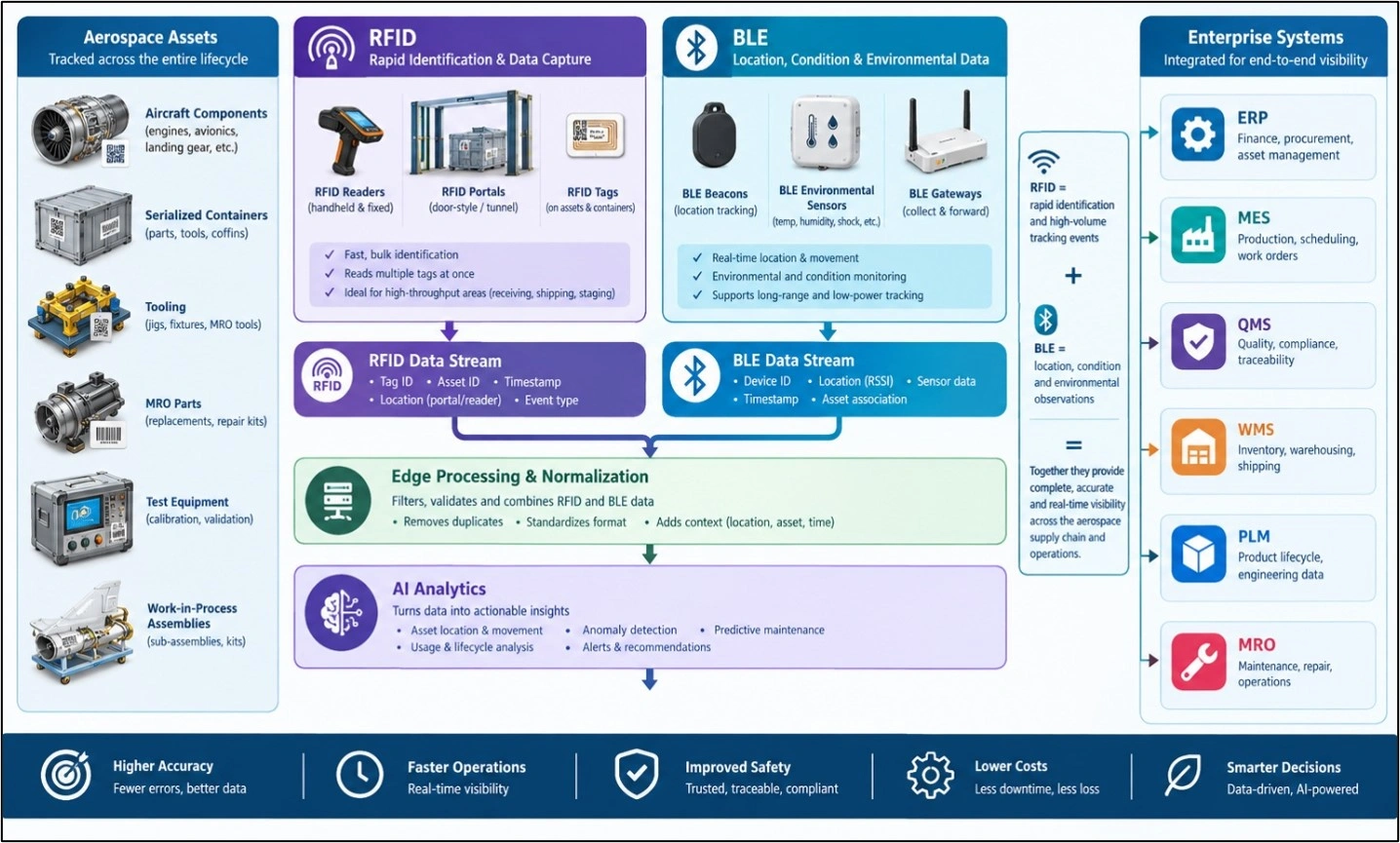
This technology integration diagram illustrates how barcode, RFID, BLE, edge processing, and AI analytics work together in aerospace component operations. RFID supports rapid identification events, while BLE provides location and environmental observations for components, tooling, MRO parts, and work-in-process assemblies. Normalized data flows into enterprise systems including ERP, MES, QMS, WMS, PLM, and MRO platforms.
Aerospace Standards, Compliance, and Engineering Governance
The applicable standards and regulations depend on the aerospace component, organization, contract, facility, and intended use of the system. Technology teams should therefore identify the governing requirements before selecting hardware or software.
Potentially relevant areas include:
- FAA requirements where applicable to the organization’s aviation activities
- EASA requirements where applicable to European operations or customers
- AS9100-series quality management requirements
- AS9110 requirements relevant to maintenance organizations
- AS9120 requirements relevant to aviation, space, and defense distributors
- SAE aerospace standards
- NIST cybersecurity guidance
- ISO/IEC 27001 information-security practices
- Customer-specific cybersecurity requirements
- Export-control requirements where applicable
- Contractual data-handling requirements
- Internal quality-management procedures
- Component-specific engineering specifications
- Calibration and measurement-control procedures
The presence of AI does not automatically change an approved engineering process into an autonomous process. Organizations should define where AI output is advisory, where deterministic automation is permitted, and where human approval is mandatory.
For safety- or quality-relevant decisions, validation should cover the complete chain from sensor measurement through data processing, AI inference, alert generation, user review, and final action.
Practical Implementation Recommendations for Aerospace Components
Successful AI-enabled aerospace component deployments generally begin with a narrowly defined operational problem and expand after measurable results have been demonstrated.
Recommended practices include:
- Start with a high-value aerospace component workflow rather than attempting facility-wide coverage immediately.
- Define the authoritative source for component identity and status before integrating wireless data.
- Perform an RF survey before fixing gateway locations.
- Test BLE performance with actual metal structures, aircraft assemblies, racks, tooling, and equipment present.
- Select beacons for identity and presence applications and sensors only where measurable condition data provides operational value.
- Establish device-to-component association procedures that prevent incorrect asset mapping.
- Normalize timestamps, units, identifiers, locations, and event types before AI analysis.
- Use deterministic engineering limits alongside AI anomaly detection.
- Keep AI-generated risk indicators distinguishable from approved quality or engineering dispositions.
- Design for network interruptions and gateway buffering where operational continuity requires it.
- Protect gateway, server, API, and user interfaces using appropriate cybersecurity controls.
- Test false positives and false negatives with representative aerospace operating data.
- Define alert ownership so every high-priority event has a responsible role.
- Establish battery, firmware, calibration, and device-replacement procedures before scaling.
- Integrate with existing ERP, MES, QMS, WMS, PLM, and MRO software instead of creating unnecessary duplicate records.
- Measure improvements against predeployment operational baselines.
- Review AI performance periodically as processes, facility layouts, and device populations change.
GAO Expertise Supporting Aerospace Component IoT Deployments
GAO is headquartered in New York City and Toronto, Canada, and is ranked among the top 10 leading B2B and B2G suppliers of BLE and RFID technologies globally. GAO and its sister companies, GAO Research and GAO Tek, form the GAO Group, with operations based in New York City and Toronto.
For three decades, GAO Group has served organizations in the United States and Canada, including Fortune 500 companies, leading research and development firms, prestigious universities, and U.S. and Canadian government agencies. Its work includes supplying and supporting hardware products and systems for RFID, BLE, IoT, testing, measurement, and related technologies.
GAO has invested substantially in product and system R&D and maintains stringent quality-assurance processes. Technical support can be provided remotely or onsite, depending on the project requirements.
For aerospace component organizations, this experience is relevant when evaluating wireless identification, sensing, gateway, RFID, and IoT hardware against real facility conditions and integration requirements.
From Aerospace Component Data to Operational Intelligence
AI-enabled aerospace component monitoring is most valuable when it connects physical operations with reliable digital evidence. BLE beacons and sensors can provide location and condition observations, while gateways, edge processing, software, and AI transform those observations into actionable information.
The strongest implementations combine:
- Clearly defined aerospace component workflows
- Appropriate BLE and RFID hardware
- Reliable gateway coverage
- Validated data associations
- Secure communications
- Edge or centralized processing
- AI models matched to specific operational questions
- Integration with existing aerospace software
- Human review for quality- and engineering-sensitive decisions
- Measurable operational KPIs
- Continuing cybersecurity and lifecycle management
Organizations evaluating these solutions should begin with the component process where better visibility, faster exception detection, improved traceability, or condition monitoring can produce a measurable operational improvement. GAO can support this evaluation through its BLE, RFID, and IoT hardware products, systems, technical expertise, and engineering support.
Building the Future of Industrial AI and IoT with Aperture Venture Studio and GAO RFID Inc.
For more than three decades, GAO Group of Companies has invested heavily in R&D for industrial BLE, RFID, and IoT. As generative AI became useful for industrial applications, we expanded our work across AI and IoT technologies, including BLE and RFID, and founded Aperture Venture Studio to develop AI and IoT solutions relevant to operational domains such as aerospace component manufacturing, inspection, logistics, and MRO.
Aperture brings together AI and IoT technical experts, entrepreneurial and operational executives, investors, and technology companies. We have also developed the Aperture Ventures Summit and TekSummit to discuss advanced AI and IoT topics.
These activities have helped build technical communities around practical AI and IoT applications.
We welcome you to join us as:
- Advisors, co-founders, or employees
- Investors
- Customers