
AI and BLE for Agricultural Equipment Manufacturing
AI-Driven Manufacturing Visibility for Agricultural Equipment
Artificial intelligence is transforming agricultural equipment manufacturing by converting production, equipment, material, and workforce data into actionable decisions. AI-powered manufacturing systems can identify production bottlenecks, predict equipment failures, improve work-in-process traceability, detect assembly deviations, optimize material movement, and provide better visibility across tractor, combine, planter, seeder, sprayer, tillage equipment, irrigation machinery, and implement production. BLE provides an effective data-capture layer through BLE beacons, BLE gateways, and BLE sensors attached to production assets, tools, containers, mobile equipment, and selected workstations. For GAO, combining AI with BLE is particularly valuable where manufacturers need location-aware production data without extensive fixed wiring. The resulting AIoT solution connects shop-floor observations with manufacturing execution systems, quality software, maintenance applications, ERP systems, and operational dashboards so production teams can act on current conditions rather than relying only on manual records.
What AI-Powered BLE Manufacturing Systems Mean for Agricultural Equipment Production
Agricultural equipment manufacturing involves complex assemblies, long production cycles, variant-rich bills of materials, heavy components, mobile workstations, weldments, hydraulic systems, electrical harnesses, drivetrains, cabs, implements, and extensive final inspection. A single product may move through fabrication, machining, welding, painting, subassembly, final assembly, calibration, testing, and shipping while accumulating thousands of component and process records.
AIoT combines artificial intelligence with IoT devices, sensors, connected equipment, and industrial systems. For agricultural equipment manufacturers, the practical objective is not simply to collect more BLE data. The objective is to connect location, condition, identity, production, and process data to decisions that improve manufacturing performance.
BLE supports this objective by providing relatively low-power wireless identification, proximity, location, and sensor connectivity. AI then interprets the resulting time-series and event data alongside information from PLCs, machine controllers, barcode systems, RFID readers, vision systems, torque tools, environmental sensors, MES, ERP, WMS, CMMS, and quality systems.
GAO supplies BLE hardware products and IoT systems that can be incorporated into these manufacturing environments. The engineering value comes from selecting the appropriate BLE device type and placing it where its data can answer a specific production question.
Typical AI-enabled applications include:
- AI production tracking: Determine where tractors, combines, planters, sprayers, implements, and major assemblies are located within production zones and identify unexpected dwell time.
- AI work-in-process traceability: Associate BLE-tagged assemblies, containers, tools, and work orders with production stations and process events.
- AI asset tracking: Locate mobile fixtures, welding equipment, test equipment, torque tools, material carts, lifting devices, and reusable production assets.
- AI maintenance prediction: Combine BLE equipment-location information with machine condition data, operating hours, vibration, temperature, current, pressure, or controller data to prioritize maintenance.
- AI material-flow optimization: Analyze movement patterns for components, kits, subassemblies, and line-side inventory to identify unnecessary travel and replenishment delays.
- AI quality monitoring: Correlate assembly location, process sequence, tool usage, inspection events, and production conditions with defects or rework.
- AI worker-tool proximity analysis: Detect whether specialized tools or equipment are available at designated work areas and identify recurring movement or availability problems.
- AI production scheduling support: Use actual WIP positions and process completion events to improve scheduling decisions when production conditions differ from the planned sequence.
The distinction between location data and manufacturing intelligence is important. A BLE beacon can indicate that an asset is near a defined gateway or location zone. AI becomes useful when repeated observations are correlated with work orders, takt requirements, process steps, equipment states, quality events, and historical production patterns.
AIoT Agricultural Equipment Manufacturing Overview
AIoT-Powered Agricultural Equipment Manufacturing Workflow
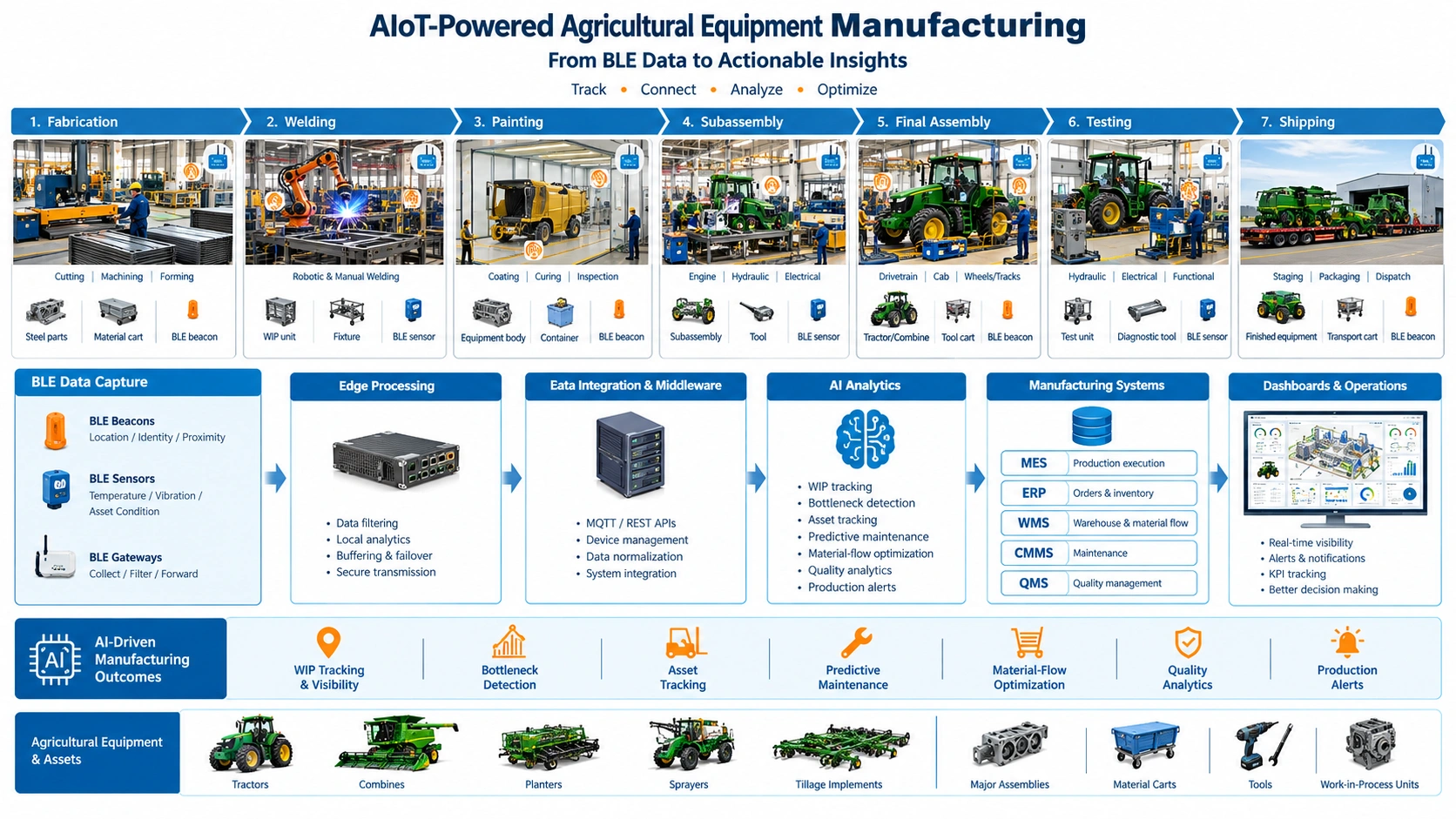
The infographic shows how BLE beacons, BLE sensors, and gateways capture production data across fabrication, welding, painting, assembly, testing, and shipping. Edge processing, middleware, and AI analytics transform this data into WIP visibility, bottleneck detection, asset tracking, predictive maintenance, material-flow optimization, quality analytics, and production alerts.
Agricultural Equipment Manufacturing Processes That Benefit from AI
AI and BLE can support multiple production workflows, but the highest-value deployments usually begin with processes where location, movement, utilization, or process timing is difficult to capture manually.
WIP Tracking Across Tractor and Implement Production
Work-in-process tracking becomes challenging when large agricultural machines occupy substantial floor space and move between fabrication, paint, assembly, inspection, testing, and rework areas. BLE beacons attached to production units or major assemblies can provide recurring location observations through strategically positioned gateways.
AI can convert these observations into production events. For example, repeated presence within a welding area followed by extended inactivity may indicate a process delay. Movement from assembly to inspection without a corresponding completion event can identify a process-control exception. Historical data can reveal that certain product configurations consistently require additional dwell time.
GAO can supply BLE gateways, beacons, and sensors for manufacturers that need wireless data capture around mobile production assets. Gateway placement should be validated through an RF survey because steel structures, machinery, liquid-filled systems, painted surfaces, and dense equipment can affect BLE propagation.
AI Asset Tracking for Manufacturing Tools and Fixtures
Agricultural equipment factories commonly use specialized fixtures, lifting devices, torque tools, diagnostic instruments, welding equipment, carts, racks, and reusable containers. Lost or misplaced assets can create production interruptions even when the asset itself is inexpensive compared with the equipment it supports.
BLE asset tracking can provide zone-level visibility without requiring a reader at every workstation. AI can analyze utilization frequency, idle time, movement history, and recurring shortages to identify which assets should be relocated, duplicated, maintained, or removed from circulation.
A practical implementation should distinguish between assets that require approximate zone location and assets requiring more precise positioning. Overengineering location precision can increase infrastructure cost without improving the manufacturing decision.
Predictive Maintenance for Production Equipment
Agricultural equipment manufacturing relies on CNC machines, robotic weld cells, paint systems, conveyors, presses, compressors, hydraulic test equipment, material-handling systems, and other production machinery. Predictive maintenance models can combine equipment condition measurements with production schedules, operating hours, fault codes, and historical maintenance records.
BLE is useful when the question involves mobile equipment, sensor connectivity, technician activity, or asset location. It should not replace a machine’s native industrial control network when high-speed deterministic control is required.
AI models can identify abnormal operating patterns and generate maintenance priorities. A useful model may consider vibration trends, motor temperature, current draw, machine cycle counts, previous failures, maintenance history, and production loading. BLE sensor data can contribute additional condition observations where wired instrumentation is impractical.
AI Quality and Rework Analysis
Quality problems in agricultural equipment manufacturing can involve weld defects, incorrect component installation, hydraulic leaks, torque deviations, wiring errors, paint defects, calibration failures, and configuration mismatches.
AI can correlate quality events with production station, work order, equipment state, tool identity, operator workflow, component batch, and WIP movement. BLE can contribute the location and identity layer needed to establish where a particular assembly or tool was during a process event.
Computer vision can complement BLE for visual inspection. RFID or barcode identification can provide stronger item-level identity where a component requires explicit scan-based confirmation. The appropriate technology should therefore be selected according to the traceability requirement rather than forcing every workflow into BLE.
From BLE Data Capture to AI Manufacturing Decisions
A production-grade AIoT solution for agricultural equipment manufacturing generally follows a data path from physical production activity to business action.
Data Acquisition at the Manufacturing Workcell
BLE beacons can identify mobile assets, WIP units, containers, tools, and fixtures. BLE sensors can provide measurements such as temperature, humidity, vibration, acceleration, or other supported parameters. Gateways receive BLE advertisements or sensor transmissions and forward relevant data into the manufacturing network.
Other sources should be incorporated where they provide authoritative process information:
- PLC and machine-controller data
- CNC machine status
- Robot controller events
- Torque-tool results
- Vision inspection results
- Barcode and RFID identification
- Environmental measurements
- Hydraulic and pneumatic test data
- Maintenance work orders
- Production work orders
- MES process confirmations
- ERP material and order records
The engineering principle is to avoid creating an isolated BLE data repository. BLE observations become significantly more valuable when they can be associated with established manufacturing identifiers such as serial number, work order, part number, routing step, workstation, machine ID, and timestamp.
Communication, Edge Processing, and Middleware
BLE gateways form the communication boundary between local BLE devices and higher-level manufacturing systems. Depending on the facility, gateways may forward information through Ethernet, Wi-Fi, cellular connectivity, or another approved network path.
Edge processing is useful when the factory needs low-latency event handling, local buffering, protocol conversion, or operation during temporary cloud connectivity interruptions. For example, an edge service can convert raw gateway observations into events such as “tractor chassis entered final assembly” or “tool has remained outside its assigned work zone.”
Middleware can then normalize device data and connect it with MES, ERP, WMS, CMMS, QMS, SCADA, historian, and other software. MQTT, HTTPS, REST APIs, OPC UA, database interfaces, and vendor-specific APIs may be appropriate depending on the existing systems.
GAO’s experience supplying IoT hardware and systems supports deployments where BLE must operate alongside established industrial equipment rather than replacing existing control infrastructure.
AI Analytics and Manufacturing Actions
AI processing can occur at the edge, on private servers, in cloud infrastructure, or through a hybrid arrangement. Model selection should follow the decision being made.
Common approaches include:
- Time-series anomaly detection for machine and environmental sensor data
- Classification models for production-event or quality-risk categories
- Regression models for cycle-time and maintenance prediction
- Clustering for identifying recurring movement and utilization patterns
- Forecasting models for production demand, material requirements, or equipment loading
- Computer vision models for weld, paint, assembly, labeling, and inspection applications
- Optimization algorithms for material routing, workstation allocation, and production sequencing
The final output should be an operational action rather than an abstract prediction. Examples include generating a maintenance work request, notifying a supervisor about abnormal WIP dwell, recommending a fixture relocation, identifying a quality-risk batch, or updating a production dashboard.
Engineering Design Priorities for BLE-Enabled Agricultural Equipment Plants
A successful deployment depends on more than selecting BLE hardware. Agricultural equipment factories contain large metal structures, moving machinery, electrical equipment, paint booths, racks, conveyors, test areas, and changing production layouts. These conditions can affect wireless performance and location accuracy.
Key engineering considerations include:
- Conduct an RF site survey before final gateway placement.
- Define the required location granularity, such as room, production zone, workstation, or tighter positioning.
- Separate safety-critical control functions from wireless monitoring and analytics functions.
- Establish device naming, asset-ID, gateway-ID, and timestamp conventions before collecting production data.
- Design gateway redundancy for critical production visibility areas.
- Provide local buffering when temporary network loss cannot be tolerated.
- Validate battery-life assumptions against beacon transmission intervals and actual factory conditions.
- Account for metal enclosures, welding activity, machinery movement, and production-line changes during commissioning.
- Use calibrated sensor data where measurements influence maintenance or quality decisions.
- Test AI models against real production exceptions rather than only historical averages.
- Establish clear ownership for device maintenance, gateway management, data quality, AI model monitoring, and system support.
Cybersecurity should be considered from the field device through the enterprise application. Appropriate controls can include device authentication, encrypted communications where supported, network segmentation, role-based access, secure gateway configuration, patch management, audit logging, credential management, backup procedures, and controlled remote access.
Connecting AI Manufacturing Applications to Existing Factory Systems
AI-powered BLE solutions should complement established agricultural equipment manufacturing software rather than create another disconnected information source.
MES can provide production orders, routing steps, workstation status, and completion events. ERP systems provide product, order, inventory, supplier, and financial context. WMS manages material movement and storage. CMMS or EAM software manages maintenance activities and equipment histories. QMS applications manage inspections, nonconformances, corrective actions, and quality records.
BLE observations can be mapped to these systems through middleware. A BLE gateway may report that a tagged chassis is within a defined production zone, while MES identifies the corresponding serial number and operation. AI can then compare actual dwell time with expected process time and generate an exception.
RFID remains useful for workflows requiring explicit item identification, portal-based reading, bulk identification, or durable identification of selected components and containers. Barcode systems can remain appropriate for controlled operator confirmation. Computer vision can provide additional evidence for visual conditions. A well-engineered agricultural equipment manufacturing solution therefore uses BLE alongside other identification and sensing technologies according to the operational requirement.
GAO provides BLE, RFID, and other IoT hardware products and systems that can support these mixed-technology environments, with integration decisions based on the physical process, required data accuracy, existing factory systems, and operational constraints.
Cloud and Server Deployment Considerations for Agricultural Equipment Manufacturing
Agricultural equipment manufacturers often operate multiple plants, engineering facilities, supplier networks, and centralized manufacturing systems. The appropriate deployment model depends on connectivity, cybersecurity requirements, data governance, latency, IT ownership, and the need for centralized analytics.
Cloud Version
A cloud-hosted SaaS deployment can centralize data from multiple factories and support fleet-wide analytics, consolidated dashboards, model management, and remote operational visibility. It is particularly useful when production sites need a common software environment and reliable outbound connectivity is available.
Cloud deployment should still retain appropriate edge processing for time-sensitive events, local buffering, and resilience when WAN connectivity is interrupted.
Server Version
A Server Version can run on factory servers, customer-managed servers, private data centers, edge servers, or other privately hosted enterprise infrastructure. This approach can be appropriate when manufacturing data must remain within controlled infrastructure, when network connectivity is limited, or when corporate IT policies require private deployment.
A hybrid arrangement can place BLE gateway processing and immediate event handling at the plant while sending selected information to centralized private or cloud infrastructure for cross-site analytics.
The decision should be based on actual plant requirements rather than assuming that one deployment model is universally superior.
Technical Capabilities and Business Value of AI-Powered BLE Manufacturing
Combining AI with BLE-enabled data capture can improve agricultural equipment manufacturing when the system is designed around measurable production decisions. The greatest value typically comes from correlating location, condition, process, and enterprise data rather than treating wireless observations as an isolated tracking application.
More Accurate Work-in-Process Visibility
AI can convert BLE location events into useful production indicators such as station arrival, station departure, dwell duration, route deviation, and time between process steps. Manufacturers can compare actual movement with routing requirements for tractors, combines, harvesters, planters, seeders, sprayers, balers, tillage equipment, and other agricultural machinery.
This visibility can expose hidden queue time between welding, painting, subassembly, final assembly, testing, and shipping. Production managers can then distinguish genuine capacity constraints from temporary WIP accumulation.
Faster Identification of Production Bottlenecks
Historical location and process data provides a basis for identifying recurring constraints. AI can evaluate dwell times by product family, work center, shift, routing, and production configuration.
For example, a manufacturer may discover that a particular combine configuration consistently experiences extended waiting before hydraulic testing. The problem may not be the test equipment itself. It could involve incomplete subassemblies, technician availability, missing components, or upstream scheduling. AI-assisted analysis helps connect these factors rather than simply reporting that WIP is waiting.
Improved Asset Utilization
BLE tracking can show where mobile fixtures, carts, diagnostic tools, torque equipment, welding accessories, lifting devices, and reusable containers are located. AI can evaluate movement frequency, idle duration, utilization by production zone, and repeated shortages.
The resulting information can support decisions about asset allocation, preventive maintenance, replacement, and purchasing. GAO can provide the underlying BLE hardware and IoT systems needed to capture these observations across manufacturing environments.
Predictive Maintenance and Reduced Unplanned Downtime
Predictive maintenance becomes more effective when sensor observations are combined with production context. A vibration anomaly from a motor means something different when the machine is operating under heavy production load than when it is idle.
AI can combine sensor readings, operating hours, machine cycles, fault codes, maintenance history, production schedules, and environmental conditions to estimate equipment risk. BLE can provide additional sensor connectivity or asset-location information, while PLC and machine-controller data remains authoritative for many machine operating parameters.
Potential targets include:
- CNC spindle and motor condition
- Robotic welding equipment
- Conveyor drives
- Hydraulic test equipment
- Air compressors
- Paint-system equipment
- Material-handling equipment
- Automated fastening equipment
- Pumps and motors
- Environmental-control equipment
Better Quality and Traceability
Agricultural equipment contains numerous assemblies whose quality can affect field reliability and warranty exposure. AI can correlate inspection results with serial numbers, production stations, component batches, tools, operators, machine conditions, and process timing.
BLE contributes location and proximity information where appropriate. RFID and barcode identification can provide stronger item-level identification for selected components. Computer vision can detect visible defects. The resulting multi-source data can establish a more complete production history.
Reduced Material-Handling Waste
Material movement represents a substantial operational consideration in large agricultural equipment factories. Components may travel between receiving, supermarkets, kitting areas, machining, welding, paint, subassembly, final assembly, and finished-goods staging.
AI can analyze movement records to identify excessive travel, repeated replenishment requests, poorly positioned supermarkets, congestion, and recurring shortages. BLE-tagged carts, racks, kits, and containers can provide location observations without requiring every movement to be recorded manually.
AI Use Cases Across the Agricultural Equipment Manufacturing Lifecycle
The strongest deployments connect individual AI applications into a continuous production information flow.
Receiving and Incoming Material Control
AI can analyze receiving patterns, supplier delivery timing, component availability, inspection results, and production demand. BLE-enabled reusable containers and selected material-handling assets can provide location information after receiving.
This can help identify containers that remain in receiving too long, kits that have not reached the expected supermarket, or material-handling assets that repeatedly accumulate in one area.
Fabrication, Machining, and Welding
Fabrication and machining operations create a mixture of fixed machines and mobile WIP. AI can identify abnormal cycle times, recurring queue conditions, and machine utilization patterns.
BLE can identify the movement of fixtures, workpieces, carts, and specialized tooling. BLE sensors can additionally monitor selected environmental or equipment conditions where wireless sensing is suitable.
Welding cells introduce challenging RF conditions because of metal structures, equipment movement, and electrical activity. Gateway positioning and field testing therefore become important before production-scale deployment.
Painting and Surface Finishing
Paint operations introduce distinctive process requirements involving controlled movement, curing, drying, coating inspection, and environmental conditions. AI can correlate WIP dwell times and environmental observations with quality outcomes.
BLE location events can establish when an agricultural equipment body or implement entered and exited a paint-related zone. Sensor data can supplement environmental monitoring where the sensor specifications support the required temperature, humidity, chemical exposure, and operating conditions.
Subassembly and Final Assembly
Final assembly involves many concurrent activities, including drivetrain installation, hydraulic connections, electrical harness installation, cab assembly, wheel and track installation, fluid filling, software configuration, and component verification.
AI can identify process deviations by comparing actual station sequence and duration with expected production routing. BLE-tagged tools and fixtures can provide contextual information about tool availability and location.
Testing, Calibration, and End-of-Line Inspection
Testing may include hydraulic testing, electrical diagnostics, engine or powertrain checks, functional testing, calibration, leak testing, brake testing, steering checks, and final inspection.
AI can compare test results with historical patterns and product configurations. Location events can associate test activity with the correct production unit and testing zone, reducing the risk of incorrectly associating a result with another unit.
Finished Equipment Staging and Shipping
Completed tractors, combines, planters, sprayers, and implements can occupy large staging areas before shipment. BLE can provide zone-level visibility for selected finished equipment and transport assets.
AI can analyze staging duration, shipment readiness, order priority, and movement history to identify delayed shipments and inefficient yard movements.
Deployment Lifecycle for AI and BLE Manufacturing Solutions
Successful agricultural equipment manufacturing deployments should progress through controlled engineering stages rather than attempting immediate plant-wide coverage.
Requirements and Process Mapping
Start by documenting the production decision the solution must improve. Examples include reducing WIP search time, identifying assembly bottlenecks, improving fixture availability, detecting abnormal equipment conditions, or reducing material-handling travel.
Map each requirement to:
- Physical asset
- Required data
- Data frequency
- Required location precision
- Required response time
- Existing source system
- AI decision
- Responsible production role
- Expected KPI improvement
This prevents the project from becoming a general-purpose tracking exercise without a measurable operational objective.
Site Survey and BLE Engineering
Survey production areas for gateway mounting locations, network availability, radio interference, metal obstructions, machinery movement, power availability, and environmental conditions.
Manufacturers should test actual production conditions rather than surveying an empty factory. A gateway’s effective coverage can change when large agricultural machines, steel racks, containers, or production equipment occupy the space.
BLE transmission intervals should also be selected according to the business requirement. More frequent transmissions can improve event responsiveness but may increase device power consumption and wireless traffic.
Pilot Deployment
A pilot should represent a meaningful production workflow. A useful example could track a defined group of tractor chassis through welding, painting, assembly, inspection, and testing while simultaneously monitoring selected production assets.
The pilot should establish baseline measurements before AI recommendations are activated. Otherwise, the manufacturer may be unable to distinguish actual improvement from normal production variation.
Data and AI Validation
AI models should be evaluated against known production events. Engineers should review false positives, missed events, sensor failures, gateway outages, unexpected routing, and production exceptions.
Model validation should include different product configurations and production conditions. Agricultural equipment manufacturers often produce multiple variants on shared lines, so a model trained only on one configuration may produce unreliable recommendations when the product mix changes.
Production Commissioning
Commissioning should verify device identity, gateway connectivity, timestamp synchronization, data transmission, database records, middleware mappings, API integrations, dashboard behavior, alert routing, and failure recovery.
Production teams should also verify that generated events correspond to real physical conditions. A technically correct data packet is not necessarily a correct manufacturing event.
Scale-Up and Continuous Optimization
Once the pilot demonstrates measurable value, the manufacturer can extend coverage to additional lines, plants, assets, or workflows. Device naming conventions, gateway configuration, data schemas, cybersecurity controls, and support procedures should remain consistent across sites.
AI models should be monitored after deployment because manufacturing conditions change. New equipment, revised routings, seasonal production changes, different product mixes, and altered material flows can affect model performance.
AI and BLE Deployment Lifecycle for Agricultural Equipment Manufacturing
The lifecycle diagram presents a practical 10-stage deployment path, from production requirements and process mapping through RF surveying, BLE hardware selection, pilot deployment, data integration, AI model validation, commissioning, KPI measurement, and continuous optimization. It also connects the lifecycle to key manufacturing systems, BLE technologies, and agricultural equipment assets.
Cybersecurity and Reliability for BLE Manufacturing Deployments
Wireless manufacturing systems should be treated as part of the plant’s broader information-security environment. The security requirement depends on whether BLE data is used only for monitoring or contributes to maintenance, production, quality, or other operational decisions.
Important controls include:
- Assign unique identities to gateways and managed devices.
- Restrict gateway administration to authorized personnel.
- Use secure credential-management practices.
- Segment industrial wireless infrastructure from unrelated corporate traffic where appropriate.
- Encrypt communications across network paths when supported by the selected system.
- Apply controlled firmware and software update procedures.
- Maintain gateway and device inventories.
- Log authentication, configuration, and system events.
- Define procedures for lost, damaged, or replaced BLE devices.
- Protect AI and manufacturing databases through role-based access.
- Maintain backups and recovery procedures for critical application data.
- Control remote maintenance access through approved security mechanisms.
Reliability also requires operational monitoring. A missing BLE transmission could mean an asset moved, a battery failed, a device was damaged, or a gateway stopped communicating. AI should not automatically treat every missing observation as a production event.
GAO’s hardware and technical support capabilities can help organizations address device selection, deployment, troubleshooting, and lifecycle support for BLE and related IoT systems.
KPIs for Measuring AI-Powered Manufacturing Improvements
A manufacturing program should establish measurable KPIs before implementation. Suitable metrics vary by process, but agricultural equipment manufacturers can evaluate:
- WIP search time
- WIP dwell time
- Production cycle time
- First-pass yield
- Rework rate
- Scrap rate
- Unplanned equipment downtime
- Mean time between failures
- Mean time to repair
- Equipment utilization
- Tool utilization
- Fixture utilization
- Material replenishment response time
- Line-side stockout frequency
- Material travel distance
- Production schedule adherence
- On-time completion rate
- Inspection turnaround time
- Quality escape rate
- End-of-line test failure rate
- Maintenance response time
- Asset recovery time
- Staging dwell time
- Shipment readiness time
- Gateway availability
- BLE device availability
- Sensor data completeness
- AI alert precision
- AI alert response time
- Production exception resolution time
KPI selection should reflect the original business problem. Tracking hundreds of metrics does not necessarily improve production. A smaller set of trusted indicators connected to actionable workflows generally produces more useful operational results.
Selecting BLE Hardware for Agricultural Equipment Manufacturing
BLE hardware selection should follow the physical and operational requirements of each application.
BLE beacons are generally appropriate for transmitting an identifier from a tagged asset, fixture, container, or mobile production unit. BLE sensors add measurements such as temperature, humidity, vibration, acceleration, or other supported parameters.
BLE gateways collect nearby device transmissions and forward information to the processing environment. Gateway selection should consider coverage, antenna characteristics, network interfaces, installation location, power availability, environmental rating, management functions, and required throughput.
Agricultural equipment manufacturing may require different device configurations in different zones. A sensor used near an outdoor equipment staging area can face substantially different temperature, moisture, dust, and mechanical conditions than a device installed inside a controlled assembly area.
GAO can supply different BLE hardware configurations according to the required manufacturing use case, while system designers should validate environmental specifications and RF performance against the actual installation conditions.
Interoperability with Industrial and Manufacturing Systems
Interoperability is critical because agricultural equipment factories rarely operate with one software system. The AI solution should exchange information with existing manufacturing applications without disrupting production control.
Relevant systems can include:
- MES for production routing and work-in-process status
- ERP for orders, products, inventory, and supplier information
- WMS for material and warehouse operations
- CMMS or EAM for maintenance
- QMS for inspection and nonconformance management
- SCADA and historians for industrial process information
- PLC and machine-controller systems
- Production scheduling software
- Laboratory and test-management systems
- Warehouse and yard-management applications
- Business intelligence and reporting software
Common integration mechanisms include REST APIs, MQTT, OPC UA, HTTPS, database interfaces, message queues, and vendor-specific connectors.
A practical data model should maintain consistent identifiers for asset ID, serial number, work order, production station, gateway ID, device ID, event type, and timestamp. Without consistent identifiers, AI analytics may generate technically plausible but operationally misleading correlations.
Practical Implementation Recommendations for Agricultural Equipment Manufacturers
Manufacturers planning AI-powered BLE deployments should prioritize operational clarity over technology volume.
- Start with a production problem that has a measurable financial or operational impact.
- Select the smallest useful BLE coverage area for the initial pilot.
- Use actual agricultural equipment and production conditions during RF testing.
- Define location accuracy requirements before selecting positioning methods.
- Combine BLE with RFID, barcode, machine data, and computer vision where those technologies provide stronger evidence.
- Keep safety-critical machine control independent from non-deterministic wireless analytics functions.
- Establish data ownership and system responsibilities between operations, IT, engineering, maintenance, and quality teams.
- Validate gateway placement after racks, machines, tractors, combines, and other large metal objects are present.
- Build local buffering and fault recovery into applications where production visibility cannot tolerate network interruptions.
- Establish battery-replacement procedures for large BLE device populations.
- Validate AI alerts against confirmed production events before allowing automated operational actions.
- Monitor model performance after product variants and production routings change.
- Maintain a device inventory and documented commissioning records.
- Integrate AI outputs into the workflow where supervisors and engineers already work rather than creating disconnected alerts.
- Measure improvements against a baseline and review KPIs periodically.
GAO Support for AI, BLE, and Agricultural Equipment Manufacturing
GAO provides BLE, RFID, and other IoT hardware products and systems for organizations implementing wireless identification, sensing, tracking, and industrial data-capture solutions. Our role can include helping organizations evaluate BLE beacons, gateways, sensors, and related IoT equipment according to the physical production environment and required application.
GAO is headquartered in New York City and Toronto, Canada, and is ranked among the top 10 leading B2B and B2G BLE and RFID suppliers globally. GAO, GAO Research, and GAO Tek form GAO Group, with operations based in New York City and Toronto.
For three decades, GAO Group has served customers across the United States and Canada, including Fortune 500 companies, leading R&D organizations, prestigious universities, and U.S. and Canadian government agencies. Its product and system development includes substantial R&D investment, stringent quality assurance processes, and expert technical support delivered remotely or onsite.
For agricultural equipment manufacturers, this experience can be relevant when BLE tracking, RFID identification, sensor monitoring, and AI-driven analytics must coexist with established production equipment and manufacturing software.
Key Takeaways for AI and BLE in Agricultural Equipment Manufacturing
AI-powered manufacturing becomes more useful when production data is connected to specific decisions. For agricultural equipment manufacturers, BLE can provide location, identity, proximity, and selected sensor observations for WIP, fixtures, tools, containers, mobile equipment, and other production assets.
AI can then interpret those observations alongside MES, ERP, WMS, CMMS, QMS, machine, quality, and maintenance data. The resulting applications can improve WIP visibility, bottleneck detection, predictive maintenance, asset utilization, material flow, quality traceability, and production scheduling.
A successful implementation depends on careful RF engineering, appropriate hardware selection, reliable data models, secure integration, validated AI models, measurable KPIs, and controlled deployment. GAO can support organizations evaluating BLE, RFID, and IoT hardware and systems for these manufacturing requirements.
Building the Future of Industrial AI and IoT with Aperture Venture Studio and GAO
For more than three decades, GAO Group has invested heavily in R&D covering industrial BLE, RFID, and IoT. As generative AI became increasingly useful for industrial applications, we expanded our work in AI and IoT technologies and founded Aperture Venture Studio to advance practical AIoT solutions for manufacturing environments such as agricultural equipment production. Aperture brings together AI and IoT technical experts, entrepreneurial and operational executives, investors, and leading companies. We also developed Aperture Ventures Summit and TekSummit to discuss advanced AI and IoT topics and foster technical communities. We welcome you to join us as advisors, co-founders or employees, investors, or customers.