
AI and BLE for Airport Logistics
AI-Driven Airport Logistics for Cargo, Baggage, and Ground Operations
AI-driven airport logistics combines operational data, connected equipment, cargo and baggage records, vehicle activity, facility information, and AI analytics to improve the movement of goods and operational resources through airports. The approach applies to air cargo terminals, cargo warehouses, baggage handling areas, ramp operations, ground support equipment, aircraft servicing, maintenance facilities, landside cargo transfer, and airport logistics centers. AI can analyze flight schedules, cargo volumes, baggage flows, ULD movements, dock activity, loading requirements, equipment availability, maintenance records, and transfer times to identify operational risks and recommend actions. BLE gateways, BLE beacons, and BLE sensors can provide localized information for selected reusable assets, ground equipment, maintenance resources, and environmental conditions. GAO supplies BLE, RFID, and other IoT technology-based hardware products and systems that can support these airport logistics workflows. The resulting AIoT solution connects physical airport operations with prediction, anomaly detection, optimization, and operational decision support.
How AI Transforms Airport Logistics
Airport logistics operates under strict time constraints. Cargo, baggage, ULDs, ground support equipment, aircraft servicing resources, trucks, warehouse activities, and flight schedules are closely connected. A delay in one process can affect aircraft turnaround, cargo transfer, connecting flights, warehouse capacity, or downstream transportation.
AI can analyze these dependencies continuously rather than relying only on manually reviewed reports. Machine learning, predictive analytics, computer vision, optimization algorithms, anomaly detection, and Edge AI can be applied according to the specific airport logistics problem.
Key AI applications include:
- AI air cargo volume forecasting based on flight schedules, historical shipments, seasonality, trade lanes, customer demand, and planned capacity
- AI warehouse capacity planning for cargo staging, ULD storage, build-up and breakdown operations, and dock utilization
- AI ULD tracking and movement analysis using RFID, barcode, computer vision, GPS, and selected BLE data
- AI baggage and cargo transfer prediction using flight schedules, handling milestones, connection windows, and processing times
- AI ground support equipment utilization analysis for baggage tractors, belt loaders, cargo loaders, tugs, forklifts, dollies, and other airport equipment
- AI predictive maintenance for cargo handling systems, conveyors, lifts, vehicles, refrigeration equipment, and ground support equipment
- AI cargo exception detection for delayed shipments, misplaced ULDs, missed handling milestones, temperature exceptions, and documentation discrepancies
- AI dock and truck scheduling using cargo availability, appointment data, warehouse capacity, and flight-related deadlines
- AI ramp logistics optimization for coordinating equipment and personnel around aircraft arrival and departure windows
- AI asset utilization and recovery for selected reusable airport logistics equipment
BLE serves as an enabling technology for selected applications rather than a universal airport tracking method. BLE can provide proximity and localized asset information where an airport needs additional visibility, while RFID, barcode, GPS, OCR, computer vision, telematics, and established airport systems remain important for other identification and operational requirements.
Airport Logistics Workflows Supported by AI
Air Cargo Arrival and Acceptance
Cargo acceptance involves shipment documentation, security screening, weighing, labeling, ULD preparation, warehouse receiving, customs processes, and flight planning.
AI can analyze shipment arrival patterns, scheduled flight capacity, warehouse workload, dock availability, screening queues, and handling times to predict periods of operational pressure. Cargo teams can use these predictions to allocate warehouse resources and reduce avoidable processing delays.
AI can also identify cargo acceptance records that differ from expected patterns, such as unusually long processing times or missing operational milestones.
Cargo Warehouse and ULD Management
Air cargo warehouses must coordinate import cargo, export cargo, transfer shipments, ULDs, pallets, containers, racks, staging areas, build-up stations, breakdown stations, forklifts, and loading docks.
AI can analyze warehouse occupancy, ULD availability, shipment priority, flight schedules, cargo status, and handling resources to recommend staging priorities.
For example, a model can identify export shipments approaching a build-up deadline and compare their status with available ULDs, warehouse space, handling equipment, and assigned personnel. This allows cargo supervisors to address constraints before they affect aircraft loading.
Baggage and Cargo Transfer Coordination
Although baggage and air cargo are distinct workflows, airport logistics teams must often coordinate shared resources such as vehicles, handling equipment, ramps, access routes, and operational personnel.
AI can analyze transfer times, flight schedules, connection windows, equipment availability, and handling events to identify potential missed connections or resource conflicts.
For air cargo, the same analytical approach can be used to evaluate transfer shipments moving between arriving and departing flights. AI can prioritize cargo that has narrow connection windows or requires additional handling.
Ramp and Ground Support Equipment Operations
Ground support equipment directly affects aircraft turnaround. Baggage tractors, belt loaders, passenger stairs, aircraft tugs, cargo loaders, forklifts, dollies, GPUs, air start units, catering vehicles, and other service equipment must be available when aircraft arrive.
AI can analyze flight schedules, aircraft stands, equipment utilization, maintenance status, travel time, service requirements, and historical turnaround performance.
The system can predict equipment demand by time and location and help supervisors position resources before aircraft arrival. This can reduce unnecessary equipment movement and improve availability during short turnaround windows.
Airport Cargo Dock and Truck Operations
Air cargo terminals depend on coordinated truck arrivals, cargo availability, dock doors, warehouse receiving, security procedures, and shipment release status.
AI can forecast dock demand using truck appointments, flight schedules, cargo volume, warehouse workload, and historical processing times. It can identify periods where truck arrivals may exceed available dock capacity.
Cargo operators can use these predictions to adjust appointments, allocate dock personnel, prioritize shipments, and reduce truck dwell at the cargo terminal.
Cargo Screening and Security Coordination
Air cargo security involves screening, access control, shipment documentation, secure handling areas, custody records, and controlled movement.
AI can identify unusual processing patterns by correlating access events, shipment milestones, screening status, cargo location, and handling records. Such analytics can help security and cargo teams prioritize exceptions without replacing required security procedures or official records.
RFID, barcode, OCR, computer vision, access control, and other identification technologies can provide complementary evidence. BLE can support localized awareness of selected reusable assets but should not be treated as the sole security mechanism for airport cargo.
Cold-Chain and Temperature-Sensitive Air Cargo
Pharmaceuticals, biological materials, food products, flowers, and other temperature-sensitive shipments can require controlled handling conditions during airport logistics processes.
AI can evaluate temperature records, cargo dwell, warehouse conditions, flight schedules, transfer milestones, refrigeration status, and environmental events to identify potential cold-chain exceptions.
BLE sensors may provide supplemental environmental information for selected cargo areas, equipment, or reusable assets. Dedicated temperature monitoring systems remain important where shipment-level regulatory or operational requirements demand them.
Enterprise-Grade Technical Overview of AI-Driven Airport Logistics Operations
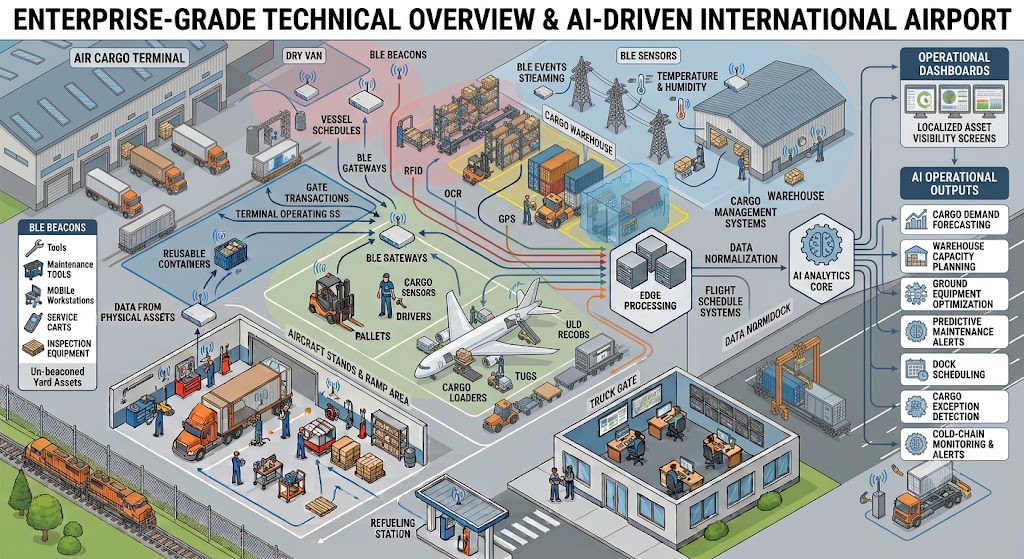
This detailed isometric diagram maps an AI-enabled airport cargo and ramp ecosystem, depicting aircraft stands, a cargo warehouse, loading docks, and maintenance areas. BLE beacons monitor essential reusable ground assets—such as maintenance tools, service carts, and mobile workstations—streaming data through strategically placed BLE gateways and edge processing units. Integrated with cargo management software, flight schedule systems, and ULD records, an AI analytics core powers key operational outputs including cargo demand forecasting, warehouse capacity planning, ground equipment optimization, and cold-chain exception alerts.
AI Applications Across Airport Logistics
AI Air Cargo Demand Forecasting and Capacity Planning
Air cargo volumes fluctuate according to flight schedules, trade lanes, seasonal demand, passenger aircraft belly capacity, dedicated freighter operations, customer requirements, and regional economic activity.
AI forecasting models can combine historical shipment volumes with flight schedules, planned capacity, cargo categories, warehouse workload, and transportation patterns.
Cargo operators can use forecasts to plan warehouse labor, staging space, dock capacity, ULD requirements, screening resources, and ground handling equipment. The same models can identify expected workload peaks before they create congestion.
AI ULD Tracking and Exception Management
ULDs such as containers, pallets, and specialized units move through acceptance, storage, build-up, staging, aircraft loading, unloading, breakdown, and return processes.
AI can analyze ULD identification events, flight assignments, cargo status, warehouse location, handling milestones, and transfer times to identify anomalies.
Examples include ULDs that remain in a staging area longer than expected, units assigned to a flight but not progressing through required handling steps, or equipment that appears in an operational zone inconsistent with its assigned task.
BLE can provide additional localized information for selected reusable handling resources. RFID and barcode systems remain important for ULD and shipment identification where those technologies are already embedded in cargo workflows.
AI Airport Ground Equipment Utilization and Maintenance
Ground support equipment can become a major source of turnaround delays when the correct equipment is unavailable, poorly positioned, or undergoing unexpected maintenance.
AI can evaluate equipment utilization, flight schedules, stand assignments, operating hours, fault codes, maintenance history, battery condition, fuel usage, inspection results, and equipment location data.
Predictive maintenance models can identify equipment with elevated failure risk and help maintenance supervisors prioritize inspections and service. Resource planning models can also estimate equipment demand by stand and time period.
BLE can supplement these workflows by providing localized visibility for selected maintenance tools, inspection equipment, and reusable service assets.
AI Cargo Exception and Anomaly Detection
Airport cargo exceptions can involve delayed acceptance, missing documentation, failed screening milestones, incorrect staging, ULD discrepancies, missed flight connections, temperature excursions, warehouse congestion, or truck delays.
AI can correlate events from multiple systems to distinguish normal processing variation from conditions that require intervention.
An exception engine may prioritize a shipment when its handling time is increasing while the associated flight departure window is approaching. Another model may identify an unusual combination of cargo dwell and warehouse congestion that increases the probability of a missed transfer.
This approach helps cargo supervisors focus on exceptions that could materially affect flight schedules, cargo delivery, or customer commitments.
AI Dock, Truck, and Warehouse Flow Optimization
Air cargo truck operations depend on shipment readiness, dock availability, security processing, warehouse capacity, appointment schedules, and handling resources.
AI can forecast dock demand and identify likely periods of truck congestion. It can compare scheduled and actual arrival times with cargo readiness and warehouse processing capacity.
The resulting recommendations can support dock assignment, appointment planning, labor allocation, and cargo staging decisions.
AI Cold-Chain Exception Detection
Temperature-sensitive air cargo can be exposed to risk during warehouse storage, aircraft loading and unloading, ramp transfers, customs processing, security screening, and truck handoffs.
AI can combine temperature history with cargo dwell, shipment requirements, handling milestones, facility conditions, and flight schedules.
Instead of treating every temperature variation identically, AI can rank exceptions according to duration, severity, cargo sensitivity, and operational context. This allows cold-chain teams to focus on shipments where intervention is most important.
AI Airport Logistics Security and Asset Loss Prevention
Airport cargo facilities contain controlled areas, high-value cargo, reusable handling equipment, ground support resources, and restricted operational zones.
AI can correlate access-control events, cargo transactions, equipment movement, screening records, shipment status, and facility activity to identify unusual patterns.
For example, an AI system can flag an asset that repeatedly enters restricted zones outside its expected operating schedule or identify a cargo process with inconsistent custody events.
These analytics should supplement, rather than replace, established airport security procedures, access controls, screening requirements, and official cargo records.
Airport Logistics Data Flow and AI Decision Process
An airport AIoT solution must connect physical logistics activities with reliable data processing and airport enterprise software. The operational flow typically moves from data acquisition through communications, edge processing, middleware, AI analytics, and business action.
Data Acquisition
Airport logistics data can originate from:
- Cargo management systems
- Warehouse management systems
- Flight schedules and aircraft turnaround systems
- ULD management systems
- RFID readers and tags
- Barcode scanners
- OCR and computer vision systems
- GPS and vehicle telematics
- Ground support equipment telemetry
- Baggage handling systems
- Cargo screening systems
- Access-control systems
- Temperature and environmental monitoring
- BLE gateways, beacons, and selected sensors
- CMMS and EAM maintenance systems
- Truck appointment and dock scheduling systems
- Manual inspection and operational records
The combination of these sources allows AI to understand relationships between cargo, equipment, aircraft schedules, warehouse capacity, and ground operations.
Communication and Edge Processing
Airport logistics environments contain large facilities, metal cargo containers, aircraft, vehicles, warehouses, controlled areas, and moving equipment. Wireless and wired connectivity therefore needs to be designed around the physical environment and operational requirements.
BLE gateways can collect beacon and sensor transmissions within defined airport logistics zones and forward selected events to edge computing systems or network services.
Edge processing can filter duplicate detections, normalize timestamps, validate device identifiers, buffer events during temporary network interruptions, and monitor device health. Other systems may use Ethernet, Wi-Fi, cellular connectivity, GPS, industrial communication protocols, or existing airport network infrastructure.
Middleware and Airport Enterprise Software
Middleware connects physical device events with the software used by cargo and airport operations. Relevant systems can include:
- Cargo management systems for shipment status and handling events
- Warehouse management systems for cargo storage and processing
- ULD management systems
- Flight and aircraft turnaround systems
- Ground handling management software
- Fleet management systems for ground support equipment
- CMMS and EAM systems for maintenance
- Transportation management systems for cargo movement
- ERP systems for asset and procurement records
- Security and access-control systems
- Cold-chain monitoring systems
- Data warehouses and business intelligence software
API interfaces, event messaging, databases, integration services, and other data exchange methods can connect these systems according to the airport’s existing IT environment.
AI Analytics and Operational Action
AI models can transform normalized airport logistics data into demand forecasts, anomaly scores, risk classifications, equipment failure predictions, resource recommendations, and workflow priorities.
The operational value comes from connecting those outputs to decisions.
A cargo volume forecast can trigger warehouse labor planning. A ULD exception can prompt a search or handling investigation. A predictive maintenance alert can create an inspection priority. A ground equipment demand forecast can influence resource positioning before aircraft arrival.
GAO provides BLE gateways, BLE beacons, BLE sensors, RFID products, and other IoT hardware systems that can serve as data acquisition components within these broader airport logistics solutions.
BLE Hardware and AI Software for Airport Logistics
BLE Beacons for Selected Airport Logistics Assets
BLE beacons can provide location or proximity information for selected airport logistics assets where frequent movement makes manual tracking inefficient. Suitable assets can include maintenance tools, inspection equipment, mobile workstations, service carts, selected ground support resources, reusable handling equipment, and other mobile resources used around cargo terminals and airport service areas.
Each beacon should be associated with an asset record in the airport’s asset management software. AI can then combine beacon observations with work orders, equipment utilization, maintenance history, flight schedules, and operational events to identify underused assets, delayed resources, unusual movement patterns, or equipment that is not available where required.
BLE should not replace authoritative identification technologies for cargo, ULDs, shipments, or aircraft operations. RFID, barcode, OCR, GPS, computer vision, telematics, and existing airport systems may remain more appropriate for specific identification and traceability requirements.
BLE Gateways for Airport Cargo and Ground Operations
BLE gateways receive transmissions from selected beacons and BLE devices within defined airport logistics zones. Gateways can be deployed in cargo warehouses, maintenance areas, GSE staging locations, cargo docks, equipment rooms, and selected service areas where zone-level visibility is useful.
Gateway data can be forwarded to an edge server or airport network through Ethernet, Wi-Fi, or other suitable connectivity. Edge processing can filter duplicate detections, validate device identifiers, normalize timestamps, and temporarily store events when network connectivity is interrupted.
AI applications can use these normalized events with cargo management, warehouse, GSE, maintenance, and transportation data. This approach allows BLE observations to become operational inputs rather than isolated device readings.
BLE Sensors for Airport Logistics Conditions
BLE sensors can monitor selected environmental conditions relevant to airport logistics, such as temperature and humidity in warehouses, staging areas, equipment rooms, and controlled cargo environments. These measurements can support AI-based exception detection when combined with shipment requirements, cargo dwell time, facility conditions, and handling events.
Temperature-sensitive pharmaceutical, food, biological, and other controlled shipments may require specialized monitoring and compliance systems. BLE environmental sensing can supplement those systems where appropriate rather than being treated as a universal replacement for dedicated regulated monitoring equipment.
AI, Middleware, and Airport Logistics Software Integration
AI-enabled airport logistics solutions typically require integration with existing operational software rather than operating independently. Relevant systems can include cargo management software, warehouse management systems, ULD management, GSE fleet management, CMMS/EAM, transportation management systems, ERP, access-control software, cold-chain monitoring, business intelligence, and data warehouse systems.
Middleware can normalize events from BLE, RFID, barcode, GPS, telematics, computer vision, and other sources. APIs, event messaging, database interfaces, and integration services can then transfer validated data to enterprise applications.
AI models can use this consolidated information to generate forecasts, anomaly scores, maintenance predictions, resource recommendations, and operational priorities. Human operators can review significant recommendations before actions affecting cargo movement, equipment dispatch, maintenance, or flight-support activities are executed.
Cloud and Server Deployment for Airport Logistics
Cloud Version
A cloud deployment can provide centralized airport logistics analytics across multiple terminals, facilities, or airport locations. Cargo forecasts, ULD exceptions, GSE utilization, maintenance risks, warehouse capacity, and operational KPIs can be viewed through centralized software.
Cloud deployment can simplify software updates, expand computing resources as data volumes increase, and support machine learning across larger operational datasets. Airport authorities and organizations managing multiple facilities can also use centralized reporting to compare performance between locations.
Connectivity, cybersecurity, data governance, latency, data residency, and organizational requirements should be evaluated before selecting a cloud deployment.
Server Version
A server deployment can place airport logistics software on customer-managed servers, private data centers, or edge computing infrastructure. This approach can be useful where operational systems require local processing, existing private IT infrastructure, controlled data handling, or continued operation during intermittent external connectivity.
Local processing can allow selected BLE events, equipment data, and operational records to be analyzed close to the cargo warehouse, maintenance area, or GSE staging environment. Local systems can continue collecting and processing data before synchronization with centralized enterprise systems.
Hybrid Deployment
A hybrid deployment combines local or edge processing with cloud or centralized server analytics. Time-sensitive functions such as equipment-location events, local alerts, gateway health, and operational exception processing can remain close to the airport operation.
Cloud or centralized servers can support longer-term analytics, cross-terminal reporting, AI model development, historical trend analysis, and enterprise dashboards. This approach allows airport logistics organizations to balance operational resilience with centralized analytical capabilities.
Engineering Considerations for AI-Enabled Airport Logistics
BLE Coverage and Device Placement
Airport logistics environments contain metal aircraft structures, ULDs, cargo racks, vehicles, walls, doors, machinery, and other materials that can influence radio performance. BLE deployment therefore requires an RF assessment under actual operating conditions.
Gateway placement should be based on the physical layout of cargo warehouses, maintenance areas, equipment staging zones, docks, and other selected operational areas. Engineers should evaluate coverage, interference, detection boundaries, battery requirements, mounting positions, gateway density, and expected reporting frequency.
A pilot should be conducted before large-scale deployment because theoretical coverage does not necessarily represent actual performance around aircraft, cargo equipment, and moving vehicles.
Asset Identity and Cargo Traceability
Each tracked asset should have a stable identifier that maps the BLE beacon or device to an asset master record. The software should distinguish between the physical device identifier, asset identifier, equipment identifier, shipment identifier, ULD identifier, and operational transaction.
BLE proximity information can indicate that an asset was detected within a defined zone, but it does not automatically prove that a particular cargo transaction occurred. Authoritative cargo events should continue to come from the appropriate cargo management, ULD, WMS, RFID, barcode, or other enterprise system.
Data Quality and Event Normalization
AI results depend on reliable operational data. Airport logistics systems should address duplicate BLE detections, missing events, stale observations, clock differences, gateway outages, battery depletion, device replacement, and inconsistent asset records.
Event normalization should establish consistent timestamps, identifiers, locations, event types, and confidence indicators. AI software can then distinguish a genuine operational exception from a temporary communication problem or incomplete data.
Airport System Integration
Integration planning should consider the airport’s existing cargo, warehouse, ULD, GSE, maintenance, transportation, ERP, security, and reporting systems. The integration method should match the capabilities and constraints of the existing environment.
API-based integration can support real-time application communication, while message queues can support event-driven workflows. Database interfaces and scheduled data exchanges may remain appropriate for legacy systems. The objective is to create reliable information flow without disrupting systems already supporting critical airport operations.
Operational Trade-Offs
BLE can provide economical zone-level or proximity information for selected mobile assets, while other technologies may be better suited to different airport logistics requirements. GPS can provide broader outdoor positioning, RFID can support specific identification workflows, computer vision can analyze visual events, and telematics can provide equipment operating data.
AI should select and combine the appropriate data sources rather than forcing every workflow into a BLE-based design. This technology-neutral approach improves system reliability and prevents BLE from being used outside its practical operating characteristics.
Enterprise Technical Airport Logistics Floor-Plan & Selective BLE Coverage Map
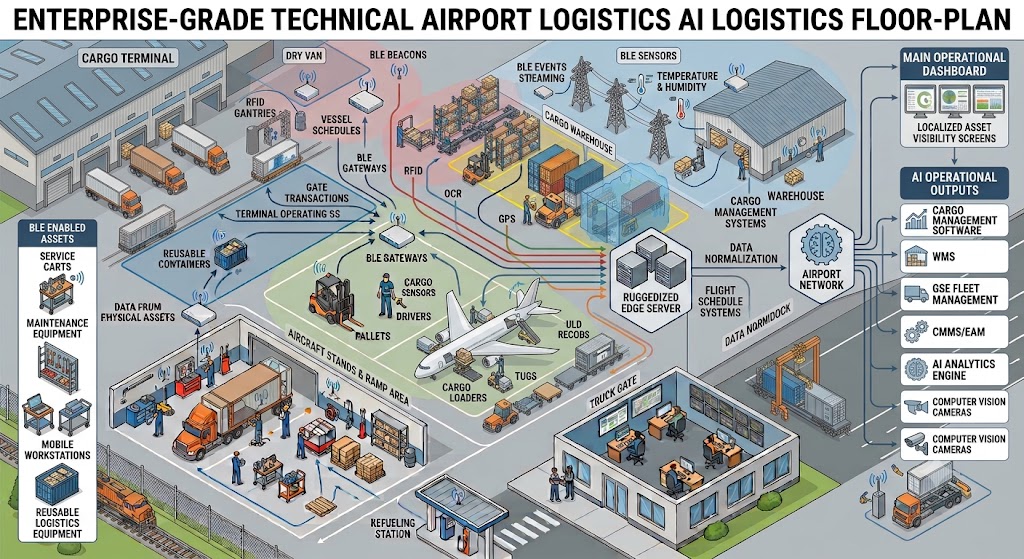
This isometric floor-plan details selective Bluetooth Low Energy (BLE) coverage across an airport cargo and ground-handling environment. BLE gateways positioned in strategic operational zones—such as the maintenance area, GSE staging zones, and cargo docks—receive data from beacon-tagged service carts, maintenance equipment, and mobile workstations. Transmitted via a ruggedized edge server and airport network, this localized BLE telemetry works alongside complementary technologies (RFID, GPS, computer vision) to feed WMS, GSE fleet management, and AI analytics engines.
AI Use Cases That Improve Airport Logistics Performance
Predictive Flight and Cargo Handling Risk
AI can combine flight schedules, cargo volume, shipment characteristics, warehouse capacity, staffing levels, ULD status, and historical processing times to identify flights and cargo flows that are likely to experience handling delays.
BLE observations can supplement this analysis when selected equipment or reusable resources need to be located or verified within operational zones.
Warehouse Congestion and Capacity Forecasting
AI can forecast warehouse occupancy using historical cargo volumes, scheduled arrivals, shipment dwell times, dock activity, ULD movements, and current inventory conditions.
The resulting forecasts can help warehouse managers adjust labor allocation, staging areas, dock assignments, and cargo movement priorities before congestion becomes operationally significant.
Predictive Maintenance for GSE and Cargo Handling Equipment
AI can analyze equipment usage, maintenance history, fault codes, operating hours, inspection records, and telematics to predict maintenance requirements for cargo loaders, belt loaders, tugs, baggage tractors, dollies, GPUs, forklifts, and other equipment.
BLE can supplement this workflow by helping locate selected equipment or maintenance resources. The AI decision should rely on equipment condition and maintenance data rather than BLE location alone.
ULD and Reusable Asset Utilization
AI can analyze ULD movements, dwell times, flight requirements, handling activity, and historical utilization to identify shortages, excess inventory, delayed returns, and unusual movement patterns.
BLE may support selected reusable assets associated with ULD handling or airport logistics, while ULD identity and transaction records remain governed by the appropriate cargo and ULD systems.
Cargo Transfer and Intermodal Coordination
AI can evaluate cargo arrival times, truck appointments, dock availability, warehouse capacity, shipment priority, flight connections, and transfer requirements.
This can help coordinate air cargo with trucking and other transportation activities. AI recommendations can prioritize dock resources, loading sequences, staging locations, and exception handling based on current operational conditions.
Cold-Chain Exception Detection
AI can correlate temperature measurements with shipment requirements, cargo dwell time, warehouse conditions, transfer events, and handling history. The system can identify abnormal temperature patterns or prolonged exposure that require investigation.
BLE environmental devices can provide selected measurements where their technical characteristics meet the deployment requirements. Critical monitoring should continue using appropriately qualified equipment and established procedures.
Airport Logistics Security Anomaly Detection
AI can analyze access events, asset movements, cargo transactions, equipment activity, and operational schedules to identify unusual behavior. Examples include equipment entering an unexpected zone, a selected asset remaining stationary for an unusual period, or movement that conflicts with an assigned workflow.
BLE can provide supporting proximity information, but security decisions should also use access-control systems, identity management, surveillance, cargo records, and other authoritative sources.
Cybersecurity and Data Protection for Airport Logistics
AI and connected airport logistics systems should be designed with cybersecurity controls from the beginning of the deployment. BLE gateways, beacons, sensors, edge servers, application servers, and integration interfaces can all become potential points of operational or data exposure.
Recommended controls include:
- Unique device identities and controlled authentication
- Gateway hardening and restricted administrative access
- Encryption for supported wireless and network communications
- Network segmentation for operational IoT devices and airport enterprise systems
- Least-privilege access for users, applications, and services
- Credential, certificate, and key management
- Secure firmware and configuration update procedures
- Centralized logging and security event monitoring
- Controlled API authentication and authorization
- Defined data retention and deletion policies
- Cloud and private-server security governance
- Backup, redundancy, and recovery procedures
- Incident response procedures covering connected airport equipment
- Device inventory and lifecycle management
- Regular security assessment and configuration review
Airport organizations should align cybersecurity practices with their applicable organizational, contractual, infrastructure, and regulatory requirements. BLE should be treated as one component of the overall security design rather than as a standalone airport security mechanism.
Deployment Lifecycle for Airport Logistics
Planning and Airport Site Assessment
Deployment should begin with a clearly defined logistics problem such as cargo dwell, ULD visibility, GSE utilization, maintenance delays, warehouse congestion, or cold-chain exception management.
A site assessment should document operational zones, existing systems, network connectivity, RF conditions, asset types, workflow dependencies, security requirements, and data ownership.
Hardware Selection and Pilot
The pilot should use hardware appropriate for the selected workflow. BLE gateways, beacons, and sensors should be evaluated alongside RFID, barcode, GPS, telematics, and other technologies already used by the airport.
Pilot measurements should include detection reliability, battery life, gateway availability, event latency, data completeness, and integration performance.
Integration and System Testing
Integration testing should verify that device events reach the correct software systems and that asset identifiers, locations, timestamps, and operational transactions remain consistent.
Testing should include normal workflows, missing data, gateway outages, network interruptions, device replacement, duplicate events, and incorrect asset assignments.
Commissioning and Operational Validation
The system should be validated under real airport conditions rather than only in a laboratory environment. Testing should cover peak cargo periods, vehicle movement, warehouse activity, maintenance operations, and representative environmental conditions.
Operational personnel should confirm that AI alerts and recommendations are understandable and useful.
Optimization and Model Tuning
AI models should be monitored after deployment because airport logistics patterns change with seasonal cargo volumes, flight schedules, new routes, equipment changes, staffing levels, and facility modifications.
Model performance should be evaluated using operational outcomes rather than model accuracy alone.
Maintenance and Device Lifecycle
BLE batteries, gateways, sensors, mounting hardware, network equipment, and software components require lifecycle management. Device inventories should identify installation locations, assigned assets, firmware versions, battery conditions, maintenance history, and replacement requirements.
Scaling Across Terminals and Airports
A validated workflow can be expanded from one operational zone to additional warehouses, cargo facilities, GSE areas, terminals, or airport locations. Standardized asset identifiers, integration interfaces, cybersecurity controls, and KPI definitions make multi-site expansion easier to manage.
KPIs for AI-Enabled Airport Logistics
Airport logistics organizations can establish baseline measurements before deployment and compare them with post-deployment results. Useful KPIs include:
- Cargo processing time
- Warehouse dwell time
- ULD dwell time
- ULD location accuracy
- Cargo transfer completion rate
- Missed connection rate
- Dock turnaround time
- Truck dwell time
- Warehouse capacity utilization
- Cargo throughput
- GSE availability
- GSE utilization
- Unplanned equipment downtime
- Mean time to repair
- Preventive maintenance compliance
- Flight turnaround support time
- Cargo exception resolution time
- Cold-chain exception duration
- Asset recovery time
- Reusable asset utilization
- Screening queue time
- Labor productivity
- Data and event completeness
- AI alert precision
- AI false-positive rate
- System uptime
- BLE gateway availability
- Beacon and sensor battery life
Practical Benefits of AI and BLE for Airport Logistics
AI-driven airport logistics can improve performance by converting large volumes of operational data into prioritized decisions.
- Improved cargo visibility: AI combines cargo, warehouse, flight, ULD, and handling information to identify delays and exceptions earlier.
- Better warehouse capacity utilization: Forecasting helps managers anticipate incoming cargo and allocate staging, labor, and storage resources.
- Faster ULD recovery: AI identifies unusual dwell and movement patterns, while selected location data can help personnel locate reusable resources.
- Reduced GSE search time: Selected BLE-tagged equipment can be located by operational zone, reducing time spent searching for mobile resources.
- Fewer unplanned maintenance events: Predictive models identify equipment risk using operating and maintenance data before failures disrupt cargo operations.
- Improved dock and truck flow: AI can compare appointments, cargo readiness, dock availability, and actual processing times to identify bottlenecks.
- Earlier cold-chain response: AI can detect temperature-related patterns and connect them with shipment and handling events.
- Better resource positioning: Forecasts can help place equipment and personnel where upcoming cargo and flight requirements are expected.
- Improved turnaround coordination: AI can combine cargo, GSE, flight, maintenance, and handling information to support time-sensitive decisions.
- Scalable operational analytics: Centralized analytics can compare performance across warehouses, terminals, facilities, and airport locations.
Implementation Recommendations for Airport Logistics
Successful implementation should begin with the airport logistics problem rather than the technology. Organizations should:
- Define the business problem and measurable baseline KPI before selecting hardware.
- Establish the authoritative source for each cargo, asset, ULD, equipment, and operational event.
- Use BLE only where zone-level or proximity information provides practical value.
- Preserve RFID, barcode, GPS, computer vision, OCR, telematics, and existing airport systems where they are better suited.
- Integrate with cargo management, WMS, ULD, GSE, CMMS/EAM, TMS, ERP, and security systems.
- Use edge processing where low latency, resilience, or local operation is important.
- Use cloud or centralized servers for cross-terminal analytics, reporting, and model development where appropriate.
- Incorporate cybersecurity controls during the pilot instead of adding them after deployment.
- Validate BLE performance under actual airport RF and operating conditions.
- Establish clear data ownership, retention, access, and governance rules.
- Maintain a complete lifecycle process for gateways, beacons, sensors, software, and integrations.
- Keep operationally significant AI recommendations explainable and subject to appropriate human review.
- Monitor AI performance and model drift after deployment.
- Train cargo, warehouse, maintenance, GSE, IT, and operations personnel.
- Compare post-deployment performance against documented baseline KPIs.
- Scale from one high-value workflow to additional zones and terminals after operational validation.
GAO Engineering and Technology Support for Airport Logistics
GAO supplies BLE gateways, BLE beacons, BLE sensors, RFID products, and other IoT technology-based hardware products and systems for organizations developing connected airport logistics solutions. GAO is headquartered in New York City and Toronto, Canada, and has served customers across the United States and Canada for three decades, including Fortune 500 companies, leading R&D organizations, universities, and government agencies.
Our work emphasizes practical hardware selection, system integration, quality assurance, and deployment considerations. We invest heavily in R&D and provide remote and onsite technical support to help organizations evaluate connected technologies for cargo, warehouse, GSE, maintenance, asset tracking, and other operational requirements.
Building the Future of Industrial AI and IoT with Aperture Venture Studio and GAO RFID Inc.
For more than three decades, GAO has invested heavily in R&D involving industrial BLE, RFID, and IoT. As AI became increasingly useful for industrial applications, we expanded our work combining AI with connected technologies to address practical airport logistics requirements, including air cargo visibility, ULD management, ground support equipment, maintenance, warehouse operations, and connected transportation workflows. We have founded Aperture Venture Studio to support these applications and bring together AI and IoT technical experts, operational leaders, investors, and leading companies. We welcome advisors, investors, customers, and technical professionals interested in practical AI and IoT applications. Aperture Venture Studio