
AI and BLE for Airport Terminal Facilities
AI and BLE Transform Airport Terminal Facility Operations
AI and BLE for Airport Terminal Facilities combine Bluetooth Low Energy beacons, sensors, gateways, edge computing, enterprise software, and AI analytics to improve how airport facilities monitor assets, manage passenger-facing environments, coordinate maintenance, and respond to operational conditions. BLE provides a practical wireless data layer for equipment identification, location, condition monitoring, and environmental measurements, while AI converts these data streams into anomaly detection, prediction, prioritization, and operational recommendations. Applications can span baggage handling areas, passenger terminals, gates, lounges, security zones, concessions, restrooms, mechanical rooms, electrical rooms, and back-of-house facilities. For airport operators, the value comes from connecting physical facility conditions with maintenance and operational decisions without requiring every monitored asset to be connected through wired infrastructure.
GAO supplies BLE beacons, BLE sensors, gateways, RFID products, and IoT systems that can support these airport terminal facility applications. The resulting system can connect field data with maintenance, building-management, asset-management, and operational software while maintaining appropriate separation between monitoring functions and safety-critical airport systems.
Airport Terminal AI and BLE Operations Overview Infographic
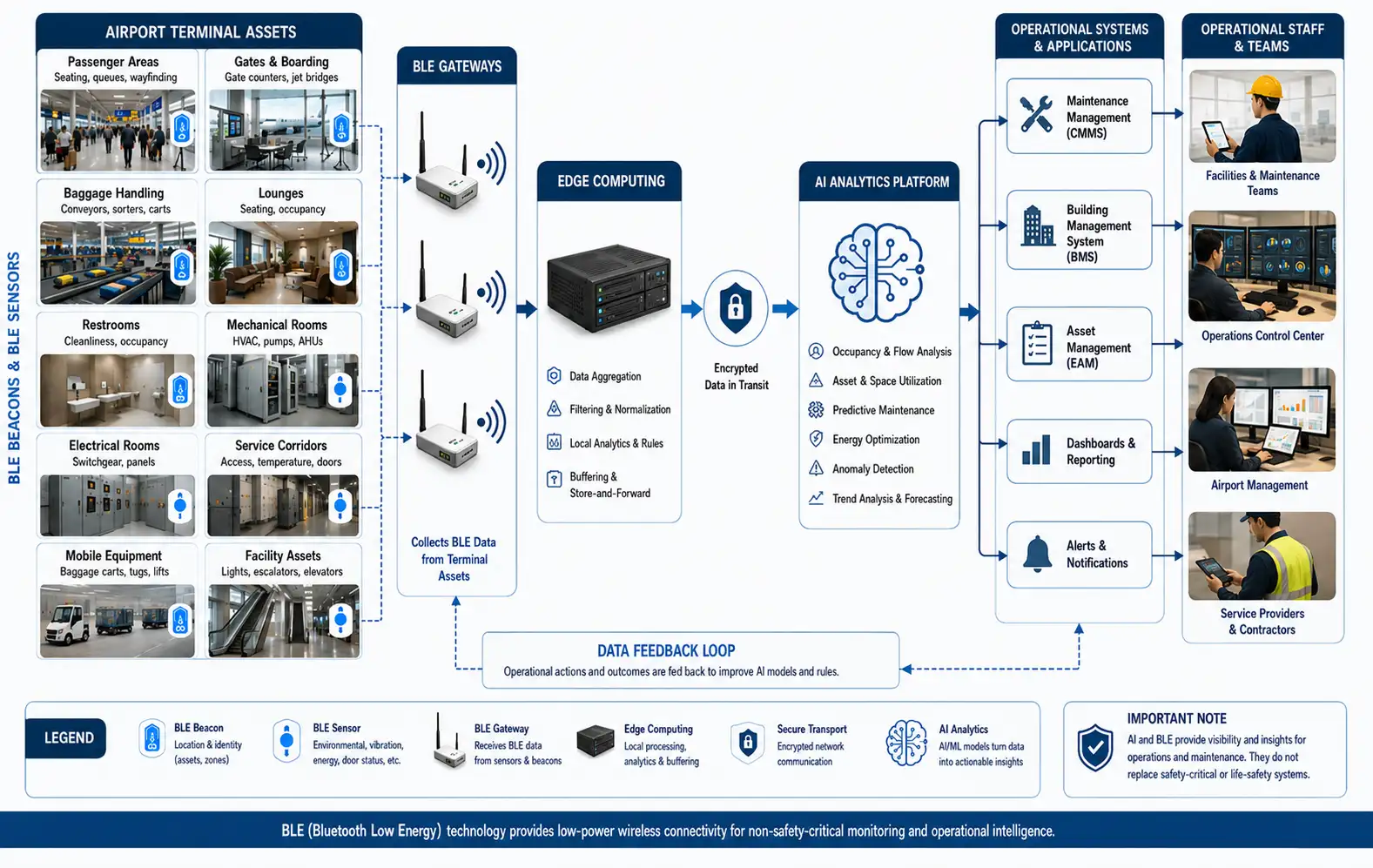
This infographic illustrates how BLE beacons and sensors capture data from airport terminal assets and environments, which is collected by BLE gateways and processed through edge computing and AI analytics. It shows how resulting insights support maintenance management, building management, asset management, dashboards, alerts, and operational staff while keeping safety-critical systems separate.
What AI and BLE Mean for Airport Terminal Facilities
BLE is particularly useful where airport terminal operators need wireless identification, proximity detection, location awareness, or sensor measurements without installing dedicated cabling to every monitored object. BLE beacons can identify assets, zones, equipment, or service points. BLE sensors can measure variables such as temperature, humidity, vibration, door state, occupancy-related conditions, or other application-specific parameters. BLE gateways receive transmissions from field devices and forward normalized information to edge or server-based software.
AI adds a decision layer to these observations. Instead of treating each sensor reading as an isolated event, an AI system can analyze historical and real-time data to identify unusual equipment behavior, forecast maintenance requirements, classify recurring events, and prioritize work. Airport terminal facilities therefore can move from simple condition visibility toward data-assisted maintenance and operational planning.
The relationship between AI and BLE is important because BLE provides comparatively low-power field connectivity while AI provides interpretation of the resulting data. A BLE vibration sensor on an air-handling-unit motor, for example, can provide periodic condition data. AI models can establish a baseline for that equipment and identify deviations that warrant inspection. Similarly, BLE temperature sensors in technical rooms can provide additional measurements that help facilities teams identify abnormal environmental conditions.
GAO’s BLE hardware and IoT systems can be incorporated into these applications according to the physical environment, required sensing range, gateway density, battery expectations, network availability, and integration requirements of the airport terminal.
Airport Terminal Applications for AI and BLE
Facility Equipment Condition Monitoring
Airport terminals contain large numbers of mechanical and electrical assets whose availability affects passenger comfort and facility operations. HVAC equipment, air-handling units, pumps, fans, motors, compressors, electrical cabinets, generators, and other service equipment can be monitored with appropriately selected BLE sensors.
Useful measurements can include:
- Vibration trends from rotating equipment
- Equipment and room temperature
- Humidity in selected technical spaces
- Door or cabinet status
- Equipment operating-state information where technically appropriate
- Environmental conditions around critical facility equipment
AI can compare current measurements with historical behavior and identify patterns that differ from an established operating baseline. Maintenance personnel can then investigate abnormal conditions before they become larger facility disruptions.
Airport Asset Location and Utilization
Mobile assets can become difficult to locate when they move between gates, service corridors, storage rooms, maintenance areas, and other terminal zones. BLE beacons attached to qualifying assets can provide identification and proximity information through strategically positioned gateways.
Applications can include:
- Maintenance carts
- Cleaning equipment
- Service equipment
- Portable tools
- Material-handling equipment
- Facilities support assets
- Selected baggage-service equipment
- High-value or frequently misplaced equipment
AI can analyze historical movement patterns to identify unusual dwell times, repeated movement between zones, underutilized equipment, or operational bottlenecks.
Baggage and Back-of-House Facility Monitoring
Airport baggage environments include conveyors, motors, drives, cabinets, service areas, and equipment rooms that operate under demanding schedules. BLE condition sensors can provide supplementary monitoring data for selected non-safety-critical equipment.
AI analysis can help identify abnormal vibration or temperature patterns and support maintenance prioritization. BLE should be engineered as a monitoring and data-collection mechanism rather than being treated as a substitute for certified control, emergency, or safety systems.
Passenger Terminal Environmental Monitoring
Passenger comfort depends on environmental conditions across waiting areas, gates, lounges, restrooms, concessions, and other occupied spaces. BLE sensors can provide localized measurements where existing building-management instrumentation does not provide sufficient granularity.
AI can correlate environmental observations with time, zone, equipment condition, and operational patterns. Facilities personnel can use the resulting information to investigate recurring temperature or humidity issues and improve maintenance scheduling.
Restroom, Service Area, and Facility Condition Monitoring
Airport terminal facilities require continuous attention to high-use spaces. BLE sensors can support monitoring of selected environmental and facility conditions, while AI can identify recurring patterns that help facilities teams allocate inspections and maintenance resources.
The system should be designed around measurable operational requirements rather than attempting to infer every passenger activity from wireless signals.
Airport Terminal BLE Use-Case Map: Sensors, Beacons, and Gateway Deployment
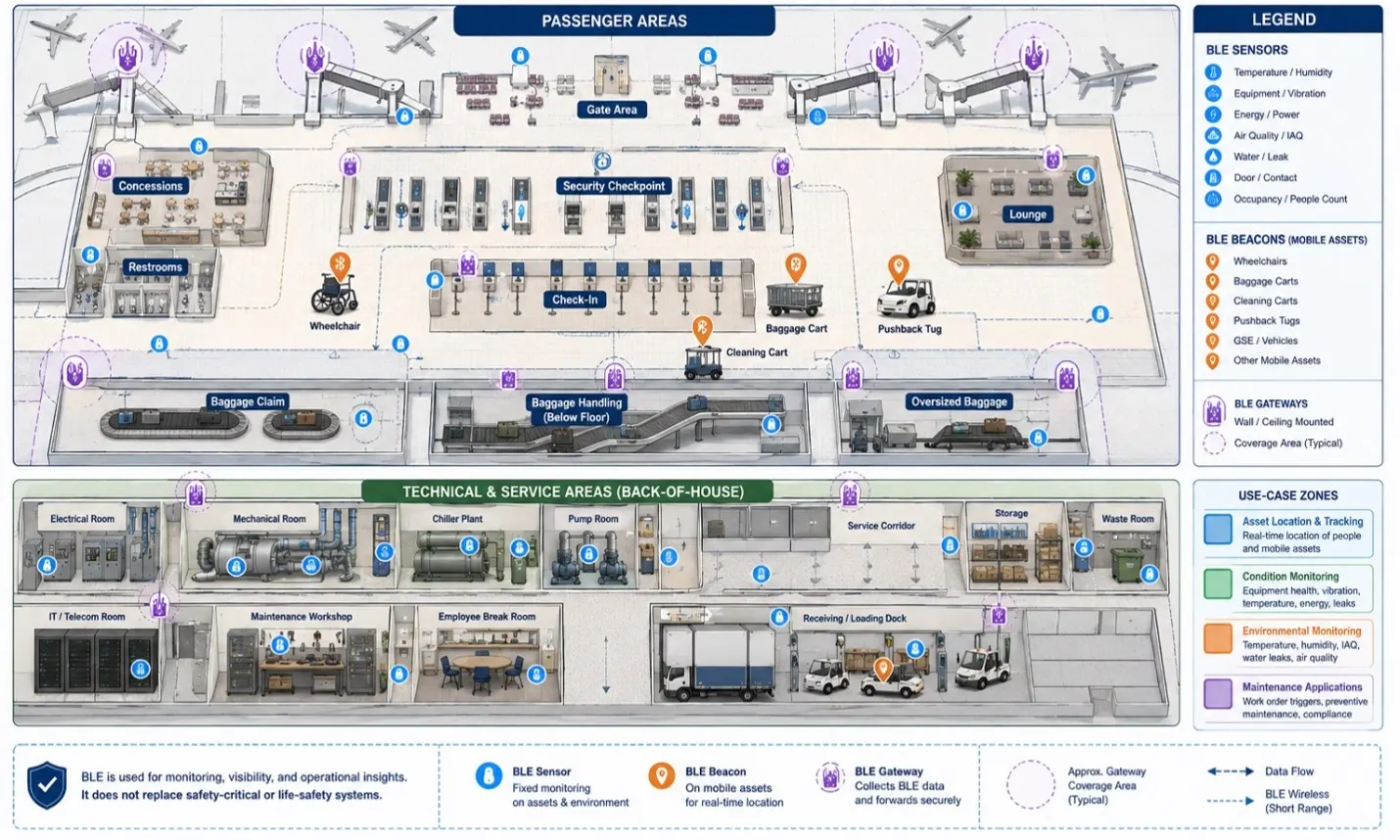
This technical floor-plan maps BLE deployment across passenger, baggage, and back-of-house airport areas. It shows BLE sensors for equipment and environmental monitoring, beacons for mobile-asset tracking, and gateways positioned for wireless coverage and data collection.
From Airport Terminal Data Capture to AI-Assisted Decisions
An effective AI and BLE solution for Airport Terminal Facilities begins at the field level. BLE sensors and beacons generate observations that must be collected, transported, normalized, stored, analyzed, and connected to an operational process.
Field Data Acquisition
BLE sensors capture measurements according to application requirements. Sampling frequency should reflect the physical phenomenon being monitored. A slowly changing environmental variable may not require the same sampling strategy as rotating-equipment vibration.
BLE beacons provide identification or location-related transmissions. Their placement should account for walls, equipment enclosures, metal structures, passenger movement, interference, gateway position, and required location accuracy.
BLE Gateway Collection
Gateways receive BLE transmissions from devices within their effective radio environment. Gateway selection and placement should consider terminal geometry, radio propagation, device density, network connectivity, power availability, maintenance access, and physical security.
Gateway software can filter, normalize, buffer, and forward data before it reaches centralized software. Local buffering is valuable where temporary network interruptions could otherwise create gaps in facility data.
Edge and Server Processing
Edge processing can perform preliminary validation, aggregation, filtering, and event detection close to the terminal. Centralized processing can then store longer-term time-series information and provide broader analytics across airport facilities.
A cloud-hosted system can be appropriate when centralized management, multi-site access, and scalable computing are priorities. A customer-managed server can be preferable where airport IT policies, data-location requirements, network constraints, or operational-control considerations favor privately hosted processing.
AI Analytics
AI methods should be selected according to the data and operational problem rather than applied as a generic layer. Relevant methods can include:
- Anomaly detection for equipment condition data
- Time-series analysis for environmental measurements
- Predictive maintenance models for selected mechanical assets
- Classification of recurring facility events
- Forecasting for maintenance workload and equipment behavior
- Pattern analysis for asset movement and dwell time
- Risk-based prioritization of maintenance events
Model performance depends heavily on data quality, sensor placement, equipment context, historical maintenance records, and the quality of feedback from facilities personnel.
Operational Action
The final objective is not simply to produce an AI score. The result should connect to an operational decision. An abnormal vibration pattern might generate an inspection recommendation. A persistent temperature anomaly might create a facilities investigation. Repeated asset dwell time might prompt a review of equipment allocation.
Integration can connect AI results with computerized maintenance management systems, building-management systems, asset-management software, dashboards, work-order systems, and other airport facility software where supported by the relevant interfaces.
End-to-End Airport Terminal AI and BLE Workflow Diagram
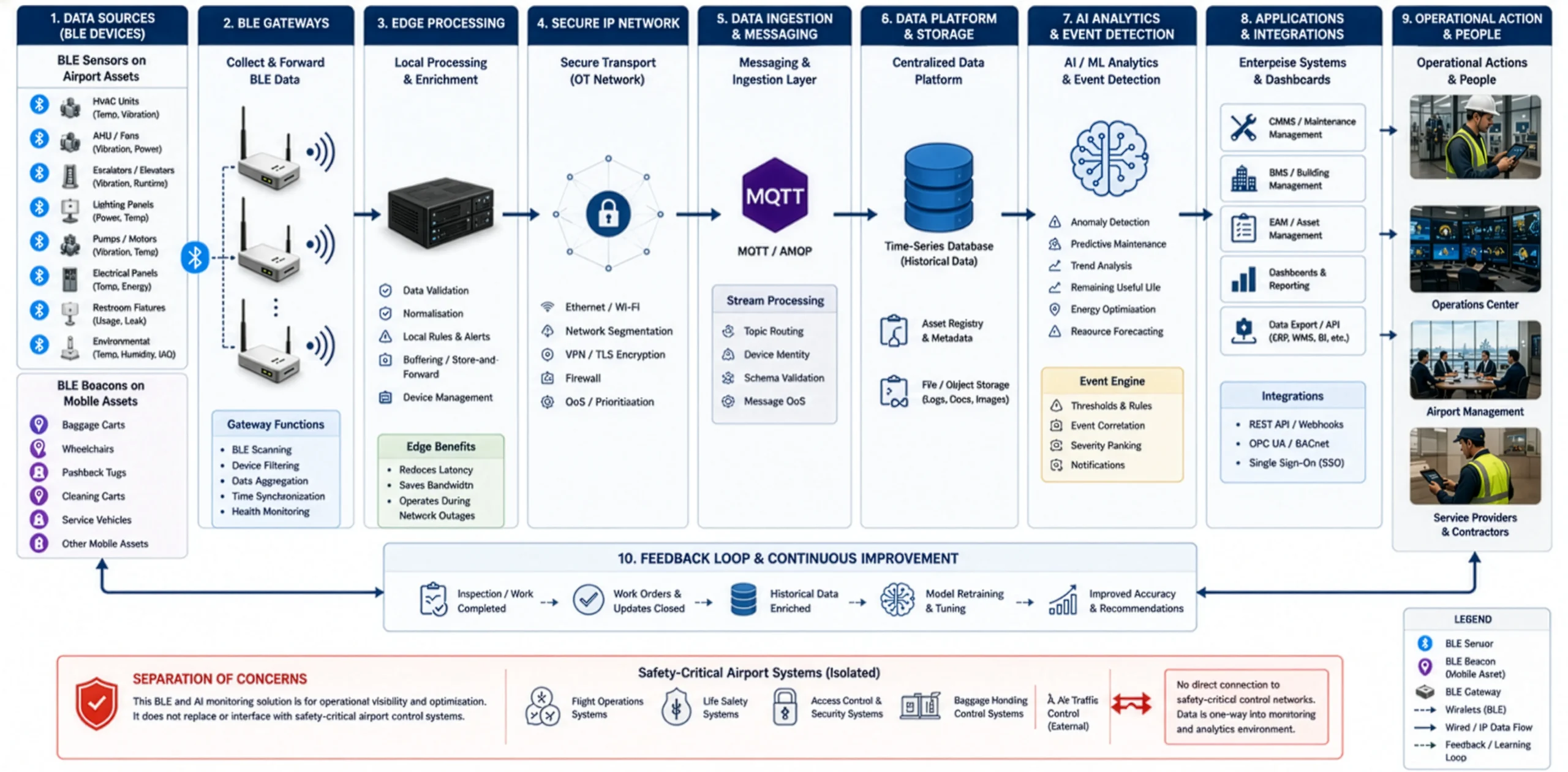
This technical workflow traces airport terminal data from BLE sensors and mobile-asset beacons through gateways, edge processing, secure networking, messaging, time-series storage, AI analytics, and operational systems. A feedback loop connects completed inspections and maintenance with historical data and model improvement, while safety-critical airport control systems remain isolated.
Airport Terminal AI and BLE System Components
BLE Sensors and Beacons
BLE sensors should be selected according to the measurement, environmental conditions, battery requirements, enclosure requirements, installation method, and maintenance interval. Sensors installed around mechanical equipment may require mounting methods that provide repeatable measurements and withstand vibration or temperature conditions.
BLE beacons are suitable for asset identification and proximity-oriented applications. Location accuracy depends on gateway density, radio conditions, signal behavior, and the selected positioning method. Airport operators should define the required accuracy before deciding how many gateways to deploy.
BLE Gateways and Network Connectivity
BLE gateways form the bridge between local wireless devices and the airport’s IP-connected software environment. Ethernet, Wi-Fi, or cellular connectivity may be considered according to location and IT requirements.
Gateway networks should be segmented appropriately. Firewall rules, authentication, encrypted communications, controlled administrative access, logging, and firmware-management procedures should be included in the design.
Middleware and Enterprise Integration
Middleware provides a practical boundary between field devices and airport software. MQTT can support lightweight event and telemetry messaging, while OPC UA may be appropriate where interoperability with industrial or building automation systems is required.
The integration layer should preserve asset identifiers, timestamps, sensor metadata, gateway information, zone information, and other contextual data. Without reliable context, AI analytics can produce technically correct calculations that are difficult for facilities personnel to act upon.
Cloud Version and Server Version
A Cloud Version places application software and analytics within managed cloud infrastructure. This approach can support centralized access, scalable computing, multi-location administration, remote software management, and long-term data analysis.
A Server Version places software on edge servers, customer-managed servers, private data centers, airport IT infrastructure, or other privately hosted enterprise infrastructure. This approach can provide greater control over data location and integration boundaries and can be appropriate where airport policies or network requirements favor private hosting.
The correct choice depends on airport IT governance, connectivity, cybersecurity requirements, data-retention policies, operational continuity requirements, integration constraints, and the number of facilities being managed. A hybrid arrangement can also separate local data collection and buffering from centralized analytics.
GAO can support the hardware and IoT portions of these deployments with BLE sensors, beacons, gateways, RFID products, and related systems selected for the airport terminal application.
Engineering Considerations for Airport Terminal BLE Deployment
Airport terminal environments introduce several deployment considerations that should be addressed during site assessment and commissioning.
- Radio propagation:Reinforced structures, metal equipment, walls, doors, baggage systems, and other physical obstructions can affect BLE signal behavior.
- Gateway placement:Gateway locations should be selected using coverage testing rather than relying solely on theoretical radio range.
- Device density:High concentrations of BLE devices require appropriate gateway capacity and data-handling design.
- Battery management:Battery-powered sensors require realistic transmission intervals, environmental assessment, battery-life estimation, and replacement planning.
- Asset identity:BLE device identifiers should map consistently to airport asset records and physical locations.
- Time synchronization:Reliable timestamps are important for correlating sensor events with equipment operation and maintenance activity.
- Network segmentation:BLE gateways should be isolated appropriately from safety-critical and sensitive airport networks.
- Maintenance access:Sensor and gateway locations should allow inspection, battery replacement, firmware updates, and eventual hardware replacement.
- Data quality:AI models require validated measurements, consistent metadata, and sufficient historical observations.
- Operational integration:Alerts should enter established facilities workflows rather than creating a separate queue that personnel must monitor manually.
A site survey should therefore precede large-scale installation. Pilot deployments can validate radio coverage, sensor behavior, gateway capacity, data quality, integration, and maintenance procedures before expansion across additional terminal zones.
Airport Terminal BLE Deployment Lifecycle: Planning, Integration, and Operational Expansion
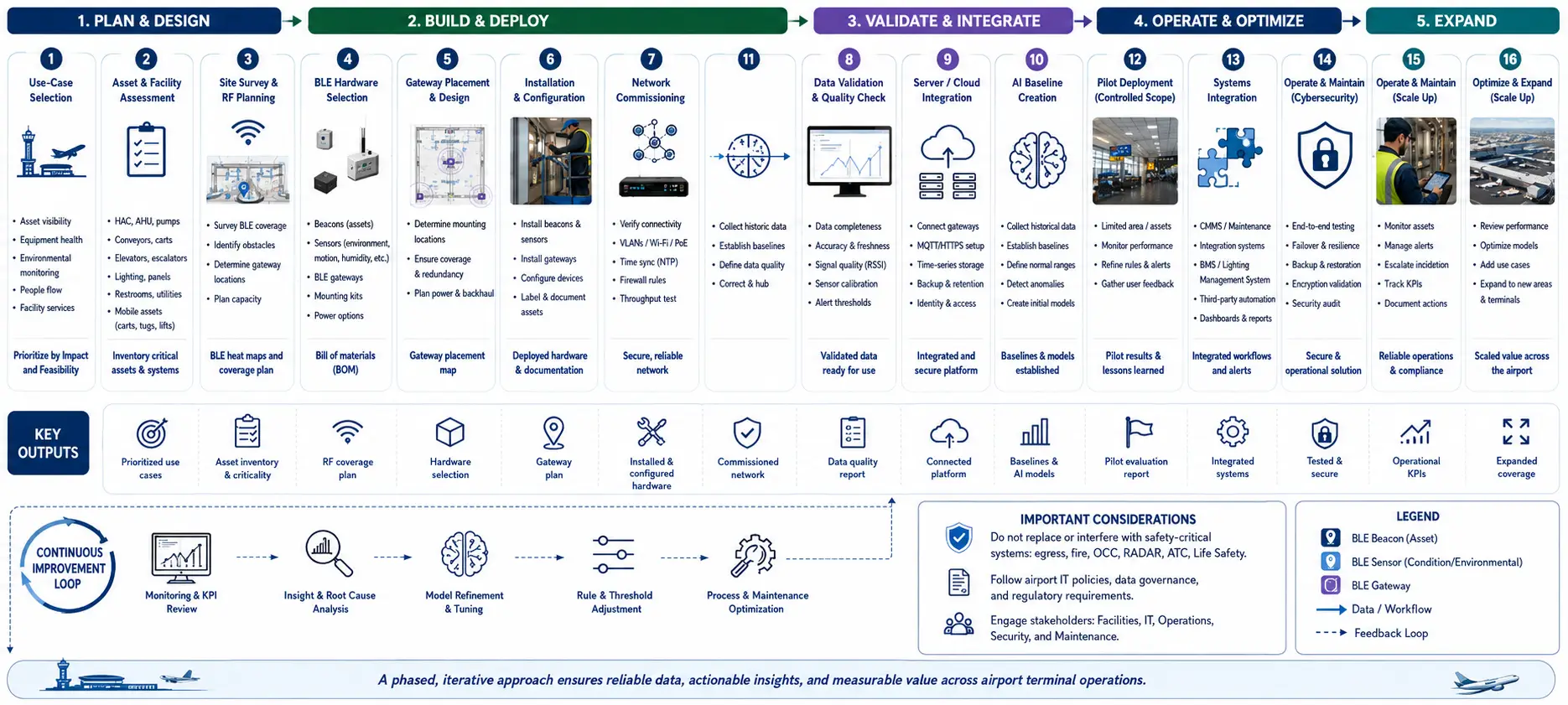
This lifecycle diagram presents a structured 15-step approach for deploying BLE across airport terminal facilities, from use-case selection and RF planning through hardware installation, network commissioning, AI baselining, pilot testing, and systems integration. It also shows cybersecurity review, operational maintenance, continuous optimization, and controlled expansion across additional assets and terminal areas.
Technical Capabilities and Operational Value of AI and BLE in Airport Terminal Facilities
AI and BLE can provide airport facilities teams with a connected method for observing equipment, mobile assets, environmental conditions, and operational patterns. The practical value depends on how well the wireless sensing system is integrated with established maintenance and facility-management processes.
Predictive and Condition-Based Maintenance
Traditional preventive maintenance often relies on fixed schedules. BLE sensors can provide additional condition information that allows maintenance teams to consider actual equipment behavior.
AI can analyze vibration, temperature, operating-state, and historical maintenance information to identify deviations from normal behavior. A model can flag equipment that requires inspection without automatically assuming that every anomaly represents an imminent failure.
This distinction is important for airport facilities. Maintenance recommendations should support engineering judgment, inspection procedures, equipment documentation, and established work-order processes. AI should prioritize investigation rather than bypass qualified personnel.
Improved Asset Visibility
BLE identification and location data can reduce time spent searching for mobile facilities assets. Historical location information can also reveal how assets move through terminal zones.
Useful metrics include:
- Asset utilization
- Zone dwell time
- Time between assignments
- Idle duration
- Movement frequency
- Asset availability
- Repeated movement between service locations
AI can identify recurring movement patterns that may indicate inefficient asset allocation or unusual operational behavior.
Faster Detection of Facility Anomalies
Continuous BLE measurements can provide more frequent observations than manual inspection alone. AI can evaluate these observations against historical baselines and generate prioritized events.
For example, an unusual temperature increase in a technical room may deserve investigation. A gradual increase in vibration from a rotating mechanical asset may justify an inspection before the next scheduled maintenance interval.
The objective is to shorten the time between abnormal behavior and human awareness while reducing unnecessary alerts.
More Granular Environmental Visibility
Airport terminal facilities contain large spaces where environmental conditions can vary by zone. BLE sensors can provide localized measurements that complement existing building-management instrumentation.
AI can analyze measurements by location, time, equipment condition, occupancy-related operating periods where suitable data is available, and historical trends. Facilities personnel can then distinguish isolated events from recurring conditions.
Maintenance Prioritization
Airport facilities teams often manage many simultaneous work requests. AI can help rank events using factors such as anomaly severity, historical behavior, asset criticality, recurrence, and time since previous maintenance.
A practical implementation should preserve the distinction between an AI-generated recommendation and a confirmed maintenance requirement. Work-order personnel should be able to review the underlying sensor evidence and equipment history before taking action.
Scalability Across Terminal Zones
A modular BLE deployment can begin with a limited number of high-value assets and expand after the pilot demonstrates acceptable radio coverage, data quality, battery performance, integration, and operational usefulness.
Expansion can proceed by terminal zone, asset class, equipment type, or facility function. This approach reduces the risk of installing large numbers of sensors before the airport understands the resulting data volume and maintenance requirements.
Cybersecurity and Reliability for Airport Terminal AI and BLE Systems
Airport environments require careful separation between monitoring systems and systems associated with safety, security, access control, navigation, or other regulated operational functions. AI and BLE deployments should therefore be scoped according to the consequence of failure and the sensitivity of the connected environment.
BLE devices should use appropriate device-management practices, while gateways should be protected through controlled administrative access, authentication, software updates, logging, and network segmentation.
Relevant controls can include:
- Segmented gateway networks
- Firewall policies
- Encrypted IP communications
- Strong gateway authentication
- Role-based administrative access
- Device inventory and identity management
- Firmware-management procedures
- Security logging
- Monitoring of gateway connectivity
- Backup and recovery procedures
- Controlled remote administration
BLE monitoring data should not automatically receive access to airport operational-control networks. A properly designed system can collect facility information while maintaining a defined boundary between IoT monitoring infrastructure and safety-critical systems.
Reliability also requires consideration of network outages. Gateways should be capable of buffering appropriate data when connectivity to centralized software is temporarily unavailable. Local buffering can preserve measurements for later synchronization, although the retention period and behavior should be defined during system design.
Airport Terminal AI and BLE Cybersecurity Architecture
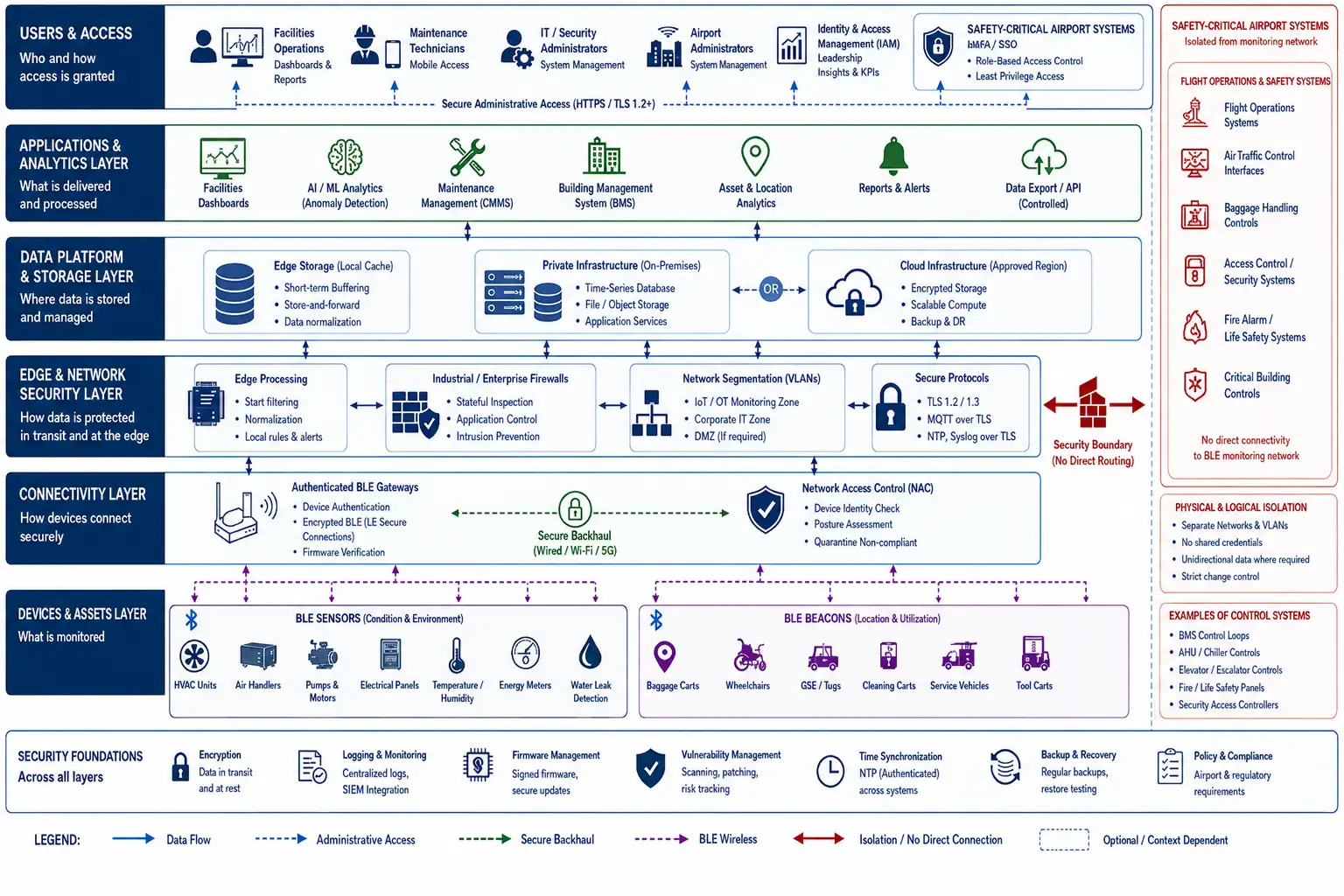
This layered architecture shows how BLE sensors and beacons connect through authenticated gateways, segmented networks, firewalls, edge processing, secure data platforms, and controlled applications. It highlights encryption, identity management, logging, firmware management, and a strict security boundary separating facility monitoring from safety-critical airport systems.
Airport Systems Integration and Interoperability
AI and BLE deployments deliver greater operational value when their outputs are connected to software already used by airport facilities and maintenance personnel.
Potential integration targets include:
- Computerized maintenance management systems
- Building management systems
- Facility management software
- Enterprise asset management systems
- Work-order management software
- IoT data storage
- Operational dashboards
- Reporting systems
- Selected warehouse or inventory systems
- Existing RFID and identification systems
Integration should begin with a clear data model. Each BLE device should correspond to an identifiable asset, zone, or measurement point. Timestamps, device identifiers, gateway identifiers, measurement units, and asset metadata should be retained consistently.
API-based integration may be appropriate for software systems that provide suitable interfaces. MQTT can support telemetry exchange, while OPC UA may be appropriate for interoperability with selected automation and industrial systems.
RFID and BLE can also coexist. RFID may be useful for identification and inventory processes where its characteristics are better suited to the application, while BLE can provide wireless sensing, beaconing, or continuous proximity information. Selecting one technology for every airport use case is generally less effective than matching the technology to the operational requirement.
GAO provides both BLE and RFID technologies, allowing airport facilities teams to consider the two technologies within a broader IoT deployment rather than treating them as mutually exclusive options.
Airport Terminal Implementation Recommendations
A successful AI and BLE deployment should begin with measurable operational problems rather than with a decision to install wireless devices.
Select High-Value Initial Use Cases
Good pilot candidates generally have:
- Clearly defined operational problems
- Accessible assets
- Measurable conditions
- Sufficient maintenance history
- Identifiable business or operational owners
- A realistic path to system integration
- Limited dependence on safety-critical control
Examples include condition monitoring of selected HVAC equipment, location monitoring for mobile facilities assets, environmental monitoring in technical rooms, and maintenance-event detection.
Establish the Asset and Data Model
Before installing sensors, define how assets, locations, BLE devices, measurements, gateways, work orders, and AI events will be represented.
The asset model should remain consistent as the deployment expands. Otherwise, integration and analytics become increasingly difficult as additional terminal zones and equipment types are added.
Perform a Radio Site Survey
A physical BLE survey should account for:
- Terminal construction materials
- Metal structures
- Equipment rooms
- Doors and partitions
- Baggage equipment
- Gateway mounting locations
- Network availability
- Electrical power
- Radio interference
- Expected device density
- Required positioning accuracy
Coverage should be validated using representative hardware in the actual airport environment.
Establish an AI Baseline
AI models require representative operating data. During the initial period, the system should collect and validate observations while facilities personnel document known operating states, maintenance events, inspections, and abnormal conditions.
The resulting baseline provides the context required to distinguish normal variation from meaningful anomalies.
Integrate Alerts With Existing Workflows
An alert that exists only on an IoT dashboard may not change maintenance behavior. AI events should therefore be mapped to an existing operational process.
A practical workflow might be:
- BLE sensor records abnormal equipment behavior
- Gateway forwards the measurement
- Edge or server software validates the data
- AI model evaluates the deviation
- System assigns an anomaly score
- Facilities personnel review the evidence
- Inspection or work order is created when appropriate
- Maintenance action is completed
- Result is recorded
- Historical data is used to improve future analysis
Measure Pilot Performance
Pilot evaluation should focus on technical and operational measurements rather than vague claims.
Relevant KPIs include:
- Sensor data availability
- Gateway connectivity
- Battery status
- Data-loss rate
- BLE coverage
- Location accuracy where applicable
- False-alert rate
- Anomaly detection performance
- Mean time to acknowledge alerts
- Maintenance response time
- Asset search time
- Asset utilization
- Work-order completion
- Equipment downtime
- Environmental exception frequency
These measurements provide a basis for deciding whether the solution should expand.
Airport Terminal AI and BLE Decision Tree for Facilities Deployment
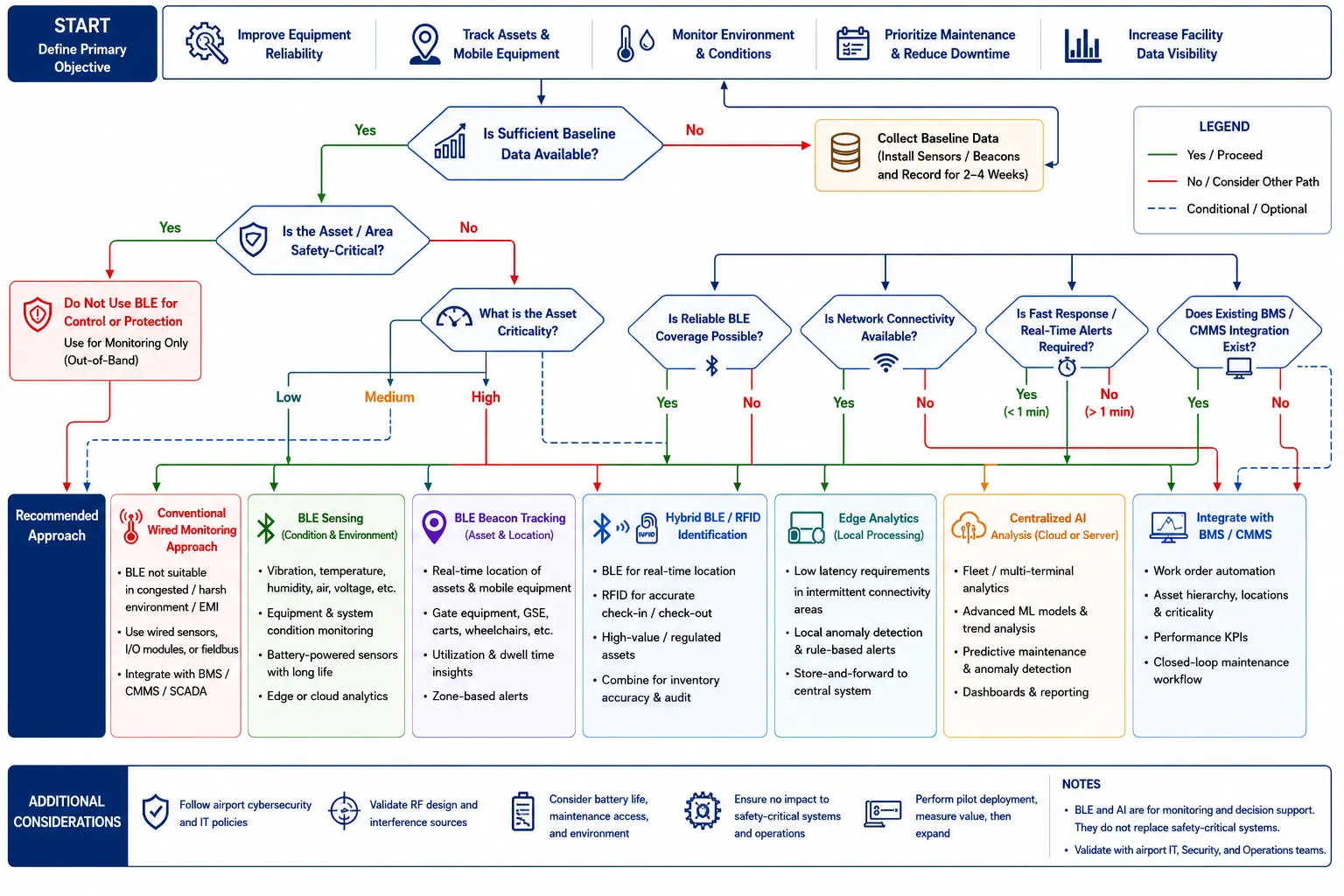
This decision tree helps airport facilities teams select an appropriate monitoring and analytics approach based on objectives, data availability, safety implications, asset criticality, BLE coverage, connectivity, response requirements, and existing BMS/CMMS integration. Recommended paths include wired monitoring, BLE sensing, beacon tracking, hybrid BLE/RFID, edge analytics, centralized AI, and BMS/CMMS integration.
Standards, Protocols, and Technical Governance
Airport terminal IoT systems should be evaluated against applicable airport, building, cybersecurity, wireless, electrical, and data-governance requirements. The precise requirements vary according to jurisdiction, airport ownership, facility type, and the systems being connected.
Relevant technical areas can include:
- Bluetooth Low Energy specifications
- IPv4 or IPv6 networking
- MQTT messaging
- OPC UA interoperability
- Ethernet
- Wi-Fi
- Cellular connectivity where appropriate
- TLS-encrypted communications
- Identity and access management
- Network segmentation
- Building-management interfaces
- CMMS or EAM integration interfaces
- Applicable electrical and facility requirements
- Applicable cybersecurity requirements
- Airport-specific IT and operational-security policies
The technology selection process should verify the current requirements applicable to the specific airport rather than assuming that one standards set applies universally.
Safety-critical systems require additional care. BLE and AI monitoring should not be introduced into a control loop simply because wireless sensing is technically possible. The system’s role, failure behavior, latency, availability, and cybersecurity requirements should be evaluated before integration with any operational technology.
Practical Deployment Lessons for Airport Facilities
Several engineering principles consistently improve the quality of AI and BLE projects.
First, sensor quantity should not be the primary success metric. A smaller number of well-selected sensors on high-value equipment can provide more useful information than a large installation with poorly defined operational objectives.
Second, data context is as important as data volume. A temperature measurement becomes significantly more useful when the software knows which asset produced it, where the asset is installed, what measurement unit is being used, and what operating conditions were present.
Third, AI models should be evaluated continuously. Airport terminal conditions change with equipment replacement, seasonal weather, maintenance, renovations, operational schedules, and changes to terminal use. A model that performs well during a pilot may require recalibration as the operating environment changes.
Fourth, facilities personnel should remain part of the decision process. Their inspections, maintenance records, and explanations of abnormal events are valuable feedback for improving AI models.
Finally, cybersecurity and maintainability should be designed from the beginning. Adding security controls after hundreds or thousands of field devices have been deployed is more difficult than establishing device identity, gateway security, network segmentation, firmware procedures, and administrative controls during initial deployment.
Applying AI and BLE Where Airport Facilities Need Better Visibility
AI and BLE for Airport Terminal Facilities can provide a practical foundation for wireless asset identification, condition monitoring, environmental sensing, and AI-assisted maintenance decisions. The strongest deployments begin with specific facility problems, validate BLE coverage and data quality through pilots, integrate results with existing maintenance workflows, and maintain clear security boundaries around sensitive airport systems.
Cloud, server, and hybrid deployment models can each be appropriate depending on airport IT requirements, connectivity, data governance, and operational objectives. GAO’s BLE, RFID, and IoT technologies can support organizations evaluating these options and developing practical airport facility monitoring systems.
Airport Terminal AI and BLE Technology Landscape
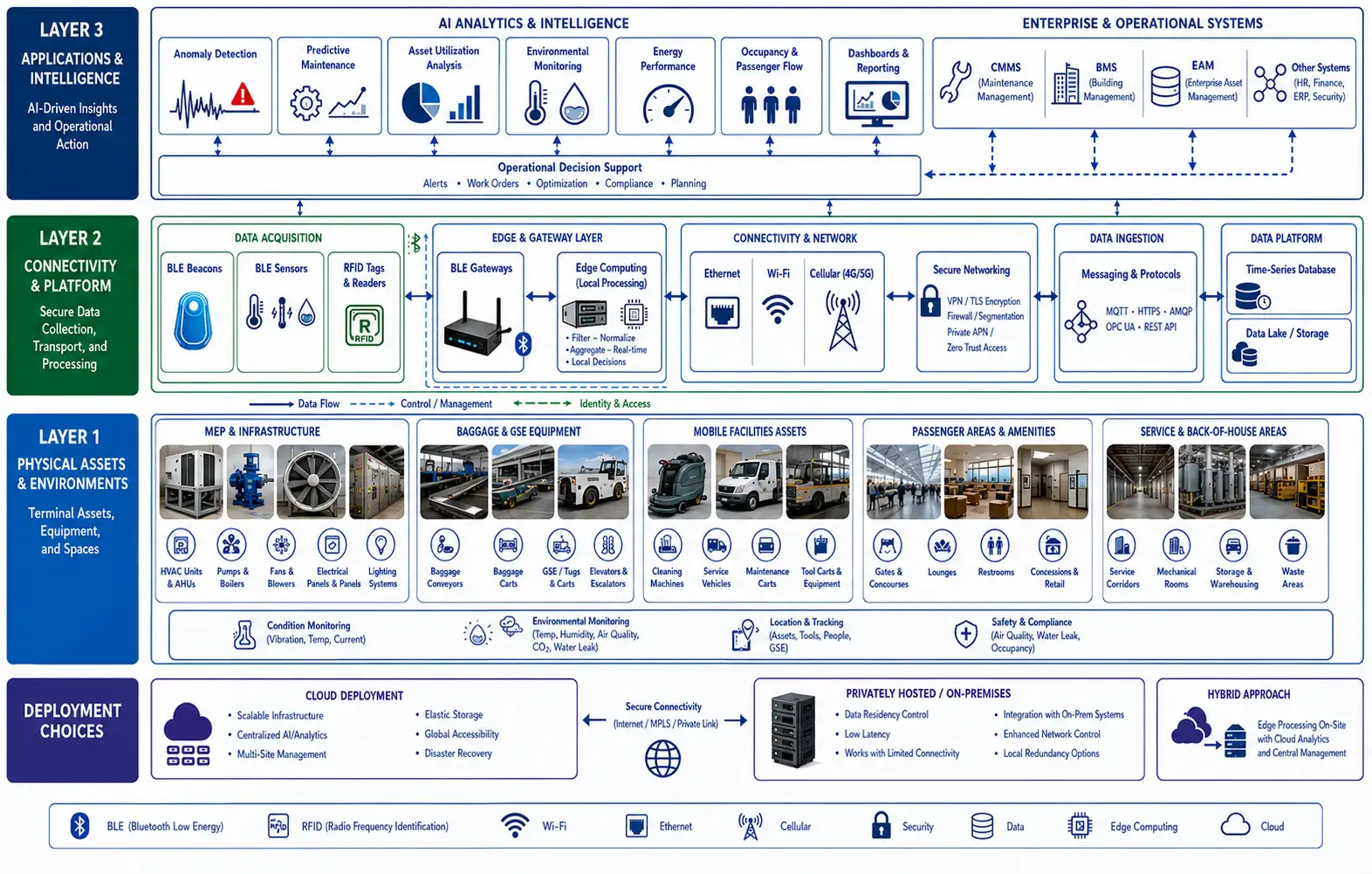
This three-layer technology landscape connects airport physical assets and environments with BLE/RFID data acquisition, gateways, edge computing, secure networks, and data platforms. The upper layer maps AI-driven applications such as anomaly detection, predictive maintenance, asset utilization, environmental monitoring, and operational decision support to CMMS, BMS, EAM, dashboards, and cloud, private-server, or hybrid deployment models.
Why GAO Is Relevant to Airport Terminal AI and BLE Projects
GAO supplies BLE beacons, BLE sensors, BLE gateways, RFID products, and IoT systems that can be used in applications involving asset identification, wireless sensing, condition monitoring, and facility data collection. Our role can extend from individual hardware components to systems that connect field devices with software and operational workflows.
GAO has served organizations across the United States and Canada for three decades, including Fortune 500 companies, research and development organizations, universities, and government agencies. Headquartered in New York City and Toronto, Canada, GAO is recognized among leading B2B and B2G BLE and RFID suppliers.
Our related companies, GAO Research and GAO Tek, form GAO Group, with operations based in New York City and Toronto. GAO Group has invested heavily in research and development and maintains quality-assurance processes intended to support reliable products and technical deployments.
For airport terminal facilities, this experience is relevant where the project requires careful hardware selection, wireless deployment planning, system integration, technical support, and long-term operational consideration.
Building the Future of Industrial AI and IoT with Aperture Venture Studio and GAO RFID Inc.
For more than three decades, GAO Group of Companies has invested heavily in R&D for industrial BLE, RFID, and IoT. As generative AI became increasingly useful for industrial applications, we expanded our work in AI and IoT, including BLE and RFID, and established Aperture Venture Studio to advance practical AI and IoT solutions for industries such as airport terminal facilities.
Aperture has attracted AI and IoT technical experts, entrepreneurial and operational executives, investors, and leading companies. We have also developed the Aperture Ventures Summit and TekSummit to discuss advanced AI and IoT topics and foster technical communities.
We welcome you to join us as:
- Advisors, Co-founders, or Employees
- Investors
- Customers