
AI and BLE for Ambulatory Care Centers
AI-Powered Ambulatory Care with BLE Location Intelligence
AI for ambulatory care centers combines artificial intelligence with connected medical assets, patient-flow data, staff activity, environmental sensors, and operational systems to help outpatient facilities make faster and more informed decisions. BLE gateways, beacons, and sensors provide a practical method for collecting location, proximity, occupancy, and equipment-status data across waiting areas, examination rooms, procedure areas, laboratories, pharmacies, storage rooms, and staff-only zones.
The value is not simply knowing where an asset or person is located. AI can analyze the resulting time-series data to identify appointment-flow bottlenecks, predict equipment demand, detect unusual movement patterns, estimate room utilization, and support operational decisions. For ambulatory care centers managing high patient volumes with limited rooms, clinicians, and medical equipment, this combination can improve resource utilization while reducing avoidable delays. GAO supplies BLE and IoT hardware products and systems that can provide the sensing and connectivity layer required for these applications.
AI and BLE for Ambulatory Care Centers: Healthcare Operations Intelligence
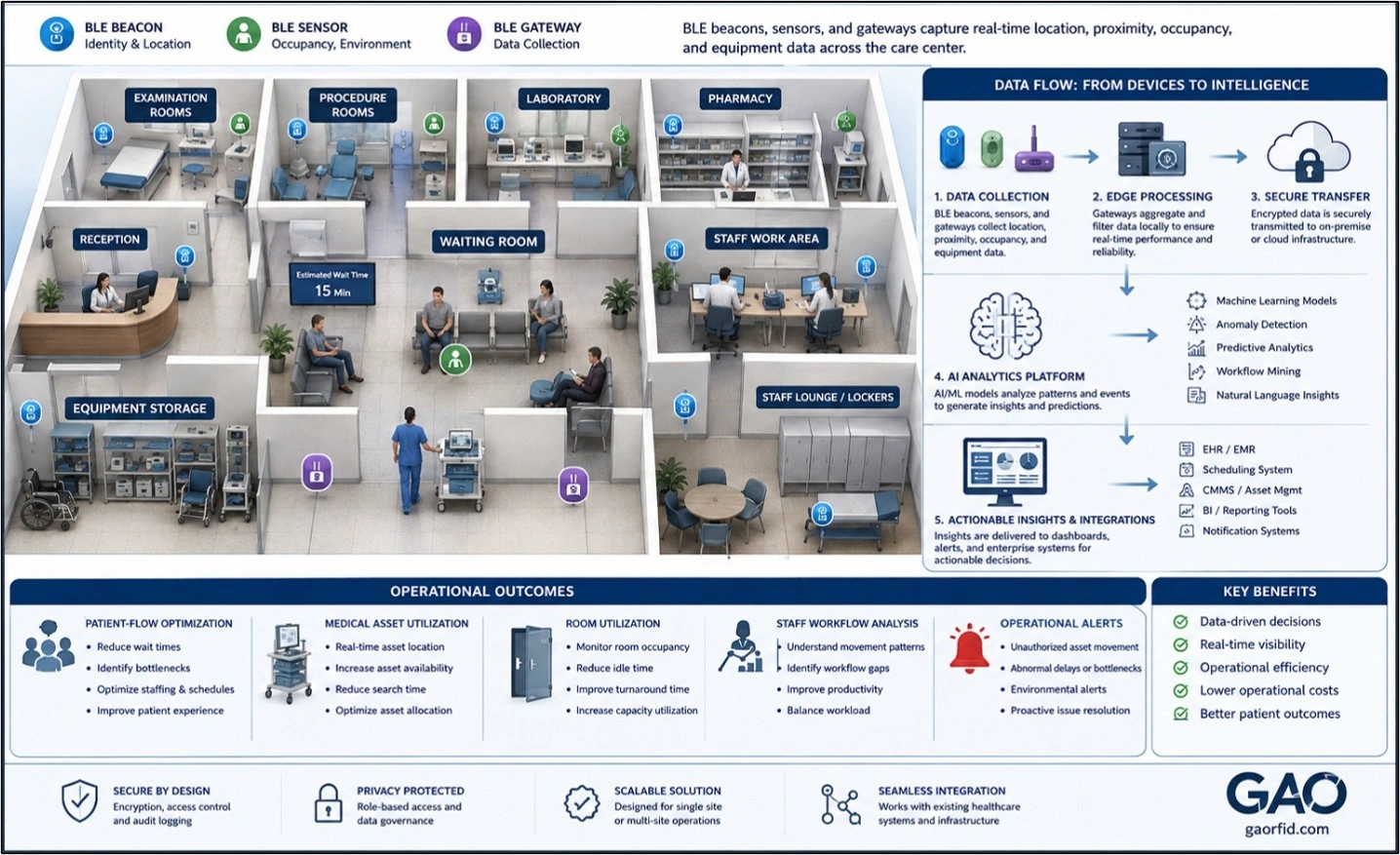
What AI Means for Ambulatory Care Centers
AI-enabled ambulatory care operations use machine learning, statistical analytics, rules-based detection, and, where appropriate, computer vision or natural language processing to transform operational data into recommendations or automated actions. BLE contributes continuous contextual data that is difficult to obtain from conventional administrative systems alone.
For example, an electronic health record or appointment scheduling application can indicate that a patient has an appointment, but it may not reveal how long that patient remained in the waiting area, whether an examination room was actually occupied, or how frequently mobile diagnostic equipment moved between departments. BLE location data can fill part of this operational information gap.
Common AI applications include:
- Predicting patient waiting-time patterns from historical appointment, arrival, room, and staffing data
- Detecting abnormal delays between registration, triage, examination, diagnostic testing, and discharge
- Predicting demand for mobile medical equipment based on historical utilization
- Identifying underused or overbooked examination and procedure rooms
- Detecting equipment that remains stationary for unusually long periods
- Supporting staff workflow analysis through authorized location and proximity data
- Generating operational alerts when equipment enters or leaves designated areas
- Estimating room occupancy and utilization from BLE sensor data
- Identifying recurring patient-flow bottlenecks
- Supporting preventive maintenance decisions using equipment movement and usage patterns
The objective should be operational intelligence rather than indiscriminate monitoring. Ambulatory care organizations need to define what data is necessary for a particular use case, who can access it, how long it is retained, and whether identifiable patient information is actually required.
Ambulatory Care Workflows Where AI Delivers the Most Value
Ambulatory care centers have highly structured workflows, but those workflows can become difficult to manage when appointment schedules, walk-in patients, clinical rooms, diagnostic services, and shared equipment compete for limited resources.
Patient Arrival, Registration, and Waiting
The patient journey often begins at reception or self-service registration and continues through waiting, triage, examination, diagnostic services, treatment, and discharge. AI can analyze historical arrival patterns and operational timestamps to identify where delays accumulate.
BLE can provide supplementary location information when appropriate. For example, a BLE-enabled patient tag or authorized mobile device can provide an approximate presence event within designated zones. BLE gateways installed at suitable locations receive beacon signals and forward relevant events to processing software.
AI models can then combine these events with appointment schedules, staffing levels, room availability, and historical throughput.
The result can be an operational view of questions such as:
- Which time periods consistently create excessive waiting?
- Which clinical areas experience the greatest congestion?
- How does late patient arrival affect downstream appointments?
- Which rooms experience the longest turnaround times?
- When should additional registration or clinical support resources be assigned?
This approach can help operations managers distinguish between a scheduling problem, a room-capacity problem, a staffing constraint, and a process bottleneck.
Examination and Procedure Room Utilization
Room utilization is a critical operational metric for ambulatory care centers. A room may appear available in a scheduling system while actually being occupied, awaiting cleaning, undergoing preparation, or being held for a clinical workflow.
BLE sensors and gateways can provide additional operational signals around room occupancy and equipment movement. AI can analyze these signals alongside appointment and scheduling records to identify utilization patterns.
For example, a model may identify that several examination rooms experience short but frequent periods of inactivity between appointments while another room consistently develops a queue. Operations teams can use these findings to review scheduling rules, room assignments, turnover processes, and staffing patterns.
The technology should support clinical operations rather than interfere with them. Sensor placement, gateway coverage, signal behavior, infection-control requirements, and facility layout all need to be considered during deployment.
Mobile Medical Equipment Tracking
Ambulatory care centers may share wheelchairs, infusion equipment, portable monitors, ultrasound equipment, diagnostic devices, carts, and other mobile assets across departments. Searching for equipment can consume staff time and can delay patient care.
A BLE beacon attached to an authorized asset can transmit an identifier that is detected by nearby BLE gateways. The location system can translate gateway observations into an estimated asset location or zone. AI can analyze historical movement and utilization to determine which assets are frequently requested, where they tend to accumulate, and whether the current inventory is sufficient.
This enables use cases such as:
- Medical equipment location
- Equipment utilization analysis
- Asset movement history
- Excessive idle-time detection
- Department-level equipment demand forecasting
- Equipment availability alerts
- Workflow-based asset allocation
- Support for preventive maintenance workflows
GAO’s BLE hardware can serve as the sensing and connectivity layer while customer software and clinical information systems perform the operational processing required by the facility.
AI and BLE-Enabled Asset Tracking for Ambulatory Care Centers
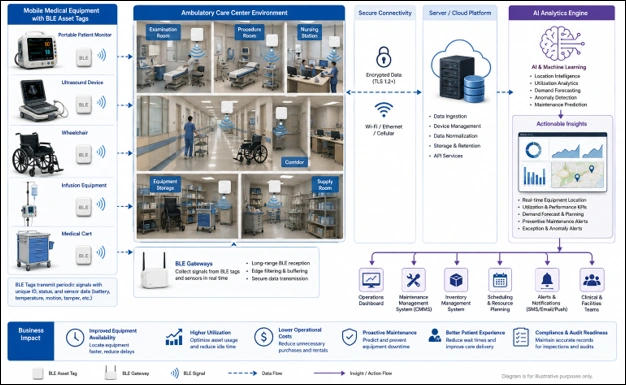
From BLE Data Capture to AI-Driven Operational Decisions
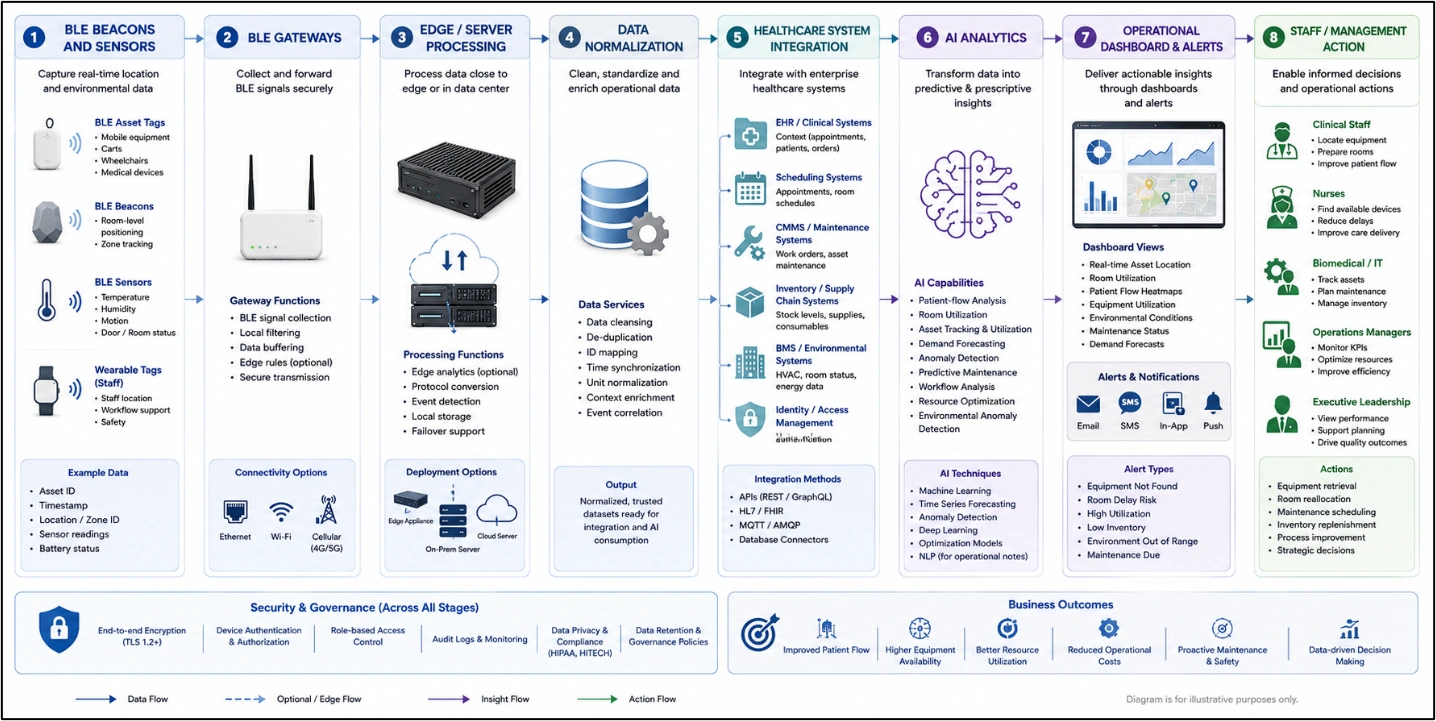
A practical AI and BLE solution for an ambulatory care center consists of several connected stages. The exact implementation depends on facility size, clinical workflow, cybersecurity requirements, existing software, and whether the organization requires cloud-hosted or privately hosted processing.
Data Acquisition
The process begins with BLE-enabled devices and sensors. BLE beacons can be attached to equipment or used for zone identification, while BLE sensors can collect environmental or occupancy-related measurements where applicable.
Potential data sources include:
- BLE asset beacons
- BLE proximity sensors
- BLE occupancy sensors
- BLE gateways
- Authorized mobile devices
- Appointment scheduling systems
- Electronic health record systems
- Facilities management software
- Medical equipment management systems
- Access-control systems
- Environmental monitoring systems
The solution should avoid collecting more information than the operational objective requires. For example, an asset-tracking application may only need an equipment identifier and location zone rather than patient-identifying information.
BLE Communication and Gateway Processing
BLE devices transmit short-range wireless signals. Gateways positioned throughout the facility receive those signals and forward selected data to a local server or cloud service.
Gateway placement requires more than simply installing hardware at regular intervals. Walls, doors, medical equipment, furniture, human occupancy, building materials, and radio-frequency interference can affect signal behavior. A deployment should therefore include a site survey and validation process.
For location applications, organizations also need to establish the required accuracy. A system intended to determine whether a wheelchair is in the rehabilitation area does not necessarily require the same precision as an application attempting to determine a device’s position within a specific clinical room.
Edge Processing and Data Normalization
Raw BLE observations may contain duplicate events, signal-strength fluctuations, missing observations, and other inconsistencies. Middleware can normalize these events before they reach AI analytics.
A typical processing sequence may include:
- Gateway receives BLE advertisement
- Device identifier is validated
- Signal and timestamp data are captured
- Duplicate or invalid events are filtered
- Gateway or server associates the observation with a location zone
- Normalized events are stored
- Operational data is combined with scheduling or equipment records
- AI models analyze historical and current data
- A dashboard, alert, or workflow application presents the result
This separation between sensing, data processing, analytics, and operational action makes the system easier to troubleshoot and scale.
AI Analytics and Decision Support
AI models can operate on historical and near-real-time data. A forecasting model might predict equipment demand for a particular department, while an anomaly-detection model could identify unusual room utilization or asset movement.
The appropriate model depends on the business problem. Machine learning should not be introduced simply because data is available. A rules-based threshold may be more appropriate for a straightforward alert, while a predictive model may be justified when historical patterns contain sufficient data to support forecasting.
The AI output should ultimately connect to a real operational decision, such as reallocating equipment, reviewing appointment capacity, changing room assignments, investigating abnormal delays, or initiating maintenance.
AI-to-Action Workflow for Ambulatory Care Centers
BLE Hardware, AI Software, and Deployment Models for Ambulatory Care
A production deployment should treat BLE hardware, data processing, AI software, healthcare applications, networking, and security controls as coordinated components rather than isolated technologies.
BLE beacons provide identifiers or sensor data associated with assets, zones, or other authorized entities. BLE sensors can provide additional measurements such as occupancy or environmental conditions where appropriate. BLE gateways provide the connection between local wireless devices and the facility’s IP network or processing environment.
The software layer can include device management, location processing, event databases, APIs, analytics engines, dashboards, alerting services, and integration middleware. Depending on the use case, these components may exchange information with appointment scheduling applications, electronic health records, computerized maintenance management systems, facilities management software, or other operational applications.
Cloud Version
A cloud-hosted deployment can centralize BLE event processing, dashboards, analytics, and AI workloads. This model can be appropriate for organizations that need centralized management across multiple ambulatory care locations or want to reduce the amount of software infrastructure maintained at each site.
The facility still requires local BLE gateways and reliable network connectivity. Security controls should include authenticated communication, access management, encryption where appropriate, device lifecycle management, logging, and monitoring.
Cloud processing can also make it easier to aggregate historical data across locations, provided governance policies permit such aggregation.
Server Version
A privately hosted server deployment can place processing within customer-managed servers, private data centers, or other controlled infrastructure. This model can be appropriate where organizational policies require greater control over data processing, network connectivity, integration boundaries, or software hosting.
A server-based deployment does not eliminate the need for cybersecurity. It requires patch management, authentication, network segmentation, backups, logging, vulnerability management, and controlled administrative access.
The decision between cloud and server deployment should be based on the ambulatory care center’s data governance requirements, existing IT capabilities, integration strategy, scalability requirements, network reliability, and operational support model.
Cloud Version vs. Server Version for AI and BLE Ambulatory Care Solutions
| Aspect | Cloud Version | Server Version |
|---|---|---|
| Data Processing Location | Data is processed and stored in managed cloud infrastructure. | Data is processed on customer-managed servers, private data centers, or edge servers. |
| Infrastructure Responsibility | Cloud provider manages core computing, storage, networking, and infrastructure availability. | Healthcare organization manages servers, storage, networking, operating systems, and infrastructure availability. |
| Scalability | Can scale computing and storage resources as device volumes, data volumes, and facility coverage increase. | Scaling depends on available server capacity and the organization’s infrastructure planning. |
| Multi-Site Management | Suitable for centralized management and analytics across multiple ambulatory care centers. | Can support multiple sites through the organization’s network and centralized management tools, depending on implementation. |
| Connectivity Dependency | Requires reliable network connectivity for data transfer and access to cloud services. | Can operate primarily within the organization’s local network, reducing dependence on external internet connectivity. |
| Integration Control | Uses cloud APIs and integration services according to the deployment and provider configuration. | Provides greater control over connections to internal databases, healthcare applications, and network interfaces. |
| Security Administration | Security responsibilities are shared between the cloud provider and healthcare organization, including infrastructure controls, access policies, encryption, and data governance. | Healthcare organization manages infrastructure security, access controls, encryption, monitoring, and applicable compliance configurations. |
| Maintenance Responsibility | Cloud provider typically manages infrastructure maintenance, updates, and core service availability. | Healthcare organization is responsible for server hardware, operating systems, software updates, patches, backups, and infrastructure maintenance. |
| AI Processing | AI analytics can be centrally managed and applied across multiple locations. | AI processing can remain within privately hosted infrastructure or close to the healthcare facility. |
| Appropriate Ambulatory Care Use Cases | Multi-location outpatient networks, centralized analytics, organizations with approved cloud governance, and facilities seeking managed infrastructure. | Organizations requiring greater control over data processing, facilities with existing private infrastructure, constrained connectivity environments, or strict internal data-handling requirements. |
| Best Fit | Organizations prioritizing centralized management, scalability, and managed infrastructure. | Organizations prioritizing infrastructure control, local processing, and integration within privately managed IT environments. |
Security and Privacy by Design
Ambulatory care deployments can involve sensitive operational and potentially patient-related information. BLE identifiers should therefore be treated as controlled data rather than automatically assuming that location information is harmless.
Security considerations include:
- Network segmentation for IoT and BLE gateway traffic
- Strong authentication for gateways and administrative interfaces
- Role-based access controls
- Encryption for data transmitted across IP networks
- Secure device provisioning and credential management
- Firmware and software patch management
- Audit logging
- Data retention policies
- Asset and device inventory
- Monitoring for unauthorized devices or unusual gateway behavior
- Separation of operational identifiers from patient-identifying information where possible
The system design should also distinguish between clinical data and operational telemetry. A medical equipment location system, for example, may be able to operate using an asset identifier without receiving the patient’s name, diagnosis, or clinical record.
Operational Improvements from AI-Enabled BLE Solutions
The combination of AI with BLE-generated operational data can provide ambulatory care centers with a more complete view of how patients, staff, rooms, and mobile assets move through daily operations. The most useful deployments connect these observations to measurable operational objectives rather than treating location data as an end in itself.
Patient Flow and Waiting-Time Optimization
AI can identify recurring relationships between appointment schedules, arrival patterns, room availability, staffing levels, and observed movement through designated areas. This can help operations teams determine where patient flow slows down.
For example, if historical data shows that a particular clinical service consistently develops a queue after a certain appointment period, management can investigate whether the cause is insufficient room capacity, appointment clustering, staff availability, diagnostic turnaround time, or another process constraint.
BLE provides an additional operational signal by showing when authorized devices or tagged assets enter and leave defined zones. Combined with existing scheduling and clinical workflow data, these signals can support more detailed analysis of:
- Registration-to-triage time
- Waiting-area dwell time
- Room turnover time
- Examination duration
- Diagnostic service delays
- Patient movement between clinical zones
- Discharge workflow duration
The objective is to identify process constraints that can be addressed through scheduling, staffing, room allocation, or workflow changes.
Medical Equipment Utilization
AI can transform equipment location records into utilization insights. Historical BLE observations can show where equipment spends most of its time, how frequently it moves, and which departments repeatedly require particular assets.
This can support decisions about equipment allocation and procurement. A center may discover that a portable diagnostic device is heavily used during specific periods but remains idle during others. Rather than purchasing additional equipment immediately, management can evaluate whether scheduling or redistribution could address the demand.
Useful metrics include:
- Asset utilization rate
- Asset idle time
- Asset movement frequency
- Department-level demand
- Equipment search time
- Time between equipment requests
- Equipment availability
- Utilization by time of day
- Utilization by clinical service
AI forecasting can further estimate future demand when sufficient historical data is available.
Room and Facility Utilization
Ambulatory care centers often have expensive clinical space that must support multiple appointment types and services. AI can analyze room occupancy observations together with scheduling data to identify discrepancies between planned and actual utilization.
This can reveal:
- Frequently underused examination rooms
- Consistently overloaded clinical areas
- Extended room turnover periods
- Appointment scheduling patterns that create avoidable gaps
- Rooms that are repeatedly unavailable during scheduled operating periods
- Differences between scheduled utilization and observed utilization
These findings can support facility planning without requiring immediate physical expansion.
Staff Workflow Support
Authorized staff location information can provide operational insight into movement between work areas, supply rooms, examination rooms, laboratories, and other designated zones. Any such implementation should have a clearly defined operational purpose, appropriate access controls, and organizational policies governing the collection and use of staff location data.
AI can identify workflow patterns such as excessive movement between distant areas, recurring delays in equipment retrieval, or periods when particular clinical areas experience unusually high workload.
The objective should be process improvement and resource planning, not unrestricted employee surveillance.
AI and BLE Ambulatory Care Operations KPI Dashboard
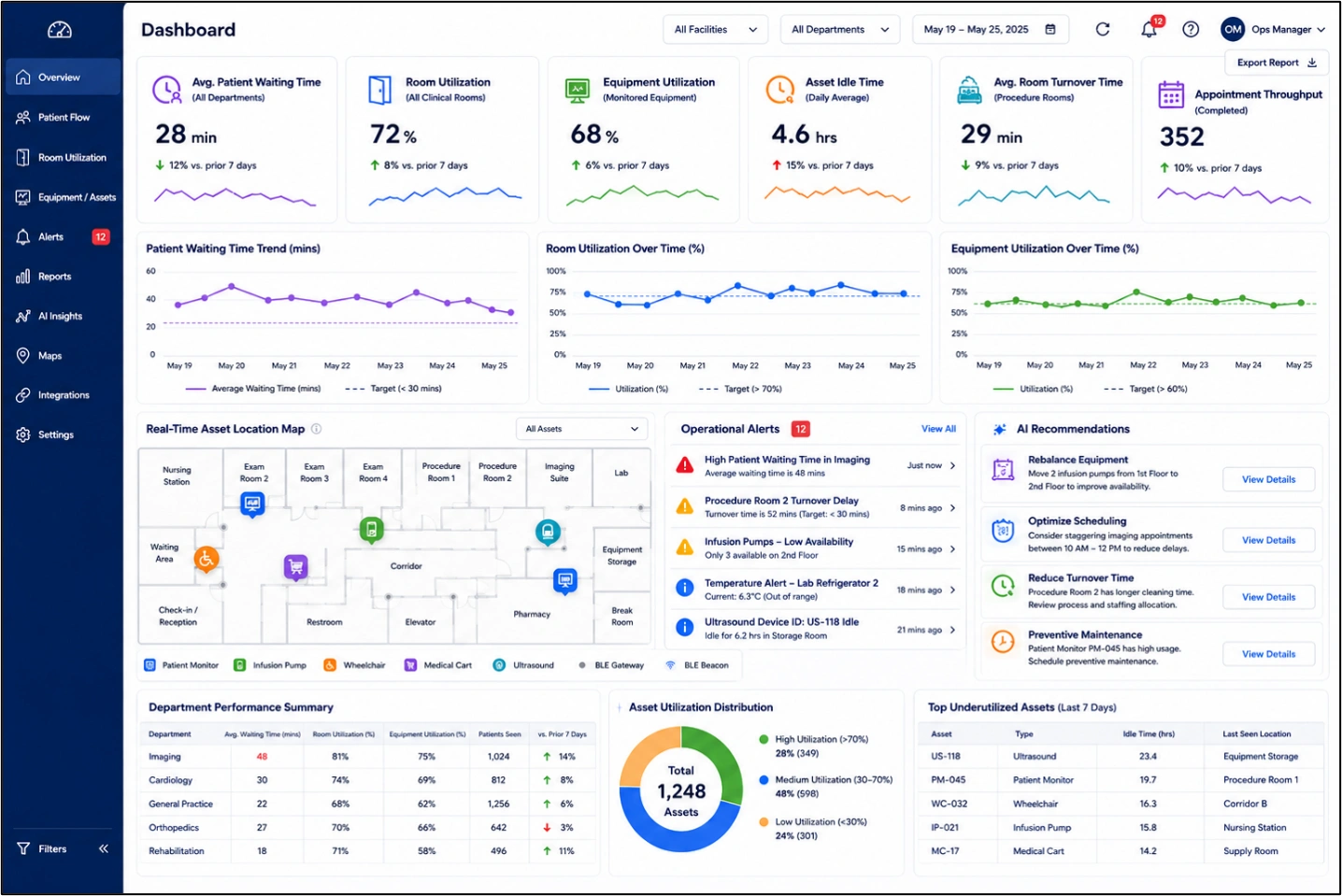
AI Use Cases for Ambulatory Care Centers
AI and BLE can support several operational scenarios when the underlying data is sufficiently reliable and the use case has a measurable business objective.
Predictive Patient Flow
Historical appointment schedules, arrival patterns, room availability, staffing information, and operational timestamps can be analyzed to forecast periods of congestion.
An AI model can estimate expected demand for a clinical service and identify conditions associated with longer waiting times. Operations managers can use these predictions to review staffing or appointment allocation before congestion becomes severe.
Equipment Demand Forecasting
Equipment movement and utilization histories can be combined with appointment schedules and clinical service demand. A forecasting model can estimate future demand for mobile equipment.
This can support decisions about:
- Equipment redistribution
- Department-level inventory
- Maintenance scheduling
- Equipment procurement
- Peak-period preparation
Forecasting should be validated against actual demand before being used for important operational decisions.
Anomaly Detection
Anomaly detection is particularly useful when normal operational patterns are well established.
Examples include:
- An asset remaining in an unexpected zone
- Equipment leaving an authorized area
- A room showing unusual utilization behavior
- Unexpected gaps in gateway observations
- An unusual increase in patient-flow delays
- Equipment movement that differs substantially from historical patterns
AI can flag these conditions for human review rather than automatically treating every anomaly as an operational failure.
Asset Loss Prevention and Zone Monitoring
BLE-enabled equipment monitoring can establish virtual zones around storage rooms, clinical departments, or other authorized areas. If an asset moves outside an expected zone, the system can generate an alert.
This can be useful for mobile equipment that is expensive, difficult to replace, or frequently shared between departments.
A practical implementation should account for BLE signal variability. Zone-based alerts should therefore be validated against the physical facility to reduce false alarms.
Predictive Maintenance Support
BLE data can provide evidence about equipment movement and usage, but it should not automatically be treated as a direct measure of mechanical condition.
When BLE observations are combined with actual equipment telemetry, maintenance records, operating hours, fault codes, or manufacturer-provided data, AI can help identify maintenance patterns and prioritize inspections.
This can help maintenance teams move from purely calendar-based workflows toward condition-informed maintenance where sufficient data exists.
Integration with Ambulatory Care Software
BLE and AI solutions become more useful when operational information can be connected to existing healthcare applications.
Potential integration points include:
- Electronic health record systems
- Appointment scheduling software
- Practice management software
- Computerized maintenance management systems
- Facilities management systems
- Medical equipment management software
- Workforce management applications
- Business intelligence systems
- Identity and access management systems
- Notification and alerting systems
Integration should be designed around clearly defined data flows. A location system does not necessarily need full access to an electronic health record. In many cases, the better design is to exchange only the minimum operational attributes required for the specific workflow.
Application programming interfaces, database integration, message brokers, or middleware can be used depending on the existing software environment.
Healthcare IT teams should document:
- Which system owns each data element
- Which system is permitted to modify it
- How identifiers are mapped
- How data is authenticated
- How failed transactions are handled
- How integration events are logged
- How long operational data is retained
These controls help prevent inconsistencies between scheduling, location, asset, and analytics systems.
Engineering Considerations for BLE Deployment
BLE deployments in ambulatory care centers require facility-specific engineering. A design that works well in an office environment may require substantial adjustment in a clinical facility because of room construction, equipment density, privacy requirements, infection-control considerations, and the movement of people and equipment.
Gateway Placement and Coverage
Gateway locations should be selected based on the intended application rather than simply maximizing the number of gateways.
For asset-zone monitoring, gateways may be positioned to provide reliable coverage around equipment storage areas, examination rooms, procedure areas, and corridors. Higher-resolution location applications may require more carefully planned gateway placement and calibration.
A site survey should evaluate:
- Building materials
- Room configuration
- Signal attenuation
- Interference
- Gateway network connectivity
- Mounting locations
- Power availability
- Required coverage
- Required location accuracy
BLE Signal Variability
Received signal strength can fluctuate because of reflections, obstruction, human movement, device orientation, and environmental conditions. This is particularly relevant in healthcare environments where people and mobile equipment are constantly changing the radio environment.
Consequently, a location algorithm should not assume that a single signal-strength reading represents an exact physical position.
Filtering, averaging, zone logic, calibration, and multi-gateway observations can improve reliability. The correct approach depends on the required accuracy and the facility’s physical characteristics.
Device Management and Lifecycle
Large ambulatory care deployments may contain hundreds or thousands of BLE devices. Device management therefore becomes an operational requirement.
Organizations should establish processes for:
- Device registration
- Asset-to-beacon association
- Battery monitoring
- Battery replacement
- Firmware management
- Device inspection
- Device decommissioning
- Lost-device handling
- Gateway health monitoring
- Configuration management
A beacon that is physically attached to a medical asset but missing from the software inventory can undermine the accuracy of the entire tracking workflow.
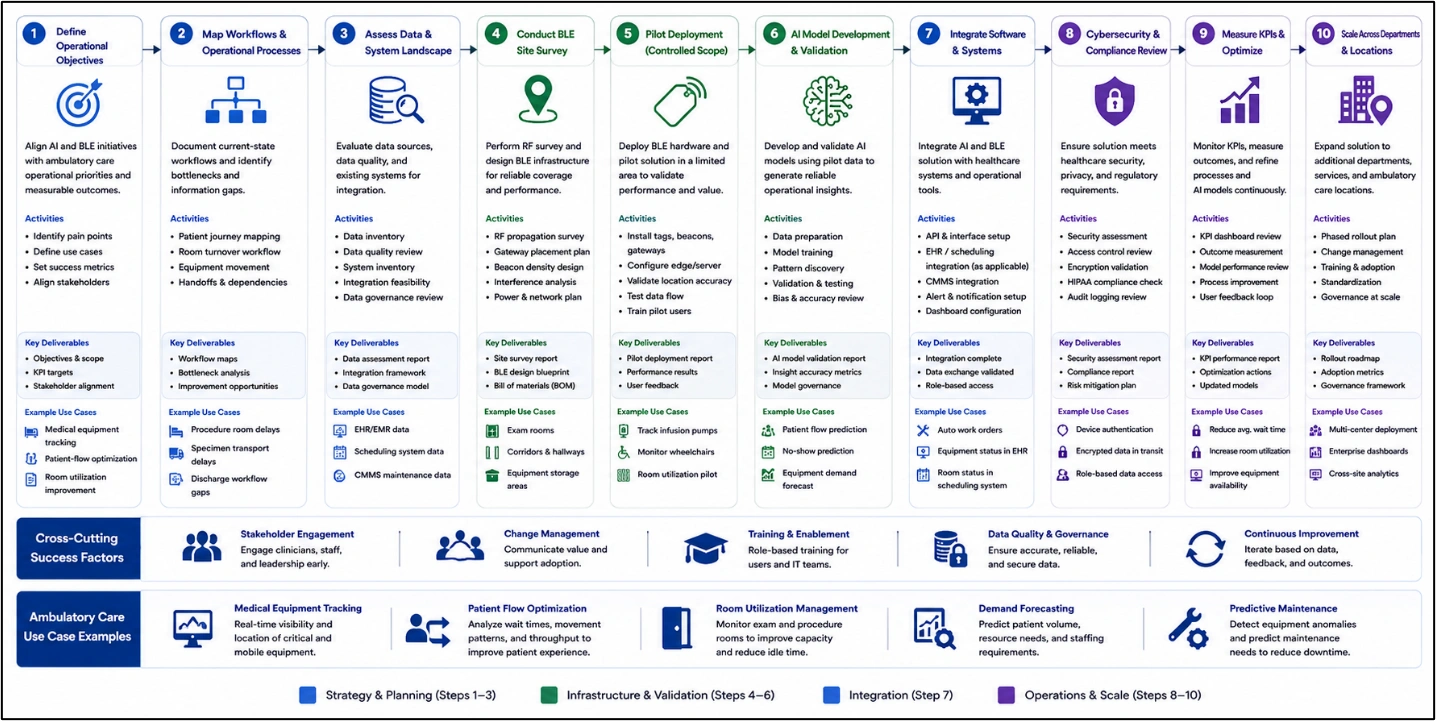
Implementation Roadmap for AI and BLE in Ambulatory Care
A successful implementation should begin with a specific operational problem rather than with hardware procurement.
Define the Operational Objective
Start by identifying a measurable problem such as excessive patient waiting, poor equipment visibility, low room utilization, or inefficient asset allocation.
The organization should establish baseline KPIs before deployment so that improvements can later be evaluated.
Map the Workflow and Data Sources
Document the actual workflow from patient arrival through registration, clinical assessment, examination, diagnostics, treatment, and discharge. Separately map how equipment and staff move through the facility.
Identify which data already exists in scheduling, EHR, facilities, maintenance, or other software and determine what additional information BLE can provide.
Conduct a Site Survey
Before installing gateways, evaluate the physical environment. Test representative BLE devices in relevant clinical spaces and identify potential coverage limitations.
The pilot should validate both technical performance and operational usefulness.
Pilot a Focused Use Case
A limited pilot can reduce implementation risk. Suitable starting points include mobile medical equipment tracking, room utilization, or patient-flow analysis in one clinical department.
Pilot results should be evaluated using predefined KPIs rather than subjective impressions.
Validate AI Models
AI models should be tested against historical or observed operational outcomes. False positives, false negatives, missing data, and unusual operational conditions should be documented.
Human review should remain part of workflows where AI recommendations could influence important operational decisions.
Integrate and Scale
After validation, the solution can be integrated with relevant operational applications and expanded to additional departments or locations.
Scaling should include gateway capacity, network requirements, data storage, device management, cybersecurity, software support, and staff training.
GAO can support organizations with BLE and IoT hardware products and systems that form part of this deployment process, while the final application and integration design should reflect the healthcare organization’s specific operational and IT requirements.
AI and BLE Deployment Roadmap for Ambulatory Care Centers
KPIs for Measuring AI-Enabled Ambulatory Care Operations
The success of an AI and BLE deployment should be measured using operational outcomes rather than the number of devices installed.
Relevant KPIs can include:
- Average patient waiting time
- Registration-to-clinician time
- Room utilization rate
- Room turnover time
- Appointment throughput
- Equipment utilization rate
- Equipment idle time
- Equipment search time
- Asset availability
- Asset location accuracy
- Gateway availability
- BLE event processing latency
- Alert accuracy
- Forecasting accuracy
- Percentage of successfully integrated events
- Number of unresolved asset-location exceptions
The appropriate KPI set depends on the use case. A medical equipment tracking project should prioritize asset visibility and search-time reduction, while a patient-flow project should emphasize waiting time, throughput, and room utilization.
Practical Recommendations for Ambulatory Care AI and BLE Deployments
Several engineering principles can improve the reliability and long-term value of these systems.
- Start with a measurable clinical operations or facility-management problem.
- Collect only the data required for the defined use case.
- Separate operational asset identifiers from patient-identifying information where practical.
- Perform a BLE site survey before final gateway placement.
- Validate location accuracy against real facility conditions.
- Use edge or server-side filtering to reduce noisy and duplicate events.
- Integrate with existing scheduling, EHR, maintenance, and facilities software only where necessary.
- Establish clear ownership for operational data.
- Design cybersecurity controls before production deployment.
- Monitor gateway and beacon health continuously.
- Include battery replacement and device lifecycle management in operating procedures.
- Validate AI predictions and anomaly detection against real operational outcomes.
- Keep human review in workflows where automated decisions could materially affect patient operations.
- Measure improvement against a baseline established before deployment.
- Scale gradually after the pilot demonstrates technical reliability and operational value.
GAO’s experience supplying BLE, RFID, and IoT hardware products and systems can help organizations address the physical sensing and connectivity requirements of these deployments. The broader solution should then be engineered around the ambulatory care center’s workflows, software environment, data governance requirements, and operational objectives.
Building the Future of Industrial AI and IoT with Aperture Venture Studio and GAO RFID Inc.
For more than three decades, GAO Group of Companies has invested heavily in R&D for industrial BLE, RFID, and IoT technologies. As AI has become increasingly useful for operational applications, we have continued developing AI and IoT solutions that combine connected sensing with intelligent analytics. We have also founded Aperture Venture Studio to support the development and scaling of AI and IoT solutions relevant to areas such as healthcare operations.
Aperture has attracted AI and IoT technical experts, operational executives, investors, and leading companies while supporting technical discussions through events such as Aperture Ventures Summit and TekSummit.
GAO, headquartered through its operations in New York City and Toronto, Canada, serves organizations across the United States and Canada, including Fortune 500 companies, R&D organizations, universities, and government agencies. GAO and its sister companies have invested substantially in R&D, quality assurance, and technical support.
We welcome participation from:
- Advisors, co-founders, or employees
- Investors
- Customers