
AI and BLE for Aquaculture Facilities
Intelligent Aquaculture Facilities Powered by AI and BLE Systems
Aquaculture facilities are becoming increasingly data-driven as fish farms, shrimp farms, hatcheries, recirculating aquaculture systems (RAS), offshore cages, and land-based aquaculture operations face growing pressure to improve production efficiency, fish health, sustainability, and regulatory compliance. Artificial Intelligence of Things (AIoT) combines artificial intelligence with connected sensing technologies to transform how aquaculture assets, environmental conditions, feeding systems, and biological processes are monitored and managed.
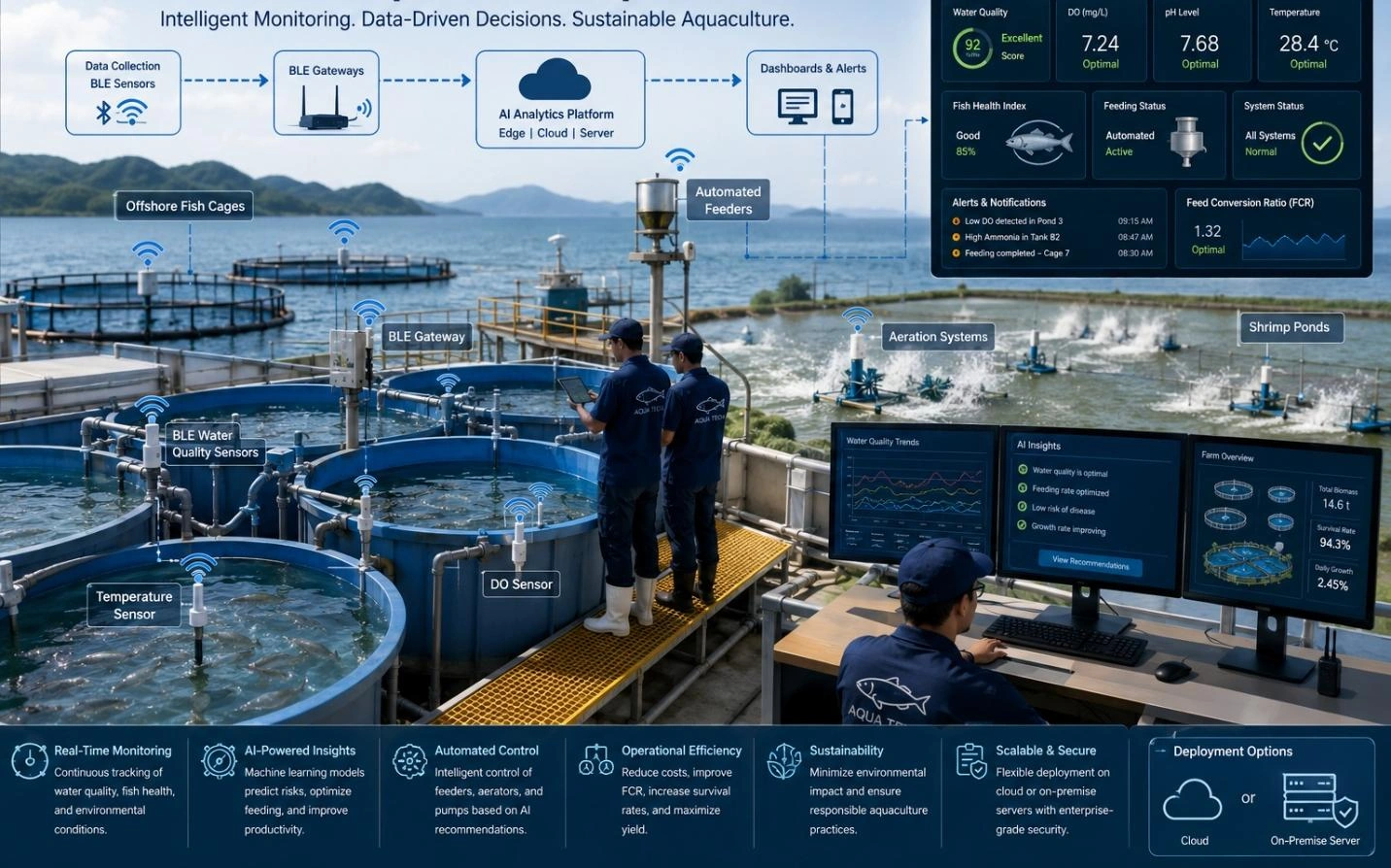
Within aquaculture facilities, BLE sensors, BLE beacons, and BLE gateways provide continuous visibility into water quality parameters, equipment conditions, worker activities, and asset locations. AI software analyzes this operational data to identify anomalies, predict disease risks, optimize feeding schedules, improve dissolved oxygen management, and support real-time operational decision-making.
The combination of AI and BLE technologies enables aquaculture operators to move beyond reactive management toward predictive and adaptive operations. Fish mortality reduction, feed conversion ratio improvement, water resource optimization, energy efficiency enhancement, and regulatory compliance management are among the measurable outcomes. Organizations deploying these solutions gain better control over production environments while improving profitability and sustainability across aquaculture operations.
AI-Enabled Aquaculture Operations Using BLE and Artificial Intelligence for Intelligent Fish Farming
Why AI Is Transforming Modern Aquaculture Facilities
Aquaculture facilities operate within highly dynamic biological and environmental conditions. Fish growth rates, feed efficiency, dissolved oxygen levels, water temperature, pH stability, ammonia concentration, nitrite accumulation, salinity fluctuations, and pathogen exposure continuously influence production outcomes.
Traditional monitoring methods often rely on periodic manual sampling and operator experience. Although these methods remain valuable, they may not provide sufficient visibility into rapidly changing conditions that affect aquatic species health and farm productivity.
AI systems enable aquaculture operators to continuously evaluate environmental, biological, and operational variables simultaneously. Machine learning algorithms can identify subtle patterns that may indicate:
- Disease outbreaks
- Oxygen depletion events
- Feed waste accumulation
- Water quality deterioration
- Equipment failures
- Biofilter performance degradation
- Stress conditions affecting fish growth
- Energy inefficiencies in aeration and pumping systems
BLE technologies serve as critical data acquisition components within these intelligent aquaculture environments. Environmental sensors distributed throughout ponds, tanks, raceways, hatcheries, and grow-out facilities continuously collect operational information that AI software transforms into actionable recommendations.
For aquaculture managers, veterinarians, farm operators, production supervisors, and sustainability teams, this shift creates opportunities to improve stock survival rates, increase biomass yield, reduce operating costs, and strengthen environmental stewardship.
GAO has supplied BLE-based monitoring technologies and industrial IoT solutions to organizations requiring reliable asset visibility, environmental monitoring, and operational intelligence across complex production environments.
Core Concepts Behind AI-Enabled Aquaculture Operations
AIoT in Aquaculture Facilities
Artificial Intelligence of Things combines connected sensing devices with advanced analytics to create intelligent aquaculture management systems.
A typical aquaculture AIoT deployment includes:
- Environmental monitoring devices
- Water quality sensors
- BLE-enabled telemetry systems
- Edge computing servers
- AI analytics software
- Operational dashboards
- Automated control systems
- Enterprise software integration
The objective is not merely to collect data but to generate operational intelligence that improves biological performance and production efficiency.
Relationship Between AI and BLE Technologies
BLE technologies provide low-power wireless communication for distributed sensing and tracking across aquaculture environments.
Examples include:
- Dissolved oxygen monitoring sensors
- Water temperature sensors
- pH sensors
- Salinity monitoring devices
- Worker safety wearables
- Feed inventory tracking tags
- Pump condition monitoring devices
- Aeration equipment monitoring sensors
AI software processes incoming data streams to identify trends, forecast future conditions, and recommend corrective actions before operational issues escalate.
Enterprise Relevance for Aquaculture Operators
Aquaculture organizations increasingly require real-time operational visibility because modern facilities often contain:
- Hatchery operations
- Nursery systems
- Grow-out ponds
- RAS facilities
- Water treatment infrastructure
- Feed storage facilities
- Cold chain systems
- Processing operations
Data-driven management improves coordination between biological production teams, maintenance departments, quality assurance personnel, environmental compliance teams, and executive management.
High-Value AI Applications in Aquaculture Facilities
AI Water Quality Management
Water quality remains the most critical factor affecting aquatic species health.
AI models continuously evaluate:
- Dissolved oxygen
- Water temperature
- pH
- Turbidity
- Ammonia
- Nitrite
- Nitrate
- Salinity
- Oxidation reduction potential
Machine learning algorithms identify trends that may indicate deteriorating conditions before thresholds are exceeded.
AI Feeding Optimization
Feed often represents the largest operating expense within aquaculture facilities.
AI systems can analyze:
- Feeding behavior
- Biomass estimates
- Water conditions
- Growth rates
- Historical feeding records
These analyses support dynamic feeding schedules that reduce waste while improving feed conversion ratios.
AI Fish Health Monitoring
Disease outbreaks can significantly impact production and profitability.
AI models evaluate:
- Environmental stress indicators
- Behavioral changes
- Feeding anomalies
- Mortality patterns
- Historical disease records
This approach supports earlier intervention and improved biosecurity management.
AI Asset Reliability Management
Critical aquaculture equipment includes:
- Aerators
- Water pumps
- Oxygen generators
- Filtration systems
- UV sterilization equipment
- Ozone treatment systems
- Feed delivery systems
Predictive maintenance models use sensor data to identify emerging equipment issues before operational disruptions occur.
AI Energy Optimization
Aquaculture facilities consume substantial electrical energy through:
- Aeration systems
- Water circulation systems
- Oxygenation equipment
- Heating systems
- Cooling systems
- Water treatment equipment
AI software identifies operational inefficiencies and recommends energy optimization strategies while maintaining biological performance requirements.
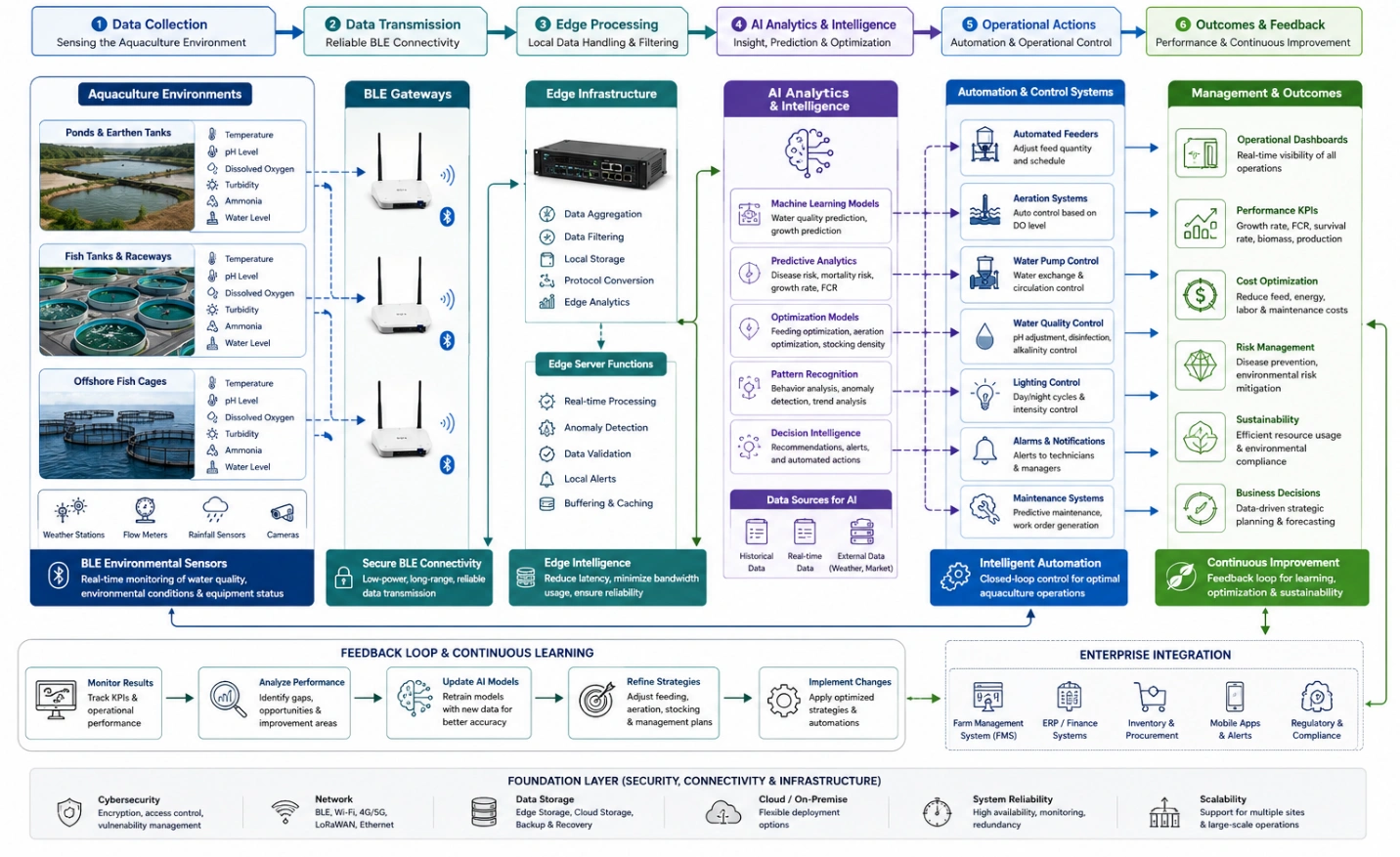
AI-Enabled Aquaculture Operational Intelligence Workflow Using BLE, Edge Computing, and Artificial Intelligence
Aquaculture Facility Deployment Scenarios and Operational Challenges
Recirculating Aquaculture Systems (RAS)
RAS facilities require continuous monitoring because water quality deviations can affect large fish populations within relatively short periods.
Common challenges include:
- Oxygen management
- Biofilter optimization
- Solids removal performance
- Water recirculation reliability
- Disease containment
- Energy consumption management
AI-supported monitoring enables rapid detection of operational abnormalities while supporting stable production environments.
Offshore Aquaculture Cages
Marine aquaculture operations face environmental variability that can influence production performance.
Important monitoring areas include:
- Current velocity
- Water temperature stratification
- Dissolved oxygen gradients
- Cage integrity
- Feeding performance
- Weather impacts
BLE-enabled sensing combined with AI analytics helps operators improve situational awareness across dispersed offshore assets.
Shrimp Farming Operations
Shrimp farms often experience challenges related to:
- Water quality stability
- Disease prevention
- Feed management
- Pond aeration
- Stocking density optimization
AI models can identify conditions associated with elevated disease risk and support proactive intervention strategies.
Hatcheries and Nurseries
Hatchery environments require highly controlled operating conditions.
Monitoring priorities include:
- Larval development
- Water chemistry
- Temperature consistency
- Oxygen availability
- Feeding schedules
- Biosecurity compliance
Continuous monitoring supports higher survival rates and more predictable production outcomes.
End-to-End Operational Workflow for AI-Enabled Aquaculture Facilities
Environmental and Operational Data Acquisition
The operational workflow begins with distributed sensing throughout aquaculture facilities.
Data sources may include:
- Water quality monitoring stations
- BLE environmental sensors
- Aeration equipment sensors
- Feed inventory monitoring devices
- Pump condition monitoring systems
- Worker safety wearables
- Energy consumption meters
- Weather monitoring stations
Continuous monitoring provides a comprehensive operational view of biological, environmental, and mechanical systems.
Wireless Data Communication
BLE sensors communicate with strategically positioned BLE gateways located throughout:
- Fish hatcheries
- RAS facilities
- Pond operations
- Feed storage buildings
- Processing facilities
- Maintenance workshops
Gateways aggregate sensor information and forward data to edge servers or cloud-hosted software environments for processing.
Edge Processing and Data Validation
Before analytics processing occurs, edge computing systems perform:
- Data filtering
- Quality validation
- Sensor calibration checks
- Event detection
- Local alert generation
This approach reduces latency for operationally critical events such as oxygen depletion incidents or equipment failures.
AI Analytics and Predictive Intelligence
AI engines analyze operational information using:
- Machine learning
- Predictive analytics
- Time-series analysis
- Anomaly detection
- Statistical modeling
- Pattern recognition
Models continuously evaluate relationships between environmental conditions, fish health indicators, equipment performance, and production outcomes.
Technical Architecture of an AI-Enabled Aquaculture Solution Using BLE, Edge Computing, Cloud AI, and Enterprise Integration
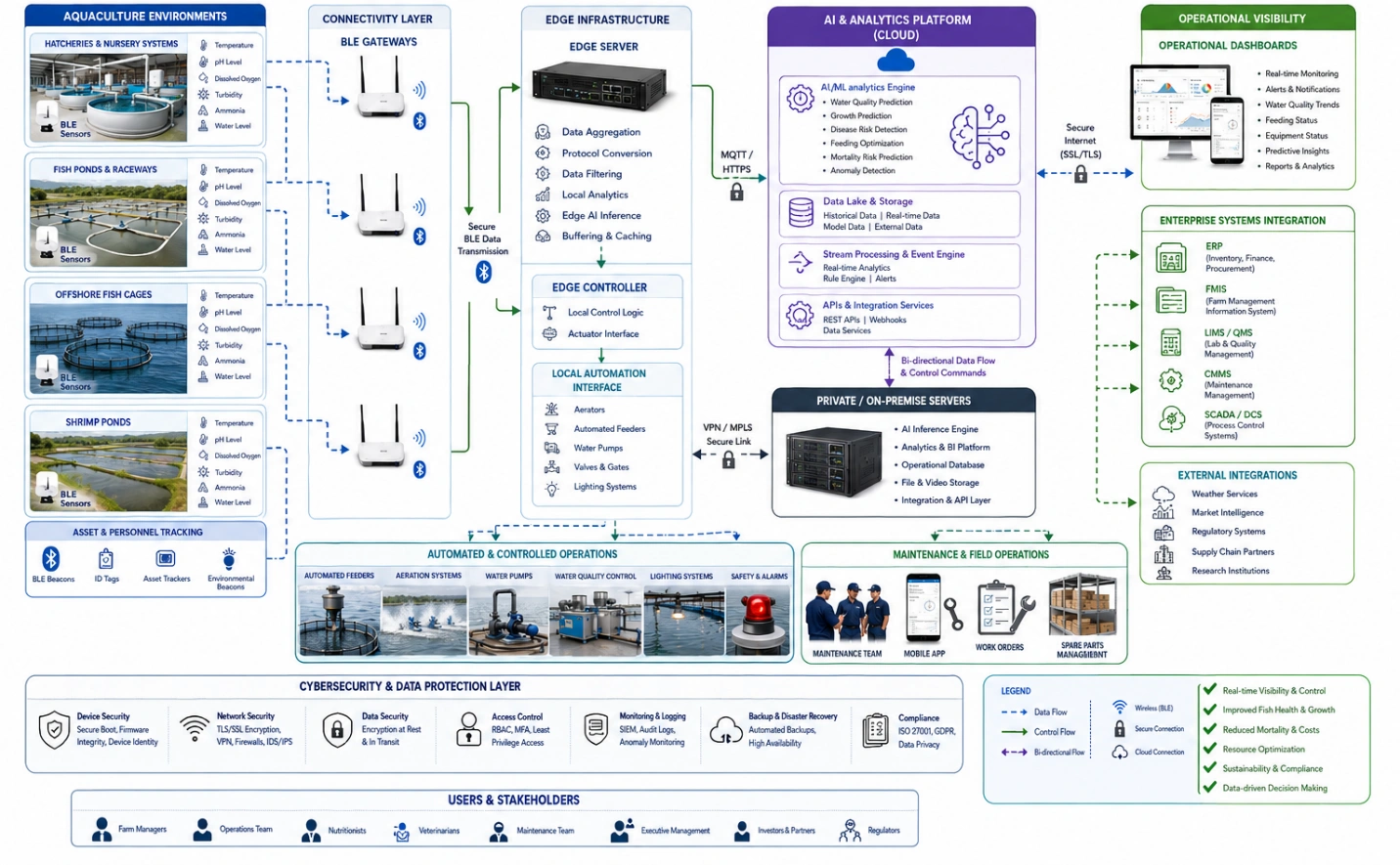
Technology Components Supporting AI-Powered Aquaculture Facilities
BLE Sensors for Environmental Intelligence
BLE sensors provide critical environmental visibility throughout aquaculture facilities.
Common sensor deployments include:
- Dissolved oxygen sensors
- Temperature sensors
- pH monitoring devices
- Salinity sensors
- Conductivity sensors
- Water level sensors
- Turbidity sensors
- Vibration monitoring sensors
These devices provide the foundational operational data required for AI-driven analysis.
BLE Beacons for Asset and Personnel Visibility
BLE beacons help monitor the location and movement of:
- Mobile maintenance equipment
- Feed transport carts
- Oxygen cylinders
- Water testing instruments
- Service vessels
- Personnel working in restricted areas
Location intelligence improves operational coordination and safety management.
BLE Gateways and Communication Infrastructure
BLE gateways collect information from sensors and beacons while providing connectivity to broader operational networks.
Deployment locations often include:
- Control rooms
- Feed storage facilities
- Hatcheries
- Pump houses
- Processing areas
- Maintenance facilities
Gateways serve as communication bridges between field devices and higher-level software systems.
Software, AI Models, Security, and Deployment Considerations for AI-Enabled Aquaculture Facilities
Modern aquaculture facilities depend on intelligent software that converts operational data into actionable recommendations. While BLE devices collect field information, AI software coordinates data management, analytics, prediction, visualization, automation, and integration with business systems.
A complete AI-enabled aquaculture solution typically includes data acquisition software, middleware, AI analytics engines, operational dashboards, reporting tools, cybersecurity controls, and interfaces to enterprise business applications.
AI Models Used in Aquaculture Facilities
Different AI models address different operational objectives throughout the aquaculture production lifecycle.
Predictive Machine Learning
Predictive models analyze historical and real-time production data to forecast future operating conditions.
Typical applications include:
- Fish growth prediction
- Biomass estimation
- Feed demand forecasting
- Water quality forecasting
- Disease probability assessment
- Harvest scheduling
- Energy consumption prediction
- Equipment remaining useful life estimation
Anomaly Detection
Unsupervised learning algorithms continuously identify abnormal operating conditions that differ from historical behavior.
Examples include:
- Unexpected dissolved oxygen reduction
- Abnormal pump vibration
- Water circulation irregularities
- Feeding behavior anomalies
- Fish mortality spikes
- Sensor malfunction detection
- Power consumption abnormalities
Computer Vision
Computer vision systems complement environmental monitoring by analyzing underwater and surface imagery.
Applications include:
- Fish counting
- Biomass estimation
- Behavior analysis
- Feeding response evaluation
- Mortality detection
- Net integrity inspection
- Surface activity monitoring
- Species classification
Reinforcement Learning
Adaptive learning algorithms optimize operational decisions through continuous feedback.
Potential optimization targets include:
- Feeding schedules
- Aeration timing
- Oxygen injection rates
- Water circulation strategies
- Energy management
- Stocking density adjustments
Digital Twin Modeling
Digital twins simulate biological and operational processes using live operational data.
Aquaculture operators can evaluate operational scenarios before implementing physical changes, reducing production risks and improving planning accuracy.
Enterprise Software Integration
AI-enabled aquaculture facilities rarely operate as isolated systems. Maximum operational value is achieved when AI software exchanges information with existing business applications.
Typical integrations include:
- Enterprise Resource Planning (ERP)
- Computerized Maintenance Management Systems (CMMS)
- Manufacturing Execution Systems (MES) used within aquaculture processing operations
- Laboratory Information Management Systems (LIMS)
- Geographic Information Systems (GIS)
- Environmental Management Information Systems (EMIS)
- Supply chain management software
- Fleet management software
- Warehouse Management Systems (WMS)
- Business Intelligence (BI) reporting software
- Quality Management Systems (QMS)
These integrations enable automatic work order creation, inventory updates, compliance reporting, production planning, and executive performance dashboards.
GAO has helped organizations deploy BLE hardware products and IoT systems that integrate with existing operational software, reducing implementation complexity while preserving previous technology investments.
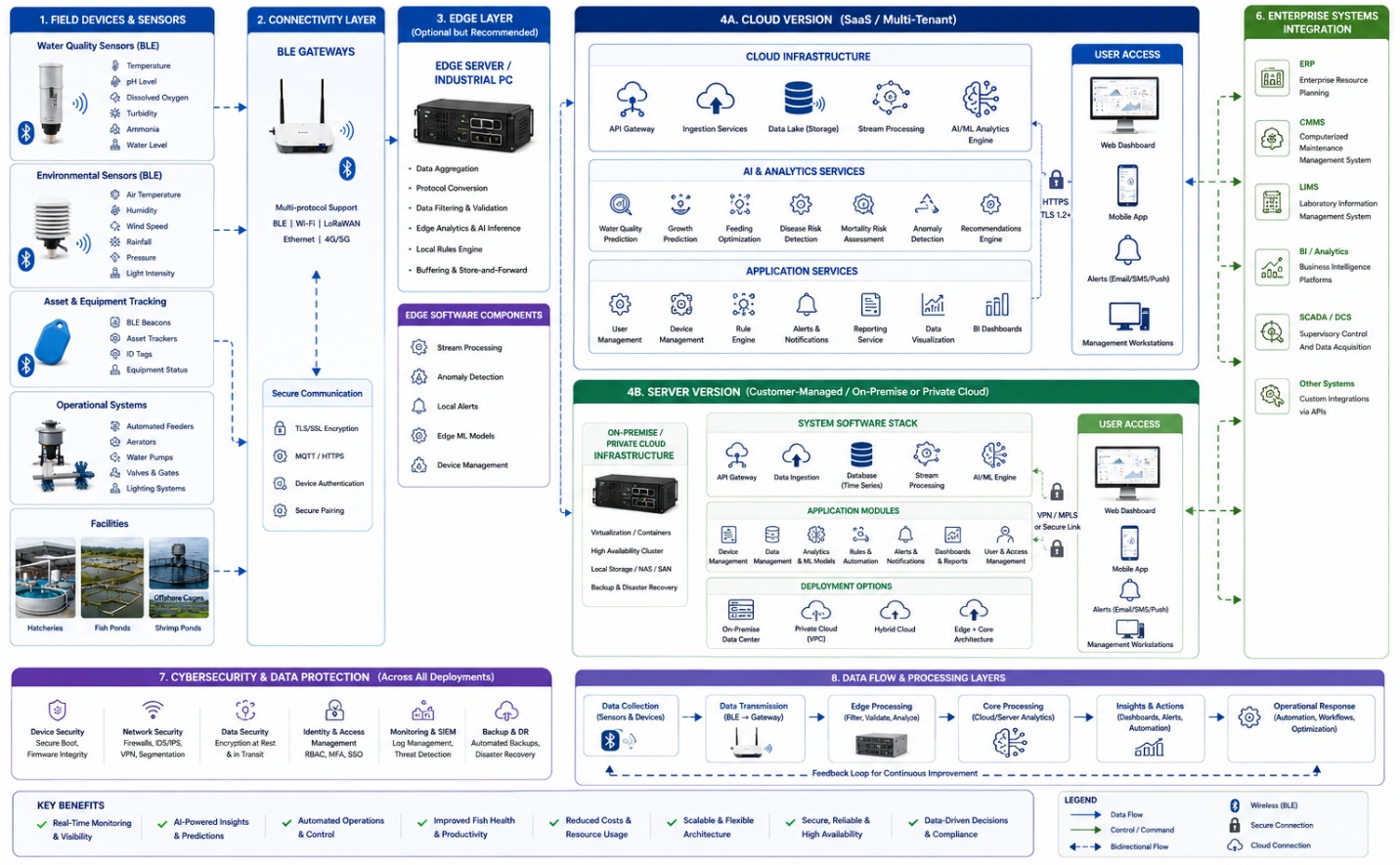
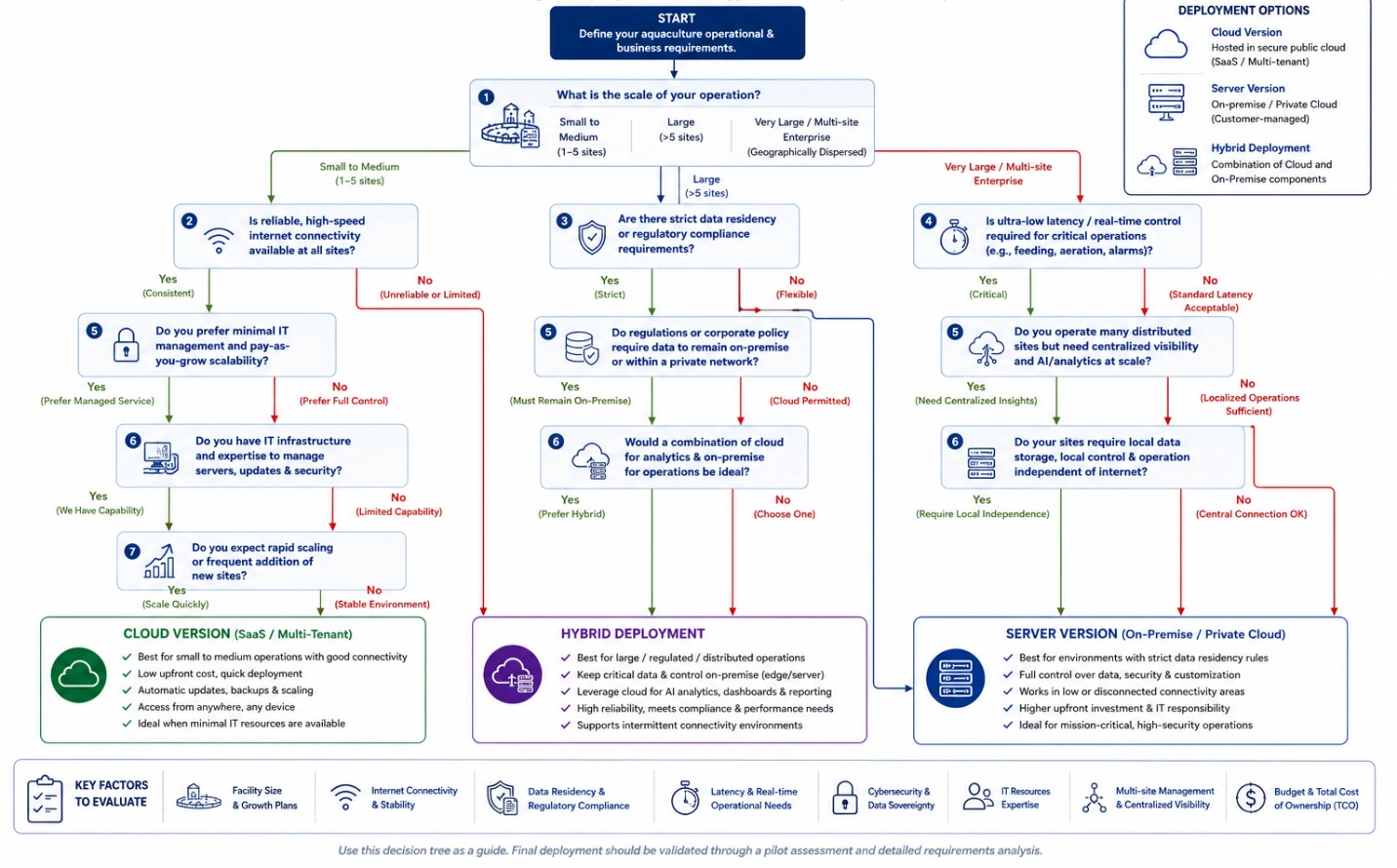
Cloud Version
Cloud-hosted software is appropriate when aquaculture organizations operate multiple geographically distributed facilities or require centralized operational visibility.
Typical characteristics include:
- Centralized analytics
- Remote monitoring
- Automatic software updates
- Elastic computing resources
- Multi-site reporting
- Disaster recovery capabilities
- Mobile access for managers and field personnel
- AI model retraining using large historical datasets
Cloud deployment is often selected by organizations operating multiple hatcheries, offshore cage farms, shrimp farms, or land-based production facilities across different regions.
Server Version
Many aquaculture organizations prefer privately managed server deployments because they require local control, deterministic performance, regulatory compliance, or limited external connectivity.
Server deployments may reside on:
- Edge servers
- Private data centers
- Customer-managed servers
- Regional operational centers
- Industrial computing servers
- Hybrid private cloud infrastructure
Benefits include:
- Low-latency processing
- Continued operation during Internet outages
- Local data governance
- Custom cybersecurity policies
- Integration with legacy operational software
- Greater control over AI model management
Many facilities implement hybrid deployments where operational decisions occur locally while long-term analytics and reporting are synchronized with centralized systems.
Communication Technologies
Although BLE serves as the primary local wireless communication technology within this solution, several additional communication technologies commonly support aquaculture operations.
Examples include:
- Ethernet
- Industrial Wi-Fi
- Fiber optic networking
- Cellular LTE
- 5G
- Satellite communications for offshore facilities
- MQTT
- HTTPS
- REST APIs
- OPC UA where processing operations interface with industrial automation equipment
Selecting communication technologies depends on facility size, environmental conditions, infrastructure availability, cybersecurity requirements, and operational latency objectives.
Cybersecurity Considerations
Aquaculture facilities increasingly depend on connected operational technology, making cybersecurity an essential design consideration.
Recommended practices include:
- Multi-factor authentication
- Identity and access management
- Device authentication
- Certificate management
- Encrypted communications
- Secure firmware management
- Network segmentation
- Continuous vulnerability assessment
- Security event monitoring
- Backup and disaster recovery procedures
- Zero Trust security principles
- Role-based access control
Operational technology networks should remain isolated from public networks whenever practical while still allowing controlled access for authorized personnel.
For more than three decades, GAO Group, headquartered in New York City and Toronto, Canada, has invested heavily in research and development of BLE, RFID, and IoT technologies while maintaining stringent quality assurance processes and providing expert technical support both remotely and onsite.
AI-Enabled Aquaculture System Architecture with Cloud and Customer-Managed Server Deployment Models
Technical Capabilities and Business Value of AI-Powered Aquaculture Facilities
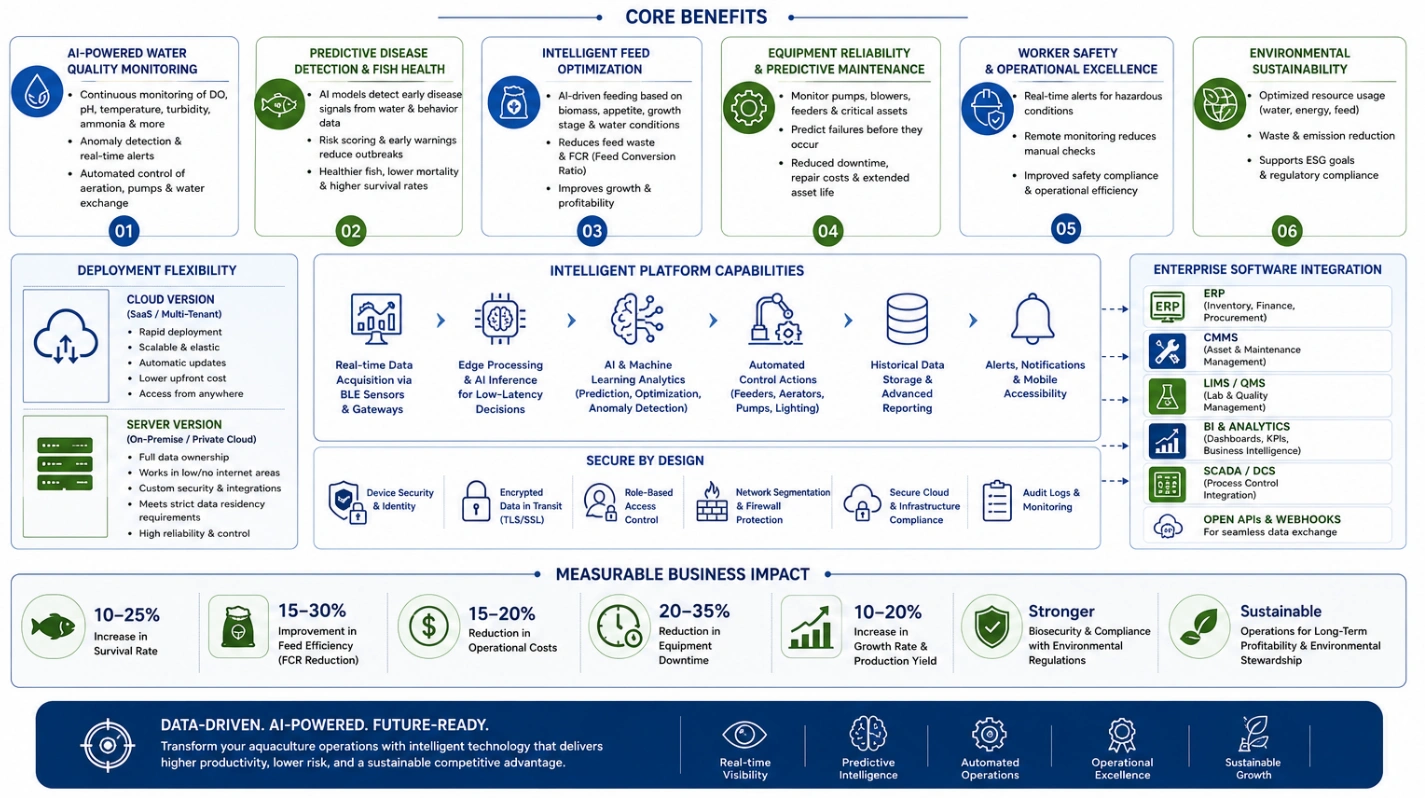
Artificial intelligence enhances aquaculture management by transforming continuous operational data into informed decisions that improve biological performance, operational efficiency, and financial outcomes.
Major technical capabilities include:
- Continuous environmental monitoring
- Predictive disease detection
- Intelligent feed optimization
- Biomass estimation
- Automated operational alerts
- Predictive maintenance
- Energy optimization
- Workforce safety monitoring
- Asset visibility
- Multi-site operational reporting
- AI-assisted production planning
- Automated compliance reporting
These capabilities produce measurable operational improvements.
Improved Fish Health
Continuous monitoring enables early detection of unfavorable environmental conditions before they negatively affect aquatic species.
Benefits include:
- Reduced mortality
- Lower disease incidence
- Improved welfare
- More consistent growth
Better Feed Conversion
AI continuously adjusts feeding recommendations using environmental and biological information.
Benefits include:
- Lower feed waste
- Reduced nutrient discharge
- Improved feed conversion ratio
- Higher profitability
Increased Equipment Reliability
Predictive maintenance reduces unexpected failures affecting:
- Pumps
- Aerators
- Oxygen systems
- Filtration equipment
- Feed delivery systems
Benefits include:
- Reduced downtime
- Lower maintenance costs
- Improved production continuity
Enhanced Sustainability
AI supports sustainable aquaculture by optimizing:
- Water utilization
- Oxygen usage
- Energy consumption
- Feed efficiency
- Environmental compliance
This reduces environmental impact while maintaining production performance.
Better Decision Support
Management teams gain access to operational dashboards showing:
- Production KPIs
- Water quality trends
- Biomass forecasts
- Maintenance status
- Energy performance
- Environmental compliance metrics
Decision-making becomes faster, more consistent, and supported by continuously updated operational intelligence.
Engineering Best Practices for Successful Implementation
Organizations planning AI-enabled aquaculture deployments should consider the complete implementation lifecycle rather than focusing solely on hardware installation.
Recommended practices include:
- Conduct detailed site assessments before sensor placement.
- Select sensors based on biological requirements and water chemistry.
- Validate wireless signal coverage across ponds, tanks, and offshore cages.
- Establish data quality validation procedures before AI model training.
- Integrate operational software with existing enterprise systems whenever practical.
- Define measurable business objectives before deployment.
- Train operational personnel using standardized procedures.
- Monitor AI model performance continuously.
- Implement regular sensor calibration schedules.
- Develop cybersecurity governance policies before commissioning.
- Establish preventive maintenance programs for communication infrastructure.
- Continuously refine AI models using operational feedback.
Pilot deployments typically reduce implementation risks while allowing organizations to validate expected operational improvements before expanding facility-wide.
AI-Enabled Aquaculture Deployment Decision Tree for Cloud, On-Premises, and Hybrid Architecture Selection
Conclusion: Advancing Intelligent Aquaculture with AI and BLE Technologies
Artificial intelligence supported by BLE technologies is changing how aquaculture facilities manage biological production, environmental conditions, operational efficiency, and long-term sustainability. Continuous monitoring, predictive analytics, intelligent automation, and enterprise software integration enable aquaculture operators to make faster, better-informed decisions while reducing operational risks.
Successful implementation depends on carefully selecting sensing technologies, communication infrastructure, AI models, cybersecurity controls, and deployment strategies that align with each facility’s operational objectives. Organizations adopting these solutions can improve fish health, optimize feed utilization, enhance equipment reliability, strengthen environmental compliance, and increase production efficiency.
Drawing on decades of experience serving Fortune 500 companies, leading research organizations, prestigious universities, and government agencies throughout the United States and Canada, GAO continues to supply BLE, RFID, and IoT hardware products and systems that support intelligent aquaculture monitoring, asset visibility, and AI-enabled operational improvements.
Executive Benefits of AI-Enabled Aquaculture Facilities Using BLE, Artificial Intelligence, and Enterprise IoT
Building the Future of Industrial AI and IoT with Aperture Venture Studio and GAO
For more than three decades, GAO Group of Companies has invested extensively in research and development of industrial BLE, RFID, and IoT technologies. As generative AI has demonstrated significant value in intelligent aquaculture management, environmental monitoring, and connected agricultural operations, we have continued advancing AI and IoT technologies and have founded Aperture Venture Studio to accelerate the development and adoption of practical AI and IoT solutions for aquaculture facilities and other industrial sectors.
Aperture Venture Studio has attracted distinguished AI researchers, IoT engineering specialists, experienced operational executives, respected investors, and leading technology organizations. Through initiatives such as the Aperture Ventures Summit and TekSummit, we foster technical collaboration on advanced AI, Industrial IoT, BLE, RFID, and intelligent automation.
These ongoing efforts have strengthened diverse technical communities and collaborative innovation around Industrial AI and IoT. We welcome you to join us as:
- Advisors, co-founders, or employees
- Investors
- Customers seeking advanced AI, BLE, RFID, and Industrial IoT technologies, engineering expertise, products, and technical support from GAO