
AI and BLE for Automotive Component Production
AI-Driven Production Visibility for Automotive Components
AI is transforming automotive component production by converting production-floor data into actionable intelligence for machining, stamping, casting, molding, welding, electronics assembly, inspection, material handling, and maintenance operations. AI-based systems can analyze equipment condition, work-in-progress movement, tooling utilization, production cycle data, environmental conditions, and process events to identify anomalies, predict maintenance requirements, and improve production decisions. BLE gateways, beacons, and sensors provide a practical wireless data layer for tracking mobile assets, tooling, containers, work-in-progress components, and equipment conditions. When combined with edge computing, machine learning, manufacturing software, and industrial networks, these data streams support more responsive production control. For automotive component manufacturers, the objective is not simply connectivity. It is improved traceability, equipment availability, production scheduling, quality control, material flow, and operational decision-making across high-volume manufacturing processes. GAO supplies BLE, RFID, and IoT hardware products and systems that can support these connected manufacturing requirements.
AIoT Architecture for Automotive Component Production
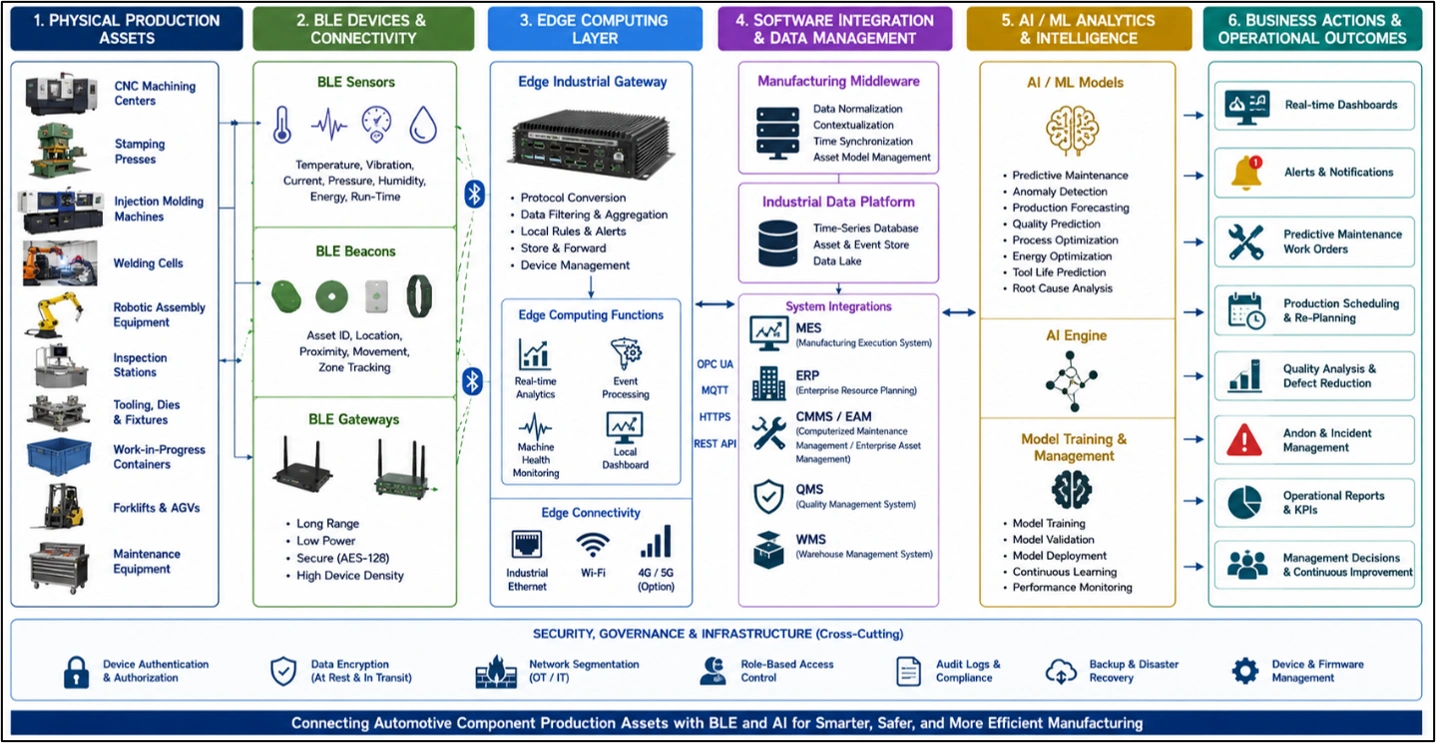
This architecture diagram shows how CNC machines, stamping presses, molding equipment, robots, inspection stations, tooling, WIP containers, and other automotive production assets connect through BLE sensors, beacons, and gateways to edge computing, manufacturing software, and AI/ML analytics. It illustrates the flow from shop-floor data collection through MES, ERP, CMMS/EAM, and QMS integration to predictive maintenance, production scheduling, quality analysis, alerts, and operational decisions.
What AI Means for Automotive Component Production
Artificial Intelligence of Things, or AIoT, combines artificial intelligence with connected sensors, equipment, devices, and industrial systems. In automotive component production, AIoT becomes valuable when sensor observations and operational events are connected to manufacturing decisions rather than being collected only for visualization.
A production facility may generate thousands of operational events during a single shift. A CNC machine can produce spindle, vibration, temperature, cycle-time, and alarm data. A stamping press can generate information about cycle counts, tooling condition, downtime, and production rate. A molding process can involve temperature, pressure, material, and machine-state variables. Material handling generates location and movement events. Inspection systems produce quality measurements and defect classifications.
AI can correlate these signals with production history to identify relationships that are difficult to detect through manual monitoring. For example, an AI model can associate increasing vibration from a machining asset with tool wear, declining cycle performance, or an increased probability of unplanned maintenance. A production team can then investigate the condition before it develops into a machine stoppage or quality problem.
BLE supports this process where wireless identification, location, presence, or low-power sensing is appropriate. BLE beacons can identify tooling, fixtures, bins, carts, containers, and mobile equipment. BLE sensors can provide information such as temperature, humidity, vibration, acceleration, or other supported measurements. BLE gateways collect these signals and forward relevant data to edge or server-based software.
The important engineering principle is that AI provides the analytical capability while BLE provides selected operational observations and identification data. Neither should be treated as a replacement for PLCs, industrial control networks, machine vision, MES, SCADA, or established manufacturing systems.
GAO’s existing automotive manufacturing work has included BLE and RFID applications for asset tracking, personnel tracking, supply chain management, work-in-progress, and traceability, providing a foundation for extending connected production use cases into AI-driven analysis.
Automotive Component Production Applications
AI for Tooling and Fixture Utilization
Tooling is a major operational concern in automotive component production because fixtures, dies, molds, cutting tools, gauges, welding fixtures, and specialized production equipment can move between workstations, tool rooms, maintenance areas, and storage locations.
BLE identification can associate a tool or fixture with its approximate location and utilization history. AI can then analyze this information alongside production schedules, machine utilization, maintenance records, and tool-change events.
Potential applications include:
- Detecting abnormal tool utilization patterns
- Identifying underused or frequently relocated fixtures
- Supporting tool-room inventory visibility
- Predicting maintenance requirements from usage history
- Correlating tooling availability with production delays
- Improving fixture allocation for scheduled production orders
AI for Work-in-Progress Traceability
Automotive component production frequently involves multiple processing stages. A component may move from cutting or stamping to machining, washing, heat treatment, surface treatment, inspection, assembly, and packaging.
BLE-enabled identification can help associate containers, carts, racks, or WIP carriers with production zones. AI can analyze movement history and process timestamps to identify abnormal dwell times, routing deviations, bottlenecks, or recurring queue accumulation.
This is particularly useful when WIP cannot be continuously identified using fixed RFID portals or when mobile containers require flexible wireless location monitoring.
AI for Predictive Maintenance
Predictive maintenance is one of the strongest AI applications for automotive component production because unplanned downtime can affect multiple downstream operations.
A practical implementation combines:
- Machine operating data from PLCs and industrial controllers
- Vibration and temperature observations
- BLE sensor data where wireless sensing is suitable
- Machine alarm history
- Maintenance work orders
- Spare-parts records
- Production cycle counts
- Tool-change information
- Historical failure records
Machine-learning models can establish baseline operating conditions and identify deviations. The maintenance team can then prioritize inspection based on predicted risk rather than relying exclusively on fixed maintenance intervals.
BLE should not be treated as the sole source of machine-health information. Where high-frequency vibration analysis or deterministic control data is required, wired industrial sensors and machine-native interfaces may remain preferable. BLE is more useful for retrofit sensing, mobile equipment, distributed measurements, and situations where cabling would be costly or operationally disruptive.
Operational Challenges AI Can Address
Automotive component manufacturers must balance production volume, quality, machine availability, traceability, labor utilization, material flow, and maintenance requirements. Several recurring operational problems create opportunities for AI-driven improvement.
| Production challenge | AI-driven approach | Supporting BLE application |
|---|---|---|
| Unplanned CNC downtime | Anomaly detection and failure-risk prediction | Wireless vibration or temperature sensing |
| Tooling availability problems | Utilization and demand analysis | Tool and fixture identification |
| Excessive WIP dwell time | Process-time and movement analysis | WIP carrier and cart location |
| Material-search delays | Location intelligence | BLE beacons and gateways |
| Maintenance scheduling gaps | Predictive maintenance models | Equipment-condition sensing |
| Production bottlenecks | Cycle-time and flow analysis | Movement and process-event data |
| Lost fixtures or gauges | Location tracking | BLE asset beacons |
| Environmental variation | Condition monitoring | BLE temperature/humidity sensors |
| Manual traceability | Automated event association | BLE identification and location events |
| Poor equipment utilization | Utilization analytics | Mobile-equipment identification |
AI and BLE Use-Case Matrix for Automotive Component Production
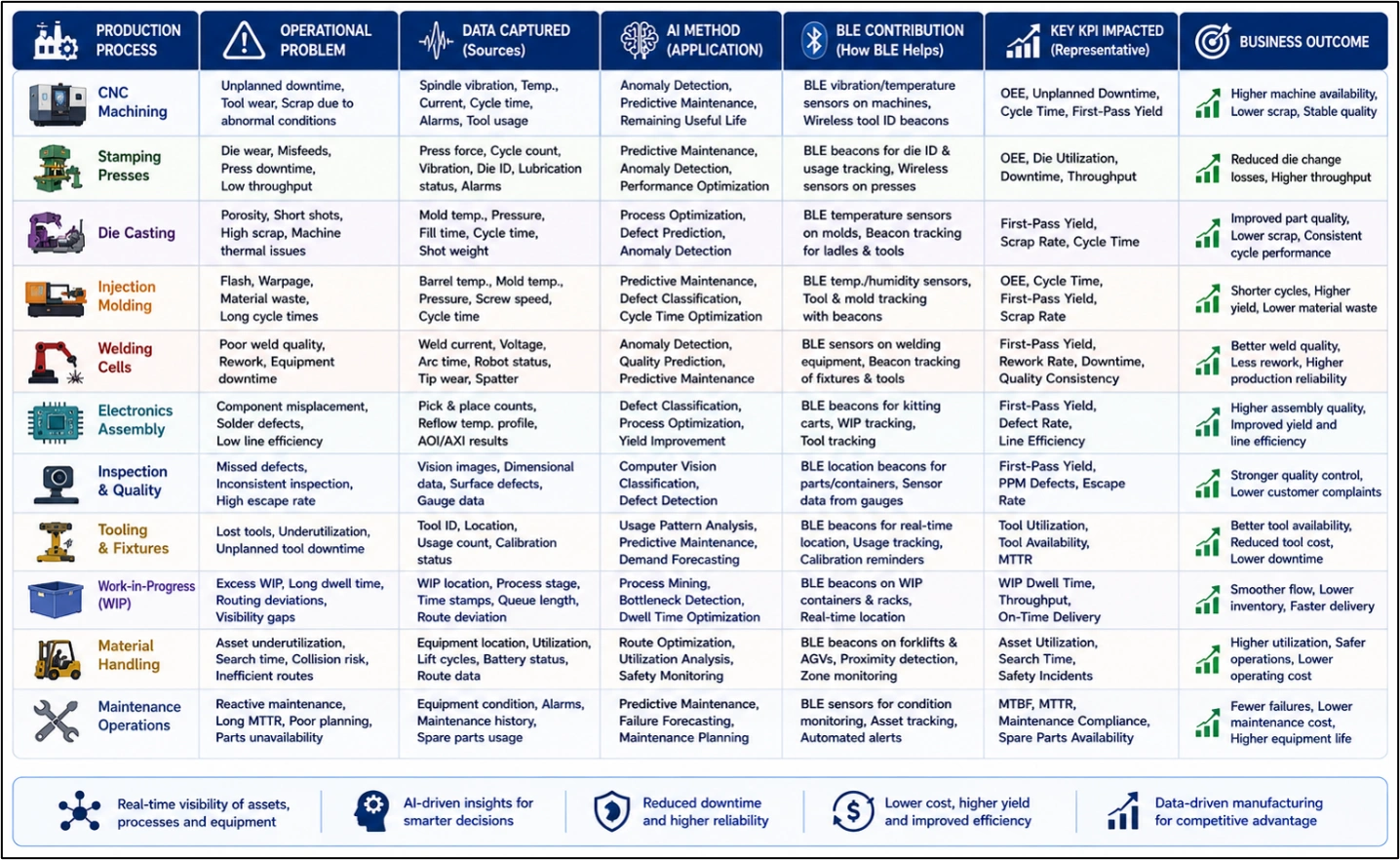
This infographic maps 11 automotive component production areas, including CNC machining, stamping, die casting, injection molding, welding, electronics assembly, inspection, tooling, WIP, material handling, and maintenance. It connects each process with operational problems, captured data, AI methods, BLE contributions, affected KPIs, and expected production outcomes.
From Production Data to AI-Driven Decisions
A practical AIoT deployment for automotive component production normally follows a multi-stage data flow.
Data Acquisition
The first stage captures operational information from the physical production environment. Data sources may include:
- CNC controllers and machine interfaces
- PLCs and industrial sensors
- Vibration and temperature sensors
- BLE sensors
- BLE beacons attached to tools, fixtures, containers, and mobile equipment
- BLE gateways installed around production areas
- RFID readers and tags where automatic identification is more appropriate
- Machine vision systems
- Quality inspection equipment
- Maintenance systems
- Production orders and MES records
The objective is to capture data that can influence a production decision. Collecting large volumes of irrelevant telemetry can increase infrastructure and data-management costs without improving operations.
Wireless Communication and Edge Collection
BLE gateways receive advertisements or sensor data from nearby BLE devices and forward relevant observations to an edge computer, industrial server, or other approved data-processing endpoint.
Gateway placement requires more than estimating radio range from a product specification. Automotive production facilities contain metal machinery, electrical equipment, racks, tooling, vehicles, enclosed cabinets, and moving objects that can affect radio propagation.
A commissioning survey should therefore evaluate:
- Machine density
- Metal obstructions
- Gateway mounting positions
- Radio interference
- Required location accuracy
- BLE device transmission interval
- Battery-life requirements
- Gateway coverage overlap
- Network availability
- Maintenance access
- Production-zone boundaries
The resulting wireless deployment should be validated under actual production conditions rather than only during an empty-factory test.
AIoT Software and Deployment Models for Automotive Production
BLE Hardware and Gateway Layer
BLE gateways provide the connection between low-power wireless devices and higher-level production software. BLE beacons can provide identification and proximity information, while BLE sensors can supply condition measurements.
GAO offers BLE gateways, beacons, sensors, and related IoT hardware that can be selected according to the physical environment, required sensing capability, communication range, installation constraints, and integration requirements. GAO’s BLE product portfolio includes industrial-oriented beacon and tag options supporting applications such as asset monitoring and manufacturing visibility.
Edge Processing and Industrial Connectivity
Edge processing is useful when automotive production data must be evaluated close to the manufacturing operation. An edge server can normalize incoming device data, buffer events during temporary network outages, perform initial filtering, and execute selected AI inference workloads without sending every raw observation to a remote cloud environment.
Common integration technologies may include:
- MQTT for lightweight telemetry exchange
- OPC UA for industrial interoperability
- REST APIs for application integration
- Webhooks for event-driven workflows
- Industrial Ethernet for machine connectivity
- Wi-Fi for approved wireless infrastructure
- Database connectors for production and maintenance systems
The integration layer should preserve timestamps, device identifiers, asset identifiers, machine identifiers, production-zone information, and data-quality indicators. Without consistent context, AI models can produce technically valid predictions that are operationally difficult to interpret.
Cloud Version
A Cloud Version is appropriate when geographically distributed production facilities need centralized analytics, remote monitoring, cross-site benchmarking, and scalable storage.
A cloud deployment can consolidate data from multiple automotive component plants and provide centralized AI model management, dashboards, reporting, and analytics. It is particularly useful when corporate engineering teams need visibility across facilities.
However, cloud deployment should not automatically mean that all manufacturing decisions depend on an external connection. Time-sensitive control functions should remain within appropriate industrial control systems. Edge processing can continue local monitoring and event handling when cloud connectivity is interrupted.
Server Version
A Server Version runs software on customer-managed infrastructure, such as a factory server, private data center, edge server, or other privately hosted enterprise environment.
This model can be preferable where production data must remain within controlled infrastructure, where plant networks have restricted external connectivity, or where IT teams require direct control over system updates, storage, authentication, and network segmentation.
For automotive component production, a hybrid deployment can also be practical. Edge servers can handle local device communication and rapid inference while selected historical information is transferred to centralized systems for engineering analytics and long-term model development.
AI Models and Analytics for Automotive Component Production
AI models should be selected according to the production decision they need to support. A model that works well for machine-health prediction may be inappropriate for quality classification or production scheduling.
Predictive Maintenance
Machine-learning models can analyze historical machine condition, alarm events, vibration, temperature, operating hours, cycle counts, and maintenance records to estimate equipment health or failure risk.
For CNC machining, stamping presses, molding equipment, compressors, pumps, conveyors, and robotic cells, predictive models can help maintenance teams prioritize inspections and replacement activities.
Anomaly Detection
Anomaly detection establishes a normal operating profile and identifies significant deviations.
For example, an automotive component production system can compare current equipment temperature, vibration, cycle duration, or WIP movement against historical operating patterns. An unusual combination of signals can trigger an investigation before the condition becomes a production interruption.
Production Forecasting and Optimization
AI can analyze historical production rates, machine availability, order requirements, changeover times, material availability, and WIP levels to support production planning.
Potential outputs include:
- Production-delay risk
- Expected machine utilization
- WIP accumulation
- Predicted throughput
- Maintenance-related production impact
- Material-handling requirements
- Tooling demand
- Production bottleneck probability
The final production decision should remain subject to manufacturing constraints and validated operating rules rather than being accepted automatically from an AI model.
Quality Intelligence
AI can combine inspection results with process conditions to identify patterns associated with defects.
For automotive components, relevant variables can include dimensional measurements, surface defects, weld characteristics, molding conditions, machining parameters, temperature profiles, material batches, and equipment states.
Computer vision can classify visible defects, while machine-learning models can investigate relationships between process parameters and nonconforming parts.
Integration with Automotive Manufacturing Systems
AI-driven production systems should complement existing manufacturing software rather than create isolated data stores.
Important integration points can include:
- MES for production orders, routing, work-center status, WIP, and production history
- ERP for purchasing, inventory, production planning, and business records
- SCADA for supervisory monitoring and process visualization
- PLC systems for machine-state and control information
- CMMS or EAM software for maintenance history and work orders
- QMS for inspection results, nonconformance, corrective actions, and quality records
- WMS for material and storage operations
- CAD and PLM systems for engineering and product information
- Industrial databases for historical machine and process data
- Identity and access-management systems for controlled user access
A middleware layer can normalize data from different systems before AI processing. This is especially important when equipment from different manufacturers uses different protocols, naming conventions, timestamps, and data structures.
GAO has supplied RFID, BLE, and IoT hardware products and systems that can be incorporated into broader tracking, monitoring, and industrial data workflows. The appropriate integration approach depends on the customer’s existing production software, network controls, equipment interfaces, and data requirements.
Cybersecurity and Data Reliability
Connecting production equipment and wireless devices introduces cybersecurity considerations that must be addressed during system design rather than after deployment.
Automotive component production environments should consider:
- Network segmentation between IT and OT environments
- Controlled gateway communication
- Device authentication
- Encrypted communications where supported
- Role-based access control
- Secure API authentication
- Firewall rules
- Certificate and credential management
- Firmware update procedures
- Audit logging
- Asset inventory
- Data retention policies
- Backup and recovery procedures
- Monitoring for abnormal network activity
BLE devices should also be assigned unique identifiers and managed as production assets. Gateway configuration should prevent unauthorized devices or unexpected data sources from being accepted into the production data flow.
Data quality is equally important. AI predictions can become unreliable when sensor readings contain missing timestamps, duplicated events, incorrect device identifiers, abnormal sampling intervals, or poorly calibrated sensors.
A commissioning process should therefore include data validation, device-to-asset mapping, timestamp verification, gateway coverage testing, network testing, and AI-output validation against known production conditions.
Secure AIoT Data Flow for Automotive Component Production
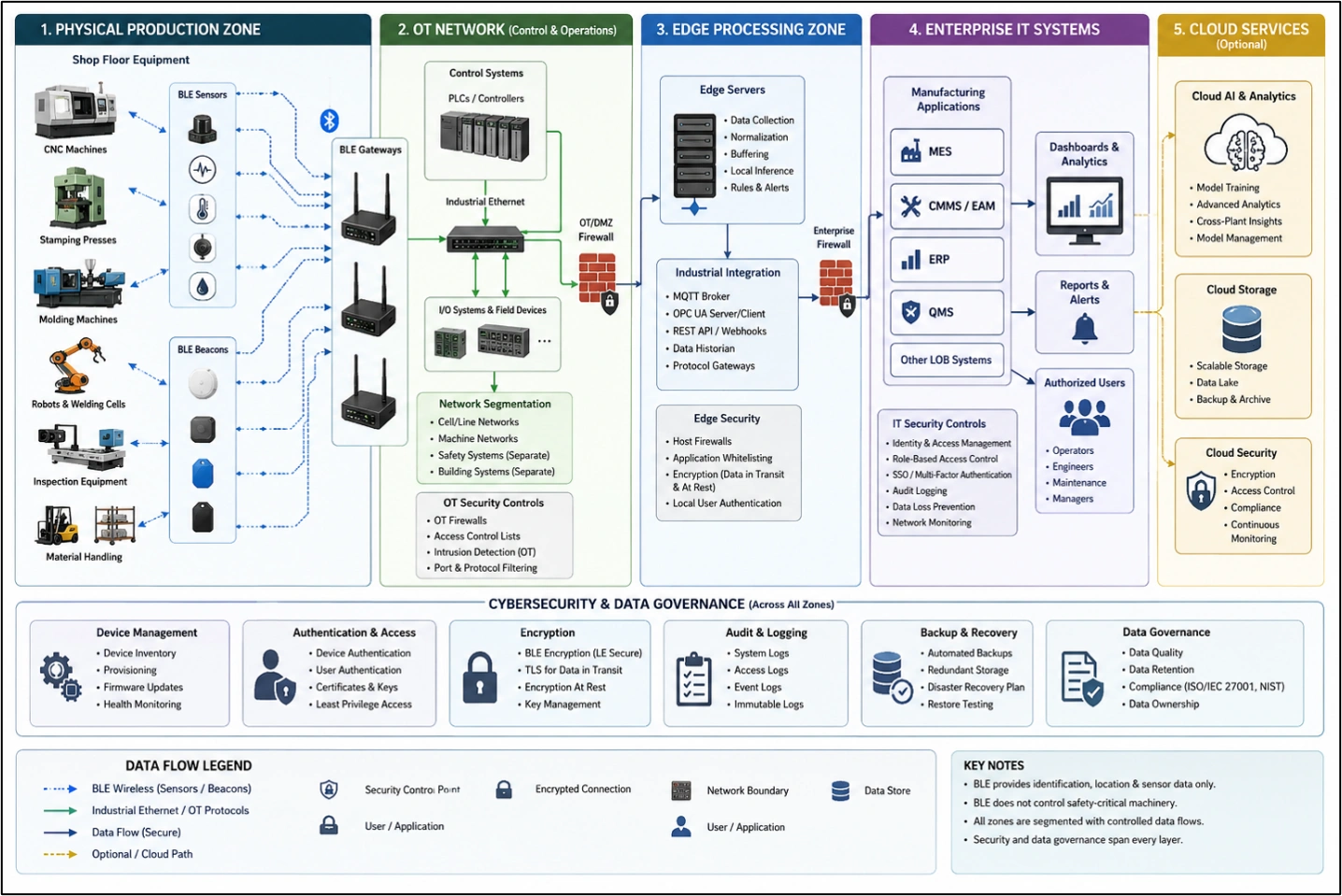
A cybersecurity-aware architecture showing how BLE sensors, industrial equipment, OT networks, edge servers, AI analytics, and enterprise manufacturing systems securely exchange production data.
KPIs for AI-Enabled Automotive Component Production
The value of an AIoT deployment should be evaluated through measurable production outcomes rather than the number of connected devices.
Relevant KPIs include:
| KPI | Application |
|---|---|
| Overall Equipment Effectiveness (OEE) | Measures equipment availability, performance, and quality |
| Unplanned downtime | Evaluates machine-failure reduction |
| Mean Time Between Failures (MTBF) | Measures equipment reliability |
| Mean Time to Repair (MTTR) | Measures maintenance response |
| Cycle time | Identifies production-performance variation |
| Throughput | Measures completed component output |
| First-pass yield | Measures production quality |
| Scrap rate | Tracks nonconforming component production |
| Tool utilization | Evaluates tooling efficiency |
| WIP dwell time | Identifies production-flow delays |
| Asset-search time | Measures time spent locating tools and equipment |
| Maintenance compliance | Tracks planned maintenance execution |
| Energy consumption per component | Supports production-efficiency analysis |
| Inventory accuracy | Evaluates material and container visibility |
The baseline should be established before deployment whenever possible. Comparing pre-deployment and post-deployment performance provides a stronger evaluation than reporting system activity alone.
Deployment Engineering for Automotive Component Production
Site Survey and Requirements Definition
Deployment begins by identifying the production processes where improved visibility or sensing can influence a measurable decision.
Engineering teams should document:
- Production zones
- Machine locations
- Tool rooms
- WIP routes
- Material supermarkets
- Maintenance areas
- Inspection stations
- BLE device locations
- Gateway mounting points
- Network connection points
- Environmental conditions
- Existing RFID and IoT installations
A small pilot should normally focus on a defined production problem, such as tooling visibility or predictive maintenance for a specific machine group.
Hardware Selection
BLE hardware selection should consider the actual automotive production environment rather than only nominal communication range.
Important factors include:
- Required sensing parameters
- Battery operating life
- Temperature range
- Mechanical protection
- Mounting method
- Device size
- Transmission interval
- Gateway density
- Location accuracy
- Metal interference
- Cleaning processes
- Exposure to oils, dust, vibration, or moisture
BLE may be appropriate for mobile assets and retrofit sensing, while wired industrial sensors or RFID may be preferable for other production requirements. Selecting the technology according to the operational problem avoids forcing one communication method into every use case.
Commissioning and Validation
Commissioning should verify the complete chain from physical event to business action.
A practical test can follow this sequence:
- Activate a BLE beacon or sensor
- Confirm gateway reception
- Verify device identity
- Confirm timestamp accuracy
- Check network transmission
- Validate middleware processing
- Confirm database storage
- Verify MES, CMMS, or other system integration
- Validate AI data preparation
- Compare AI output with known production conditions
- Confirm dashboard or alert behavior
- Record performance under normal production activity
Production operators and maintenance personnel should participate in acceptance testing because a technically correct system may still fail operationally if alerts are excessive, asset identifiers are unclear, or workflows do not match actual plant procedures.
AI-Enabled Automotive Component Production Deployment Lifecycle
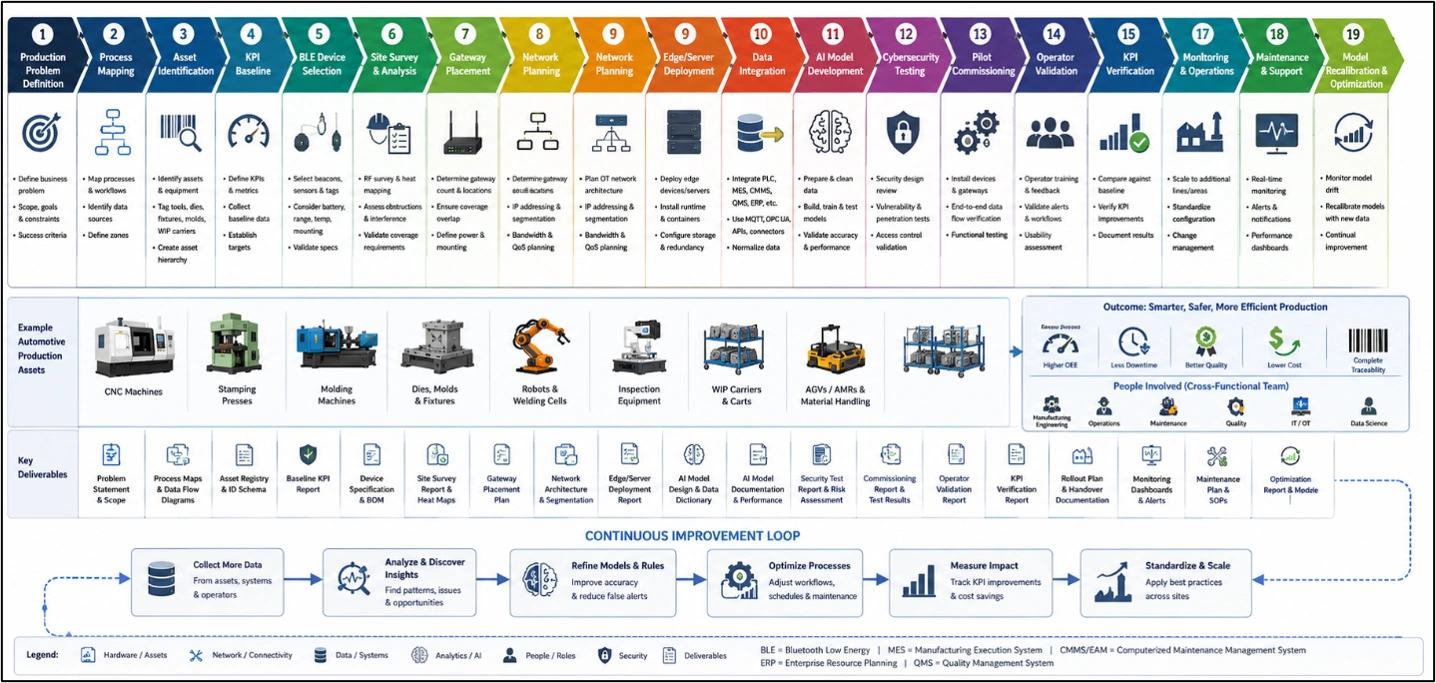
A 19-step engineering workflow covering production problem definition, BLE deployment, data integration, AI development, cybersecurity, commissioning, KPI validation, rollout, and continuous optimization.
Scaling AI Across Automotive Component Production
Once a pilot demonstrates measurable value, expansion should be based on repeatable engineering requirements.
A multi-line or multi-plant deployment should standardize device naming, asset identifiers, gateway configuration, data schemas, security policies, AI model monitoring, and KPI definitions.
Production engineers should also distinguish between models that can be reused and models that require retraining. A predictive-maintenance model developed for one CNC machine type may not perform reliably on another machine with different spindle characteristics, operating loads, or maintenance history.
Model drift should therefore be monitored as production conditions change. New tooling, machine replacements, production-rate changes, material variations, and process modifications can alter the statistical patterns used by AI.
GAO’s experience supplying connected hardware and IoT systems to organizations in the United States and Canada supports deployments where product selection, technical integration, remote assistance, and implementation requirements must be considered together. GAO is headquartered in New York City and Toronto, Canada, and is ranked among the top 10 leading B2B and B2G BLE and RFID suppliers globally. Its products and systems are used by organizations including Fortune 500 companies, R&D firms, universities, and government agencies.
Practical Recommendations for AI and BLE in Automotive Component Production
A successful implementation should prioritize operational value, data quality, and maintainability.
- Start with a measurable automotive production problem rather than deploying devices without a defined decision process.
- Select BLE for identification, proximity, location, and appropriate low-power sensing requirements.
- Continue using PLCs, industrial sensors, machine interfaces, RFID, and computer vision where they are technically better suited.
- Establish asset and device identifiers before collecting production data.
- Validate BLE coverage under real operating conditions with machinery running and material movement occurring.
- Use edge processing when latency, local resilience, or production-network constraints require it.
- Integrate AI outputs with MES, CMMS/EAM, QMS, ERP, or other existing systems where operational action occurs.
- Protect OT networks through segmentation, controlled communication, authentication, and monitoring.
- Establish baseline KPIs before measuring improvements.
- Validate AI predictions against maintenance and production records.
- Monitor model performance after production changes.
- Design battery replacement, gateway maintenance, firmware management, and device lifecycle procedures before large-scale deployment.
Key Takeaways for Automotive Component Manufacturers
AI can improve automotive component production when it connects production data to specific operational decisions. Predictive maintenance can reduce unexpected equipment interruptions, anomaly detection can identify abnormal operating behavior, AI-based quality analysis can reveal process-defect relationships, and production analytics can expose WIP and tooling constraints.
BLE gateways, beacons, and sensors can provide useful wireless identification, location, and condition data for tools, fixtures, containers, mobile equipment, and selected production assets. Their greatest value comes when the resulting information is combined with machine data, MES records, maintenance history, quality information, and AI models.
GAO provides BLE, RFID, and IoT hardware products and systems, together with technical support for connected industrial applications. GAO Group companies have invested heavily in product and system R&D for three decades and maintain stringent quality-assurance processes with remote and onsite expert support.
Building the Future of Industrial AI and IoT with Aperture Venture Studio and GAO RFID Inc.
For more than three decades, GAO Group of Companies has invested heavily in industrial BLE, RFID, and IoT R&D. As generative AI became increasingly useful for industrial applications, we expanded our work across AIoT, Industrial AI, BLE, and RFID technologies. We founded Aperture Venture Studio to help advance practical AI and IoT solutions for manufacturing applications such as automotive component production. Aperture brings together technical experts, operational executives, investors, and technology companies. We have also developed the Aperture Ventures Summit and TekSummit to discuss advanced AI and IoT topics. We welcome you to join us as advisors, co-founders or employees, investors, or customers.