
AI and BLE for Automotive Electronics Assembly
AI-Driven Automotive Electronics Assembly with Connected Production Data
AI and IoT are changing automotive electronics assembly by turning production, quality, material, and equipment data into actionable manufacturing intelligence. AI-driven electronics assembly solutions can combine machine vision, machine learning, edge computing, BLE sensors, BLE beacons, and BLE gateways to monitor processes and identify conditions that may affect quality or throughput. In automotive electronics manufacturing, this can include printed circuit board assembly, electronic control unit production, component kitting, soldering, inspection, functional testing, rework, and finished-unit traceability. BLE provides a practical wireless data layer for selected mobile assets, tools, work-in-process carriers, environmental sensors, and location-aware equipment, while AI analyzes the resulting data alongside manufacturing execution system, quality, and machine data. The objective is not simply to connect equipment. It is to establish reliable production visibility that helps engineers detect process deviations, reduce avoidable downtime, improve traceability, and support faster quality decisions.
AI-Driven Automotive Electronics Assembly with BLE and Production Analytics
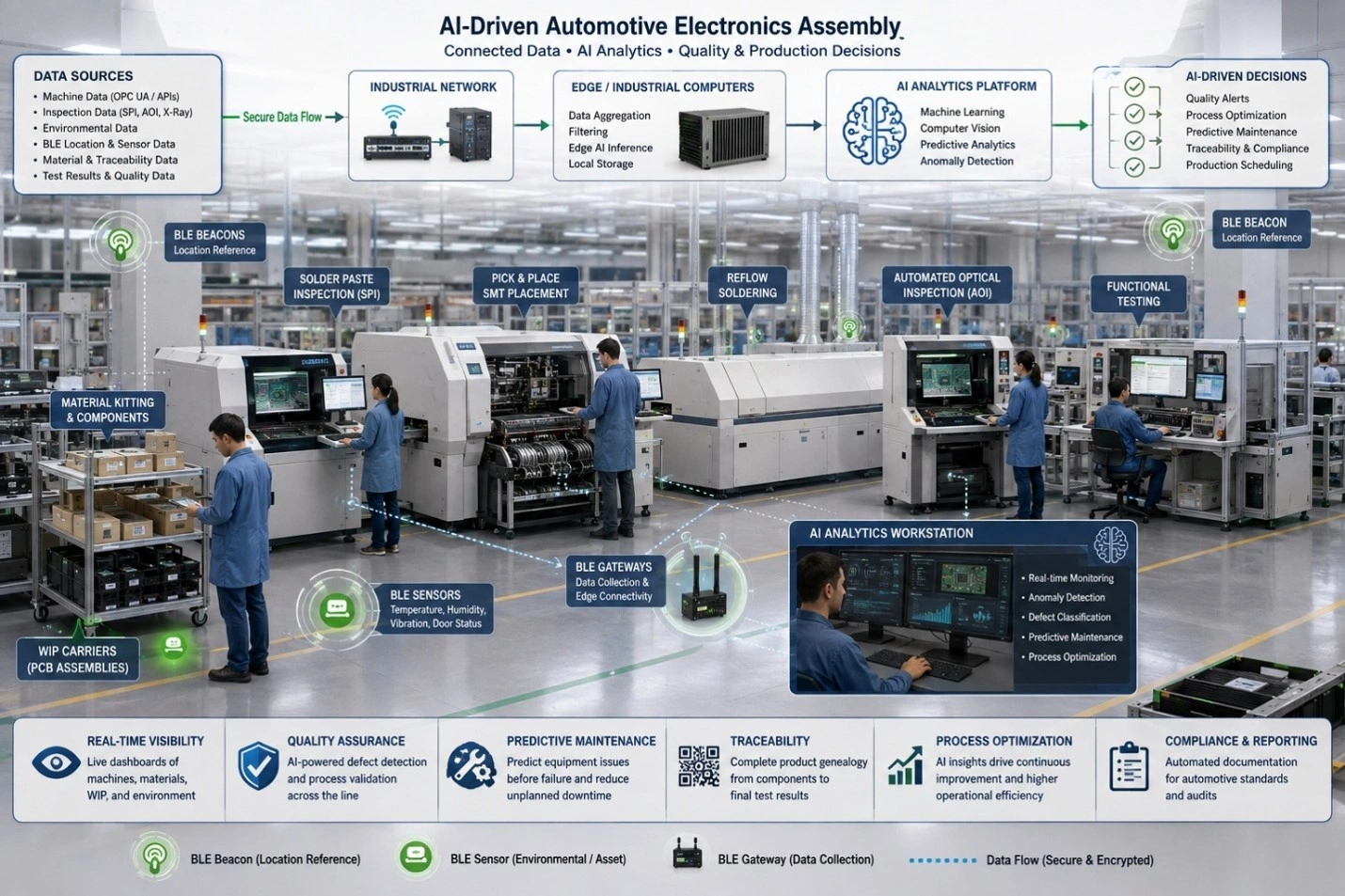
What AI Means for Automotive Electronics Assembly
AI-driven automotive electronics assembly applies machine learning, computer vision, statistical models, anomaly detection, predictive analytics, and increasingly edge AI to manufacturing decisions that traditionally depended on manual inspection, fixed process rules, historical reports, and operator experience.
The most valuable applications are closely tied to measurable manufacturing problems:
- AI quality inspection for PCB assemblies and electronic control units
- AI-driven detection of soldering and component-placement anomalies
- Predictive maintenance for SMT equipment, reflow ovens, conveyors, testers, and production tooling
- AI-assisted material and WIP traceability
- AI production scheduling and bottleneck identification
- AI-based process anomaly detection
- AI-assisted root-cause analysis for recurring defects
- AI-driven monitoring of environmental conditions affecting electronics assembly
- AI-assisted rework prioritization
- AI-based production-performance forecasting
The resulting system can combine information from machine vision cameras, solder paste inspection systems, automated optical inspection equipment, automated X-ray inspection, functional testers, programmable logic controllers, manufacturing execution systems, quality databases, enterprise resource planning systems, and wireless IoT devices.
This is particularly relevant to automotive electronics because assembly operations must maintain consistent process control while producing increasingly complex electronic assemblies. Electronic control units, battery-management electronics, body-control modules, power electronics, sensors, communication modules, and other vehicle electronics may contain large numbers of components and require detailed production records.
IPC workmanship requirements provide an important reference point for electronic assemblies. IPC documentation distinguishes requirements for soldered electrical and electronic assemblies from visual acceptability criteria and also identifies automotive-specific considerations such as AIAG-CQI-17 and Automotive Electronics Council qualification standards.
GAO supports organizations with hardware products and connected IoT systems that can contribute to this broader production-data environment. The engineering objective is to match the sensing and connectivity method to the physical process rather than adding wireless devices where existing machine interfaces already provide better data.
Automotive Electronics Assembly Applications for AI-Driven Manufacturing
AI Quality Inspection and Defect Detection
Quality inspection is one of the strongest applications for AI in automotive electronics assembly because defects can arise from multiple interacting process variables.
AI models can analyze inspection images and process measurements to identify patterns associated with:
- Solder bridging
- Insufficient solder
- Tombstoning
- Component misalignment
- Missing components
- Incorrect component placement
- Lead and pad anomalies
- PCB contamination
- Conformal-coating irregularities
- Connector defects
- Assembly damage
- Repeated defect patterns across production lots
Computer vision should not simply replace established inspection controls. A more robust approach uses AI as an additional analytical layer around existing AOI, SPI, X-ray inspection, and functional-testing processes.
For example, a recurring defect detected at AOI can be correlated with feeder identity, component lot, machine program, production shift, stencil condition, solder paste age, reflow profile, operator intervention, and WIP location. This gives manufacturing engineers substantially more information for root-cause analysis than an isolated defect code.
AI Predictive Maintenance for Electronics Assembly Equipment
SMT production equipment is sensitive to mechanical wear, contamination, calibration drift, feeder problems, nozzle conditions, conveyor abnormalities, and thermal-process variation.
AI predictive maintenance can combine equipment telemetry with production outcomes to identify conditions that precede equipment-related quality problems or downtime.
Relevant equipment includes:
- Pick-and-place machines
- Solder paste printers
- Reflow ovens
- SPI systems
- AOI systems
- X-ray inspection equipment
- Board handling conveyors
- Component feeders
- Automatic test equipment
- Functional test fixtures
- Robotic handling equipment
- Industrial compressors and supporting utilities
A useful predictive-maintenance model should not simply produce an abstract “machine health score.” Maintenance personnel need an actionable relationship between an observed condition and a maintenance decision.
For example, increasing nozzle-related placement anomalies combined with machine-cycle data and inspection results may justify an inspection or maintenance intervention before the issue becomes a high-volume defect source.
AI Material, WIP, and Tool Traceability
Automotive electronics assembly depends on controlled movement of components, reels, trays, PCBs, WIP carriers, fixtures, test equipment, and finished electronic assemblies.
BLE beacons and BLE sensors can contribute location and condition information for selected mobile assets. BLE gateways positioned around production zones can collect wireless transmissions and forward relevant events to manufacturing software.
This is especially useful when an organization needs to answer questions such as:
- Where is a WIP carrier?
- Which production zone last handled a specific assembly?
- Which fixture was used for a test operation?
- How long did a material container remain outside its designated area?
- Which mobile test instrument was used near a particular work cell?
- How long did a WIP unit remain between two production operations?
The wireless layer should complement, rather than replace, product serialization, barcode systems, machine interfaces, and formal manufacturing traceability.
AI Environmental Monitoring for Electronics Assembly
Temperature, humidity, particulate conditions, equipment temperature, and other environmental variables can affect sensitive electronics manufacturing processes.
BLE sensors can collect selected environmental measurements and transmit them through BLE gateways to local or centralized software. AI can then identify abnormal environmental patterns and correlate them with production quality information.
For example, a manufacturing engineer could investigate whether an unusual increase in soldering-related defects coincided with environmental changes, process changes, or material conditions.
The value comes from correlation rather than sensing alone.
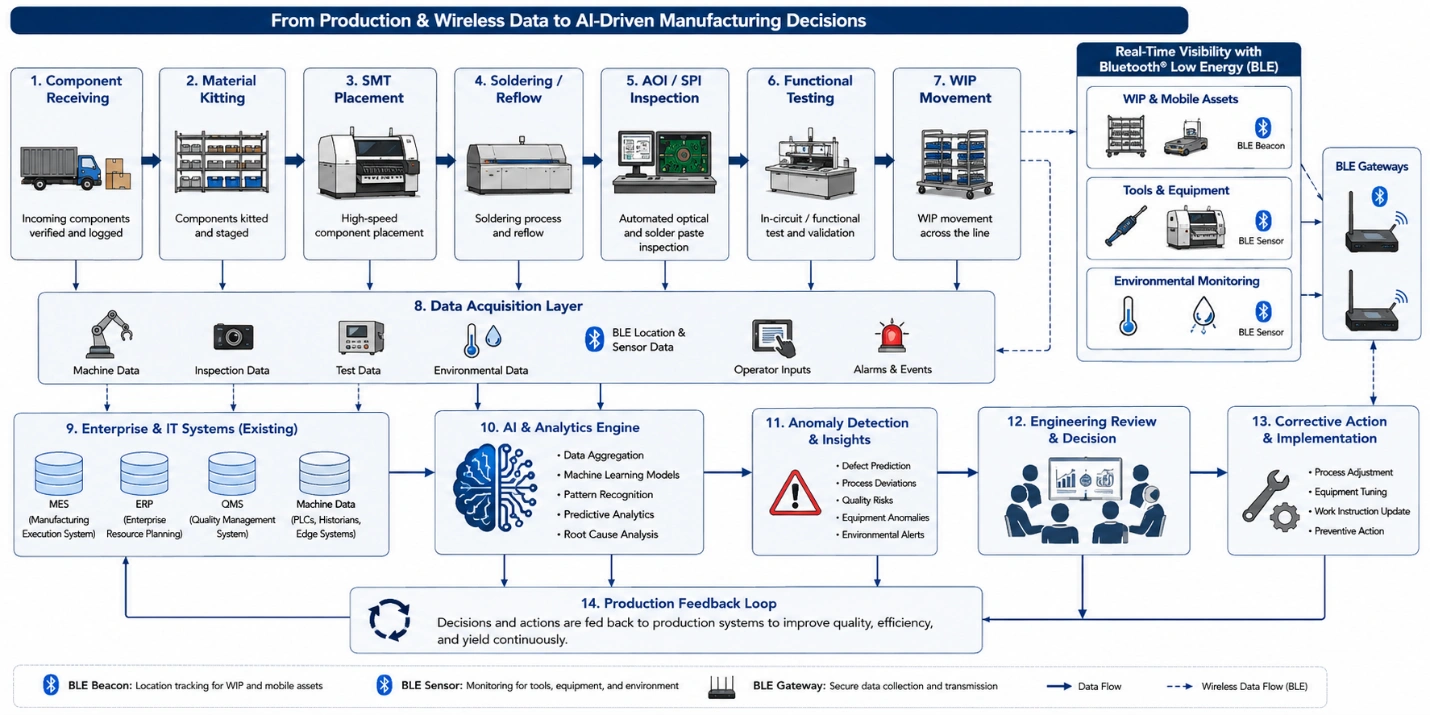
AI-Driven Automotive Electronics Manufacturing Workflow with BLE Data Integration
Automotive Electronics Assembly Challenges AI Can Address
AI deployment should begin with a clearly defined manufacturing problem. Automotive electronics assembly presents several conditions that make data-driven process control valuable.
High Product and Process Complexity
A single electronics assembly operation can involve hundreds or thousands of component-level decisions. Product variants, firmware versions, BOM revisions, machine programs, feeder assignments, component lots, and test configurations can create substantial traceability requirements.
AI can help correlate these variables and identify relationships that are difficult to detect through manually reviewed reports.
Defect Escalation and Containment
A small process deviation can become expensive when it continues through a production run before detection.
AI-based anomaly detection can monitor trends in inspection results and process measurements. When configured correctly, the system can alert engineers to a developing pattern rather than waiting for a predefined defect threshold.
Human review remains important for production containment and corrective-action decisions, particularly where quality or functional safety is involved.
Fragmented Manufacturing Data
Electronics assembly data frequently exists across separate systems:
- MES
- ERP
- QMS
- SCADA systems
- PLCs
- AOI and SPI systems
- Functional testers
- Maintenance management systems
- Laboratory systems
- Barcode systems
- Engineering databases
- Machine vendor software
AI becomes more useful when these data sources can be related through common identifiers such as work-order numbers, serial numbers, machine IDs, process steps, component lots, fixture IDs, and timestamps.
WIP Visibility Across Production Zones
Traditional barcode processes can provide strong identification at designated scan points but may provide limited continuous location information.
BLE can supplement these processes by providing wireless proximity or location signals for selected WIP carriers, tools, fixtures, and mobile equipment. The accuracy required should determine the positioning method. A simple zone-level location requirement does not necessarily justify centimeter-level positioning.
Manufacturing Cybersecurity and Data Integrity
Connected production systems introduce additional cybersecurity considerations. Wireless gateways, edge computers, databases, APIs, machine interfaces, and AI services should be treated as part of the manufacturing security boundary.
NIST’s manufacturing cybersecurity guidance emphasizes a risk-based approach for protecting manufacturing systems, including industrial control systems, networks, and production technologies.
AI systems also require controls for data integrity, access management, model behavior, monitoring, and system resilience. NIST’s AI Risk Management Framework identifies characteristics including validity and reliability, safety, security and resilience, accountability, transparency, and privacy.
AIoT Data Flow from Assembly Line to Manufacturing Decision
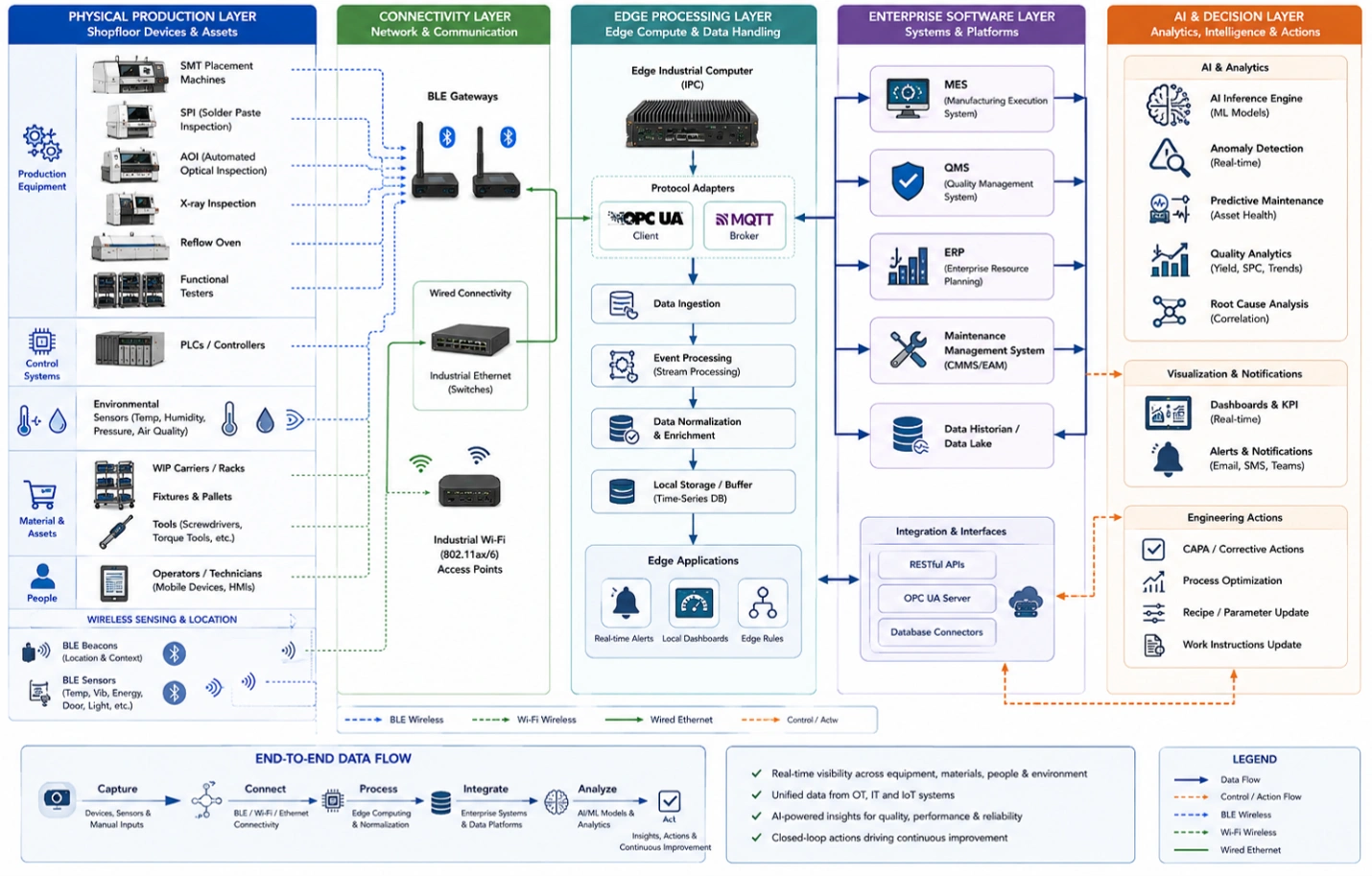
AIoT, or Artificial Intelligence of Things, combines artificial intelligence with IoT devices, sensors, connected equipment, and industrial systems. For automotive electronics assembly, the most effective implementations treat AIoT as a connected production-data process rather than as a standalone AI application.
A practical data flow can follow this sequence:
Physical process → Data capture → Connectivity → Edge processing → Middleware → Manufacturing software → AI analytics → Decision → Production action → Feedback
Data Acquisition at the Assembly Cell
Data begins at physical production processes.
Relevant sources include:
- AOI inspection results
- SPI measurements
- X-ray inspection results
- Reflow temperature profiles
- Pick-and-place machine events
- Feeder status
- Component lot information
- Functional test results
- Fixture identifiers
- Machine alarms
- Operator inputs
- WIP identifiers
- Environmental sensors
- BLE asset-location events
- BLE tool and fixture telemetry
The system should capture timestamps and identifiers consistently. Without reliable time synchronization and entity identification, AI models may discover correlations that are operationally misleading.
BLE Connectivity for Selected Assembly Assets
BLE is particularly suitable where low-power wireless communication is needed for mobile or distributed objects.
BLE beacons can provide identity or presence signals, while BLE sensors can transmit measurements such as environmental or equipment-related data. BLE gateways collect these wireless signals and forward them to the appropriate local or centralized software.
The engineering decision should consider RF propagation around metal production equipment, shielding from machinery, gateway placement, interference, battery life, required location accuracy, packet loss, and maintenance accessibility.
Automotive electronics factories contain substantial metal equipment, cabinets, conveyors, racks, and machinery. Consequently, RF surveys and pilot deployments are important before specifying gateway density or claiming a particular positioning accuracy.
Edge Processing and Industrial Networking
Edge processing can reduce latency and limit unnecessary transmission of raw data.
An industrial edge computer may normalize incoming BLE events, perform local filtering, buffer data during network interruptions, and execute selected AI inference workloads.
Common supporting technologies may include:
- Ethernet
- Industrial Wi-Fi
- MQTT
- OPC UA
- REST APIs
- SQL databases
- Message brokers
- Industrial PCs
- Virtual machines
- Containerized services
- Time-series databases
The appropriate protocol depends on the source system. OPC UA may be appropriate for machine and industrial data integration, while MQTT can be useful for lightweight event distribution.
AIoT Architecture for Automotive Electronics Assembly and Smart Manufacturing
Core Systems Supporting AI-Enabled Electronics Assembly
Manufacturing Execution Systems
MES remains a central source of production context. AI should use MES information such as work orders, routing steps, product variants, production status, serial numbers, and operator actions to understand what was actually happening when a process event occurred.
Quality Management Systems
QMS data provides defect codes, nonconformance records, corrective actions, inspection outcomes, and quality history. Connecting QMS information with machine and WIP data helps AI models move from simple defect detection toward root-cause analysis.
ERP and Material Systems
ERP systems can provide purchase orders, supplier information, inventory records, production orders, and material transactions. AI can use these records to examine relationships between component lots, production conditions, supplier information, and downstream quality outcomes.
Maintenance Management Software
Maintenance records can significantly improve predictive-maintenance models because they establish historical relationships between machine conditions, interventions, component replacements, and failures.
GAO’s role can include supplying BLE and IoT hardware products and systems that provide additional physical-world data for these software environments. The integration strategy should remain system-neutral so that wireless data can be consumed by the customer’s existing manufacturing software rather than forcing unnecessary changes to established production controls.
BLE Hardware and Software for Automotive Electronics Assembly
BLE represents the wireless sensing and identification layer rather than the complete AI solution.
BLE Beacons
BLE beacons can be attached to:
- WIP carriers
- Test fixtures
- Material carts
- Mobile tools
- Maintenance equipment
- Production racks
- Reusable containers
Their primary value is providing a persistent wireless identity or presence signal that can be detected by nearby gateways.
BLE Sensors
BLE sensors extend this capability by transmitting physical measurements. Depending on the application, sensors may support environmental monitoring, equipment condition measurements, or other operational variables relevant to electronics assembly.
Sensor selection should be based on measurement accuracy, sampling frequency, operating temperature, battery life, enclosure requirements, calibration needs, and maintenance intervals.
BLE Gateways
BLE gateways provide the connection between wireless devices and the factory’s IP network.
A gateway may receive BLE advertisements or sensor messages, filter or normalize events, and forward relevant information to edge or server software. Gateway placement should be based on the physical characteristics of the assembly area rather than simply calculated from nominal radio range.
Metal cabinets, equipment frames, racks, PCB handling systems, and moving machinery can significantly affect radio propagation.
Cloud Version and Server Version
A Cloud Version can be appropriate when automotive electronics assembly organizations need centralized access across multiple facilities and their data policies permit cloud-hosted processing. Cloud deployment can simplify centralized analytics, fleet-level reporting, model management, and remote access.
A Server Version can be more appropriate where production data must remain within factory servers, private data centers, customer-managed infrastructure, or controlled edge environments. It can also be useful where production continuity must not depend on an external WAN connection.
A hybrid implementation can keep latency-sensitive inference and data buffering near the production line while transferring selected historical data to centralized systems.
The decision should consider:
- Network availability
- Data residency requirements
- Cybersecurity policies
- AI inference latency
- Data volume
- Model-management requirements
- Existing IT infrastructure
- Multi-site reporting requirements
- Disaster recovery
- Production continuity requirements
For automotive electronics assembly, the strongest deployment is usually the one that minimizes operational risk while fitting existing manufacturing controls.
AI-Driven Operational Workflow for Automotive Electronics Assembly
A reliable AI solution for automotive electronics assembly should connect production events to decisions without disrupting validated manufacturing processes. The workflow begins with data acquisition at individual workstations and ends with an engineering, quality, maintenance, or production action.
From Production Data to AI Decision
The operational sequence typically includes:
- Capture: Machine interfaces, AOI, SPI, functional testers, PLCs, barcode readers, environmental sensors, BLE beacons, and BLE sensors generate production data.
- Identify: Serial numbers, PCB identifiers, work orders, component lots, fixture IDs, machine IDs, and WIP carrier identities establish manufacturing context.
- Transmit: BLE gateways collect selected wireless data and forward it through Ethernet or industrial wireless networks.
- Normalize: Edge software converts heterogeneous events into consistent timestamps, identifiers, measurements, and status records.
- Correlate: Middleware associates wireless events with MES routing steps, machine events, inspection results, maintenance records, and quality data.
- Analyze: AI models identify anomalies, predict equipment conditions, classify inspection images, detect process drift, or identify relationships between variables.
- Decide: The system generates an alert, recommendation, work-order trigger, quality investigation, maintenance request, or production-control action.
- Verify: Engineers and technicians validate the result against production evidence before making consequential process changes.
- Learn: Confirmed outcomes become additional training or validation data for future model improvement.
This closed loop is particularly valuable when a production problem cannot be explained by one data source. A solder defect, for example, may require correlation between SPI measurements, stencil information, solder-paste conditions, placement data, reflow profiles, component lots, inspection images, and the affected WIP population.
Edge AI for Time-Sensitive Production Decisions
Edge AI is useful where inference latency, network resilience, or data volume makes centralized processing impractical.
A factory edge computer can perform local anomaly detection, image inference, data filtering, and temporary storage. If the connection to a central server becomes unavailable, the edge system can continue collecting critical production events and synchronize them when connectivity returns.
Not every AI model belongs at the edge. Large historical analyses, cross-plant benchmarking, model training, and long-term trend analysis may be better suited to centralized computing.
The engineering objective is therefore to place each workload according to latency, compute requirements, data sensitivity, and production continuity.
AI Capabilities That Improve Electronics Assembly Performance
Predictive Quality and Process Anomaly Detection
AI can identify subtle deviations before they become widespread production defects.
A model can compare current production behavior against historical patterns and detect unusual combinations of process variables. For automotive electronics assembly, useful variables may include solder-paste volume, placement accuracy, reflow-zone temperatures, machine alarms, inspection measurements, component lot numbers, environmental conditions, and product variants.
A practical implementation should distinguish between statistical correlation and verified causation. AI output should guide investigation rather than automatically change validated process parameters.
Computer Vision for PCB and Electronic Assembly Inspection
Computer vision can extend AOI by detecting visual patterns across large inspection datasets.
AI-assisted inspection can support:
- Defect classification
- Image-based anomaly detection
- False-positive reduction
- Defect clustering
- Inspection trend analysis
- Cross-line comparison
- Rework prioritization
The model should be evaluated against known-good and known-defective assemblies, including different PCB revisions, component packages, lighting conditions, and legitimate manufacturing variations.
Quality engineers should establish acceptance thresholds, false-negative controls, model validation procedures, and human review rules before AI output becomes part of a production quality decision.
Predictive Maintenance and Equipment Health
AI can estimate the probability of equipment degradation by combining historical maintenance events with machine telemetry and production outcomes.
For example, recurring placement errors combined with nozzle usage, feeder behavior, machine alarms, and inspection data may reveal a developing equipment problem.
Useful KPIs include:
- Mean time between failures
- Mean time to repair
- Unplanned downtime
- Planned versus unplanned maintenance
- First-pass yield
- Defects per million opportunities
- Overall equipment effectiveness
- Changeover duration
- Equipment availability
- Maintenance response time
AI becomes valuable when these indicators lead to an actionable maintenance decision rather than another dashboard that technicians must manually interpret.
WIP and Tool Visibility
BLE-enabled location awareness can help production teams determine the current zone of reusable WIP carriers, test fixtures, mobile tools, material carts, and maintenance equipment.
AI can analyze movement patterns to identify:
- Repeated WIP waiting points
- Excessive transport time
- Fixture shortages
- Abnormal dwell time
- Tool utilization patterns
- Production-zone congestion
- Repeated movement between rework and inspection areas
This information can help industrial engineers distinguish actual process bottlenecks from perceived bottlenecks.
Deployment Engineering for Automotive Electronics Assembly
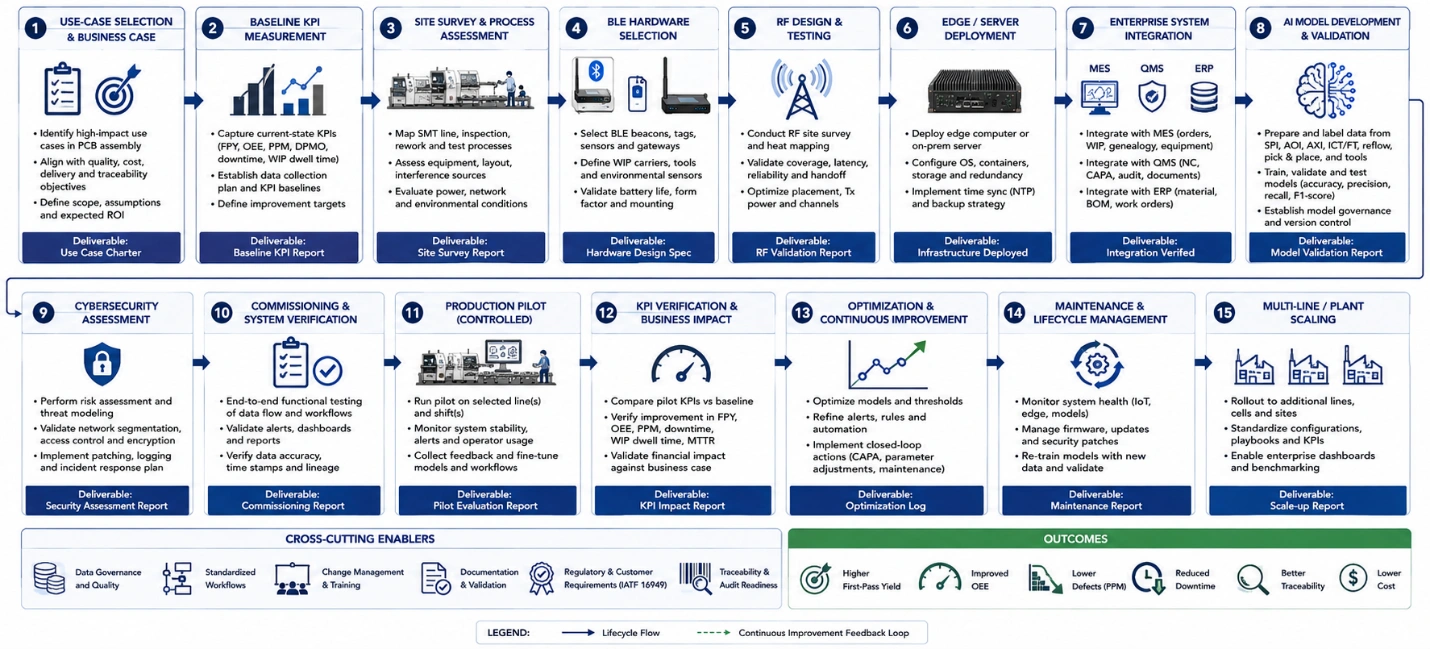
Successful deployment depends as much on commissioning and integration discipline as on the AI model itself.
Site Survey and Use-Case Definition
The first step should identify a measurable manufacturing problem.
Examples include excessive WIP search time, recurring AOI defects, unexplained equipment downtime, incomplete tool traceability, or environmental excursions.
The project team should document:
- Production area and process step
- Assets to be monitored
- Required measurement or location accuracy
- Existing data sources
- Required response time
- Network availability
- Cybersecurity restrictions
- Data retention requirements
- Applicable quality procedures
- Responsible production and engineering personnel
- Baseline KPI values
BLE deployment should begin with an RF survey where wireless positioning or sensing is required. Metal racks, equipment enclosures, conveyors, electrical cabinets, and other structures can create multipath and attenuation that affect received-signal-strength-based positioning.
Hardware Selection and Commissioning
Hardware should be selected around the manufacturing environment.
BLE sensors and beacons should be evaluated for:
- Battery life
- Operating temperature
- Enclosure requirements
- Mounting method
- Radio performance
- Measurement accuracy
- Maintenance accessibility
- Required sampling interval
- Cleaning requirements
- Electromagnetic environment
Gateway selection should consider antenna placement, network connectivity, processing capability, enclosure requirements, power availability, and physical access.
Commissioning should verify actual coverage rather than relying solely on theoretical radio range.
Integration with Manufacturing Software
A mature implementation should preserve existing production identifiers.
Typical integration relationships include:
BLE/Wireless Data → Middleware → MES/QMS/ERP/Maintenance Software → AI Analytics
Machine information can enter through OPC UA, industrial APIs, database interfaces, or vendor-specific interfaces. REST APIs can support application-level integration, while MQTT can distribute event messages efficiently between connected services.
The integration layer should normalize timestamps, device identifiers, production identifiers, units of measurement, and event types.
Data lineage is important. An engineer investigating an AI-generated alert should be able to determine which source records contributed to the recommendation.
Cybersecurity and Reliability Controls
Connected automotive electronics assembly systems should be designed around least privilege, network segmentation, controlled interfaces, and auditable access.
Important controls include:
- Unique device identities
- Role-based access control
- Encrypted communications where supported
- Certificate or credential management
- Secure gateway configuration
- Network segmentation
- Firewall rules
- Controlled API access
- Software patch management
- Audit logging
- Backup and recovery procedures
- Device inventory
- Configuration management
- Monitoring for unusual network behavior
Wireless security should also be considered at the BLE layer. Device authentication, pairing configuration, key management, and gateway security should be evaluated according to the capabilities of the selected devices and the sensitivity of the application.
Production continuity requires another layer of protection. Gateway outages should not automatically result in lost production records. Local buffering, retry logic, timestamp preservation, and controlled synchronization can reduce the effect of temporary network failures.
AI security also requires protection against corrupted training data, unauthorized model changes, inappropriate access to production information, and unexplained model behavior.
Testing, Validation, and Production Acceptance
AI and BLE systems should be tested against the actual automotive electronics assembly process rather than validated only in a laboratory environment.
Connectivity Testing
Testing should verify:
- BLE device discovery
- Gateway coverage
- Packet reception
- Message latency
- Battery reporting
- Device identification
- Network failover
- Local buffering
- Data synchronization
RF performance should be tested with production machinery operating because the physical environment can differ substantially from an empty factory floor.
AI Model Validation
Model performance should be measured using production-relevant datasets.
Quality teams may evaluate:
- Precision
- Recall
- False-positive rate
- False-negative rate
- Detection latency
- Model drift
- Performance by product variant
- Performance by production line
- Performance under changing environmental conditions
A model that performs well on historical data but poorly on a new PCB revision should not be treated as production-ready.
Operational Acceptance Testing
Operators, manufacturing engineers, maintenance technicians, IT personnel, and quality engineers should participate in acceptance testing.
The system should demonstrate that an AI alert can be traced back to the relevant machine, WIP unit, inspection event, or wireless device and that the responsible employee knows what action the alert requires.
Scaling AI and BLE Across Electronics Assembly Lines
Scaling should occur after the first production deployment has demonstrated measurable value.
A successful pilot can establish reusable standards for device naming, gateway configuration, data schemas, API interfaces, cybersecurity controls, AI model validation, and maintenance procedures.
Multi-line deployment should account for differences in:
- SMT equipment
- PCB product families
- Factory layouts
- RF conditions
- MES configurations
- Quality processes
- Machine interfaces
- Network policies
- Production volumes
- Local maintenance practices
Standardization should not mean forcing identical hardware configurations onto every line. A line with high-density metal equipment may require different BLE gateway placement from an open assembly area.
GAO’s experience supplying BLE, RFID, and IoT hardware products and systems can support organizations that need to extend connected sensing and identification across production environments while integrating the resulting data with existing systems.
KPIs for AI-Enabled Automotive Electronics Assembly
The effectiveness of an AI-driven electronics assembly solution should be demonstrated through manufacturing outcomes.
| KPI | AI/BLE Contribution | Manufacturing Relevance |
|---|---|---|
| First-pass yield | Detects process and quality anomalies | Measures assemblies passing without rework |
| OEE | Identifies downtime and process losses | Measures equipment effectiveness |
| Defects per million opportunities | Detects recurring defect patterns | Supports quality improvement |
| WIP dwell time | Tracks movement and waiting patterns | Identifies production bottlenecks |
| Unplanned downtime | Predictive maintenance | Reduces unexpected equipment interruption |
| Mean time between failures | Equipment condition analysis | Measures reliability |
| Mean time to repair | Maintenance analytics | Measures recovery efficiency |
| Traceability completeness | Links wireless and production events | Strengthens production history |
| Rework rate | Identifies defect drivers | Reduces additional labor and material use |
| Inspection false-positive rate | AI vision classification | Reduces unnecessary manual review |
| Material search time | BLE location awareness | Reduces time locating mobile assets |
| Fixture utilization | Movement analytics | Improves test-resource planning |
| Process excursion response time | Automated alerts | Accelerates engineering intervention |
KPIs should be measured before deployment so that the production team can distinguish actual improvement from normal process variation.
GAO Expertise in Industrial BLE and IoT for Manufacturing
Headquartered in New York City and Toronto, Canada, GAO is ranked among the world’s top 10 leading B2B and B2G BLE and RFID suppliers, with a smaller B2B2C and B2D presence. Our hardware and systems are intended for practical applications where wireless identification, sensing, data collection, and industrial connectivity must work within real operating environments.
GAO Group includes GAO, GAO Research, and GAO Tek, with operations based in New York City and Toronto. For three decades, the group has served customers across the United States and Canada, including Fortune 500 companies, leading R&D organizations, prestigious universities, and government agencies.
That operating history is relevant to automotive electronics assembly because successful IoT deployment depends on more than selecting a radio technology. Device durability, installation conditions, data interfaces, commissioning, system integration, technical support, and lifecycle maintenance all affect the final result.
GAO has invested substantially in R&D for BLE, RFID, and IoT products and systems and maintains stringent quality-assurance processes. Technical support is available remotely or onsite, helping engineering and IT teams address deployment issues that emerge after hardware reaches the production environment.
Implementation Recommendations for AI and BLE in Electronics Assembly
Organizations considering AI-enabled automotive electronics assembly should approach implementation as a manufacturing engineering program rather than a standalone software project.
Recommended practices include:
- Start with one measurable production problem rather than attempting to digitize every process simultaneously.
- Establish baseline FPY, OEE, defect, downtime, WIP dwell, and traceability metrics before deployment.
- Use existing MES, QMS, machine, and inspection data wherever possible before introducing additional sensors.
- Deploy BLE where wireless sensing or location provides information that existing interfaces cannot provide economically.
- Conduct RF surveys around SMT machines, conveyors, metal racks, cabinets, and test equipment.
- Use edge processing where low latency, network resilience, or local data handling is important.
- Keep AI recommendations auditable and traceable to source production data.
- Require human validation before AI changes a safety-critical or quality-critical manufacturing parameter.
- Validate AI models against different PCB variants, production lines, and normal manufacturing variation.
- Design gateway and sensor maintenance into the production support process.
- Protect manufacturing networks through segmentation, access control, monitoring, and controlled interfaces.
- Use cloud deployment when centralized analytics and multi-site access justify it and data policies permit it.
- Use server or edge deployment where local control, latency, data governance, or production continuity is more important.
- Define ownership among manufacturing engineering, quality, maintenance, OT, IT, and data-science teams before commissioning.
- Scale only after the pilot demonstrates measurable operational improvement.
Key Takeaways for AI-Enabled Automotive Electronics Assembly
AI can improve automotive electronics assembly when it is connected to reliable production evidence and a defined manufacturing decision. Computer vision can strengthen defect analysis, machine learning can identify process anomalies, predictive models can support maintenance planning, and wireless sensing can improve visibility of selected WIP, tools, fixtures, and environmental conditions.
BLE is most valuable as an enabling connectivity layer for low-power wireless devices where direct machine integration, wired sensing, or barcode identification does not provide the required information.
The strongest implementations combine AI, manufacturing data, connected equipment, disciplined integration, cybersecurity, and human engineering judgment. GAO provides BLE, RFID, and IoT hardware products and systems that can form part of these connected manufacturing solutions.
Organizations planning an AI-driven electronics assembly initiative can evaluate GAO’s technology solutions, product capabilities, engineering expertise, and technical support to determine which sensing, identification, and connectivity approach best fits their production requirements.
AI-Enabled Automotive Electronics Assembly Implementation Lifecycle
Building the Future of Industrial AI and IoT with Aperture Venture Studio and GAO RFID Inc.
For more than three decades, GAO Group of Companies has invested heavily in R&D for industrial BLE, RFID, and IoT. As generative AI became increasingly useful for industrial applications, we expanded our work in AIoT, combining AI with connected sensors, equipment, BLE, and RFID. We founded Aperture Venture Studio to advance practical AI and IoT solutions for manufacturing applications such as automotive electronics assembly.
Aperture brings together AI and IoT technical experts, operational leaders, investors, and industry participants. We also organize the Aperture Ventures Summit and TekSummit to discuss advanced AI and IoT topics.
We welcome qualified participants as:
- Advisors, co-founders, or employees
- Investors
- Customers