
AI and BLE for Banking Operations
AI-Driven Banking Operations with BLE
Artificial intelligence is changing banking operations by turning operational data into actionable decisions for branch management, asset control, physical security, facilities teams, and service operations. BLE enables this intelligence by providing a practical method for identifying, locating, monitoring, and communicating with connected assets and sensors inside branches, offices, data centers, vault areas, and other controlled banking environments. BLE beacons, BLE sensors, and BLE gateways can capture proximity, location, environmental, and equipment-status information, while AI models analyze those signals to identify operational patterns, anomalies, risks, and maintenance requirements. For banking operations, the value comes from combining AI-driven analytics with reliable physical-world data rather than treating connectivity as an isolated technology. GAO supplies BLE, RFID, and IoT hardware and systems that can support these operational scenarios, including deployments requiring remote or onsite technical assistance.
What AI Means for Modern Banking Operations
AI for banking operations refers to the use of machine learning, anomaly detection, predictive analytics, computer vision, natural language processing, and related AI methods to improve physical and operational processes surrounding financial services. The focus is different from AI applications used for credit scoring, fraud modeling, or customer-facing financial recommendations. Banking operations AI addresses the physical and organizational systems that keep branches, offices, equipment, service areas, and supporting infrastructure functioning reliably.
BLE provides a source of real-world operational signals. A tagged asset can report its proximity to a BLE gateway, while a BLE sensor can provide information such as temperature, humidity, motion, occupancy, or equipment conditions. AI software can combine these signals with historical records and data from banking systems to determine whether an event is normal, unusual, or operationally significant.
Relevant AI applications include:
- AI asset tracking for banking operations:Identifying the location and movement of portable equipment, IT assets, security equipment, maintenance tools, and other operational assets.
- AI branch monitoring:Analyzing occupancy, movement, environmental conditions, and equipment status to improve branch operations.
- Predictive maintenance:Identifying patterns that indicate developing equipment problems before an operational failure occurs.
- Anomaly detection:Detecting unusual movement, unexpected asset presence, abnormal environmental conditions, or deviations from established operating patterns.
- AI-assisted facilities management:Using sensor data and historical patterns to improve HVAC, environmental monitoring, equipment servicing, and facility utilization.
- Operational security monitoring:Combining BLE location and sensor events with access-control and security systems to identify unusual physical activity.
- AI incident prioritization:Correlating operational events and assigning greater attention to conditions that have higher potential business impact.
- Workforce and service optimization:Using operational information to improve technician dispatch, equipment servicing, and branch support activities.
The strongest implementations do not replace banking controls with AI predictions. Instead, AI supplements established procedures by providing additional evidence, prioritization, and early warnings.
AI and BLE Banking Operations System Architecture
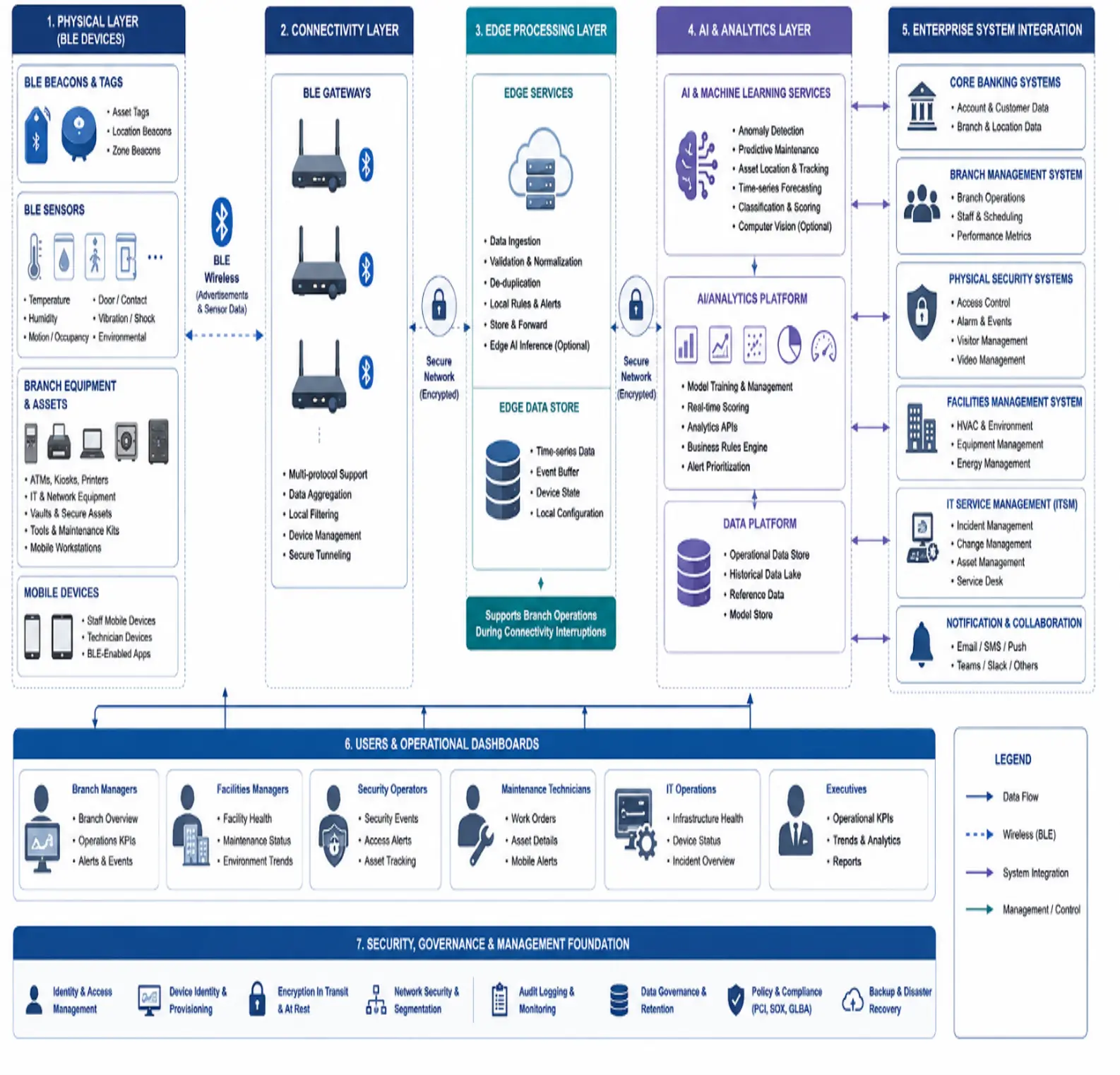
The diagram shows how BLE-enabled banking assets and operational data move through gateways, edge processing, AI analytics, and enterprise software to support monitoring, asset tracking, predictive maintenance, security events, and operational decisions.
Banking Operations Use Cases for AI and BLE
AI Asset Tracking for Branch and Office Operations
Portable operational assets can become difficult to manage when they move between rooms, branches, maintenance areas, storage locations, and service departments. BLE tags can associate physical assets with digital records, while gateways collect proximity and location information.
AI can analyze movement histories to identify unusual asset transfers, frequently misplaced equipment, inefficient storage patterns, or assets that remain inactive for unusually long periods. This can support inventory reconciliation and improve the visibility of operational equipment without requiring personnel to manually check every item.
Typical assets can include:
- IT and networking equipment
- Portable diagnostic equipment
- Maintenance tools
- Security equipment
- Facility management equipment
- Mobile workstations
- Operational devices
- Selected high-value portable assets
The banking organization can combine BLE observations with asset-management records to create more reliable operational status information.
AI-Powered Branch Monitoring
Bank branches contain multiple operational zones, including customer-service areas, employee workspaces, equipment rooms, storage areas, and restricted spaces. BLE sensors can provide information about occupancy, motion, environmental conditions, and equipment proximity.
AI can establish normal operating patterns for different areas and identify deviations. For example, an unexpected environmental change in an equipment room can generate an alert, while abnormal occupancy behavior in a restricted operational area can be escalated to the appropriate security workflow.
The objective is not simply to collect sensor readings. The objective is to convert those readings into operational decisions that banking personnel can act upon.
Predictive Maintenance for Banking Facilities
Banking operations depend on reliable physical infrastructure. HVAC equipment, network hardware, backup systems, environmental controls, security equipment, and other facility systems require planned inspection and maintenance.
BLE sensors can contribute operational measurements that complement existing building-management and equipment-monitoring systems. AI models can compare current measurements with historical operating behavior and maintenance records to identify early indicators of equipment degradation.
A predictive maintenance workflow can:
- Collect equipment and environmental measurements.
- Normalize and validate incoming sensor data.
- Compare current values with historical operating patterns.
- Detect abnormal trends.
- Estimate maintenance priority.
- Create or update a service-management event.
- Provide technicians with relevant equipment and location information.
- Record the maintenance outcome for future model improvement.
This approach can reduce dependence on purely calendar-based maintenance when condition-based information is available.
AI-Assisted Physical Security and Restricted-Area Monitoring
Physical security teams can use BLE location information as an additional operational signal alongside established access-control, video surveillance, alarm, and security-management systems. BLE should not be treated as a replacement for security-grade controls where stronger authentication or access verification is required.
A BLE-enabled system can help answer operational questions such as whether a tagged asset is present in an expected location, whether equipment has moved outside an approved area, or whether a sensor has detected an unexpected condition. AI can correlate these events with time, location, asset identity, historical behavior, and other authorized operational data.
For example, an unexpected movement event may have little significance when it coincides with an approved maintenance task. The same movement may require investigation when it occurs outside authorized operating hours without a corresponding work order. AI-based event correlation can reduce unnecessary alerts by providing context to operational teams.
Environmental Monitoring for Banking Facilities
Temperature, humidity, motion, and other environmental conditions can affect sensitive equipment and controlled operational spaces. BLE sensors can collect measurements from distributed locations and send them through BLE gateways to centralized software.
AI can analyze the resulting time-series data to identify abnormal trends rather than relying only on fixed thresholds. A gradual temperature increase, for example, may deserve attention before a predefined critical threshold is reached.
Environmental AI applications can support:
- Equipment-room monitoring
- Network and telecommunications rooms
- Storage areas
- Controlled operational spaces
- Branch environmental monitoring
- Data-center support processes
- Water or leak detection where compatible sensors are deployed
- Early identification of unusual environmental patterns
Banking Operations Workflow from BLE Data to AI Decisions
A practical AI and BLE solution begins with physical data acquisition and ends with an operational action. The complete workflow can include the following stages:
- Data acquisition:BLE beacons and sensors generate identity, proximity, location, environmental, motion, or equipment-condition data.
- BLE communication:Nearby BLE gateways receive wireless advertisements or sensor data and forward relevant information through the banking organization’s network.
- Edge processing:Local software can filter duplicate readings, validate data, perform preliminary calculations, and continue selected operations when connectivity to centralized services is interrupted.
- Secure transport:Validated events move through protected network connections toward the selected server or cloud environment.
- Data ingestion:Middleware receives device events and converts them into structured records suitable for analytics and enterprise integration.
- AI processing:Machine learning or statistical models identify anomalies, trends, correlations, classifications, or predicted operational conditions.
- Decision logic:AI results are combined with business rules, asset information, operating schedules, locations, and authorization data.
- Enterprise integration:Relevant events can be transferred to systems such as computerized maintenance management systems, asset-management software, facilities-management systems, security software, IT service-management systems, or operational dashboards.
- Operational response:Branch managers, facilities teams, security personnel, IT teams, or maintenance technicians receive prioritized information and perform the appropriate action.
- Feedback:Completed work orders, confirmed incidents, false alerts, and maintenance results become historical data that can improve future analytics.
This workflow is particularly important in banking because operational systems frequently need to coexist with existing software rather than operate as isolated IoT deployments.
BLE-to-AI Data Flow for Banking Operations
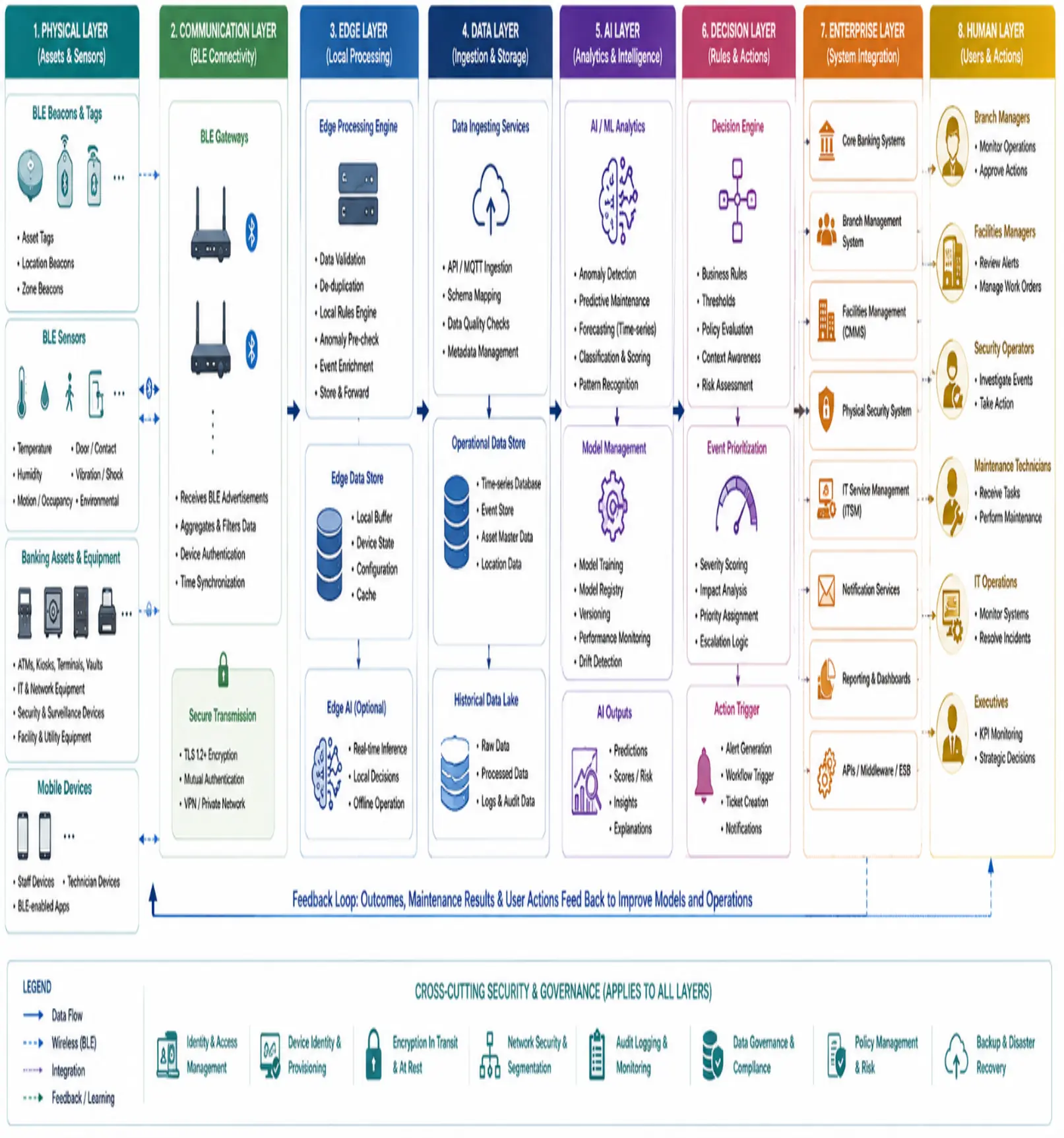
The diagram shows the complete path from physical banking assets and BLE sensors through BLE gateways, secure networks, edge processing, data ingestion, AI analytics, decision rules, enterprise software, and operational personnel, with feedback loops for continuous improvement.
BLE Hardware and AI Software for Banking Operations
BLE hardware serves as the physical data collection layer for banking operations. The specific hardware configuration should be selected according to the required coverage, asset type, location accuracy, battery life, environmental conditions, security requirements, and integration requirements.
BLE Beacons and Asset Tags
BLE beacons can transmit identifiers that allow nearby gateways or authorized devices to determine the presence or proximity of tagged assets. Battery-powered tags can be attached to portable equipment, while fixed beacons can help define locations or zones.
Banking deployments should consider:
- Battery life and replacement schedules
- Transmission interval
- Physical mounting method
- Radio coverage
- Asset movement patterns
- Required location accuracy
- Tamper considerations
- Environmental conditions
BLE Sensors
BLE sensors extend the system beyond identification and proximity. Depending on the device, sensors can capture environmental or physical conditions such as temperature, humidity, motion, acceleration, or other supported measurements.
Sensor selection should be based on the actual operational decision that the data must support. Collecting measurements without a defined operational purpose increases data volume without necessarily improving banking operations.
BLE Gateways
BLE gateways receive data from nearby BLE devices and transfer it to edge software, servers, or cloud services. Gateway placement affects coverage, latency, battery behavior, and location accuracy.
For branches and banking facilities, gateway locations should account for walls, equipment rooms, floor layouts, radio interference, and the expected movement of tagged assets. A site survey is often necessary before final installation.
GAO provides BLE hardware and IoT technologies that can be incorporated into asset monitoring, sensor data collection, and location-aware operational systems.
Cloud and Server Deployment for Banking Operations
Cloud Version
A cloud-hosted implementation can centralize data ingestion, AI processing, dashboards, device management, and analytics across multiple branches or facilities. This model can be appropriate when banking organizations need centralized visibility and scalable computing resources.
Cloud deployment should still address:
- Data residency requirements
- Encryption in transit and at rest
- Identity and access management
- Network segmentation
- API security
- Audit logging
- Retention policies
- Model governance
- Availability requirements
- Integration with existing banking systems
AI processing can occur centrally when the application does not require immediate local decisions and connectivity is sufficiently reliable.
Server Version
A privately hosted server deployment can place application software on customer-managed servers, private data centers, edge servers, or other controlled enterprise infrastructure. This approach can be useful where banking organizations require greater control over data processing, network connectivity, integration boundaries, or operational policies.
Server-based deployment can also support edge processing close to branches or facilities. Time-sensitive events can be evaluated locally before selected information is forwarded to centralized systems.
A hybrid implementation can combine local edge processing with centralized server or cloud analytics. The appropriate choice depends on security policy, latency requirements, branch connectivity, data governance, scale, and the existing IT environment.
Security and Integration Considerations
Security must be considered across the entire data path, from BLE devices to gateways, networks, AI software, databases, and connected banking systems. BLE connectivity alone does not establish an appropriate security model for a banking deployment.
Engineering teams should evaluate:
- Device identity and provisioning
- Secure gateway configuration
- Network segmentation
- Encryption
- Role-based access control
- API authentication and authorization
- Audit logging
- Firmware management
- Vulnerability management
- Data retention
- Incident response
- Physical protection of gateways and sensors
- Secure integration with existing banking software
BLE events should also be correlated with authoritative systems where identity or authorization is important. For example, a BLE asset-location event should not independently authorize access to a restricted banking area.
GAO’s technology experience spans BLE, RFID, and IoT products and systems, with R&D, quality assurance, and technical support intended to support deployments that require reliable hardware and engineering assistance. GAO serves organizations in the United States and Canada, including Fortune 500 companies, research organizations, universities, and government agencies.
Defense-in-Depth Security for AI-Enabled Banking Operations
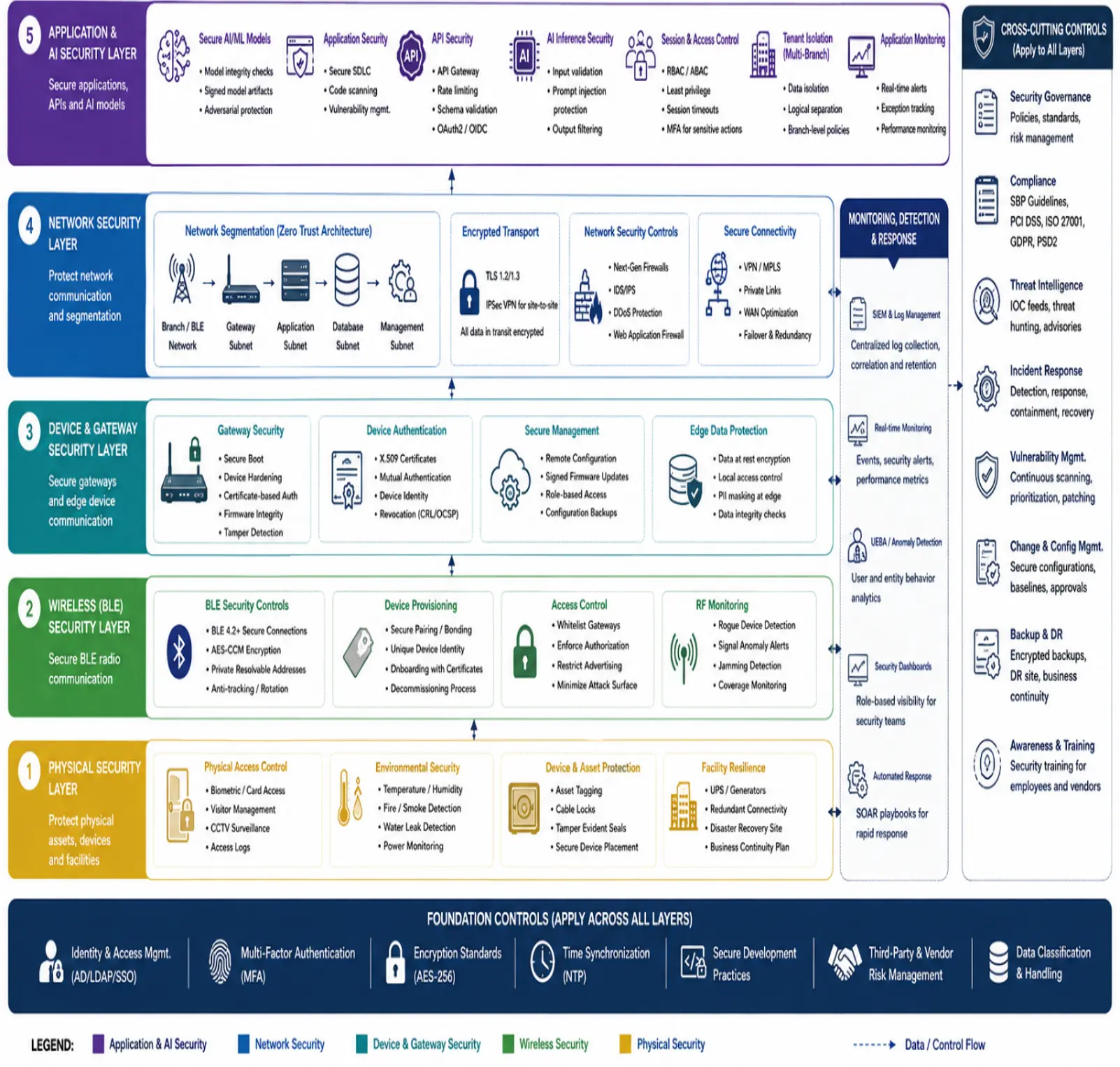
The diagram illustrates layered cybersecurity controls across physical banking infrastructure, BLE devices, gateways, networks, applications, AI systems, data, monitoring, and governance.
Practical Engineering Considerations for Banking Deployments
A successful deployment depends on more than selecting BLE hardware and an AI model. Banking environments require careful planning around physical coverage, operational processes, existing software, security controls, and long-term maintenance.
Key engineering considerations include:
- Define the operational decision first:Determine what action the system must improve before selecting sensors or AI models.
- Perform a radio site survey:Evaluate walls, floors, equipment, interference, gateway locations, and required coverage.
- Establish data quality controls:Handle duplicate readings, missing data, timestamp inconsistencies, device failures, and unexpected sensor values.
- Start with measurable use cases:Asset tracking, environmental monitoring, predictive maintenance, and anomaly detection can each have different technical requirements.
- Integrate with existing workflows:AI alerts become more useful when connected to established maintenance, security, facilities, and IT service processes.
- Use human validation for consequential decisions:AI should support authorized banking personnel rather than bypass established controls.
- Monitor model performance:Changes in branch layouts, equipment, operating schedules, or device behavior can affect model accuracy.
- Plan lifecycle management:Include battery replacement, firmware updates, gateway maintenance, sensor calibration, cybersecurity reviews, and model retraining where required.
GAO can support organizations that need BLE and IoT hardware products and systems as part of these deployment requirements, including engineering support for organizations operating distributed physical environments.
Banking Operations AI and BLE Deployment Priorities
The strongest business case for AI-enabled BLE in banking operations comes from connecting physical operational events to measurable improvements in asset visibility, maintenance response, environmental control, security monitoring, and service efficiency. BLE provides the operational data source, while AI provides methods for detecting patterns and prioritizing decisions.
Banking organizations should begin with a defined operational problem, establish measurable KPIs, validate the BLE coverage and data quality, integrate the solution with existing workflows, and then expand to additional branches or facilities after the initial deployment demonstrates reliable results.
AI Capabilities That Improve Banking Operations
AI adds value to BLE-enabled banking operations when it converts large volumes of physical-world events into prioritized operational information. The objective is not simply to increase the number of connected devices. The objective is to improve how banking teams understand assets, facilities, equipment conditions, and operational exceptions.
Machine learning models can establish normal behavior from historical operational data. Anomaly detection can then identify events that differ significantly from expected patterns. Time-series models can evaluate environmental or equipment measurements over time, while classification models can categorize operational events according to predefined conditions.
For banking operations, these capabilities can improve:
- Asset visibility by identifying unusual movement, prolonged inactivity, or unexpected location changes.
- Maintenance planning by identifying developing equipment or environmental problems.
- Branch operations by detecting unusual occupancy or operational conditions.
- Security monitoring by correlating physical events with authorized operational activities.
- Facilities management by analyzing environmental conditions and equipment behavior.
- Service management by prioritizing incidents according to severity and operational context.
- Resource utilization by identifying underused or frequently moved operational assets.
- Operational reporting by converting raw sensor events into meaningful performance indicators.
AI should remain explainable enough for operational teams to understand why an event was prioritized. A maintenance technician, branch manager, or security operator should be able to identify the underlying asset, location, timestamp, sensor information, and relevant historical context rather than receiving an unexplained prediction.
Operational KPIs for AI-Enabled Banking Systems
A banking deployment should establish measurable KPIs before expanding beyond an initial proof of concept. The appropriate metrics depend on the use case, but several measurements are particularly relevant.
| Operational Area | Example KPI | Measurement Objective |
| Asset management | Asset location accuracy | Determine whether tagged assets are identified in the correct area |
| Asset utilization | Asset utilization rate | Identify equipment that is underused or unavailable |
| Maintenance | Mean time to repair | Measure how quickly operational problems are resolved |
| Maintenance | Unplanned equipment incidents | Track unexpected failures or service events |
| AI monitoring | False-alert rate | Determine whether AI-generated alerts are operationally useful |
| Environmental monitoring | Threshold violations | Measure abnormal environmental conditions |
| Security | Unrecognized movement events | Identify unexpected asset or equipment movement |
| Operations | Incident response time | Measure the time from event detection to operational response |
| Network | Gateway availability | Verify reliable BLE data collection |
| Device management | Sensor availability | Measure whether deployed sensors are functioning |
| Financial operations | Cost per monitored location | Evaluate deployment and operating efficiency |
These KPIs can also become training and validation criteria for AI models. For example, reducing false alerts may be more important than maximizing the raw number of detected events. Similarly, a predictive-maintenance model should be evaluated against actual maintenance outcomes rather than only statistical model accuracy.
Scaling AI and BLE Across Banking Facilities
Scaling from one branch or facility to a larger banking network introduces additional engineering requirements. Device provisioning, gateway configuration, network management, data normalization, software integration, cybersecurity, and operational support become increasingly important as deployment size grows.
A scalable deployment should establish standardized procedures for:
- BLE device registration and identification
- Gateway installation and configuration
- Asset-to-device association
- Sensor calibration and testing
- Network configuration
- Software updates
- Battery replacement
- Fault detection
- Data retention
- AI model monitoring
- Incident escalation
- Security review
- Decommissioning and device retirement
Branches may have different physical layouts, building materials, network configurations, operating hours, and equipment inventories. A deployment that performs well in one location should therefore be validated against the conditions of additional facilities rather than assuming identical performance everywhere.
AI models can also experience operational drift. A change in branch layout, gateway position, asset movement behavior, equipment replacement, or operating schedule may alter the data distribution used by the model. Monitoring should therefore cover both device health and model performance.
Scaling AI and BLE Across Banking Branches
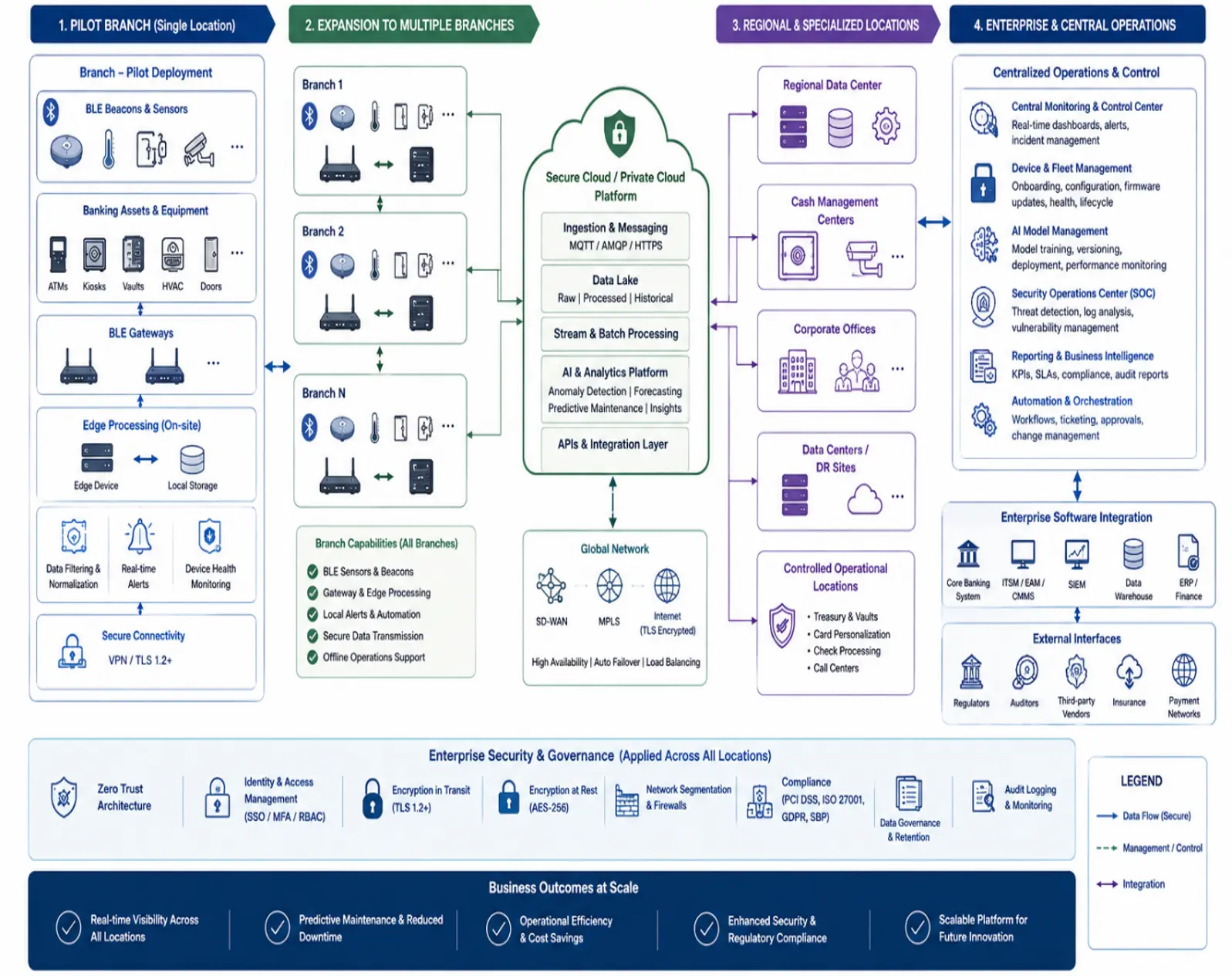
The diagram illustrates how an AI and BLE banking solution can scale from a pilot branch to multiple branches, regional facilities, specialized locations, and centralized enterprise operations with centralized monitoring, device management, AI model management, cybersecurity, and enterprise software integration.
Integration with Banking and Operational Software
BLE and AI systems deliver greater operational value when they exchange information with existing software rather than creating another isolated source of alerts.
Relevant integration points may include:
- Asset management systems
- Computerized maintenance management systems
- Facilities management software
- IT service management systems
- Physical access-control systems
- Security information systems
- Building management systems
- Enterprise resource planning systems
- Operational dashboards
- Notification and incident-management systems
- Identity and access-management services
Application programming interfaces can transfer structured events between the AI system and operational applications. Middleware can normalize information from different BLE devices and convert device-specific messages into consistent operational records.
For example, an AI system might identify abnormal environmental behavior around an equipment area. Instead of sending only a generic notification, the integration layer can associate the event with a specific facility, equipment identifier, location, maintenance history, and responsible team. The resulting service event becomes more actionable.
Integration design should also consider failure behavior. If an external banking application becomes temporarily unavailable, the BLE and AI system should have a defined method for buffering events, retrying delivery, recording failures, and preventing duplicate transactions.
AI Model Selection for Banking Operations
Different banking operational problems require different AI approaches. Selecting a model should follow the available data and required decision rather than starting with a specific AI technology.
Anomaly Detection
Anomaly detection is useful when the system has examples of normal behavior but relatively few examples of failures or security incidents. Models can evaluate deviations in sensor readings, asset movement patterns, occupancy behavior, or equipment activity.
This approach can be particularly useful for identifying previously unknown operational conditions.
Time-Series Forecasting
Time-series models analyze measurements collected over time. Banking facilities can use forecasting to estimate expected environmental conditions or equipment behavior and identify deviations from expected trends.
The model should account for factors such as operating hours, seasonal changes, maintenance activity, and facility-specific behavior.
Classification Models
Classification models can categorize events into operational classes such as normal, warning, maintenance required, or critical. Training data should be representative of the actual banking environment and reviewed for labeling quality.
Predictive Models
Predictive models can estimate the likelihood of a future operational condition based on historical observations. Predictive maintenance is one example, but similar approaches can support asset utilization and facilities-management decisions.
Edge AI
Edge AI can process selected information close to the source. This can reduce communication latency and minimize the amount of raw operational data transmitted to centralized systems.
For banking environments, edge processing can be useful when local decisions must continue during temporary network disruptions or when data-processing policies favor local handling.
Deployment, Commissioning, and Testing
Successful deployment requires controlled commissioning rather than simply installing BLE devices and activating software.
A practical implementation process should include:
- Requirements definition:Identify the operational problem, users, assets, facilities, KPIs, and expected decisions.
- Site assessment:Evaluate building layouts, radio propagation, gateway positions, network connectivity, and physical installation constraints.
- Hardware selection:Select beacons, sensors, and gateways according to operational requirements.
- Pilot deployment:Install a limited number of devices in a representative banking environment.
- Data validation:Verify device identity, timestamps, measurements, gateway reception, and event delivery.
- AI validation:Compare model outputs with known operational conditions and historical records.
- Integration testing:Confirm that events reach maintenance, security, facilities, or IT systems correctly.
- Security testing:Validate authentication, authorization, encryption, logging, network segmentation, and device-management procedures.
- Operational acceptance testing:Have actual banking operations personnel evaluate whether alerts and dashboards support their workflows.
- Performance monitoring:Measure reliability, latency, false alerts, device availability, and operational outcomes.
- Controlled expansion:Extend the deployment only after the initial environment demonstrates acceptable performance.
Commissioning documentation should record device identifiers, installation locations, gateway relationships, network configuration, software versions, test results, and responsible personnel. This information becomes important for future maintenance and troubleshooting.
AI and BLE Banking Deployment Lifecycle
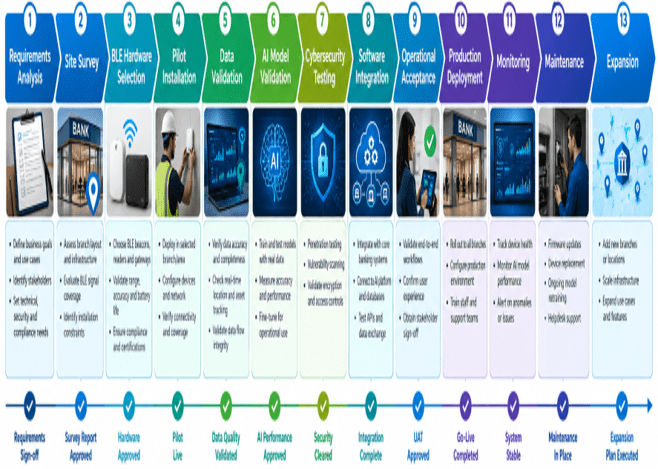
The lifecycle shows the engineering stages required to move an AI and BLE banking solution from requirements definition through validated production operation.
Maintenance and Lifecycle Management
BLE deployments contain physical devices that require ongoing management. Battery-powered beacons and sensors have finite operating lives, while gateways and software require configuration, firmware, security, and performance maintenance.
A lifecycle management process should monitor:
- Battery condition
- Device connectivity
- Gateway availability
- Sensor health
- Firmware versions
- Calibration requirements
- Physical damage
- Device replacement
- Network changes
- Software dependencies
- AI model performance
- Security vulnerabilities
- Integration failures
Maintenance records should be connected to asset identifiers whenever practical. This creates a relationship between the physical device, the monitored asset, the operational location, and the service history.
AI can also assist lifecycle management by identifying devices whose behavior differs from expected operating patterns. A sensor that repeatedly stops communicating, for example, may require investigation before the device becomes completely unavailable.
Cybersecurity, Privacy, and Governance
Banking operations require careful governance of data generated by connected devices. Even when BLE data does not contain customer financial information, location and operational information can still be sensitive.
Data governance should define:
- What data is collected
- Why the data is collected
- Which personnel can access it
- How long it is retained
- Where it is processed
- How it is transmitted
- Which applications can consume it
- How operational events are audited
- How devices are removed from service
BLE identifiers should not automatically be treated as anonymous. Depending on deployment design, repeated identifiers can potentially reveal movement patterns or operational behavior. Appropriate access controls, identifier management, retention policies, and data minimization should therefore be considered.
AI governance is also important. Model outputs should be monitored for reliability, unexpected behavior, and changes in operating conditions. High-impact operational decisions should retain appropriate human oversight and established authorization procedures.
Business Value of AI-Enabled Banking Operations
The business value of AI and BLE becomes measurable when physical operational information improves a banking process.
Potential outcomes include:
- Reduced time spent locating operational assets
- Faster maintenance response
- Earlier detection of environmental problems
- Better equipment utilization
- Reduced unnecessary service visits
- More consistent branch operational monitoring
- Improved visibility into distributed assets
- Better prioritization of operational incidents
- More structured maintenance information
- Improved coordination between branch, facilities, IT, and security teams
The economic case should account for the complete lifecycle rather than hardware acquisition alone. Deployment costs can include site surveys, installation, gateway infrastructure, software integration, network configuration, battery replacement, device management, cybersecurity controls, maintenance, and AI model operations.
A well-defined pilot can help determine whether the expected operational improvements justify broader deployment.
GAO’s Role in BLE and IoT Banking Solutions
GAO provides BLE, RFID, and IoT hardware products and systems that can serve as components in connected operational solutions. Its technical focus includes wireless identification, sensing, asset monitoring, gateways, and related IoT technologies that can support physical operational data collection.
GAO is headquartered in New York City and Toronto, Canada, and is positioned among the leading B2B and B2G BLE and RFID suppliers. GAO and its sister companies, GAO Research and GAO Tek, operate as part of GAO Group, serving organizations across the United States and Canada.
The group has spent approximately three decades developing and supplying technology products and systems, with customers including Fortune 500 companies, R&D organizations, universities, and government agencies. Its operations include R&D investment, quality-assurance processes, and remote or onsite technical support.
For banking operations teams, this experience is relevant when BLE hardware must be incorporated into a larger system involving asset identification, environmental sensing, location information, gateways, AI analytics, and enterprise software integration.
Implementation Recommendations for Banking Operations
Banking organizations considering AI-enabled BLE should approach deployment as an operational improvement project rather than a standalone wireless technology project.
Recommended practices include:
- Define the banking operations problem before selecting hardware.
- Identify the assets, locations, users, and decisions involved.
- Establish measurable KPIs for the pilot.
- Perform a physical and RF site assessment.
- Select BLE devices according to battery, coverage, environmental, and accuracy requirements.
- Validate data quality before developing complex AI models.
- Start with interpretable analytics where operational data is limited.
- Integrate AI events with existing maintenance, facilities, security, and IT workflows.
- Apply defense-in-depth cybersecurity controls.
- Establish device and battery lifecycle procedures.
- Monitor false positives and false negatives.
- Maintain human oversight for consequential operational decisions.
- Validate model performance after changes to facilities or operating procedures.
- Document installation and commissioning information.
- Expand gradually after measurable operational benefits are demonstrated.
Key Takeaways for AI and BLE in Banking Operations
AI-enabled banking operations can connect physical assets and facilities with data-driven decision-making. BLE beacons, sensors, and gateways provide useful operational signals, while AI can analyze those signals to identify anomalies, predict conditions, prioritize incidents, and improve maintenance and asset-management processes.
The most effective implementations focus on specific banking operational problems such as asset visibility, environmental monitoring, predictive maintenance, branch monitoring, and physical security support. Successful deployments also require secure integration with existing systems, reliable device management, careful site planning, measurable KPIs, and ongoing model and hardware lifecycle management.
GAO’s BLE, RFID, and IoT technologies can support organizations developing these connected operational systems. Banking technology teams can evaluate the available hardware and system options based on their specific facility, asset, security, connectivity, and integration requirements.
Decision tree for selecting AI and BLE banking operations.
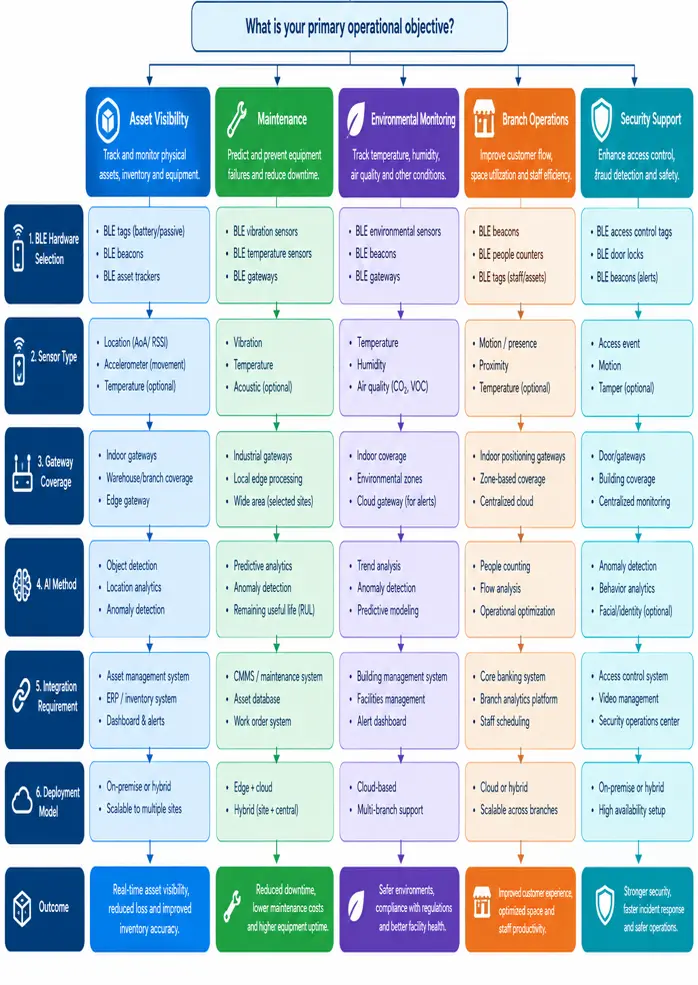
The decision tree helps banking operations teams connect operational objectives with appropriate BLE devices, AI methods, integrations, and deployment approaches.
Building the Future of Industrial AI and IoT with Aperture Venture Studio and GAO RFID Inc.
For more than three decades, GAO Group of Companies has invested heavily in R&D for industrial BLE, RFID, and IoT. As generative AI has become increasingly useful for industrial and operational applications, we have expanded our work across AI and IoT technologies, including BLE and RFID, and established Aperture Venture Studio to support the development and scaling of AI and IoT solutions relevant to operational environments such as banking facilities and financial infrastructure.
Aperture has attracted AI and IoT technical experts, entrepreneurial and operational executives, investors, and leading companies. We have also developed Aperture Ventures Summit and TekSummit to discuss advanced AI and IoT topics.
These activities contribute to technical communities focused on practical AI and IoT applications.
We welcome participation as:
- Advisors, co-founders, or employees
- Investors
- Customers