
AI and BLE for Gene Therapy Facilities: Intelligent Monitoring, Asset Tracking, and Operational Control
AI and BLE for Biomedical Research: From Laboratory Data to Research Decisions
AI for biomedical research uses machine learning, analytics, sensor data, and connected research assets to improve how laboratories capture, correlate, monitor, and interpret operational data. BLE gateways, BLE beacons, and BLE sensors provide a practical data acquisition layer for locating samples and equipment, monitoring environmental conditions, tracking personnel or study materials, and collecting time-series measurements.
The value extends beyond asset visibility. Biomedical research organizations can combine BLE-generated location, temperature, humidity, motion, proximity, and equipment-state data with laboratory information management systems (LIMS), electronic laboratory notebooks (ELN), electronic data capture (EDC), research databases, and analytics software. AI can then identify abnormal conditions, predict operational risks, detect deviations, and support research workflow decisions. For organizations managing complex laboratories, biobanks, animal research facilities, clinical research environments, and translational research programs, this combination can improve traceability, data quality, resource utilization, environmental control, and research reproducibility.
GAO provides BLE, RFID, and IoT hardware products and systems that can serve as data acquisition components within these biomedical research workflows.
Biomedical Research AI and BLE System Overview
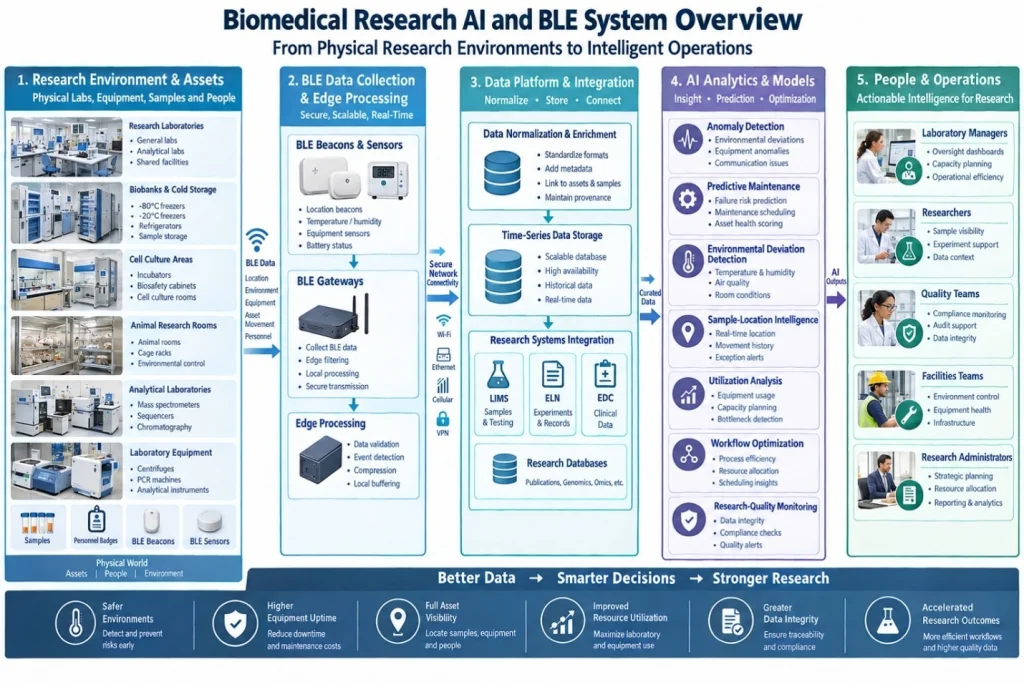
This technical system diagram illustrates how BLE beacons, sensors, and gateways collect data from biomedical research environments and move it through edge processing, secure connectivity, data integration, and AI analytics. It shows connections with LIMS, ELN, EDC, research databases, and key AI functions such as anomaly detection, predictive maintenance, environmental monitoring, sample-location intelligence, and workflow optimization.
Why AI Matters in Modern Biomedical Research Operations
Biomedical research generates highly heterogeneous data. A single research program can involve biospecimens, experimental protocols, instrument outputs, environmental measurements, freezer conditions, study subjects, reagents, laboratory consumables, equipment maintenance records, and researcher activities. Much of this information originates in separate systems or remains associated with physical objects rather than connected digital records.
BLE can provide continuous or event-driven observations from physical research environments, but connectivity alone does not create research intelligence. AI becomes valuable when these observations are correlated with experimental context and operational records.
For example, a temperature excursion in a conventional monitoring system may simply generate an alarm. An AI-enabled system can evaluate the duration and severity of the excursion, compare it with historical patterns, identify the affected storage area, correlate the event with access or equipment activity, and prioritize the event for investigation. Similar analysis can be applied to freezer utilization, incubator behavior, laboratory equipment downtime, sample movement, and environmental stability.
The objective is not to replace scientific judgment. The objective is to give researchers and laboratory operations teams better evidence for decisions.
Biomedical Research Problems That AI Can Address
- Sample traceability: AI can correlate BLE location events with sample identifiers, storage zones, transfer activities, and laboratory workflows to identify unusual movement patterns or missing-location records.
- Cold-chain and environmental monitoring: BLE sensors can capture temperature, humidity, and related conditions around freezers, refrigerators, incubators, storage rooms, and experimental areas. AI can distinguish persistent drift from isolated measurement noise.
- Research equipment utilization: Location and sensor events can reveal whether high-value instruments are idle, heavily utilized, moved between rooms, or associated with recurring operational interruptions.
- Predictive equipment maintenance: Sensor trends and equipment activity can provide signals for detecting abnormal operating behavior before a failure interrupts an experiment.
- Laboratory workflow optimization: AI can analyze movement patterns and equipment utilization to identify bottlenecks in sample preparation, analysis, storage, and transfer processes.
- Environmental deviation detection: Machine learning models can establish normal operating patterns for controlled research environments and flag unusual conditions.
- Research data quality: Contextual sensor data can strengthen the metadata surrounding experiments, particularly when environmental conditions influence sample or experimental integrity.
NIH’s current Data Management and Sharing requirements reinforce the importance of appropriate data management, metadata, preservation, interoperability, and responsible sharing for applicable NIH-funded or conducted research. The updated 2026 DMS Plan format also emphasizes appropriate standards and data management practices.
High-Value AI Applications Across Biomedical Research
AI and BLE are particularly useful when a biomedical research process contains physical assets or environmental variables that change over time. The strongest applications therefore connect physical research activities with digital records rather than treating BLE as an isolated tracking technology.
Biobanking and Biospecimen Management
Biobanks manage large numbers of biological specimens under controlled storage conditions. Samples may move between accessioning areas, processing laboratories, freezers, temporary staging areas, analytical laboratories, and long-term storage.
BLE-enabled location sensing can provide additional visibility into these movements. AI can analyze movement histories, storage occupancy, retrieval frequency, and environmental observations to identify unusual patterns.
Important engineering considerations include:
- Sample-level identification should remain linked to the organization’s authoritative identifier rather than relying on BLE device identifiers alone.
- BLE location data should be treated as an observation with time, gateway, signal characteristics, and confidence rather than as an absolute coordinate.
- Temperature monitoring should use appropriately calibrated sensors when measurements affect sample integrity or regulated processes.
- AI-generated alerts should remain distinguishable from validated laboratory records and quality events.
- Storage capacity models should account for freezer type, rack or box structure, sample categories, access frequency, and retention requirements.
GAO BLE hardware can contribute the sensing and proximity layer while laboratory software remains the system of record for specimen identity and research information.
Cell Culture and Controlled Laboratory Environments
Cell culture research depends on controlled temperature, humidity, CO₂ concentration, equipment operation, and disciplined handling procedures. Incubators, biosafety cabinets, refrigerators, freezers, microscopes, centrifuges, and other equipment may be shared across research teams.
AI can correlate environmental measurements and equipment usage with operational events. For example, repeated environmental deviations around an incubator can be compared against access frequency, door-open events, equipment activity, and historical measurements.
This creates opportunities for:
- Detecting recurring environmental instability
- Identifying equipment behavior associated with deviations
- Monitoring utilization of shared research equipment
- Detecting unusual access or movement patterns
- Supporting root-cause investigations
- Prioritizing maintenance activities
- Improving scheduling of shared laboratory resources
The engineering objective is to preserve the scientific context surrounding each observation. A temperature reading without its sensor identity, timestamp, location, calibration information, and relevant experimental context has limited analytical value.
Animal Research and Preclinical Studies
Preclinical research environments introduce additional requirements because research activities may involve controlled rooms, animal housing areas, specialized equipment, environmental monitoring, and study-specific operational procedures.
BLE can provide non-invasive proximity and location observations for selected assets, equipment, environmental sensors, and authorized personnel. AI can analyze environmental trends, room utilization, equipment activity, and operational events without treating location data as a substitute for validated study records.
Privacy and access controls are particularly important where human personnel movement is monitored. Research organizations should define whether location information is being used for safety, workflow optimization, security, facility management, or another legitimate operational purpose and should establish appropriate retention and access rules.
Pharmaceutical and Translational Research Laboratories
Translational research frequently connects laboratory research with development activities, analytical testing, sample management, and clinical research processes. Data may cross LIMS, ELN, EDC, laboratory instruments, research databases, and quality systems.
AI can help identify relationships across these datasets while BLE supplies additional physical-world context such as equipment location, sample movement, storage conditions, and laboratory activity.
For regulated workflows, electronic records generated or used in applicable FDA-regulated processes may fall within the scope of 21 CFR Part 11. FDA guidance addresses electronic records and electronic signatures when they are maintained or submitted under applicable regulatory requirements.
This distinction is important: adding BLE and AI to a research workflow does not automatically make the resulting system compliant. Validation, access control, auditability, data integrity, record retention, change control, and intended use must be evaluated according to the specific research and regulatory context.
AI Use-Case Map for Biomedical Research
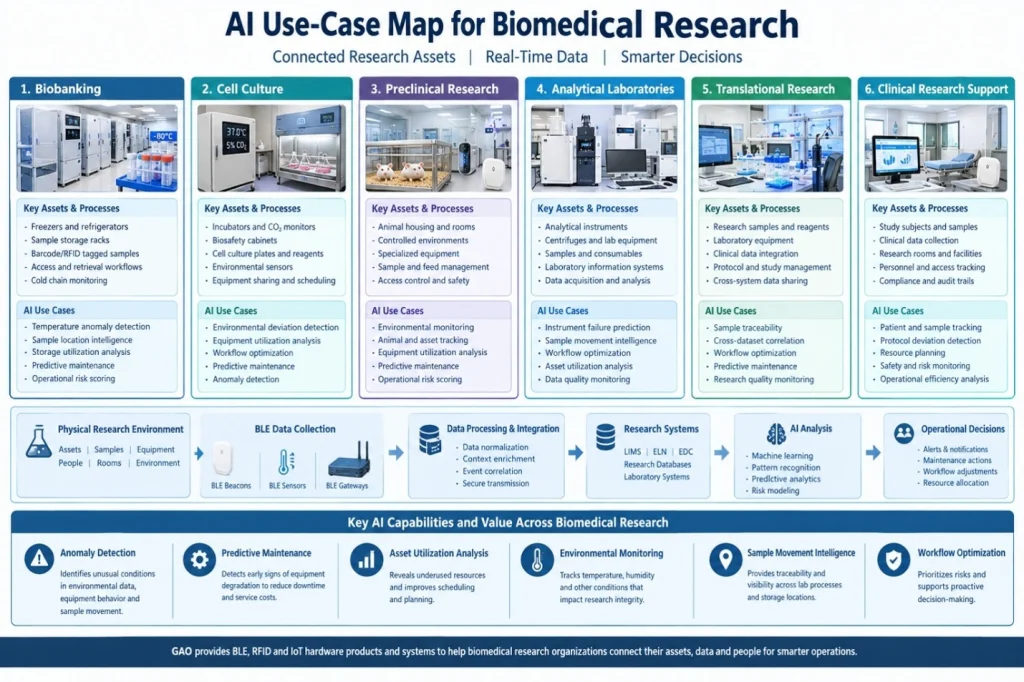
This infographic maps AI applications across biobanking, cell culture, preclinical research, analytical laboratories, translational research, and clinical research support. It connects biomedical research assets and workflows with BLE data collection, research systems, AI analytics, and operational decisions, highlighting anomaly detection, predictive maintenance, environmental monitoring, sample intelligence, and workflow optimization.
From Research Activity to AI-Assisted Decision
A practical biomedical research solution should follow a controlled data path from physical observation to operational action. The basic workflow is:
- Physical research activity: A sample is moved, an incubator operates, a freezer changes condition, equipment is used, or a researcher accesses a controlled area.
- Data acquisition: BLE sensors, beacons, and other IoT devices capture environmental, proximity, movement, or equipment-related observations.
- BLE communication: Nearby gateways collect BLE advertisements or sensor transmissions and forward relevant observations through the research facility network.
- Edge processing: The gateway or local computing layer can filter duplicates, validate message structure, normalize timestamps, and reduce unnecessary data transmission.
- Data integration: Middleware associates sensor observations with asset identifiers, locations, equipment records, study metadata, and relevant laboratory systems.
- Historical storage: Time-series and event data are retained for trend analysis, investigation, reporting, and model development according to the organization’s data governance requirements.
- AI processing: Machine learning models identify anomalies, trends, correlations, utilization patterns, or predicted events.
- Human review: Researchers, laboratory managers, facilities teams, quality personnel, or maintenance teams review AI-generated findings according to the intended workflow.
- Operational action: The organization may investigate a deviation, inspect equipment, relocate resources, schedule maintenance, review a sample movement, or adjust a laboratory process.
- Feedback: Confirmed outcomes can be used to improve thresholds, rules, training datasets, and model performance.
This workflow separates observation, analysis, and decision-making. That separation is important because an AI prediction should not automatically become a scientific or quality decision without appropriate human review and process controls.
AI-Enabled Biomedical Research Data-to-Decision Workflow
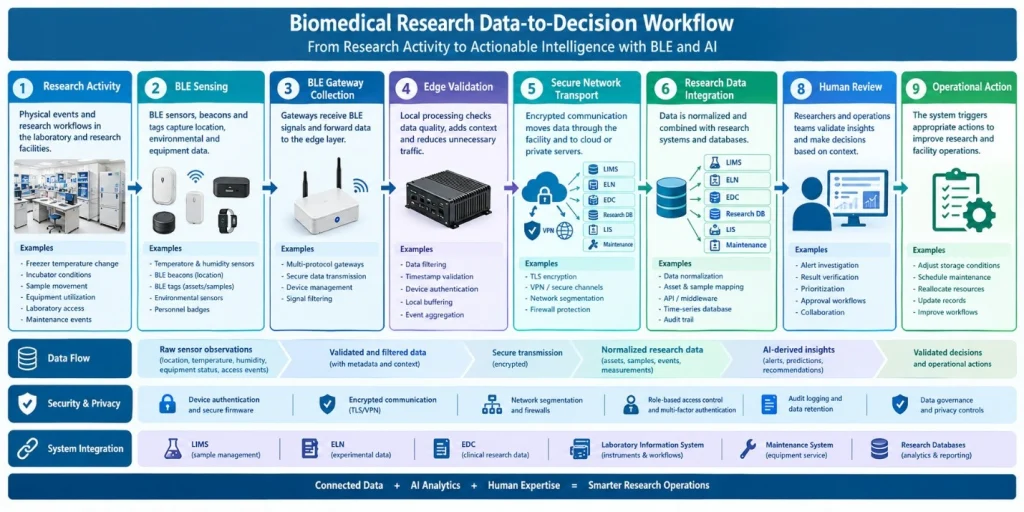
This workflow illustrates how biomedical research data moves from BLE-enabled sensing and gateway collection through edge validation, secure transport, data integration, and AI/ML analysis. It shows how normalized research data and AI-derived insights support human review and operational decisions across laboratory systems.
Operational Challenges in AI-Enabled Biomedical Research
Biomedical research environments create several engineering challenges that must be addressed before AI models are deployed.
Data Context and Identity
A BLE sensor can report a measurement, but the research organization needs to know what the measurement represents. Sensor identity, physical location, calibration status, timestamp, asset relationship, study context, and measurement units should be captured as structured metadata.
This becomes particularly important when the same laboratory contains hundreds of sensors or when equipment and storage locations change.
BLE Location Accuracy
BLE-based positioning is affected by radio propagation, room layout, metal equipment, walls, human presence, gateway placement, transmission power, and environmental conditions. Therefore, a biomedical research implementation should define the required location resolution before selecting the positioning method.
Room-level visibility may be sufficient for equipment utilization, while more granular sample workflows may require additional identification technologies or carefully engineered gateway density.
AI Data Quality
Biomedical research AI is highly dependent on the quality of its training and operational data. Missing timestamps, duplicate events, sensor drift, incorrect asset associations, gateway outages, and inconsistent metadata can produce misleading results.
A useful implementation therefore includes:
- Sensor health monitoring
- Gateway connectivity monitoring
- Timestamp synchronization
- Duplicate-event handling
- Data-quality rules
- Calibration and maintenance metadata
- Asset-to-sensor association controls
- Model input validation
- Historical data retention policies
NIH guidance emphasizes good scientific data management and appropriate metadata because data quality and interoperability support validation, reproducibility, reuse, and responsible sharing.
Human Privacy and Research Governance
BLE systems may observe the movement of researchers, technicians, contractors, or other personnel. Organizations should therefore avoid collecting more location information than is necessary for the stated research or operational purpose.
Where protected health information is involved, the applicable privacy framework must also be considered. HHS guidance explains that the HIPAA Privacy Rule establishes conditions for using or disclosing protected health information for research, while de-identification can support certain uses outside the PHI framework when the regulatory requirements are satisfied.
The technical solution should therefore incorporate role-based access control, encryption, identity management, appropriate retention, audit logging, and data minimization from the beginning rather than adding these controls after deployment.
Engineering Design Priorities for Biomedical Research AI
A successful implementation should begin with the research process rather than the sensor specification. GAO’s BLE hardware and IoT systems can be selected according to the required sensing, identification, connectivity, and environmental-monitoring functions.
Key design questions include:
- What research process requires better visibility?
- Which physical observations are currently missing from LIMS, ELN, EDC, or other systems?
- Is the required location accuracy room-level, zone-level, or more granular?
- Which environmental variables can materially affect research outcomes?
- Which observations require calibrated instrumentation?
- Which data should remain in the laboratory’s authoritative system of record?
- Which AI outputs require human approval?
- What data must be retained for investigation, reproducibility, or regulatory purposes?
- Can the existing network support the required gateway density and data volume?
- Which components require local processing because of latency, connectivity, privacy, or data-residency requirements?
These decisions should be documented before large-scale deployment.
Biomedical Research AI Deployment Decision Tree
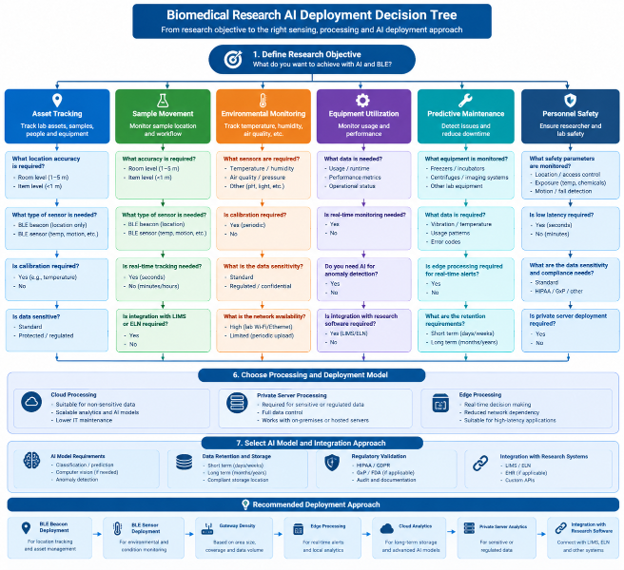
This decision tree guides biomedical research teams from research objectives through sensing, data sensitivity, connectivity, AI model, integration, and deployment decisions. It connects BLE beacons and sensors with gateway density, edge processing, cloud analytics, private servers, and research software integration.
Biomedical Research Systems and Data Integration
BLE should normally operate as one data source within a broader research information environment. A typical deployment can connect BLE gateways to secure network infrastructure and then expose normalized observations to software through APIs, message brokers, databases, or integration middleware.
Common integration targets include:
- LIMS: Sample accessioning, specimen metadata, laboratory workflows, and test records.
- ELN: Experimental documentation, protocols, observations, and research notes.
- EDC: Structured clinical research data collection where applicable.
- Laboratory instrument software: Analytical measurements and equipment status.
- CMMS or maintenance systems: Equipment maintenance history, work orders, and service schedules.
- Identity and access management: Researcher authentication and role-based authorization.
- Data warehouses and research databases: Long-term analysis and cross-study research.
- Analytics and AI software: Machine learning, anomaly detection, forecasting, and operational reporting.
The integration strategy should preserve the distinction between source observations and derived intelligence. A BLE gateway event should remain traceable to its originating device and timestamp, while an AI-generated risk score should retain references to the data and model logic used to produce it.
This approach supports reproducibility and makes troubleshooting easier when researchers question an alert or analytical result.
Cloud Version and Server Version for Biomedical Research
Cloud Version is appropriate when research organizations require centralized analytics across multiple laboratories, sites, or research programs and have policies that permit relevant data to be processed in a cloud environment. Cloud deployment can simplify centralized software maintenance, remote analytics, and scalable data storage.
Server Version is appropriate when organizations require software to operate on customer-managed servers, private data centers, research facility servers, or other privately hosted infrastructure. This model can provide greater control over network boundaries, data location, integration with internal systems, and local operational policies.
The choice should depend on data sensitivity, institutional IT policy, connectivity, latency, integration requirements, research collaboration models, cybersecurity controls, and applicable regulatory obligations rather than assuming one deployment model is universally superior.
For NIH-funded research, data management and sharing requirements should also be incorporated into system planning. NIH’s 2026 guidance states that the DMS Plan format was updated for applications and awards, while the underlying 2023 DMS Policy remains in effect.
Cloud vs. Private Server for Biomedical Research AI and BLE
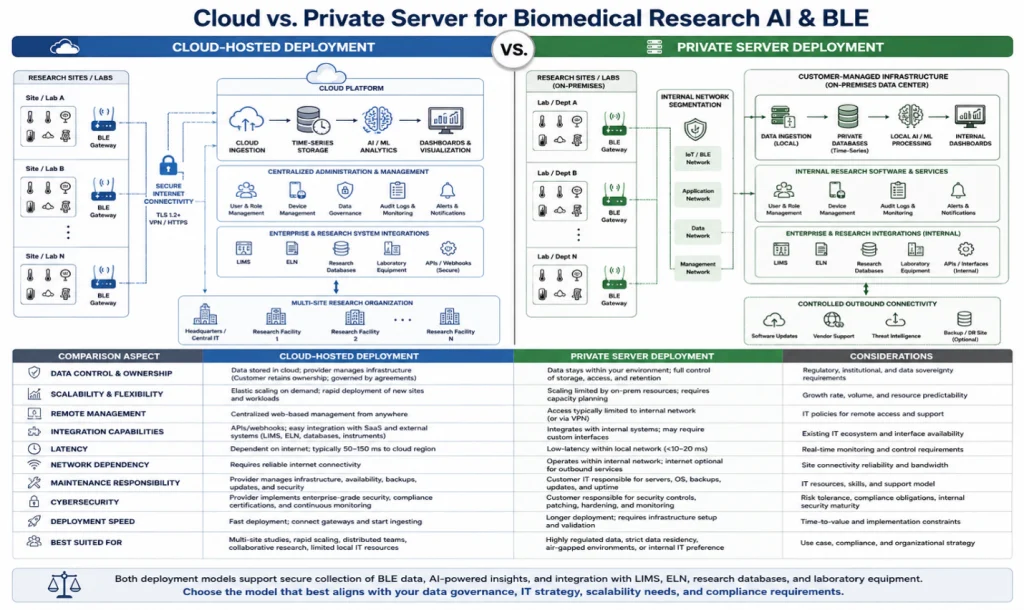
This technical comparison diagram illustrates cloud-hosted and privately hosted architectures for biomedical research AI and BLE systems. It compares data control, scalability, network dependency, latency, cybersecurity, maintenance, integration, and deployment suitability. The key takeaway is that both models support research-system integration, but the optimal choice depends on data governance, IT strategy, scalability, and compliance requirements.
AI Models and Analytics for Biomedical Research
AI methods should be selected according to the research question, available data, and consequences of an incorrect prediction. Biomedical research organizations should not assume that a more complex model automatically produces a better operational result.
Anomaly Detection for Laboratory Conditions
Unsupervised and semi-supervised anomaly detection can establish normal patterns for temperature, humidity, equipment activity, gateway communication, or storage utilization. The model can then identify observations that deviate materially from expected behavior.
This is particularly useful for:
- Freezer and refrigerator temperature trends
- Incubator environmental stability
- Laboratory room conditions
- Equipment operating patterns
- Gateway communication anomalies
- Unusual sample or asset movement
- Unexpected equipment inactivity
An effective system should distinguish between a genuine abnormal condition and a temporary sensor communication problem. Combining sensor-health indicators with the measured variable can substantially reduce false alarms.
Predictive Maintenance for Research Equipment
Predictive maintenance models can analyze equipment operating history, sensor measurements, utilization, maintenance records, and failure events to estimate the likelihood of abnormal operation.
For example, repeated changes in equipment activity combined with increasing temperature variation may justify inspection before a freezer or incubator experiences a major failure. Similarly, unusual utilization patterns around centrifuges, analytical instruments, or other shared equipment can support maintenance prioritization.
AI predictions should be treated as maintenance decision support unless the organization has established and validated an automated control process.
Forecasting and Resource Utilization
Time-series models can forecast freezer occupancy, equipment demand, laboratory room utilization, and expected maintenance requirements. These forecasts can help research managers plan capacity without relying solely on historical averages.
AI can also identify underutilized equipment and recurring scheduling bottlenecks. This is valuable when high-cost research instruments are shared among multiple teams.
Computer Vision and Multimodal AI
Computer vision can complement BLE observations where visual information is relevant. Cameras may support equipment-state recognition, workflow verification, inventory observations, or laboratory safety monitoring where permitted by organizational policies.
A multimodal AI system can potentially combine sensor readings, location events, equipment data, laboratory records, and visual observations. The resulting analysis can provide richer operational context than any individual data source.
However, biomedical research organizations should apply strict controls to camera data, personnel privacy, access permissions, retention, and model governance.
AI Model Stack for Biomedical Research: Data, Analytics, and Decision Layers
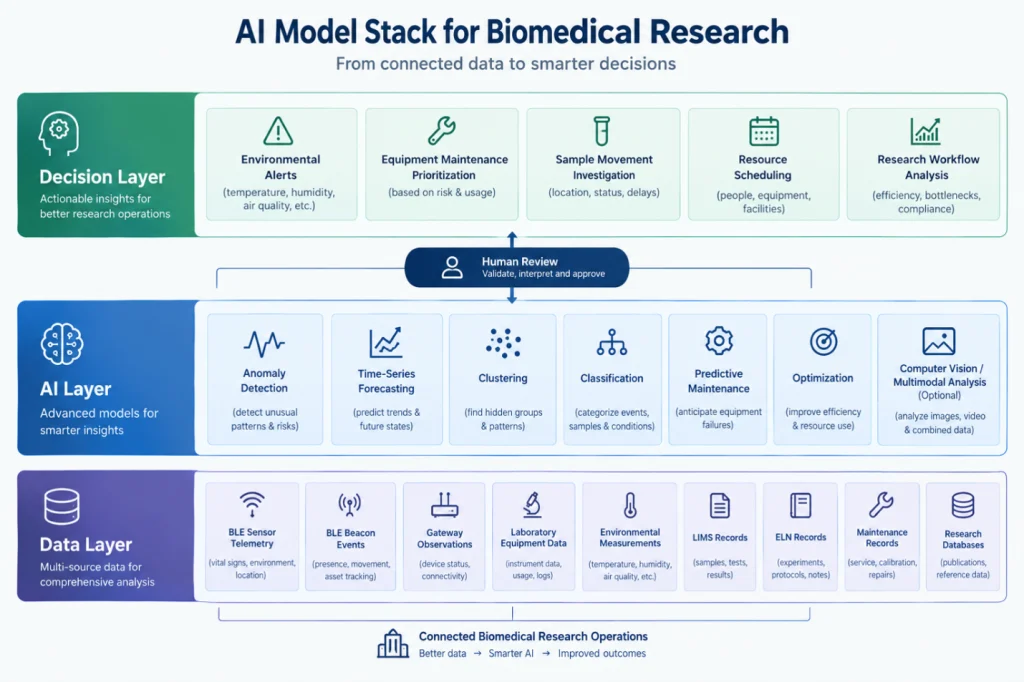
This layered technical diagram shows how biomedical research data—from BLE sensors, laboratory equipment, LIMS, ELN, and research databases—flows into AI models such as anomaly detection, forecasting, classification, and optimization. Human review connects AI-generated insights to operational decisions including environmental alerts, equipment maintenance, sample movement, resource scheduling, and research workflow analysis.
Security and Data Governance for BLE-Enabled Research AI
Biomedical research systems can contain sensitive research information, proprietary experimental data, personnel information, and potentially regulated information. Security therefore has to cover both the physical BLE infrastructure and the software handling research data.
Secure BLE and Gateway Operations
BLE deployments should use appropriate device configuration, authentication mechanisms where supported, controlled gateway enrollment, secure firmware management, and device inventory management.
Gateway security should include:
- Hardened operating configurations
- Strong administrative authentication
- Role-based access control
- Secure credential management
- Firmware and software patching
- Network segmentation
- Encrypted communications
- Gateway health monitoring
- Centralized logging where appropriate
- Controlled physical access
BLE identifiers should not automatically be treated as confidential identities. Organizations should assess whether a beacon or sensor identifier can be correlated with a person, research subject, sample, equipment record, or other sensitive information.
Data Security and Access Control
Research software should separate administrative, laboratory, quality, maintenance, research, and analytical permissions according to organizational requirements.
Security controls can include:
- Encryption in transit and at rest
- Role-based access control
- Multi-factor authentication
- API authentication and authorization
- Audit logging
- Data retention policies
- Backup and recovery controls
- Network segmentation
- Vulnerability management
- Secure software update processes
- Incident response procedures
NIST Cybersecurity Framework 2.0 provides a broad risk-management framework that organizations can use to structure cybersecurity activities around governance, identification, protection, detection, response, and recovery.
The appropriate security baseline should be determined by the research organization’s risk profile and applicable requirements rather than by BLE technology alone.
Data Integrity and AI Governance
AI-generated information should remain distinguishable from source laboratory records. A research organization should be able to determine:
- Which sensor generated the original observation
- When the observation was captured
- Which gateway received it
- Whether the data was transformed or filtered
- Which software processed it
- Which AI model generated the prediction
- What model version was used
- Whether a human reviewed the result
- What operational action followed
This traceability becomes particularly valuable during scientific investigations, quality reviews, system troubleshooting, and model-performance assessments.
Biomedical Research AI Deployment Lifecycle
A technically sound deployment should progress through controlled engineering stages rather than beginning with a large-scale sensor rollout.
Planning and Site Assessment
The first stage identifies the research workflow, physical environment, required measurements, data owners, integration requirements, and expected decisions.
Site surveys should consider laboratory floor plans, freezer and incubator locations, equipment density, walls, metal structures, electromagnetic conditions, gateway placement, network availability, and areas requiring different positioning accuracy.
Hardware Selection and Pilot Deployment
BLE beacons, sensors, and gateways should be selected according to measurement accuracy, battery requirements, environmental conditions, transmission range, installation constraints, and integration requirements.
A pilot should cover representative laboratory conditions rather than an idealized room. Testing should include areas with equipment congestion, cold-storage units, walls, doors, and other physical obstructions.
Commissioning and Validation
Commissioning should verify:
- Device identity
- Sensor readings
- Timestamp accuracy
- Gateway connectivity
- BLE coverage
- Location estimates
- Data transmission
- API or middleware integration
- Alert behavior
- User permissions
- Logging
- Backup and recovery
Environmental sensors that influence research decisions should be evaluated against appropriate reference instruments or calibration procedures.
AI Model Development
Historical data should be examined for missing values, sensor failures, changes in laboratory configuration, maintenance events, seasonal effects, and other conditions that can distort model training.
Models should be evaluated using data that represents actual operational conditions. Where possible, testing should include known historical anomalies and normal operating periods.
Production Optimization
After commissioning, research organizations should monitor model performance, false-positive rates, missed events, gateway availability, battery status, sensor drift, and integration reliability.
Model retraining should follow a controlled process. Changes in laboratory equipment, room configuration, sensor placement, research procedures, or data sources can change the statistical characteristics of the data.
Biomedical Research AI Deployment Lifecycle: From Planning to Continuous Optimization
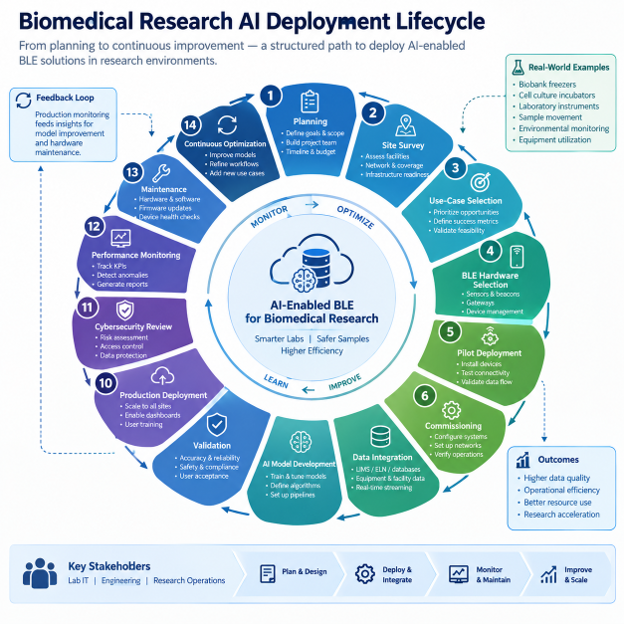
This lifecycle diagram illustrates a practical roadmap for deploying AI-enabled BLE solutions in biomedical research environments. It covers planning, site surveys, hardware selection, pilot deployment, data integration, AI development, validation, cybersecurity, production deployment, monitoring, maintenance, and continuous optimization.
KPIs for AI-Enabled Biomedical Research Operations
Performance should be measured using operational and research-support metrics rather than simply counting connected BLE devices.
Relevant KPIs can include:
- Sample-location exception rate
- Environmental excursion frequency
- Environmental excursion duration
- Mean time to detect environmental deviations
- Mean time to acknowledge alerts
- Mean time to resolve equipment issues
- Freezer and refrigerator utilization
- Research equipment utilization
- Equipment downtime
- Predictive-maintenance precision
- False-positive alert rate
- Missed-event rate
- Sensor availability
- Gateway availability
- Battery replacement frequency
- BLE location accuracy
- Data completeness
- Data latency
- Integration failure rate
- Research workflow cycle time
- Sample retrieval time
- Asset search time
- Laboratory capacity utilization
- Maintenance response time
- AI model drift
- AI prediction accuracy
- Percentage of AI alerts receiving human review
- Percentage of sensor records with complete metadata
- Number of unresolved data-quality exceptions
- Recovery time following gateway or network failure
The most useful KPI set depends on the research process. A biobank may prioritize sample retrieval and environmental integrity, while a shared analytical laboratory may emphasize equipment utilization and downtime.
Interoperability with Biomedical Research Software
Interoperability is critical because BLE data rarely represents the complete research record.
A practical integration design can use APIs, databases, message brokers, or middleware to move normalized observations between the IoT collection layer and research software.
LIMS and ELN Integration
LIMS commonly manages laboratory samples, testing workflows, and associated records, while ELN systems support experimental documentation. BLE observations can supplement these systems with physical-world context.
For example, an LIMS record may identify a biospecimen and its storage location, while BLE observations can provide a time-stamped history of the associated storage area or monitored environmental conditions.
Maintenance and Facility Systems
Equipment activity can be correlated with CMMS records to improve maintenance planning. Gateway and sensor health can also be incorporated into facility operations so that an inactive sensor does not silently create a monitoring gap.
Research Data and Analytics Systems
Normalized sensor events can be exported to data warehouses, research databases, or analytics environments for longitudinal analysis.
Data schemas should retain sufficient metadata to preserve provenance. Important fields may include device identifier, asset identifier, gateway identifier, measurement type, unit, timestamp, location, quality state, and processing status.
Practical Benefits of AI for Biomedical Research
The combination of AI with BLE-enabled sensing can produce several measurable improvements when the implementation is aligned with actual laboratory workflows.
- Better research asset visibility: BLE location observations reduce the effort required to locate mobile equipment and selected research assets.
- Earlier environmental risk detection: AI can identify abnormal temperature or humidity behavior before a condition becomes a significant operational problem.
- Improved sample workflow traceability: Location events can provide additional evidence around sample and container movement.
- Higher equipment utilization: Utilization analysis can expose idle periods and scheduling constraints affecting shared instruments.
- Reduced unplanned downtime: Predictive analytics can identify patterns associated with equipment deterioration.
- Faster investigations: Historical sensor and location data can provide a chronological record for analyzing environmental or operational events.
- Improved data context: Physical-world observations can enrich research records with information that laboratory software may not capture directly.
- Scalable monitoring: Additional laboratories, storage areas, and equipment can be added using repeatable sensing and gateway deployment practices.
- Stronger operational resilience: Continuous monitoring can identify gateway, sensor, network, or equipment problems before they create prolonged visibility gaps.
GAO supplies BLE beacons, BLE sensors, BLE gateways, RFID products, and IoT systems that can support these types of connected biomedical research workflows. The appropriate product configuration depends on the sensing requirement, physical environment, communication range, integration method, and deployment model.
Biomedical Research AI Value Chain: From BLE & IoT Data to Operational Outcomes
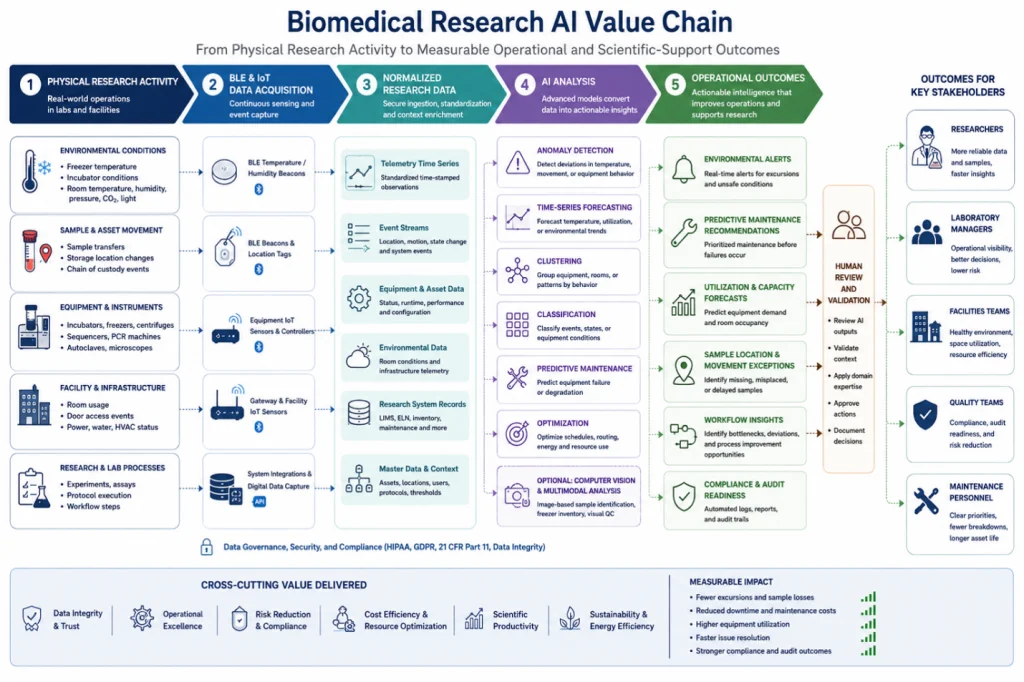
This value-chain infographic shows how physical biomedical research activities become actionable insights through BLE and IoT data acquisition, normalized research data, and AI analysis. It connects AI outputs—including anomaly alerts, predictive maintenance, utilization forecasts, sample-location exceptions, and workflow insights—to human-reviewed operational decisions and measurable outcomes for research and laboratory teams.
Implementation Recommendations for Biomedical Research Organizations
A successful AI and BLE deployment should be designed around the decision that the research organization needs to improve.
Recommended engineering practices include:
- Start with a measurable research or laboratory operations problem rather than deploying sensors without a defined purpose.
- Map the physical workflow before selecting BLE hardware.
- Establish authoritative identifiers for samples, equipment, rooms, and storage locations.
- Conduct an RF site survey before finalizing gateway placement.
- Separate location requirements from environmental monitoring requirements because they may require different sensing configurations.
- Treat sensor data as time-stamped observations with provenance rather than unquestioned truth.
- Integrate BLE observations with LIMS, ELN, maintenance, and research databases where this adds operational context.
- Establish data-quality rules before training AI models.
- Use historical laboratory events to evaluate anomaly-detection and predictive-maintenance models.
- Keep human review in workflows where an AI output could influence sample disposition, research interpretation, quality decisions, or safety.
- Apply cybersecurity and privacy controls during system design rather than after deployment.
- Define cloud versus private server requirements using data governance, connectivity, integration, and institutional IT policies.
- Pilot representative laboratory environments before scaling across research facilities.
- Monitor sensor health and AI performance continuously after commissioning.
- Establish a controlled process for firmware updates, model changes, sensor replacement, and gateway relocation.
- Document assumptions, limitations, model performance, and known failure modes.
GAO Expertise for AI and BLE in Biomedical Research
Headquartered in New York City and Toronto, Canada, GAO is recognized among the leading global B2B and B2G suppliers of BLE and RFID technologies. GAO, together with its sister companies GAO Research and GAO Tek, forms GAO Group, with operations based in New York City and Toronto.
For three decades, GAO Group has served organizations across the United States and Canada, including Fortune 500 companies, leading R&D organizations, universities, and government agencies. Its extensive R&D investment, stringent quality assurance processes, and remote or onsite technical support provide a practical foundation for deploying connected sensing technologies in demanding operational environments.
For biomedical research organizations, that experience is relevant when BLE hardware must operate alongside laboratory equipment, research software, environmental monitoring systems, and other IoT technologies. GAO can provide hardware products and systems that help organizations build the physical data-acquisition layer required for AI-enabled research operations.
Building the Future of Industrial AI and IoT with Aperture Venture Studio and GAO RFID Inc.
For more than three decades, GAO Group of Companies has invested heavily in R&D for industrial BLE, RFID, and IoT. As generative AI became increasingly useful for industrial applications, we expanded our work across AI and IoT technologies, including BLE and RFID, and founded Aperture Venture Studio to build, launch, and scale next-generation AI and IoT companies for various industries. For biomedical research, this work supports the development of practical AI and IoT solutions that connect physical research environments with actionable data.
Aperture has attracted AI and IoT technical experts, entrepreneurial and operational executives, influential investors, and leading companies. We have also developed Aperture Ventures Summit and TekSummit to discuss advanced AI and IoT topics and foster technical communities.
We welcome you to join us as:
- Advisors, co-founders, or employees
- Investors
- Customers
Move from Biomedical Research Data to Actionable Intelligence
AI can turn disconnected laboratory observations into useful operational intelligence when the underlying data is reliable, contextualized, secure, and connected to the systems researchers already use. BLE beacons, sensors, and gateways provide one practical method for capturing physical-world observations, while AI supplies anomaly detection, forecasting, predictive maintenance, and workflow analysis.
The strongest implementations begin with a clearly defined biomedical research problem, establish reliable data and identity relationships, integrate with existing research software, and introduce AI only where it can improve a measurable decision.
GAO can help organizations evaluate BLE hardware, IoT sensing, system integration, deployment requirements, and technical support for AI-enabled biomedical research applications. Explore GAO’s technology solutions and engineering capabilities to determine how connected sensing and AI can support your research environment.