
AI and BLE for Border Management
AI-Driven Border Security and Operational Intelligence for Modern Border Management
Border Management organizations face increasing pressure to strengthen border security, improve situational awareness, accelerate threat detection, manage critical assets, and optimize personnel deployment across vast and complex operational environments. AI-powered border management solutions use Artificial Intelligence of Things (AIoT) technologies, supported by BLE gateways, BLE beacons, and BLE sensors, to provide real-time visibility, predictive intelligence, and operational decision support.
Within Border Management operations, AI transforms large volumes of surveillance, location, personnel, vehicle, infrastructure, and sensor data into actionable intelligence. Border agencies can improve patrol coordination, monitoring of restricted zones, checkpoint operations, cargo inspection workflows, and emergency response activities. BLE-enabled location awareness complements AI analytics by providing valuable contextual data from personnel, vehicles, assets, checkpoints, inspection facilities, command centers, and border infrastructure.
As border security challenges become increasingly dynamic, AI-powered monitoring, tracking, and decision-support systems help agencies improve operational effectiveness, reduce response times, strengthen security controls, and enhance resource utilization across land borders, ports of entry, maritime boundaries, and remote surveillance zones.
GAO has helped organizations implement BLE-enabled IoT solutions that improve operational visibility, asset accountability, and intelligent monitoring across mission-critical environments.
Understanding AI-Powered Border Management Operations
Border Management agencies are responsible for controlling the movement of people, vehicles, cargo, and goods across national boundaries while maintaining security, regulatory compliance, and operational efficiency.
AI-powered border management combines:
- Artificial intelligence
- Machine learning
- Edge AI
- Computer vision
- Sensor networks
- Operational analytics
- IoT-enabled monitoring systems
- BLE-based location awareness technologies
These technologies help agencies move beyond reactive operations toward intelligence-driven border security management.
Why AI Matters in Border Management
Border environments generate significant amounts of operational data from:
- Border checkpoints
- Vehicle inspection lanes
- Customs processing facilities
- Immigration control points
- Surveillance towers
- Patrol vehicles
- Remote monitoring stations
- Maritime monitoring facilities
- Cargo screening systems
- Security operations centers
AI systems analyze this information to identify anomalies, detect operational risks, forecast resource requirements, optimize patrol activities, and support security personnel with faster decision-making.
The Role of BLE in Border Operations
BLE technologies provide location awareness and asset visibility across border facilities and operational zones.
Common applications include:
- Patrol vehicle tracking
- Officer accountability monitoring
- Inspection equipment tracking
- Mobile asset visibility
- Facility occupancy monitoring
- Restricted-area access monitoring
- Evidence storage tracking
- Cargo inspection workflow monitoring
Rather than functioning as a standalone solution, BLE serves as a supporting data source that enhances AI-driven operational intelligence.
Integrated Border Management AI & BLE Operational Ecosystem
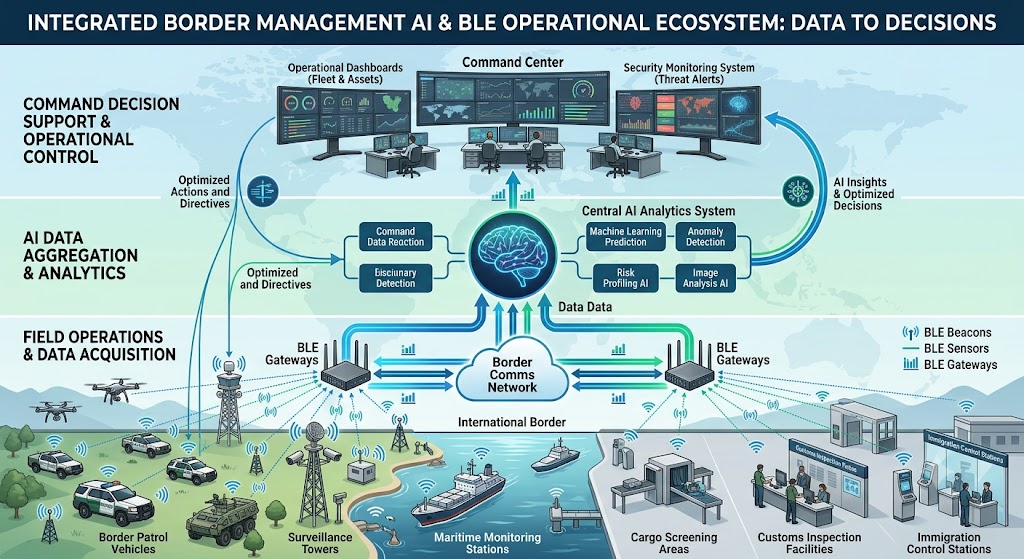
A comprehensive enterprise-grade diagram illustrating the multi-layered data movement from diverse physical field operations—checkpoints, inspection facilities, patrol units, and surveillance assets—via BLE infrastructure to a centralized AI analytics system, powering command dashboards and optimized decision support.
Key AI Applications in Border Management
AI delivers measurable value across multiple Border Management functions.
Intelligent Border Surveillance
AI-powered surveillance systems help identify suspicious activities across border crossings, remote monitoring zones, and restricted areas.
Key functions include:
- Threat detection
- Anomaly identification
- Behavioral analysis
- Perimeter monitoring
- Intrusion detection
- Automated alert generation
Computer vision systems can analyze video streams while AI models evaluate patterns that may indicate security risks.
Personnel Accountability and Workforce Visibility
Border operations involve officers, inspectors, patrol units, customs personnel, canine units, emergency response teams, and support staff operating across large geographic areas.
AI-supported workforce management enables:
- Personnel location awareness
- Shift utilization analysis
- Workforce deployment optimization
- Patrol route evaluation
- Safety monitoring
Asset Tracking and Equipment Readiness
Mission-critical assets must remain available and operational.
Examples include:
- Inspection devices
- Radiation detection equipment
- Mobile scanners
- Surveillance systems
- Patrol vehicles
- Communication devices
- Emergency response equipment
AI helps identify utilization patterns, maintenance requirements, and equipment availability.
Cargo and Inspection Process Optimization
Border agencies inspect large volumes of cargo and commercial shipments.
AI supports:
- Inspection prioritization
- Cargo risk scoring
- Screening optimization
- Resource allocation
- Inspection workflow analysis
Operational bottlenecks can be identified and corrected through continuous monitoring and analytics.
Border Infrastructure Monitoring
Critical border infrastructure requires continuous oversight.
Examples include:
- Security fencing
- Access control systems
- Inspection facilities
- Communications equipment
- Surveillance towers
- Power systems
AI models can identify operational abnormalities and support predictive maintenance planning.
Operational Challenges Addressed by AI-Powered Border Management
Border Management organizations operate within highly complex environments involving security, compliance, logistics, public safety, and international coordination.
Common operational challenges include:
- Limited visibility across remote border regions
- Delayed threat detection
- Resource allocation inefficiencies
- Equipment accountability issues
- Personnel safety concerns
- Communication gaps between facilities
- Inspection bottlenecks
- Infrastructure maintenance challenges
- Cross-agency coordination difficulties
- High operational costs
AI-driven intelligence systems help address these challenges through predictive analytics, automation, and improved situational awareness.
Engineering Considerations for Border Deployments
Successful implementations require consideration of:
- Remote communications coverage
- Environmental conditions
- Infrastructure availability
- Cybersecurity requirements
- Multi-agency interoperability
- Data governance policies
- Scalability requirements
- Disaster recovery planning
Many border environments include deserts, forests, mountains, coastal regions, ports, and remote crossing points that require resilient technology deployments.
Integrated Border Security Challenge & AI Solution Matrix
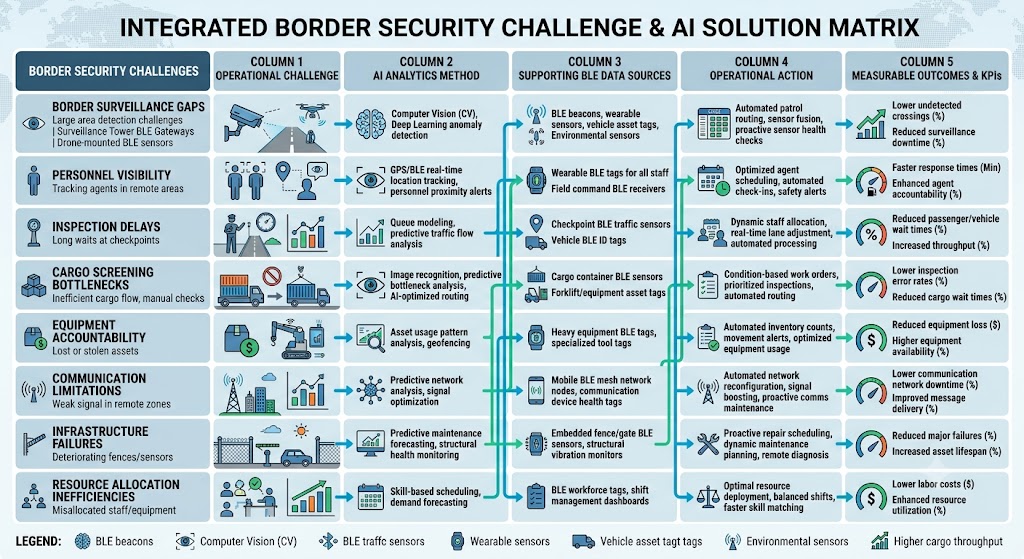
An enterprise solution matrix mapping eight critical border security challenges—including surveillance gaps, screening bottlenecks, and remote communications—to AI analytics methods, supporting BLE data streams, operational actions, and measurable performance KPIs.
Border Management Operational Workflow from Data Collection to AI Decision Support
AI-powered Border Management systems depend on continuous operational data collection and analysis.
Data Acquisition Layer
Data originates from numerous operational sources:
- Surveillance cameras
- Thermal imaging systems
- Ground sensors
- Motion detection devices
- Access control systems
- Patrol vehicles
- Inspection facilities
- BLE-enabled personnel identifiers
- BLE asset tracking devices
- Environmental monitoring sensors
These systems continuously generate operational information regarding border activities.
Communications and Data Transport
Collected information moves through secure communications infrastructure.
Common technologies include:
- BLE communications
- Fiber networks
- Secure wireless systems
- Cellular communications
- Satellite communications
- Private government networks
- Public safety communication systems
Reliable communications are essential for maintaining operational visibility across geographically dispersed locations.
Edge Processing and Local Intelligence
Edge computing systems perform initial analysis close to operational environments.
Functions may include:
- Video preprocessing
- Sensor filtering
- Event detection
- Data normalization
- Local alert generation
- Temporary storage
Edge processing reduces latency and improves operational responsiveness.
Centralized Analytics and Operational Intelligence
Operational data is consolidated into centralized analytics environments where AI models evaluate:
- Threat patterns
- Personnel activity
- Asset utilization
- Vehicle movement
- Infrastructure conditions
- Inspection workflows
- Incident trends
Results are presented to command personnel through operational dashboards and decision-support systems.
Technology Infrastructure Supporting AI-Powered Border Management
Border Management solutions require integrated hardware, software, communications, analytics, and cybersecurity systems working together to support secure and efficient operations.
Technology Infrastructure Supporting AI-Powered Border Management
Border Management solutions require integrated hardware, software, communications, analytics, and cybersecurity systems working together to support secure and efficient operations. Modern border operations often span international crossings, customs facilities, immigration processing centers, remote surveillance sectors, maritime boundaries, vehicle inspection stations, and command centers. Successful deployments depend on reliable data collection, resilient communications, and intelligent decision-support systems.
BLE Hardware Supporting Border Operations
BLE technologies provide localized visibility across personnel, assets, facilities, and operational zones.
Common hardware components include:
- BLE beacons attached to inspection equipment
- BLE-enabled officer identification devices
- BLE asset tracking tags
- BLE environmental sensors
- BLE gateways deployed at checkpoints
- Mobile BLE gateways installed in patrol vehicles
- Facility monitoring devices
- Restricted-area monitoring devices
- Equipment utilization tracking devices
- Personnel accountability devices
These technologies provide location awareness data that improves operational visibility and supports AI-driven decision-making.
AI Analytics and Decision-Support Software
AI systems process information collected from border operations and transform it into actionable intelligence.
Common AI functions include:
- Threat detection models
- Risk-scoring algorithms
- Vehicle movement analysis
- Cargo inspection prioritization
- Personnel deployment optimization
- Resource utilization forecasting
- Infrastructure health monitoring
- Incident prediction analytics
- Patrol route optimization
- Operational anomaly detection
Machine learning models continuously improve by learning from historical inspection records, incident reports, patrol activities, and operational performance metrics.
Enterprise Software Integration
AI-powered Border Management systems commonly integrate with:
- Border Control Management Systems
- Immigration Processing Systems
- Customs Management Systems
- Geographic Information Systems (GIS)
- Surveillance Management Software
- Access Control Systems
- Asset Management Software
- Workforce Management Systems
- Emergency Response Systems
- Security Operations Center Software
Integration enables agencies to create a unified operational view across multiple border functions and jurisdictions.
Communications Infrastructure
Border operations often require communications across remote and geographically dispersed locations.
Common communication technologies include:
- BLE communications
- Secure wireless networks
- Cellular communications
- Public safety communications systems
- Satellite communications
- Fiber-optic networks
- Private government networks
- Emergency communications systems
Redundant communications pathways improve reliability and support operational continuity during emergencies.
Cloud Version Deployment
Cloud-hosted deployments are beneficial when Border Management agencies require:
- Centralized operational visibility
- Multi-site monitoring
- Regional command coordination
- Scalable AI analytics
- Disaster recovery capabilities
- Rapid software deployment
Cloud environments are particularly useful for agencies managing multiple border crossings, inspection facilities, and command centers.
Server Version Deployment
Privately hosted server deployments are often preferred when agencies require:
- Greater control over operational data
- Compliance with national security requirements
- Dedicated computing resources
- Isolated operational environments
- Direct integration with government systems
Many border agencies utilize private data centers and dedicated operational servers to support mission-critical functions.
Security and Compliance Considerations
Border Management systems process highly sensitive operational information.
Recommended security controls include:
- Device authentication
- End-to-end encryption
- Role-based access controls
- Multi-factor authentication
- Continuous security monitoring
- Audit logging
- Network segmentation
- Incident response procedures
Strong cybersecurity controls are essential for protecting operational integrity and maintaining public trust.
Operational Benefits of AI-Powered Border Management
Enhanced Situational Awareness
AI continuously evaluates information from surveillance systems, operational sensors, inspection facilities, and personnel activities.
Benefits include:
- Faster threat recognition
- Improved border visibility
- Better operational awareness
- Enhanced incident detection
- Improved decision support
Improved Resource Allocation
AI helps agencies deploy personnel, vehicles, and inspection resources more effectively.
Benefits include:
- Better patrol utilization
- Optimized staffing levels
- Improved checkpoint operations
- Reduced operational inefficiencies
- Enhanced mission planning
Faster Threat Detection
AI-powered analytics help identify suspicious activities more quickly than traditional monitoring approaches.
Benefits include:
- Earlier risk identification
- Improved response times
- Reduced security vulnerabilities
- Enhanced operational readiness
- Better incident management
Increased Asset Accountability
Critical operational assets remain visible throughout their lifecycle.
Benefits include:
- Reduced equipment loss
- Improved asset utilization
- Better inventory management
- Faster equipment retrieval
- Improved maintenance planning
Strengthened Border Infrastructure Management
AI helps agencies monitor the health and availability of operational infrastructure.
Benefits include:
- Improved facility reliability
- Reduced downtime
- Better maintenance scheduling
- Enhanced infrastructure visibility
- Increased operational resilience
Improved Cross-Agency Coordination
Border operations often involve customs agencies, immigration authorities, law enforcement organizations, maritime agencies, and emergency response teams.
Benefits include:
- Better information sharing
- Improved operational coordination
- Faster incident response
- Enhanced mission effectiveness
- Improved command visibility
GAO has supplied BLE-enabled tracking technologies, IoT hardware, and connected monitoring solutions that support asset accountability, operational awareness, and intelligent monitoring in mission-critical environments.
Implementation Considerations for Border Management Organizations
Successful Border Management deployments require careful planning, operational alignment, cybersecurity governance, and long-term scalability considerations.
Recommended implementation practices include:
- Define operational objectives and performance metrics
- Identify high-priority border security use cases
- Evaluate communications coverage requirements
- Assess infrastructure readiness
- Establish asset identification standards
- Integrate existing border management software
- Conduct pilot deployments
- Validate AI model performance
- Train operational personnel
- Establish continuous improvement processes
Additional planning considerations include:
- National security requirements
- Data retention policies
- Privacy regulations
- Cross-border information-sharing procedures
- Evidence management requirements
- Interagency coordination standards
- Disaster recovery planning
- Business continuity requirements
Organizations that align technology deployments with operational objectives typically achieve stronger long-term results.
Advancing Border Security Through AI-Powered Operational Intelligence
AI-powered Border Management solutions help agencies improve situational awareness, strengthen border security, optimize personnel deployment, improve checkpoint operations, and enhance infrastructure monitoring. By combining AI, IoT technologies, connected monitoring systems, and operational analytics, agencies can transform operational data into actionable intelligence that supports mission-critical decision-making.
Successful deployments require resilient communications, strong cybersecurity controls, integrated operational systems, well-defined governance policies, and continuous performance measurement. Border Management organizations that align AI initiatives with operational priorities can improve security effectiveness, resource utilization, infrastructure reliability, and operational readiness.
Organizations seeking to modernize Border Management operations can learn more about GAO’s BLE-enabled hardware products, IoT systems, technical expertise, and implementation support services designed for mission-critical operational environments.
Building the Future of Industrial AI and IoT with Aperture Venture Studio and GAO RFID Inc.
For more than three decades, GAO Group of Companies has invested heavily in research and development involving BLE, RFID, IoT, and connected monitoring technologies. As AI-powered border security and operational intelligence solutions continue to evolve, we have expanded our focus on AI and IoT technologies that improve situational awareness, operational visibility, and mission-critical decision support.
We have founded Aperture Venture Studio to accelerate innovation in AI and IoT solutions supporting border security, public sector operations, and other critical environments.
Aperture has attracted leading AI and IoT technical experts, operational executives, investors, and technology leaders. Through initiatives such as Aperture Ventures Summit and TekSummit, we continue advancing discussions around emerging AI and IoT technologies.
Headquartered in New York City and Toronto, GAO has served customers throughout the United States and Canada for decades, including Fortune 500 organizations, leading research institutions, universities, and government agencies. We welcome participation from:
- Advisors and technical experts
- Employees and industry professionals
- Investors
- Customers seeking advanced AI and IoT solutions