
AI and BLE for Civil Infrastructure
Transforming Civil Infrastructure Operations with AI-Driven BLE Intelligence
Civil infrastructure owners and operators face increasing pressure to maintain transportation networks, bridges, tunnels, highways, rail corridors, water distribution systems, utility corridors, public facilities, and critical infrastructure assets while improving safety, reliability, resilience, and operational efficiency. AI-enabled infrastructure monitoring supported by BLE beacons, BLE sensors, and BLE gateways provides continuous visibility into infrastructure conditions, workforce activities, equipment utilization, environmental factors, and maintenance operations.
Artificial Intelligence of Things (AIoT) combines artificial intelligence with connected infrastructure devices, sensors, and operational systems to convert infrastructure data into actionable engineering insights. Within civil infrastructure environments, AI helps analyze structural conditions, equipment performance, environmental exposure, workforce movements, inspection records, maintenance histories, and operational risks.
Civil engineers, transportation authorities, public works departments, infrastructure operators, maintenance contractors, inspection teams, and asset managers increasingly use AI-powered BLE solutions to support predictive maintenance, infrastructure resilience, condition monitoring, asset tracking, and operational optimization. Through decades of supplying BLE, RFID, and IoT technologies, GAO has helped organizations improve infrastructure visibility and decision-making.
Comprehensive Civil Infrastructure AI Operations Ecosystem Diagram
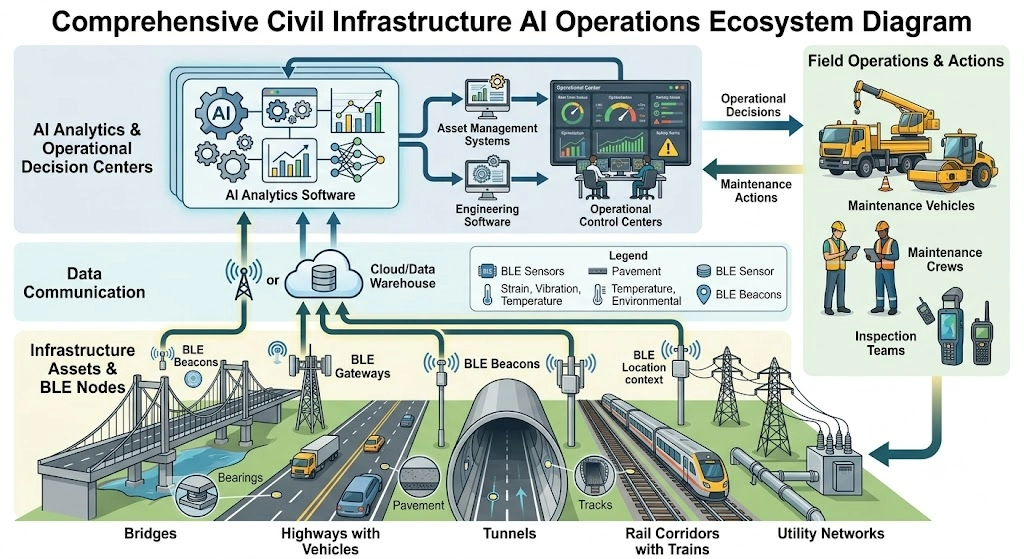
A professional infographic overview diagram illustrating how BLE nodes and devices on civil infrastructure assets feed operational data into AI analytics, which then informs decision support systems, asset management, and field maintenance actions. The diagram shows the connected workflow across bridges, highways, tunnels, rail corridors, and utility networks.
Understanding AI-Powered BLE Solutions in Civil Infrastructure
Civil infrastructure management increasingly depends on real-time awareness of asset condition, operational performance, maintenance requirements, environmental exposure, and resource utilization. Traditional inspection schedules and manual reporting processes often provide limited visibility into rapidly changing infrastructure conditions.
BLE-enabled monitoring systems provide continuous data collection throughout infrastructure environments. AI software processes this information to identify patterns, forecast future conditions, prioritize maintenance activities, and support engineering decisions.
Key civil infrastructure applications include:
- Structural health monitoring
- Bridge condition assessment
- Tunnel safety monitoring
- Transportation asset tracking
- Utility corridor monitoring
- Construction project monitoring
- Workforce safety management
- Maintenance optimization
- Equipment utilization analysis
- Environmental condition monitoring
By combining AI analytics with BLE-generated infrastructure data, organizations can improve operational awareness while reducing reliance on reactive maintenance practices.
Civil Infrastructure Applications for AI-Enabled BLE Systems
Structural Health Monitoring
Civil infrastructure assets experience continual stress from traffic loads, environmental exposure, material aging, vibration, moisture, corrosion, and temperature fluctuations.
AI-assisted structural monitoring solutions help evaluate:
- Bridge decks
- Bridge bearings
- Expansion joints
- Retaining walls
- Tunnel linings
- Concrete structures
- Steel structures
- Elevated roadways
- Utility supports
- Flood protection structures
BLE-enabled monitoring devices provide data that supports condition assessment models and maintenance planning activities.
Infrastructure Asset Tracking
Large infrastructure projects rely on numerous mobile and fixed assets.
Examples include:
- Inspection equipment
- Surveying instruments
- Maintenance vehicles
- Portable generators
- Construction machinery
- Traffic management equipment
- Temporary barriers
- Mobile lighting systems
- Safety equipment
- Environmental monitoring devices
AI-powered asset tracking improves utilization rates, equipment availability, and maintenance scheduling.
Workforce Safety Monitoring
Civil infrastructure projects often involve hazardous work environments including:
- Confined spaces
- Active transportation corridors
- Elevated structures
- Utility excavations
- Tunnel systems
- Construction zones
AI-driven safety monitoring can assist supervisors by identifying unusual worker movement patterns, restricted-area access events, prolonged inactivity incidents, and emergency situations requiring investigation.
Transportation Infrastructure Management
Transportation agencies manage extensive networks that include:
- Highways
- Bridges
- Interchanges
- Rail systems
- Transit facilities
- Service roads
- Traffic control assets
AI systems can analyze operational data to support maintenance prioritization, traffic management planning, and infrastructure investment decisions.
Utility Infrastructure Monitoring
Civil infrastructure also includes utility assets such as:
- Water distribution systems
- Wastewater systems
- Stormwater systems
- Utility vaults
- Pump stations
- Pipeline networks
- Utility corridors
AI models help identify developing risks, abnormal operating conditions, and maintenance requirements before service disruptions occur.
Civil Infrastructure AI Application Matrix
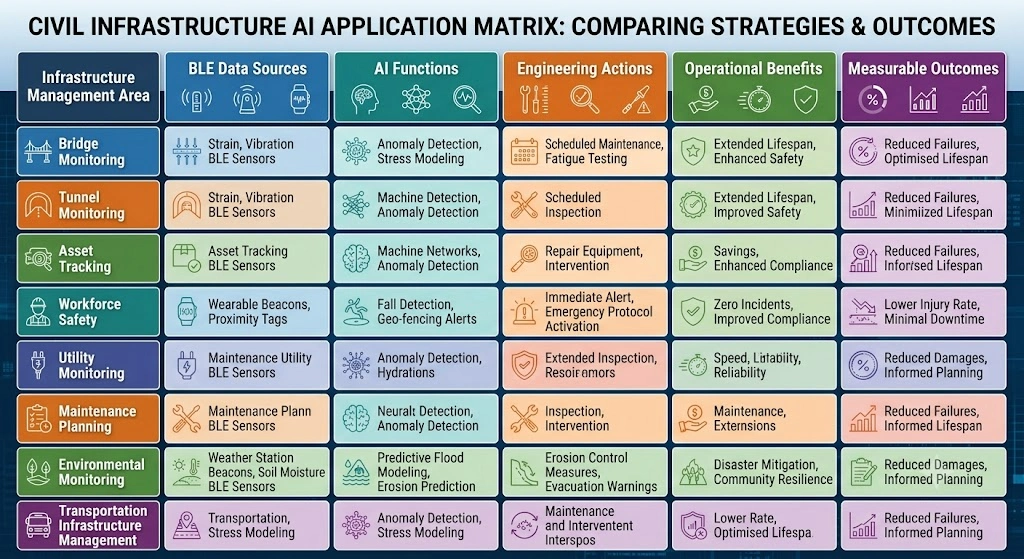
A detailed infographic matrix comparing various civil infrastructure domains (Bridges, Tunnels, Assets, Workforce, Utilities, Maintenance, Environment, Transportation) across five critical categories: BLE Data Sources, AI Functions, Engineering Actions, Operational Benefits, and Measurable Outcomes.
Civil Infrastructure Operational Workflow from Data Collection to Engineering Decisions
AI-enabled civil infrastructure solutions depend on a structured operational workflow that transforms infrastructure events into engineering insights and operational actions.
Infrastructure Data Acquisition
Operational data originates from multiple infrastructure sources including:
- BLE beacons
- BLE sensors
- BLE gateways
- Structural monitoring devices
- Inspection systems
- Environmental sensors
- Utility monitoring systems
- Maintenance records
- Traffic monitoring systems
- Engineering surveys
- Asset inventories
These sources continuously generate information related to infrastructure condition, asset performance, workforce activities, and environmental conditions.
Communication and Data Transport
Collected infrastructure data is transmitted through communication systems that may include:
- BLE communications
- Fiber networks
- Cellular networks
- Private wireless systems
- Municipal communications infrastructure
- Secure IP networks
Communication reliability is critical because infrastructure operators often require continuous operational awareness across geographically distributed assets.
Edge Processing and Data Normalization
Infrastructure monitoring systems frequently process data at the network edge before forwarding information to centralized systems.
Edge processing functions may include:
- Event filtering
- Data validation
- Signal conditioning
- Alert generation
- Device health monitoring
- Communication optimization
Normalized infrastructure data improves consistency across multiple engineering and operational systems.
Infrastructure Software Integration
AI-enabled civil infrastructure solutions commonly integrate with:
- Enterprise Asset Management (EAM) software
- Computerized Maintenance Management Systems (CMMS)
- Geographic Information Systems (GIS)
- Infrastructure inspection software
- Engineering information management systems
- Transportation management systems
- Utility management systems
- Capital planning systems
- Workforce management software
Integration enables AI software to evaluate infrastructure conditions within broader operational and maintenance contexts.
AI Analytics and Engineering Intelligence
AI engines process infrastructure data using:
- Predictive maintenance models
- Time-series forecasting
- Anomaly detection
- Pattern recognition
- Risk assessment algorithms
- Condition prediction models
- Resource optimization algorithms
- Failure prediction analytics
These analytical capabilities support engineering teams responsible for maintaining infrastructure reliability and public safety.
Operational Actions and Infrastructure Decisions
AI-generated insights can support:
- Maintenance scheduling
- Asset prioritization
- Inspection planning
- Resource allocation
- Workforce deployment
- Risk mitigation
- Emergency response planning
- Capital improvement planning
Engineering teams use these recommendations to improve infrastructure performance while optimizing operational resources.
BLE Infrastructure Components, AI Technologies, and Deployment Models for Civil Infrastructure
Civil infrastructure monitoring solutions require coordinated interaction among field devices, communication systems, engineering software, analytics engines, and operational management systems. Effective implementation depends on selecting technologies that support long asset lifecycles, geographically distributed operations, environmental resilience, and infrastructure reliability requirements.
BLE Hardware Components for Civil Infrastructure
BLE hardware deployed across civil infrastructure environments commonly includes:
- BLE beacons for workforce location awareness and asset identification
- BLE sensors for environmental monitoring
- BLE gateways for infrastructure-wide data collection
- Temperature monitoring devices
- Vibration monitoring sensors
- Moisture detection sensors
- Corrosion monitoring devices
- Equipment utilization sensors
- Asset identification tags
- Safety monitoring devices
These devices help collect operational information from bridges, tunnels, transportation corridors, utility networks, maintenance facilities, and construction zones.
Engineering Software Systems
Civil infrastructure operations often integrate AI-enabled monitoring with:
- Enterprise Asset Management (EAM) software
- Computerized Maintenance Management Systems (CMMS)
- Geographic Information Systems (GIS)
- Infrastructure inspection management software
- Transportation operations software
- Utility operations software
- Workforce management systems
- Environmental monitoring software
- Capital planning software
- Emergency management systems
GAO has supplied BLE and IoT hardware products that support integration with many of these operational systems.
AI Technologies Used in Civil Infrastructure
AI solutions for civil infrastructure frequently employ:
- Machine learning
- Predictive analytics
- Time-series forecasting
- Condition prediction models
- Anomaly detection
- Pattern recognition
- Risk scoring algorithms
- Maintenance optimization models
- Infrastructure deterioration analysis
- Resource allocation optimization
These methods help engineering teams identify risks, improve planning accuracy, and optimize infrastructure maintenance programs.
Communication Infrastructure
Civil infrastructure environments may utilize:
- BLE communications
- Fiber-optic networks
- Cellular communications
- Municipal communications systems
- Private wireless networks
- Ethernet infrastructure
- Secure VPN connectivity
Communication design should account for infrastructure geography, environmental conditions, redundancy requirements, and operational continuity objectives.
Cloud Software Deployment
Cloud-hosted software deployments are often selected when organizations require:
- Multi-region infrastructure visibility
- Centralized reporting
- Scalable analytics processing
- Cross-department collaboration
- Remote access capabilities
- Large-scale historical data analysis
Transportation authorities, utility operators, and public works organizations frequently use cloud-hosted solutions to consolidate operational information from multiple facilities and infrastructure assets.
Server-Based Deployment
Server-based deployment may be appropriate when organizations require:
- Greater control of operational data
- Private infrastructure management
- Regulatory compliance requirements
- Localized processing capabilities
- Reduced dependency on external hosting providers
- Dedicated engineering environments
Server deployments may operate from municipal data centers, transportation operations centers, utility control facilities, regional infrastructure management offices, or privately hosted enterprise servers.
Cybersecurity for Infrastructure Operations
Critical infrastructure environments require robust cybersecurity controls.
Recommended controls include:
- Multi-factor authentication
- Device identity verification
- Role-based access control
- Data encryption
- Security monitoring
- Network segmentation
- Audit logging
- Vulnerability management
- Incident response procedures
Because civil infrastructure often supports public safety and essential services, cybersecurity planning should be incorporated throughout the deployment lifecycle.
Technical Capabilities and Operational Improvements
Infrastructure Condition Visibility
AI-powered monitoring provides improved awareness of infrastructure conditions by continuously analyzing operational information generated throughout civil infrastructure environments.
Capabilities include:
- Condition monitoring
- Trend analysis
- Risk identification
- Maintenance forecasting
- Asset utilization monitoring
- Environmental exposure analysis
Improved visibility allows engineering teams to make more informed decisions regarding infrastructure maintenance and investment priorities.
Predictive Maintenance and Asset Reliability
Traditional maintenance approaches often rely on periodic inspections and reactive repairs.
AI-driven maintenance solutions help organizations:
- Detect developing infrastructure issues
- Forecast maintenance requirements
- Reduce unexpected failures
- Improve maintenance scheduling
- Extend asset service life
- Improve infrastructure availability
These benefits are achieved through continuous analysis of historical and real-time operational data.
Workforce Productivity Improvements
Infrastructure maintenance operations require efficient deployment of personnel, equipment, and resources.
AI-assisted workforce management supports:
- Resource allocation
- Crew scheduling
- Work prioritization
- Equipment coordination
- Inspection planning
- Maintenance execution
These improvements can reduce operational inefficiencies and improve service delivery.
Transportation and Utility Operations Optimization
Infrastructure operators can use AI-generated insights to improve:
- Traffic management planning
- Utility maintenance scheduling
- Infrastructure inspections
- Incident response activities
- Resource deployment
- Operational coordination
Improved operational planning contributes to increased reliability and service continuity.
Infrastructure Resilience and Risk Reduction
Civil infrastructure organizations increasingly focus on resilience against environmental, operational, and asset-related risks.
AI can support:
- Risk monitoring
- Vulnerability assessment
- Infrastructure prioritization
- Emergency preparedness
- Recovery planning
- Operational continuity
These capabilities help organizations improve long-term infrastructure performance.
GAO has supported organizations by supplying BLE, RFID, and IoT hardware products and systems that contribute to infrastructure visibility, monitoring, and operational decision support.
Engineering Considerations and Deployment Best Practices
Infrastructure Assessment and Planning
Successful deployments begin with comprehensive assessment activities including:
- Asset inventory reviews
- Infrastructure condition assessments
- Communication coverage evaluations
- Operational workflow analysis
- Stakeholder requirements gathering
- Cybersecurity planning
Planning activities help align technology deployment with operational objectives.
Device Placement Strategy
BLE device placement should account for:
- Structural characteristics
- Environmental conditions
- Coverage requirements
- Accessibility constraints
- Maintenance requirements
- Communication reliability
Proper placement significantly influences system performance and long-term maintainability.
Software Integration Planning
Integration planning should evaluate compatibility with:
- GIS software
- Asset management systems
- Maintenance management software
- Inspection management systems
- Transportation operations systems
- Utility operations systems
Well-planned integration improves operational efficiency and reduces data silos.
Scalability Considerations
Civil infrastructure networks often expand over time.
Solutions should accommodate:
- Additional infrastructure assets
- New monitoring locations
- Increased device counts
- Higher data volumes
- Expanded analytics requirements
Scalable designs reduce future deployment complexity.
Lifecycle Management
Long-term success requires:
- Device maintenance planning
- Firmware management
- Security updates
- Performance monitoring
- Periodic system reviews
- Infrastructure expansion planning
Lifecycle management supports reliable operation throughout the service life of the solution.
Implementation Recommendations for Civil Infrastructure Organizations
Organizations evaluating AI-enabled civil infrastructure solutions should focus on:
- Defining measurable operational objectives
- Prioritizing infrastructure risks and maintenance requirements
- Integrating engineering and operational systems
- Establishing cybersecurity controls early
- Selecting scalable monitoring technologies
- Monitoring performance metrics continuously
- Supporting long-term lifecycle management
Successful deployments typically begin with clearly defined infrastructure challenges and operational goals rather than technology-first initiatives.
Advancing Civil Infrastructure Performance Through AI and BLE
AI-enabled civil infrastructure monitoring improves infrastructure visibility, maintenance planning, asset reliability, workforce productivity, operational resilience, and engineering decision-making. BLE devices provide valuable operational information that supports AI-driven analytics, predictive maintenance, and infrastructure management activities. Combined with appropriate software integration, cybersecurity controls, and deployment planning, these solutions help civil infrastructure organizations improve service reliability while optimizing operational resources.
Headquartered in New York City and Toronto, GAO serves organizations throughout the United States and Canada. For more than three decades, GAO has supported Fortune 500 companies, leading research institutions, government agencies, and infrastructure operators through extensive investments in research and development, rigorous quality assurance processes, and expert technical support delivered remotely and onsite.
Building the Future of Industrial AI and IoT with Aperture Venture Studio and GAO RFID Inc.
For more than three decades, GAO Group of Companies has invested heavily in research and development involving industrial BLE, RFID, and IoT technologies. As AI has demonstrated increasing value across civil infrastructure monitoring, infrastructure maintenance, transportation operations, utility management, and infrastructure resilience initiatives, we have expanded our focus on AI and IoT solutions that support these operational requirements.
To help accelerate innovation across AI and IoT applications for infrastructure-intensive industries, we have established Aperture Venture Studio to help build and advance AI and IoT companies addressing emerging infrastructure challenges and operational requirements.
Aperture has attracted highly experienced AI and IoT technical experts, operational executives, investors, and industry leaders. Through Aperture Ventures Summit and TekSummit, we continue facilitating discussions involving advanced AI, IoT, BLE, RFID, infrastructure monitoring, and industrial technology topics.
These initiatives have helped foster strong technical communities and collaboration across AI and IoT domains.
We welcome participation as:
- Advisors, Co-founders, or Employees
- Investors
- Customers