
AI and BLE for Clinical Laboratories
AI-Driven Clinical Laboratory Operations with BLE Location and Sensing
AI is changing how clinical laboratories manage specimens, laboratory equipment, mobile assets, temperature-controlled storage, reagent inventory, staff workflows, and testing operations. When AI applications receive reliable location, environmental, equipment, and workflow data from BLE-enabled devices, laboratory managers can gain better visibility into operational bottlenecks, asset utilization, equipment conditions, and storage environments. BLE asset tags, gateways, beacons, and sensors provide the physical data needed to support AI-driven workflow analysis, anomaly detection, predictive maintenance, environmental monitoring, and operational decision-making. This combination can help clinical laboratories improve specimen handling, reduce equipment search time, identify abnormal operating conditions, and optimize the use of laboratory resources. GAO provides BLE, RFID, sensor, and IoT hardware products and systems that can support these clinical laboratory data acquisition and monitoring requirements.
AI-Enabled Clinical Laboratory Operations with BLE Asset Tracking and IoT
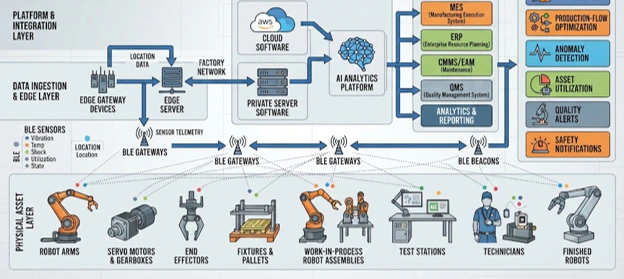
Alt Text: AI-enabled clinical laboratory showing BLE tracking, sensors, gateways, AI analytics, and software integration.
This visual illustrates how BLE asset tags, beacons, gateways, and environmental sensors connect clinical laboratory workflows with edge processing, middleware, AI analytics, and laboratory software. It shows how physical laboratory data can support workflow optimization, equipment monitoring, predictive maintenance, cold-chain integrity, inventory management, and operational decision-making.
What AI-Enabled Clinical Laboratory Operations Mean for Modern Laboratories
AI-enabled clinical laboratory operations combine artificial intelligence with connected laboratory equipment, sensors, asset-tracking technologies, workflow software, and operational data. The objective is to help laboratory teams understand what is happening across physical and digital processes and identify actions that can improve performance.
Clinical laboratories generate large amounts of operational information. Specimen arrival times, accessioning events, analyzer utilization, equipment status, refrigerator temperatures, freezer conditions, reagent inventory, maintenance records, and workflow timestamps can all provide useful signals. However, these signals are often distributed across separate systems or physical processes.
BLE can provide an additional source of physical context. BLE asset tags can identify the presence and movement of selected laboratory assets, while BLE gateways collect device transmissions. BLE sensors can provide temperature, humidity, motion, door, vibration, or other measurements where appropriate.
AI can then analyze these observations alongside other laboratory data. For example, a laboratory could evaluate whether prolonged specimen-processing times correlate with analyzer utilization, equipment downtime, transport delays, or workflow congestion. Similarly, temperature analytics can identify unusual patterns that may not be obvious from a single threshold alarm.
The resulting system is therefore not simply a BLE tracking installation. It is an AI-enabled operational solution in which connected physical data supports analysis, alerts, forecasting, and laboratory management decisions.
Clinical Laboratory Applications for AI-Enabled Operations
The most relevant applications depend on the laboratory’s workflow, equipment, facility layout, and operational objectives. AI can support multiple clinical laboratory functions when sufficient and reliable data is available.
AI-Powered Specimen Workflow Optimization
Specimen handling involves multiple stages, including receiving, accessioning, identification, preparation, centrifugation, aliquoting, sorting, analysis, verification, storage, and disposition. Delays can occur between any of these stages.
AI can analyze timestamps and location-related events to identify recurring delays and workflow bottlenecks. BLE-enabled location data can provide additional context around mobile transport assets, specimen-handling equipment, carts, or designated workflow zones.
The objective is to identify where process time is being consumed and provide laboratory managers with information for workflow improvement.
AI Asset Tracking for Laboratory Equipment
Clinical laboratories may operate mobile analyzers, centrifuges, transport carts, portable devices, storage containers, testing accessories, and other assets that move between rooms or work areas.
BLE asset tags can provide location information for selected equipment and mobile assets. AI can analyze historical movement and utilization patterns to identify frequently relocated equipment, underutilized assets, unusual movement, or areas where equipment availability creates workflow constraints.
This can reduce the dependence on manual asset searches and improve visibility into laboratory equipment utilization.
AI Equipment Monitoring and Predictive Maintenance
Laboratory analyzers and supporting equipment require reliable operation and scheduled maintenance. Equipment failures can interrupt testing capacity and contribute to workflow delays.
AI can analyze equipment utilization, operating conditions, maintenance history, alarm events, and sensor measurements to identify patterns associated with abnormal operation or increasing maintenance requirements.
BLE sensors can provide supplementary physical measurements where existing equipment interfaces do not provide sufficient operational data. The resulting information can help maintenance personnel prioritize inspection and service activities.
AI-Enabled Cold-Chain and Environmental Monitoring
Clinical laboratories use refrigerators, freezers, cold rooms, and other controlled environments for specimens, reagents, controls, and other temperature-sensitive materials.
BLE temperature and environmental sensors can provide continuous measurements from designated monitoring points. AI can analyze trends, recovery behavior, repeated excursions, and other patterns rather than relying exclusively on isolated threshold alarms.
This can help laboratory personnel identify developing environmental problems and investigate potential causes before they become significant operational incidents.
AI Laboratory Inventory and Reagent Management
Reagent and consumable availability directly affects laboratory continuity. Stockouts, inaccurate inventory records, inappropriate storage conditions, and expiry can create operational problems.
AI can analyze inventory consumption, historical demand, storage conditions, location information, and other approved data sources to support demand forecasting and inventory planning.
BLE sensing can provide location and environmental information for selected storage areas or mobile inventory assets. Where RFID or barcode identification is already used for item-level identification, BLE can complement rather than replace those technologies.
AI Workflow and Resource Forecasting
Clinical laboratory workload can fluctuate according to time, day, testing volume, service requirements, and other operational factors. AI can analyze historical workload and workflow data to forecast demand.
Forecasting can support decisions concerning equipment utilization, staffing, specimen-processing capacity, transport resources, storage requirements, and maintenance scheduling.
AI Applications Across Clinical Laboratory Workflows: Data, Operations, and Outcomes
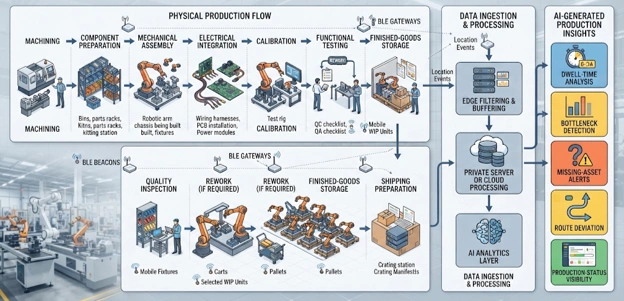
Alt Text: Clinical laboratory AI map linking data sources to workflow applications, functions, and operational outcomes.
This visual maps how AI can support clinical laboratory operations across specimen workflow optimization, asset tracking, equipment monitoring, predictive maintenance, cold-chain monitoring, reagent inventory management, workload forecasting, and anomaly detection. It connects each application to relevant data sources, responsible laboratory functions, and expected operational outcomes, highlighting how integrated data and AI can improve efficiency, quality, compliance, and patient care.
AI and BLE Data Flow Across Clinical Laboratory Operations
A practical clinical laboratory solution can collect physical observations and convert them into operational intelligence through several connected stages.
- Physical data capture: BLE asset tags, beacons, sensors, and connected laboratory equipment generate location, environmental, movement, and equipment observations.
- BLE data collection: BLE gateways receive transmissions from nearby devices and associate observations with configured laboratory zones or gateway locations.
- Edge processing: Local processing can filter duplicate readings, validate data, normalize timestamps, and temporarily store information during network interruptions.
- Secure network communication: Validated data can be transmitted through the laboratory’s approved IP network to the appropriate software services.
- Middleware processing: Middleware can normalize device information and associate device identifiers with laboratory assets, rooms, equipment records, or workflow stages.
- Data storage: Relevant measurements and operational events can be retained in appropriate databases or time-series storage.
- AI analysis: Machine learning, anomaly detection, forecasting, classification, and other analytical methods can identify patterns in laboratory operations.
- Software integration: Analytical results can be presented through laboratory dashboards or integrated with appropriate LIS, CMMS, inventory, environmental monitoring, or business intelligence systems.
- Operational response: Laboratory personnel can investigate alerts, adjust workflows, relocate assets, initiate maintenance, or review environmental conditions.
The quality of the final AI output depends heavily on the quality of the data entering the system. Incorrect asset associations, poor gateway placement, missing readings, inconsistent timestamps, and unmonitored sensor failures can reduce the reliability of downstream analytics.
Clinical Laboratory AI Data Flow: From Sensor Capture to AI-Assisted Decisions
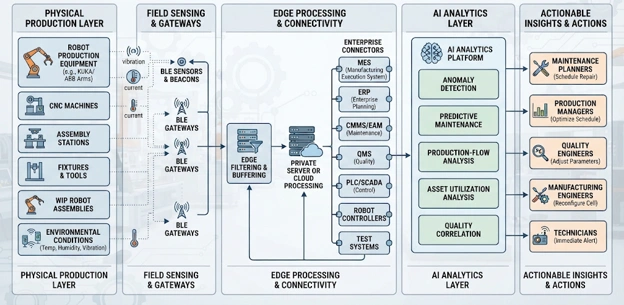
Alt Text: Clinical laboratory data flow from sensors and equipment through AI analytics to staff decisions and actions.
This diagram illustrates the end-to-end flow of clinical laboratory data, from BLE tags, environmental sensors, equipment, and workflow events through gateways, edge processing, middleware, databases, AI analytics, and enterprise systems. It shows how AI-generated insights and alerts reach laboratory staff and trigger operational, maintenance, quality, and compliance decisions.
BLE Infrastructure for AI-Enabled Clinical Laboratories
BLE is an enabling technology within the broader clinical laboratory solution. Its role is to provide wireless physical data that AI applications can use alongside other laboratory information.
BLE Asset Tags
BLE asset tags can be attached to selected mobile laboratory equipment, transport carts, containers, or other approved assets. Their primary value is providing a wireless identifier that can be detected by nearby gateways.
The tag selection should consider battery life, physical dimensions, mounting requirements, cleaning procedures, environmental exposure, transmission interval, and the required location resolution.
BLE Beacons
BLE beacons can establish reference points for laboratory rooms, corridors, storage areas, workstations, or defined workflow zones. Their placement should reflect the location model required by the application.
Room-level tracking does not necessarily require the same infrastructure density as workstation-level tracking. Deploying additional beacons or gateways can increase location resolution but also increases installation, maintenance, and data-processing requirements.
BLE Sensors
BLE sensors can provide environmental and physical measurements such as temperature, humidity, motion, vibration, or door activity.
For clinical laboratory use, sensor selection should consider measurement accuracy, calibration requirements, battery life, environmental conditions, mounting method, measurement interval, and the operational consequences of missing or inaccurate readings.
BLE Gateways
BLE gateways collect transmissions from BLE devices and forward relevant information to local or centralized software. Gateway placement should account for laboratory walls, equipment density, metal surfaces, refrigerators, freezers, cabinets, and other factors that can affect radio performance.
A site survey and physical validation are therefore preferable to relying solely on theoretical wireless range specifications.
GAO supplies BLE gateways, beacons, sensors, RFID technologies, and related IoT hardware products and systems that can support these types of clinical laboratory deployments.
Clinical Laboratory Deployment Architecture and Integration Considerations
The solution should be designed around laboratory workflows, existing IT infrastructure, and required operational outcomes. A typical deployment can contain physical devices, BLE gateways, edge services, networking, middleware, AI processing, data storage, dashboards, and connections to laboratory software.
The integration layer is particularly important because clinical laboratories may already operate LIS, CMMS, inventory, environmental monitoring, identity management, and business intelligence systems. Device identifiers and laboratory asset records should be mapped consistently so that AI analytics receive meaningful contextual information.
For example, a temperature reading has greater operational value when the software knows which refrigerator generated the reading, where that refrigerator is located, which monitoring zone it belongs to, and whether the sensor is currently active and correctly calibrated.
The system should also distinguish operational IoT monitoring from clinical diagnostic decision-making. AI used to optimize equipment utilization or identify workflow bottlenecks has different validation requirements from AI that directly influences clinical diagnosis or treatment.
AI-Enabled Clinical Laboratory BLE Deployment Architecture: Devices, Data, AI, and Enterprise Systems
Alt Text: Clinical laboratory BLE architecture linking sensors and equipment to edge systems, AI, enterprise apps, and users.
This technical architecture illustrates how BLE asset tags, beacons, sensors, laboratory equipment, and workflow events connect through gateways, secure networks, edge servers, middleware, databases, and AI processing. It shows both data and control flows into LIS, CMMS, inventory, environmental monitoring, identity management, and security systems, enabling laboratory staff to monitor operations and act on AI-generated insights.
Cloud and Server Deployment for Clinical Laboratories
A Cloud Version can host software, data storage, device management, dashboards, and AI services within cloud infrastructure. This model can support centralized management when a laboratory organization operates multiple locations and has approved secure connectivity to cloud services.
A Server Version can run software on customer-managed servers, private data centers, laboratory servers, edge servers, or other privately hosted infrastructure. This model can provide greater control over data location, connectivity, integration, and internal system management.
The appropriate deployment depends on laboratory governance, cybersecurity requirements, network availability, integration requirements, data-handling policies, AI processing needs, and internal IT capabilities.
A hybrid configuration can also be appropriate. Time-sensitive processing can occur near the laboratory while selected analytical information is transferred to centralized infrastructure for broader reporting or multi-site analysis.
AI Capabilities for Clinical Laboratory Operations
AI delivers the greatest operational value when clinical laboratory data is analyzed continuously and connected to defined business or workflow decisions. BLE location and sensing data can provide physical context, while laboratory software contributes workflow, equipment, inventory, and maintenance information.
Anomaly Detection
AI anomaly detection can establish normal operating patterns for laboratory workflows, equipment, and controlled environments. The system can identify unusual temperature behavior, unexpected asset movement, prolonged equipment inactivity, abnormal workflow duration, or changes in resource utilization.
An anomaly should not automatically be treated as a confirmed failure. Alerts should provide sufficient context for laboratory personnel to investigate and determine the appropriate response.
Predictive Maintenance
Predictive maintenance can combine equipment utilization, maintenance history, operating conditions, alarm events, and available sensor data. AI can identify changes in operating patterns that may indicate an increased likelihood of equipment problems.
This allows maintenance teams to prioritize inspections and service activities using operational evidence rather than relying exclusively on fixed schedules or responding only after equipment failure.
Workflow Prediction and Optimization
AI can analyze historical specimen volumes, processing times, equipment utilization, and workflow events to identify recurring congestion and forecast periods of increased demand.
Laboratory managers can use these insights to evaluate staffing requirements, equipment allocation, specimen-processing capacity, transport resources, and workflow scheduling. The resulting recommendations should remain subject to laboratory policies and appropriate human oversight.
Environmental Intelligence
Temperature, humidity, door activity, and other environmental measurements can be analyzed over time rather than treated as isolated readings. AI can identify gradual changes, repeated excursions, unusual recovery patterns, or environmental conditions that differ from historical behavior.
This is particularly relevant to refrigerators, freezers, reagent storage, specimen storage, and other controlled laboratory environments.
Clinical Laboratory KPIs for AI-Enabled Operations
The success of an AI-enabled laboratory solution should be measured through operational outcomes rather than the number of BLE devices installed.
Relevant KPIs include:
- Specimen turnaround time
- Specimen dwell time by workflow stage
- Analyzer utilization
- Equipment downtime
- Mean time between failures
- Mean time to repair
- Temperature excursion frequency and duration
- Asset search time
- Asset utilization
- Inventory accuracy
- Reagent stockout frequency
- Reagent expiry-related waste
- Workflow queue length
- Alert response time
- False-positive alert rate
- Sensor and gateway uptime
- Data availability
- Maintenance completion rate
Baseline measurements should be established before deployment so that laboratory teams can compare performance after implementation.
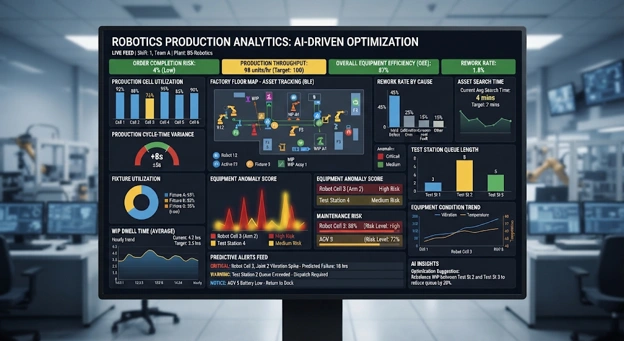
Clinical Laboratory AI Operations KPI Dashboard
Alt Text: Clinical laboratory AI dashboard showing workflow, equipment, temperature, asset, inventory, and maintenance KPIs.
A clinical laboratory operations dashboard translating specimen, workflow, equipment, environmental, asset, inventory, sensor, and maintenance data into actionable performance indicators. KPI cards and trend charts provide a consolidated view of laboratory efficiency, equipment reliability, environmental events, and operational response.
Integrating AI and BLE With Laboratory Software
AI-enabled clinical laboratory operations should complement existing software rather than create another isolated source of information. Integration can connect physical observations with the records and workflows already used by laboratory personnel.
Potential integration points include:
- Laboratory Information Systems: Approved workflow information can provide context for specimen-processing analysis.
- Laboratory middleware: Device information can be normalized and associated with appropriate laboratory records.
- Computerized Maintenance Management Systems: Equipment anomalies and utilization information can support maintenance prioritization.
- Inventory management systems: Location, environmental, and consumption information can improve visibility of laboratory materials.
- Environmental monitoring software: BLE sensor measurements can supplement existing temperature and humidity monitoring.
- Business intelligence software: Aggregated operational information can support laboratory management dashboards and trend analysis.
Data mapping should be designed carefully. A BLE identifier has little operational meaning without a controlled association to an asset, location, equipment record, or monitoring point. The system should also maintain accurate records when assets are moved, replaced, reassigned, or removed from service.
Cybersecurity and Data Governance for Clinical Laboratory IoT
BLE devices, gateways, edge systems, and AI software should be incorporated into the laboratory’s broader cybersecurity program.
Important controls include:
- Device authentication and controlled device enrollment
- Secure communications between gateways and software services
- Network segmentation for IoT and laboratory systems
- Role-based access control
- Credential and key management
- Firmware and software update procedures
- Gateway and sensor inventory management
- Security logging and monitoring
- Vulnerability management
- Defined data-retention policies
- Controlled API access
- Protection of information associated with patients or clinical workflows
The monitoring system should also minimize unnecessary collection of patient-identifying information. Asset location, equipment status, and environmental measurements can often be collected without embedding patient information into the BLE layer.
AI systems should have access only to the information required for their intended function. Model outputs should also be traceable to appropriate source data so that laboratory personnel can investigate unexpected recommendations or alerts.
Clinical Laboratory IoT Cybersecurity Controls: BLE to AI Systems
Alt Text: Clinical laboratory cybersecurity diagram showing BLE devices, networks, AI systems, software, access controls, and security layers.
This diagram illustrates a layered cybersecurity approach for clinical laboratory AI and BLE solutions, covering connected devices, gateways, segmented networks, secure APIs, laboratory software, AI analytics, and user access. It highlights controls including device authentication, encryption, firewalls, RBAC, monitoring, patch management, data protection, and cross-cutting security governance.
Data Quality and Interoperability
AI performance depends on reliable input data. Clinical laboratory deployments should therefore monitor the quality of sensor, gateway, location, and workflow information continuously.
Important data-quality controls include:
- Timestamp validation
- Duplicate-event detection
- Missing-data identification
- Device identity verification
- Sensor calibration records
- Battery-state monitoring
- Gateway connectivity monitoring
- Asset-to-tag association management
- Location-zone validation
- Data provenance and audit records
The system should distinguish between an actual laboratory condition and a missing sensor reading. For example, an absent temperature measurement should not automatically be interpreted as evidence that a refrigerator remained within its acceptable range.
Middleware can help normalize information from different BLE devices and connect that information with existing laboratory software. This provides a consistent data model for AI applications and reduces dependence on individual device formats.
Implementing AI-Enabled Clinical Laboratory Operations
A phased implementation approach can reduce operational disruption and provide opportunities to validate technical assumptions before wider deployment.
Requirements and Workflow Assessment
The project should begin by identifying specific laboratory problems and defining the information required to address them. Requirements may include specimen workflow visibility, mobile equipment tracking, cold-chain monitoring, analyzer utilization, inventory visibility, or maintenance analytics.
A site assessment should document laboratory rooms, equipment density, network availability, potential radio obstructions, gateway locations, sensor mounting points, and required monitoring resolution.
Pilot Deployment
A pilot should represent a real laboratory workflow. It may begin with selected mobile assets, one environmental monitoring area, or a defined specimen-processing workflow.
Pilot testing should evaluate wireless reliability, sensor performance, location accuracy, data quality, gateway connectivity, alert behavior, integration, and user response.
Commissioning and Validation
Commissioning should verify device registration, asset associations, gateway configuration, software connectivity, data transmission, alert generation, and recovery from network interruptions.
Testing should include normal operation and defined failure scenarios such as sensor failure, battery depletion, gateway disconnection, network interruption, abnormal environmental readings, and restoration after an outage.
AI recommendations should initially operate with appropriate human review. Model performance should be evaluated against laboratory-defined acceptance criteria before more automated actions are introduced.
User Acceptance and Production Deployment
Laboratory personnel should confirm that alerts are understandable, relevant, and assigned to the appropriate roles. Excessive alerts can create alarm fatigue even when the underlying technology operates correctly.
Production deployment should therefore include defined escalation procedures, user training, documentation, support processes, and performance monitoring.
Clinical Laboratory AI Implementation Lifecycle Roadmap
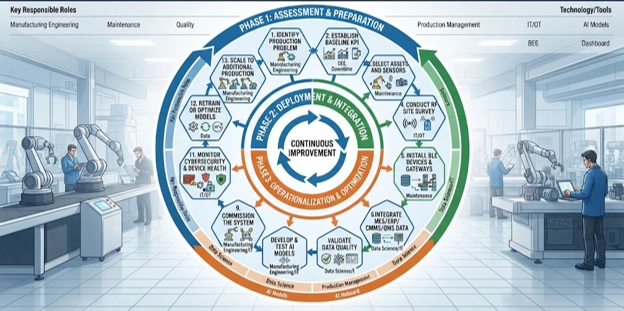
Alt Text: A five-phase flowchart illustrating the clinical laboratory AI implementation lifecycle, covering planning, deployment, technical integration, operational validation, and optimization with key deliverables.
This infographic outlines a comprehensive five-phase roadmap for successfully implementing artificial intelligence solutions within a clinical laboratory setting. It details critical steps from initial planning and technical integration to operational validation and ongoing optimization, specifying key deliverables for each stage to ensure a smooth and compliant deployment. The primary takeaway is a structured, phased approach that bridges the gap between technical testing and operational use, culminating in continuous improvement.
Scaling AI and BLE Across Clinical Laboratory Facilities
Scaling from one laboratory area to multiple departments or facilities requires consistent data definitions, device management, cybersecurity policies, and software configuration.
Organizations should establish standardized definitions for laboratory assets, locations, workflow stages, monitoring points, sensor measurements, alerts, and KPIs. Local laboratory differences can then be managed through controlled configuration rather than completely separate implementations.
Data volume should also be considered. Thousands of sensors transmitting frequent measurements can generate substantial network traffic and storage requirements. Edge filtering, event aggregation, appropriate sampling intervals, and retention policies can reduce unnecessary data processing while preserving information required for AI analysis.
Multi-site deployments can use centralized dashboards while retaining appropriate local operational controls. The selected Cloud Version, Server Version, or hybrid arrangement should reflect each organization’s connectivity, governance, security, integration, and support requirements.
Maintenance and Continuous Optimization
AI-enabled clinical laboratory monitoring requires ongoing management after commissioning. Devices, software, laboratory layouts, and workflows all change over time.
Routine management should include:
- Battery replacement and battery-life monitoring
- Sensor calibration and verification
- Gateway health checks
- Firmware and software updates
- Network connectivity monitoring
- Asset-tag reassignment
- Device inspection and cleaning
- AI model performance monitoring
- Alert-threshold review
- Data-quality audits
- Cybersecurity vulnerability management
AI models should also be reviewed when laboratory workflows change significantly. A model trained on historical operating conditions may become less reliable if new analyzers, additional testing services, revised workflows, or facility changes alter the underlying data patterns.
Practical Recommendations for Clinical Laboratories
Clinical laboratories considering AI-enabled operational monitoring should begin with clearly defined problems rather than technology selection alone.
- Establish measurable baseline KPIs before deployment.
- Identify workflows where better physical visibility can produce meaningful operational value.
- Use BLE for appropriate location, proximity, environmental, and asset-monitoring requirements.
- Continue using barcode, RFID, or other identification technologies where they provide the required level of identification.
- Conduct physical and wireless site surveys before finalizing gateway locations.
- Design asset identity management before large-scale deployment.
- Build data-quality monitoring into the solution from the beginning.
- Validate AI recommendations with laboratory personnel before increasing automation.
- Separate operational AI applications from clinical diagnostic functions unless appropriate clinical validation has been completed.
- Apply cybersecurity controls across devices, gateways, networks, applications, data, and AI services.
- Establish lifecycle plans for batteries, calibration, firmware, software, and hardware replacement.
- Select Cloud Version, Server Version, or hybrid deployment according to laboratory governance and technical requirements.
- Continuously compare operational performance against the baseline established before deployment.
How GAO Supports AI-Enabled Clinical Laboratory Solutions
GAO supplies BLE, RFID, sensor, gateway, and IoT hardware products and systems that can support clinical laboratory asset tracking, environmental monitoring, equipment visibility, and connected operational workflows. Hardware selection can be aligned with required sensing capabilities, communication range, battery requirements, installation conditions, and integration needs.
Headquartered in New York City and Toronto, Canada, GAO is ranked among the top 10 leading B2B and B2G BLE and RFID suppliers in the world. GAO, GAO Research Inc., and GAO Tek Inc. form GAO Group, with the companies based in New York City and Toronto.
For three decades, GAO Group has served customers across the United States and Canada, including Fortune 500 companies, leading R&D organizations, prestigious universities, and government agencies. The group has invested heavily in R&D, maintains stringent quality assurance processes, and provides expert technical support remotely or onsite.
For clinical laboratories, this experience is relevant when BLE, RFID, sensing, and IoT hardware must operate as components of a larger technical solution.
Key Takeaways for AI-Enabled Clinical Laboratory Operations
AI can help clinical laboratories move from fragmented operational observations toward data-driven workflow management. By combining AI with reliable location, environmental, equipment, and workflow information, laboratories can identify bottlenecks, improve asset visibility, monitor controlled environments, support maintenance planning, and forecast operational demand.
BLE provides one practical wireless method for collecting this physical information. Its effectiveness depends on appropriate device selection, site validation, data quality, cybersecurity, software integration, and lifecycle management.
Organizations should therefore define the operational problem first, establish measurable KPIs, validate the technology through representative laboratory workflows, and expand only after technical and operational performance has been demonstrated. GAO’s BLE, RFID, sensor, and IoT products and technical capabilities can be evaluated as part of this broader clinical laboratory solution design.
Building the Future of Industrial AI and IoT with Aperture Venture Studio and GAO RFID Inc.
For more than three decades, GAO Group of Companies has invested heavily in R&D for industrial BLE, RFID, and IoT technologies. As generative AI became increasingly useful in industrial applications, we expanded our work across AI and IoT, including BLE and RFID, and founded Aperture Venture Studio to build, launch, and scale next-generation AI and IoT companies and solutions relevant to applications such as intelligent clinical laboratory operations.
Aperture has attracted AI and IoT technical experts, entrepreneurial and operational executives, influential investors, and leading companies. We have also developed the Aperture Ventures Summit and TekSummit to discuss advanced AI and IoT topics.
These activities have helped develop technical communities around AI and IoT. We welcome participation as:
- Advisors, co-founders, or employees
- Investors
- Customers