
CNC Equipment Manufacturing
AI-Powered CNC Equipment Manufacturing Using BLE for Industrial Equipment Manufacturing
Computer Numerical Control (CNC) equipment manufacturing demands exceptional precision, repeatability, and process consistency throughout machining, assembly, calibration, testing, and quality assurance. Artificial Intelligence (AI), enabled by Bluetooth Low Energy (BLE) sensors, beacons, and gateways, is helping CNC equipment manufacturers improve machine reliability, optimize production scheduling, strengthen quality control, and reduce unplanned downtime through intelligent data analysis and connected industrial operations.
Rather than relying solely on periodic inspections or historical reports, AI continuously evaluates operational data collected from production machinery, precision assembly stations, spindle test benches, coordinate measuring machines (CMMs), and environmental monitoring devices. This enables manufacturers to predict equipment failures, detect process deviations, optimize machining performance, and improve manufacturing traceability. BLE provides a low-power wireless communication layer that connects production assets without extensive wiring, allowing AI to deliver actionable insights across CNC equipment manufacturing facilities.
For more than three decades, GAO has supplied industrial BLE, RFID, and IoT hardware products and systems that help manufacturers improve production visibility, equipment monitoring, and operational intelligence. Headquartered in New York City and Toronto, Canada, GAO supports customers across North America with industrial-grade sensing technologies, engineering expertise, and technical support.
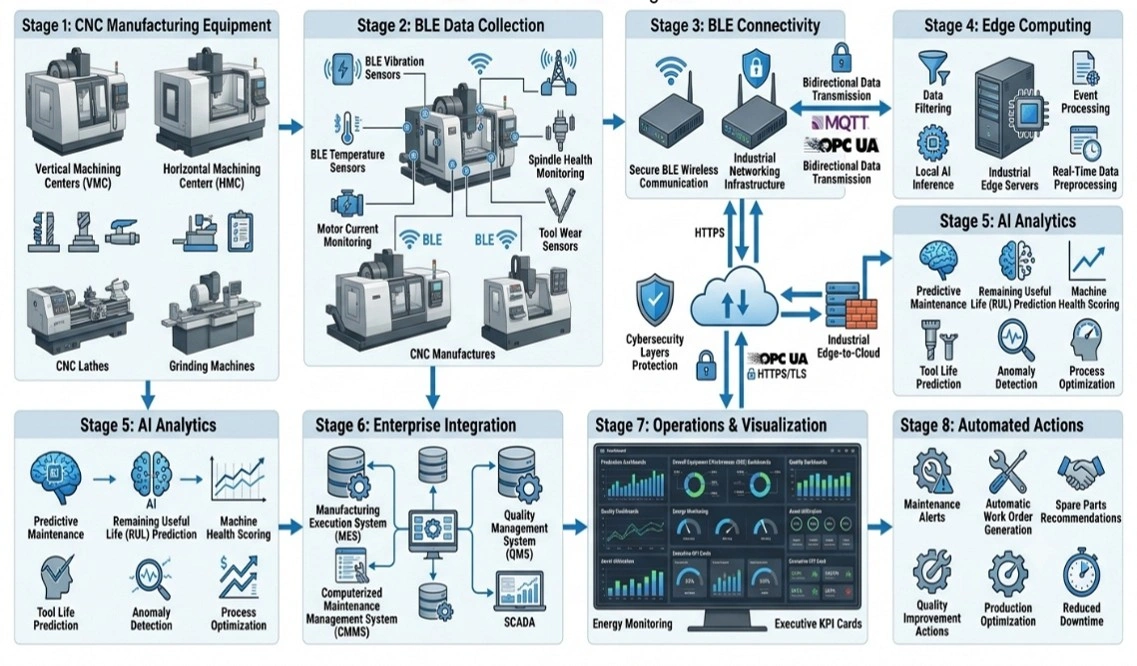
AI-Enabled Connected Machining Operations Architecture
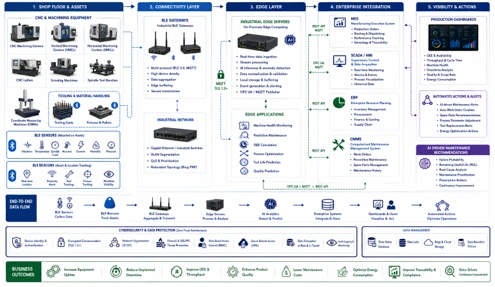
Understanding AI-Driven CNC Equipment Manufacturing
AI-enabled CNC equipment manufacturing applies machine learning, Industrial AI, Edge AI, computer vision, and AIoT technologies throughout the design, machining, assembly, testing, and validation of CNC machine tools.
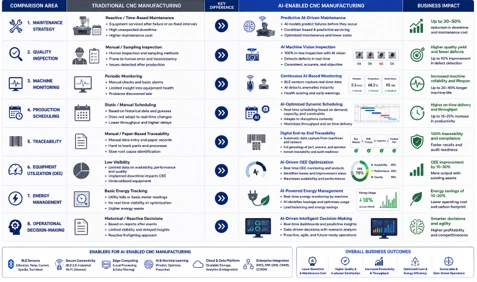
Unlike traditional automation that depends on predefined thresholds, AI continuously analyzes machining conditions, equipment performance, production quality, and operational trends to recommend improvements before production problems occur.
BLE serves as the communication layer connecting distributed production assets through:
- BLE sensors measuring machine health
- BLE beacons identifying mobile tooling and production assets
- BLE gateways collecting manufacturing data for AI analysis
Together, these technologies support intelligent manufacturing by improving operational awareness across machining cells, assembly areas, inspection laboratories, and final acceptance testing.
Core capabilities include:
- Predictive spindle maintenance
- Intelligent machine utilization analysis
- AI-assisted machining optimization
- Automated quality inspection
- Production scheduling optimization
- Tool lifecycle management
- Work-in-progress visibility
- Energy consumption monitoring
- Digital manufacturing traceability
- Equipment performance benchmarking
Instead of reacting to failures after they occur, AI identifies subtle operational changes that indicate developing problems, allowing engineering teams to intervene proactively.
Why AI Is Transforming CNC Equipment Manufacturing
Manufacturing CNC machining centers, CNC lathes, horizontal machining centers (HMCs), vertical machining centers (VMCs), grinding machines, multi-axis machining systems, and precision automation equipment requires extremely tight dimensional tolerances and repeatable production processes.
Small deviations in spindle vibration, thermal expansion, tool alignment, axis calibration, lubrication, or fixture positioning can affect machine accuracy, assembly quality, and customer acceptance testing.
AI helps manufacturers continuously evaluate these variables and detect patterns that are difficult to identify through conventional statistical process control alone.
Primary operational drivers include:
- Increasing Overall Equipment Effectiveness (OEE)
- Improving machining precision
- Reducing scrap and rework
- Minimizing spindle failures
- Optimizing production scheduling
- Improving first-pass yield
- Reducing calibration time
- Enhancing equipment traceability
- Lowering maintenance costs
- Improving production forecasting
AI analyzes information from numerous manufacturing systems, including:
- CNC controllers
- PLCs
- Servo drives
- Spindle monitoring systems
- Coordinate Measuring Machines (CMMs)
- Laser interferometers
- Ball bar testing equipment
- Vision inspection systems
- Tool presetters
- Manufacturing Execution Systems (MES)
- Quality Management Systems (QMS)
By correlating data across these sources, AI transforms raw operational information into predictive maintenance alerts, machining recommendations, quality insights, and production optimization opportunities.
AI Applications Across CNC Equipment Manufacturing
Artificial intelligence supports every major stage of CNC equipment manufacturing, from precision component machining through final machine acceptance testing.
Predictive Maintenance for Manufacturing Equipment
Production facilities manufacturing CNC machines rely on precision machining centers, spindle balancing systems, grinding equipment, and automated assembly stations.
BLE-connected condition monitoring devices measure:
- Spindle vibration
- Bearing temperature
- Lubrication performance
- Motor current
- Hydraulic pressure
- Coolant conditions
Machine learning models analyze these measurements to predict equipment degradation before production interruptions occur.
Intelligent Precision Machining Optimization
Machining performance directly affects the dimensional accuracy and surface finish of CNC machine components.
AI continuously evaluates:
- Cutting forces
- Tool wear
- Feed rates
- Spindle speed stability
- Surface roughness
- Thermal compensation
- Material removal efficiency
These insights help manufacturing engineers optimize machining parameters while maintaining production quality.
Automated Quality Inspection
Computer vision systems automatically inspect critical CNC machine components including:
- Linear guide installations
- Ball screw assemblies
- Spindle housings
- Machine castings
- Tool changers
- Control panels
- Electrical assemblies
AI identifies dimensional deviations, cosmetic defects, incorrect assembly sequences, and missing components before final acceptance testing.
Intelligent Tool Management
Manufacturing CNC equipment requires extensive use of cutting tools, fixtures, gauges, torque tools, and calibration equipment.
BLE beacons attached to these assets enable AI to:
- Track utilization
- Monitor calibration schedules
- Reduce tool search time
- Improve inventory accuracy
- ptimize replacement planning
Digital Production Traceability
Manufacturing traceability is essential for warranty support, regulatory compliance, and continuous improvement.
AI consolidates production records from machining, assembly, inspection, calibration, and testing into a complete digital manufacturing history for every CNC machine produced.
CNC Equipment Manufacturing Deployment Scenarios
AI-supported manufacturing solutions can be implemented throughout CNC equipment production facilities.
Precision Component Machining
AI monitors machining stability during production of:
- Machine beds
- Column castings
- Spindle housings
- Ball screw supports
- Rotary tables
- Tool changer mechanisms
Predictive analytics identifies process variation before machining tolerances exceed specification.
Mechanical Assembly Operations
Assembly engineers benefit from AI-assisted verification of:
- Linear guide installation
- Ball screw alignment
- Servo motor integration
- Hydraulic assemblies
- Lubrication systems
- Cooling circuits
- Electrical cabinet assembly
Computer vision confirms proper assembly while AI identifies recurring production issues.
Calibration and Acceptance Testing
Before shipment, CNC machines undergo rigorous calibration and performance validation.
AI evaluates:
- Axis positioning accuracy
- Repeatability
- Circular interpolation performance
- Thermal stability
- Spindle runout
- Vibration characteristics
- Tool changer reliability
Historical testing data enables AI to identify long-term quality trends and recommend manufacturing process improvements.
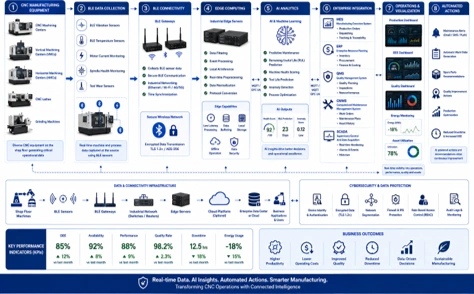
Operational Workflow from Data Acquisition to AI-Driven Manufacturing Decisions
AI-enabled CNC equipment manufacturing follows a structMiddleware validates, timestamps, normalizes, and routes information to AI software.
AI models analyze machining conditions, equipment health, production trends, and quality metrics.
Manufacturing software such as MES, ERP, QMS, CMMS, and SCADA receives AI-generated insights.
Engineers, production supervisors, quality specialists, and maintenance planners review recommendations or trigger automated workflows.
Continuous feedback from production results is used to retrain AI models, improving prediction accuracy over time.
Core Technologies Supporting AI-Powered CNC Equipment Manufacturing
Successful AI-driven CNC equipment manufacturing combines intelligent sensing, industrial communication, edge computing, manufacturing software, and cybersecurity into a unified production solution. BLE technologies provide efficient wireless connectivity for non-critical machine monitoring and asset visibility, while AI transforms production data into predictive insights that improve machining accuracy, equipment reliability, and manufacturing efficiency.
BLE Sensors for Machine Condition Monitoring
BLE sensors collect operational data from production equipment without requiring extensive wiring modifications. They are particularly valuable for monitoring auxiliary equipment, legacy machines, and mobile manufacturing assets.
Typical monitored parameters include:
- Spindle bearing temperature
- Motor vibration
- Servo drive temperature
- Hydraulic system pressure
- Pneumatic pressure
- Lubrication flow
- Coolant temperature
- Ambient humidity
- Dust concentration
- Electrical current
- Energy consumption
These measurements allow AI models to identify abnormal operating conditions before machining performance deteriorates.
BLE Beacons for Asset Visibility
BLE beacons improve visibility across manufacturing operations by identifying the location of critical assets.
Typical tracked assets include:
- Tool presetters
- Precision gauges
- Calibration instruments
- Tool holders
- Cutting tool carts
- Mobile inspection equipment
- Work-in-progress machine assemblies
- Forklifts
- AGVs
- Maintenance toolkits
Location intelligence enables AI to optimize production logistics, reduce equipment search time, and improve resource utilization.
BLE Gateways
BLE gateways aggregate information from connected sensors and beacons before securely forwarding the data to edge servers or centralized software.
Engineering considerations include:
- Gateway density
- Radio coverage
- Metal interference
- Network redundancy
- Wireless coexistence
- Data buffering
- Scalability for production expansion
Proper gateway placement ensures reliable communication throughout machining halls, assembly areas, quality laboratories, and testing facilities.
Artificial Intelligence Models Used in CNC Equipment Manufacturing
Different AI techniques address different manufacturing challenges.
Machine Learning
Machine learning analyzes production history, equipment behavior, and operational trends to predict:
- Spindle failures
- Bearing degradation
- Tool wear
- Production delays
- Machine utilization
- Surface finish consistency
- Remaining useful life of components
Computer Vision
Computer vision automates inspection of precision-machined and assembled components.
Typical inspection tasks include:
- Surface defect detection
- Casting inspection
- Fastener verification
- Cable routing inspection
- Label verification
- Paint quality assessment
- Dimensional verification
- Assembly completeness
Edge AI
Edge AI processes manufacturing information close to production equipment, reducing latency and improving operational resilience.
Typical applications include:
- Real-time spindle monitoring
- Safety monitoring
- Immediate production alerts
- Tool breakage detection
- Machine anomaly detection
Predictive Analytics
Predictive analytics evaluates historical production information together with live operational data to forecast:
- Maintenance requirements
- Production capacity
- Spare parts demand
- Energy consumption
- Product quality trends
- Calibration intervals
Communication Infrastructure and Manufacturing Software Integration
Reliable communication ensures AI insights become part of daily manufacturing operations.
Typical workflow includes:
- BLE devices collect operational information.
- Gateways forward data through secure industrial networks.
- Edge servers preprocess manufacturing data.
- Middleware validates and standardizes incoming information.
- AI software performs analytics and prediction.
- MES coordinates production execution.
- ERP synchronizes inventory and procurement.
- CMMS automatically generates maintenance work orders.
- QMS records inspection results and corrective actions.
- SCADA provides supervisory monitoring of production assets.
This integrated approach enables consistent decision-making throughout CNC equipment manufacturing.
Cloud Version and Server Version Deployment
Selecting the appropriate deployment model depends on operational objectives, cybersecurity requirements, and production infrastructure.
Cloud Version
Cloud-hosted deployments are suitable for manufacturers operating multiple production sites that require centralized reporting and long-term analytics.
Advantages include:
- Centralized production visibility
- Simplified software maintenance
- Cross-factory benchmarking
- Scalable computing resources
- Remote engineering collaboration
- Historical trend analysis
Server Version
Server-managed deployments place AI software on customer-managed edge servers, factory servers, private data centers, or other privately hosted enterprise infrastructure.
This model is appropriate when manufacturers require:
- Ultra-low latency
- Local processing of sensitive manufacturing data
- Operation during internet outages
- Compliance with internal cybersecurity policies
- Tight integration with isolated production networks
Many CNC equipment manufacturers implement hybrid deployments that combine local AI inference with cloud-based reporting and enterprise analytics.
Cybersecurity and Engineering Best Practices
Because CNC equipment manufacturing involves proprietary machining programs, engineering drawings, production data, and intellectual property, cybersecurity must be incorporated throughout the solution lifecycle.
Recommended practices include:
- Device authentication
- Encrypted wireless communication
- Role-based access control
- Network segmentation
- Secure firmware updates
- Continuous vulnerability assessment
- Event logging
- Backup and disaster recovery
- Regular software patch management
Deployment planning should also consider wireless signal propagation, machining hall layout, electromagnetic interference, equipment accessibility, scalability, and future production expansion.
Technical Capabilities and Operational Improvements
AI-powered CNC equipment manufacturing delivers measurable technical and operational improvements across machining, assembly, inspection, and maintenance.
Key capabilities include:
- Predictive maintenance of spindles, bearings, and servo systems
- AI-assisted machining parameter optimization
- Intelligent production scheduling
- Automated dimensional inspection
- Digital work-in-progress tracking
- Machine utilization analysis
- Tool lifecycle management
- Calibration scheduling
- Energy optimization
- Production traceability
Operational improvements include:
- Higher Overall Equipment Effectiveness (OEE)
- Increased first-pass yield
- Reduced scrap and rework
- Shorter machine commissioning time
- Improved machine availability
- Lower maintenance costs
- Faster root cause analysis
- Better workforce productivity
- Improved quality consistency
- Enhanced manufacturing traceability
Drawing on decades of industrial experience, GAO has supplied BLE, RFID, and Industrial IoT hardware that helps manufacturers improve equipment visibility, machine condition monitoring, and operational intelligence. Our products and engineering support assist organizations in integrating connected sensing technologies into existing manufacturing environments.
AI-Enabled CNC Manufacturing Workflow
Traditional vs AI-Enabled CNC Manufacturing
Implementation Recommendations
Organizations planning AI-enabled CNC equipment manufacturing should adopt a phased deployment strategy.
Recommended practices include:
- Establish measurable business objectives before implementation.
- Conduct wireless site surveys for gateway placement.
- Prioritize monitoring of critical production assets.
- Validate sensor accuracy before full deployment.
- Integrate AI outputs with MES, ERP, SCADA, CMMS, and QMS.
- Define baseline KPIs before enabling AI optimization.
- Develop cybersecurity policies for connected manufacturing equipment.
- Train engineering, maintenance, and production teams on AI-assisted decision-making.
- Continuously evaluate model performance and retrain AI using updated production data.
- Design for scalability to accommodate future production lines and facilities.
AI-Enabled CNC Manufacturing – Performance Improvements
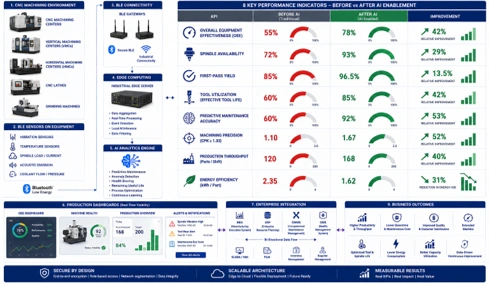
AI-Enabled CNC Manufacturing Workflow – End-to-End Data Flow
Advancing CNC Equipment Manufacturing with AI and BLE
Artificial intelligence supported by BLE connectivity enables CNC equipment manufacturers to improve machining precision, increase equipment availability, optimize maintenance, and strengthen manufacturing traceability. By combining AI with connected industrial sensing, organizations can reduce operational risk, improve production efficiency, and make engineering decisions based on continuously updated manufacturing data.
Recognized among the world’s leading B2B and B2G suppliers of BLE and RFID technologies, GAO, headquartered in New York City and Toronto, Canada, has served Fortune 500 companies, research institutions, universities, and government agencies across the United States and Canada for more than three decades. Through continuous investment in research and development, rigorous quality assurance, and expert remote and onsite technical support, GAO helps manufacturers deploy reliable Industrial AI and IoT solutions that support long-term operational excellence.
Building the Future of Industrial AI and IoT with Aperture Venture Studio and GAO
For more than three decades, GAO Group of Companies has invested heavily in research and development of industrial BLE, RFID, and IoT technologies. As generative AI has demonstrated significant value in CNC equipment manufacturing and advanced industrial automation, we have expanded our AIoT capabilities by combining artificial intelligence with connected manufacturing systems. To accelerate innovation in Industrial AI and IoT, we founded Aperture Venture Studio to help develop and scale advanced AI and IoT solutions for manufacturing and other technology-intensive industries.
Aperture has attracted leading AI researchers, IoT specialists, experienced operational executives, influential investors, and established technology organizations. We have also developed the Aperture Ventures Summit and TekSummit to promote technical collaboration and knowledge sharing on advanced AI and IoT topics. These initiatives have strengthened technical communities focused on industrial innovation. We welcome advisors, employees, investors, and customers who are interested in advancing the future of intelligent manufacturing with GAO.