
AI and BLE for Commercial Fishing
AI-Enabled BLE Monitoring for Commercial Fishing
AI and Bluetooth Low Energy (BLE) can help commercial fishing operators connect vessel operations, fishing equipment, cold-chain assets, crew-support systems, and shore-side logistics with continuously collected operational data. BLE beacons, BLE sensors, and BLE gateways provide practical wireless identification, condition monitoring, and proximity data, while AI analyzes that information to identify abnormal conditions, forecast equipment needs, optimize workflows, and support operational decisions.
Commercial fishing presents demanding deployment conditions. Vessels operate in saltwater, vibration, changing temperatures, limited connectivity, and environments where equipment may be distributed across decks, engine rooms, processing areas, refrigerated storage, and cargo spaces. AI and BLE systems therefore need appropriate sensor placement, gateway coverage, edge processing, network resilience, cybersecurity, and integration with existing vessel and shore-side systems. GAO supplies BLE beacons, BLE sensors, BLE gateways, RFID products, and IoT systems that can support these data-collection and monitoring requirements.
AI and BLE Commercial Fishing System Architecture
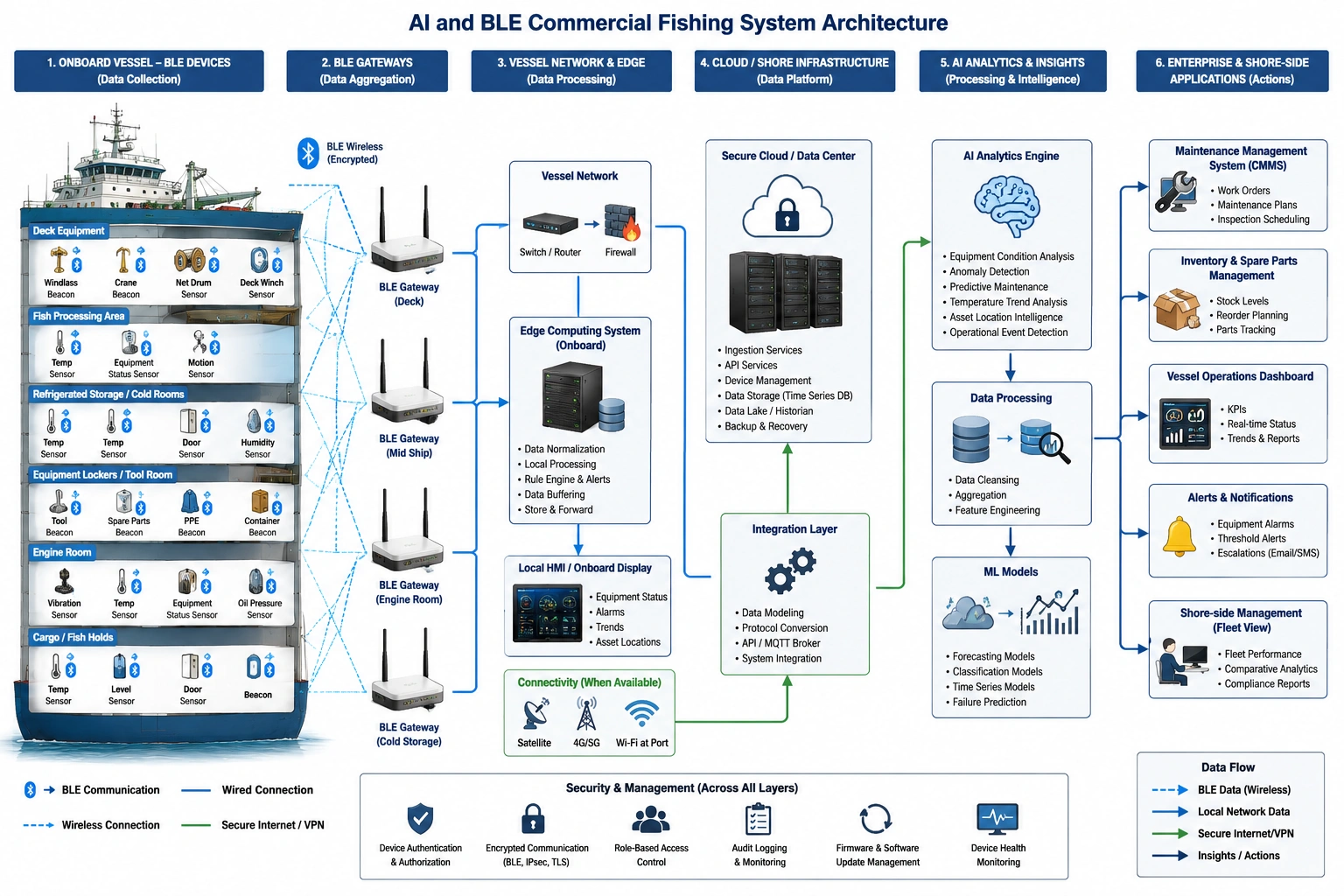
This technical diagram illustrates how BLE sensors, beacons, and gateways collect data across commercial fishing vessel areas and route it through onboard edge computing, secure connectivity, AI analytics, and shore-side systems. It highlights applications including equipment condition monitoring, predictive maintenance, refrigeration monitoring, asset tracking, inventory management, and operational alerts.
How AI and BLE Apply to Commercial Fishing Operations
Commercial fishing involves a distributed chain of physical activities. Fishing vessels acquire equipment and supplies at port, travel to fishing grounds, operate propulsion and deck machinery, deploy and retrieve fishing gear, handle catches, preserve products, maintain machinery, and return catches to shore-side processing or distribution operations. Each stage produces operational information, but much of that information can remain fragmented across equipment logs, manual inspections, standalone sensors, vessel systems, and enterprise software.
BLE provides a relatively low-power wireless method for collecting data from sensors and identifying nearby assets. BLE beacons can associate equipment, containers, tools, safety-related assets, or other mobile objects with locations or operational zones. BLE sensors can measure conditions such as temperature, humidity, vibration, motion, or other parameters depending on the selected device. BLE gateways collect nearby device transmissions and forward relevant information to an edge computer, vessel network, or shore-side system.
AI adds an analytical layer to this collected data. Instead of treating individual sensor readings as isolated events, AI can evaluate historical and real-time information together. A vibration trend from an engine-room asset, for example, becomes more useful when associated with equipment identity, operating hours, maintenance history, temperature, load conditions, and previous inspection results.
Commercial fishing applications can therefore include:
- Predictive maintenance for propulsion equipment, pumps, compressors, generators, refrigeration equipment, and deck machinery
- Condition monitoring for motors, bearings, gearboxes, fans, and other rotating machinery
- Temperature monitoring for refrigerated or chilled catch storage
- Asset identification and location monitoring for fishing gear, tools, containers, equipment, and mobile assets
- Inventory visibility for spare parts, consumables, maintenance materials, and operational supplies
- Monitoring of equipment movement between vessel zones, storage areas, and port facilities
- Detection of abnormal operating conditions using sensor time-series data
- Maintenance prioritization based on equipment condition and historical failure patterns
- Cold-storage monitoring through temperature trends and threshold alerts
- Operational reporting based on continuously collected vessel and equipment data
The strongest applications are generally those where physical inspection is difficult, equipment condition changes over time, or operational assets move between locations without reliable manual tracking.
Commercial Fishing Challenges That Make AI and BLE Valuable
Commercial fishing vessels create several engineering conditions that influence how AI and BLE systems should be designed. Wireless communication cannot simply be treated like an indoor office deployment because vessel structure, metal surfaces, machinery, weather exposure, electromagnetic interference, and changing operating conditions can affect wireless performance.
Distributed Vessel Equipment
Commercial fishing equipment can be distributed across engine rooms, machinery spaces, decks, refrigeration areas, processing spaces, storage compartments, and crew-accessible areas. A single gateway may not provide reliable BLE coverage throughout the vessel.
Gateway placement should therefore be determined through an actual RF survey. Metal bulkheads, machinery, enclosed compartments, and equipment cabinets can influence signal propagation. BLE gateway locations should also provide practical access to power and the vessel network.
Harsh Marine Conditions
Saltwater exposure, condensation, vibration, temperature variation, mechanical shock, and cleaning processes can affect sensors and gateways. Device selection should consider enclosure protection, mounting method, operating temperature, battery characteristics, corrosion exposure, and maintenance accessibility.
Sensors installed near engines or deck machinery may require different specifications from devices installed in refrigerated storage. A common device specification should not automatically be applied to every vessel zone.
Intermittent Connectivity
A fishing vessel may have strong network connectivity at port but substantially different connectivity offshore. AI and IoT systems should therefore distinguish between data collection and continuous cloud connectivity.
Edge processing can allow gateways or vessel-side computing systems to buffer sensor data, perform initial validation, generate local alerts, and synchronize information when an external connection becomes available. This reduces dependence on uninterrupted backhaul connectivity.
Manual Inspection and Maintenance Constraints
Engineers and crew members often work around machinery under demanding operational conditions. AI-based condition monitoring does not eliminate inspections or maintenance procedures. Instead, it can help maintenance personnel identify which equipment requires closer attention.
A useful system should provide actionable information such as asset identity, abnormal parameter, trend direction, timestamp, operating context, and recommended inspection priority rather than producing unexplained anomaly scores.
Refrigeration and Catch Handling
Temperature control is particularly important when commercial fishing operations include refrigerated, chilled, or frozen catch handling. BLE temperature sensors can provide distributed measurements from storage locations that may otherwise require manual checks.
AI can analyze temperature trends and identify unusual changes, repeated excursions, sensor failures, or differences between normal operating patterns and current conditions. The resulting information can support refrigeration maintenance and operational response.
Commercial Fishing AI and BLE Operational Workflow
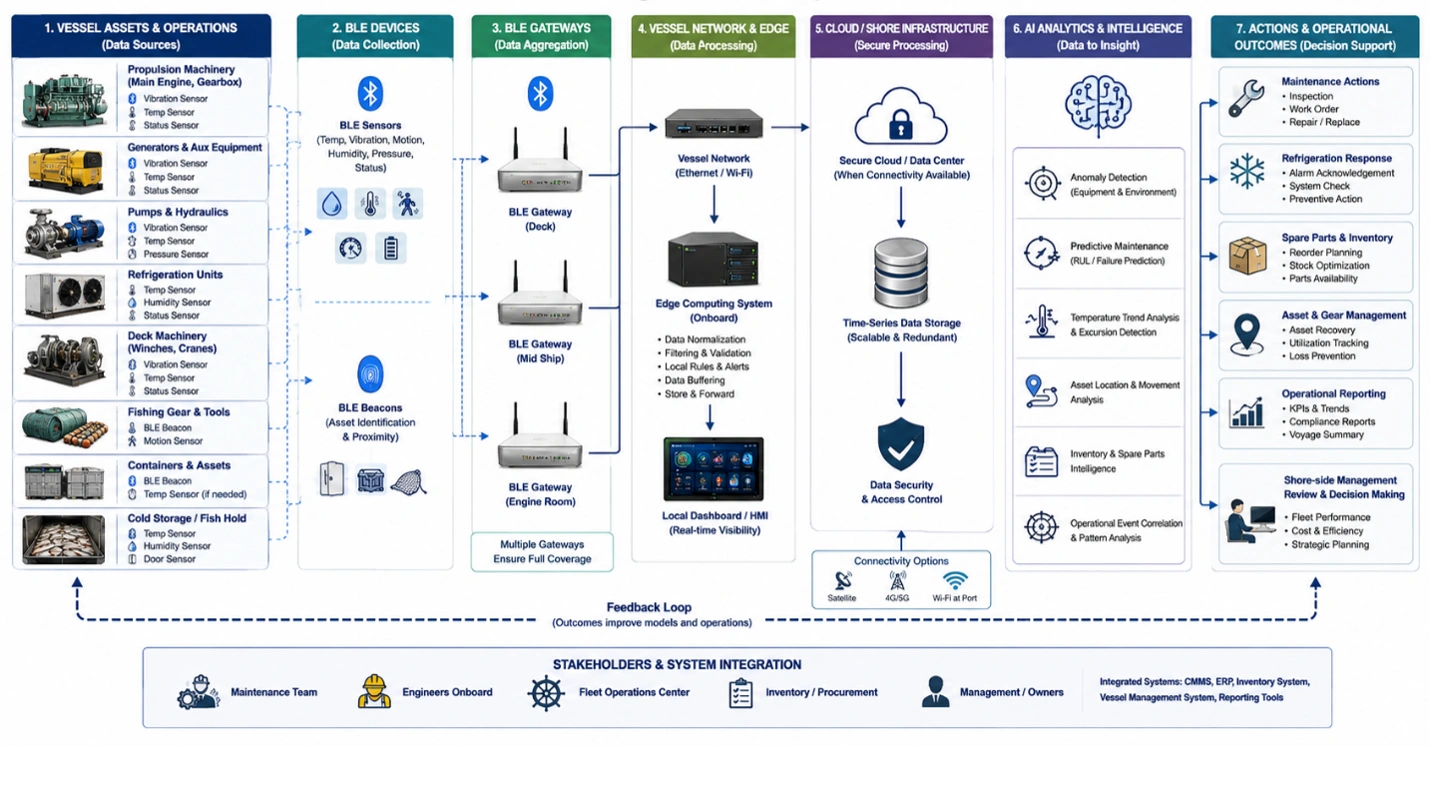
This workflow diagram shows how commercial fishing vessel assets generate data through BLE sensors and beacons, which is collected by BLE gateways and processed through onboard edge computing. AI analytics then transform the data into maintenance, refrigeration, inventory, asset-management, reporting, and shore-side decision-support actions.
AI and BLE Use Cases Across Commercial Fishing
AI and BLE can be deployed selectively rather than across every vessel operation. A practical implementation starts with workflows where additional data can improve an existing operational decision.
Predictive Maintenance for Vessel Machinery
Rotating machinery provides an important opportunity for sensor-based monitoring. BLE vibration and temperature sensors can be installed on appropriate motors, pumps, bearings, gearboxes, compressors, fans, generators, or other equipment where condition changes are meaningful.
AI models can establish a baseline from historical sensor measurements and operating conditions. Statistical anomaly detection, time-series analysis, classification models, or machine-learning models can then identify deviations from expected behavior.
The system can associate an abnormal pattern with the specific asset and maintenance history. Instead of simply reporting that vibration increased, the maintenance workflow can identify the equipment, show the trend, compare it with historical behavior, and create or recommend an inspection or maintenance action.
GAO’s BLE sensors and gateways can serve as the field-level data collection components in systems where commercial fishing operators require additional equipment-condition information.
Refrigeration and Cold-Storage Monitoring
BLE temperature sensors can continuously monitor refrigerated spaces and other temperature-sensitive locations. Measurements can be associated with specific compartments, storage zones, containers, or equipment.
AI can evaluate temperature trends rather than relying exclusively on fixed threshold alerts. For example, a gradual change in temperature may provide an earlier indication of refrigeration degradation than a single threshold breach.
Relevant analytical functions include:
- Temperature trend analysis
- Abnormal temperature detection
- Sensor failure detection
- Refrigeration performance monitoring
- Repeated excursion analysis
- Compartment-to-compartment comparison
- Maintenance prioritization
The system should maintain a reliable timestamp and asset or location association for every measurement so that operators can distinguish an actual environmental change from a faulty or displaced sensor.
Fishing Gear and Mobile Asset Tracking
BLE beacons can provide identification and proximity information for fishing gear, tools, containers, maintenance equipment, and other mobile assets. Gateways installed in appropriate vessel or port zones can detect nearby beacon transmissions.
This information can help operators determine whether an asset is aboard the vessel, located in a particular operational zone, or detected near a port-side receiving area. AI can analyze movement histories to identify unusual patterns, frequently misplaced equipment, or repeated delays in asset retrieval.
BLE should not be treated as a universal precision-location technology. Actual positioning accuracy depends on gateway density, vessel structure, radio conditions, beacon configuration, and the chosen location-estimation method.
Spare Parts and Maintenance Inventory
Maintenance-intensive vessels need access to appropriate spare parts, consumables, tools, and replacement components. BLE identification can supplement inventory records by providing additional information about the movement of selected physical assets.
AI can combine inventory information with maintenance history and equipment-condition data. This can support spare-parts planning by identifying equipment with rising failure indicators and checking whether the corresponding replacement parts are available.
Operational Anomaly Detection
AI can combine multiple data streams rather than evaluating every sensor independently. For example, abnormal equipment temperature combined with increased vibration and unusual operating duration may provide stronger evidence of a developing equipment problem than any single measurement.
This approach requires reliable timestamps, consistent asset identifiers, appropriate sampling intervals, and sufficient historical data. Poor sensor placement or inconsistent data collection can reduce model quality regardless of the sophistication of the AI method.
Commercial Fishing AI and BLE Data Flow
A technically sound deployment separates field sensing, wireless communication, edge processing, enterprise integration, and AI analytics into manageable functions.
Data Acquisition
BLE sensors collect measurements from physical assets or environmental locations. BLE beacons provide identification or presence information for selected assets.
Typical data attributes include:
- Device identifier
- Asset identifier
- Sensor measurement
- Timestamp
- Gateway identifier
- Location or vessel zone
- Battery condition
- Signal information
- Sensor status
Data quality should be checked at this stage. Duplicate messages, missing timestamps, implausible values, stale devices, and battery-related failures should be detected before analytics consume the data.
BLE Gateway Collection
BLE gateways provide the connection between BLE devices and the vessel’s broader data system. Gateway deployment should account for RF coverage, vessel layout, power availability, network access, environmental conditions, and maintenance access.
Gateways can aggregate data from multiple sensors and forward it using an appropriate IP-based network connection. Depending on the deployment, the gateway may also perform filtering, buffering, protocol conversion, and preliminary processing.
Edge Processing
Edge computing becomes especially useful when connectivity to shore-side infrastructure is intermittent. A vessel-side edge computer can temporarily store measurements, validate incoming records, calculate selected local indicators, and generate alerts without requiring every event to travel immediately to a remote server.
MQTT can be used where lightweight publish/subscribe messaging is appropriate. Other interfaces can be introduced when integrating with existing vessel systems or industrial equipment.
AI Analytics and Enterprise Integration
Validated data can be stored in time-series databases or other appropriate data stores. AI services can then analyze historical and current measurements.
Integration may involve maintenance management software, inventory systems, vessel-management software, refrigeration monitoring systems, ERP software, dashboards, reporting systems, or other operational applications.
AI outputs should remain connected to identifiable operational actions. A useful commercial fishing solution should answer questions such as:
- Which vessel asset is showing abnormal behavior?
- What parameter changed?
- When did the change begin?
- Is the condition worsening?
- Has this asset experienced similar behavior previously?
- Does maintenance history provide supporting evidence?
- Does the vessel have the required spare part?
- Does the condition require immediate inspection or planned maintenance?
AI and BLE Use-Case Matrix for Commercial Fishing
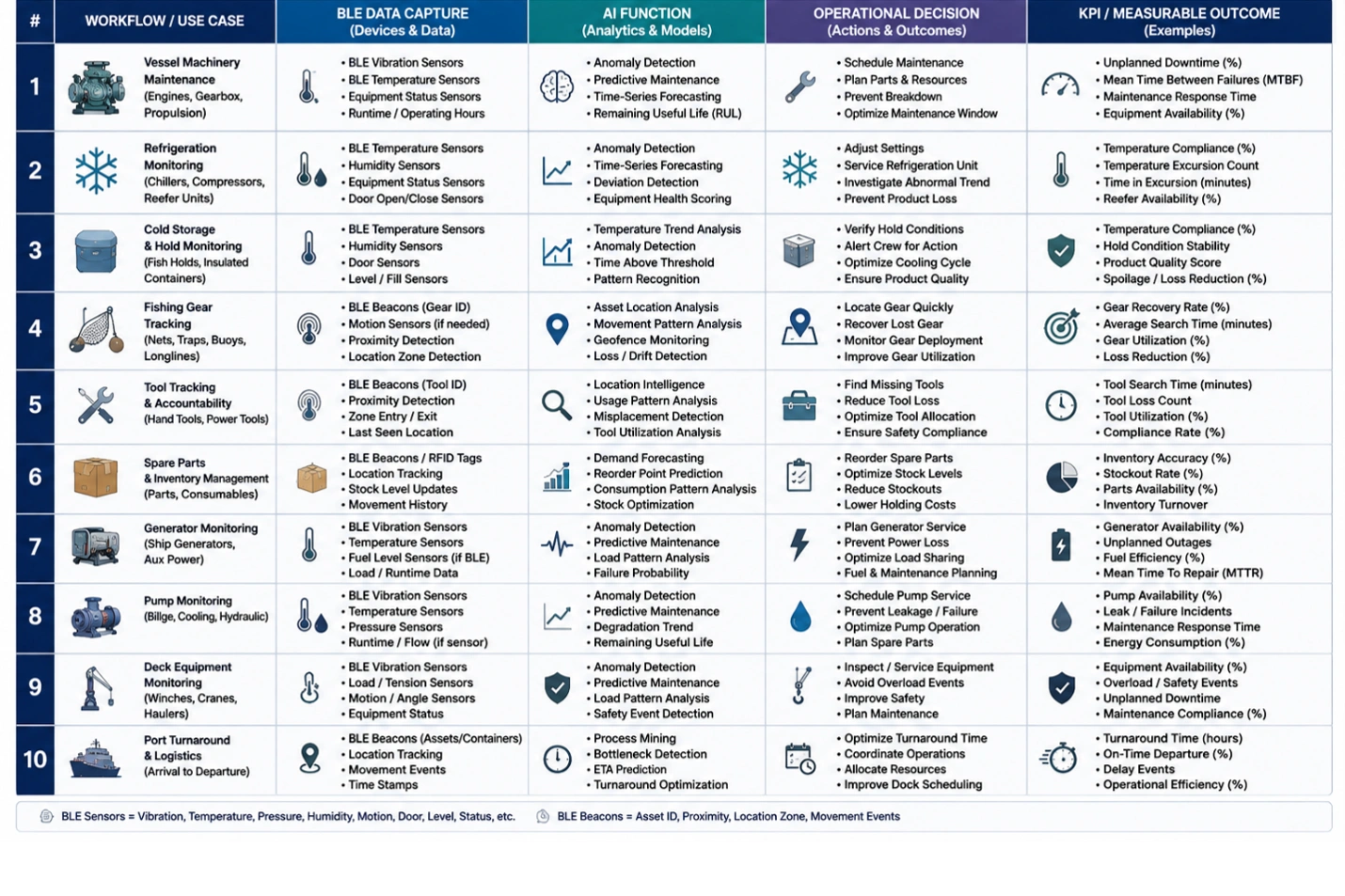
This matrix maps ten commercial fishing workflows to BLE sensors and beacons, AI analytics, operational decisions, and measurable KPIs. It highlights applications ranging from vessel machinery and refrigeration monitoring to fishing gear tracking, inventory management, generator and pump monitoring, deck equipment, and port turnaround.
BLE Hardware for Commercial Fishing AIoT Deployments
BLE hardware selection should follow the measurement requirement and vessel operating environment rather than simply selecting devices based on radio range.
BLE Sensors
BLE sensors can measure parameters relevant to machinery and environmental monitoring. Commercial fishing deployments may use temperature sensors for refrigerated areas and equipment, vibration sensors for rotating machinery, motion sensors for selected assets, and other specialized sensing devices where the measurement requirement justifies them.
Battery life is an important engineering consideration because offshore access to equipment may be limited. Sampling frequency, transmission interval, sensor processing, battery capacity, environmental conditions, and radio configuration all influence service life.
BLE Beacons
BLE beacons can provide an identifier associated with an asset or operational object. They are useful where the primary requirement is asset presence or proximity rather than continuous sensor measurement.
Examples include:
- Fishing equipment
- Maintenance tools
- Containers
- Spare equipment
- Portable machinery
- Selected safety-support assets
Beacon placement should minimize shielding from metal structures and avoid locations where equipment cleaning, impact, or water exposure could damage the device.
BLE Gateways
Gateways collect BLE transmissions and connect them with the vessel’s IP network or edge computing environment. Gateway selection should consider supported BLE versions, simultaneous device handling, network interfaces, operating temperature, enclosure requirements, power options, local storage, processing capability, and management functions.
GAO provides BLE gateways that can be incorporated into IoT data-collection systems where gateway-based aggregation is required.
Edge and Server Components
The gateway layer should not be expected to perform every AI function. Depending on the deployment, computationally intensive analytics can operate on an edge server, vessel-side computer, private server, or cloud infrastructure.
A hybrid model can be useful for commercial fishing because local processing can support offshore operations while centralized infrastructure can aggregate information across multiple vessels and voyages.
Commercial Fishing AI Deployment Models
Commercial fishing operators can choose between cloud-hosted and privately hosted server deployments depending on vessel connectivity, fleet size, data-governance requirements, and the amount of analytics that must remain available offshore.
Cloud Version
A cloud-hosted deployment can aggregate information from multiple vessels and provide centralized analytics for fleet managers, maintenance teams, inventory personnel, and shore-side operations.
The cloud model is particularly useful when:
- Multiple vessels need centralized reporting
- Shore-side teams require fleet-wide KPI analysis
- Historical data needs to be consolidated across voyages
- AI models require larger computing resources
- Software updates and centralized administration are important
- Connectivity is adequate for periodic synchronization
Cloud connectivity should not be assumed to be continuous. Vessel gateways or edge computers can buffer operational data and synchronize records when a suitable connection becomes available.
Server Version
A privately hosted server deployment can place application and data-processing software on a vessel-side server, customer-managed server, private data center, or other controlled infrastructure.
This model can be appropriate when commercial fishing operators require greater control over operational data, local processing, or connectivity-independent functionality.
A server deployment can support:
- Local data storage
- Vessel-side analytics
- Local dashboards
- Offline operation
- Controlled data access
- Integration with private maintenance or inventory software
- Reduced dependence on external cloud connectivity
A hybrid configuration can combine both approaches. Critical vessel-side monitoring can remain available locally while selected historical data and aggregated KPIs are synchronized with shore-side infrastructure.
AI Methods for Commercial Fishing Operations
AI selection should correspond to the operational problem and available training data. A predictive-maintenance model, for example, requires different data and validation methods from a temperature-anomaly detector.
Anomaly Detection
Anomaly detection can identify sensor behavior that differs from an established operating baseline. This approach can be useful when failure examples are limited.
For commercial fishing machinery, models can examine variables such as vibration, temperature, runtime, operating cycles, and historical equipment behavior. The model should account for normal changes caused by different operating conditions so that expected load-related changes are not incorrectly classified as failures.
Time-Series Forecasting
Time-series models can analyze measurements collected over hours, days, voyages, or maintenance cycles. Temperature forecasting can help identify developing refrigeration problems, while equipment-condition trends can help maintenance personnel identify deterioration before a severe failure occurs.
Forecasting accuracy depends on consistent sampling, sufficient historical data, sensor reliability, and meaningful operating context.
Predictive Maintenance
Predictive maintenance combines equipment-condition data with maintenance history and operational information to estimate the likelihood or timing of a developing problem.
Useful inputs can include:
- Vibration measurements
- Bearing temperature
- Motor temperature
- Operating hours
- Equipment load
- Maintenance history
- Previous failures
- Inspection records
- Equipment type and age
AI output should support maintenance planning rather than automatically replacing engineering judgment.
Classification
Classification models can categorize operational conditions into predefined states, such as normal, warning, or abnormal. This can simplify large volumes of sensor information and help maintenance personnel prioritize attention.
Classification should be validated against real vessel operating conditions because the same sensor value may have different significance under different loads, operating modes, or environmental conditions.
Commercial Fishing KPI Monitoring with AI and BLE
KPI selection should connect directly to operational objectives. Collecting large volumes of sensor data without defining measurable outcomes can produce unnecessary complexity.
Relevant KPIs can include:
- Unplanned equipment downtime
- Equipment availability
- Mean time between failures
- Mean time to repair
- Predictive-maintenance alert accuracy
- Maintenance response time
- Refrigeration temperature compliance
- Temperature excursion duration
- Cold-storage equipment availability
- Asset search time
- Fishing gear location accuracy
- Spare-parts inventory accuracy
- BLE sensor connectivity
- Gateway availability
- Sensor battery life
- Data synchronization success rate
- AI anomaly detection precision
- False-alert rate
- Vessel data completeness
KPI baselines should be established before deploying AI-driven optimization. This allows operators to determine whether the new system is actually improving maintenance performance, cold-storage control, asset visibility, or operational response.
Cybersecurity and Reliability for Vessel-Based BLE Systems
BLE deployments in commercial fishing should be treated as part of a broader IoT and vessel-network security design. Wireless sensors should not be given unnecessary access to critical vessel-control networks.
A practical security design can separate monitoring and analytics traffic from safety-critical machinery control.
Important measures include:
- Authenticated BLE devices and gateways where supported
- Encrypted wireless and IP communications
- Network segmentation
- Firewall controls between operational and enterprise networks
- Role-based access control
- Strong administrative authentication
- Secure gateway configuration
- Firmware and software update management
- Device inventory and lifecycle tracking
- Audit logging
- Data integrity checks
- Backup and recovery procedures
- Monitoring for unauthorized devices
- Controlled access to AI and operational dashboards
Monitoring systems should generally remain logically separated from safety-critical propulsion, navigation, and machinery-control functions unless an integration has been specifically engineered, validated, and approved for that purpose.
Reliability also requires planning for device failure. BLE sensor loss, gateway outages, depleted batteries, network interruptions, and corrupted measurements should generate distinguishable technical alarms rather than being interpreted as normal operating conditions.
Commercial Fishing BLE Integration with Existing Systems
AI and BLE deployments become more useful when sensor information can be associated with existing business and maintenance records.
Potential integration targets include:
- Maintenance management systems
- Vessel management software
- Inventory management systems
- ERP software
- Refrigeration monitoring systems
- Asset databases
- Fleet dashboards
- Reporting systems
- Time-series databases
- Data historians
An asset identifier should remain consistent across the BLE layer, AI software, maintenance records, and operational databases. Without reliable identity mapping, a technically accurate sensor reading may still be difficult to use operationally.
Integration middleware can normalize data formats, translate protocols, apply validation rules, and route information to the appropriate software. MQTT may be suitable for lightweight IoT messaging, while REST APIs, database interfaces, or other protocols can support application integration depending on existing systems.
Practical Commercial Fishing AI and BLE Deployment Lifecycle
A phased deployment reduces technical risk and provides measurable evidence before fleet-wide expansion.
Use-Case Selection
Start with one high-value workflow. Predictive maintenance for a frequently failing pump, temperature monitoring for a refrigerated storage area, or tracking a high-value mobile asset can provide a focused pilot.
The selected use case should have:
- A clearly defined operational problem
- An identifiable asset or process
- Measurable baseline KPIs
- Available maintenance or operational records
- A realistic method for installing sensors
- A defined action when an AI alert occurs
Vessel Assessment and Site Survey
Inspect vessel layouts, equipment locations, machinery spaces, refrigeration areas, network infrastructure, power availability, environmental conditions, and potential BLE interference sources.
An RF survey should identify appropriate gateway locations rather than assuming that theoretical BLE range will provide complete vessel coverage.
Hardware Selection and Installation
Select BLE sensors, beacons, and gateways according to environmental conditions and measurement requirements.
Installation should document:
- Device identifier
- Asset association
- Physical location
- Sensor type
- Sampling configuration
- Gateway association
- Battery information
- Installation date
- Maintenance requirements
Commissioning and Data Validation
Before AI modeling begins, verify that sensor measurements correspond to real physical conditions. Temperature sensors should be compared against appropriate reference instruments, while vibration sensors should be checked for correct mounting and meaningful signal behavior.
Data validation should also confirm timestamps, identifiers, gateway connectivity, missing records, duplicate events, and synchronization behavior.
AI Baseline and Pilot
AI models should first learn normal operating behavior. Pilot deployments should measure false positives, missed anomalies, alert latency, sensor reliability, and maintenance response.
Operators should review AI alerts against actual inspection findings. This feedback loop provides evidence for improving model thresholds and retraining models.
Integration and Expansion
After the pilot demonstrates measurable value, the system can be expanded to additional equipment or vessels.
Fleet-wide expansion should standardize device naming, asset identifiers, gateway configuration, data models, cybersecurity controls, maintenance procedures, and KPI definitions while allowing for differences between vessel designs.
Engineering Recommendations for Commercial Fishing AIoT
Several practical principles can improve the reliability of AI and BLE deployments:
- Start with a measurable operational problem rather than deploying sensors without a defined use case.
- Select BLE sensor types according to the parameter that actually indicates equipment or environmental condition.
- Perform an RF survey before finalizing gateway locations.
- Use marine-appropriate hardware specifications for exposed or harsh operating environments.
- Maintain consistent asset identifiers across sensors, gateways, AI software, and maintenance systems.
- Design edge buffering for offshore connectivity interruptions.
- Validate sensor data before using it for AI training or operational decisions.
- Establish baseline KPIs before introducing AI optimization.
- Keep monitoring networks logically separated from safety-critical vessel-control systems.
- Treat AI alerts as decision-support outputs that require appropriate operational validation.
- Monitor sensor battery condition, gateway availability, data completeness, and synchronization as technical KPIs.
- Introduce fleet-wide deployment only after the pilot demonstrates measurable operational value.
GAO Technologies for Commercial Fishing AI and BLE Systems
GAO provides BLE beacons, BLE sensors, BLE gateways, RFID products, and IoT systems that can support data acquisition, asset identification, condition monitoring, and wireless connectivity requirements.
GAO has supplied technology products and systems to organizations across the United States and Canada for three decades, including Fortune 500 companies, R&D organizations, universities, and government agencies. GAO is headquartered in New York City and Toronto, Canada, while GAO, GAO Research, and GAO Tek form the broader GAO Group.
The practical role of BLE hardware is to provide reliable field data that can be connected to software, AI analytics, maintenance processes, inventory systems, and operational dashboards. Hardware selection should therefore be considered together with sensor placement, gateway coverage, networking, data management, cybersecurity, and integration requirements.
Key Takeaways for Commercial Fishing AI and BLE
AI and BLE can give commercial fishing operators more continuous visibility into vessel equipment, refrigeration conditions, mobile assets, maintenance requirements, and selected operational processes. BLE sensors and beacons provide the physical data layer, while gateways connect vessel devices to edge or centralized computing systems.
AI becomes most valuable when its outputs are linked to defined operational actions. Predictive maintenance can prioritize equipment inspections, temperature analytics can identify refrigeration problems, and asset tracking can reduce time spent locating equipment.
Successful deployments depend on appropriate hardware, reliable data, vessel-specific RF planning, resilient connectivity, cybersecurity, integration with existing systems, and measurable KPIs. GAO can support organizations evaluating BLE, RFID, and IoT hardware and system requirements for these applications.
Building the Future of Industrial AI and IoT with Aperture Venture Studio and GAO
For more than three decades, GAO Group has invested heavily in R&D of industrial BLE, RFID, and IoT technologies. As AI became increasingly useful for industrial applications, we expanded our work across AI and IoT systems and established Aperture Venture Studio to support the development and scaling of AI and IoT technologies relevant to industries such as commercial fishing.
Aperture brings together technical experts, operational leaders, investors, and technology organizations interested in advanced AI and IoT applications. We have also developed Aperture Ventures Summit and TekSummit to facilitate discussion of emerging AI and IoT technologies.
We welcome participation as:
- Advisors, co-founders, or employees
- Investors
- Customers