
AI-Powered Commercial Property Management Using BLE Technology
How AI is Transforming Commercial Property Management with BLE
Commercial property management is rapidly evolving from reactive facility maintenance toward predictive, data-driven operations. Artificial Intelligence (AI), supported by Bluetooth Low Energy (BLE) gateways, BLE beacons, and BLE sensors, enables commercial property managers to monitor building assets, occupancy, environmental conditions, maintenance activities, and tenant experiences with significantly greater accuracy than traditional methods. AI analyzes continuous operational data collected throughout office buildings, shopping malls, mixed-use developments, business parks, hotels, healthcare facilities, educational campuses, and corporate headquarters to identify operational patterns, predict maintenance requirements, optimize space utilization, and improve building performance.
Within commercial property management, AIoT combines AI with connected BLE devices, building systems, enterprise software, and facility operations to transform raw operational data into actionable intelligence. Rather than relying solely on manual inspections or scheduled maintenance, AI continuously evaluates equipment health, occupant behavior, environmental conditions, and asset movement to support faster decision-making and more efficient building operations. Organizations implementing AI-enabled BLE solutions often achieve improvements in energy efficiency, asset utilization, maintenance planning, occupant comfort, operational resilience, and long-term property value. GAO has supplied BLE and IoT hardware solutions that help organizations deploy intelligent building monitoring systems across diverse commercial property environments.
AI-Enabled Commercial Property Management Reference Architecture
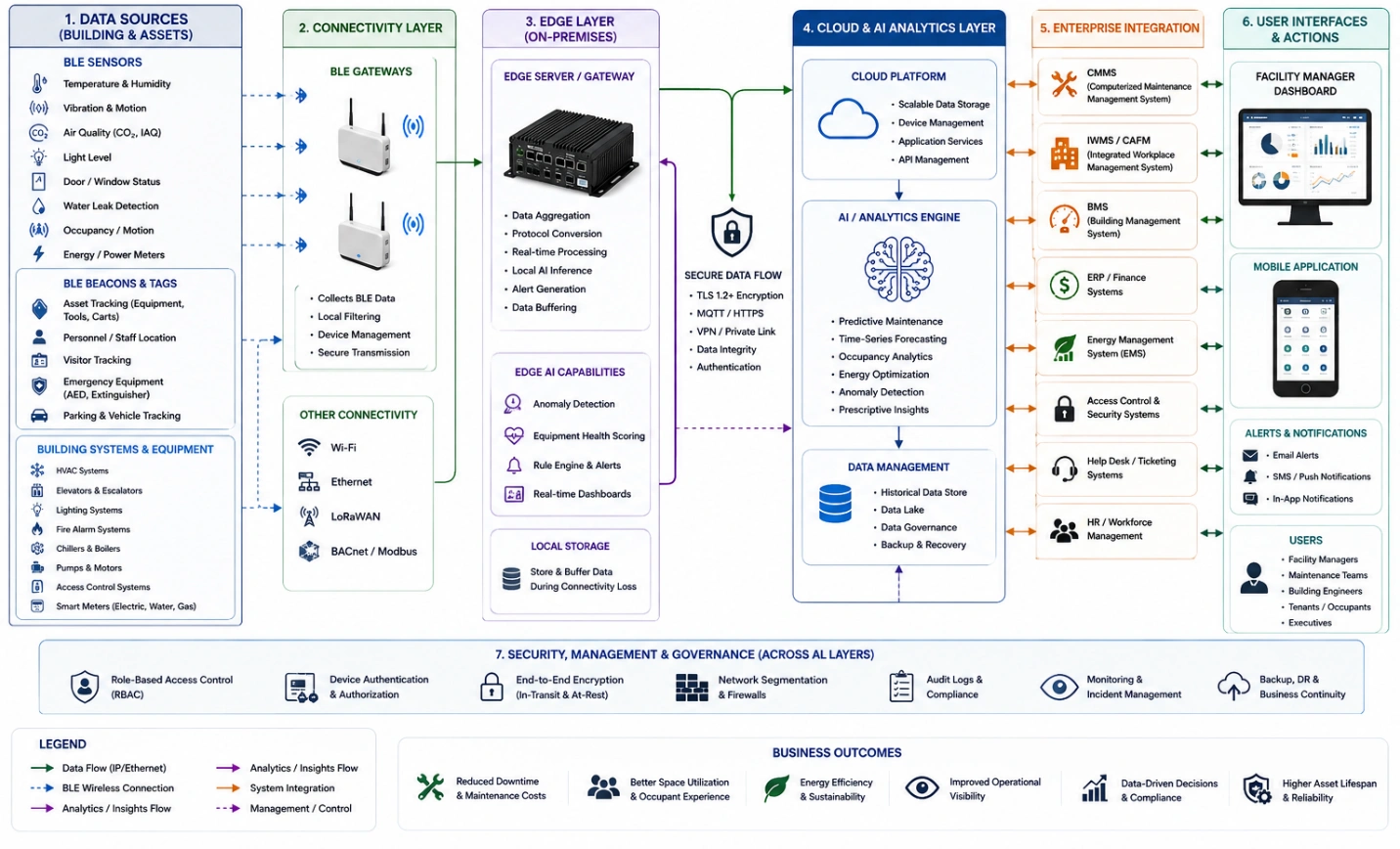
AI-Driven Commercial Property Management and the Role of BLE Technology
Commercial properties contain thousands of physical assets that require continuous monitoring, maintenance, and coordination. HVAC equipment, electrical distribution panels, elevators, lighting systems, fire protection equipment, conference rooms, parking facilities, access control points, cleaning equipment, security devices, and tenant spaces generate operational information that can support better management decisions when captured accurately.
Artificial Intelligence improves commercial property management by processing large volumes of operational data collected from connected building systems. BLE technology serves as one of the primary data acquisition methods by enabling low-power communication between physical assets and digital management systems.
BLE Gateways, BLE Beacons, and BLE Sensors contribute different capabilities throughout the property:
- BLE beacons continuously broadcast identification signals that help locate mobile assets, maintenance equipment, cleaning carts, emergency devices, and personnel when appropriate.
- BLE sensors collect environmental measurements such as temperature, humidity, vibration, occupancy, air quality, light intensity, door status, and equipment operating conditions.
- BLE gateways receive information from nearby BLE devices and securely forward data to edge servers or cloud-hosted building management software for AI analysis.
AI transforms these data streams into operational intelligence by detecting abnormal equipment behavior, forecasting maintenance needs, optimizing energy consumption, improving occupant comfort, identifying underutilized spaces, and supporting facility management teams with data-driven recommendations.
Unlike traditional Building Management Systems (BMS) that primarily monitor predefined thresholds, AI continuously learns operational patterns and adapts recommendations as building usage changes over time.
Commercial property operators increasingly integrate AI with BLE-enabled monitoring because the technology can be deployed incrementally without requiring extensive modifications to existing building infrastructure.
GAO has supported organizations by providing BLE hardware products and IoT systems that integrate with modern commercial building solutions while maintaining compatibility with existing facility management investments.
Commercial Property Management Applications for AI-Enabled BLE Solutions
AI-supported BLE solutions provide measurable operational improvements across numerous commercial property management functions.
Smart Building Asset Management
Large commercial buildings often contain thousands of movable and fixed assets distributed across multiple floors and facilities.
AI analyzes BLE location data to:
- Track maintenance equipment
- Locate emergency response devices
- Monitor portable building assets
- Reduce asset search time
- Improve maintenance scheduling
- Identify asset utilization trends
- Detect misplaced equipment
Typical assets include:
- Fire extinguishers
- AED devices
- Cleaning machines
- Ladders
- Power tools
- Portable HVAC units
- Conference equipment
- Security equipment
- Inspection devices
- IT equipment
Predictive Building Maintenance
Reactive maintenance frequently leads to equipment failures, tenant complaints, and increased repair costs.
AI continuously evaluates operational data collected through BLE-connected sensors monitoring:
- Air handling units
- Chillers
- Cooling towers
- Pumps
- Boilers
- Electrical switchgear
- Elevators
- Escalators
- Variable frequency drives
- Water systems
Machine learning models identify:
- Vibration abnormalities
- Temperature deviations
- Equipment degradation
- Performance drift
- Energy inefficiencies
- Abnormal operating cycles
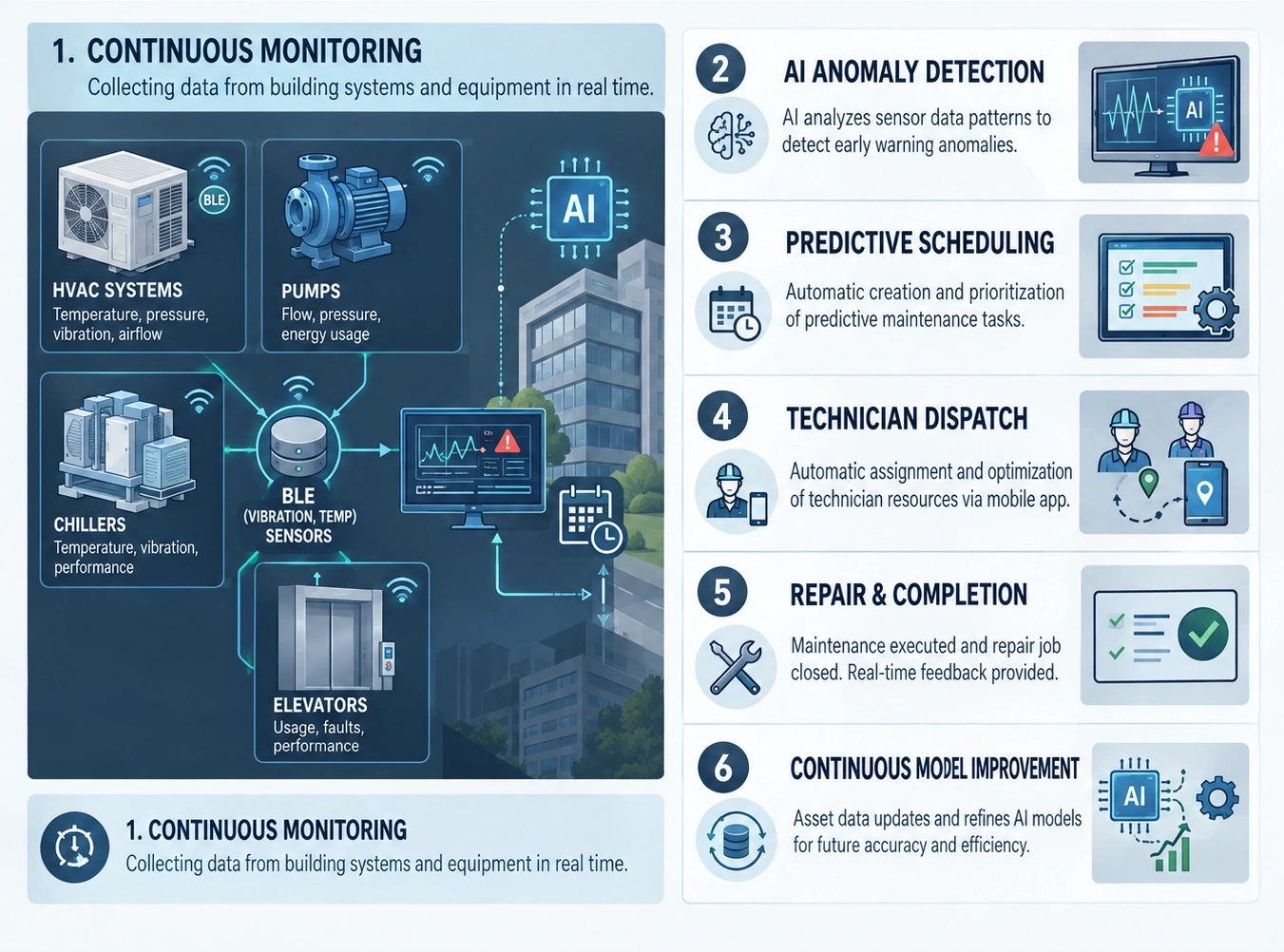
Maintenance teams receive recommendations before failures affect tenants or building operations.
AI-Powered Predictive Maintenance Lifecycle
Occupancy Intelligence and Space Utilization
Commercial buildings experience constantly changing occupancy patterns.
BLE occupancy sensors combined with AI help facility managers:
- Analyze conference room utilization
- Measure workspace occupancy
- Optimize shared office layouts
- Improve desk reservation strategies
- Reduce energy waste
- Identify underutilized tenant spaces
- Support hybrid workplace planning
Property owners can make informed leasing and renovation decisions using long-term occupancy analytics.
Indoor Navigation and Visitor Experience
Large office campuses, hospitals, shopping centers, airports, and mixed-use developments present navigation challenges.
BLE beacons support indoor positioning while AI enhances navigation by:
- Recommending efficient routes
- Guiding visitors to meeting rooms
- Directing maintenance personnel
- Locating emergency exits
- Supporting accessibility requirements
- Reducing visitor confusion
Environmental Monitoring
Occupant comfort directly affects tenant satisfaction.
BLE environmental sensors monitor:
- Indoor temperature
- Relative humidity
- Carbon dioxide
- Indoor air quality
- Particulate matter
- Noise levels
- Lighting conditions
AI identifies environmental trends that may reduce occupant comfort while recommending HVAC adjustments or ventilation improvements.
Energy Optimization
Commercial properties consume significant electrical energy.
AI combines data from:
- BLE occupancy sensors
- Building automation systems
- Smart meters
- Lighting systems
- HVAC equipment
- Weather information
The AI system predicts occupancy demand and automatically recommends energy-saving strategies while maintaining occupant comfort.
Security and Access Monitoring
AI-assisted BLE monitoring enhances physical security by correlating information from:
- BLE-enabled credentials
- Access control systems
- Security cameras
- Door sensors
- Visitor management software
- Building alarms
Suspicious access patterns can be identified more rapidly than traditional rule-based monitoring.
Cleaning and Facility Service Optimization
Cleaning schedules based solely on time frequently waste labor resources.
AI uses occupancy information collected from BLE sensors to:
- Prioritize heavily used areas
- Schedule cleaning dynamically
- Optimize workforce allocation
- Reduce unnecessary inspections
- Improve restroom servicing
- Support sustainability initiatives
Operational Workflow for AI-Driven Commercial Property Management
Effective AI-enabled commercial property management depends on a structured operational workflow that transforms distributed building data into intelligent operational decisions.
Data Acquisition
BLE sensors, BLE beacons, smart meters, environmental sensors, equipment controllers, access control devices, and Building Management Systems continuously generate operational data.
Collected information may include:
- Occupancy counts
- Equipment temperature
- Equipment vibration
- Indoor air quality
- Asset location
- Door status
- Energy consumption
- Elevator activity
- Water consumption
- Lighting utilization
Local Communication
BLE devices transmit low-power wireless data to strategically positioned BLE gateways throughout the property.
Gateway placement considers:
- Building layout
- Wall construction
- Elevator shafts
- Signal interference
- Multi-floor communication
- Network redundancy
Reliable wireless coverage ensures consistent data availability for AI processing.
Edge Processing
Edge servers located within the commercial property perform initial processing by:
- Filtering duplicate data
- Validating sensor readings
- Detecting communication failures
- Compressing operational information
- Executing latency-sensitive AI models
- Triggering immediate operational alerts
Edge intelligence reduces response time for critical facility events.
Enterprise Software Integration
Processed operational data integrates with existing business systems, including:
- Computerized Maintenance Management Systems (CMMS)
- Integrated Workplace Management Systems (IWMS)
- Building Management Systems (BMS)
- Computer-Aided Facility Management (CAFM)
- Enterprise Resource Planning (ERP)
- Energy Management Systems (EMS)
- Security Information Management software
- Help desk systems
- Tenant service management software
Integration enables facility managers to access AI-generated insights within familiar operational workflows instead of switching between disconnected applications.
AI Analytics
Artificial Intelligence evaluates historical and real-time information using multiple analytical techniques, including:
- Predictive maintenance models
- Occupancy forecasting
- Time-series analysis
- Anomaly detection
- Pattern recognition
- Energy optimization algorithms
- Equipment health scoring
- Demand forecasting
The AI system continuously improves prediction accuracy as more operational data becomes available.
Operational Decision Support
AI-generated recommendations support facility teams by helping prioritize:
- Preventive maintenance
- Space allocation
- Energy optimization
- Capital improvement planning
- Workforce scheduling
- Asset replacement
- Tenant comfort improvements
- Operational risk reduction
Instead of replacing facility managers, AI improves decision quality by providing continuously updated operational intelligence.
BLE Technology, AI Models, Software, and System Components for Commercial Property Management
Artificial intelligence delivers the greatest operational value when supported by reliable, continuous data collection. Within commercial property management, Bluetooth Low Energy (BLE) gateways, BLE beacons, and BLE sensors provide an energy-efficient method for collecting operational data from assets, equipment, occupied spaces, and environmental conditions. Rather than operating as isolated devices, these components work together with building software, edge computing, enterprise applications, and AI analytics to create an intelligent property management solution.
Commercial office towers, mixed-use developments, shopping centers, healthcare campuses, hotels, educational facilities, and business parks each have different operational priorities. The hardware selection, communication design, and AI processing strategy should therefore align with building size, occupancy density, maintenance objectives, and cybersecurity requirements rather than adopting a one-size-fits-all approach.
GAO has supported organizations by supplying industrial BLE hardware and IoT systems that integrate with existing commercial property management software while minimizing disruption to daily building operations.
BLE Beacons
BLE beacons periodically transmit unique identifiers that enable AI software to determine the approximate location of tagged assets and mobile equipment.
Typical commercial property applications include:
- Maintenance tool tracking
- Cleaning equipment location
- Security patrol verification
- Emergency equipment monitoring
- Visitor navigation
- Conference equipment tracking
- Portable medical equipment location within healthcare facilities
- Parking asset identification
Battery-powered BLE beacons typically operate for several years depending on transmission interval, signal strength, environmental conditions, and battery capacity, making them suitable for large commercial buildings where maintenance access may be limited.
AI-Powered Occupancy Optimization
BLE Sensors
BLE sensors extend asset visibility by collecting operational measurements from equipment and indoor environments.
Common sensor types include:
- Temperature sensors
- Relative humidity sensors
- Vibration sensors
- Air quality sensors
- Carbon dioxide sensors
- Light level sensors
- Occupancy sensors
- Motion detectors
- Door and window sensors
- Water leak sensors
- Pipe temperature sensors
- Refrigeration monitoring sensors
These measurements allow AI models to evaluate equipment condition, environmental quality, energy consumption, occupant comfort, and facility performance without requiring manual inspections.
BLE Gateways
BLE gateways serve as communication bridges between distributed BLE devices and centralized software systems.
Typical gateway responsibilities include:
- Receiving BLE transmissions
- Aggregating sensor data
- Performing local filtering
- Encrypting communications
- Forwarding information to edge servers
- Supporting remote device management
- Monitoring gateway health
- Managing firmware updates
Commercial properties often deploy gateways strategically throughout office floors, utility rooms, equipment spaces, parking garages, and common areas to ensure reliable wireless coverage while minimizing signal interference.
AI Models Supporting Intelligent Property Operations
Artificial Intelligence uses multiple analytical techniques because commercial property operations involve diverse operational objectives rather than a single prediction task.
Predictive Maintenance Models
Historical equipment behavior is analyzed to estimate remaining useful life and identify early signs of failure.
Typical monitored equipment includes:
- Chillers
- Air handling units
- Cooling towers
- Pumps
- Boilers
- Elevators
- Escalators
- Backup generators
- Electrical switchgear
- Variable frequency drives
AI evaluates trends such as increasing vibration, abnormal temperatures, changing operating cycles, and energy consumption to recommend maintenance before failures occur.
Occupancy Analytics
Occupancy prediction models analyze:
- Historical attendance
- Daily schedules
- Seasonal trends
- Meeting room reservations
- Holiday patterns
- Tenant usage behavior
Facility managers use these insights to improve:
- Workspace allocation
- HVAC scheduling
- Lighting control
- Cleaning operations
- Space planning
Energy Optimization Models
Machine learning continuously evaluates relationships between:
- Outdoor weather
- Occupancy
- HVAC performance
- Utility pricing
- Equipment efficiency
- Building operating schedules
The AI software recommends operating adjustments that reduce energy consumption while maintaining occupant comfort.
Anomaly Detection
Anomaly detection algorithms identify operational behavior that differs from established building patterns.
Examples include:
- Unexpected equipment shutdowns
- Continuous HVAC operation
- Water leaks
- Unauthorized occupancy
- Electrical load spikes
- Elevator performance degradation
- Sensor failures
- Network communication interruptions
Commercial Property Management Software Integration
Successful AI implementation depends on integrating operational intelligence with existing business software rather than introducing disconnected monitoring tools.
Frequently integrated systems include:
- Building Management Systems (BMS)
- Computerized Maintenance Management Systems (CMMS)
- Integrated Workplace Management Systems (IWMS)
- Computer-Aided Facility Management (CAFM)
- Enterprise Resource Planning (ERP)
- Energy Management Systems (EMS)
- Visitor Management Systems
- Access Control Systems
- Security Information and Event Management (SIEM)
- Digital Twin software
- Geographic Information Systems (GIS)
- Asset Management software
- Work Order Management software
- Utility Billing software
Integration enables maintenance teams, property managers, energy managers, and security personnel to access AI recommendations within their existing operational workflows.
Communication Technologies Supporting AI-Based Commercial Property Management
BLE forms one component of the communication infrastructure supporting intelligent buildings.
Additional communication technologies may include:
- Ethernet
- Wi-Fi
- BACnet
- Modbus TCP
- MQTT
- HTTPS
- OPC UA
- Zigbee
- LoRaWAN
- Cellular LTE
- 5G
- IPv6 networking
- SNMP
Protocol selection depends on equipment compatibility, required latency, cybersecurity policies, and existing building infrastructure.
Interoperability between multiple communication standards allows property owners to modernize facilities incrementally rather than replacing all building systems simultaneously.
Cloud and Server Deployment Considerations
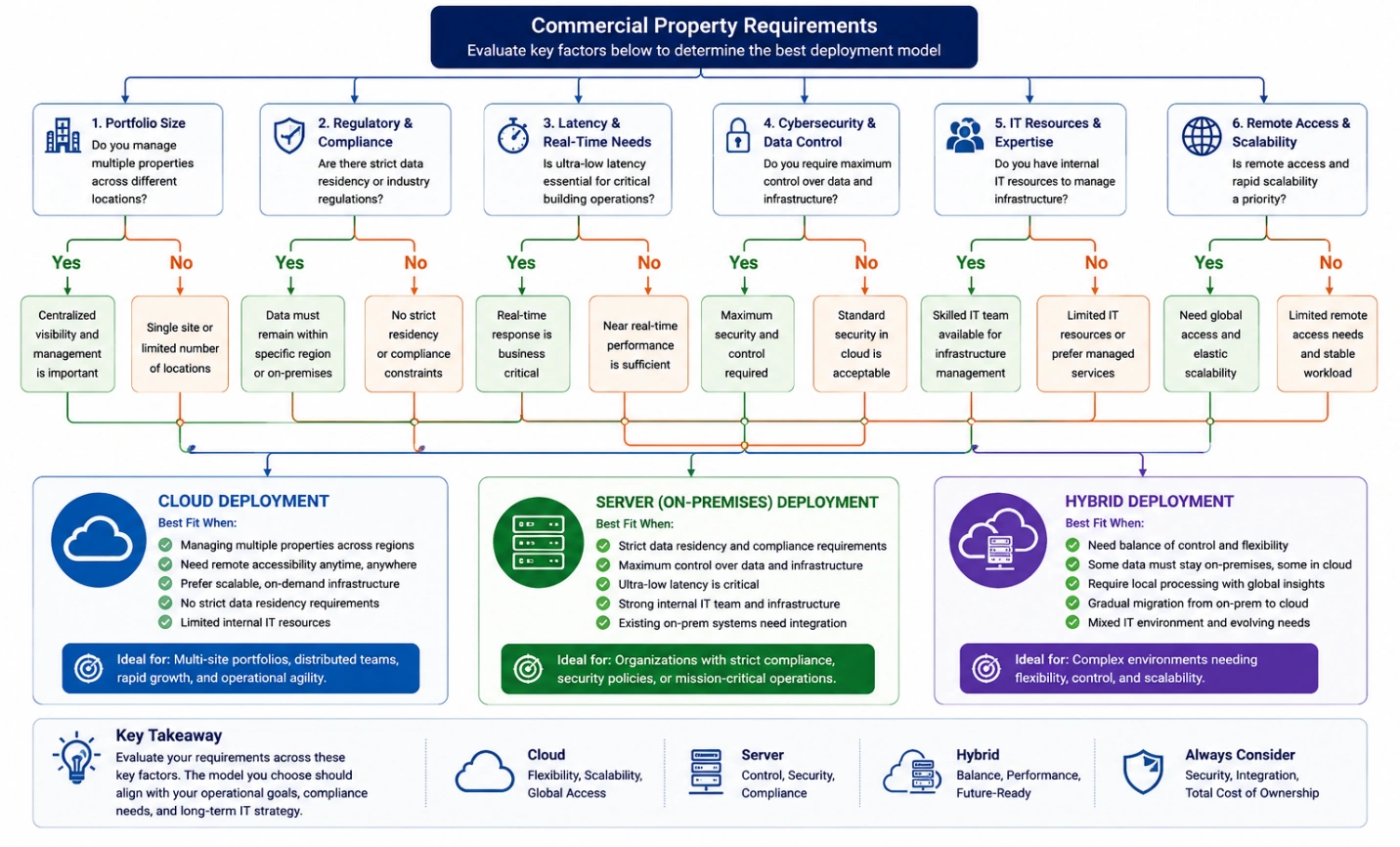
Commercial property portfolios vary significantly in operational scale, regulatory requirements, and IT governance. Selecting the appropriate deployment model depends on operational objectives, cybersecurity policies, available IT resources, and integration requirements.
Cloud Deployment
Cloud-hosted software is appropriate for organizations managing geographically distributed commercial properties.
Typical characteristics include:
- Centralized portfolio management
- Remote building monitoring
- Automatic software updates
- Elastic computing resources
- Simplified AI model deployment
- Multi-site reporting
- Disaster recovery capabilities
- Reduced local infrastructure requirements
Property owners responsible for office portfolios across multiple cities frequently benefit from centralized cloud management because operational data from numerous facilities can be analyzed collectively to identify portfolio-wide performance trends.
Server Deployment
Some organizations prefer customer-managed server deployments within private data centers, regional IT facilities, or dedicated edge servers.
Typical advantages include:
- Greater control over operational data
- Integration with existing internal systems
- Compliance with organizational cybersecurity policies
- Reduced external network dependency
- Lower latency for critical building operations
- Customized AI model deployment
- Greater control over software updates
Healthcare campuses, financial institutions, government facilities, research laboratories, and critical infrastructure properties frequently choose privately managed server deployments because operational data governance is often a strategic requirement.
Hybrid Deployment
Many commercial property organizations implement hybrid deployments that combine edge computing with cloud analytics.
Typical workflow:
- BLE devices collect operational information.
- Edge servers perform immediate processing.
- Critical alarms remain within the facility.
- Historical operational data synchronizes with cloud software.
- AI models analyze portfolio-wide trends.
- Facility managers receive centralized dashboards.
Hybrid deployment balances operational responsiveness with enterprise-wide analytics.
Cloud, Server, or Hybrid: Commercial Property Deployment Decision Tree
Cybersecurity and Data Protection
Commercial buildings increasingly rely on connected operational technology, making cybersecurity an essential design consideration throughout the deployment lifecycle.
Recommended engineering practices include:
- End-to-end encryption for device communications
- Secure authentication between BLE gateways and management software
- Role-based access control for facility personnel
- Multi-factor authentication for administrative users
- Digitally signed firmware updates
- Secure device provisioning
- Network segmentation between operational technology and corporate IT
- Continuous vulnerability assessments
- Security event logging and audit trails
- Regular certificate and encryption key rotation
Cybersecurity planning should begin during solution design rather than being introduced after deployment. Routine penetration testing, firmware lifecycle management, and compliance with organizational security policies help reduce operational risk while maintaining long-term system reliability.
Technical Capabilities and Engineering Advantages
Combining AI with BLE-enabled building intelligence provides measurable technical improvements across commercial property management.
Key capabilities include:
- Continuous asset visibility throughout multi-building facilities
- Predictive maintenance based on equipment condition rather than fixed schedules
- Occupancy-aware HVAC and lighting optimization
- Real-time environmental quality monitoring
- Indoor navigation for visitors and maintenance personnel
- Intelligent work order prioritization
- Automated equipment health scoring
- Faster incident detection and response
- Portfolio-wide performance benchmarking
- Reduced manual inspections through continuous monitoring
- Scalable support for thousands of connected devices across distributed commercial properties
Beyond operational efficiency, AI-driven insights enable property managers to make evidence-based decisions regarding capital planning, tenant services, energy conservation, and long-term asset lifecycle management. By integrating BLE-generated data with existing enterprise software, organizations can improve service quality while maintaining flexibility for future expansion and evolving building requirements.
Business Benefits of AI-Enabled Commercial Property Management
Artificial intelligence supported by BLE technology delivers measurable operational and financial value across the commercial property lifecycle. The greatest benefits are achieved when AI insights are integrated into daily facility management processes rather than treated as standalone analytics.
Improved Asset Visibility
Commercial buildings contain thousands of critical assets distributed across multiple floors, mechanical rooms, parking structures, and tenant spaces. AI combined with BLE location data enables facility teams to locate assets quickly, reducing time spent searching for maintenance equipment, emergency devices, cleaning machines, and portable IT assets.
Key improvements include:
- Reduced asset search time
- Improved equipment utilization
- Lower replacement costs for misplaced assets
- Better maintenance planning
- More accurate asset inventories
Higher Maintenance Efficiency
Condition-based maintenance allows facility teams to prioritize work based on actual equipment health instead of fixed maintenance intervals.
Benefits include:
- Reduced unplanned equipment failures
- Lower emergency repair costs
- Extended equipment service life
- Improved technician productivity
- Better spare parts planning
- Increased reliability of critical building systems
Better Energy Performance
Energy optimization models continuously analyze occupancy, weather conditions, equipment performance, and historical operating patterns.
Organizations may achieve:
- Lower electricity consumption
- Reduced HVAC operating costs
- Improved lighting efficiency
- Better demand management
- Lower greenhouse gas emissions
- Improved sustainability reporting
Enhanced Tenant Experience
Modern tenants expect commercial buildings to provide comfortable, responsive, and well-maintained environments.
AI supports improved tenant experiences through:
- Consistent indoor environmental quality
- Faster maintenance response
- Reduced equipment downtime
- Improved meeting room availability
- Better indoor navigation
- Enhanced building safety
Higher tenant satisfaction often contributes to stronger tenant retention and improved property value.
Improved Decision-Making
AI transforms large volumes of operational data into actionable recommendations.
Property managers gain visibility into:
- Building performance trends
- Equipment health
- Maintenance priorities
- Occupancy patterns
- Energy performance
- Capital investment requirements
- Operational risks
These insights support long-term planning based on measurable operational evidence rather than assumptions.
Scalability and Future Expansion
Commercial property portfolios often grow through acquisitions, new developments, or portfolio consolidation. AI-enabled BLE solutions should be designed with scalability in mind to accommodate additional buildings, devices, and operational requirements without major redesign.
Engineering considerations include:
- Modular deployment of BLE gateways and sensors
- Support for multi-building management
- Flexible software integration
- Standardized communication protocols
- Centralized device management
- Remote firmware updates
- Expandable storage and computing resources
A scalable solution enables organizations to extend intelligent building capabilities across office campuses, retail centers, healthcare facilities, hospitality properties, and mixed-use developments while maintaining consistent operational practices.
Implementation Best Practices
Successful deployment requires careful planning across technical, operational, and organizational disciplines. Organizations should begin with clearly defined business objectives and measurable performance indicators before selecting hardware or software components.
Recommended practices include:
- Conduct a comprehensive site survey to evaluate building layout, wireless coverage, and potential sources of signal interference.
- Define operational goals such as predictive maintenance, occupancy analytics, energy optimization, or asset tracking before deployment.
- Select BLE devices appropriate for environmental conditions, battery life requirements, and communication range.
- Integrate AI insights with existing CMMS, IWMS, BMS, ERP, and security systems to reduce operational complexity.
- Validate AI models using representative operational data before full-scale deployment.
- Establish device lifecycle management procedures covering installation, calibration, firmware updates, battery replacement, and decommissioning.
- Develop cybersecurity policies for device authentication, network segmentation, encryption, and user access management.
- Train facility managers, maintenance personnel, and IT teams to interpret AI recommendations and respond appropriately.
- Continuously review key performance indicators and refine AI models as operational conditions evolve.
Organizations that adopt a phased deployment strategy typically experience smoother implementation, lower operational risk, and better long-term performance.
GAO works with organizations by supplying BLE hardware products and IoT systems while providing technical guidance for planning, deployment, integration, testing, and ongoing operational support.
Key Technical Insights
AI-enabled commercial property management is transforming how buildings are monitored, maintained, and optimized. By combining AI with BLE gateways, beacons, and sensors, property managers gain continuous visibility into assets, environmental conditions, occupancy, and equipment performance.
The combination of edge computing, cloud or privately managed server deployments, enterprise software integration, and machine learning enables proactive maintenance, improved energy efficiency, enhanced tenant experiences, and data-driven operational planning. Proper system design, cybersecurity, interoperability, and scalability remain essential to achieving long-term success.
Organizations evaluating intelligent building solutions should prioritize clearly defined operational objectives, compatible communication technologies, secure deployment practices, and integration with existing facility management software. A structured implementation approach allows commercial property owners to improve operational resilience while maximizing the value of their existing infrastructure investments.
With headquarters in New York City and Toronto, Canada, GAO is recognized among the world’s leading B2B suppliers of BLE and RFID technologies. For more than three decades, GAO and its sister companies, GAO Research and GAO Tek, have supported Fortune 500 companies, research institutions, universities, and government organizations across the United States and Canada through sustained investment in research and development, rigorous quality assurance, and expert technical support.
To learn more about AI-enabled commercial property management solutions, BLE hardware products, and engineering expertise, contact GAO to discuss your technical requirements and deployment objectives.
Building the Future of Industrial AI and IoT with Aperture Venture Studio and GAO
For more than three decades, GAO Group of Companies has invested extensively in the research and development of industrial BLE, RFID, and IoT technologies that support intelligent commercial property management and other mission-critical applications. As generative AI has matured for industrial use, we have expanded our focus on AIoT solutions that combine AI with BLE, RFID, connected sensors, and intelligent building systems. To further accelerate innovation in AI and IoT solutions for commercial property management and other industries, we founded Aperture Venture Studio to help advance and scale practical AI and IoT technologies.
Aperture has attracted highly experienced AI researchers, IoT engineers, operational executives, industry experts, investors, and leading technology organizations. We have also established the successful Aperture Ventures Summit and TekSummit, bringing together professionals to explore emerging developments in artificial intelligence, industrial IoT, BLE, RFID, intelligent building technologies, and digital transformation.
These initiatives have helped foster strong technical communities and collaborative relationships across AI and IoT. We welcome opportunities to engage with:
- Advisors, co-founders, and employees
- Investors
Customers seeking advanced AI and IoT solutions