
AI and BLE for Commercial Vehicle Assembly
AI-Driven Commercial Vehicle Assembly with BLE-Enabled Visibility
AI and IoT are increasingly being used in commercial vehicle assembly to connect production data with real-time operational decisions. AI can analyze assembly-cycle data, component movement, torque records, quality results, equipment conditions, and production events to identify deviations and improve manufacturing decisions. BLE beacons, BLE sensors, and BLE gateways provide a practical wireless data layer for tracking mobile assets, work-in-process vehicles, tools, material containers, and selected production conditions. For commercial vehicle manufacturers, the combination supports applications such as AI-assisted assembly verification, tool and fixture monitoring, work-in-process traceability, line-side inventory control, predictive maintenance, and production-flow optimization. GAO supplies BLE, RFID, and IoT hardware products and systems that can be incorporated into these manufacturing workflows. The resulting solution can connect shop-floor observations with MES, ERP, quality management, maintenance, and analytics software while supporting edge or server-based processing.
Why AI Matters in Commercial Vehicle Assembly
Commercial vehicle assembly differs from many high-volume manufacturing environments because production can involve multiple vehicle configurations, long assembly sequences, variant-specific components, heavy tooling, specialized workstations, and significant manual activity. A single production line may handle trucks, buses, vocational vehicles, or other commercial configurations with different chassis, powertrain, body, electrical, and interior requirements.
AI becomes useful when the manufacturing system must interpret large volumes of operational data rather than simply record individual events.
For example, an AI model can correlate:
Vehicle identification with its build configuration and bill of materials
Workstation cycle time with takt-time requirements
Torque-tool results with specific fasteners, operators, and vehicle units
BLE location events with WIP movement between assembly zones
Tool utilization with battery condition, calibration status, and maintenance records
Part-container locations with line-side consumption
Equipment sensor readings with abnormal operating conditions
Inspection results with production parameters and recurring defects
This creates an AI-assisted decision process in which production data can be transformed into alerts, predictions, recommendations, or automated actions.
BLE is particularly useful where commercial vehicle assembly requires wireless identification or location information without installing a wired connection on every mobile object. BLE sensors can also capture selected conditions, while gateways collect nearby transmissions and forward the resulting data to manufacturing software.
AI and BLE Architecture for Commercial Vehicle Assembly
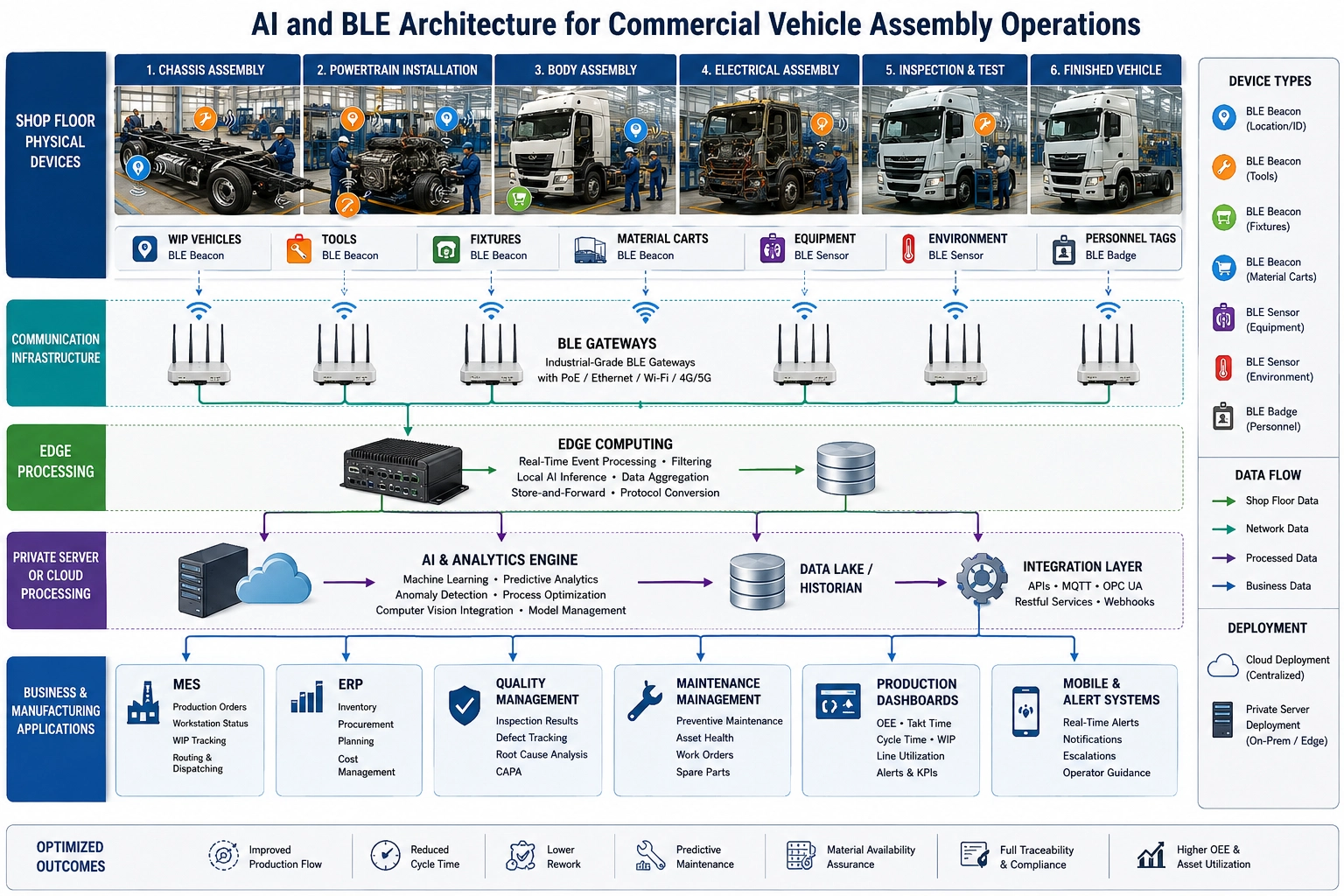
The diagram shows how BLE-enabled vehicles, tools, fixtures, material carts, and equipment connect through gateways and edge processing to AI analytics and manufacturing systems. It highlights integration with MES, ERP, quality, maintenance, production dashboards, and alert systems.
Commercial Vehicle Assembly Applications for AI and BLE
AI-Assisted Work-in-Process Vehicle Tracking
Commercial vehicle assembly requires visibility into where each chassis or partially assembled vehicle is located and which production stage it has reached. BLE tags or beacons can be associated with vehicles, carriers, or production assets, while gateways positioned around assembly zones capture proximity events.
AI can use these events alongside MES production records to identify abnormal dwell times, missed process transitions, congestion, or vehicles that remain too long in a particular assembly area.
A practical implementation does not treat a BLE location event as proof that an assembly operation has been completed. Location information should instead be correlated with authoritative production transactions such as workstation completion, barcode or RFID reads, torque records, inspection results, or operator confirmations.
This distinction is important because BLE proximity generally provides zone-level or relative location information rather than the deterministic process confirmation required for quality records.
AI-Driven Assembly Quality Monitoring
Commercial vehicles contain many safety-critical and performance-critical assemblies, including braking systems, steering components, suspension systems, wheel-end components, electrical connections, and powertrain-related components. AI can analyze inspection results and process measurements to identify patterns associated with defects or rework.
BLE-enabled tools and sensors can contribute contextual information such as tool presence, equipment condition, workstation activity, or environmental measurements. The AI system can then associate these observations with the affected vehicle or production stage.
For example, if repeated quality deviations occur at a particular workstation, analytics can compare the affected units with tool usage, cycle time, environmental conditions, component batches, and maintenance records. This can help manufacturing engineers investigate whether the issue is associated with equipment, material, process variation, or operator workflow.
Tool and Fixture Visibility
Commercial vehicle assembly relies on specialized torque tools, lifting equipment, fixtures, diagnostic devices, welding equipment, battery tools, and other production assets. Losing a critical tool can interrupt a workstation and create unnecessary search time.
BLE beacons attached to mobile tools can provide location or proximity information through gateways. A manufacturing application can show the last detected zone, current availability, or movement history.
AI can extend this capability by analyzing utilization patterns. For example, repeated idle periods, unusually frequent movement, or increasing tool usage at particular stations can support decisions about tool allocation and maintenance.
Tool location should not replace formal calibration controls. Calibration status, maintenance records, and tool configuration should remain managed through the appropriate quality or maintenance system.
AI-Based Line-Side Material Management
Commercial vehicle assembly uses large numbers of components and subassemblies, including harnesses, fasteners, brackets, seats, instrument panels, body components, axles, wheels, batteries, and configuration-specific parts.
BLE sensors and tags can help monitor selected material containers, carts, racks, or mobile replenishment assets. AI can combine these observations with consumption records and production schedules to identify potential shortages before they interrupt the line.
The strongest implementation connects wireless observations with the material-management system rather than treating BLE detection as an independent inventory database.
Predictive Maintenance for Assembly Equipment
Assembly operations depend on conveyors, lifts, torque equipment, fastening systems, robotic equipment, compressors, welding equipment, test stations, and material-handling machinery. AI-based predictive maintenance can analyze equipment telemetry, maintenance history, operating cycles, alarms, and sensor readings to detect abnormal behavior.
BLE sensors can supplement fixed industrial sensors where wireless measurement is practical. For example, temperature, vibration, or utilization information from selected mobile or difficult-to-wire equipment can provide additional context.
The maintenance system should establish clear thresholds for automated alerts. A machine-learning anomaly score can identify unusual behavior, but maintenance engineers still need actionable evidence before taking equipment out of production.
AI-Powered BLE Use Cases in Commercial Vehicle Assembly
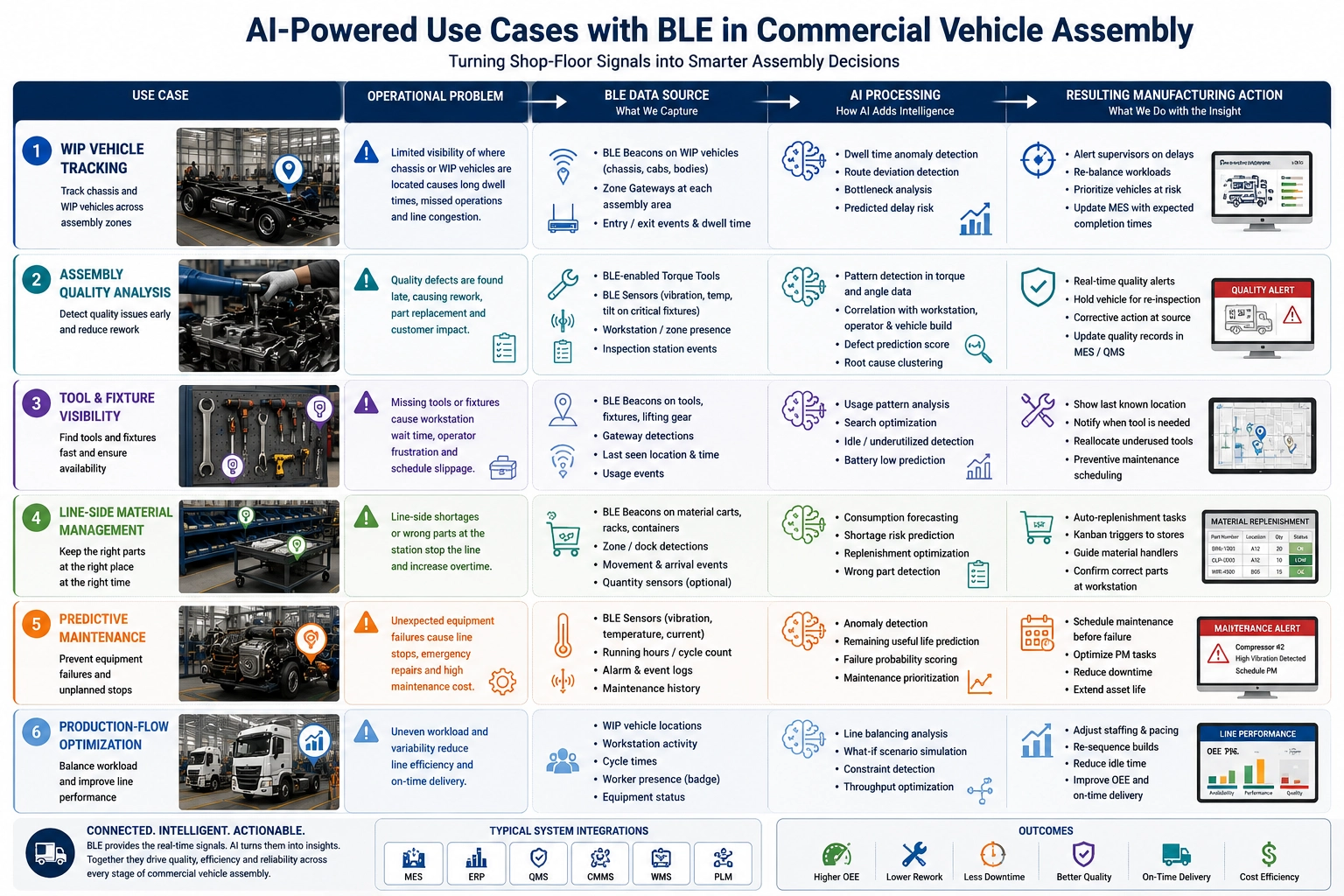
This infographic shows six commercial vehicle assembly applications where BLE data is combined with AI to improve WIP tracking, quality analysis, tool visibility, material replenishment, predictive maintenance, and production-flow optimization. It also illustrates how these insights connect with MES, ERP, QMS, CMMS, WMS, and PLM systems.
Commercial Vehicle Assembly Workflow from Data Capture to AI Decision
A practical AIoT solution for commercial vehicle assembly should follow the actual manufacturing information flow rather than treating sensors and analytics as isolated technologies.
Data Acquisition at the Assembly Line
Data begins with physical events and manufacturing transactions. Depending on the application, sources can include BLE sensors, BLE beacons, torque tools, PLCs, machine controllers, barcode readers, RFID readers, inspection equipment, operator terminals, MES transactions, and maintenance systems.
BLE is most appropriate where wireless identification, proximity, movement, or selected sensor measurements are needed. It should not be selected simply because wireless connectivity is available.
BLE Communication and Gateway Collection
BLE gateways receive advertisements or sensor data from nearby BLE devices. Gateway placement should account for metal chassis structures, enclosed production areas, electromagnetic interference, antenna orientation, device density, and required detection zones.
Commercial vehicle assembly presents a particularly important RF consideration because large metal structures can affect radio propagation. A gateway deployment that works in an open test area may behave differently beside a completed chassis, cab, trailer body, or metal rack.
Site surveys and production-floor testing should therefore be performed under representative operating conditions.
Edge Processing and Data Normalization
Gateway data normally requires filtering, timestamp normalization, device identification, signal processing, and association with production zones. Edge computing can perform these tasks close to the manufacturing line.
Edge processing is valuable when the assembly operation requires low-latency alerts or when the manufacturer wants local operation during temporary network disruption.
The edge system can also remove duplicate BLE events and convert raw wireless observations into higher-level events such as:
Vehicle entered chassis assembly zone
Tool detected at workstation
Material cart entered replenishment area
Sensor reported abnormal temperature
Asset remained stationary beyond the configured dwell period
Middleware and Manufacturing-System Integration
Normalized events can be transferred through APIs, MQTT, OPC UA, database interfaces, or other integration mechanisms, depending on the existing manufacturing environment.
The solution may exchange information with MES, ERP, warehouse management, computerized maintenance management systems, quality management software, manufacturing execution databases, and production dashboards.
A critical engineering practice is to establish a consistent identity model. A vehicle identifier, workstation identifier, tool identifier, material identifier, and BLE device identifier should have clear relationships so that AI models do not receive ambiguous or conflicting records.
AI Analytics and Manufacturing Decisions
Once operational data is normalized, AI can perform classification, anomaly detection, forecasting, regression, clustering, or other analytical tasks.
Commercial vehicle assembly applications may use:
Time-series models for cycle-time and equipment-condition analysis
Anomaly-detection models for abnormal workstation behavior
Regression models for production-cycle prediction
Classification models for quality-risk assessment
Computer vision for assembly and inspection verification
Optimization methods for material replenishment and production sequencing
Predictive models for maintenance-risk estimation
The output should be connected to a defined manufacturing action. An AI prediction that does not influence a production, maintenance, quality, or logistics decision provides limited operational value.
AI and BLE Workflow for Commercial Vehicle Assembly
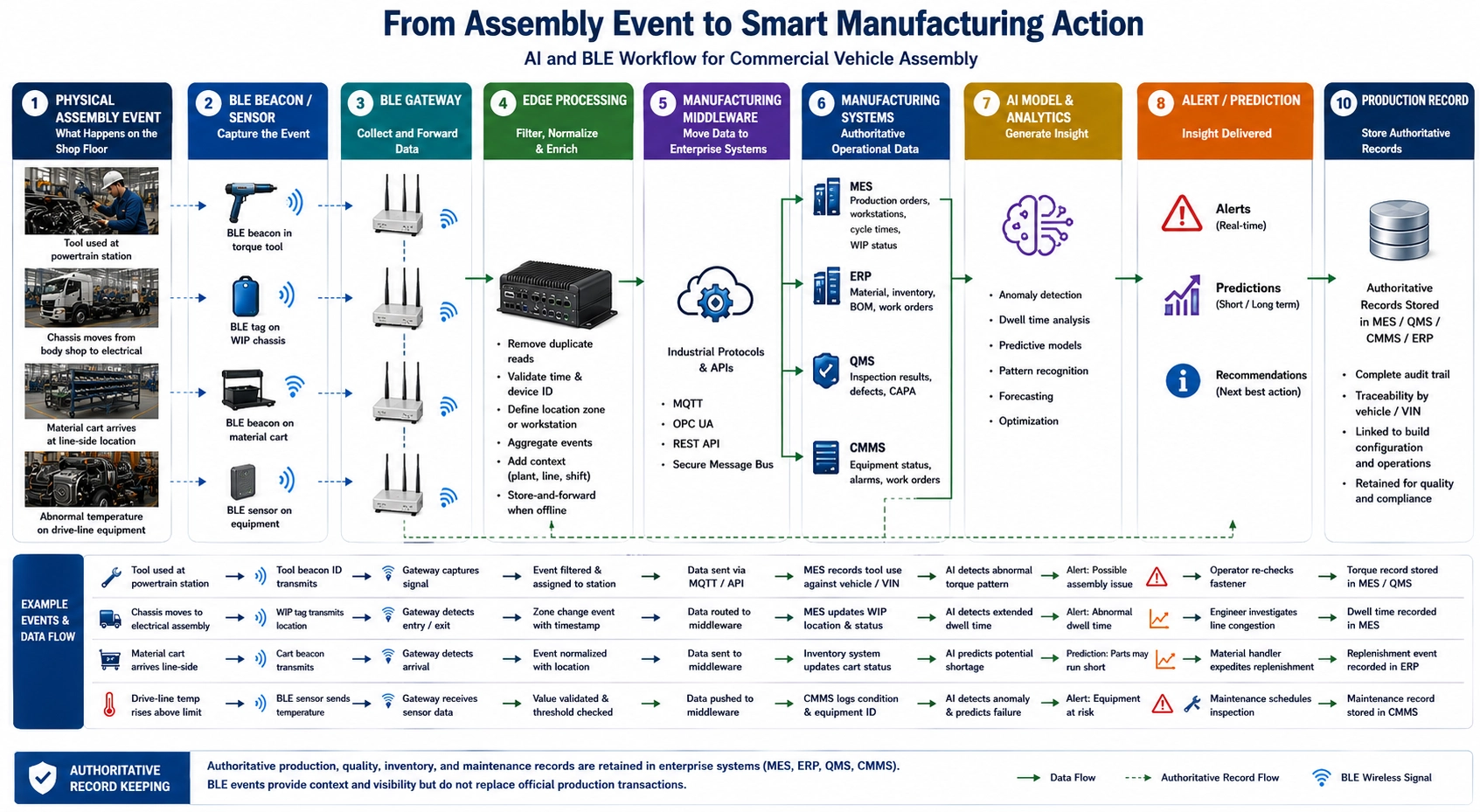
This workflow diagram traces commercial vehicle assembly data from physical events such as tool usage, chassis movement, material-cart arrival, and equipment temperature changes through BLE sensing, gateway collection, edge processing, manufacturing systems, AI analytics, and operational actions. It also shows how authoritative production, quality, inventory, and maintenance records remain stored in MES, ERP, QMS, and CMMS systems.
Technical Foundation for Commercial Vehicle Assembly
The technical design should begin with the manufacturing problem, required decision latency, data ownership, existing systems, RF environment, and required accuracy. BLE gateways, beacons, and sensors are enabling components rather than substitutes for MES, quality management, maintenance, or production-control systems.
BLE Hardware for Assembly Operations
BLE beacons can identify vehicles, tools, fixtures, carts, or other mobile assets. BLE sensors can capture selected measurements where battery-powered wireless sensing is practical. BLE gateways collect nearby transmissions and forward data to the processing environment.
GAO provides BLE and IoT hardware that can support these types of industrial deployments, allowing system integrators and manufacturing teams to select devices according to range, battery life, enclosure requirements, sensor capability, mounting method, and operating environment.
Hardware selection should consider temperature, vibration, dust, mechanical impact, cleaning procedures, battery replacement access, and the presence of metal structures around commercial vehicle production.
Communication and Integration Protocols
BLE handles the short-range wireless communication between devices and gateways. The gateway-to-software connection can use IP networking and application-level protocols appropriate to the manufacturer’s environment.
MQTT can be useful for lightweight telemetry distribution, while OPC UA is commonly relevant when manufacturing equipment and industrial automation systems need structured machine data exchange. REST APIs can support integration with business and manufacturing applications.
The correct combination depends on the existing controls and software environment. A new wireless solution should integrate with established manufacturing data flows instead of creating a parallel information silo.
Edge AI and Centralized Processing
Edge AI is appropriate when commercial vehicle assembly requires rapid local decisions, limited dependence on external connectivity, or local processing of sensitive production information. A factory server or edge computer can process gateway events and execute selected AI models close to the production line.
Centralized processing can provide greater computational resources for historical analysis, model training, cross-line comparisons, and long-term production analytics.
A hybrid approach is often practical: real-time event processing remains close to the assembly line while larger analytics workloads operate on a private server or cloud environment.
Cybersecurity and Data Protection
Wireless manufacturing systems should be incorporated into the plant’s broader cybersecurity program. Security controls should include device authentication where supported, protected gateway communications, network segmentation, role-based access, secure credential management, software patching, logging, and controlled API access.
Production systems should also distinguish operational data from personally identifiable information. If operator identity is associated with production events, access should be controlled according to the manufacturer’s data-governance requirements.
GAO’s hardware and systems can be evaluated as part of a broader deployment in which cybersecurity responsibilities are shared among device suppliers, system integrators, IT teams, OT engineers, and software providers.
Cloud Version and Server Version Deployment
The Cloud Version is suitable when commercial vehicle manufacturers need centralized access to production analytics across multiple plants, production lines, or assembly facilities. Cloud-hosted software can support centralized AI model management, historical data analysis, dashboard access, and software updates while reducing the need for each facility to maintain the complete application stack.
The Server Version is appropriate when production data must remain within customer-managed infrastructure, when factory connectivity is constrained, or when the manufacturing organization requires direct control over computing resources. The server may operate on a factory server, edge server, private data center, or other privately hosted infrastructure.
A hybrid deployment can place time-sensitive BLE event processing and selected AI inference close to the assembly line while sending approved historical data to centralized computing resources. This approach can reduce latency without forcing every manufacturing function into the same processing environment.
Engineering Considerations for BLE Deployment on Vehicle Assembly Lines
Commercial vehicle assembly introduces several conditions that should be addressed before commissioning a BLE system.
Metal-rich production environments: Chassis frames, cabs, body panels, racks, and tooling can reflect or attenuate radio signals. Gateway placement should therefore be validated using real production vehicles rather than relying exclusively on theoretical range.
Zone definition: If the requirement is workstation-level visibility, gateways should be positioned to produce sufficiently distinct detection zones. A basic proximity event should not be presented as centimeter-level positioning.
Device density: Large assembly facilities can contain many BLE devices operating simultaneously. The gateway and network design should account for expected device counts, advertising intervals, scanning behavior, and data throughput.
Battery management: Battery-powered beacons and sensors require a maintenance strategy covering expected battery life, replacement intervals, spare inventory, and low-battery alerts.
Mounting and durability: Devices attached to tools, fixtures, carts, or vehicles need mounting methods compatible with vibration, impact, cleaning procedures, and normal material-handling activities.
Process correlation: BLE events should be correlated with vehicle IDs, workstation IDs, production orders, and other authoritative manufacturing records.
RF validation: Commissioning should include signal testing during actual assembly operations, including conditions where multiple vehicles and metal components occupy the production area.
GAO can support organizations evaluating BLE hardware for these manufacturing conditions, while system integrators and plant engineering teams can determine gateway placement, network configuration, software integration, and commissioning requirements.
BLE Gateway RF Deployment for Commercial Vehicle Assembly
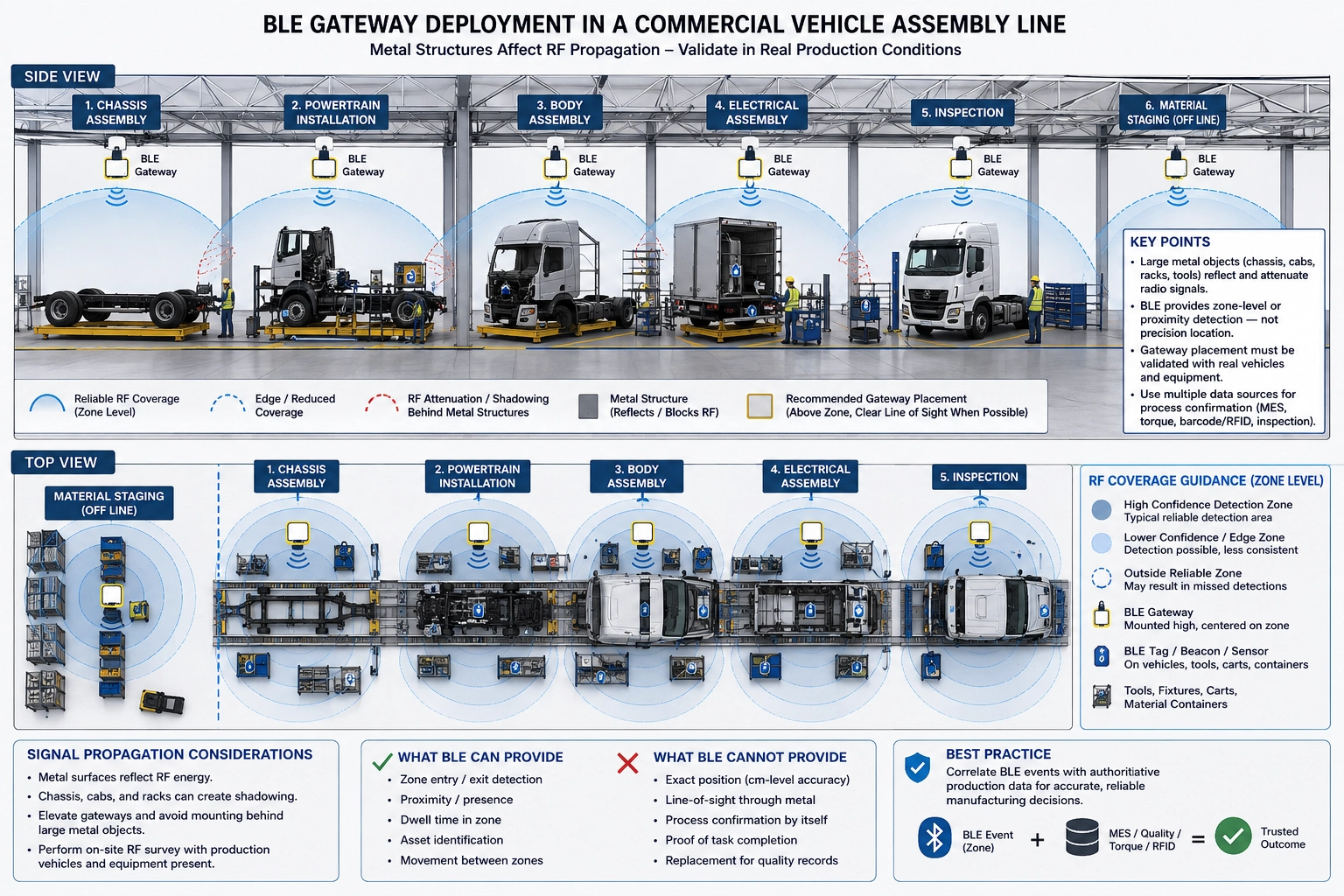
Technical side- and top-view illustration showing BLE gateway placement, RF coverage zones, metal-induced signal attenuation, and reliable zone-level detection across a commercial vehicle assembly line.
AI-Driven Improvements in Commercial Vehicle Assembly
Production Flow and Takt-Time Optimization
AI can analyze workstation completion events, cycle times, vehicle configurations, labor requirements, and WIP movement to identify production bottlenecks.
A commercial vehicle assembly line may experience longer cycles when a particular configuration requires additional wiring, specialized equipment, or extra inspection steps. AI can distinguish recurring configuration-related variation from abnormal delays.
BLE location events can provide supplementary evidence about vehicle dwell time and movement between zones. Combining this information with MES production records gives manufacturing engineers a more complete view of where production flow is slowing.
Assembly Sequence and Process Compliance
AI can help identify deviations from expected assembly sequences by comparing production events against the defined manufacturing process.
For example, an analytics system may detect that a vehicle moved from one production zone to another without an expected process transaction. This should generate an investigation or workflow exception rather than automatically assuming that the assembly operation was missed.
Computer vision, torque data, barcode or RFID identification, operator input, and MES transactions can provide additional evidence. BLE contributes contextual location information that helps associate events with physical work areas.
Predictive Quality and Rework Reduction
AI can analyze historical defects, rework codes, inspection measurements, component information, process parameters, and production conditions to identify factors associated with quality problems.
For commercial vehicle assembly, this can be particularly useful for recurring issues involving wiring, fastening, component fitment, body alignment, fluid systems, or configuration-specific assemblies.
A predictive model can prioritize vehicles or workstations for additional inspection. Quality engineers should validate the model before using its output as a production-control decision.
Intelligent Material Replenishment
Line-side material shortages can interrupt assembly even when inventory exists elsewhere in the plant. AI can forecast consumption from production schedules, historical usage, vehicle configurations, and current WIP.
BLE-tagged material carts and containers can provide location context. A replenishment system can use this information to determine whether a required container is at the correct staging area, moving toward the line, or outside its expected zone.
The objective is not simply to locate containers. The higher-value objective is to predict when material availability could affect a specific assembly sequence and initiate replenishment early enough to protect takt time.
Maintenance and Asset Utilization
AI-based maintenance analytics can identify abnormal patterns in assembly equipment before they result in an unplanned stoppage. BLE can supplement fixed equipment telemetry by identifying mobile tools and tracking selected equipment utilization.
For example, tool usage history can be correlated with calibration schedules, maintenance events, battery condition, and workstation demand. Maintenance teams can use these relationships to prioritize inspections and manage spare equipment.
Commercial Vehicle Assembly KPIs for AIoT Deployment
The effectiveness of an AI and BLE solution should be measured against manufacturing outcomes rather than device counts.
KPI
Commercial Vehicle Assembly Application
Potential Data Sources
Takt-time adherence
Measures whether vehicle production keeps pace with planned demand
MES, workstation events
Cycle-time variance
Identifies abnormal assembly duration
MES, operator systems, BLE events
WIP dwell time
Detects vehicles waiting between assembly stages
BLE, MES
First-pass yield
Measures vehicles completing a process without rework
Quality system, MES
Rework rate
Tracks additional work required after inspection
Quality system
Tool utilization
Identifies underused or overburdened tools
BLE, tool controllers
Line stoppage duration
Measures production loss associated with interruptions
MES, PLC, maintenance
Material shortage events
Measures interruptions caused by unavailable components
Inventory system, BLE
Preventive maintenance compliance
Tracks scheduled maintenance execution
CMMS
Mean time between failures
Measures equipment reliability
Maintenance system
Mean time to repair
Measures restoration speed after equipment failure
CMMS
Traceability completeness
Measures whether required production events are recorded
MES, quality system
Assembly defect rate
Tracks defects by process or workstation
Quality system
WIP location accuracy
Measures reliability of physical production visibility
BLE, MES
Unplanned maintenance events
Indicates equipment reliability improvement
CMMS, sensor data
The KPI design should establish a baseline before deployment. Otherwise, the manufacturer may be unable to determine whether AI-driven recommendations actually improved production performance.
Implementation Lifecycle for Commercial Vehicle Assembly
Planning and Requirements Definition
The deployment should begin by defining the manufacturing decision that the system must improve.
Useful questions include:
Which commercial vehicle assembly process currently lacks sufficient visibility?
Is the objective WIP tracking, tool visibility, material replenishment, quality analysis, maintenance, or production optimization?
What location accuracy is actually required?
Which systems already contain authoritative vehicle and production information?
How quickly must an alert or prediction be generated?
Which data must remain inside customer-managed infrastructure?
What operating conditions can affect BLE performance?
Starting with the decision requirement prevents the project from becoming a device-installation exercise without a measurable manufacturing objective.
Hardware Selection and Pilot Deployment
A pilot should represent actual production conditions. Testing only in an empty production area can produce misleading results because commercial vehicle assembly introduces metal structures, moving equipment, workers, vehicles, racks, and changing RF conditions.
Pilot testing should evaluate:
Gateway coverage
Detection consistency
Device battery performance
Data transmission reliability
Vehicle and asset identification
Gateway-to-server connectivity
Integration with existing manufacturing software
Behavior during network interruptions
Device mounting durability
False detections and missed detections
Software Integration and Testing
Integration testing should verify the complete path from BLE device to manufacturing action.
Test cases should include normal production movement, unexpected vehicle movement, duplicate device events, gateway communication loss, device battery depletion, network interruption, incorrect asset association, and recovery after service restoration.
AI models should also be evaluated using representative historical or pilot data. Model accuracy should be measured using metrics appropriate to the specific task rather than a generic accuracy score.
Commissioning and Production Validation
Before production rollout, manufacturing, IT, OT, quality, maintenance, and cybersecurity stakeholders should agree on operating procedures.
Commissioning should document gateway locations, device identifiers, software versions, network addresses, data mappings, alert thresholds, maintenance procedures, and ownership responsibilities.
The production team should also have a method for reporting incorrect location events or system-generated exceptions. Feedback from operators and manufacturing engineers is valuable for improving detection rules and AI models.
Optimization and Scaling
Once the initial use case demonstrates measurable value, the system can be expanded to additional assembly zones or facilities.
Scaling should not mean duplicating the original configuration without review. Different production halls may have different RF conditions, vehicle mix, workstation layouts, network infrastructure, and operational requirements.
AI models may also require retraining or recalibration when vehicle configurations, production processes, equipment, or operating conditions change.
Security, Interoperability, and Long-Term Maintainability
A production-grade commercial vehicle assembly solution should be treated as part of the manufacturing environment’s operational technology and information technology controls.
Device inventories should remain current, gateway software should be maintained, network access should be restricted, and system logs should support troubleshooting and security investigations.
Interoperability is equally important. BLE data should be exposed through documented interfaces and mapped to stable manufacturing identifiers. The system should avoid creating proprietary dependencies that prevent integration with MES, ERP, quality, maintenance, or analytics software.
Long-term maintainability also requires documented device replacement procedures. If a BLE beacon attached to a production tool is replaced, the new device identifier should be associated with the same logical tool record without corrupting historical data.
GAO’s experience supplying BLE, RFID, and IoT hardware products and systems to organizations in North America supports practical consideration of hardware selection, deployment conditions, and technical support requirements. GAO is headquartered in New York City and Toronto, Canada, and its products and systems have served organizations across manufacturing and other technology-intensive environments.
GAO’s Role in Commercial Vehicle Assembly IoT Solutions
GAO provides BLE, RFID, and IoT hardware products and systems that can serve as components of commercial vehicle assembly solutions. Typical engineering work may involve selecting appropriate BLE beacons, sensors, gateways, readers, and related devices for specific production requirements.
GAO is part of the GAO Group, together with GAO Research Inc. and GAO Tek Inc., with operations based in New York City and Toronto, Canada. GAO is ranked among the top 10 leading B2B and B2G BLE and RFID suppliers in the world.
For more than three decades, GAO Group companies have served customers in the United States and Canada, including Fortune 500 companies, leading research and development organizations, universities, and government agencies. The group has invested substantially in product and system research and development and maintains quality assurance processes with remote and onsite technical support.
For commercial vehicle manufacturers, the practical value is not simply the availability of wireless devices. The important consideration is whether the selected hardware can operate reliably within the assembly environment and contribute useful data to the manufacturer’s existing production, quality, logistics, and maintenance processes.
Key Takeaways for AI-Enabled Commercial Vehicle Assembly
AI can provide commercial vehicle manufacturers with stronger production intelligence when it is connected to reliable shop-floor data and well-defined manufacturing decisions. BLE beacons, sensors, and gateways can contribute location, proximity, condition, and asset information for applications where wireless data capture is appropriate.
The strongest implementations combine BLE with MES, ERP, quality management, maintenance software, industrial controls, computer vision, and other data sources rather than treating wireless tracking as a standalone solution.
Manufacturers should begin with a measurable production problem, validate hardware under real assembly conditions, establish reliable data identities, test system integration, protect OT and IT interfaces, and measure results against manufacturing KPIs.
GAO can help organizations evaluate BLE, RFID, and IoT hardware products and systems for these applications. Technical teams can explore GAO’s product capabilities and engineering support to determine which approach best fits their commercial vehicle assembly requirements.
Building the Future of Industrial AI and IoT with Aperture Venture Studio and GAO RFID Inc.
For more than three decades, GAO Group of Companies has invested heavily in industrial BLE, RFID, and IoT R&D. As generative AI became increasingly useful for industrial applications, we expanded our work in AIoT, including AI with BLE and RFID. Through Aperture Venture Studio, we support the development and scaling of AI and IoT solutions relevant to applications such as commercial vehicle assembly, production intelligence, and industrial automation.
Aperture has attracted AI and IoT technical experts, entrepreneurial and operational executives, investors, and leading companies. We have also developed the Aperture Ventures Summit and TekSummit to discuss advanced AI and IoT topics and foster technical communities. We welcome advisors, co-founders or employees, investors, and customers to join us.