
AI and BLE for Consumer Device Manufacturing
AI for Consumer Device Manufacturing: Production Visibility and Intelligent Decision-Making
AI for consumer device manufacturing helps electronics factories turn production, quality, equipment, and asset data into actionable operational intelligence. By combining AI, machine learning, edge computing, and connected IoT data, manufacturers can detect production bottlenecks, predict equipment problems, improve quality analysis, strengthen traceability, and optimize material and asset utilization. BLE gateways, BLE beacons, and BLE sensors provide useful real-time information from production areas, mobile carts, fixtures, tools, test equipment, and environmental conditions. When this information is correlated with MES, QMS, ERP, WMS, maintenance, and test-system data, AI can identify patterns that are difficult to detect through conventional monitoring. The result is a more data-driven approach to consumer device manufacturing in which production engineers, quality teams, maintenance personnel, and operations managers can make faster and better-informed decisions.
AI-Driven Consumer Device Manufacturing with BLE: End-to-End Architecture.
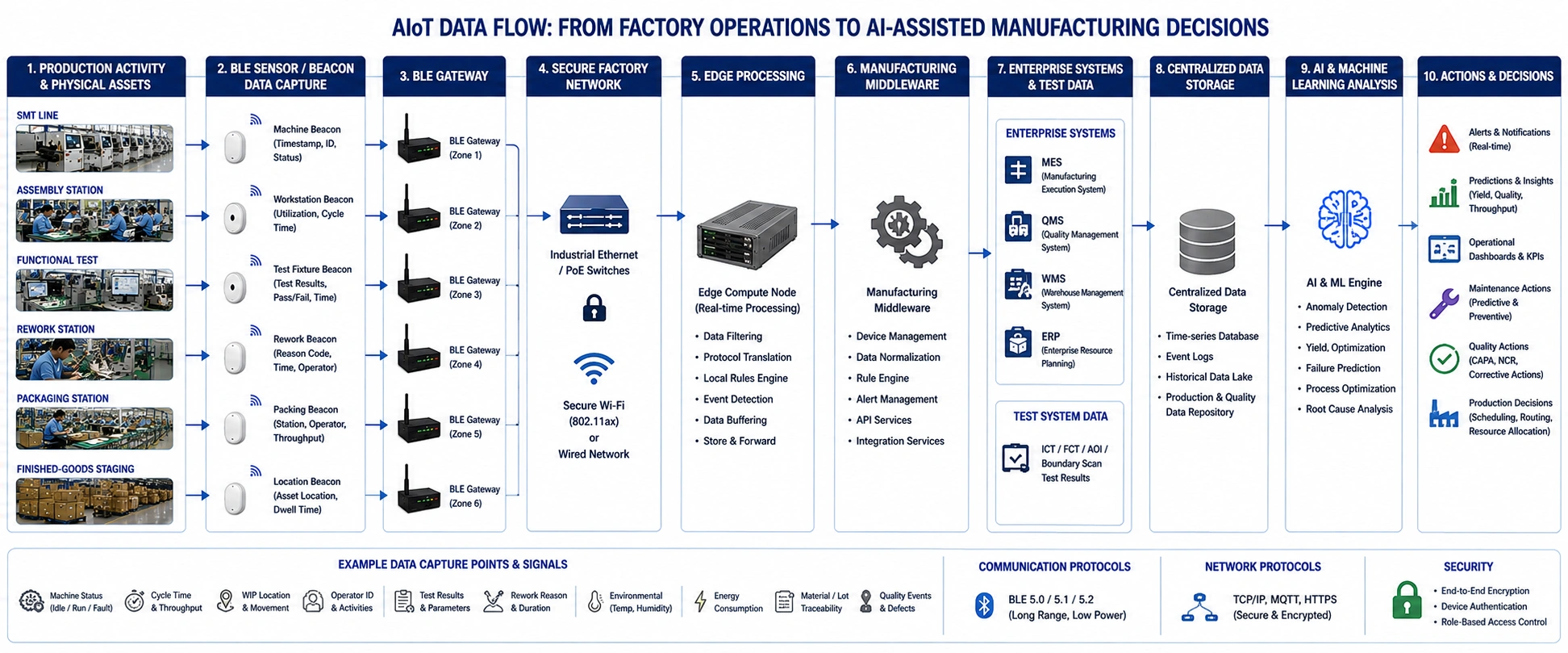
This architecture diagram shows how BLE beacons, sensors, and gateways collect manufacturing data across SMT production, device assembly, functional testing, quality inspection, packaging, and finished-goods staging. The data moves through industrial Ethernet or secure Wi-Fi to edge computing, manufacturing middleware, data storage, AI analytics, and systems such as MES, WMS, QMS, and ERP. AI-generated insights support predictive maintenance, quality analysis, production optimization, alerts, and operational actions.
AI for Consumer Device Manufacturing: Production Visibility and Intelligent Decision-Making
AI for consumer device manufacturing combines artificial intelligence with connected production equipment, sensors, test systems, manufacturing software, and operational data to improve how electronics factories monitor, predict, and control production. BLE gateways, BLE beacons, and BLE sensors can provide localized data about work-in-process movement, production assets, environmental conditions, tools, fixtures, and material handling activities. AI models can then correlate these signals with MES, QMS, ERP, WMS, test-station, and maintenance data to identify abnormal conditions, predict operational problems, and support faster decisions.
For consumer electronics manufacturers, the value is not simply knowing where an asset is. The objective is to connect physical production events with manufacturing decisions. AI can help identify bottlenecks across SMT and assembly lines, detect deviations in test processes, improve material flow, predict equipment maintenance requirements, and strengthen product traceability. GAO provides BLE, RFID, and IoT hardware products and systems that can support these connected manufacturing workflows.
Why AI Is Changing Consumer Device Manufacturing
Consumer device manufacturing operates under demanding requirements for production volume, short product lifecycles, configuration control, quality consistency, and traceability. Smartphones, tablets, wearables, wireless accessories, smart-home products, consumer electronics assemblies, and their subassemblies can pass through numerous processes before shipment.
AI becomes particularly useful when production data is too large or too dynamic for manual analysis. Machine learning models can identify relationships between equipment conditions, process parameters, test results, operator workflows, material movement, and quality outcomes.
Key applications include:
- Predictive maintenance for SMT placement equipment, reflow ovens, automated optical inspection systems, functional testers, conveyors, and assembly equipment
- AI-assisted quality analysis using inspection results, test measurements, process history, and defect classifications
- Work-in-process tracking across assembly, test, rework, quality inspection, packaging, and finished-goods staging
- Intelligent tool and fixture utilization monitoring
- Material-flow analysis for component kits, reels, trays, subassemblies, and production containers
- Production bottleneck detection using cycle time, queue time, equipment utilization, and WIP movement
- Environmental monitoring for temperature, humidity, vibration, and other conditions that can affect sensitive electronics production
- AI-supported production scheduling and capacity analysis
- Traceability analysis linking serialized products, components, workstations, test results, and production events.
AIoT Data Flow for BLE-Enabled Consumer Device Manufacturing
A horizontal workflow showing how BLE data from SMT lines, assembly, testing, rework, packaging, and finished-goods staging moves through gateways, secure factory networks, edge processing, manufacturing middleware, enterprise systems, centralized storage, and AI/ML analytics to support alerts, maintenance, quality actions, dashboards, and production decisions.
Consumer Device Manufacturing Use Cases for AI-Enabled Operations
AI-Powered Work-in-Process Tracking
Work-in-process visibility is particularly important when a consumer product passes through multiple assembly and testing stations. BLE beacons can identify tagged carts, fixtures, containers, test assets, or selected WIP carriers, while BLE gateways collect proximity and location-related signals.
The resulting event stream can be combined with MES records to determine whether a production order is moving through its expected routing. AI models can analyze dwell time, queue duration, station utilization, and routing history to identify abnormal WIP accumulation.
A practical implementation should distinguish between location inference and product genealogy. BLE can provide useful proximity and location information, but manufacturers should not assume that a BLE signal alone proves the identity of a specific serialized product. Product genealogy should remain anchored to controlled serialization, barcode, RFID, MES, or other authoritative identification processes where required.
Predictive Maintenance for Electronics Production Equipment
Unexpected downtime on SMT lines, automated inspection systems, test stations, conveyors, or specialized assembly equipment can disrupt production schedules and increase recovery costs.
AI-based predictive maintenance can combine equipment telemetry, maintenance history, alarm records, operating cycles, temperature, vibration, utilization, and production performance. BLE sensors can contribute additional measurements where suitable, especially for retrofit monitoring or assets that do not expose sufficient native telemetry.
The engineering objective is not to generate more alerts. A useful model should identify conditions that correlate with actual maintenance events and provide enough lead time for technicians to intervene.
GAO’s connected sensing and identification technologies can be incorporated into such systems where wireless monitoring is appropriate, while existing machine interfaces remain important sources of high-frequency equipment data.
AI-Assisted Quality and Test Analysis
Consumer device manufacturing can generate substantial amounts of automated test and inspection data. AOI, SPI, functional testing, electrical testing, calibration, burn-in, and final inspection can each produce information relevant to product quality.
AI can analyze historical test measurements and defect patterns to identify combinations of process conditions associated with failures. For example, a manufacturer could correlate test failures with production station, fixture, time period, component lot, environmental conditions, machine state, and rework history.
BLE sensors can complement this information by capturing localized environmental or asset-level observations. The strongest implementation connects these wireless observations with authoritative MES and QMS records rather than treating BLE data as an independent quality system.
Intelligent Tool, Fixture, and Test Asset Management
Consumer device factories use specialized fixtures, programming tools, calibration equipment, test adapters, torque tools, mobile carts, and other production assets. Missing or incorrectly allocated equipment can create avoidable production delays.
BLE beacons can provide identity and proximity information for selected mobile assets, while gateways installed around production areas collect their signals. AI analytics can identify abnormal idle periods, unusual movement patterns, excessive utilization, or recurring shortages around particular production cells.
This creates a more useful operational picture than a simple asset-location dashboard because the system can relate asset behavior to production throughput and workstation demand.
AI-Enabled Consumer Electronics Factory with BLE Sensors and Gateways
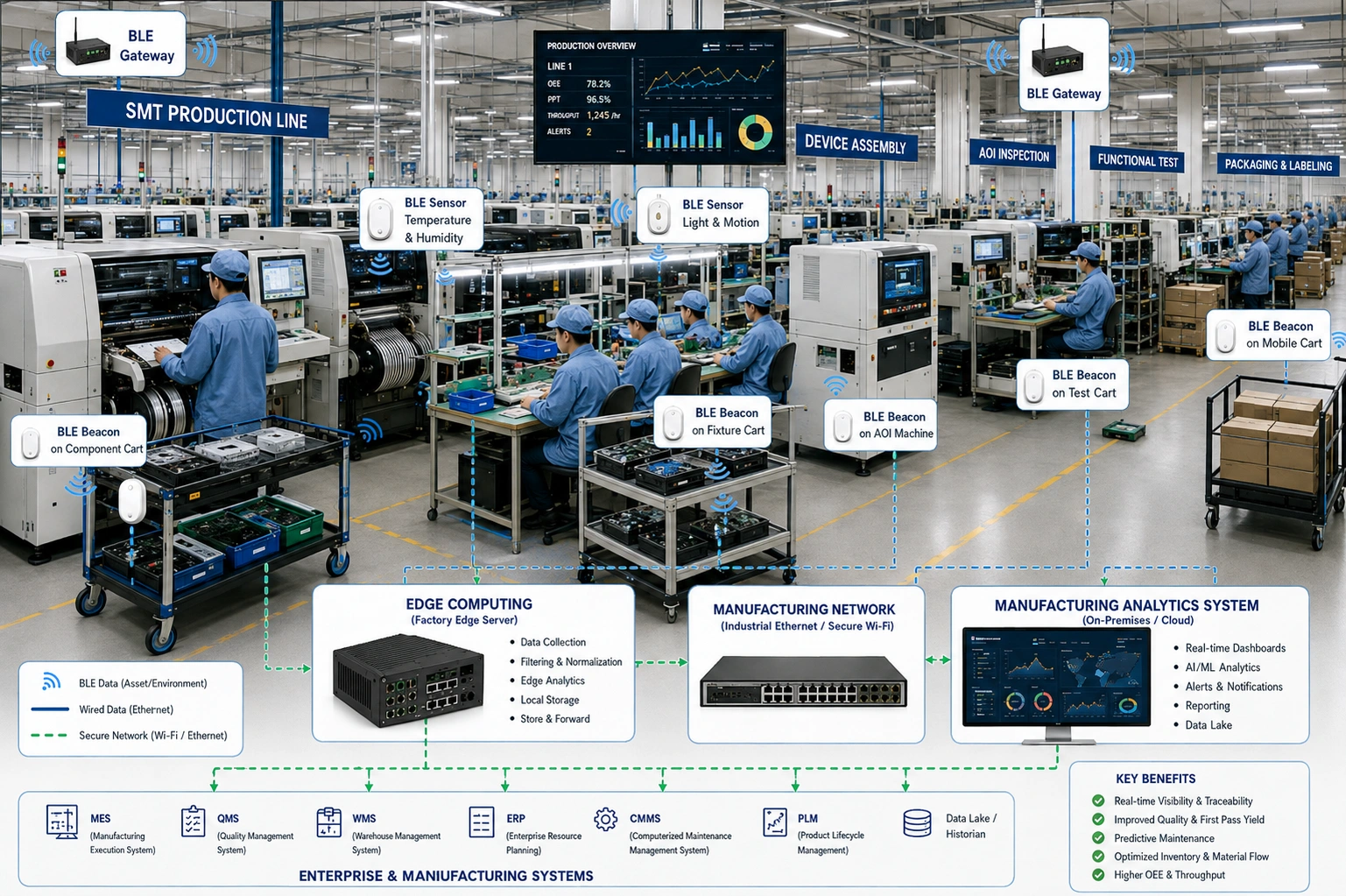
This factory illustration shows a modern consumer electronics manufacturing environment spanning SMT production, device assembly, AOI inspection, functional testing, and packaging. BLE gateways, sensors, and beacons collect asset and environmental data and connect through the manufacturing network to edge computing and AI analytics, with integration into MES, QMS, WMS, ERP, CMMS, PLM, and data-historian systems.
The Consumer Device Manufacturing Data-to-Decision Workflow
Data Acquisition at Production and Test Stations
The first stage is physical data collection. Relevant sources may include BLE sensors, BLE beacons, machine controllers, test systems, barcode scanners, RFID readers, AOI systems, SPI equipment, environmental sensors, PLCs, maintenance systems, and operator interfaces.
BLE is particularly useful when wireless connectivity is preferable for mobile assets, retrofit monitoring, location-related events, or sensors that would otherwise require additional cabling.
BLE Gateway and Factory Connectivity
BLE gateways receive advertisements or sensor data from nearby BLE devices and forward selected information to upstream software. Gateway placement should account for production-cell geometry, metal structures, machinery, radio interference, required coverage, and the expected positioning accuracy.
Consumer electronics factories often contain substantial metal equipment and dense wireless environments. A site survey should therefore precede final gateway placement. Coverage assumptions based only on open-space laboratory measurements can produce unreliable production results.
Edge Processing and Event Normalization
Edge computing can filter, normalize, buffer, and enrich device data before transmission to central software. This is useful when factories need local continuity during temporary network interruptions or when high-frequency sensor information does not need to be sent upstream in raw form.
Middleware can normalize BLE events and combine them with production identifiers, station IDs, timestamps, asset IDs, and manufacturing-order information.
AI Analytics and Manufacturing Systems
The normalized data can be correlated with MES, QMS, WMS, ERP, CMMS or EAM, test databases, maintenance records, and production scheduling systems.
AI methods may include:
- Supervised machine learning for defect or failure classification
- Time-series models for equipment and environmental behavior
- Anomaly detection for unusual process or asset conditions
- Predictive models for maintenance and production delays
- Clustering for identifying recurring production patterns
- Computer vision for visual inspection where cameras are appropriate
- Generative AI for querying manufacturing records, summarizing incidents, and assisting technical personnel with controlled access to production knowledge
AI should not automatically become the authoritative source for production records. Critical manufacturing transactions should remain governed by the appropriate MES, QMS, ERP, or other system of record.
Business Actions and Closed-Loop Improvement
The final stage converts analytics into action. Examples include maintenance work orders, quality investigations, line-balancing decisions, material replenishment, asset reassignment, engineering review, or production scheduling changes.
The most valuable implementations establish a measurable feedback loop. A prediction should lead to an operational action, and the outcome should subsequently be recorded so the AI model can be evaluated and improved.
AI, BLE Hardware, and Software for Consumer Electronics Factories
A practical solution normally combines several technology layers rather than relying on one device or software package.
- BLE beacons: Provide identifiable wireless signals for selected carts, fixtures, tools, containers, and mobile production assets.
- BLE sensors: Capture relevant measurements such as temperature, humidity, vibration, motion, or equipment-related conditions where appropriate.
- BLE gateways: Collect nearby BLE transmissions and forward data to edge or server software.
- Edge computers: Perform local filtering, buffering, protocol conversion, and selected analytics close to production operations.
- Industrial networks: Ethernet, Wi-Fi, and other factory networking technologies connect gateways, edge computers, machines, and enterprise systems.
- Manufacturing middleware: Normalizes device events and provides integration between connected hardware and manufacturing applications.
- MES: Supplies production orders, routing, work-center, WIP, and manufacturing execution information.
- QMS: Provides quality records, nonconformance information, inspection data, corrective actions, and related quality processes.
- WMS and ERP: Provide material, inventory, order, procurement, and business transaction context.
- CMMS or EAM: Connect asset information and maintenance history with equipment-related analytics.
- AI and machine learning software: Converts historical and real-time manufacturing data into predictions, anomaly detection, classifications, and decision support.
- Databases and time-series storage: Preserve sensor, event, equipment, production, and analytical records for appropriate retention periods.
- Security controls: Include device authentication, access control, network segmentation, encryption where supported, credential management, software patching, audit logging, and controlled API access.
Cloud Version for Distributed Manufacturing Operations
A cloud-hosted software deployment can be appropriate when organizations operate multiple consumer device manufacturing sites and need centralized analytics, reporting, model management, or cross-site benchmarking.
The cloud service can receive normalized data from factory gateways or edge systems through secure connections. This approach can simplify centralized software maintenance and support common analytics across geographically distributed facilities.
However, cloud connectivity should not be treated as a substitute for local production controls. Factory operations that require low latency or continuity during WAN interruptions should retain appropriate edge processing and local operating capabilities.
Server Version for Controlled Factory Environments
A server deployment can run on customer-managed factory servers, private data centers, edge servers, or other privately hosted infrastructure. This model can be suitable when consumer device manufacturers require greater control over production data, network boundaries, integration points, or operational dependencies.
Server deployments can also be useful where manufacturing networks are isolated or where internal policies restrict production information from being transferred to external cloud infrastructure.
The choice should be based on data sensitivity, latency requirements, connectivity, IT policies, maintenance responsibility, scalability requirements, and integration with existing factory systems rather than on cloud versus server terminology alone.
Engineering Considerations for Reliable AI-Enabled Consumer Device Manufacturing
Successful deployment depends on more than selecting BLE hardware and an AI model. Radio performance, data quality, system integration, manufacturing identifiers, time synchronization, cybersecurity, and operational ownership all affect the quality of the resulting decisions.
Key engineering considerations include:
- Perform a physical RF survey before finalizing BLE gateway locations, particularly around metal production equipment and dense machinery.
- Define which assets actually require wireless tracking instead of attempting to instrument every production object.
- Establish authoritative identifiers for products, work orders, stations, fixtures, tools, and material lots.
- Separate high-frequency machine telemetry from lower-frequency BLE location and sensor events.
- Buffer important edge data so temporary network failures do not automatically create gaps in operational history.
- Validate AI predictions against actual production outcomes before using them for automated decisions.
- Integrate with MES, QMS, ERP, WMS, and maintenance software through controlled interfaces rather than creating parallel records.
- Apply network segmentation between factory control systems, IoT devices, edge computing, and business applications.
- Establish device lifecycle procedures covering provisioning, firmware updates, battery replacement, retirement, and asset reassignment.
- Measure false positives and false negatives for AI alerts because excessive alerts can reduce operator trust and create alert fatigue.
The result should be a manufacturing solution in which BLE-generated events become one reliable source of operational context within a broader AI and IoT system, rather than an isolated tracking application.
Technical and Operational Benefits of AI-Enabled Consumer Device Manufacturing
Combining AI with connected manufacturing data can improve consumer device production because it allows manufacturers to move from retrospective reporting toward prediction, anomaly detection, and evidence-based operational decisions. The greatest value comes from correlating multiple data sources rather than analyzing BLE events independently.
Better Production Flow and Bottleneck Detection
AI can analyze WIP movement, station cycle time, queue duration, equipment utilization, changeover periods, and production routing to identify where manufacturing flow is deteriorating.
For example, if a particular assembly or functional-test station repeatedly develops longer queues during specific production configurations, an AI model can correlate the event with equipment utilization, fixture availability, staffing conditions, material replenishment, or preceding process performance.
BLE-generated location events can add physical context to MES transactions, helping production engineers distinguish between a genuine process bottleneck and a temporary movement or staging issue.
Improved Traceability and Manufacturing Genealogy
Traceability is essential when consumer products contain numerous electronic components, firmware versions, subassemblies, and production configurations.
AI can analyze relationships among serialized products, component lots, workstations, test results, inspection outcomes, repair events, and production timestamps. BLE can supplement this information with asset and environmental context.
A robust implementation should preserve the distinction between:
- Product identity
- Component or material identity
- Production order
- Manufacturing station
- Tool or fixture identity
- Location event
- Test result
- Quality event
- Environmental measurement
- Maintenance event
This separation makes investigations more reliable and prevents probabilistic location information from being mistaken for authoritative product genealogy.
Reduced Unplanned Downtime
Predictive maintenance can identify early changes in equipment behavior before they become production interruptions. AI models can compare current telemetry against historical operating patterns and maintenance outcomes.
BLE sensors can be useful for selected retrofit scenarios where native machine telemetry is unavailable or insufficient. Temperature, vibration, motion, or utilization observations can provide additional evidence for maintenance models.
The measurable objective should be reduced unplanned downtime, increased mean time between failures, improved maintenance planning, and reduced mean time to repair rather than simply increasing the number of monitored devices.
Higher Quality and Faster Root-Cause Analysis
AI-assisted quality analysis can reduce the time required to identify recurring defect patterns. Models can evaluate relationships between inspection results, functional-test measurements, production stations, component lots, environmental conditions, equipment state, and rework history.
This can help quality engineers prioritize investigations based on evidence rather than relying solely on manual spreadsheet analysis.
Computer vision may also be integrated for suitable visual inspection tasks, while BLE sensing can provide contextual information about the physical production environment.
More Efficient Asset and Fixture Utilization
Production fixtures and test equipment can represent significant operational investments. AI can analyze utilization, idle time, movement, workstation demand, and maintenance history to identify underused or constrained resources.
BLE beacons can provide wireless identity and proximity information for selected mobile assets. The resulting data can support decisions such as fixture allocation, equipment repositioning, preventive maintenance scheduling, and production-cell planning.
GAO’s BLE and RFID hardware can support these identification and sensing requirements where the physical characteristics of the manufacturing process make wireless data collection appropriate.
Consumer Device Manufacturing KPIs for AI and BLE Solutions
A deployment should be evaluated using manufacturing outcomes rather than the quantity of connected devices. Baseline measurements should be captured before implementation and compared with post-deployment results.
KPI AI and BLE Contribution Manufacturing Significance
First-pass yield Correlates process and test data with failure patterns Measures quality without rework
Overall equipment effectiveness Combines availability, performance, and quality information Indicates production-line effectiveness
WIP cycle time Analyzes movement and station timestamps Identifies production-flow delays
Queue time Detects abnormal waiting between processes Reveals capacity constraints
Unplanned downtime Predictive maintenance identifies risk conditions Measures equipment reliability
Mean time between failures Uses historical equipment behavior Tracks maintenance improvement
Mean time to repair Provides asset and incident context Measures recovery efficiency
Test failure rate Identifies patterns across stations and lots Supports quality engineering
Rework rate Correlates defects with process conditions Measures avoidable production effort
Fixture utilization Tracks asset use and demand Helps optimize production resources
Asset search time Uses BLE-based location information Reduces time spent locating mobile assets
Material staging time Analyzes movement and production demand Improves material flow
Environmental exception rate Detects abnormal sensor conditions Supports controlled production conditions
AI alert precision Measures useful alerts versus false positives Protects operator trust
Prediction lead time Measures how early problems are detected Determines practical AI value
KPI selection should remain tied to the specific production problem. A manufacturer implementing predictive maintenance should not judge the project primarily by BLE coverage, while a manufacturer addressing fixture shortages should not use model accuracy as its only success criterion.
Cybersecurity and Data Governance for Connected Consumer Electronics Factories
Connected manufacturing environments introduce additional endpoints and communication paths that must be governed as part of the factory’s cybersecurity program.
BLE devices should be inventoried and assigned controlled identities. Gateway credentials should not be shared across installations, and device replacement procedures should include credential revocation where applicable.
Recommended controls include:
- Network segmentation between BLE gateways, edge systems, manufacturing applications, and business networks
- Role-based access control for production, engineering, maintenance, quality, and IT personnel
- Secure gateway configuration and controlled administrative access
- Encryption for applicable communications and data transfers
- Credential rotation and secure secret management
- Firmware and software patch management
- Audit logging for administrative and configuration events
- Device inventory and lifecycle management
- API authentication and authorization
- Backup and recovery procedures for manufacturing data
- Monitoring for unexpected gateway or device behavior
- Controlled remote access for support personnel
AI introduces additional governance requirements. Training datasets should have known provenance, model versions should be tracked, and production recommendations should be auditable.
Generative AI should receive particular controls when it is connected to manufacturing records. Retrieval-based systems should restrict access according to user permissions and should distinguish retrieved manufacturing facts from generated interpretations.
For safety-critical or quality-critical processes, AI recommendations should normally remain subject to defined engineering controls and human approval until validation demonstrates that automated action is appropriate.
Interoperability with MES, QMS, ERP, WMS, and Factory Systems
AI-enabled consumer device manufacturing rarely succeeds as an isolated software installation. The solution must exchange information with systems already responsible for manufacturing execution and business transactions.
Typical integration points include:
- MES for production orders, routing, station status, WIP, and work instructions
- QMS for inspections, nonconformances, corrective actions, and quality history
- ERP for orders, procurement, inventory, and business records
- WMS for material movement and storage operations
- CMMS or EAM for maintenance work orders and asset history
- Test systems for functional, electrical, firmware, and calibration results
- AOI and SPI systems for inspection data
- PLC and machine interfaces for equipment state and process information
- Identity and access-management systems for controlled user access
- Data warehouses or analytical databases for historical analysis
API-based integration is often preferable when supported by existing applications. Message-based interfaces can be useful when event-driven processing is required. Industrial protocols and machine-specific interfaces may remain necessary for equipment-level data acquisition.
A useful design principle is to keep responsibilities clear. MES should remain responsible for manufacturing execution, QMS for quality records, ERP for business transactions, and maintenance software for maintenance workflows. The AI solution should connect these sources and provide analysis without creating unnecessary duplicate systems of record.
Enterprise AI Analytics Integration Architecture for Consumer Device Manufacturing
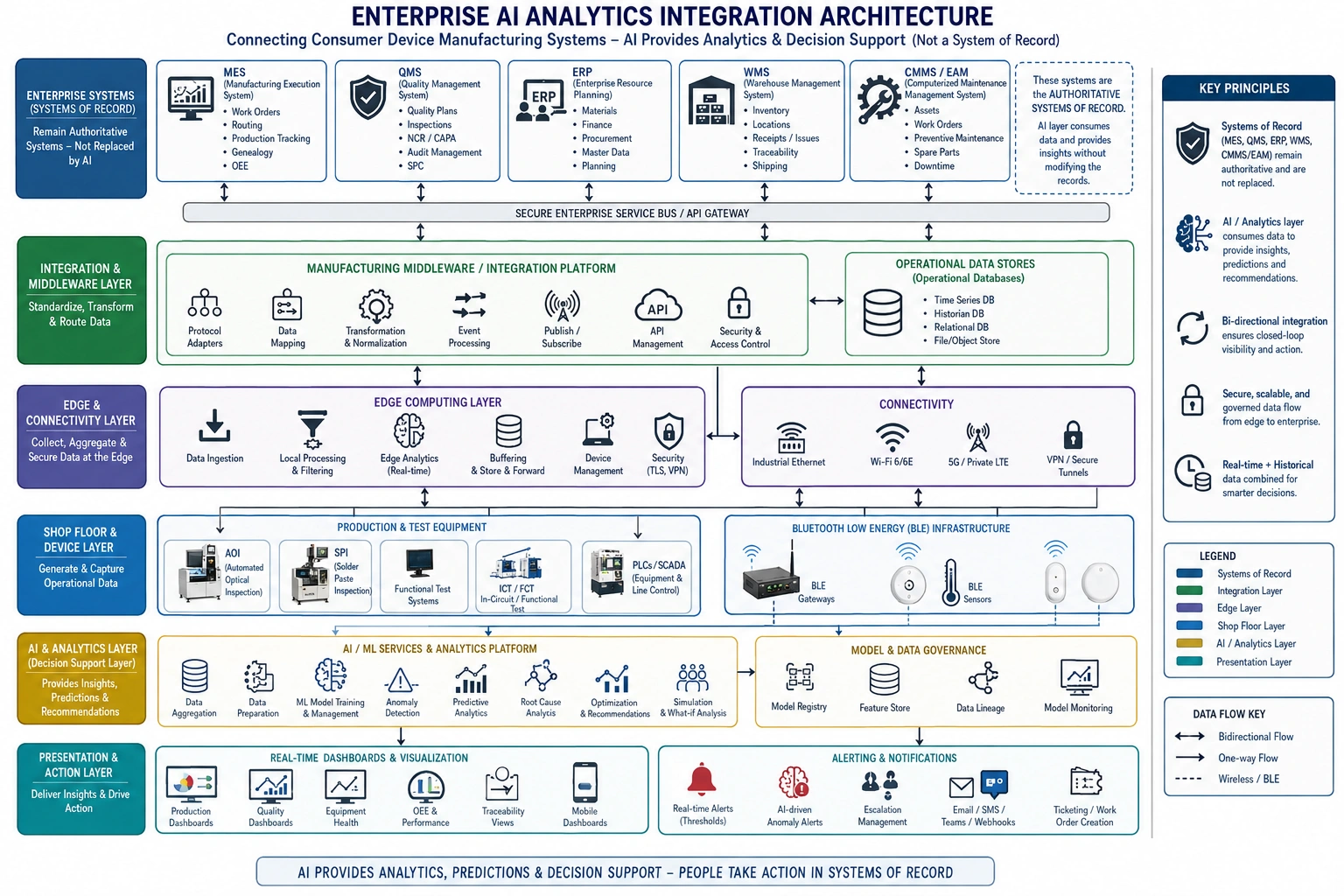
A layered integration architecture showing how MES, QMS, ERP, WMS, CMMS/EAM, production equipment, BLE devices, edge computing, middleware, and operational databases connect with AI/ML analytics, dashboards, and alerting—while existing enterprise systems remain the systems of record.
Deployment Lifecycle for AI-Enabled Consumer Device Manufacturing
Planning and Site Assessment
Planning should begin with the operational problem rather than the hardware. Production engineering, manufacturing IT, quality, maintenance, and operations teams should define the target workflow, current baseline, required data, decision latency, and measurable KPI.
A physical assessment should document machinery, production cells, material flow, radio conditions, network availability, gateway mounting locations, and existing data interfaces.
Hardware Selection and Pilot Design
BLE gateways, beacons, and sensors should be selected according to the actual application. Battery life, transmission interval, environmental rating, mounting method, radio behavior, measurement accuracy, gateway capacity, and maintenance requirements should be evaluated.
The pilot should be deliberately narrow. A single production cell, asset category, or quality problem can provide better evidence than attempting to instrument an entire factory immediately.
Commissioning and Validation
Commissioning should verify device identity, gateway connectivity, data timestamps, signal behavior, sensor readings, network performance, and integration with manufacturing software.
Test cases should include expected movement, stationary assets, gateway outages, network interruptions, battery replacement, device reassignment, and invalid or missing data.
AI models should be evaluated against historical or controlled production data before operational use. Accuracy alone is insufficient. Precision, recall, false-positive rates, false-negative rates, prediction lead time, and business impact should also be evaluated according to the application.
Optimization and Production Rollout
Once the pilot demonstrates measurable value, deployment can expand to additional lines, plants, asset classes, or manufacturing processes.
Rollout should be controlled through standard configuration templates, device provisioning procedures, network policies, integration documentation, and operational training.
GAO can support organizations requiring BLE, RFID, and IoT hardware products and systems as they move from evaluation toward larger production deployments.
Maintenance and Continuous Improvement
Connected manufacturing solutions require ongoing lifecycle management. Battery replacement, firmware management, gateway health, calibration, device reassignment, data-quality monitoring, and AI model performance should be reviewed regularly.
Production changes also matter. A new product generation, factory layout, machine replacement, new test station, or changed production routing can alter the data patterns on which an AI model depends.
A mature implementation therefore treats AI model monitoring and IoT device lifecycle management as continuing engineering activities rather than one-time deployment tasks.
Practical Recommendations for Consumer Device Manufacturers
Organizations evaluating AI and BLE for consumer device manufacturing should prioritize measurable production problems and reliable data foundations.
- Start with one high-value use case such as WIP visibility, fixture tracking, predictive maintenance, or quality analysis.
- Establish the authoritative source for every critical manufacturing identifier.
- Conduct RF and network surveys before installing production-scale BLE gateways.
- Use BLE where wireless sensing or proximity information provides a practical advantage.
- Avoid using BLE location information as a substitute for controlled product serialization.
- Combine physical IoT observations with MES, QMS, ERP, WMS, maintenance, and test data.
- Keep low-latency operational functions close to the factory through appropriate edge processing.
- Select cloud or privately hosted server deployment according to data governance, connectivity, latency, and IT requirements.
- Validate AI models using actual manufacturing outcomes rather than synthetic success metrics alone.
- Design cybersecurity controls before connecting devices to production networks.
- Define battery, firmware, calibration, replacement, and device-retirement procedures.
- Measure operational improvement against a documented baseline.
- Expand only after the pilot demonstrates reliable data quality and measurable business value.
Where GAO Supports AI-Enabled Consumer Device Manufacturing
GAO supplies BLE, RFID, and other IoT hardware products and systems that can provide the physical data layer required by connected manufacturing applications. For consumer device manufacturing, these technologies can support selected asset-tracking, environmental-monitoring, production-flow, identification, and equipment-monitoring workflows.
Headquartered in New York City and Toronto, Canada, GAO is recognized among the leading global B2B and B2G suppliers of BLE and RFID technologies, with additional relevance to B2B2C and B2D applications. GAO, together with sister companies GAO Research and GAO Tek, forms GAO Group, with operations based in New York City and Toronto.
For more than three decades, GAO Group has served organizations across the United States and Canada, including Fortune 500 companies, leading research and development organizations, universities, and government agencies. Its investment in R&D, quality assurance, and technical support enables organizations to evaluate and deploy connected hardware according to specific operational requirements.
GAO’s engineering-oriented approach is particularly relevant when BLE devices, RFID technologies, IoT sensing, gateways, and software systems must operate alongside existing manufacturing infrastructure rather than replace it.
AI-Enabled BLE Solution Deployment Lifecycle
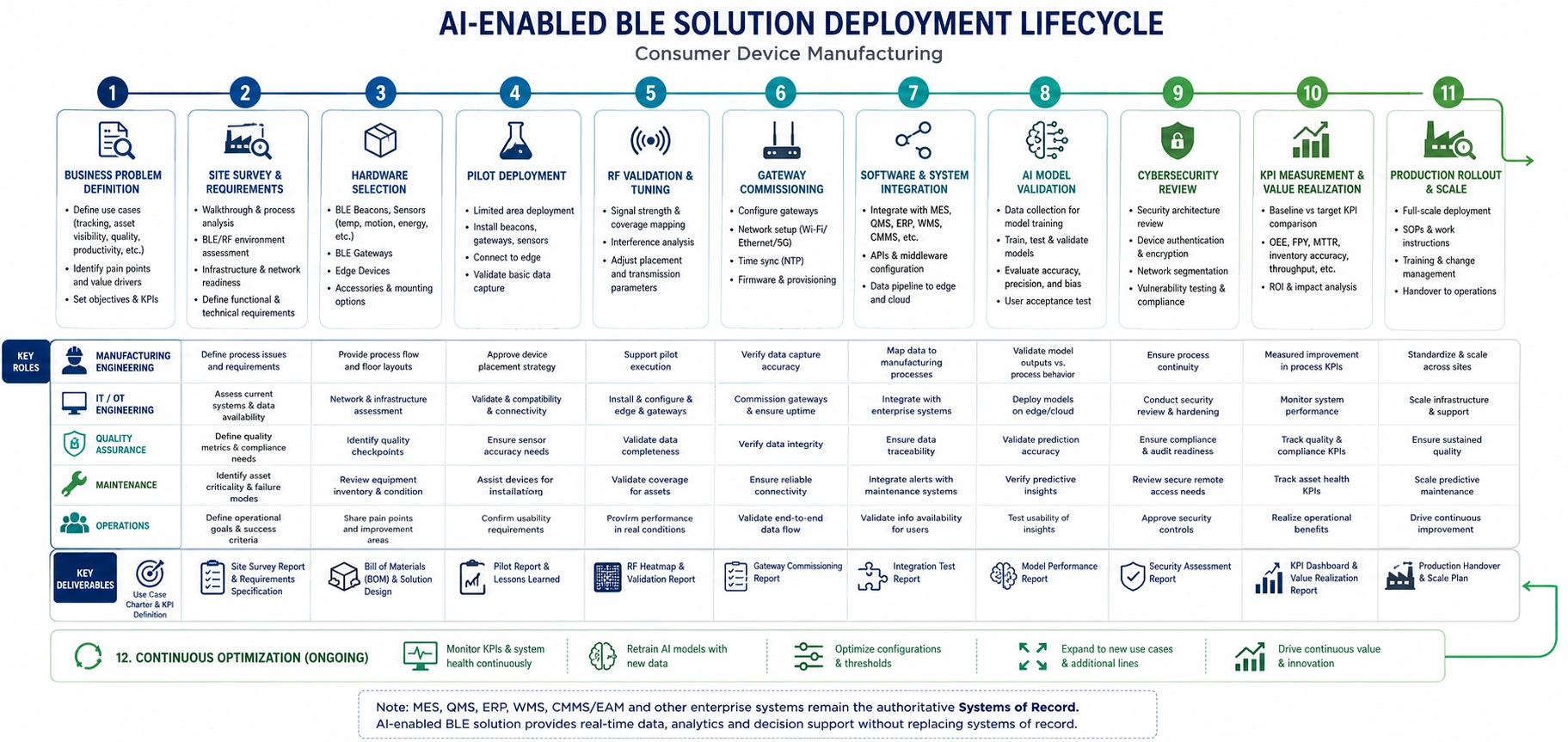
A 12-stage lifecycle showing the practical deployment journey for AI-enabled BLE solutions, from business problem definition and site surveying through pilot deployment, integration, validation, production rollout, and continuous optimization.
Key Takeaways for AI-Enabled Consumer Device Manufacturing
AI can provide greater value to consumer device manufacturing when it is connected to reliable physical and production data. BLE gateways, BLE beacons, and BLE sensors can supply useful context for asset movement, environmental conditions, equipment monitoring, and selected WIP workflows, while MES, QMS, ERP, WMS, test systems, and maintenance software provide authoritative manufacturing context.
The most effective implementations focus on measurable operational problems such as production bottlenecks, unplanned downtime, quality variation, traceability gaps, fixture availability, and inefficient material movement.
GAO can help organizations evaluate BLE, RFID, and IoT hardware products and systems for these applications, including the engineering considerations involved in factory deployment, integration, testing, and ongoing support. Readers evaluating AI-enabled consumer device manufacturing solutions can explore GAO’s technology offerings and technical expertise to determine which connected sensing and identification approach fits their production requirements.
Building the Future of Industrial AI and IoT with Aperture Venture Studio and GAO RFID Inc.
For more than three decades, GAO Group of Companies has invested heavily in R&D for industrial BLE, RFID, and IoT technologies. As generative AI became increasingly useful for industrial applications, we expanded our work across AI and IoT, including BLE and RFID, and founded Aperture Venture Studio to help develop AI and IoT solutions relevant to manufacturing and other technology-intensive industries.
Aperture has attracted AI and IoT technical experts, entrepreneurial and operational executives, investors, and leading companies. We have also developed the Aperture Ventures Summit and TekSummit to discuss advanced AI and IoT topics.
Together, these activities have helped build technical communities around AI and IoT. We welcome participation as advisors, co-founders or employees, investors, or customers.