
AI and BLE for Consumer Packaging
AI-Enabled Operational Visibility for Consumer Packaging
AI and BLE are increasingly useful for consumer packaging operations that require accurate asset visibility, condition monitoring, production traceability, and data-driven decisions. BLE beacons, BLE sensors, and BLE gateways can capture information from production assets, material handling equipment, reusable containers, work-in-process materials, and environmental conditions. AI can then analyze this operational data to identify patterns, predict abnormal conditions, optimize material movement, and support production and maintenance decisions. For consumer packaging manufacturers, the combination is particularly relevant where high production volumes, frequent changeovers, short production cycles, quality requirements, and distributed equipment make manual monitoring difficult. GAO supplies BLE, RFID, and IoT hardware products and systems that can provide the data acquisition layer needed for these applications. When properly engineered, AI and BLE can connect shop-floor observations with manufacturing execution, maintenance, inventory, and operational decision processes.
AI and BLE in Consumer Packaging Operations: From Connected Assets to Intelligent Decisions
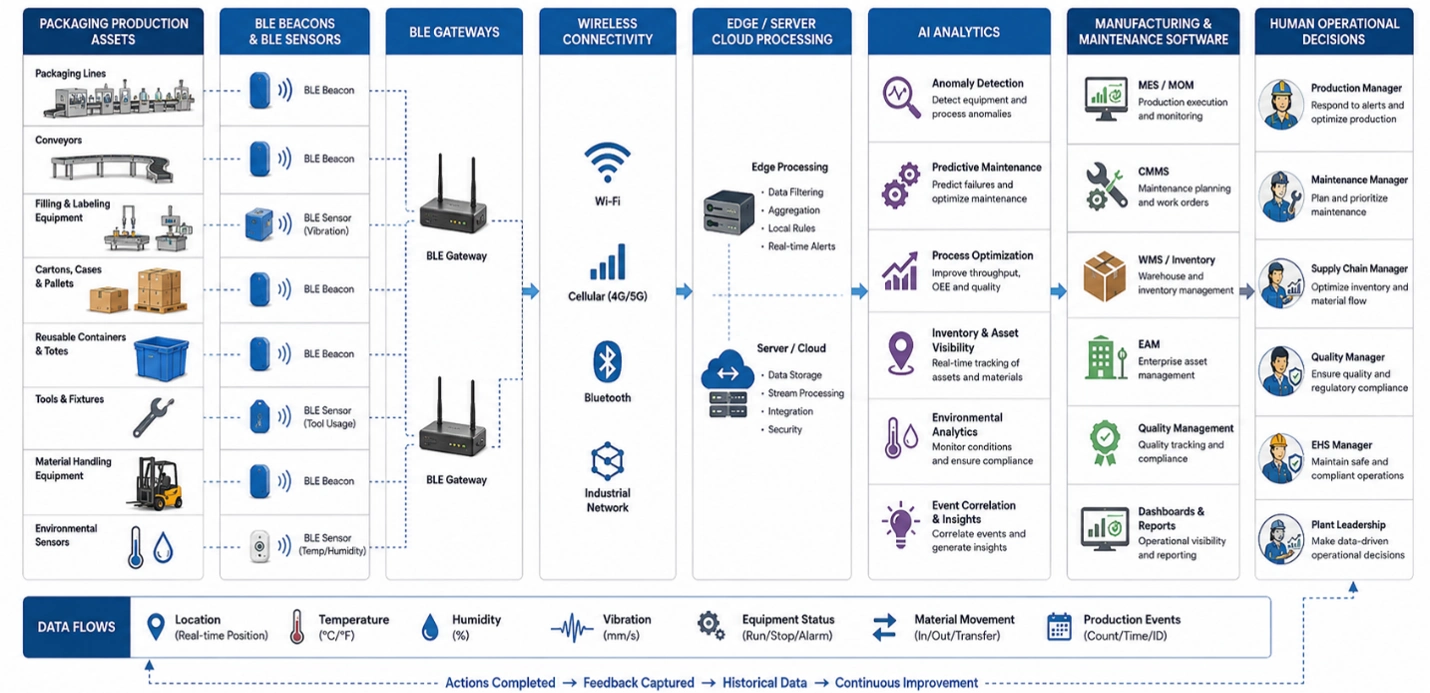
This infographic illustrates how BLE-enabled packaging assets generate operational data that moves through BLE gateways, wireless connectivity, edge or cloud processing, and AI analytics. It connects data such as location, temperature, humidity, vibration, equipment status, material movement, and production events to manufacturing software and human decisions across production, maintenance, inventory, quality, and operational management.
What AI and BLE Mean for Consumer Packaging Operations
Consumer packaging manufacturing combines high-speed production with frequent product changes, tight quality tolerances, material movement, and extensive use of packaging materials and production equipment. These conditions create a large volume of operational data that can be difficult to collect consistently through manual processes.
BLE provides a practical wireless mechanism for collecting selected data from physical assets and operating environments. BLE beacons can identify equipment, containers, tools, pallets, production areas, or other tagged objects. BLE sensors can measure parameters such as temperature, humidity, vibration, motion, light, occupancy, or equipment-related conditions. BLE gateways receive nearby BLE transmissions and forward the collected information to software through appropriate network connections.
AI adds an analytical layer to these data streams. Instead of simply recording that a packaging machine, material cart, pallet, or environmental sensor generated an event, AI models can identify recurring patterns, detect anomalies, estimate operating conditions, prioritize maintenance events, and support production decisions.
The resulting AI and BLE system can therefore connect physical activity on the consumer packaging floor with digital analysis. The value depends on appropriate sensor placement, gateway coverage, data quality, integration with existing software, and the operational processes used to act on AI-generated insights.
GAO’s BLE and IoT hardware can support the data collection requirements of consumer packaging facilities where asset identification, location visibility, environmental sensing, and equipment monitoring are required.
Consumer Packaging Applications for AI and BLE
AI and BLE can be applied to several operational areas within consumer packaging production. The appropriate combination depends on the equipment, material flow, production environment, response requirements, and existing manufacturing software.
Production Asset and Equipment Visibility
BLE beacons can be associated with packaging machinery, change parts, tooling, mobile equipment, carts, and other production assets. BLE gateways positioned around production areas can collect beacon signals and provide software with location-related information.
AI can analyze historical movement and utilization information to identify assets that spend excessive time outside their intended production area, frequently move between lines, or experience unusual utilization patterns.
This can help production and maintenance personnel answer practical questions such as:
- Where is a required changeover tool?
- Which mobile equipment is being underutilized?
- How frequently does a particular asset move between packaging lines?
- Which production areas experience repeated equipment congestion?
- Are critical tools available when a scheduled changeover begins?
Packaging Material and Work-in-Process Tracking
Consumer packaging operations can involve rolls, cartons, cases, pallets, containers, labels, tooling, and other materials moving between storage, staging, production, inspection, and shipping areas.
BLE identification can supplement existing barcode or RFID processes where continuous or proximity-based visibility is useful. BLE sensors can also add environmental information to selected material-handling processes.
AI can analyze movement histories to identify recurring delays, excessive staging time, abnormal material movement, or bottlenecks between production stages.
The engineering objective is not simply to locate every object. A better design identifies which material flows materially affect production performance and then selects BLE tags, sensors, gateways, and data retention policies accordingly.
Environmental Monitoring for Packaging Operations
Temperature and humidity can be relevant to packaging materials, adhesives, inks, labels, stored products, and selected production processes. BLE sensors can periodically transmit environmental measurements to gateways.
AI can establish operating baselines and identify unusual trends rather than relying only on fixed threshold alarms. For example, a gradual environmental change across a storage or production area can be more useful to maintenance personnel when detected before it becomes a process disruption.
Sensor selection should account for measurement range, accuracy, battery life, enclosure requirements, calibration, gateway distance, radio interference, and the physical characteristics of the production environment.
Predictive Maintenance for Packaging Equipment
Packaging lines may include conveyors, motors, gearboxes, pumps, compressors, labelers, fillers, wrappers, sealers, printers, inspection systems, and other rotating or electrically driven equipment.
BLE vibration or condition sensors can provide periodic measurements from selected assets. AI models can analyze trends and deviations from historical operating behavior to support condition-based maintenance.
A practical deployment should not treat every vibration change as a failure prediction. Machine operating state, production speed, product format, load, maintenance history, and sensor installation position can materially affect the measurements. AI models therefore require contextual data and appropriate validation before maintenance personnel use their outputs for work-order prioritization.
BLE-Enabled Consumer Packaging Asset Monitoring and AI Predictive Maintenance Diagram
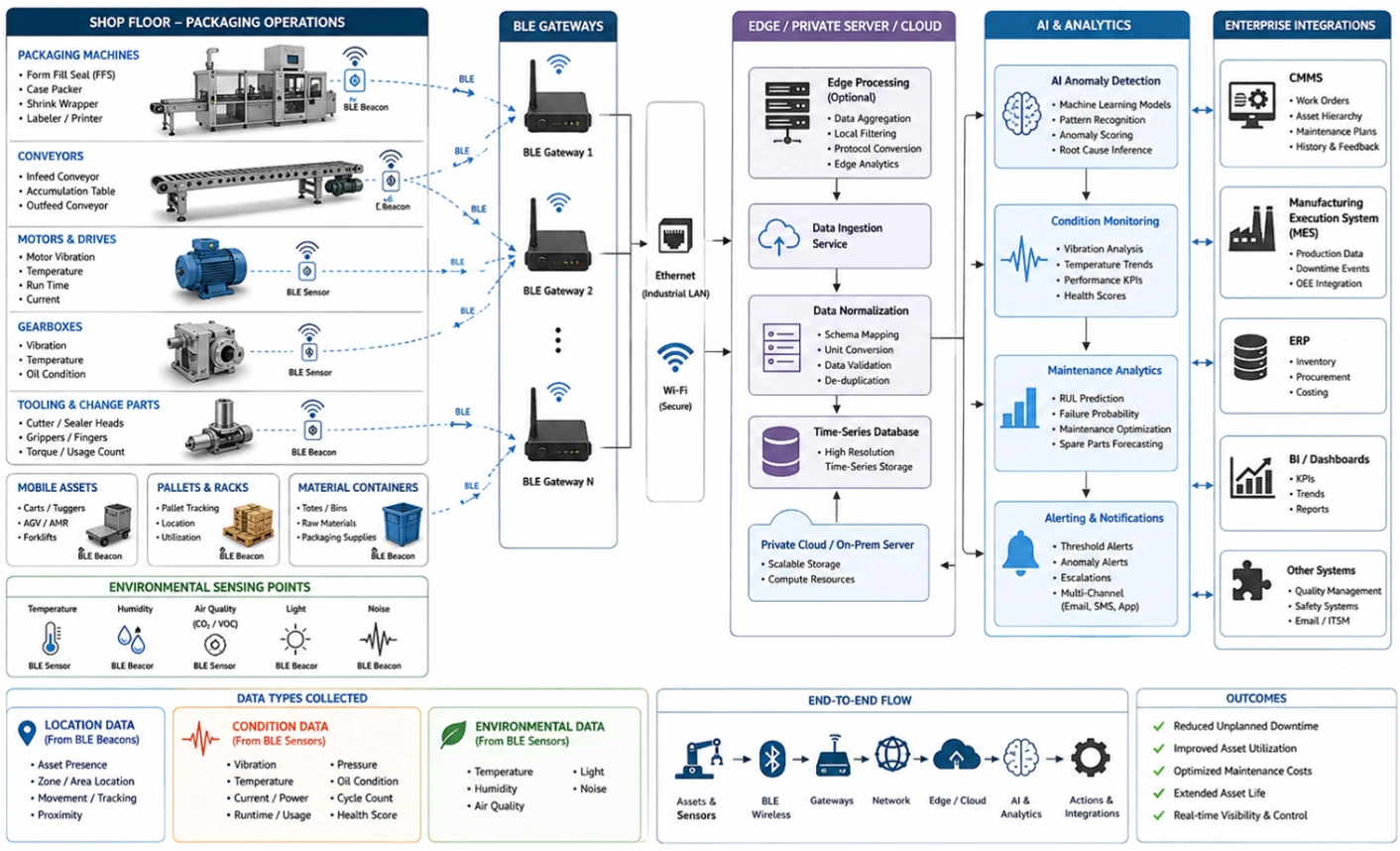
This visual illustrates how BLE-enabled packaging machines, conveyors, motors, gearboxes, tooling, mobile assets, and environmental sensors connect to BLE gateways and edge or cloud systems. It shows the complete data flow from asset monitoring and data normalization to AI anomaly detection, maintenance analytics, alerts, and integration with CMMS and manufacturing systems. The key takeaway is how BLE and AI provide real-time asset visibility and support predictive maintenance.
From BLE Data Capture to AI-Driven Packaging Decisions
A complete AI and BLE deployment should be designed as a connected operational workflow rather than as an isolated wireless installation.
Data Acquisition
BLE beacons provide identification and presence information, while BLE sensors can provide measured operational or environmental parameters. Device configuration should reflect the required sampling interval, transmission power, battery-life target, physical mounting conditions, and measurement accuracy.
For packaging machinery, sensor placement is especially important. A vibration sensor attached to an unsuitable surface can generate data that does not accurately represent the condition of the monitored component. Similarly, a temperature sensor installed too close to a heat source may produce readings that are technically correct at its location but operationally misleading.
BLE Gateways and Communication
BLE gateways collect nearby transmissions and forward the information into the broader data system. Gateway density should be determined through a site survey rather than a simple area-per-gateway calculation.
Metal equipment, production structures, walls, machinery enclosures, RF interference, gateway mounting height, and changing production layouts can affect BLE signal behavior. Consumer packaging facilities with dense equipment arrangements should therefore validate coverage under actual operating conditions.
Gateway connectivity may use Ethernet, Wi-Fi, cellular connectivity, or other appropriate networking methods. The selected connection should reflect latency requirements, cybersecurity policies, network availability, and the location of the gateway.
Edge, Cloud, and Server Processing
Gateway-level or edge processing can perform initial filtering, buffering, device validation, and event handling before data reaches centralized software. This is useful where network interruptions are possible or where immediate local processing is required.
Cloud-hosted processing can simplify centralized management across multiple consumer packaging facilities. It can provide centralized data storage, AI model execution, dashboards, device management, and cross-site analytics when connectivity and organizational policies permit.
A privately hosted server deployment can be preferable when manufacturing data must remain within customer-controlled infrastructure, when integration with factory systems requires local connectivity, or when operational policies place greater emphasis on local data control.
Middleware and Enterprise Software Integration
BLE data becomes more valuable when it can be associated with production context. Middleware can normalize device data, associate identifiers with assets, filter duplicate or invalid events, and route information to downstream applications.
Potential integration targets include manufacturing execution systems, computerized maintenance management systems, enterprise resource planning software, warehouse management systems, inventory applications, production dashboards, quality systems, and notification services.
Common industrial communication technologies can include MQTT, HTTP or HTTPS APIs, OPC UA, Ethernet-based networking, and database interfaces, depending on the existing environment. The integration method should be selected according to the interfaces actually supported by the customer’s systems rather than assuming that one protocol fits every deployment.
AI Analytics and Operational Actions
AI models can process historical and near-real-time BLE data to identify anomalies, classify operational conditions, estimate asset utilization, detect unusual movement, and prioritize events.
The final step is operational action. A useful system may generate a maintenance recommendation, notify a supervisor, identify a missing tool, flag abnormal environmental conditions, or provide production personnel with a more accurate view of material movement.
The feedback from completed actions should also be retained. Maintenance outcomes, confirmed anomalies, false alarms, production events, and equipment changes can improve future analysis and help distinguish meaningful patterns from normal operational variation.
End-to-End Consumer Packaging AI and BLE Workflow for Smart Manufacturing
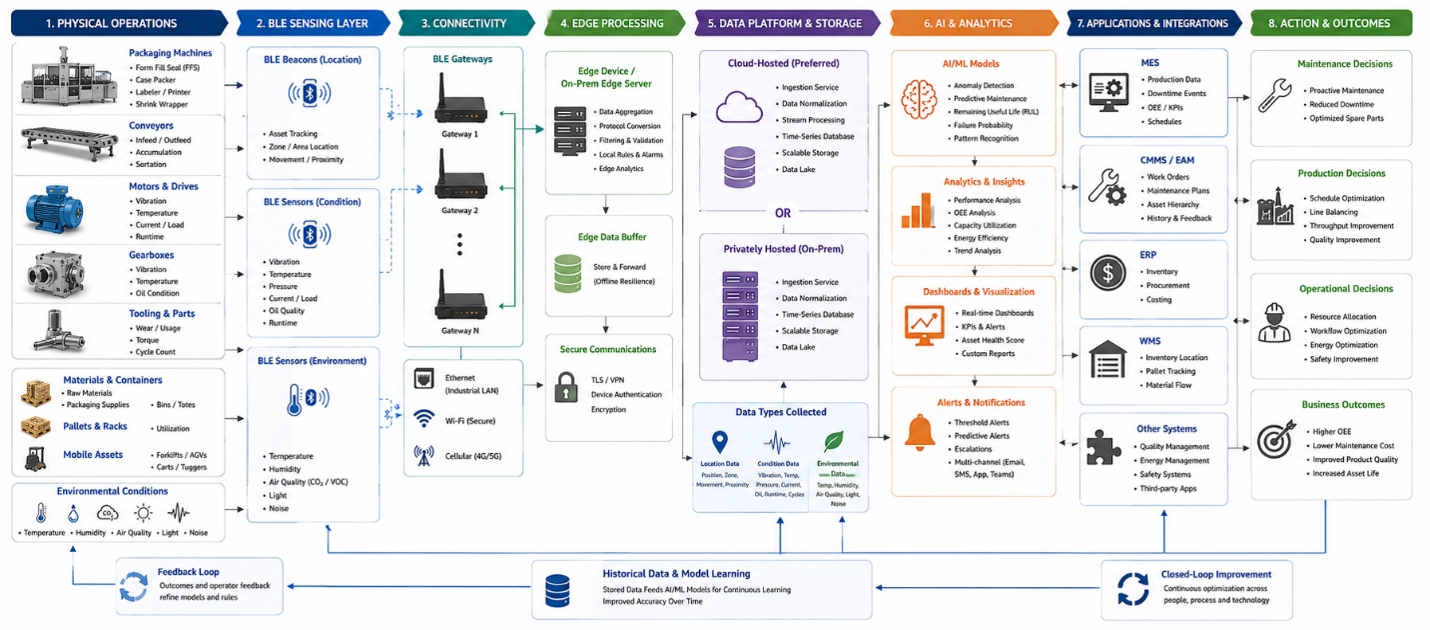
This visual maps the complete journey from physical packaging operations and environmental conditions through BLE sensing, connectivity, edge processing, data storage, AI analytics, and enterprise systems. It highlights how location, condition, and environmental data support real-time dashboards, alerts, maintenance, production, and operational decisions, with historical data feeding a continuous improvement loop.
BLE Hardware and AI Software for Consumer Packaging
A practical AI and BLE solution normally combines several technical components rather than relying on a single device.
BLE Beacons
BLE beacons transmit identifiers that allow software to associate wireless observations with physical assets or locations. They can be useful for equipment identification, mobile asset visibility, tool management, and zone-based tracking.
Selection factors include transmission interval, transmission power, battery life, enclosure rating, mounting method, temperature range, and expected RF environment.
BLE Sensors
BLE sensors extend identification into measurement. Depending on the application, devices may monitor temperature, humidity, vibration, motion, light, acceleration, or other parameters.
Consumer packaging applications should select sensors according to the physical process being monitored. A sensor designed for general environmental monitoring may not be suitable for high-vibration machinery, washdown environments, high-temperature areas, or locations exposed to packaging dust and debris.
BLE Gateways
BLE gateways form the connection between local BLE devices and the software system. They should provide sufficient BLE reception capability, appropriate network interfaces, local buffering where required, and management functions suitable for the deployment.
Gateway placement should account for RF coverage, power availability, network access, physical security, maintenance access, and future production-line changes.
AI Models
AI methods can include anomaly detection, classification, regression, time-series analysis, clustering, forecasting, and machine-learning models trained against historical operating data.
The appropriate model depends on the question being answered. Anomaly detection may be appropriate for identifying unusual equipment behavior, while time-series forecasting may support demand, utilization, or condition trends. AI should therefore be selected after defining the operational decision, available data, acceptable error rate, and response time.
Cloud Version and Server Version
A cloud-hosted version is appropriate when multiple consumer packaging facilities need centralized monitoring, shared analytics, remote management, and scalable computing resources. It can also simplify centralized software maintenance when network connectivity is reliable and organizational policies permit cloud processing.
A server version can be deployed on customer-managed servers, factory servers, private data centers, edge servers, or other privately hosted enterprise infrastructure. This model can be appropriate when local processing, controlled data residency, integration with factory networks, or continued operation during external connectivity interruptions is important.
A hybrid arrangement can also be practical. Time-sensitive processing can occur locally while selected historical data is transferred to centralized infrastructure for broader analytics. The choice should be based on latency, connectivity, cybersecurity, data governance, integration, maintenance responsibility, and the operating requirements of the packaging facility.
Technical Capabilities and Operational Improvements
Combining AI with BLE gives consumer packaging manufacturers a way to connect physical asset data with production analysis and operational decisions. The strongest results generally come from applications where BLE provides reliable observations and AI adds useful interpretation rather than simply increasing the volume of collected data.
Real-Time Asset Visibility
BLE-based identification can provide production personnel with a current view of selected equipment, tools, carts, pallets, and other mobile assets. AI can analyze location histories to identify recurring movement patterns, excessive travel, long idle periods, or unusual asset behavior.
This can reduce time spent searching for production resources and help supervisors understand how assets actually move through packaging operations. Historical location information can also reveal recurring congestion around staging areas, production lines, maintenance areas, or material-handling routes.
Anomaly Detection and Predictive Maintenance
AI can establish normal operating patterns from BLE sensor data and identify deviations that warrant investigation. For example, abnormal vibration behavior from a monitored motor or gearbox may indicate a developing mechanical issue.
The purpose is not to replace maintenance technicians with an automated prediction. Instead, AI can prioritize assets for inspection based on observed conditions and historical patterns. Maintenance personnel can then validate the condition and record the actual outcome.
This approach can support condition-based maintenance, reduce unnecessary inspections, and potentially help avoid unplanned interruptions when abnormal behavior is detected early enough to permit intervention.
Production and Material Flow Optimization
BLE movement data can expose how materials and mobile resources travel through a consumer packaging facility. AI can analyze these movement histories to identify repeated delays, excessive staging, unnecessary transportation, and areas where production resources compete for access.
For example, if a particular packaging line repeatedly experiences delays because required tooling remains in another production area, historical BLE observations can help quantify the problem. Production management can then evaluate whether tooling should be relocated, duplicated, or scheduled differently.
Environmental Condition Analysis
BLE temperature and humidity sensors can generate historical environmental datasets for production, storage, or material-handling areas. AI can identify trends and unusual combinations of conditions that may be difficult to recognize through individual threshold alarms.
This is particularly useful when environmental conditions influence packaging materials, adhesives, inks, labels, or other process inputs. The system can provide operational personnel with earlier indications that an area deserves investigation.
Improved Production Decisions
AI-generated information becomes operationally useful when it is connected to the decisions made by packaging personnel.
Potential actions include:
- Prioritizing a maintenance inspection
- Locating equipment required for a changeover
- Investigating abnormal material movement
- Reviewing environmental conditions around stored materials
- Identifying underutilized production assets
- Escalating an equipment anomaly
- Reviewing repeated production-area congestion
- Supporting production planning with historical utilization information
GAO can support these applications with BLE, RFID, and IoT hardware products and systems that provide the physical data required by downstream software and analytics.
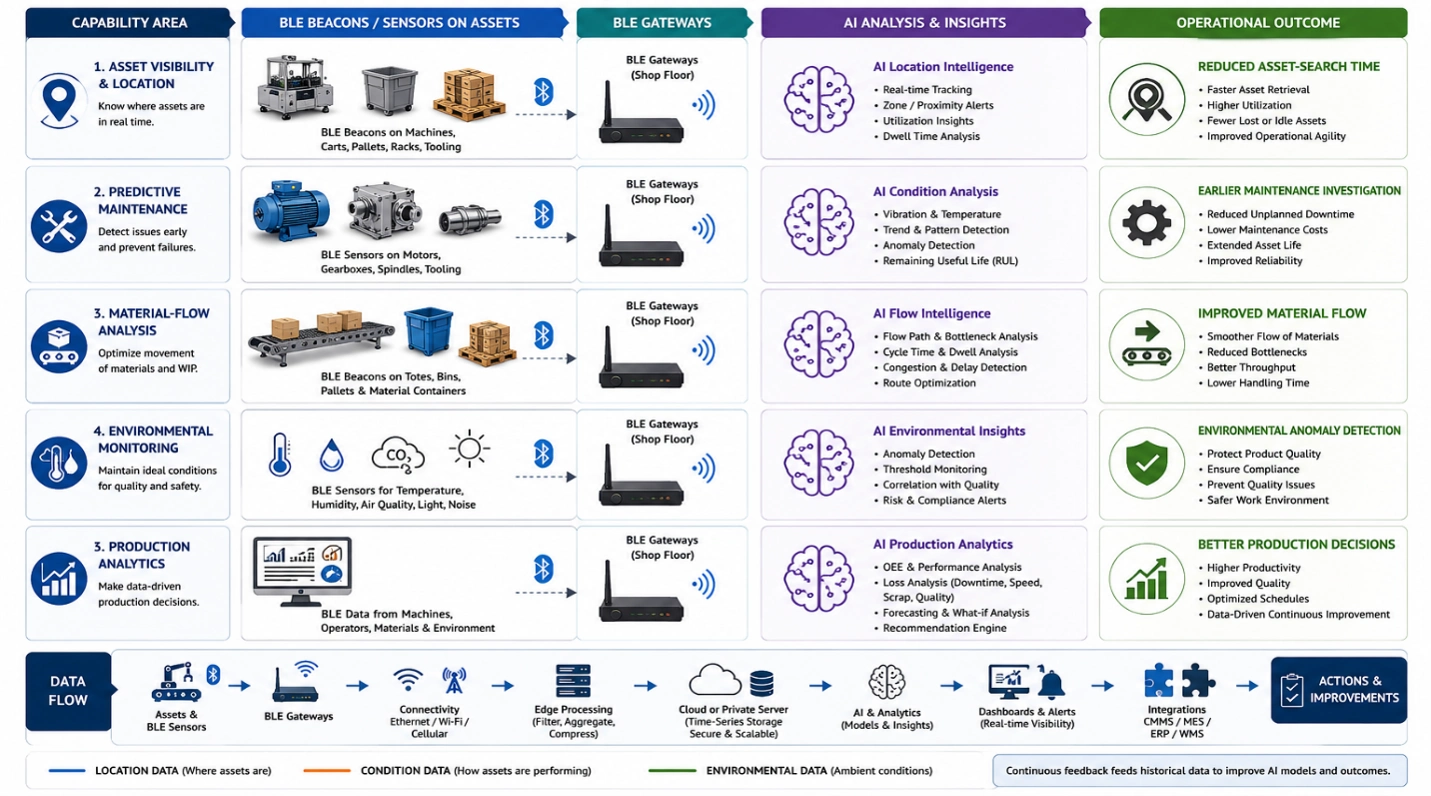
AI-Driven Consumer Packaging Benefits: BLE Intelligence and Operational Improvements
This visual shows how five key capabilities—asset visibility, predictive maintenance, material-flow analysis, environmental monitoring, and production analytics—use BLE beacons and sensors, gateways, and AI analysis to generate operational insights. It connects these capabilities to outcomes such as faster asset retrieval, earlier maintenance investigation, improved material flow, environmental anomaly detection, and better production decisions.
Integration with Consumer Packaging Manufacturing Systems
AI and BLE should normally complement existing manufacturing software rather than operate as an isolated application.
MES Integration
Manufacturing execution systems can provide production context such as work orders, production schedules, line status, product formats, and production events. Combining this information with BLE observations can make AI analysis more meaningful.
For example, a movement pattern that appears abnormal without production context may be completely normal during a planned changeover. Integrating production events helps AI distinguish expected activity from unusual behavior.
CMMS and Maintenance Integration
A computerized maintenance management system can receive selected condition alerts or prioritized maintenance recommendations. The maintenance system can then retain inspection results, corrective actions, parts usage, and work-order history.
This creates a feedback loop between BLE condition sensing and maintenance outcomes. Over time, confirmed failures and normal conditions can improve the quality of future analysis.
ERP and Warehouse Integration
ERP and warehouse management systems can provide information about materials, inventory, orders, storage locations, and movement requirements. BLE observations can add physical movement information that may not be available from transaction records alone.
This can help identify differences between planned and observed material movement and support investigations into staging delays or misplaced production resources.
API and Data Integration
REST APIs, MQTT messaging, OPC UA, database interfaces, and other integration mechanisms may be appropriate depending on the existing software environment.
A successful integration should define:
- Device and asset identifiers
- Timestamp requirements
- Location or zone definitions
- Measurement units
- Event types
- Data validation rules
- Data retention periods
- Alarm priorities
- API authentication
- Failure and retry behavior
- Ownership of operational data
Clear data definitions are especially important when several packaging lines, facilities, or software systems use different naming conventions for the same physical assets.
Cybersecurity and Reliability Considerations
AI and BLE deployments in consumer packaging facilities should be designed with cybersecurity and operational reliability from the beginning.
BLE devices should use appropriate security mechanisms for the application, while gateways and servers should be protected through access controls, secure network configuration, authentication, software updates, and appropriate segmentation.
Gateway-to-server communications should use secure protocols where supported and required by the organization’s security policy. Device identifiers should also be managed carefully so that an asset cannot be incorrectly associated with another device because of duplicate or poorly controlled identifiers.
Network segmentation can help separate IoT communications from critical control networks. Where direct integration with production systems is required, interfaces should be restricted to the necessary services and endpoints.
Reliability also requires consideration of network interruptions. Gateways may need local buffering so that temporary connectivity failures do not automatically result in permanent data loss.
Battery-powered BLE sensors introduce another operational consideration. Battery life depends on transmission interval, radio power, sensor sampling frequency, environmental conditions, and device configuration. Maintenance teams should therefore monitor battery status and establish replacement procedures before large-scale deployment.
Engineering Considerations for BLE Deployment
RF Site Survey
BLE coverage should be validated under actual packaging-facility conditions. Metal machinery, electrical equipment, walls, racks, storage structures, and moving assets can affect wireless performance.
A site survey should identify gateway locations, expected coverage zones, interference sources, power availability, network connections, and areas where signal reliability is critical.
Sensor Placement
Sensor placement affects data quality. Vibration sensors should be mounted consistently on suitable machine surfaces. Environmental sensors should represent the condition of the area being monitored rather than a localized heat or airflow source.
Installation procedures should therefore specify mounting orientation, location, fastening method, calibration requirements, and replacement procedures.
Data Quality
AI models are highly dependent on data quality. Missing readings, duplicate events, incorrect timestamps, device reassignment, sensor drift, and inconsistent asset identifiers can produce misleading results.
A production deployment should therefore include data validation before AI analysis. The system should be capable of identifying stale devices, missing measurements, unexpected transmission rates, and invalid readings.
Pilot Before Scaling
A controlled pilot can establish whether the proposed BLE hardware and AI approach performs adequately before a facility-wide deployment.
A pilot should normally focus on a specific operational problem such as:
- Tracking changeover tooling
- Monitoring selected motors or gearboxes
- Tracking mobile production assets
- Monitoring temperature or humidity
- Analyzing material movement
- Identifying production-area congestion
The pilot should define measurable success criteria and compare system observations with actual operational events.
Consumer Packaging AI and BLE Deployment Decision Tree for Industrial Operations
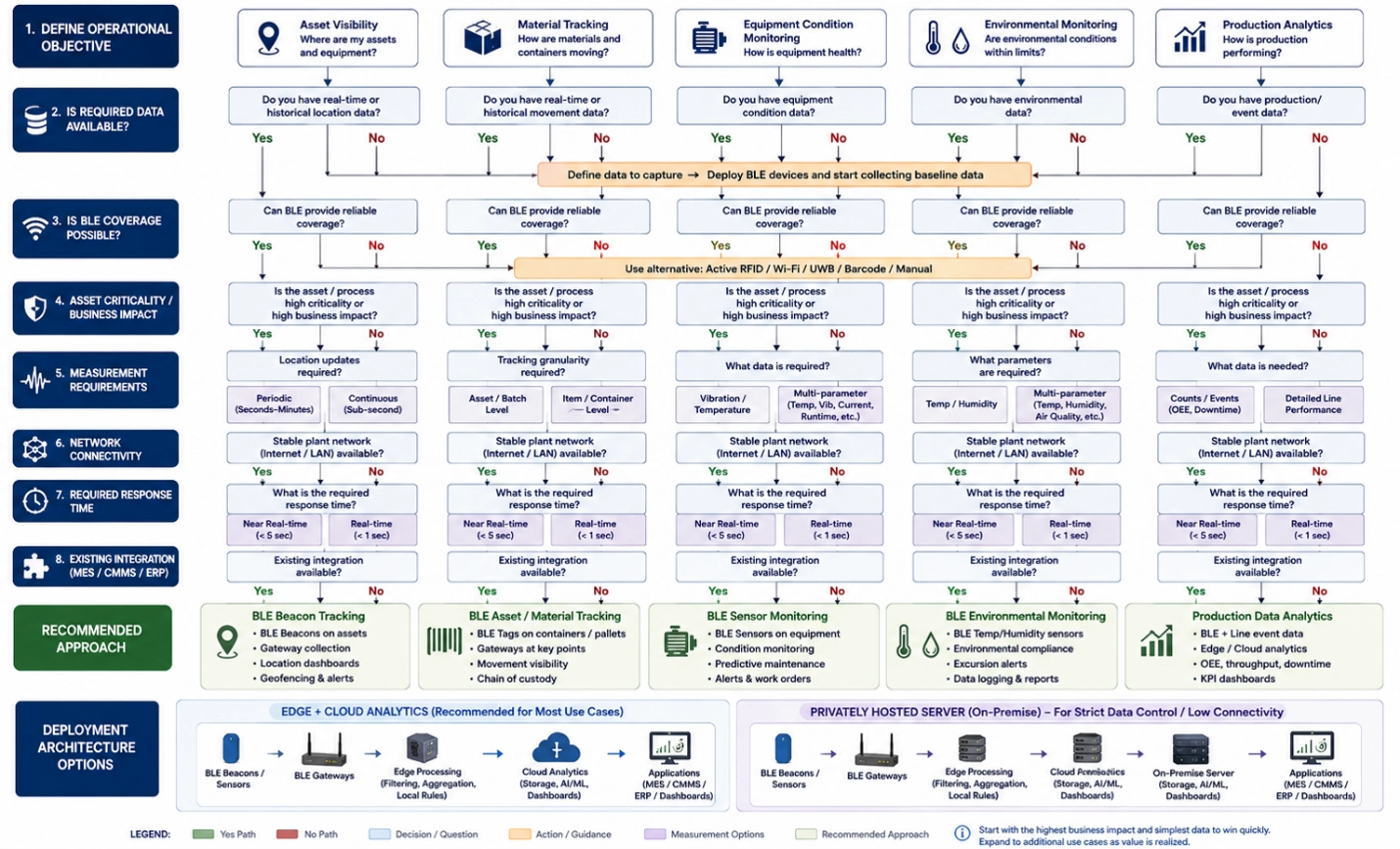
This decision tree helps packaging engineers select an appropriate AI and BLE application based on operational objectives, data availability, BLE coverage, asset criticality, measurement requirements, network connectivity, response time, and existing MES/CMMS/ERP integration. It maps these factors to recommended approaches including BLE beacon tracking, BLE asset and material tracking, BLE sensor monitoring, environmental monitoring, production analytics, and edge, cloud, or privately hosted processing.
Implementation Recommendations for Consumer Packaging Manufacturers
A successful AI and BLE deployment should begin with the operational problem rather than the technology.
Start by identifying a process where improved visibility or analysis can produce a meaningful operational decision. Define the asset population, data requirements, response time, existing software interfaces, and people responsible for acting on the results.
Next, conduct a physical and network assessment. Determine where BLE devices can be installed, how gateways will communicate with the network, whether radio coverage is sufficient, and whether environmental conditions require specialized enclosures or sensors.
The AI requirements should then be defined from the available data. A predictive-maintenance application, for example, requires sufficient historical condition information and maintenance outcomes. A location application may require different data structures and algorithms.
Integration should be tested before large-scale deployment. Asset identifiers, production-line names, maintenance records, and location definitions should be reconciled before AI models begin producing operational recommendations.
The implementation process should include:
- Define the operational objective and measurable KPI
- Select representative packaging equipment or assets
- Conduct BLE and network site surveys
- Select beacons, sensors, and gateways according to operating conditions
- Establish device identification and asset mapping procedures
- Configure data collection and validation
- Connect BLE data with appropriate manufacturing software
- Establish cybersecurity and access-control requirements
- Deploy initial analytics and AI models
- Validate AI results against actual production and maintenance events
- Train operators, maintenance personnel, and system administrators
- Establish device, battery, gateway, and software maintenance procedures
- Measure results before expanding to additional production areas
- Periodically review model performance and data quality
GAO’s experience supplying BLE, RFID, and IoT hardware products and systems can support organizations that need to evaluate device selection, wireless data collection, and deployment requirements for these applications.
KPIs for Measuring AI and BLE Performance
Consumer packaging manufacturers should evaluate the system using operational KPIs rather than simply counting installed devices.
Relevant measurements can include:
- Asset search time
- Asset utilization
- Equipment idle time
- Unplanned downtime
- Mean time between failures
- Mean time to repair
- Maintenance response time
- Changeover preparation time
- Material staging time
- Material movement distance
- Environmental excursions
- Sensor data availability
- BLE gateway uptime
- Device battery life
- Alert precision
- False-alert rate
- AI anomaly detection accuracy
- Data completeness
- Integration latency
- Production-line availability
The appropriate KPI depends on the application. A tooling-location project should primarily measure search and changeover performance, while a predictive-maintenance project should focus on maintenance outcomes and detection quality.
Scaling AI and BLE Across Consumer Packaging Facilities
Once a pilot has demonstrated operational value, expansion should be controlled rather than based solely on the number of available devices.
Additional production lines may introduce different equipment, RF conditions, product formats, operating schedules, and software requirements. Device configurations and AI models may therefore require adjustment.
Multi-site deployments should establish common naming conventions, asset identifiers, device-management procedures, security policies, and data models while still allowing individual facilities to account for local operating conditions.
Cloud-hosted systems can simplify centralized management across multiple sites, while privately hosted servers can provide greater local control where required. A hybrid model can combine local processing with centralized historical analytics.
AI models should also be monitored after deployment. Changes in equipment, maintenance practices, production speeds, product formats, and sensor installation can change the statistical characteristics of the collected data. Periodic model validation helps prevent historical assumptions from becoming operationally misleading assumptions from becoming operationally misleading.
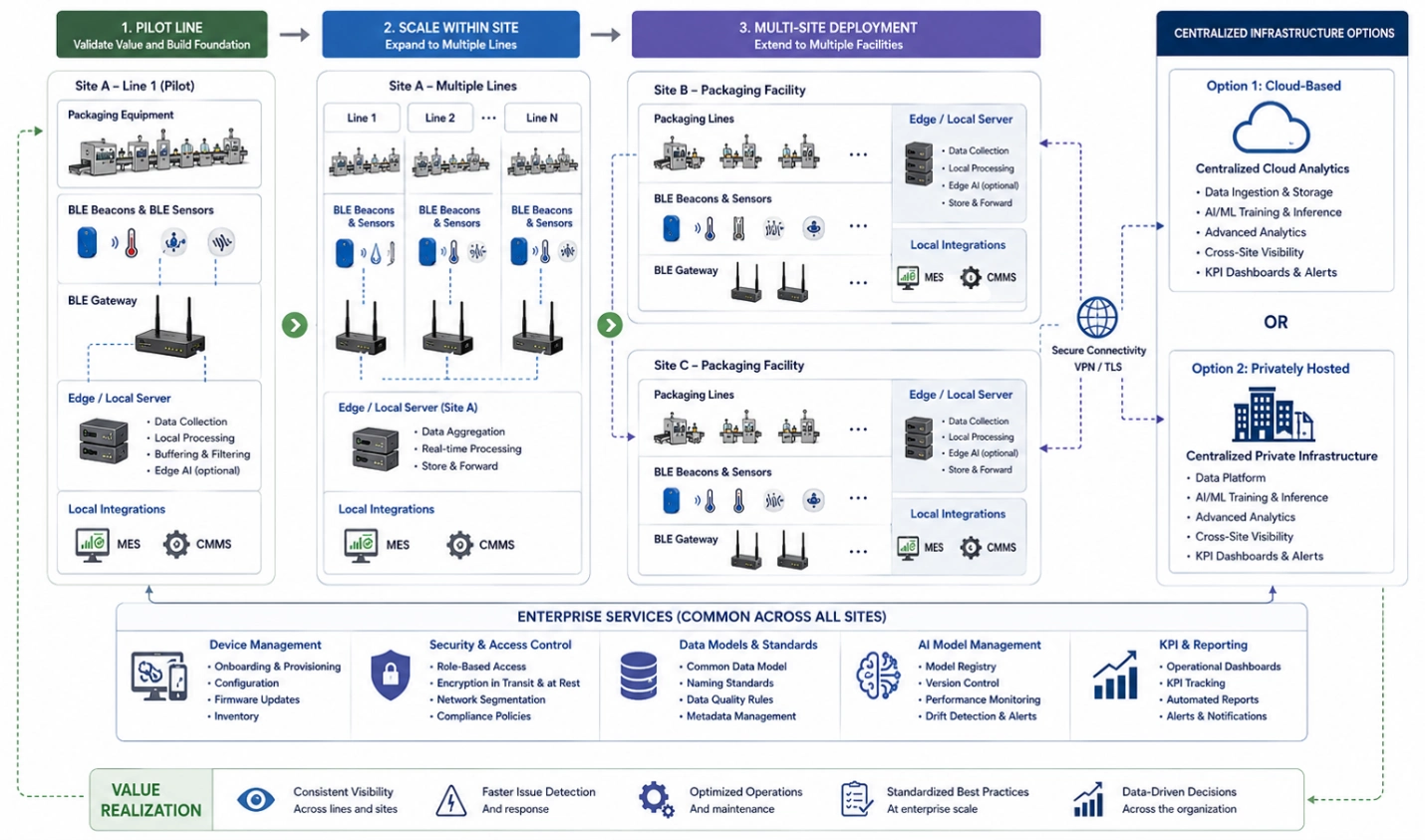
Scaling AI and BLE Across Multi-Site Consumer Packaging Manufacturing
This diagram shows how AI and BLE can scale from a pilot packaging line to multiple production lines and geographically distributed facilities. It illustrates site-level BLE devices, gateways, edge processing, MES/CMMS integration, centralized cloud or privately hosted infrastructure, and shared enterprise services for device management, security, data standards, AI model management, and KPI reporting.
GAO’s Role in AI, BLE, RFID, and IoT Deployments
GAO has supplied BLE, RFID, and IoT hardware products and systems to organizations requiring wireless identification, sensing, monitoring, and data collection. These technologies can form the physical data-acquisition layer for consumer packaging applications such as asset tracking, environmental monitoring, equipment condition sensing, and material-flow visibility.
Headquartered in New York City and Toronto, Canada, GAO is recognized among the leading global B2B and B2G suppliers of BLE and RFID technologies. GAO and its sister companies, GAO Research and GAO Tek, operate as part of GAO Group, serving organizations across the United States and Canada.
For three decades, GAO Group has served customers that include Fortune 500 companies, major research and development organizations, universities, and government agencies. Its engineering and product-development activities have included substantial investment in R&D, supported by quality assurance processes and technical assistance provided remotely or onsite.
For consumer packaging manufacturers, this background is relevant when BLE or RFID hardware must operate as part of a larger production, inventory, maintenance, or IoT system rather than as a standalone device.
Key Takeaways for AI and BLE in Consumer Packaging
AI and BLE can provide consumer packaging manufacturers with a practical method for connecting physical production assets and operating conditions with software-based analysis.
The most effective implementations focus on defined operational problems, reliable data acquisition, appropriate wireless coverage, meaningful software integration, and clear human actions.
BLE beacons can support asset and location identification, while BLE sensors can provide condition and environmental information. Gateways connect those devices with edge, cloud, or privately hosted server infrastructure. AI can then analyze the resulting data for anomalies, utilization patterns, material movement, environmental trends, and maintenance priorities.
Successful deployments should include cybersecurity, RF validation, data-quality controls, lifecycle maintenance, AI model validation, and measurable KPIs from the beginning.
Organizations evaluating these applications can learn more about GAO’s BLE, RFID, and IoT technologies, hardware products, engineering capabilities, and technical support to determine which combination is appropriate for their consumer packaging requirement
Consumer Packaging AI and BLE Technology Landscape: Assets, Connectivity, Analytics, and Deployment
This three-layer technology landscape connects physical consumer packaging assets and processes with BLE identification and sensing, gateways, networking, edge processing, and secure data ingestion. The upper layer shows AI applications, enterprise integrations, cloud and privately hosted deployments, while cross-cutting foundations cover cybersecurity, device management, data governance, integration, and operational resilience.
Building the Future of Industrial AI and IoT with Aperture Venture Studio and GAO RFID Inc.
For more than three decades, GAO Group of Companies has invested heavily in R&D for industrial BLE, RFID, and IoT technologies. As generative AI has become increasingly useful for industrial applications, we have continued developing AI and IoT technologies that can support applications such as consumer packaging asset visibility, sensing, monitoring, and operational analytics. We have also founded Aperture Venture Studio to advance AI and IoT solutions relevant to industries that rely on connected physical operations.
Aperture has attracted AI and IoT technical experts, entrepreneurial and operational executives, investors, and leading companies. We have also developed the Aperture Ventures Summit and TekSummit to discuss advanced AI and IoT topics.