
AI-Driven Controlled Environmental Agriculture Using BLE Sensors, Gateways, and Intelligent Analytics
Intelligent Controlled Environmental Agriculture with AI-Powered BLE Monitoring
Controlled Environmental Agriculture (CEA) depends on precise control of environmental variables to maximize crop quality, yield consistency, resource efficiency, and operational sustainability. Artificial Intelligence supported by Bluetooth Low Energy (BLE) sensing infrastructure enables continuous monitoring of greenhouse conditions, vertical farms, hydroponic systems, aeroponic facilities, propagation rooms, growth chambers, and climate-controlled production environments.
BLE sensors, BLE gateways, and intelligent edge devices continuously collect measurements including temperature, humidity, vapor pressure deficit (VPD), CO₂ concentration, photosynthetically active radiation (PAR), substrate moisture, nutrient solution electrical conductivity (EC), pH, dissolved oxygen, airflow, water consumption, and equipment operating conditions. AI software analyzes these large datasets to detect anomalies, forecast crop stress, optimize irrigation cycles, regulate environmental controls, and automate operational decisions.
GAO has helped organizations implement BLE-enabled sensing systems that provide reliable environmental data for AI-driven agricultural decision support. Supported by decades of research and deployments across North America, GAO supplies BLE hardware and IoT systems that integrate with advanced agricultural software used by research institutions, commercial growers, and technology developers.
Enterprise Architecture for AI-Enabled Controlled Environmental Agriculture Using BLE Technology
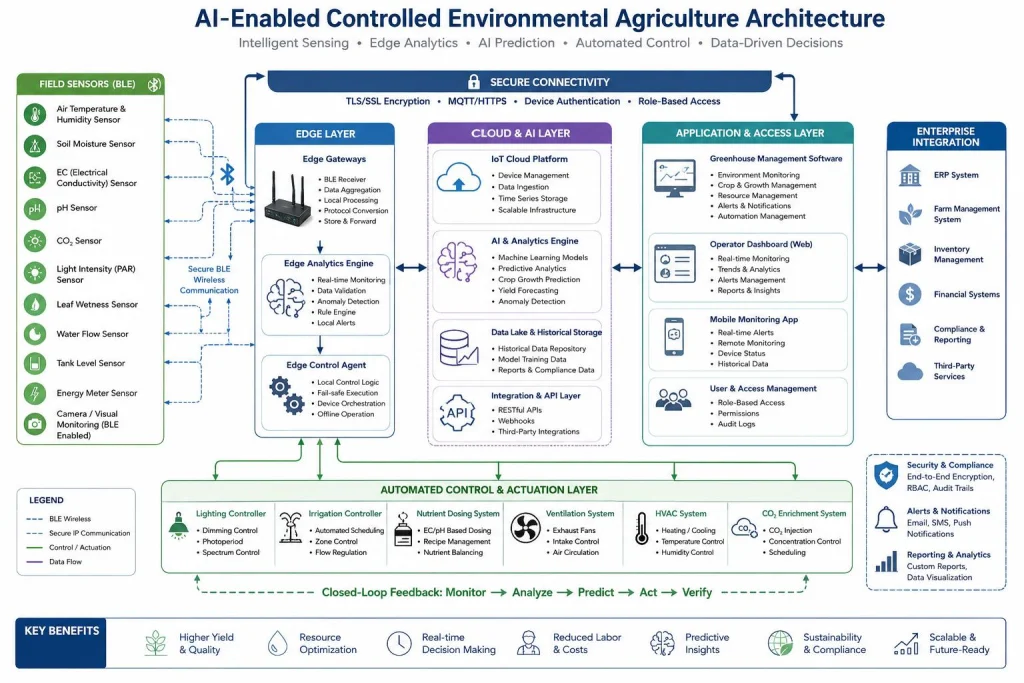
This enterprise architecture diagram illustrates how BLE environmental sensors collect greenhouse and crop data, which is processed through edge gateways and AI analytics platforms to automate irrigation, lighting, ventilation, nutrient dosing, and environmental control while integrating with cloud services, operator dashboards, mobile applications, and enterprise ERP systems.
Fundamentals of AI-Enabled BLE Systems in Controlled Environmental Agriculture
Modern controlled environmental agriculture produces crops inside carefully managed facilities where environmental parameters are continuously adjusted to maintain optimal plant growth. Unlike conventional farming, environmental conditions are actively regulated through computerized climate control systems.
BLE technology serves as the sensing layer of the overall solution. BLE environmental sensors continuously measure growing conditions while consuming minimal power, allowing battery-operated devices to function for years without maintenance. BLE gateways aggregate sensor data and securely forward information to edge servers or cloud-hosted software.
Artificial Intelligence operates above the sensing infrastructure by learning relationships among environmental variables, crop development stages, historical production data, and equipment performance. Machine learning models identify patterns that human operators cannot easily recognize, enabling predictive irrigation scheduling, nutrient optimization, disease detection, climate forecasting, and energy optimization.
Rather than replacing experienced growers, AI augments agronomic expertise by providing data-driven recommendations supported by continuous environmental monitoring.
Agricultural Applications of AI and BLE Across Controlled Environmental Agriculture
AI supported by BLE sensing technologies addresses numerous operational challenges unique to climate-controlled crop production.
Commercial Greenhouses
BLE sensors monitor:
- Air temperature
- Relative humidity
- CO₂ enrichment
- Solar radiation
- Leaf temperature
- Root zone moisture
- Ventilation performance
AI predicts:
- Heat stress
- Disease development
- Irrigation timing
- Energy consumption
- Crop growth variability
Vertical Farming
BLE devices continuously monitor:
- LED lighting intensity
- Shelf temperatures
- Nutrient circulation
- Air velocity
- Water quality
- Pump performance
AI optimizes:
- Photoperiod schedules
- Light spectrum adjustments
- Crop recipes
- Nutrient dosing
- Harvest forecasting
Hydroponic Production
BLE sensors measure:
- Nutrient EC
- Solution pH
- Dissolved oxygen
- Reservoir temperature
- Water flow
- Pump efficiency
AI continuously predicts:
- Nutrient depletion
- Root oxygen deficiencies
- Water quality degradation
- Pump maintenance requirements
Aeroponic Systems
BLE monitoring includes:
- Misting intervals
- Nozzle pressure
- Root chamber humidity
- Reservoir chemistry
- Water temperature
AI detects:
- Nozzle clogging
- Root stress
- Spray inconsistency
- Water consumption anomalies
Research Growth Chambers
BLE instrumentation provides highly accurate environmental measurements supporting:
- Plant phenotyping
- Crop genetics research
- Climate simulation experiments
- Stress-response studies
- Precision agriculture research
AI automates experiment monitoring while maintaining repeatable environmental conditions.
Seedling Nurseries and Propagation Facilities
BLE devices monitor:
- Germination temperature
- Humidity
- Lighting
- Irrigation timing
- Growing media moisture
AI predicts optimal transplant timing and identifies environmental deviations that reduce seedling quality.
AI-Enabled BLE Applications Across Controlled Environmental Agriculture
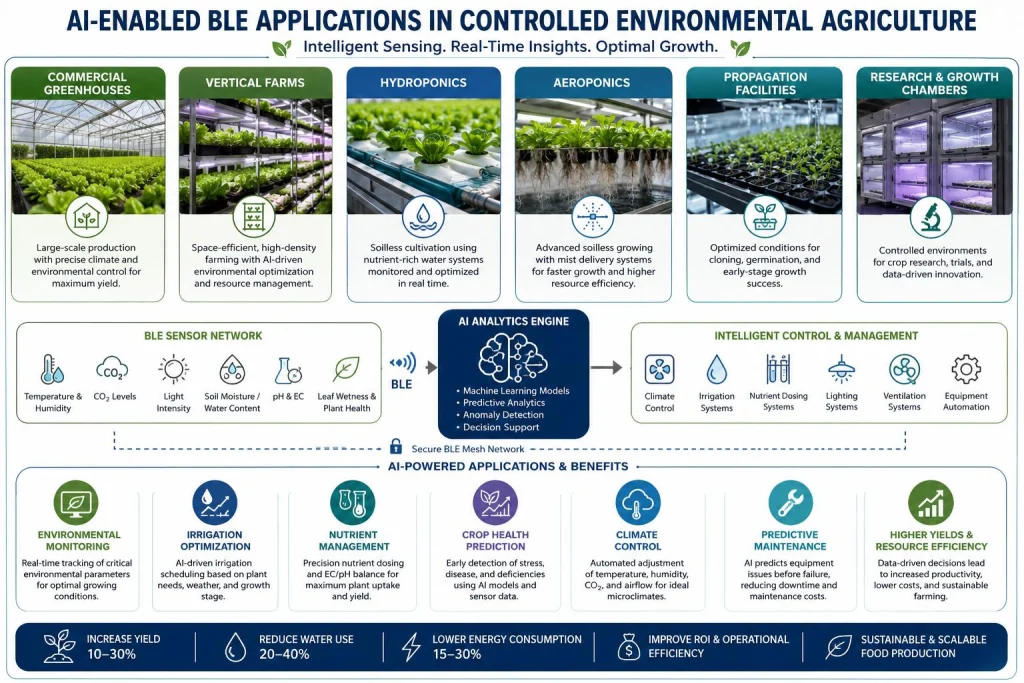
This infographic illustrates how AI-powered Bluetooth Low Energy (BLE) technologies support controlled environmental agriculture across commercial greenhouses, vertical farms, hydroponic systems, aeroponic systems, propagation facilities, and research growth chambers. It demonstrates how BLE-enabled environmental sensing and AI analytics enable real-time environmental monitoring, irrigation optimization, nutrient management, crop health prediction, climate control, and predictive maintenance to improve operational efficiency, sustainability, and crop productivity.
Operational Workflow of AI-Enabled BLE Monitoring in Controlled Environmental Agriculture
Successful deployment follows a complete operational workflow that transforms environmental measurements into automated agricultural decisions.
Environmental Data Acquisition
BLE environmental sensors collect measurements including:
- Temperature
- Relative humidity
- Vapor pressure deficit
- Carbon dioxide
- Light intensity
- Nutrient EC
- pH
- Water temperature
- Flow rate
- Soil moisture
- Reservoir levels
- Equipment vibration
- Energy consumption
Sampling intervals vary from seconds to several minutes depending on crop sensitivity and operational requirements.
BLE Communication Layer
BLE gateways securely receive sensor transmissions using Bluetooth Low Energy advertising or connected modes.
Gateway software performs:
- Device authentication
- Signal quality monitoring
- Local buffering
- Timestamp synchronization
- Sensor health monitoring
Communication reliability remains high despite dense greenhouse environments containing irrigation equipment, metallic structures, and multiple wireless devices.
Edge Computing
Edge servers perform local processing before transmitting selected datasets to centralized systems.
Typical edge processing includes:
- Sensor validation
- Noise filtering
- Outlier detection
- Missing data reconstruction
- Rule-based alarms
- Initial AI inference
Edge computing minimizes latency for critical environmental control decisions such as emergency ventilation activation or irrigation shutdown.
Enterprise Data Integration
Environmental datasets integrate with numerous agricultural software systems including:
- Greenhouse Management Systems (GMS)
- Manufacturing Execution Systems (MES) for indoor farming
- Building Management Systems (BMS)
- Computerized Maintenance Management Systems (CMMS)
- Enterprise Resource Planning (ERP)
- Laboratory Information Management Systems (LIMS)
- Geographic Information Systems (GIS)
- Digital twin software
- Crop planning software
- Energy management software
These integrations eliminate isolated datasets while enabling organization-wide operational visibility.
AI Analytics
Machine learning models continuously evaluate:
- Environmental stability
- Crop growth patterns
- Equipment efficiency
- Disease probability
- Water usage
- Fertilizer consumption
- Harvest prediction
- Resource optimization
Model outputs generate actionable recommendations rather than raw measurements.
Automated Agricultural Actions
AI recommendations trigger automated responses including:
- Irrigation adjustments
- Nutrient dosing
- Lighting optimization
- HVAC regulation
- Ventilation control
- Shade curtain positioning
- Humidification
- CO₂ enrichment
- Equipment maintenance scheduling
- Staff notifications
Closed-loop automation significantly reduces manual intervention while maintaining precise growing conditions.
AI-Enabled Agricultural Data Workflow Using BLE Sensors, Edge Computing, and AI Analytics
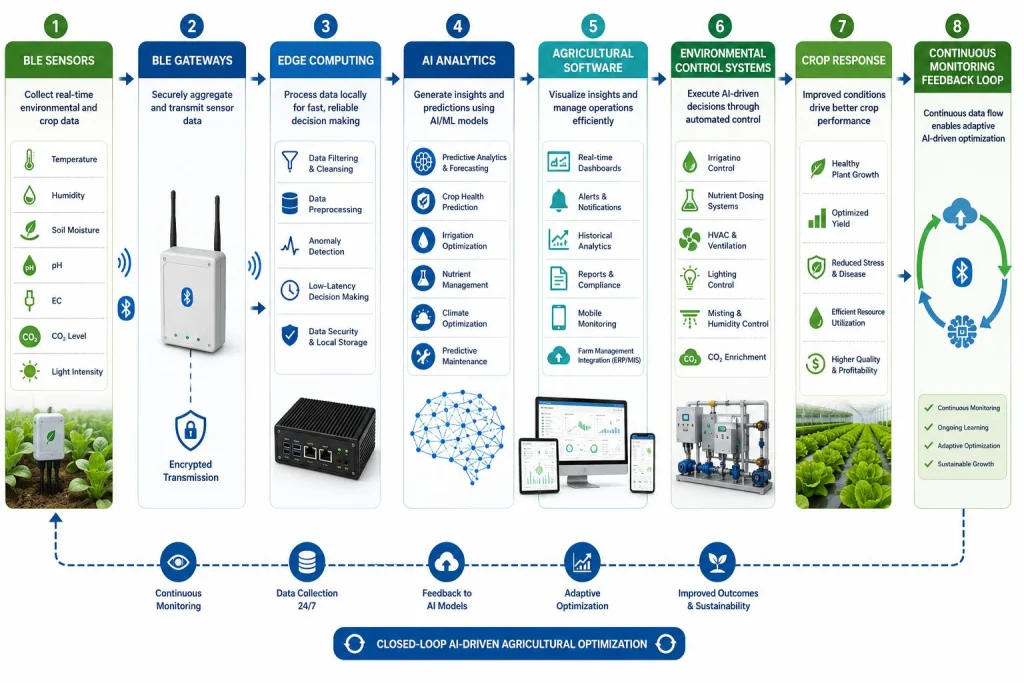
This workflow diagram illustrates the end-to-end flow of agricultural data in an AI-enabled controlled environmental agriculture system. It shows how BLE sensor data is collected, processed through edge computing and AI analytics, integrated into agricultural management software, used to automate environmental control systems, and continuously refined through a closed-loop monitoring process.
BLE Infrastructure, AI Software, Communication Technologies, and Deployment Models
A reliable AI-enabled controlled environmental agriculture solution depends on multiple integrated hardware and software layers working together to deliver accurate environmental intelligence.
BLE Hardware Components
Typical deployments include:
- BLE temperature sensors
- BLE humidity sensors
- BLE CO₂ sensors
- BLE light sensors
- BLE soil moisture probes
- BLE EC sensors
- BLE pH sensors
- BLE dissolved oxygen sensors
- BLE vibration sensors
- BLE energy monitoring devices
- BLE gateways
- Industrial edge computers
- Environmental controllers
- Industrial networking equipment
Each sensing device contributes specialized environmental information that expands the AI model’s situational awareness.
AI Software Components
Core software capabilities include:
- Time-series data management
- Machine learning pipelines
- Predictive analytics engines
- Computer vision modules for crop monitoring
- Anomaly detection models
- Forecasting algorithms
- Reinforcement learning for environmental optimization
- Decision support dashboards
- Alarm management
- Model lifecycle management
These software components continuously improve prediction accuracy as additional operational data becomes available.
Communication Protocols
Common communication technologies include:
- Bluetooth Low Energy (BLE)
- MQTT
- HTTPS
- OPC UA
- Modbus TCP
- Ethernet/IP
- Wi-Fi
- LoRaWAN (for extended outdoor connectivity)
- BACnet (building automation)
- REST APIs
- WebSockets
Protocols are selected based on latency requirements, security, interoperability, and infrastructure constraints.
Security Mechanisms
Security considerations include:
- BLE Secure Connections
- AES-128 encryption
- TLS encryption
- Certificate-based authentication
- Role-based access control
- Multi-factor authentication
- Network segmentation
- Secure firmware updates
- Device identity management
- Continuous security monitoring
Strong cybersecurity protects agricultural operations from data tampering, unauthorized access, and operational disruption.
Cloud Version for Controlled Environmental Agriculture
A cloud-hosted deployment is well suited for greenhouse operators, vertical farming companies, agricultural research organizations, and multi-site growers that require centralized visibility across geographically distributed facilities. BLE gateways securely transmit environmental data to cloud-hosted software, where AI models analyze historical and real-time information to support operational decision-making.
Key advantages include:
- Centralized monitoring of multiple growing facilities
- Automatic software and AI model updates
- Elastic computing resources for seasonal workloads
- Remote access through secure web dashboards and mobile applications
- Simplified collaboration among growers, agronomists, maintenance teams, and management
- Long-term storage of environmental and production data for trend analysis and regulatory reporting
Cloud deployments are particularly valuable when organizations require benchmarking across locations, remote technical support, or integration with cloud-hosted business software. GAO has supplied BLE-enabled monitoring hardware that integrates with cloud-based agricultural monitoring systems, helping customers improve operational visibility while maintaining secure data communications.
Server Version for Controlled Environmental Agriculture
Some agricultural organizations prefer customer-managed server deployments because of data governance policies, ultra-low latency requirements, or integration with existing operational technology.
A server-hosted solution typically operates on:
- Private data centers
- Customer-managed servers
- Greenhouse edge servers
- Agricultural research computing clusters
- Industrial edge appliances
Benefits include:
- Full control of operational data
- Reduced dependence on internet connectivity
- Faster local AI inference
- Easier integration with legacy automation systems
- Greater flexibility for customized workflows
- Compliance with organization-specific cybersecurity policies
Server deployments are often selected for research facilities, seed production companies, high-value crop producers, and organizations operating mission-critical climate control systems where uninterrupted operation is essential.
Cloud Version vs Server Version for AI-Enabled Controlled Environmental Agriculture
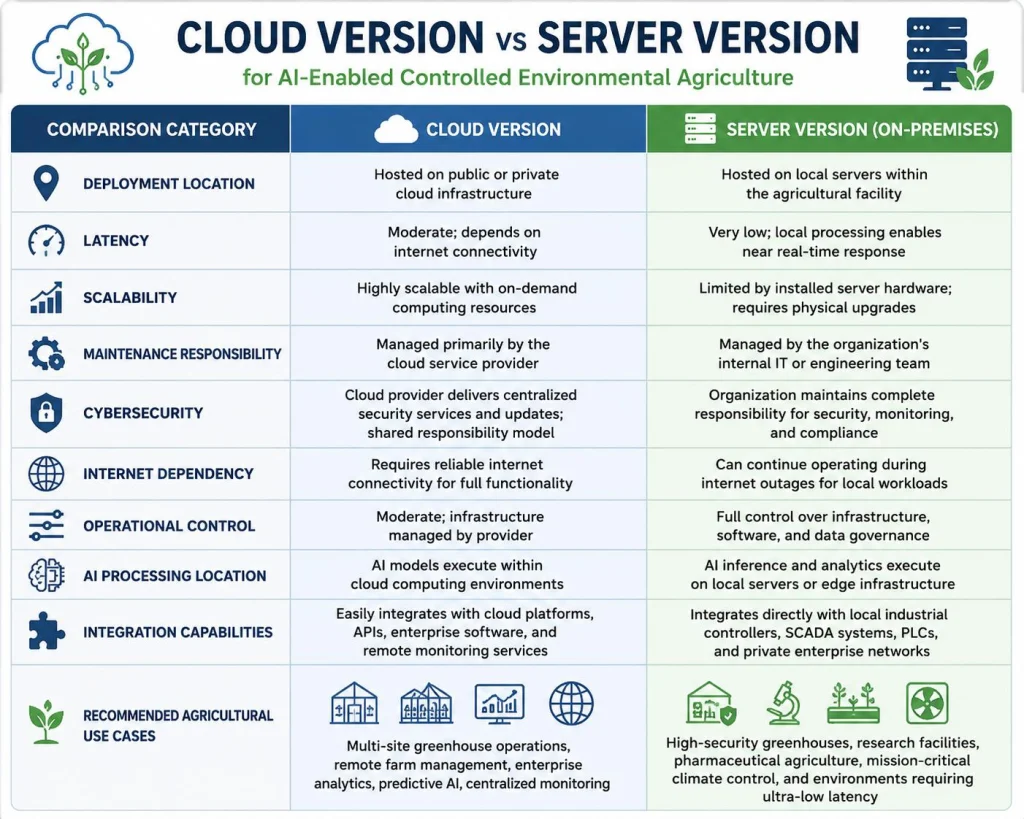
Enterprise comparison table highlighting the differences between cloud-hosted and server-hosted AI deployments for controlled environmental agriculture, including deployment architecture, performance, security, scalability, operational control, and recommended agricultural applications.
Operational Improvements Enabled by AI and BLE in Controlled Environmental Agriculture
The combination of AI and BLE sensing delivers measurable technical and operational improvements throughout controlled environmental agriculture by converting continuous environmental measurements into actionable intelligence.
Improved Crop Health Monitoring
Continuous BLE monitoring provides AI systems with high-resolution environmental data that can identify subtle changes before visible crop symptoms appear. Predictive models correlate environmental trends with crop stress, nutrient deficiencies, and disease risk, enabling earlier intervention and reducing production losses.
Precision Irrigation and Nutrient Management
AI evaluates substrate moisture, evapotranspiration, reservoir chemistry, and crop growth stages to optimize irrigation frequency and nutrient dosing. This minimizes water waste, improves fertilizer efficiency, and supports consistent crop development.
Climate Optimization
AI dynamically adjusts HVAC systems, ventilation, CO₂ enrichment, humidification, and supplemental lighting based on changing environmental conditions and crop requirements. Stable growing conditions improve crop quality while reducing energy consumption.
Predictive Equipment Maintenance
BLE vibration, temperature, and power monitoring sensors enable AI to identify early signs of degradation in pumps, fans, chillers, circulation systems, nutrient dosing equipment, and lighting infrastructure. Maintenance can be scheduled before failures interrupt production.
Energy Optimization
Energy represents one of the largest operating costs in controlled environmental agriculture. AI continuously analyzes lighting schedules, heating demand, cooling loads, and ventilation cycles to reduce unnecessary energy usage while maintaining optimal growing conditions.
Resource Utilization
AI supports efficient use of:
- Water
- Fertilizers
- Electricity
- Carbon dioxide
- Labor
- Growing media
Resource optimization contributes to lower production costs and improved environmental sustainability.
Scalability
BLE networks are highly scalable because additional sensors can be deployed without extensive cabling. As facilities expand, AI models incorporate new environmental data sources while maintaining centralized monitoring and analytics.
Enhanced Security and Reliability
Security measures such as encrypted BLE communication, authenticated gateways, secure APIs, network segmentation, and continuous monitoring help protect operational data and environmental control systems. Redundant gateways and edge processing further improve system resilience.
Benefits of AI-Enabled BLE Monitoring in Controlled Environment Agriculture
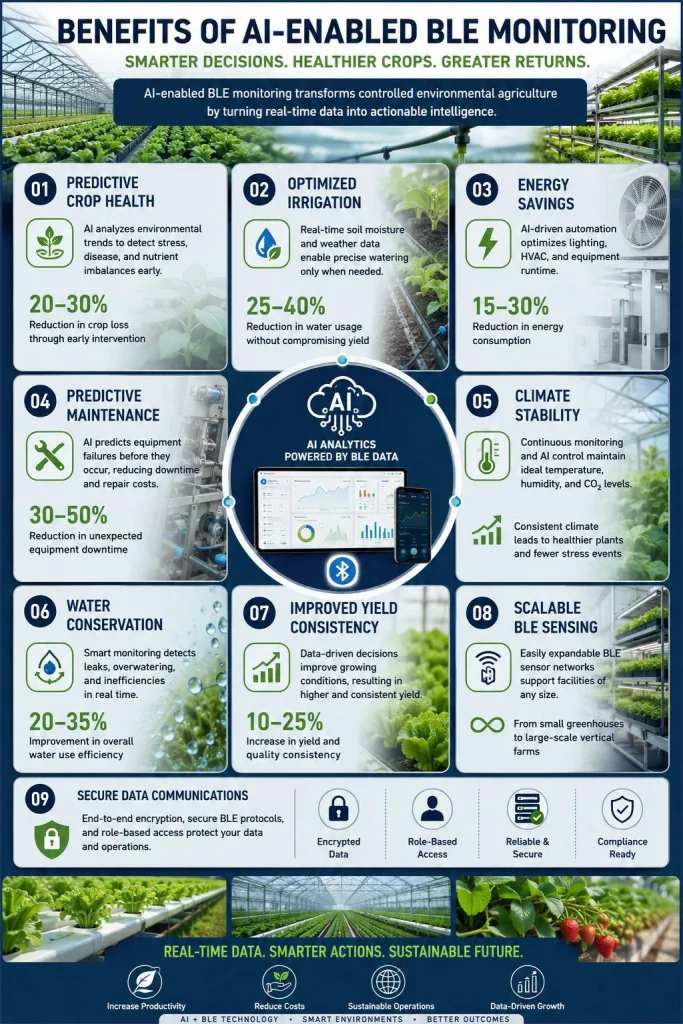
Enterprise infographic illustrating the operational and sustainability benefits of integrating AI analytics with Bluetooth Low Energy (BLE) monitoring in controlled environment agriculture. It highlights predictive crop health, optimized irrigation, energy efficiency, predictive maintenance, climate stability, water conservation, yield consistency, scalable BLE sensing, and secure data communications.
Engineering Best Practices for Successful Deployment
Successful AI-enabled BLE implementations in controlled environmental agriculture require careful planning beyond sensor installation.
Recommended engineering practices include:
- Perform RF site surveys before installing BLE gateways to minimize interference from greenhouse structures and equipment.
- Position environmental sensors at representative crop canopy locations rather than near walls, vents, or heat sources.
- Calibrate sensors regularly to maintain measurement accuracy.
- Design overlapping gateway coverage to improve communication reliability.
- Use edge processing for latency-sensitive environmental control functions.
- Integrate monitoring systems with greenhouse management software, ERP, and maintenance systems.
- Establish data retention and backup policies for historical environmental records.
- Monitor battery health and schedule preventive replacement for wireless devices.
- Validate AI models using local crop data before enabling automated control actions.
- Apply cybersecurity best practices, including secure firmware management and role-based access control.
These practices improve long-term reliability, simplify maintenance, and maximize the value of AI-driven environmental management.
Why Agricultural Organizations Choose GAO for BLE and AI Solutions
Agricultural organizations require dependable sensing infrastructure, proven wireless technologies, and knowledgeable technical support when implementing AI-enabled environmental monitoring.
Headquartered in New York City and Toronto, Canada, GAO is recognized among the world’s leading B2B and B2G suppliers of BLE and RFID technologies. Together with sister companies GAO Research and GAO Tek, GAO has served customers across the United States and Canada for more than three decades, including Fortune 500 companies, leading research institutions, prestigious universities, and government agencies.
Our investment in research and development, rigorous quality assurance processes, and expert remote and onsite technical support enables customers to deploy reliable BLE hardware and IoT systems for demanding agricultural applications.
AI-Enabled Controlled Environmental Agriculture Solution Architecture
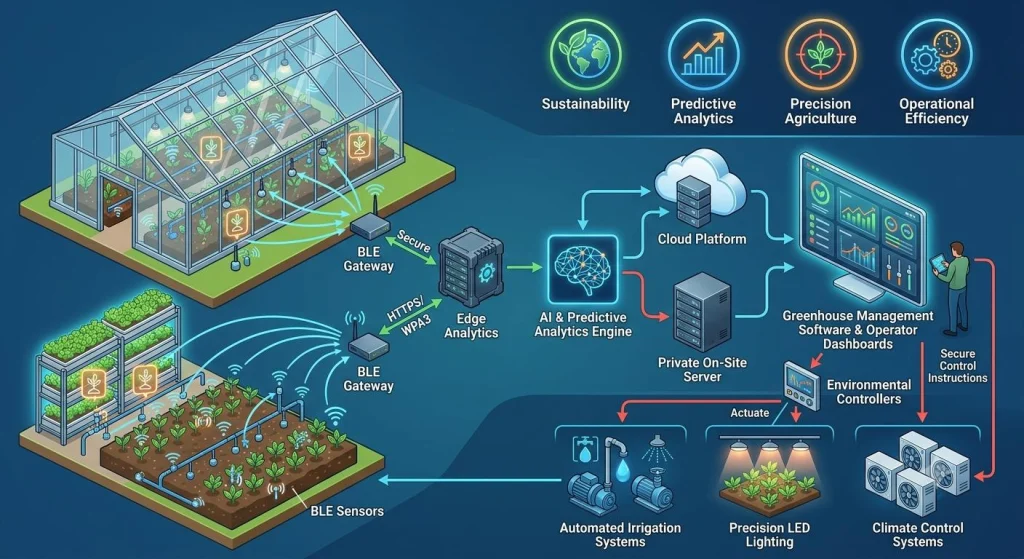
This illustration presents an integrated AI-driven agriculture ecosystem connecting greenhouse and vertical farming operations through BLE sensors, edge computing, AI analytics, cloud infrastructure, and automated control systems. It highlights real-time monitoring, predictive insights, precision agriculture, and sustainable resource management.
Advancing Controlled Environmental Agriculture with AI-Enabled BLE Intelligence
AI-powered controlled environmental agriculture supported by BLE sensors, gateways, and intelligent analytics enables growers to manage climate, irrigation, nutrient delivery, and equipment with greater precision than traditional monitoring methods. Continuous environmental sensing, combined with predictive analytics and automation, improves crop quality, operational efficiency, resource utilization, and system reliability while supporting sustainable production practices.
Organizations planning AI-enabled agricultural monitoring should evaluate communication requirements, deployment models, cybersecurity, software integration, scalability, and long-term maintenance during project planning. GAO helps customers address these technical considerations by providing BLE hardware products, IoT systems, engineering expertise, and technical support that enable reliable AI-driven agricultural monitoring and control.
Building the Future of Industrial AI and IoT with Aperture Venture Studio and GAO RFID Inc.
For more than three decades, GAO Group of Companies has invested extensively in research and development of industrial BLE, RFID, and IoT technologies. As generative AI has matured for practical agricultural applications, we have expanded our focus on AI-enabled BLE and IoT solutions that support controlled environmental agriculture and other technology-intensive sectors. To accelerate innovation in these areas, we founded Aperture Venture Studio to help advance and scale AI and IoT technologies across multiple industries.
Aperture has attracted leading AI and IoT technical experts, experienced operational executives, influential investors, and established technology organizations. Through initiatives such as the Aperture Ventures Summit and TekSummit, we foster collaboration on advanced AI and IoT topics and continue building strong technical communities.
We welcome you to join us as:
- Advisors, co-founders, or employees
- Investors
- Customers