
AI and BLE for Convenience Retail
AI-Driven Convenience Retail Operations with BLE
AI and IoT are changing convenience retail by helping store operators convert real-time operational data into faster decisions. AI solutions can analyze inventory movement, shelf conditions, refrigeration data, customer traffic patterns, equipment status, and store activity to identify conditions that require attention. BLE gateways, BLE beacons, and BLE sensors provide a practical wireless data layer for collecting location, environmental, and asset information throughout convenience stores.
For convenience retailers, the value is not simply knowing where an asset is. The objective is to reduce stockouts, protect temperature-sensitive products, improve replenishment, monitor refrigeration equipment, streamline store tasks, and support consistent customer service across many locations. BLE data can be combined with point-of-sale systems, inventory software, workforce applications, computer vision, and AI analytics. GAO supplies BLE, RFID, and IoT hardware products and systems that can support these connected convenience retail applications.
Convenience Retail AI and BLE Store Operations Overview
This visual illustrates how BLE sensors, beacons, gateways, and tagged assets collect convenience retail data for AI analytics. The AI system converts sensor and store activity data into operational actions such as replenishment, temperature alerts, equipment maintenance, and staff task assignments.
Alt Text:
AI and BLE convenience store diagram showing sensors, gateways, analytics, alerts, replenishment, and maintenance actions.
What AI Means for Convenience Retail Store Management
AI for convenience retail combines machine learning, analytics, computer vision where appropriate, and IoT-generated operational data to improve decisions that traditionally depend on manual store checks. BLE provides wireless identification, sensing, and proximity information that can become an input to these AI workflows.
A typical convenience store contains many operationally important assets and processes:
- Refrigerated display cases and beverage coolers require continuous condition monitoring.
- Shelves and product displays require frequent replenishment.
- Backroom inventory must be transferred efficiently to the sales floor.
- Handheld devices, carts, baskets, and other mobile equipment can become misplaced.
- Store employees perform opening, replenishment, cleaning, temperature-checking, and closing procedures.
- Food, beverages, and other temperature-sensitive merchandise require appropriate storage conditions.
- High-traffic periods can create congestion around checkout areas, food-service counters, and promotional displays.
AI can identify patterns across these activities. For example, repeated temperature excursions in a refrigerated case can become an input to predictive maintenance or operational alerts. BLE sensor readings can provide temperature and other environmental measurements, while BLE gateways collect the data and forward it to store software.
AI can also combine BLE information with other data sources. Point-of-sale transactions can provide demand signals, while inventory records provide product availability information. Computer vision can provide additional information about shelf conditions or customer traffic where appropriate. The resulting system can help store managers prioritize actions rather than relying only on periodic manual inspection.
Convenience Retail Applications for AI and BLE
AI Inventory and Replenishment Management
Stockouts are particularly important in convenience retail because customers often purchase products for immediate consumption. AI can analyze sales velocity, inventory records, replenishment activity, time of day, day of week, promotions, and other operational variables to identify products that may require attention.
BLE can support this process by providing location or environmental information around storage areas and equipment. BLE beacons can identify zones, while BLE gateways can collect signals from tagged assets or sensors.
The system can support store employees by identifying high-priority replenishment tasks, helping reduce unnecessary manual checks and improving response time for fast-moving products.
Refrigeration and Cold-Chain Monitoring
Convenience stores commonly operate beverage coolers, refrigerated displays, freezers, ice machines, and other temperature-sensitive equipment. BLE temperature sensors can periodically capture environmental measurements and transmit them through nearby BLE gateways.
AI analytics can examine historical temperature patterns to identify abnormal behavior. A refrigeration unit that gradually develops longer cooling cycles or repeated temperature deviations may warrant inspection before the problem becomes a larger operational issue.
Relevant actions can include:
- Temperature excursion alerts
- Refrigeration equipment condition monitoring
- Maintenance prioritization
- Historical temperature analysis
- Compliance-oriented recordkeeping
- Identification of recurring refrigeration problems across stores
GAO BLE sensors and gateways can serve as the data collection hardware within these convenience retail monitoring workflows.
AI Asset Tracking for Store Equipment
Convenience stores use mobile and semi-mobile assets such as handheld scanners, tablets, carts, maintenance equipment, reusable containers, and other operational devices. BLE beacons or BLE tags can provide proximity information that helps determine whether equipment is inside a defined store area.
AI analytics can identify recurring movement patterns and unusual asset behavior. For example, if a frequently used handheld device is repeatedly unavailable during peak replenishment periods, operational data can help managers identify the underlying pattern.
Asset tracking can therefore support equipment availability, loss reduction, staff productivity, and store-level operational visibility.
Customer Flow and Store Activity Analysis
Customer movement is another useful source of operational information. BLE proximity signals, where implemented with appropriate privacy controls, can help characterize movement between defined store zones. AI can analyze aggregated activity patterns to understand traffic concentration around checkout areas, promotional displays, food-service counters, or refrigerated sections.
Convenience retailers can use these insights to support decisions involving staffing, merchandising, queue management, and store layout.
Customer analytics should be designed around applicable privacy requirements and should avoid collecting personally identifiable information when it is not necessary for the intended operational objective.
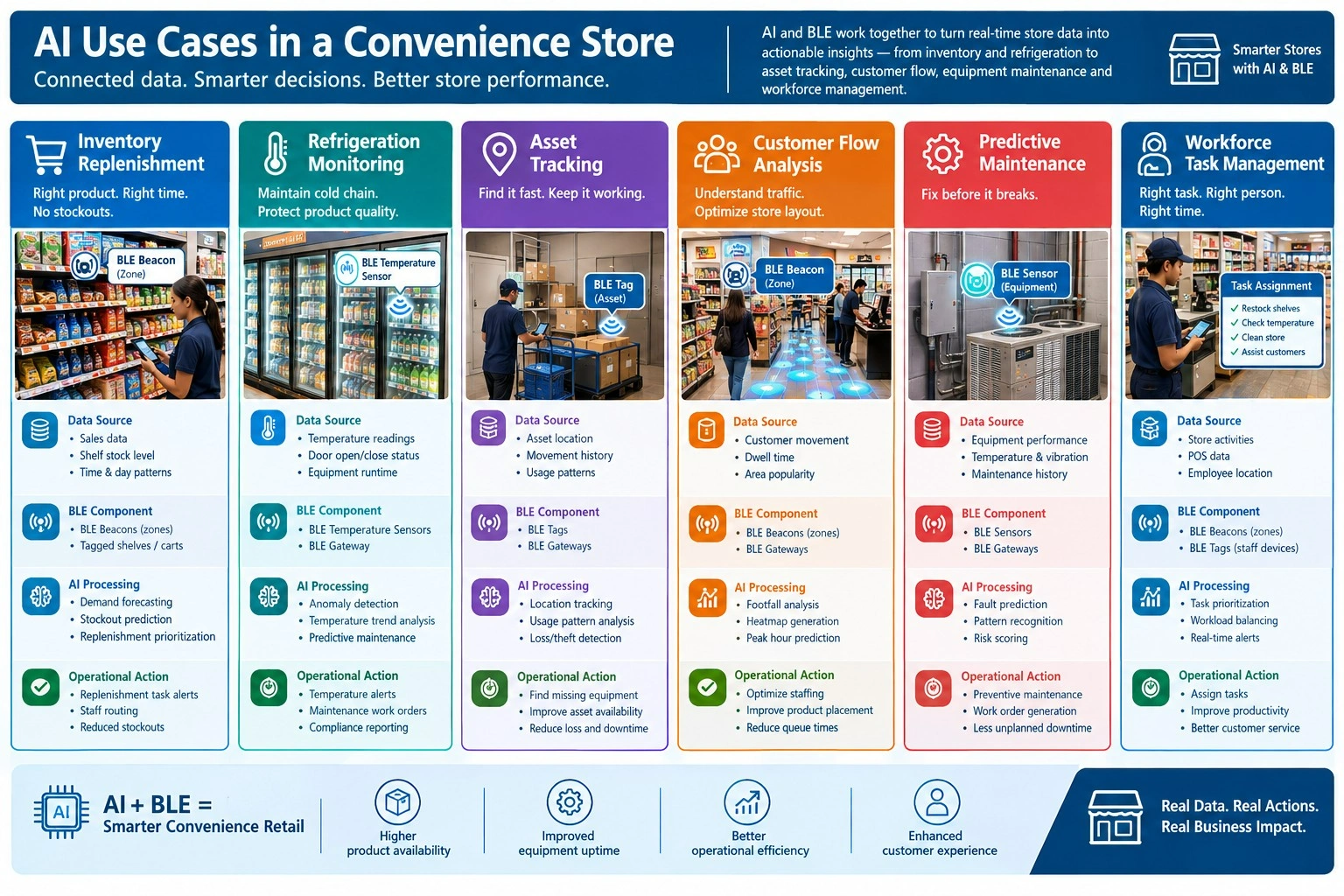
AI Use Cases in a Convenience Store
This infographic shows six practical AI applications for convenience retail: inventory replenishment, refrigeration monitoring, asset tracking, customer flow analysis, predictive maintenance, and workforce task management. It illustrates how store data and BLE components support AI processing and operational actions such as restocking, temperature alerts, maintenance, and task assignment.
Alt Text:
AI convenience store infographic showing BLE sensors, inventory, refrigeration, asset tracking, customer flow, and maintenance.
From BLE Sensor Data to AI-Driven Store Decisions
A practical convenience retail AI solution begins with data acquisition at the store level. BLE sensors and BLE beacons generate information related to environmental conditions, asset proximity, or defined store zones. BLE gateways receive the wireless signals and transfer relevant data to local software or cloud services.
The operational workflow can include:
- Data acquisition: BLE temperature sensors, asset tags, beacons, and other connected devices collect store-level information.
- BLE communication: Gateways receive Bluetooth Low Energy signals from sensors and tagged equipment.
- Edge processing: Local software can filter duplicate readings, validate measurements, apply thresholds, and buffer data during temporary connectivity loss.
- Data transmission: Processed information can be sent through Ethernet, Wi-Fi, cellular, or another available store network.
- Data storage: Store and operational data can be retained in cloud services or privately hosted servers according to business and security requirements.
- AI analytics: Machine learning and statistical models can identify abnormal conditions, forecast operational requirements, or prioritize store activities.
- Business integration: Results can be connected with inventory management, POS, maintenance, workforce management, and store operations software.
- Operational action: Employees or managers receive alerts, recommended tasks, maintenance requests, replenishment priorities, or other actionable information.
- Performance measurement: Store KPIs can be evaluated to determine whether the implementation is improving availability, equipment reliability, labor productivity, or other targeted outcomes.
Convenience Retail AI Data Workflow
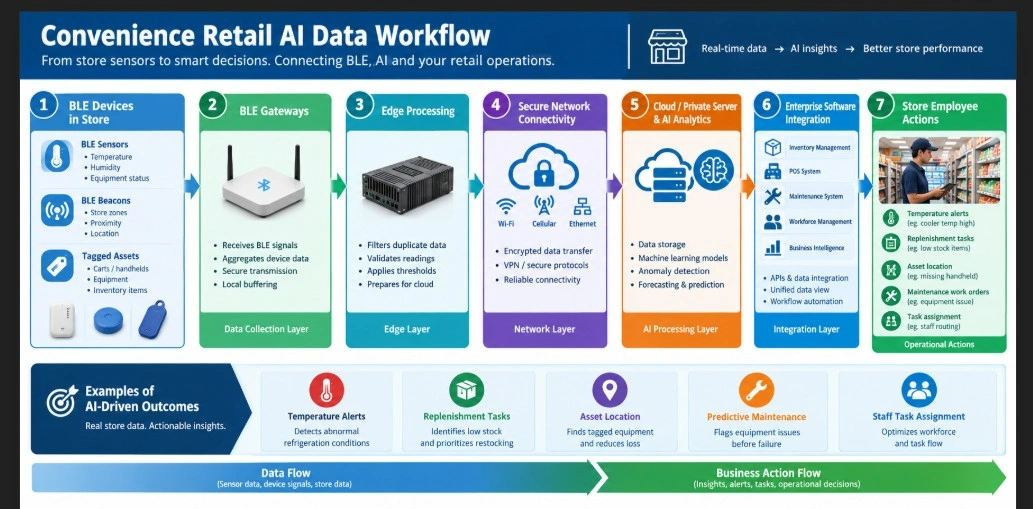
This workflow illustrates how convenience retail data moves from BLE sensors, beacons, and tagged assets through gateways, edge processing, secure connectivity, AI analytics, and enterprise software. The process ends with actionable outcomes such as temperature alerts, replenishment tasks, asset location, predictive maintenance, and staff task assignment.
Alt Text:
Convenience retail AI workflow showing BLE devices, gateways, edge processing, analytics, software integration, and actions.
BLE Hardware, AI Software, and Deployment Choices for Convenience Retail
The hardware and software design should reflect store size, number of locations, wireless conditions, network availability, data volume, security requirements, and the operational importance of each use case.
BLE Gateways
BLE gateways provide the connection between BLE devices deployed around a convenience store and the store’s wider software environment. Gateway placement affects signal coverage, data reliability, installation cost, and maintenance requirements.
A store with multiple refrigerated areas, a backroom, sales floor, and exterior service areas may require several gateways depending on building materials, device density, interference, and required coverage.
Gateway commissioning should include signal testing, device discovery validation, network configuration, data transmission testing, and failure recovery testing.
BLE Beacons and BLE Sensors
BLE beacons can define store zones or provide proximity information, while BLE sensors can measure parameters such as temperature and other environmental conditions depending on the selected device.
For refrigeration applications, sensor placement is especially important. A sensor positioned incorrectly may not represent the actual condition that matters to the retailer. Commissioning should therefore verify sensor placement, measurement behavior, battery condition, transmission interval, and gateway reception.
AI and Analytics Software
AI software can operate on historical and real-time convenience retail data. Appropriate methods depend on the business problem.
Examples include:
- Time-series forecasting for product demand and replenishment planning
- Anomaly detection for refrigeration temperature behavior
- Predictive models for equipment maintenance
- Classification models for operational alerts
- Clustering for identifying recurring store activity patterns
- Computer vision for selected shelf, traffic, or operational monitoring applications
The model should be evaluated against operational KPIs rather than model accuracy alone. A technically accurate prediction that does not improve store execution has limited operational value.
Cloud and Server Deployment for Convenience Retail
A Cloud Version can centralize data from many convenience store locations. This approach is useful for retailers operating distributed store networks because data from multiple locations can be analyzed using common software and standardized KPIs. Cloud processing can also simplify centralized model management and reporting.
A Server Version can place software on customer-managed servers, private data centers, or other privately hosted infrastructure. This approach may be appropriate where the retailer requires tighter control over data storage, network routing, integration boundaries, or operational technology environments.
A hybrid deployment can also be appropriate. Store gateways can perform local filtering and temporary data buffering, while centralized systems perform larger-scale analytics. This reduces unnecessary network traffic while preserving centralized visibility.
GAO can support convenience retail deployments with BLE, RFID, and IoT hardware and related systems. GAO has served organizations in the United States and Canada for three decades, including Fortune 500 companies, research organizations, universities, and government agencies, with emphasis on product R&D, quality assurance, and technical support.
Cloud vs. Server Deployment for Convenience Retail
A professional comparison diagram showing Cloud, Server, and Hybrid deployment models for multi-store convenience retail. It illustrates BLE sensors, beacons, store gateways, network connectivity, centralized analytics, private servers, and edge processing. A comparison table highlights data control, network dependency, maintenance, integration, and scalability.
Alt Text
Comparison diagram of cloud, server, and hybrid deployment models for multi-store convenience retail.
Engineering Considerations for Multi-Store Convenience Retail Deployment
A successful deployment requires more than installing BLE devices. Convenience stores differ in floor area, refrigeration equipment, wall construction, store layout, network quality, operating hours, and equipment density. These variables affect wireless performance and data quality.
Key engineering considerations include:
- BLE gateway placement based on measured radio coverage rather than theoretical range alone
- Sensor placement inside refrigeration equipment and other monitored locations
- Battery-life planning based on advertising or transmission intervals
- Network redundancy for critical operational alerts
- Local buffering when store connectivity is temporarily unavailable
- Time synchronization for accurate event analysis
- Device identity management and secure provisioning
- Firmware lifecycle management
- Calibration and sensor validation
- Monitoring of gateway health and device connectivity
- Role-based access to operational data
- Encryption for data transmission where applicable
- Separation of store IoT traffic from other network traffic where required
- Pilot testing before large-scale rollout
A controlled pilot involving representative convenience stores can reveal practical issues such as wireless interference, gateway placement limitations, refrigerator construction effects, battery replacement requirements, and workflow problems that may not appear during laboratory testing.
Convenience Retail BLE Deployment Floor Plan
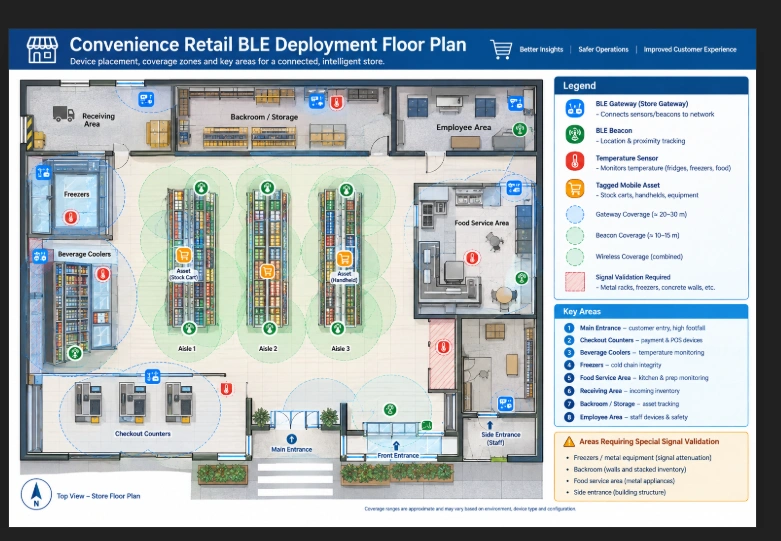
A detailed top-down store floor plan showing practical BLE deployment across aisles, checkout counters, coolers, freezers, food service, backroom, receiving, and employee areas. The diagram maps BLE gateways, beacons, temperature sensors, tagged mobile assets, wireless coverage zones, and areas requiring special signal validation.
Alt Text
Top-down convenience store BLE floor plan showing gateways, sensors, beacons, assets, coverage, and signal validation areas.
Technical Capabilities and Operational Improvements
Combining AI with connected convenience retail data can improve the way stores detect problems, prioritize work, and respond to changing operating conditions. The strongest results generally come when AI is connected to a defined business process rather than deployed as a standalone analytics function.
Real-Time Operational Visibility
BLE-enabled sensors and devices can provide frequent updates from refrigerated cases, storage areas, equipment, and defined store zones. AI software can transform these individual readings into operational information that store managers can act on.
Instead of reviewing every sensor value manually, managers can receive prioritized exceptions such as unusual temperature behavior, equipment communication failures, or abnormal asset movement.
This approach can reduce the amount of time employees spend searching for information and allow them to focus on corrective actions.
Predictive Maintenance for Convenience Store Equipment
Refrigeration equipment represents an important maintenance concern for convenience retailers. Compressor behavior, temperature trends, door activity, ambient conditions, and historical maintenance records can provide useful inputs for predictive analysis.
AI models can identify patterns associated with equipment degradation. Rather than waiting for a refrigeration failure, maintenance teams can investigate equipment showing abnormal behavior.
A predictive maintenance workflow can include:
- BLE temperature sensing
- Historical equipment data collection
- Detection of abnormal temperature patterns
- Correlation with maintenance records
- Risk scoring
- Maintenance work-order generation
- Technician inspection
- Post-maintenance validation
The objective is not to replace technicians. AI provides an additional decision-support mechanism that helps maintenance personnel prioritize inspections.
Smarter Store Workforce Management
Convenience retail employees often perform multiple responsibilities during a shift. Replenishment, checkout support, cleaning, receiving, food preparation, temperature checks, and customer assistance may compete for the same limited workforce.
AI can use operational data to identify periods of higher workload and prioritize tasks. BLE-based location or zone information can provide additional context about where equipment or store activity is occurring.
For example, a system can combine sales activity, replenishment history, and operational alerts to help determine which store task should receive immediate attention.
Multi-Store Operational Analytics
A retailer operating many convenience stores can use centralized analytics to compare operational patterns across locations.
Useful comparisons can include:
- Refrigeration alert frequency
- Stockout frequency
- Replenishment response time
- Equipment availability
- Gateway and sensor uptime
- Maintenance response time
- Store task completion
- Temperature excursion frequency
This allows regional operations teams to identify locations that require investigation and determine whether a recurring problem is store-specific or affects multiple locations.
AI and BLE Security for Convenience Retail
Security should be considered from device commissioning through data processing and software integration. A convenience retail IoT deployment may contain hundreds or thousands of sensors and gateways across geographically distributed locations.
Important security measures include:
- Unique device identities
- Secure device provisioning
- Controlled gateway access
- Encrypted network communication where applicable
- Role-based application access
- Credential rotation
- Firmware and software lifecycle management
- Network segmentation
- Centralized logging
- Gateway health monitoring
- Detection of unexpected device behavior
- Secure decommissioning of retired devices
BLE device security should be evaluated according to the specific hardware, communication profile, application, and threat model. A temperature sensor used for operational monitoring may have different security requirements from a device involved in employee workflows or customer-related analytics.
Privacy is particularly important when customer movement or proximity information is collected. Convenience retailers should minimize personally identifiable information, establish appropriate retention periods, control access, and design analytics around the actual business requirement.
Integration with Convenience Retail Software
BLE and AI solutions become more valuable when their outputs can participate in existing store workflows.
Potential integration points include:
- Point-of-sale systems
- Inventory management software
- Warehouse and distribution systems
- Enterprise asset management software
- Computerized maintenance management systems
- Workforce management software
- Store task management applications
- Business intelligence systems
- Data warehouses
- Cloud analytics services
- Customer traffic analytics
- Refrigeration monitoring systems
Integration can use APIs, message brokers, databases, web services, or other interfaces supported by the existing software environment.
A practical design should define which system owns each type of data. For example, inventory software may remain the authoritative source for product quantities, while the BLE system provides equipment or location information. AI analytics can then combine these sources without creating conflicting records.
GAO’s experience supplying BLE, RFID, and IoT hardware and systems can support projects where wireless sensing needs to connect with broader store operational processes.
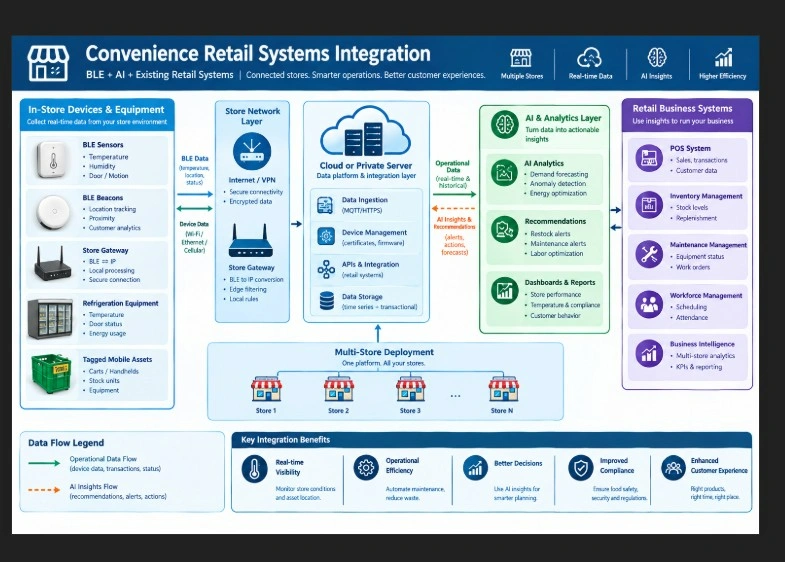
Convenience Retail Systems Integration: BLE + AI + Existing Retail Systems
An enterprise integration diagram showing how BLE sensors, beacons, gateways, refrigeration equipment, and tagged assets connect with cloud or private-server platforms. It maps operational data into AI analytics and shows AI-generated recommendations flowing into POS, inventory, maintenance, workforce management, and business intelligence systems.
Alt Text
Enterprise diagram showing BLE devices, retail systems, AI analytics, and operational data flows across multiple stores.
Measuring AI Value in Convenience Retail
AI deployments should be evaluated using operational KPIs that correspond to the original business problem. Technology installation metrics alone do not demonstrate business value.
Relevant KPIs can include:
| KPI | Convenience Retail Relevance |
|---|---|
| Stockout rate | Measures product availability problems |
| Replenishment response time | Measures how quickly employees respond to replenishment needs |
| Temperature excursion frequency | Measures refrigeration and cold-storage conditions |
| Temperature excursion duration | Shows the persistence of abnormal conditions |
| Refrigeration downtime | Measures equipment availability |
| Preventive maintenance compliance | Measures execution of planned maintenance |
| Mean time to repair | Measures maintenance response and recovery |
| Asset availability | Measures whether operational equipment is accessible |
| Store task completion rate | Measures execution of assigned activities |
| BLE device uptime | Measures wireless sensing availability |
| Gateway uptime | Measures connectivity infrastructure reliability |
| Alert-to-action time | Measures operational response to AI-generated alerts |
The baseline should be established before deployment whenever practical. After commissioning, the same KPIs can be tracked over time to determine whether the solution is producing measurable improvements.
A useful implementation should also monitor false alerts. Excessive notifications can create alert fatigue and cause employees to ignore important events. AI thresholds and notification rules should therefore be adjusted using actual store operating conditions.
Scaling from a Convenience Retail Pilot to Multiple Stores
A pilot should represent real operating conditions rather than an idealized test environment. Selecting stores with different layouts, refrigeration configurations, network conditions, and transaction volumes can expose deployment challenges early.
The pilot process can include:
- Define the business problem and baseline KPI.
- Select representative convenience stores.
- Map refrigeration units, sales-floor zones, backroom areas, and relevant assets.
- Determine sensor and gateway locations.
- Install and provision BLE devices.
- Validate wireless coverage and data quality.
- Connect store data with required software systems.
- Configure AI analytics and operational thresholds.
- Train store personnel.
- Monitor alerts and employee response.
- Measure KPI changes.
- Review security and operational performance.
- Document installation standards for future stores.
- Establish maintenance and device replacement procedures.
Standardized installation documentation becomes important during expansion. Gateway mounting, sensor positioning, device naming, network configuration, battery replacement, and commissioning tests should be documented so that different stores can achieve consistent results.
Scaling should also account for device lifecycle management. A retailer may initially deploy a few hundred devices but eventually operate thousands of sensors and gateways. Manual device administration becomes increasingly difficult at that scale, making centralized monitoring and configuration important.
Convenience Retail AI Deployment Lifecycle
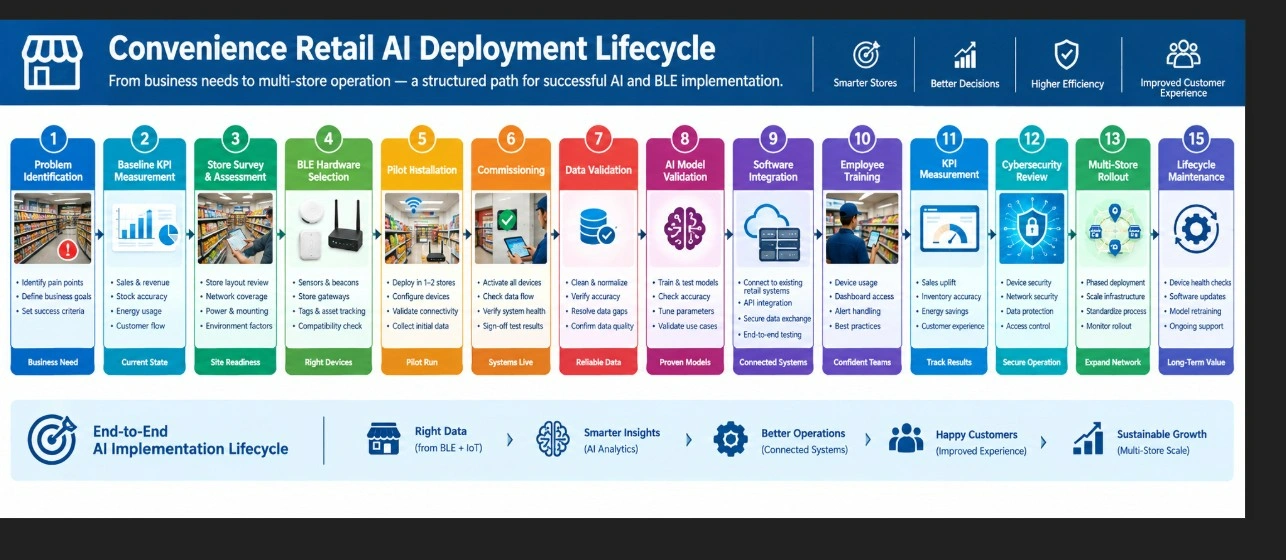
A professional 15-stage lifecycle diagram illustrating the journey from business problem identification and baseline KPI measurement to BLE deployment, AI validation, software integration, training, cybersecurity, and multi-store rollout. It emphasizes continuous monitoring and lifecycle maintenance to support reliable, scalable AI operations across convenience stores.
Alt Text:
15-stage convenience retail AI lifecycle from problem identification and BLE pilot to rollout and lifecycle maintenance.
Implementation Recommendations for AI in Convenience Retail
Successful convenience retail AI projects usually begin with a specific operational problem rather than an attempt to collect every possible data point.
Recommended practices include:
- Start with measurable problems: Select use cases such as refrigeration monitoring, stockout reduction, asset availability, or task prioritization.
- Establish a baseline: Record existing KPIs before introducing AI-driven processes.
- Design around store workflows: Alerts should lead to clear actions for store employees, managers, or maintenance personnel.
- Survey each store environment: Building materials, refrigeration equipment, network availability, and store layout can affect BLE deployment.
- Use representative pilots: Test stores should include different physical and operational conditions.
- Validate sensor placement: Measurement quality depends heavily on where sensors are installed.
- Plan for connectivity interruptions: Gateways should support appropriate local buffering for operational data where required.
- Control alert volume: Configure thresholds to minimize unnecessary notifications.
- Integrate with existing software: Avoid creating a separate workflow when an existing store application can receive the required information.
- Design cybersecurity from the beginning: Device identities, access controls, network configuration, and software updates should be considered before deployment.
- Plan device lifecycle management: Include battery replacement, firmware updates, calibration, device retirement, and replacement procedures.
- Measure business outcomes: Compare post-deployment KPIs with the established baseline.
- Document the deployment standard: Capture installation, commissioning, network, security, and maintenance procedures before large-scale rollout.
GAO can provide BLE, RFID, and IoT hardware products and systems for organizations developing connected operational solutions. Its R&D focus and technical support capabilities can be relevant when a convenience retailer requires assistance with hardware selection, deployment, and system implementation.
Building a Practical AI and BLE Strategy for Convenience Retail
AI can provide convenience retailers with a more proactive method of managing store operations. BLE sensors, beacons, and gateways can supply real-time operational information, while AI converts that information into predictions, anomaly detection, prioritization, and decision support.
The most practical implementations connect technology directly to measurable store outcomes. Refrigeration monitoring should lead to faster intervention. Inventory analytics should support replenishment. Asset visibility should improve equipment availability. Workforce analytics should help employees prioritize operational tasks.
For multi-store retailers, the combination of standardized hardware, secure connectivity, centralized analytics, and defined operational workflows can provide a repeatable method for scaling connected store capabilities.
GAO, headquartered in New York City and Toronto, Canada, has developed and supplied BLE, RFID, and IoT products and systems for customers across the United States and Canada. Its work with major companies, R&D organizations, universities, and government agencies has been supported by ongoing product R&D, quality assurance, and remote or onsite technical support.
AI-Powered Convenience Retail Operations Dashboard
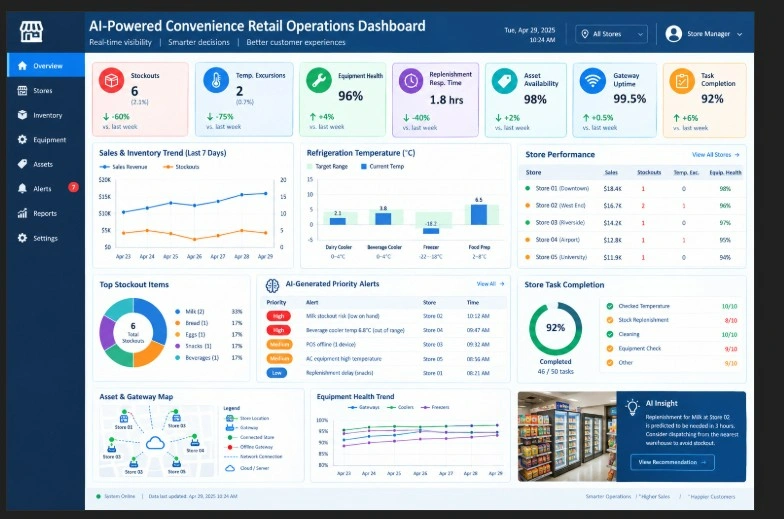
A professional enterprise dashboard showing how AI-derived insights support daily convenience retail decisions across multiple stores. It combines KPIs, trend charts, store performance, priority alerts, task completion, asset and gateway status, equipment health, and predictive replenishment recommendations.
Alt Text
AI retail dashboard showing stockouts, temperature, equipment health, assets, uptime, tasks, alerts, and trends.
Building the Future of Industrial AI and IoT with Aperture Venture Studio and GAO RFID Inc.
For more than three decades, GAO Group of Companies has invested heavily in R&D of industrial BLE, RFID, and IoT. As generative AI became useful for industrial applications, we expanded our work in AI and IoT, including BLE and RFID, and founded Aperture Venture Studio to support the development and scaling of AI and IoT solutions for applications such as intelligent convenience retail operations.
Aperture has attracted AI and IoT technical experts, entrepreneurial and operational executives, investors, and leading companies. We have also developed the Aperture Ventures Summit and TekSummit to discuss advanced AI and IoT topics.
These activities have helped develop technical communities around AI and IoT. We welcome participation from advisors, co-founders or employees, investors, and customers interested in advancing practical AI and IoT solutions.