
AI and BLE for Copper Processing
AI-Driven Copper Processing with BLE is Reshaping Modern Metal Production
Copper processing facilities operate under demanding conditions where ore quality varies continuously, thermal processes consume significant energy, mobile equipment moves across large operational areas, and production interruptions can rapidly affect downstream refining and product quality. Artificial Intelligence combined with Bluetooth Low Energy (BLE) technologies provides copper processors with continuous operational intelligence by transforming connected assets, equipment, personnel, and industrial environments into measurable and analyzable data sources.
Rather than simply locating assets, AI analyzes operational patterns collected through BLE gateways, BLE beacons, and BLE sensors to identify process anomalies, predict equipment degradation, optimize material movement, improve worker safety, and support intelligent production decisions. This AIoT approach combines industrial AI, edge intelligence, connected sensing devices, and enterprise software to deliver actionable insights throughout concentrators, smelters, electrorefineries, casting operations, warehouses, laboratories, and maintenance facilities.
Copper processing organizations increasingly deploy AI-powered BLE solutions to reduce downtime, stabilize production quality, improve energy efficiency, increase asset utilization, strengthen regulatory compliance, and support digital transformation initiatives. Supported by decades of industrial IoT experience, GAO supplies BLE and RFID hardware products and systems that help industrial organizations build reliable connected operations while integrating with existing production environments.
Enabled BLE Data Collection and Operational Intelligence Workflow for Copper Processing Facilities
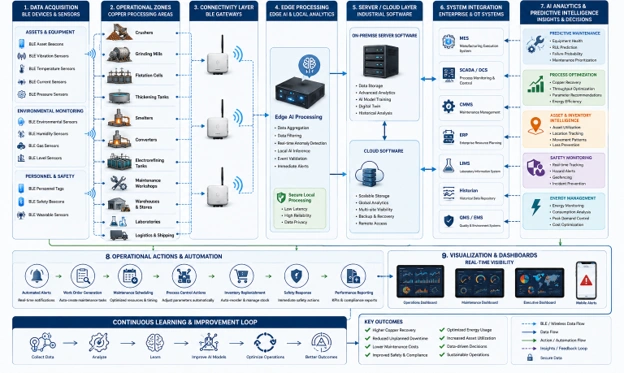
This illustration depicts how BLE gateways, BLE beacons, and BLE sensors collect operational data across every major stage of a copper processing facility, from ore receiving through shipping. The visual demonstrates how edge AI, cloud software, and industrial systems such as MES, SCADA, ERP, CMMS, and LIMS transform real-time data into predictive maintenance, process optimization, asset tracking, energy management, and safety decisions. Its key takeaway is that integrating AI with BLE technologies provides end-to-end operational visibility and data-driven decision support that improves efficiency, reliability, and production performance in copper processing operations.
Why Artificial Intelligence is Becoming Essential for Copper Processing Operations
Copper processing involves multiple interconnected production stages including crushing, grinding, flotation, thickening, filtration, smelting, converting, fire refining, electrorefining, rod production, continuous casting, and finished product handling. Every stage generates operational data that historically remained isolated across various industrial systems.
Artificial intelligence enables continuous interpretation of these datasets by recognizing hidden relationships between process variables, equipment behavior, production schedules, maintenance history, environmental conditions, and material flow. BLE technology serves as one of the important data acquisition layers by continuously monitoring equipment location, environmental conditions, mobile assets, operator movement, and production resources.
Modern copper processing facilities increasingly prioritize AI because it enables:
- Earlier detection of process instability before production losses occur.
- Intelligent maintenance scheduling based on actual equipment condition.
- Higher recovery rates during mineral concentration.
- Improved energy utilization across smelting operations.
- Better visibility of production assets across large industrial facilities.
- Faster response to abnormal operating conditions.
- Enhanced worker safety through location-aware monitoring.
- Improved operational decision support using predictive analytics.
Unlike traditional automation systems that react to predefined alarms, AI continuously learns operational behavior, identifies subtle deviations, and recommends corrective actions before significant disruptions develop.
Core Technical Foundations of AI-Enabled BLE Solutions for Copper Processing
AIoT within copper processing combines several engineering disciplines that operate together throughout production.
Industrial Artificial Intelligence
Industrial AI applies machine learning, deep learning, statistical modeling, reinforcement learning, anomaly detection, and predictive analytics to continuously evaluate production performance.
Typical AI models include:
- Predictive maintenance models
- Equipment health scoring
- Production optimization models
- Energy optimization algorithms
- Quality prediction models
- Remaining useful life estimation
- Root cause analysis
- Computer vision inspection
- Process anomaly detection
- Workforce safety analytics
BLE Data Acquisition
BLE devices provide localized wireless sensing across production facilities.
Common BLE hardware includes:
- BLE Gateways
- BLE Beacons
- BLE Environmental Sensors
- BLE Temperature Sensors
- BLE Humidity Sensors
- BLE Vibration Sensors
- BLE Current Sensors
- BLE Pressure Sensors
- BLE Asset Tags
- BLE Personnel Tags
These devices continuously capture operational information that becomes valuable when interpreted by AI models rather than viewed as isolated sensor readings.
Industrial Data Sources
AI models combine BLE information with operational data from multiple industrial systems including:
- Manufacturing Execution Systems (MES)
- Distributed Control Systems (DCS)
- Supervisory Control and Data Acquisition (SCADA)
- Enterprise Resource Planning (ERP)
- Laboratory Information Management Systems (LIMS)
- Computerized Maintenance Management Systems (CMMS)
- Energy Management Systems (EMS)
- Historian databases
- Process Information Management Systems
- Quality Management Systems
The combination of operational technology and information technology enables AI to evaluate entire production workflows rather than isolated equipment.
High-Value AI Applications Across Copper Processing Facilities
Artificial intelligence supported by BLE technologies delivers measurable operational improvements throughout nearly every production area of copper processing facilities.
AI Mineral Concentration Optimization
Flotation performance depends on numerous continuously changing variables including ore characteristics, reagent dosage, slurry density, grinding efficiency, air flow, and residence time.
BLE sensors installed throughout flotation circuits help monitor localized operating conditions while AI models correlate these observations with production performance. Engineers receive recommendations for parameter adjustments that maximize copper recovery while reducing reagent consumption.
Expected operational improvements include:
- Higher concentrate grade
- Increased metal recovery
- Reduced reagent costs
- Improved process stability
- Lower operational variability
AI Predictive Maintenance for Critical Processing Equipment
Copper processing plants depend on large rotating equipment that must operate continuously.
Examples include:
- SAG mills
- Ball mills
- Crushers
- Conveyor drives
- Slurry pumps
- Thickener drives
- Smelter blowers
- Electrorefining rectifiers
- Dust collection systems
- Cooling water pumps
BLE vibration and temperature sensors continuously monitor equipment condition while AI identifies degradation trends before catastrophic failures occur.
Instead of relying solely on scheduled maintenance intervals, maintenance planners prioritize repairs according to predicted failure probability, remaining useful life, production criticality, spare part availability, and maintenance workforce capacity.
This approach minimizes unexpected shutdowns while extending equipment life.
AI Asset Tracking for Mobile Copper Processing Resources
Large copper processing facilities often manage thousands of movable operational assets.
Examples include:
- Reagent containers
- Sampling equipment
- Calibration instruments
- Portable analyzers
- Maintenance carts
- Welding machines
- Portable generators
- Forklifts
- Oxygen cylinders
- Inspection equipment
- Mobile compressors
- Laboratory instruments
BLE beacons continuously transmit asset identity while gateways determine location throughout processing plants.
Artificial intelligence evaluates asset movement patterns to identify:
- Underutilized equipment
- Frequently misplaced assets
- Congestion areas
- Workflow bottlenecks
- Asset sharing opportunities
- Idle inventory
- Abnormal movement behavior
This operational intelligence reduces equipment replacement costs while improving workforce productivity.
AI Workforce Safety Monitoring
Copper processing facilities expose personnel to challenging operational environments including:
- High temperatures
- Molten metal
- Acid handling
- Dust generation
- Heavy mobile equipment
- Confined spaces
- Elevated structures
- Electrical hazards
BLE personnel tags combined with AI enable intelligent workforce monitoring without continuously relying on manual supervision.
AI evaluates:
- Restricted area access
- Worker proximity to hazardous equipment
- Emergency evacuation status
- Lone worker conditions
- Heat stress indicators
- Hazard exposure duration
- Workforce density
- Shift movement patterns
Safety managers receive prioritized alerts based on predicted risk rather than simple threshold alarms.
AI-Assisted BLE Operational Workflow for Intelligent Copper Processing Facilities
This workflow diagram illustrates the end-to-end AI-enabled BLE operational process within a modern copper processing facility, beginning with data acquisition from BLE gateways, beacons, and sensors deployed across production equipment, warehouses, maintenance workshops, and personnel. It demonstrates how edge AI, server and cloud software, and integrations with MES, SCADA, ERP, CMMS, and LIMS transform real-time operational data into predictive maintenance, production optimization, safety monitoring, and executive decision support. The key takeaway is that AI-powered BLE solutions enable continuous operational visibility, intelligent automation, and data-driven decision-making that improve efficiency, reliability, and safety throughout copper processing operations.
Operational Workflow from Industrial Data Collection to AI Decision Intelligence
Successful AI deployment within copper processing depends on a carefully designed operational workflow that transforms raw industrial observations into actionable recommendations.
Stage 1: Industrial Data Acquisition
BLE sensors, asset tags, and environmental monitoring devices collect information from processing assets, production equipment, storage areas, maintenance operations, laboratories, and logistics zones. Simultaneously, operational data is received from PLCs, SCADA, DCS, quality inspection systems, and historian databases.
Stage 2: Edge Data Processing
Industrial edge servers aggregate BLE data, validate sensor quality, synchronize timestamps, remove duplicate observations, and execute low-latency AI inference where immediate operational responses are required. This approach reduces bandwidth usage while maintaining rapid response for time-critical production events.
Stage 3: Enterprise Software Integration
Validated operational data is integrated with MES, ERP, CMMS, LIMS, and production scheduling systems to provide contextual information that enhances AI model accuracy. GAO’s BLE hardware solutions are designed to support interoperability with common industrial communication standards and existing production software.
Stage 4: AI Analytics and Decision Intelligence
After industrial data has been contextualized, AI models begin analyzing operational behavior across the copper processing facility. Rather than evaluating individual sensor readings, the models examine relationships among production variables, equipment health, maintenance records, energy consumption, workforce movement, environmental conditions, and production schedules.
Typical AI analytical functions include:
- Process anomaly detection
- Predictive maintenance analysis
- Asset utilization optimization
- Workforce safety risk prediction
- Energy consumption forecasting
- Material flow optimization
- Production bottleneck identification
- Equipment remaining useful life estimation
- Copper recovery prediction
- Operational KPI forecasting
Machine learning models continuously refine predictions as additional production data becomes available, enabling recommendations to become increasingly accurate over time.
Stage 5: Operational Actions and Continuous Improvement
The final stage converts AI insights into operational actions.
Depending on business requirements, recommendations may be presented to production supervisors, maintenance engineers, control room operators, metallurgists, reliability engineers, or plant managers through dashboards, alerting systems, or integrated enterprise software.
Typical business actions include:
- Scheduling maintenance work orders
- Adjusting flotation parameters
- Reallocating mobile assets
- Dispatching maintenance personnel
- Rebalancing production schedules
- Investigating abnormal process conditions
- Optimizing energy-intensive operations
- Improving workforce safety procedures
- Supporting management reporting
- Refining AI models using operational feedback
This closed-loop workflow enables continuous operational improvement while supporting informed engineering decisions throughout the copper processing lifecycle.
Layered AI-Enabled BLE System for Intelligent Copper Processing Operations
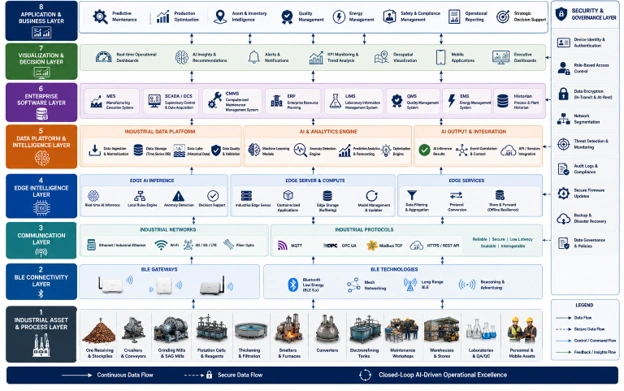
This layered block diagram illustrates the complete technical stack of an AI-enabled BLE solution for copper processing facilities, from BLE sensors and gateways through communication networks, edge computing, AI inference, industrial databases, enterprise software, and executive dashboards. It highlights how MES, ERP, SCADA, CMMS, cloud software, privately hosted server software, and cybersecurity controls work together to transform operational data into predictive maintenance, production optimization, and intelligent decision-making. The key takeaway is that a structured, multi-layer AIoT solution enables secure, scalable, and data-driven copper processing operations.
BLE Technologies, AI Components, Communication Infrastructure, and Deployment Models
Successful AI-enabled copper processing depends on selecting appropriate hardware, software, communication infrastructure, security controls, and deployment strategies that align with production requirements.
BLE Hardware Components
BLE hardware provides localized wireless visibility throughout production environments.
Major components include:
- BLE Gateways
- BLE Asset Beacons
- BLE Environmental Sensors
- BLE Temperature Sensors
- BLE Vibration Sensors
- BLE Humidity Sensors
- BLE Current Monitoring Sensors
- BLE Pressure Sensors
- BLE Personnel Badges
- BLE Mobile Equipment Tags
These devices operate throughout concentrators, smelting facilities, electrorefining buildings, maintenance workshops, warehouses, laboratories, and finished goods storage areas.
GAO has supplied BLE hardware products and systems for numerous industrial environments where reliable wireless data collection supports operational visibility.
AI Software Components
Industrial AI solutions commonly include:
- Machine learning software
- Predictive analytics engines
- Anomaly detection software
- Computer vision systems
- Time-series analytics
- Data visualization software
- Industrial dashboards
- Digital twin software
- Optimization engines
- AI inference software
These applications transform operational measurements into recommendations that improve production quality, equipment reliability, and operational efficiency.
Supporting Enterprise Software
Copper processing organizations frequently integrate AI systems with:
- Manufacturing Execution Systems (MES)
- Enterprise Resource Planning (ERP)
- Computerized Maintenance Management Systems (CMMS)
- Supervisory Control and Data Acquisition (SCADA)
- Distributed Control Systems (DCS)
- Laboratory Information Management Systems (LIMS)
- Energy Management Systems (EMS)
- Historian databases
- Quality Management Systems (QMS)
- Environmental monitoring software
Integration eliminates isolated information silos while improving operational decision-making.
Communication Infrastructure
Reliable industrial communications are essential for continuous AI operations.
Common communication technologies include:
- Bluetooth Low Energy
- Ethernet
- Industrial Ethernet
- Wi-Fi
- OPC UA
- MQTT
- REST APIs
- Modbus TCP
- PROFINET
- EtherNet/IP
Communication selection depends upon production latency requirements, environmental conditions, existing automation systems, and cybersecurity policies.
Cloud Version
Cloud-hosted software is appropriate when organizations require:
- Multi-site production visibility
- Centralized AI model management
- Simplified software maintenance
- Remote engineering access
- Enterprise-wide reporting
- Rapid scalability
- Lower internal IT administration
- Disaster recovery capabilities
Cloud deployments are particularly valuable for organizations operating multiple copper processing plants where centralized operational intelligence supports production benchmarking.
Server Version
Server software is deployed on customer-managed infrastructure such as:
- Factory servers
- Private data centers
- Regional industrial servers
- Edge computing servers
- Customer-hosted virtual environments
Server deployments are often preferred when organizations require:
- Very low operational latency
- Strict cybersecurity requirements
- Regulatory data control
- Limited external connectivity
- Existing private IT infrastructure
- High-volume local AI inference
- Continuous operation during internet outages
Many copper processing facilities adopt hybrid deployments where operational AI inference executes locally while long-term analytics are synchronized with cloud software.
Security Mechanisms
Industrial cybersecurity remains a fundamental requirement.
Recommended controls include:
- Device authentication
- Mutual certificate validation
- Role-based access control
- Multi-factor authentication
- Network segmentation
- Zero Trust security principles
- Data encryption during transmission
- Data encryption at rest
- Security logging
- Continuous vulnerability monitoring
- Secure firmware updates
- Asset identity management
These controls help protect operational technology while maintaining reliable production.
Cloud vs. Server Deployment Comparison for AI-Enabled BLE Systems in Copper Processing Facilities
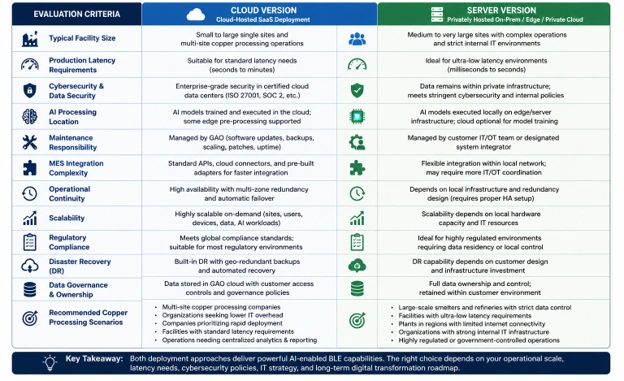
This comparison table evaluates Cloud Version and Server Version deployment models for AI-enabled BLE solutions in copper processing facilities across critical technical and operational criteria, including production latency, cybersecurity, AI processing location, MES integration, scalability, regulatory compliance, disaster recovery, and data governance. It also highlights the most suitable deployment scenarios for each approach. The key takeaway is that the optimal deployment model depends on a facility’s operational requirements, cybersecurity policies, infrastructure strategy, and long-term digital transformation objectives.
Technical Capabilities and Business Benefits
AI supported by BLE technologies delivers measurable improvements throughout copper processing operations.
Technical capabilities include:
- Continuous equipment condition monitoring
- Intelligent asset visibility
- Predictive maintenance
- Production optimization
- Process anomaly detection
- Workforce safety monitoring
- Environmental condition monitoring
- Operational KPI forecasting
- Automated reporting
- Intelligent maintenance prioritization
Operational improvements include:
- Reduced unplanned downtime
- Improved copper recovery
- Better equipment utilization
- Lower maintenance costs
- Faster maintenance response
- Improved inventory visibility
- Reduced asset loss
- Better workforce productivity
- Improved process consistency
- Reduced energy consumption
Business value includes:
- Increased operational reliability
- Improved return on industrial assets
- Reduced operational risk
- Better production planning
- Improved regulatory compliance
- Enhanced decision support
- Increased operational transparency
- Improved sustainability reporting
- Better production forecasting
- Long-term digital transformation support
Organizations selecting AI-enabled BLE solutions should evaluate technical requirements, production objectives, integration complexity, and long-term scalability before implementation.
GAO has supported customers throughout North America by supplying industrial BLE, RFID, and IoT hardware products and systems backed by rigorous quality assurance and expert technical assistance.
Enterprise Infographic: Measurable Benefits of AI-Enabled BLE Solutions in Copper Processing
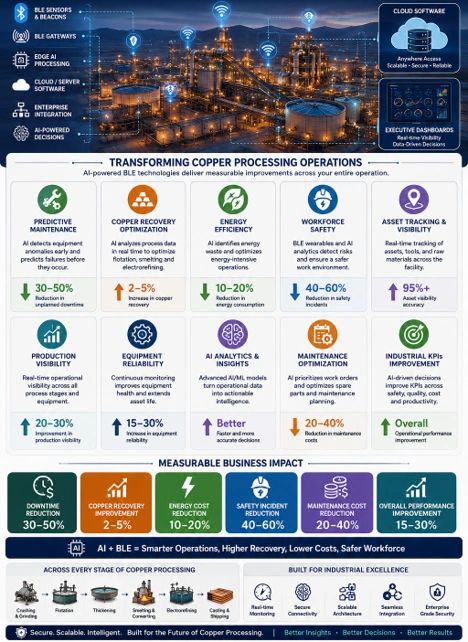
This enterprise infographic summarizes the measurable operational improvements achieved by integrating AI-enabled BLE technologies throughout copper processing facilities. It highlights key capabilities such as predictive maintenance, copper recovery optimization, energy efficiency, workforce safety, asset tracking, production visibility, equipment reliability, AI analytics, maintenance optimization, and industrial KPI improvements. The key takeaway is that AI-powered BLE solutions provide real-time operational intelligence that increases productivity, reduces costs, improves safety, and enhances overall plant performance.
Engineering Recommendations for Successful Deployment
Organizations planning AI-enabled BLE deployments within copper processing facilities should consider the following engineering practices:
- Perform comprehensive operational assessments before hardware selection.
- Define measurable business objectives aligned with production KPIs.
- Validate wireless coverage throughout processing areas.
- Integrate operational data from existing industrial software.
- Begin with high-value AI use cases before expanding deployment.
- Implement strong cybersecurity controls from project initiation.
- Continuously monitor AI model performance.
- Establish maintenance procedures for BLE infrastructure.
- Train production and maintenance personnel.
- Regularly evaluate operational performance against defined KPIs.
These practices improve deployment success while reducing operational risk.
AI-Enabled BLE Deployment Decision Tree for Cloud vs. Server Solutions in Copper Processing Facilities
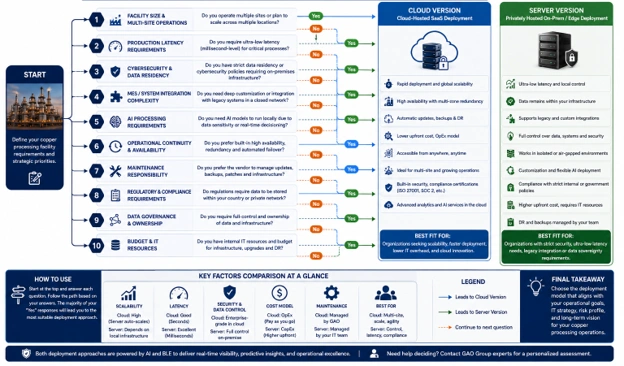
This decision tree guides copper processing organizations in selecting the most appropriate deployment model for AI-enabled BLE solutions by evaluating operational priorities such as facility size, production latency, cybersecurity, MES integration, AI processing needs, regulatory compliance, maintenance responsibility, and data governance. It compares Cloud Version and Server Version recommendations while summarizing their key advantages, helping decision-makers choose the deployment strategy that best aligns with their technical, operational, and business requirements.
Advancing Intelligent Copper Processing with AI and BLE
It is concise, technically accurate, keyword-rich (“AI,” “BLE,” “Copper Processing”), and provides a smooth transition into the final call to action and the subsequent “Building the Future of Industrial AI and IoT with Aperture Venture Studio and GAO” section. It also avoids sounding generic while supporting SEO, AEO, GEO, and AI optimization.
Building the Future of Industrial AI and IoT with Aperture Venture Studio and GAO
For more than three decades, GAO Group of Companies has invested extensively in research and development for industrial BLE, RFID, and IoT technologies. As generative AI has demonstrated significant value in industrial environments such as copper processing, we have continued advancing AI and IoT technologies while establishing Aperture Venture Studio to accelerate practical industrial AI and IoT innovation across manufacturing and process industries. Aperture has attracted experienced AI and IoT experts, operational leaders, investors, and industry partners. Through initiatives including the Aperture Ventures Summit and TekSummit, we continue fostering technical collaboration and knowledge sharing. We welcome advisors, employees, investors, and customers interested in advancing the future of industrial AI and IoT together.