
AI and BLE for Dairy Operations in Agriculture
AI-Driven Dairy Operations with BLE Livestock Monitoring and Sensing
AI is changing dairy agriculture by turning continuous livestock, environmental, equipment, and production data into actionable operational decisions. BLE gateways, beacons, and sensors provide a practical wireless data layer for collecting information such as animal location, temperature, activity, equipment status, and environmental conditions across barns, milking areas, feed storage, and pasture environments. AI models can then correlate these signals with herd records, feeding schedules, environmental conditions, and production data to identify abnormal patterns, prioritize inspections, and support predictive decision-making. For dairy farms, the value is not simply more sensor data. The objective is to convert reliable field observations into earlier intervention, better herd management, improved equipment utilization, reduced manual monitoring, and stronger traceability. GAO supplies BLE, RFID, and IoT hardware products and systems that can support livestock identification, asset monitoring, environmental sensing, and connected agricultural operations.
AI-Enabled Dairy Operations Architecture
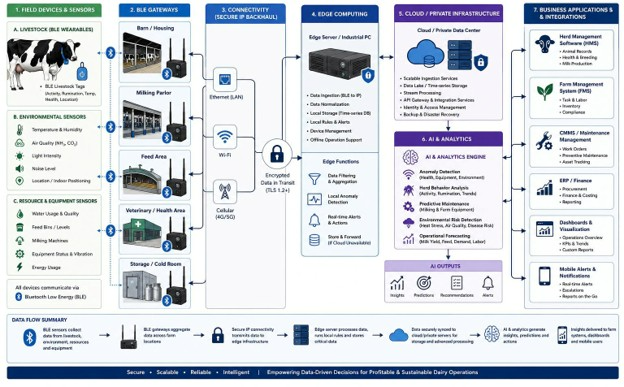
Enterprise architecture showing how BLE livestock and farm sensors connect through gateways, edge computing, cloud infrastructure, AI analytics, and business applications to enable intelligent dairy operations.
What AI-Enabled BLE Monitoring Means for Dairy Agriculture
AI-enabled BLE monitoring combines wireless sensing with machine learning, statistical analytics, rules engines, and operational software. BLE is not the decision-making layer. It is the low-power communications technology that allows distributed devices to report observations to gateways and software systems.
A dairy operation can use this approach to associate sensor observations with individual animals, groups, locations, equipment, and production processes. A BLE beacon attached to livestock can provide identity and proximity information, while BLE sensors can capture selected environmental or physiological indicators. Gateways aggregate nearby broadcasts and forward normalized records to edge or server-based applications.
AI adds value by analyzing relationships that are difficult to evaluate manually. For example, an individual animal’s activity pattern can be compared with historical behavior, feeding activity, location transitions, environmental conditions, and herd-level patterns. A significant deviation can generate an inspection recommendation rather than requiring personnel to continuously observe every animal.
The same principle applies to agricultural equipment. BLE sensing can associate equipment with locations and operating conditions, while AI models identify abnormal utilization, repeated operating patterns, or conditions that justify maintenance review.
GAO’s existing agricultural technology portfolio includes BLE gateways and livestock and farm asset management applications, providing a technical foundation for combining wireless identification and sensing with higher-level analytics.
Priority AI Applications Across Dairy Agriculture
AI Herd Health and Livestock Activity Monitoring
Continuous livestock monitoring can help dairy personnel identify changes that deserve closer examination. BLE-enabled devices can provide identity, location, activity, or sensor observations that are associated with individual cattle records.
AI can analyze:
- Activity deviations from an animal’s historical baseline
- Changes in movement between feeding, resting, milking, and veterinary areas
- Abnormal inactivity or unusual movement patterns
- Group-level behavior changes
- Environmental conditions associated with behavioral changes
- Repeated anomalies requiring veterinary or husbandry review
The engineering objective is not to make a veterinary diagnosis solely from BLE data. Instead, the system should provide a ranked operational signal that helps farm personnel decide which animals or conditions require attention.
AI-Assisted Feeding and Water Management
Feed consumption and water availability are closely connected to dairy productivity and animal welfare. BLE-enabled identification can associate animals or groups with feeding areas, while environmental and equipment sensors can monitor relevant operating conditions.
AI analytics can combine:
- Feeding-area activit
- Water-trough interaction
- Time and location patterns
- Herd movement
- Temperature and humidity
- Feeding schedules
- Historical herd records
The resulting analysis can help identify unusual patterns, investigate feeder or waterer problems, and support more consistent livestock management.
AI Environmental Monitoring for Dairy Barns
Barn temperature, humidity, ventilation conditions, and other environmental factors can change rapidly. Distributed BLE sensors provide a way to collect measurements from multiple zones rather than relying on a small number of manually checked instruments.
AI can detect:
- Abnormal temperature or humidity trends
- Differences between barn zones
- Repeated environmental excursions
- Conditions correlated with changes in livestock activity
- Sensor failures or implausible measurements
- Environmental patterns preceding operational problems
This creates a feedback loop between environmental sensing and farm operations. A system can identify a developing condition, notify responsible personnel, and preserve the relevant measurements for later analysis.
AI Equipment Monitoring and Predictive Maintenance
Dairy farms depend on milking systems, refrigeration equipment, pumps, compressors, feeders, water systems, ventilation equipment, conveyors, tractors, loaders, trailers, and other machinery.
BLE can contribute equipment identity, location, utilization, or sensor information. AI can then support maintenance workflows by identifying unusual patterns rather than relying exclusively on fixed maintenance intervals.
Potential applications include:
- Equipment utilization monitoring
- Abnormal operating-condition detection
- Maintenance prioritization
- Location-based equipment accountability
- Service history correlation
- Failure-pattern analysis
- Spare-equipment availability monitoring
A practical deployment should integrate AI alerts with an existing CMMS or maintenance workflow instead of creating a separate list of disconnected notifications.
AI Cold Chain and Milk Handling Monitoring
Milk handling introduces another important sensing requirement. Temperature excursions during storage or transportation can compromise product quality and create avoidable operational losses.
BLE temperature sensors and gateways can provide continuous observations from appropriate storage and transport locations. AI analytics can distinguish isolated sensor readings from sustained temperature trends, identify recurring refrigeration problems, and prioritize exceptions.
Where regulatory or quality requirements demand validated measurement processes, BLE sensors should complement rather than automatically replace calibrated instruments and established quality-control procedures.
AI Traceability Across Livestock, Equipment, and Agricultural Assets
Dairy operations contain moving assets and distributed work areas. Animals, feed equipment, tools, mobile machinery, containers, and maintenance equipment can move between barns, yards, milking areas, storage facilities, and service areas.
BLE identification can provide location and proximity information, while RFID can be incorporated where longer read ranges or different identification characteristics are required.
A combined identification strategy can support:
- Livestock movement records
- Equipment location
- Farm asset accountability
- Maintenance history association
- Movement between operational zones
- Automated event records
- Agricultural inventory visibility
GAO provides both BLE and RFID technologies, allowing system designers to select identification technologies according to the physical environment and operational requirement rather than forcing one wireless technology into every use case.
AI-Enabled Dairy Farm: BLE Sensing to Smarter Operations
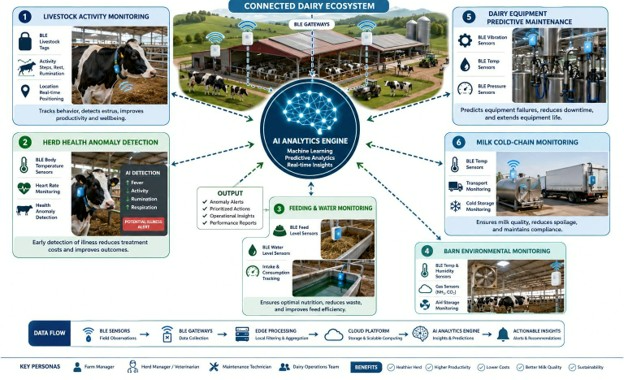
Enterprise infographic showing how BLE sensors and gateways feed AI analytics across six high-value dairy applications, from herd health and feeding to equipment maintenance and milk cold-chain monitoring.
Dairy Agriculture Operational Challenges AI Can Address
Dairy farms present several conditions that make continuous digital monitoring technically challenging. Large barns can contain metal structures, machinery, water systems, animals, partitions, and other sources of radio-frequency attenuation or multipath effects. Outdoor areas introduce greater coverage distances and changing environmental conditions. Mobile livestock also create constantly changing device positions.
Important deployment challenges include:
- Incomplete livestock identification and manual record entry
- Limited visibility into animal activity between physical inspections
- BLE gateway placement across barns and agricultural buildings
- RF attenuation caused by metal structures and equipment
- Battery management for livestock and environmental sensors
- Connectivity gaps in remote agricultural areas
- Sensor drift and calibration requirements
- False positives generated by noisy sensor data
- Data synchronization between field devices and farm softwar
- Maintaining reliable timestamps across distributed gateways
- Integrating AI alerts into existing veterinary and farm workflow
- Protecting livestock, operational, and production data
- Maintaining connectivity during power or network interruptions
- Scaling from a pilot barn to multiple agricultural sites
These issues make site surveying and commissioning important engineering activities. A BLE deployment should be tested under actual operating conditions, including livestock movement, machinery operation, doors and gates changing position, cleaning procedures, and normal staff activity.
Dairy AI and BLE Deployment Workflow
A reliable implementation starts with the operational question rather than the sensor. The design team first determines which dairy process requires better visibility, what decision must be improved, and what data is required to support that decision.
Data Acquisition
BLE sensors, beacons, and livestock devices generate observations such as:
- Device identifier
- Timestamp
- Received signal strength indicator
- Sensor measurements
- Battery condition
- Movement or activity information
- Gateway identifier
- Location or zone association
The gateway should validate and normalize incoming data before forwarding it to downstream software. Basic validation can remove malformed packets, duplicate events, impossible measurements, and obviously stale observations.
BLE Communication and Gateway Processing
BLE operates efficiently for low-power distributed sensing, but gateway design determines much of the practical system performance.
Gateways should be positioned according to required coverage, RF propagation, animal movement patterns, equipment density, and backhaul availability. Depending on the farm, gateway backhaul can use Ethernet, Wi-Fi, cellular connectivity, or another suitable IP connection.
Gateway software can perform:
- Device discovery
- BLE packet collection
- Filtering
- Timestamping
- Local buffering
- Sensor-data normalization
- Device health monitoring
- Local rule execution
- Secure transmission to servers
Local buffering is particularly important for agricultural sites where connectivity may be intermittent. A gateway should not necessarily discard operational data simply because the WAN connection is temporarily unavailable.
Edge Processing and AI Inference
Edge computing can reduce dependence on continuous cloud connectivity. A local server or industrial computer can receive gateway data, execute rules, calculate derived values, and run selected AI models.
For example, a farm may configure a local rule to identify a prolonged environmental excursion immediately, while a larger cloud-based model performs longer-term trend analysis across multiple barns.
This hybrid approach can reduce latency for time-sensitive alerts while retaining centralized analytics for historical analysis.
Dairy Data-to-Decision Workflow
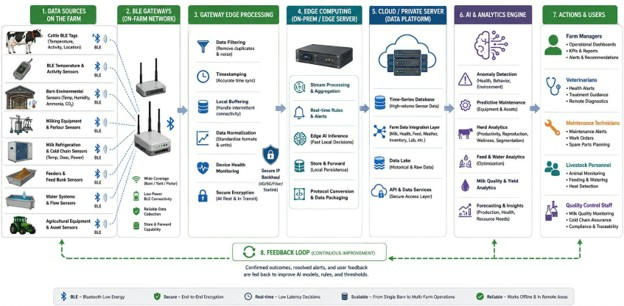
Technical workflow showing how BLE farm data moves through gateways, edge computing, cloud platforms, AI analytics, and operational teams.
AI Data Engineering for Connected Dairy Farms
AI performance depends heavily on the quality and context of the underlying data. A dairy AI system should therefore treat sensor-data engineering as a core operational requirement rather than a secondary software task.
A useful data model can associate each observation with an animal, asset, zone, device, gateway, timestamp, and measurement type. This creates the context required for historical analysis and AI model training.
A robust data pipeline should account for:
- Device identity and provisioning
- Animal or asset identity mapping
- Sensor calibration records
- Timestamp synchronization
- Missing observations
- Duplicate events
- Out-of-range measurements
- Gateway connectivity status
- Battery state
- Sensor replacement history
- Firmware versions
- Barn and zone configuration
- AI model version
- Human confirmation of operational alerts
This information allows engineers to distinguish a genuine agricultural event from a sensing problem. For example, a sudden temperature change may represent an actual barn condition, a sensor fault, a battery-related measurement error, or a gateway communication issue. AI systems should not treat all abnormal readings as livestock or equipment events.
The same principle applies to predictive maintenance. A model trained on equipment data without maintenance records may identify correlations but struggle to establish whether a detected condition actually preceded a failure. Linking sensor observations with work orders, inspection results, replacement parts, and maintenance timestamps creates much stronger training data.
GAO’s experience supplying BLE, RFID, and IoT hardware and systems supports deployments where field identification and sensing must ultimately connect to operational software and business processes. GAO also provides consulting, site-survey, software customization, and technical support capabilities relevant to wireless deployments.
Engineering Considerations for BLE Livestock and Farm Sensors
BLE hardware selection should follow the physical and operational requirements of the dairy environment.
Important engineering criteria include:
- Required communication range
- Battery operating life
- Environmental protection rating
- Operating-temperature range
- Sensor accuracy and calibration requirements
- Device mounting method
- Animal-safe enclosure design
- Gateway density
- RF interference conditions
- Local storage requirements
- Backhaul availability
- Firmware update mechanisms
- Device authentication
- Encryption
- Maintenance accessibility
Livestock devices require additional attention because their operating environment differs from conventional indoor asset tracking. Devices may encounter moisture, dirt, cleaning processes, impacts, changing temperatures, and continuous movement. The mounting mechanism must also be appropriate for the animal and the operational process.
Gateway placement should be validated using a site survey rather than relying exclusively on theoretical range specifications. A dairy barn containing metal equipment, reinforced structures, refrigeration machinery, partitions, and moving animals can produce RF conditions substantially different from an open laboratory environment.
The deployment should therefore include coverage testing, packet-loss measurements, battery-life validation, gateway failover testing, backhaul interruption testing, and verification of data consistency between field devices and the central application.
Cloud and Server Deployment Options for Dairy AI
Cloud Version
A cloud-hosted deployment is appropriate when a dairy organization operates multiple farms, requires centralized monitoring, or wants AI models and dashboards accessible across geographically distributed locations.
The cloud environment can provide:
- Centralized device and site management
- Historical sensor storage
- Multi-farm analytics
- AI model execution
- Remote dashboards
- Alert distribution
- Fleet-wide reporting
- Centralized software updates
- Long-term data analysis
Cloud processing is particularly useful when the organization wants to compare environmental conditions, livestock activity patterns, equipment utilization, or maintenance events across several agricultural sites.
Server Version
A server deployment places application software and selected analytics on customer-managed infrastructure, including an agricultural facility’s local server, private data center, edge server, or other privately hosted enterprise infrastructure.
This model can be appropriate where agricultural data must remain within controlled infrastructure, where WAN connectivity is limited, or where local processing and operational continuity are priorities.
A server-based deployment can still communicate with distributed farm locations and can support centralized databases, dashboards, AI inference, APIs, and integrations with existing farm-management software.
Hybrid Deployment
Many dairy operations benefit from combining both approaches. Gateways and edge servers can maintain local data collection and time-sensitive rules, while centralized cloud or private servers perform longer-term analytics.
A practical hybrid design separates functions according to latency and connectivity requirements:
- Local gateway: BLE acquisition and device health
- Edge server: filtering, buffering, local rules, and selected AI inference
- Cloud or private server: historical storage and cross-site analytics
- Farm software: herd, production, maintenance, and operational records
- AI layer: anomaly detection, forecasting, classification, and prioritization
- User interfaces: dashboards, alerts, reports, and mobile notifications
Cloud vs. Server vs. Hybrid Deployment for AI-Enabled Dairy Operations
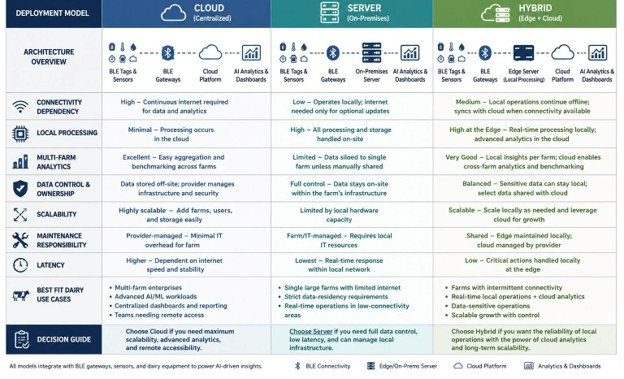
Enterprise comparison of cloud, on-premises server, and hybrid deployment models for AI-enabled dairy agriculture, covering connectivity, processing, analytics, data control, scalability, maintenance, latency, and use cases.
Security and Reliability for AI-Connected Dairy Operations
Security should cover the complete path from BLE devices to operational applications. Wireless livestock and environmental sensors can become part of a broader farm network, so device identity, gateway security, network segmentation, software access control, and data protection should be considered during initial design.
Recommended controls include:
- Device authentication and controlled provisioning
- Secure BLE configuration appropriate to the device capability
- Encryption for data transmitted beyond the gateway
- Unique credentials rather than shared default credentials
- Network segmentation for IoT gateways
- Role-based access to dashboards and operational records
- Secure API authentication
- Audit logging
- Firmware and software lifecycle management
- Backup and recovery procedures
- Gateway health monitoring
- AI model version control
- Alert and decision logging
AI governance is equally important. A model should record which data and model version produced a recommendation where practical. Human confirmation can also be captured for high-impact livestock, maintenance, or quality-control decisions. This creates an auditable relationship between sensor observations, AI outputs, and operational actions.
Technical Capabilities of AI-Enabled BLE Dairy Systems
Combining AI with BLE sensing gives dairy agriculture a continuous operational data layer that can support decisions across livestock, environmental management, equipment, and agricultural assets. The strongest implementations do not treat AI as an isolated analytics application. They connect AI outputs to established farm-management, veterinary, maintenance, quality-control, and production workflows.
Continuous Livestock Visibility
BLE livestock devices can provide recurring observations without requiring personnel to manually record every movement event. When identity, time, location, and activity data are correlated, AI can establish individual and herd-level behavioral baselines.
This supports operational use cases such as:
- Detecting unusual activity patterns that warrant animal inspection
- Identifying changes in movement between barn zones
- Comparing current behavior with historical individual behavior
- Recognizing herd-level deviations from normal patterns
- Prioritizing animals for closer observation
- Supporting veterinary and husbandry records with additional objective observations
The AI output should normally be treated as decision support rather than an autonomous veterinary diagnosis. Farm personnel remain responsible for interpreting the signal alongside physical examination, production records, feeding information, and other relevant evidence.
Automated Anomaly Detection
Rule-based systems are useful when a condition has a clearly defined threshold. AI becomes more valuable when normal operating behavior varies by animal, season, location, equipment, or time of day.
Anomaly-detection models can learn expected patterns from historical observations and identify deviations that deserve investigation.
For example, an agricultural operation could establish different expected environmental profiles for individual barn zones rather than applying one temperature threshold to an entire facility. Similarly, equipment utilization can be evaluated against its own historical operating pattern.
This reduces unnecessary alerts and helps personnel focus on exceptions with greater operational relevance.
Predictive Maintenance for Dairy Equipment
Predictive maintenance can combine BLE sensor observations with existing maintenance records and equipment operating data.
Relevant assets can include:
- Milking pumps
- Vacuum systems
- Refrigeration units
- Compressors
- Water pumps
- Feeders
- Ventilation equipment
- Conveyors
- Motors
- Agricultural vehicles
- Tractors and loaders
- Automated gates and doors
AI models can identify patterns associated with abnormal operation, increasing vibration, unusual temperature, excessive runtime, repeated faults, or changing utilization.
A practical implementation should connect AI-generated maintenance recommendations to a CMMS or maintenance-management process. The objective is not to replace technicians. It is to give maintenance personnel better information about which asset requires inspection and why.
BLE Location Intelligence for Dairy Agriculture
BLE positioning can range from simple zone detection to more sophisticated location estimation. The appropriate method depends on the required accuracy and physical environment.
For many dairy applications, zone-level information is sufficient. Knowing that an animal, machine, or asset is in a feeding area, milking area, veterinary area, storage building, or equipment bay can provide significant operational value without requiring centimeter-level positioning. RSSI-based proximity estimation can support relatively simple deployments, while more advanced BLE positioning approaches can provide improved spatial resolution when supported by appropriate hardware and site conditions.
The design decision should consider:
- Required location accuracy
- Number of monitored zones
- Gateway density
- RF propagation
- Animal and equipment movement
- Battery requirements
- Installation complexity
- Cost of additional infrastructure
- Consequences of inaccurate location data
For example, a dairy farm trying to determine whether a particular asset is inside a maintenance building may not need high-precision positioning. A more demanding livestock research application may require substantially greater spatial resolution.
BLE-Enabled Dairy Farm Location Intelligence
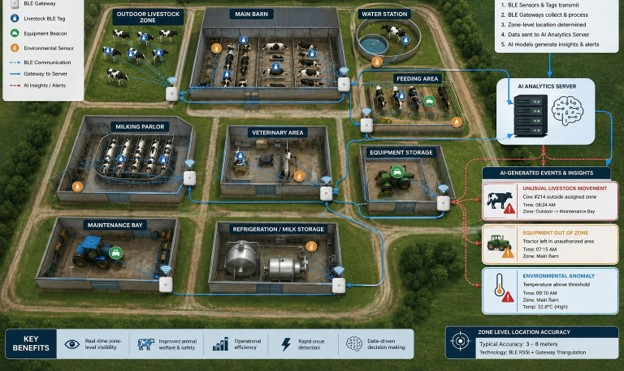
A technical top-down illustration showing BLE-enabled zone-level tracking of livestock, equipment, and environmental conditions across a modern dairy farm, with gateways transmitting location data to AI analytics for operational alerts.
Communication Protocols and Supporting Technologies
BLE provides the short-range wireless connection between supported field devices and gateways. It is normally only one part of the complete communications chain.
A typical dairy installation may use:
- Bluetooth Low Energy for local sensor and beacon communications
- Ethernet for fixed gateway backhaul
- Wi-Fi where appropriate for local IP connectivity
- Cellular networks for geographically distributed or remote agricultural sites
- TCP/IP for network communication
- HTTPS or MQTT for application data transport where supported by the software design
- REST APIs for integration with business and agricultural applications
- Secure VPN connections for controlled remote access
- Time synchronization services for consistent event timestamps
Protocol selection should follow the physical deployment rather than keyword trends. BLE is particularly suitable for low-power distributed devices, while another communications technology may be preferable for long-range backhaul between agricultural buildings.
A useful system therefore separates field-device communications from site backhaul and application integration. This prevents the common design mistake of assuming that one wireless protocol must provide every communication function.
Integration with Dairy Software and Enterprise Systems
AI-generated information becomes operationally valuable when it reaches the software already used by farm personnel.
Potential integrations include:
- Herd management software
- Farm management information systems
- Veterinary records
- Milking-management systems
- Feed-management software
- Agricultural ERP systems
- CMMS and maintenance software
- Inventory-management systems
- Environmental monitoring applications
- Quality-management software
- Business intelligence tools
- Workforce and task-management applications
- Notification and messaging systems
Integration should use stable identifiers for animals, assets, devices, locations, and operational events.
For example, the BLE identifier of a livestock device should be mapped to the farm’s animal identifier rather than becoming the primary identity used by every application. This makes device replacement easier and prevents the loss of historical continuity when a sensor is changed.
API-based integration can also prevent unnecessary duplication of farm records. Rather than copying entire databases into the AI application, the system can retrieve the specific information required for analytics and write validated events back into the appropriate operational system.
AI Models for Dairy Operations
Different dairy applications require different analytical methods. There is no single AI model that is appropriate for every farm process.
Potential methods include:
- Classification models for categorizing observed conditions
- Regression models for predicting continuous variables
- Time-series models for analyzing changing livestock or environmental measurements
- Clustering for identifying groups with similar behavior
- Anomaly detection for unusual livestock or equipment patterns
- Forecasting for operational demand and environmental trends
- Computer vision where cameras provide complementary visual observations
- Natural-language interfaces for querying operational records
- Rules engines for deterministic safety or operating thresholds
AI model selection should depend on the available data, required accuracy, operational consequences, and explainability requirements.
For many agricultural applications, a hybrid approach is preferable. A deterministic rule can handle an established critical threshold while an AI model identifies less obvious deviations. This combination can make the system easier to validate and operate.
Model performance should be measured against real operational outcomes rather than generic accuracy figures. A model that generates many technically correct alerts but overwhelms farm staff may have poor practical value.
Dairy AI Performance and Operational KPIs
A deployment should establish measurable KPIs before large-scale implementation. Appropriate metrics depend on the specific agricultural process being improved.
Relevant measures can include:
- BLE device reporting reliability
- Gateway packet reception rate
- Sensor data completeness
- Gateway uptime
- Battery replacement interval
- Location-event accuracy
- Environmental monitoring coverage
- Alert precision
- Alert response time
- False-alert rate
- AI anomaly-detection performance
- Time from anomaly detection to inspection
- Equipment downtime
- Preventive versus corrective maintenance ratio
- Mean time between failures
- Mean time to repair
- Equipment utilization
- Livestock monitoring coverage
- Manual inspection workload
- Feed-management exception rate
- Water-system availability
- Refrigeration temperature excursion frequency
- Data synchronization latency
- Network outage duration
- AI inference latency
- System availability
- Sensor replacement rate
- Maintenance cost per monitored asset
- Operational incidents associated with missing data
- Percentage of AI alerts confirmed by personnel
The most useful KPI is usually connected to a business or operational outcome. Measuring the number of BLE messages received is useful for engineering validation, but it does not by itself demonstrate improved dairy operations.
Standards, Compliance, and Data Governance
Dairy agriculture deployments may involve animal welfare, food safety, environmental, occupational safety, telecommunications, data protection, and electrical requirements. The exact regulatory obligations depend on the country, state or province, farm type, processing activity, and deployment environment.
Relevant technical and regulatory considerations can include:
- Bluetooth SIG specifications for BLE interoperability
- Applicable ISO and IEC standards for information technology and electrical equipment
- Wireless-spectrum requirements applicable to the deployment jurisdiction
- Food-safety and dairy-quality requirements
- Animal identification and traceability requirements
- Agricultural environmental regulations
- Electrical installation requirements
- Occupational health and safety requirements
- Data-protection and cybersecurity obligations
- Calibration and measurement requirements for regulated measurements
The design team should validate applicable requirements with qualified regulatory and compliance professionals before deployment. A BLE sensor used for operational monitoring should not automatically be represented as a certified instrument for a regulated measurement unless its certification and intended use support that claim.
This distinction is important for temperature monitoring, milk quality, animal-health observations, and other measurements that may have regulatory consequences.
Deployment Lifecycle for AI and BLE Dairy Systems
Planning and Site Survey
The first stage should identify the operational problem, required measurements, target assets or livestock groups, decision owners, and success criteria.
The engineering survey should document:
- Barn dimensions
- Construction materials
- Equipment locations
- Existing networks
- Power availability
- Gateway mounting locations
- RF interference sources
- Livestock movement patterns
- Cleaning procedures
- Outdoor coverage requirements
- Cellular availability
- Server or cloud connectivity
- Environmental conditions
Hardware Selection and Configuration
Sensors and gateways should be selected according to actual environmental requirements. Battery life, enclosure protection, mounting, sensor accuracy, communication range, and maintenance accessibility should be evaluated together.
Each device should receive a controlled identifier and configuration record before commissioning.
Installation and Commissioning
Commissioning should verify both wireless connectivity and application-level data.
Testing should include:
- BLE discovery
- Gateway reception
- Packet-loss testing
- Data timestamp validation
- Sensor measurement validation
- Battery reporting
- Backhaul connectivity
- Local buffering
- Server synchronization
- Dashboard visualization
- Alert generation
- API integration
- Device replacement procedures
AI Model Validation
Historical or pilot data should be evaluated before AI alerts are trusted operationally.
A suitable validation process can compare model outputs against:
- Veterinary observations
- Maintenance records
- Environmental measurements
- Equipment failure records
- Production events
- Confirmed operational incidents
This helps determine whether an apparent statistical anomaly corresponds to a meaningful agricultural event.
Optimization and Scale-Up
After the pilot, engineering teams should examine gateway placement, battery performance, sensor reliability, network availability, alert frequency, and user feedback.
Only then should the system be expanded to additional barns, livestock groups, or agricultural facilities.
GAO can support organizations through hardware selection, customization, integration, deployment assistance, and technical support for BLE, RFID, and IoT solutions. Its customer base includes organizations in the United States and Canada ranging from Fortune 500 companies and research organizations to universities and government agencies. GAO’s products and systems are supported by substantial R&D investment and quality-assurance processes, with technical assistance available remotely or onsite.
Dairy IoT Deployment Lifecycle
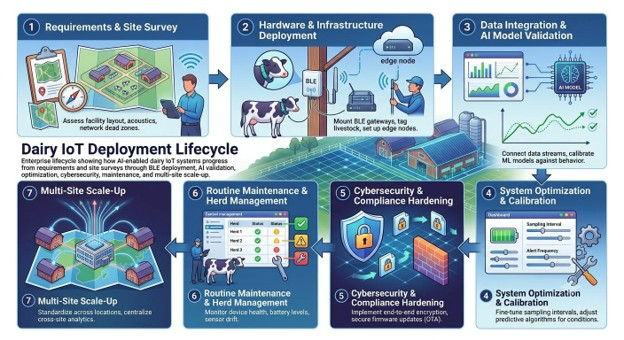
Enterprise lifecycle showing how AI-enabled dairy IoT systems progress from requirements and site surveys through BLE deployment, AI validation, optimization, cybersecurity, maintenance, and multi-site scale-up.
Practical Implementation Recommendations for Dairy Agriculture
A technically successful AI and BLE deployment should begin with a narrow operational problem that can be measured.
Recommended practices include:
- Start with a clearly defined livestock, environmental, equipment, or traceability problem
- Establish baseline KPIs before installing sensors
- Perform an RF site survey before fixing gateway locations
- Select sensor hardware according to environmental conditions
- Design for battery replacement and device maintenance from the beginning
- Use unique device identities and controlled provisioning
- Keep animal, asset, device, and location identifiers logically separate
- Validate sensor measurements against trusted reference instruments
- Buffer data locally when connectivity can be unreliable
- Integrate alerts into existing farm workflows
- Use human validation for high-impact AI recommendations
- Monitor AI false-positive and false-negative behavior
- Maintain model and firmware version records
- Segment IoT gateways from unrelated network traffic
- Plan gateway redundancy where operational continuity requires it
- Test failure conditions rather than only normal operation
- Use cloud deployment for centralized multi-site analytics where appropriate
- Use private server or edge deployment where local control or connectivity requirements justify it
- Combine BLE with RFID or other technologies when their physical characteristics better match the use case
- Scale only after pilot measurements demonstrate operational value
One particularly important lesson is to avoid collecting data simply because sensors make it technically possible. Every monitored variable should have a defined operational purpose. The engineering team should be able to explain what decision the measurement supports, who receives the resulting information, and what action follows from a meaningful change.
Key Takeaways for AI-Enabled Dairy Operations
AI can help dairy agriculture move from periodic manual observation toward continuous, data-supported operational decision-making. BLE sensors, beacons, and gateways provide a practical low-power mechanism for collecting information from livestock, agricultural assets, equipment, and environmental zones.
The greatest value comes from connecting this field data with reliable data engineering, edge or server processing, AI analytics, farm-management software, maintenance workflows, and measurable KPIs.
A successful deployment should prioritize RF engineering, sensor reliability, data quality, cybersecurity, interoperability, AI validation, and operational usability rather than focusing only on the number of connected devices.
GAO provides BLE, RFID, and IoT hardware products and systems that can form part of these connected agricultural solutions, with engineering and technical support for organizations implementing wireless identification, sensing, monitoring, and automation requirements. Organizations evaluating AI-enabled dairy monitoring can learn more about GAO’s technology solutions, products, system capabilities, and technical support through its website.
Building the Future of Industrial AI and IoT with Aperture Venture Studio and GAO RFID Inc.
For more than three decades, GAO Group of Companies has invested heavily in R&D for industrial BLE, RFID, and IoT technologies. As generative AI became increasingly useful for industrial applications, we expanded our work across AI-enabled IoT systems and established Aperture Venture Studio to help advance practical AI and IoT solutions for applications such as connected dairy agriculture, livestock monitoring, industrial sensing, and asset intelligence. Aperture brings together AI and IoT technical experts, entrepreneurial and operational executives, investors, and leading companies. We also developed the Aperture Ventures Summit and TekSummit to examine advanced AI and IoT topics. We welcome you to join us as:
- Advisors, co-founders, or employees
- Investors
- Customers