
AI-Driven BLE Solutions for Dairy Production
Advancing Dairy Production with AI-Driven BLE Intelligence
Dairy production facilities operate in highly controlled environments where milk quality, product consistency, equipment reliability, hygiene, cold chain integrity, and regulatory compliance are essential to successful operations. Processing plants producing milk, cheese, yogurt, butter, cream, milk powder, and other dairy products require continuous monitoring of production conditions to maintain food safety while maximizing productivity and minimizing waste. Bluetooth Low Energy (BLE) technologies, including BLE gateways, BLE beacons, and BLE sensors, provide real-time operational data that Artificial Intelligence (AI) transforms into actionable insights for intelligent dairy production management.
AI-powered BLE solutions enable continuous monitoring of pasteurization equipment, refrigeration systems, fermentation tanks, storage silos, production lines, inventory movement, and environmental conditions. These capabilities help dairy producers reduce downtime, improve product quality, strengthen regulatory compliance, and increase operational efficiency. GAO has helped dairy manufacturers by supplying BLE hardware and Industrial IoT technologies that support reliable industrial data collection for intelligent dairy production operations.
AI-Enabled BLE Architecture for Dairy Production: From Smart Processing Equipment to Enterprise Decision-Making
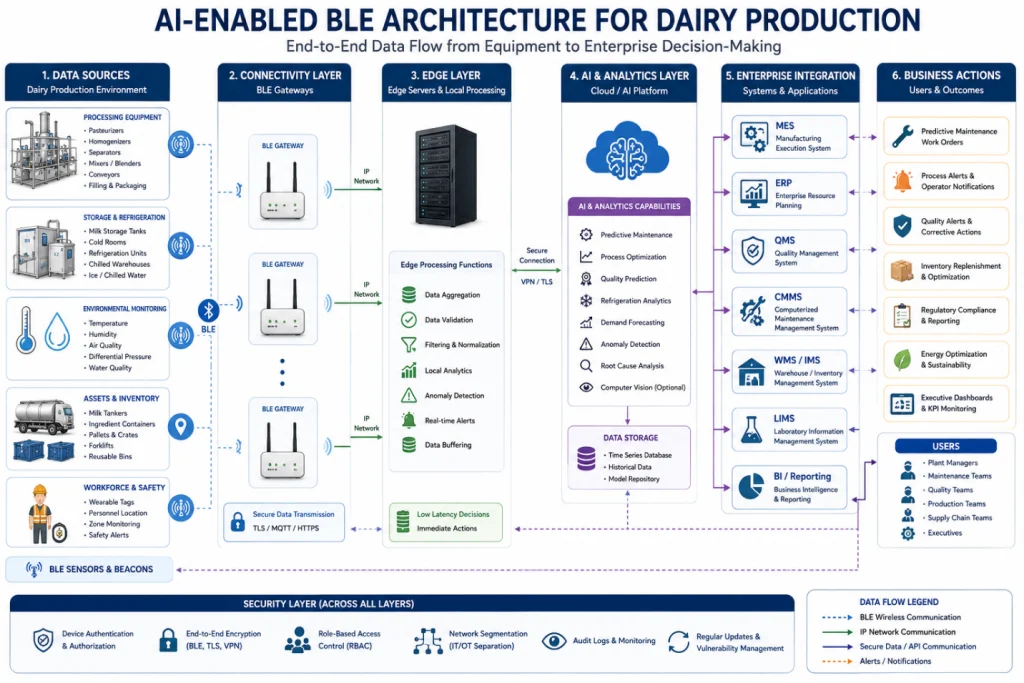
This architecture diagram illustrates the end-to-end data flow of an AI-enabled Bluetooth Low Energy (BLE) solution for dairy production. It demonstrates how BLE sensors, beacons, and gateways collect real-time operational data from dairy processing equipment, refrigeration systems, milk storage tanks, production lines, inventory assets, and environmental monitoring devices.
Understanding AI-Enabled BLE Systems in Dairy Production
Dairy production consists of multiple interconnected processing stages, including raw milk receiving, milk storage, pasteurization, homogenization, separation, fermentation, cheese production, filling, packaging, refrigerated storage, and distribution. Every stage requires continuous monitoring to ensure food safety, consistent product quality, and compliance with industry regulations.
BLE technology provides a low-power wireless communication solution that enables sensors and tracking devices to collect operational information throughout the production process. BLE gateways aggregate data from distributed sensors and securely transmit it to AI software operating on cloud-hosted or privately managed server systems.
AI converts BLE-generated operational data into actionable intelligence by:
- Predicting equipment failures before production interruptions occur.
- Monitoring pasteurization performance.
- Detecting abnormal temperature and humidity conditions.
- Tracking raw milk, ingredients, and finished dairy products.
- Optimizing production scheduling.
- Improving Overall Equipment Effectiveness (OEE).
- Supporting Hazard Analysis and Critical Control Points (HACCP) programs.
- Monitoring cleaning-in-place (CIP) processes.
- Reducing production waste.
- Enhancing end-to-end product traceability.
Rather than functioning independently, BLE serves as the wireless data acquisition layer while AI analyzes operational patterns, predicts future conditions, and recommends corrective actions. This combination enables dairy producers to move from reactive production management toward predictive, data-driven operations.
Modern AI deployments incorporate machine learning, anomaly detection, predictive analytics, deep learning, computer vision, and time-series forecasting to improve process control, equipment utilization, product quality, and operational efficiency. These technologies provide engineers, plant managers, maintenance teams, production supervisors, quality assurance specialists, and food safety personnel with actionable insights that support continuous improvement.
Dairy Production Applications and Deployment Scenarios
AI-enabled BLE solutions support numerous operational processes specific to dairy production. Each application improves product quality, production efficiency, regulatory compliance, and operational reliability.
Pasteurization Monitoring
Pasteurization is one of the most critical processes in dairy production. BLE temperature and flow sensors continuously monitor pasteurizers to ensure products consistently achieve required time and temperature conditions. AI analyzes processing trends, identifies deviations, predicts equipment issues, and supports compliance with food safety regulations.
Refrigeration and Cold Storage Monitoring
Milk and dairy products require strict temperature control throughout processing and storage. BLE temperature sensors continuously monitor refrigeration units, cold rooms, storage silos, chilled warehouses, and transport staging areas. AI predicts refrigeration equipment failures, detects abnormal cooling performance, and alerts personnel before product quality is affected.
Equipment Health Monitoring
Critical production equipment including homogenizers, separators, pasteurizers, pumps, compressors, filling machines, packaging equipment, conveyors, mixers, and CIP systems operate continuously throughout production.
BLE vibration, temperature, and energy sensors provide equipment health data while AI predicts maintenance requirements, helping reduce unplanned downtime and extending equipment service life.
Environmental Monitoring
Maintaining stable environmental conditions is essential for producing safe, high-quality dairy products.
BLE environmental sensors continuously monitor:
- Ambient temperature.
- Relative humidity.
- Air quality.
- Differential pressure.
- Water quality.
- Production room conditions.
- Refrigerated storage environments.
AI evaluates these measurements continuously to identify deviations that could affect food safety, fermentation performance, or product quality.
Raw Milk and Finished Product Traceability
BLE asset tags attached to milk tankers, storage tanks, ingredient containers, pallets, reusable crates, and finished products provide real-time visibility throughout production and distribution. AI analyzes movement patterns to improve inventory accuracy, support First-Expired-First-Out (FEFO) inventory practices, and strengthen traceability during quality investigations or product recalls.
Workforce Safety and Operational Monitoring
BLE-enabled wearable devices support personnel safety by monitoring employee locations within production areas, refrigeration facilities, cleaning zones, and restricted processing environments. AI detects unusual movement patterns, prolonged exposure to hazardous conditions, or unauthorized access to sensitive production areas.
Inventory Optimization
BLE beacons attached to raw materials, cultures, packaging materials, additives, and finished dairy products enable continuous inventory monitoring. AI forecasts demand, recommends replenishment schedules, minimizes spoilage, and optimizes warehouse utilization to reduce carrying costs and production delays.
Cleaning-in-Place (CIP) Verification
Cleaning-in-Place systems are fundamental to dairy production hygiene. BLE sensors monitor cleaning cycles, water temperature, chemical concentrations, flow rates, and equipment status. AI evaluates cleaning performance, identifies incomplete sanitation procedures, and supports compliance with HACCP, Food Safety Modernization Act (FSMA), and other dairy industry food safety requirements.
Operational Workflow of AI-Enabled BLE Solutions in Dairy Production
AI-enabled BLE solutions establish a connected dairy production environment where operational data flows continuously from processing equipment, refrigeration systems, environmental sensors, and production assets to intelligent AI software. This end-to-end workflow enables dairy producers to monitor production conditions in real time, predict operational issues, automate responses, and maintain product quality and food safety. The workflow combines BLE devices, communication infrastructure, AI analytics, enterprise software, and automated business processes to improve operational efficiency and support informed decision-making.
AI-Enabled BLE Operational Workflow for Dairy Production: From Real-Time Data Collection to Intelligent Business Actions
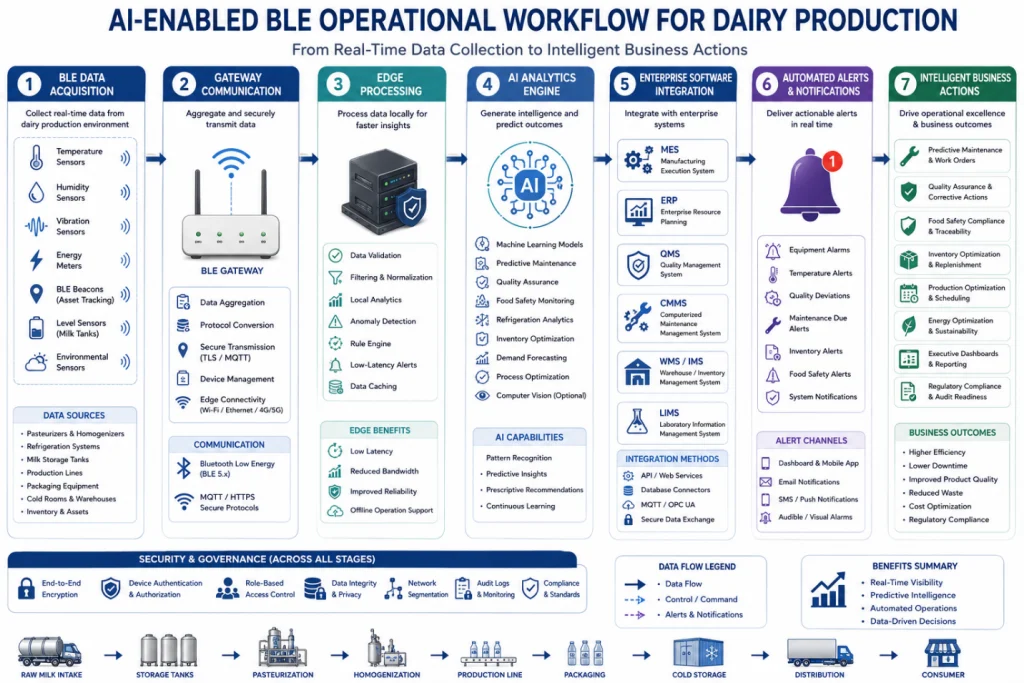
This workflow diagram illustrates the complete operational sequence of an AI-enabled Bluetooth Low Energy (BLE) solution for dairy production. It shows how BLE sensors and beacons collect real-time data from dairy processing equipment, pasteurization systems, refrigeration units, milk storage tanks, and production environments.
BLE Data Acquisition
The workflow begins with BLE-enabled devices deployed throughout the dairy production facility. These devices continuously collect operational information from processing equipment, refrigeration assets, storage environments, and production areas.
Typical BLE data sources include:
- Temperature sensors monitoring pasteurizers, refrigeration systems, cold rooms, milk storage tanks, and chilled warehouses.
- Humidity sensors installed throughout production and storage environments.
- Vibration sensors attached to homogenizers, separators, pumps, compressors, conveyors, mixers, and packaging equipment.
- Energy monitoring sensors measuring equipment power consumption.
- BLE beacons attached to milk tankers, ingredient containers, pallets, reusable crates, forklifts, and mobile production assets.
- Wearable BLE tags supporting workforce safety and personnel location awareness.
- Environmental sensors monitoring air quality, differential pressure, water quality, and clean processing conditions.
- Inventory tracking devices attached to raw milk, cultures, additives, packaging materials, and finished dairy products.
These BLE devices continuously collect operational information at configurable intervals, providing reliable wireless data collection without requiring extensive wired infrastructure.
Gateway Communication
BLE sensors and beacons communicate wirelessly with strategically positioned BLE gateways installed throughout the dairy processing facility. The gateways aggregate information from multiple BLE devices and securely transmit the collected data to edge servers or cloud-hosted AI software for further processing.
Common communication technologies include:
- Bluetooth Low Energy (BLE) 5.x
- Ethernet
- Industrial Wi-Fi
- MQTT
- HTTPS
- REST APIs
- OPC UA
- Modbus TCP
- TCP/IP
BLE communication provides low-power, scalable wireless connectivity that supports large deployments across processing plants, refrigerated warehouses, milk storage facilities, and packaging operations.
Edge Processing
Edge computing systems process operational data locally before transmitting information to centralized AI software. Local processing reduces communication latency while enabling rapid responses to critical operational events.
Edge processing functions include:
- Data validation and filtering.
- Sensor health monitoring.
- Data normalization.
- Local anomaly detection.
- Temporary data buffering during network interruptions.
- Low-latency alarm generation.
- Initial predictive maintenance analysis.
For example, if a pasteurizer temperature falls below regulatory requirements or refrigeration temperatures exceed acceptable limits, edge systems can immediately trigger alerts before cloud analytics complete broader trend analysis.
AI Analytics and Predictive Intelligence
After operational data has been processed, AI models analyze current conditions alongside historical production information to identify operational patterns, predict future events, and recommend improvements.
AI capabilities commonly include:
- Predictive maintenance for dairy processing equipment.
- Anomaly detection for environmental deviations.
- Machine learning-based production optimization.
- Time-series forecasting for refrigeration performance.
- Predictive inventory analysis.
- Computer vision integration for packaging inspection and quality verification.
- Root cause analysis of recurring production issues.
- Process optimization recommendations.
Through continuous learning, AI improves equipment reliability, minimizes production losses, enhances dairy product quality, and supports consistent manufacturing performance.
Enterprise Software Integration
AI-generated operational insights become more valuable when integrated with existing dairy production software systems. BLE-enabled AI solutions exchange information with enterprise applications to automate workflows and improve operational visibility.
Common integrations include:
- Manufacturing Execution Systems (MES)
- Enterprise Resource Planning (ERP)
- Warehouse Management Systems (WMS)
- Computerized Maintenance Management Systems (CMMS)
- Quality Management Systems (QMS)
- Laboratory Information Management Systems (LIMS)
- Supply Chain Management (SCM) software
- Food Safety Management Systems
- Building Management Systems (BMS)
- Production planning and scheduling software
These integrations support automated maintenance scheduling, inventory synchronization, production reporting, laboratory quality management, and food safety documentation across dairy production operations.
Automated Alerts and Business Actions
AI-enabled BLE solutions automatically initiate predefined business actions whenever specific operational conditions are detected.
Examples include:
- Generating maintenance work orders when equipment health deteriorates.
- Alerting operators to refrigeration or pasteurization deviations.
- Triggering inventory replenishment requests based on demand forecasts.
- Sending notifications when Cleaning-in-Place (CIP) procedures require corrective action.
- Updating inventory records following asset movement.
- Initiating quality inspections after abnormal production conditions are detected.
- Supporting automated regulatory reporting for food safety compliance.
- Recommending optimized production schedules based on equipment availability and production demand.
These automated workflows reduce manual intervention, improve response times, and help maintain continuous dairy production operations.
Core Technologies Supporting AI-Driven BLE Solutions
Successful AI-enabled BLE implementations in dairy production depend on the coordinated operation of advanced hardware, intelligent AI software, secure communication protocols, and scalable deployment infrastructure. Together, these technologies create a connected solution that supports real-time monitoring, predictive analytics, operational automation, and regulatory compliance.
BLE Hardware Components
BLE hardware forms the foundation of intelligent dairy production by providing continuous wireless data collection throughout the processing environment.
Core hardware components include:
- BLE Gatewaysthat aggregate information from nearby BLE devices and securely transmit data to edge servers or cloud-hosted software.
- BLE Beaconsattached to milk tankers, storage silos, ingredient containers, forklifts, pallets, reusable crates, and production assets for location tracking.
- BLE Environmental Sensorsmeasuring temperature, humidity, air quality, differential pressure, vibration, energy consumption, refrigeration performance, and water quality.
- Wearable BLE Tagssupporting workforce safety, personnel tracking, and controlled access monitoring.
- Battery-powered BLE Asset Tagsenabling long-term monitoring of valuable production equipment and mobile manufacturing assets.
These hardware components establish a scalable wireless sensing solution that enables AI systems to continuously monitor dairy production while supporting predictive maintenance, quality assurance, inventory management, food safety, and operational optimization.
Core Technologies Supporting AI-Driven BLE Solutions in Dairy Production
Successful AI-enabled BLE implementations in dairy production require the coordinated operation of intelligent BLE hardware, advanced AI software, secure communication protocols, scalable deployment models, and comprehensive cybersecurity. Together, these technologies provide continuous operational visibility, predictive analytics, automated decision-making, and regulatory compliance while supporting consistent product quality and efficient dairy processing. GAO supports dairy manufacturers by supplying BLE hardware and Industrial IoT technologies that enable reliable data collection and intelligent production monitoring.
Core Technologies Block Diagram for AI-Enabled BLE Solutions in Dairy Production
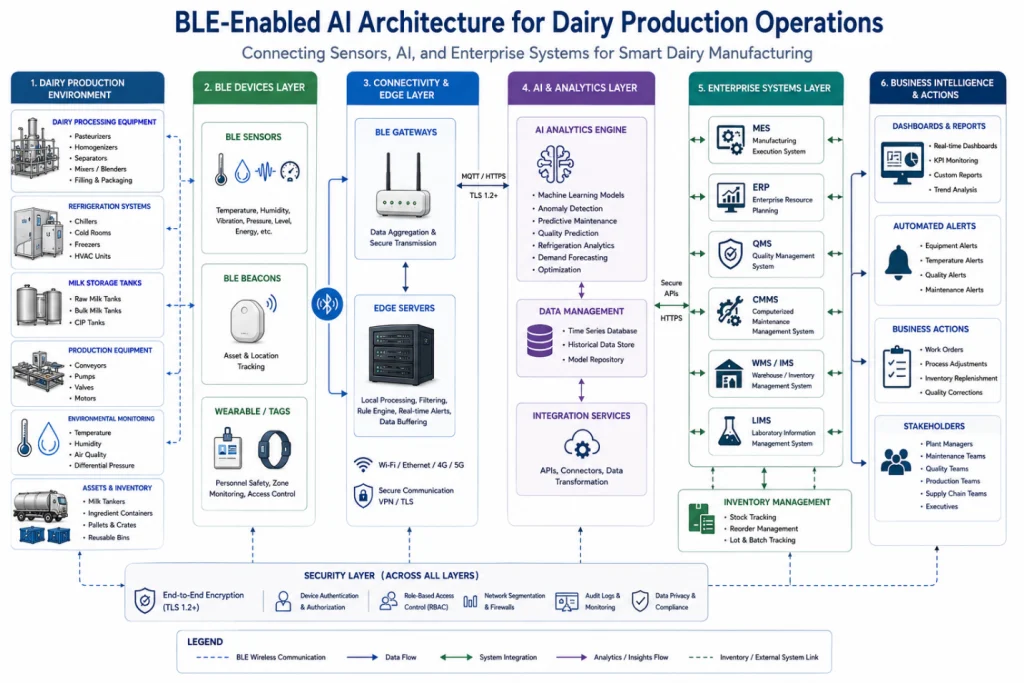
This block diagram illustrates the interaction between Bluetooth Low Energy (BLE) hardware, Artificial Intelligence (AI) software, enterprise systems, and dairy production equipment within a connected manufacturing environment. It demonstrates how BLE sensors, beacons, gateways, and edge servers collect and securely transmit operational data to AI analytics platforms, which integrate with enterprise applications such as MES, ERP, QMS, CMMS, LIMS, and inventory management systems.
Artificial Intelligence Technologies
Artificial Intelligence enables dairy producers to transform BLE sensor data into operational intelligence that improves production efficiency, product quality, food safety, and equipment reliability.
Common AI technologies include:
- Machine Learning (ML) for predictive maintenance and production optimization.
- Deep Learning for identifying complex operational patterns.
- Predictive Analytics for forecasting equipment failures and production demand.
- Time-Series Forecasting for refrigeration performance, pasteurization trends, and environmental monitoring.
- Anomaly Detection for identifying abnormal equipment behavior and food safety risks.
- Reinforcement Learning for optimizing production scheduling and resource allocation.
- Computer Vision integrated with BLE data for automated packaging inspection, labeling verification, and product quality assessment.
- Natural Language Processing (NLP) for analyzing maintenance records, laboratory reports, inspection documents, and quality assurance records.
These AI models continuously learn from historical and real-time production data, enabling dairy processors to improve operational efficiency, minimize waste, strengthen food safety, and optimize production performance.
Cloud-Based Deployment
Cloud deployments provide centralized monitoring and enterprise-wide analytics for dairy organizations operating multiple production facilities.
Key characteristics include:
- Centralized monitoring across multiple dairy plants.
- Scalable computing resources for AI model training.
- Long-term storage of production and environmental data.
- Remote access for engineering, maintenance, and production teams.
- Enterprise dashboards with real-time operational reporting.
- Simplified software updates and maintenance.
- Integration with cloud-hosted ERP, MES, SCM, and QMS software.
Cloud deployments are particularly suitable for organizations requiring centralized management, enterprise reporting, and advanced analytics across geographically distributed dairy production operations.
Server-Based Deployment
Many dairy manufacturers deploy AI software on privately managed servers to maintain greater operational control while meeting internal governance and regulatory requirements.
Typical deployment environments include:
- Factory edge servers.
- On-premises enterprise servers.
- Private data centers.
- Customer-managed industrial computing infrastructure.
Advantages include:
- Very low communication latency.
- Local control of production and quality data.
- Continued operation during internet outages.
- Reduced dependence on external infrastructure.
- Immediate response to critical production events.
- Strong alignment with internal cybersecurity policies.
Server-based deployments are well suited for dairy production facilities that require uninterrupted processing, localized decision-making, and strict control over operational data.
Hybrid Deployment Strategy
Many organizations adopt hybrid deployment models that combine local processing with cloud-based analytics.
Typical responsibilities include:
Edge or Local Server Responsibilities
- Real-time production monitoring.
- Immediate alarm generation.
- Local AI inference.
- Refrigeration monitoring.
- Pasteurization process monitoring.
- Low-latency operational decision-making.
Cloud Responsibilities
- Enterprise reporting.
- Historical trend analysis.
- AI model training and optimization.
- Executive dashboards.
- Multi-site performance benchmarking.
- Long-term operational data storage.
Hybrid deployments combine the responsiveness of local processing with the scalability and analytical capabilities of cloud computing.
Communication Protocols
Reliable communication is essential for AI-enabled BLE solutions within dairy production environments.
Common communication protocols include:
- Bluetooth Low Energy (BLE) 5.0, 5.1, 5.2, and later versions.
- MQTT for lightweight IoT messaging.
- OPC UA for industrial interoperability.
- Modbus TCP for production equipment communication.
- HTTPS for secure web communication.
- REST APIs for enterprise software integration.
- Ethernet for gateway connectivity.
- Industrial Wi-Fi for wireless networking.
- TCP/IP networking.
- Secure VPN connections for remote administration.
The selection of communication protocols depends on production requirements, cybersecurity policies, interoperability requirements, and existing manufacturing infrastructure.
Cybersecurity and Data Protection
Dairy production facilities generate operational data that directly affects food safety, product quality, and regulatory compliance. Robust cybersecurity measures help protect this information while ensuring reliable production operations.
Recommended security practices include:
- Encryption of BLE communications where supported.
- TLS encryption between gateways and servers.
- Multi-factor authentication (MFA) for administrative access.
- Role-based access control (RBAC).
- Secure device provisioning.
- Certificate-based authentication.
- Network segmentation between operational technology (OT) and enterprise IT networks.
- Continuous vulnerability assessments.
- Comprehensive audit logging.
- Regular firmware and software updates.
Integrating cybersecurity into system design reduces operational risks while supporting secure and reliable dairy production.
Engineering Best Practices
Long-term success depends on following established engineering practices throughout planning, deployment, operation, and maintenance.
Recommended practices include:
- Conduct wireless site surveys before deployment.
- Validate BLE coverage throughout production, refrigeration, storage, and packaging areas.
- Identify and mitigate radio-frequency interference.
- Calibrate environmental sensors according to documented procedures.
- Implement preventive maintenance schedules for BLE gateways and sensors.
- Validate sensor data before AI model training.
- Monitor battery health for wireless BLE devices.
- Maintain an accurate inventory of connected assets.
- Validate AI recommendations before automating production decisions.
- Periodically retrain AI models using updated production and operational data.
These engineering practices help maximize system reliability, improve AI prediction accuracy, and support continuous operational improvement.
Comparison of Cloud, Server, and Hybrid AI Deployment Models for BLE-Enabled Dairy Production
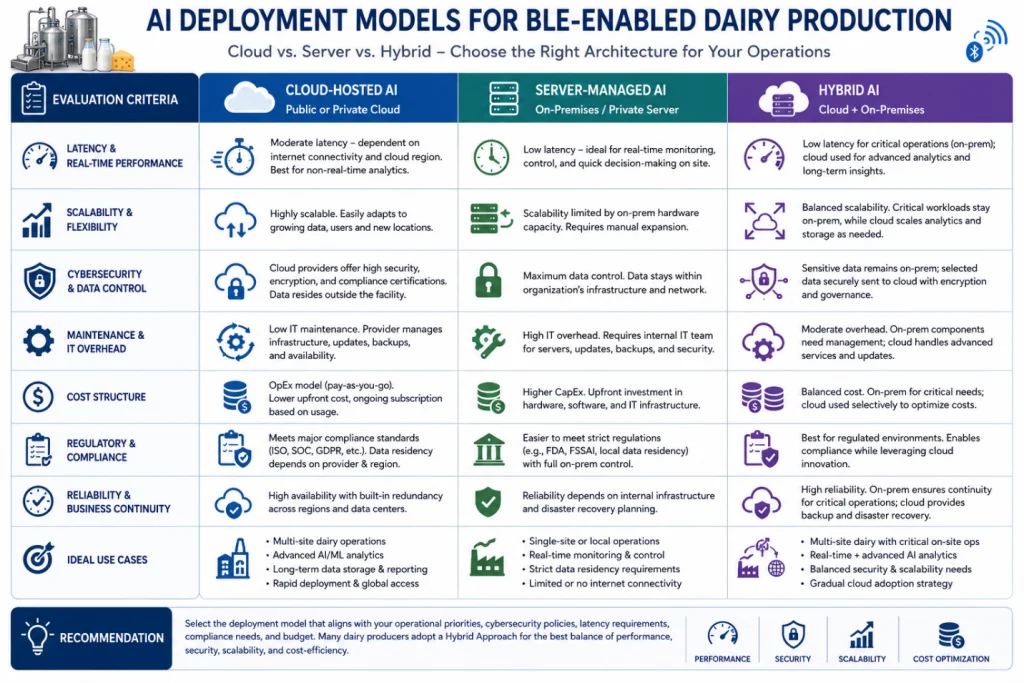
This comparison table evaluates Cloud-hosted, Server-managed (On-Premises), and Hybrid Artificial Intelligence (AI) deployment models for Bluetooth Low Energy (BLE)-enabled dairy production systems. It compares key factors including latency, scalability, cybersecurity, maintenance, regulatory compliance, business continuity, implementation costs, and ideal use cases.
Key Technical Capabilities of AI-Driven BLE Solutions in Dairy Production
AI-enabled BLE solutions provide dairy production facilities with continuous operational intelligence that improves equipment reliability, product quality, food safety, regulatory compliance, and manufacturing efficiency. By combining Bluetooth Low Energy (BLE) technologies with Artificial Intelligence (AI), dairy producers can transition from reactive operations to predictive, data-driven production management. These intelligent capabilities enable real-time monitoring, automated decision-making, and continuous process optimization across every stage of dairy production. GAO supports these initiatives by providing BLE hardware and Industrial IoT technologies that enable reliable industrial data collection for intelligent dairy production operations.
AI-Enabled BLE Solutions for Dairy Production: Technical and Business Benefits Infographic
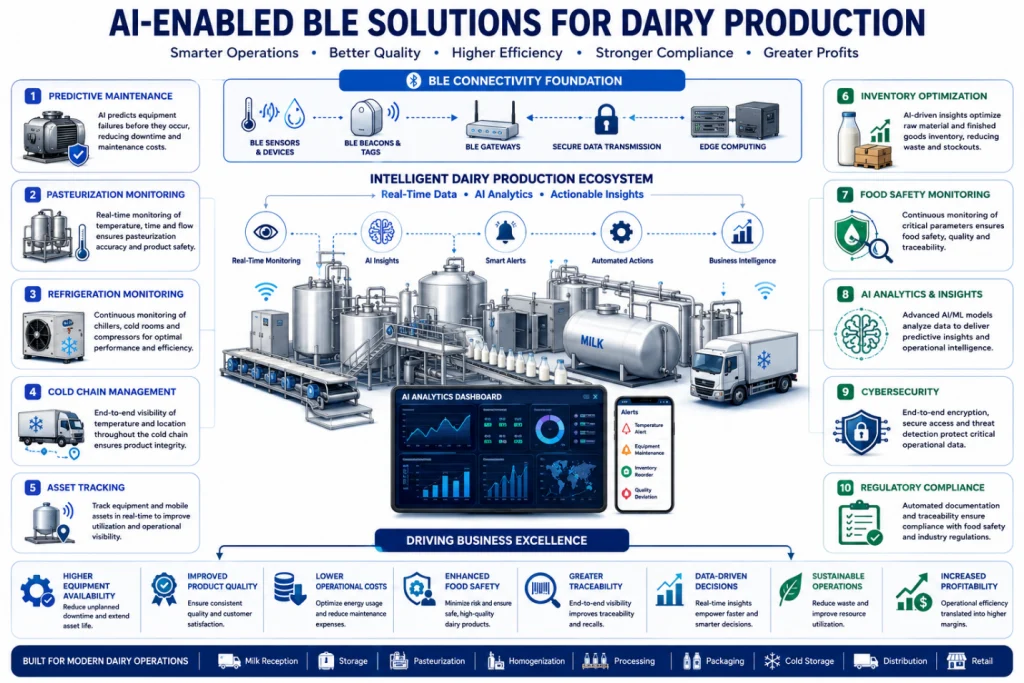
This enterprise infographic summarizes the key technical capabilities and business benefits of Artificial Intelligence (AI)-enabled Bluetooth Low Energy (BLE) solutions in dairy production. It highlights predictive maintenance, pasteurization monitoring, refrigeration monitoring, cold chain management, asset tracking, inventory optimization, food safety monitoring, AI-powered analytics, cybersecurity, regulatory compliance, and production optimization.
Intelligent Equipment Health Monitoring
Dairy production facilities depend on pasteurizers, homogenizers, separators, pumps, compressors, refrigeration systems, filling machines, packaging equipment, conveyors, and mixers operating continuously under demanding production conditions.
BLE vibration, temperature, energy, and operating-hour sensors provide continuous equipment monitoring while AI analyzes historical and real-time performance data to:
- Predict component wear before failures occur.
- Detect abnormal vibration patterns.
- Identify overheating motors and bearings.
- Estimate remaining equipment service life.
- Recommend preventive maintenance schedules.
- Reduce unexpected production interruptions.
Predictive maintenance minimizes downtime while improving equipment availability and reducing maintenance costs.
Predictive Product Quality Management
Maintaining consistent dairy product quality requires continuous monitoring throughout production. AI evaluates BLE sensor data to detect process deviations before they affect finished products.
AI supports quality management by:
- Monitoring pasteurization temperatures.
- Tracking fermentation conditions.
- Detecting abnormal humidity and environmental conditions.
- Supporting Statistical Process Control (SPC).
- Predicting potential quality deviations.
- Correlating equipment performance with product quality.
Predictive quality management enables production teams to implement corrective actions before issues compromise product consistency or food safety.
Refrigeration and Cold Chain Intelligence
Temperature control is critical throughout dairy production and storage.
BLE temperature sensors continuously monitor:
- Cold rooms.
- Milk storage tanks.
- Refrigerated warehouses.
- Chilled production environments.
- Distribution staging areas.
AI analyzes refrigeration performance to:
- Detect abnormal cooling trends.
- Predict refrigeration equipment failures.
- Optimize energy consumption.
- Prevent product spoilage.
- Improve cold chain compliance.
Continuous monitoring helps preserve dairy product quality throughout manufacturing and distribution.
Intelligent Asset Tracking
BLE beacons attached to mobile production assets provide real-time visibility across dairy processing facilities.
Commonly tracked assets include:
- Milk tankers.
- Ingredient containers.
- Reusable crates.
- Maintenance equipment.
- Mobile inspection devices.
- Production tools.
AI analyzes movement patterns to improve asset utilization, reduce search times, optimize workflows, and strengthen operational efficiency.
Smart Inventory Management
BLE-enabled inventory monitoring combined with AI provides accurate visibility throughout dairy production.
Capabilities include:
- Automated inventory reconciliation.
- Demand forecasting.
- Raw milk traceability.
- Ingredient tracking.
- Finished product visibility.
- First-Expired-First-Out (FEFO) inventory optimization.
- Warehouse utilization analysis.
- Production planning support.
These capabilities reduce waste while improving inventory accuracy and production scheduling.
Operational Improvements Enabled by AI and BLE
The integration of BLE technology with AI significantly improves operational performance throughout dairy production facilities by enabling proactive decision-making and reducing manual intervention.
Increased Production Efficiency
Continuous operational monitoring enables production managers to identify inefficiencies and optimize manufacturing performance.
AI assists by optimizing:
- Production scheduling.
- Equipment utilization.
- Material flow.
- Workforce allocation.
- Production sequencing.
- Changeover planning.
These improvements increase throughput while maintaining consistent dairy product quality.
Reduced Equipment Downtime
Predictive maintenance allows maintenance teams to address developing equipment issues before unexpected failures occur.
Benefits include:
- Improved equipment availability.
- Reduced emergency repairs.
- Lower maintenance costs.
- Extended equipment lifespan.
- Better spare parts planning.
- Increased Overall Equipment Effectiveness (OEE).
Improved Food Safety Compliance
Food safety regulations require continuous monitoring and documented evidence of production conditions.
AI-assisted BLE systems strengthen compliance by:
- Recording environmental conditions continuously.
- Monitoring pasteurization performance.
- Tracking refrigeration temperatures.
- Monitoring Cleaning-in-Place (CIP) activities.
- Supporting HACCP documentation.
- Maintaining production records.
- Improving end-to-end product traceability.
Automated documentation reduces manual recordkeeping while improving audit readiness.
Enhanced Workforce Productivity
AI automates routine monitoring activities traditionally performed manually.
Automation includes:
- Equipment condition monitoring.
- Environmental monitoring.
- Alarm prioritization.
- Asset location tracking.
- Maintenance recommendations.
- Production reporting.
This enables engineering, maintenance, quality assurance, and production personnel to focus on higher-value operational improvements.
Business Benefits of AI-Enabled BLE Solutions
Organizations implementing AI-enabled BLE solutions can achieve measurable operational and financial improvements.
Improved Product Quality
Continuous monitoring and predictive analytics reduce manufacturing variability while supporting consistent dairy product quality.
Reduced Operational Costs
Optimized maintenance, improved inventory management, reduced product waste, lower energy consumption, and increased equipment utilization contribute to reduced operating expenses.
Greater Operational Agility
Real-time operational visibility enables dairy manufacturers to respond rapidly to changing production requirements, equipment conditions, inventory levels, and supply chain disruptions.
Better Decision-Making
AI transforms operational data into actionable insights delivered through dashboards, predictive analytics, automated alerts, and enterprise reporting, enabling informed operational and strategic decisions.
Reduced Operational Risk
Early detection of equipment degradation, refrigeration failures, environmental deviations, inventory shortages, and process abnormalities reduces production risks while protecting food safety, product quality, and business continuity.
Performance, Scalability, and Security Advantages
AI-enabled BLE solutions provide a scalable foundation for modern dairy production facilities.
Performance Improvements
Organizations commonly achieve:
- Reduced production downtime.
- Improved equipment utilization.
- Faster fault detection.
- Higher production throughput.
- Lower product waste.
- Better energy efficiency.
- Improved Overall Equipment Effectiveness (OEE).
Scalability
BLE infrastructures can expand to support:
- Additional production lines.
- Larger sensor deployments.
- Multiple dairy processing facilities.
- Enterprise-wide monitoring.
- Expanded AI applications.
- Long-term operational analytics.
Security Improvements
Recommended security measures include:
- Secure BLE communications.
- TLS-encrypted gateway connections.
- Multi-factor authentication (MFA).
- Role-based access control (RBAC).
- Network segmentation.
- Continuous security monitoring.
- Device lifecycle management.
- Firmware and software updates.
- Comprehensive audit logging.
These practices help protect operational data while supporting secure, reliable, and compliant dairy production operations.
AI Deployment Decision Tree for BLE-Enabled Dairy Production: Choosing Cloud, Server, or Hybrid Infrastructure
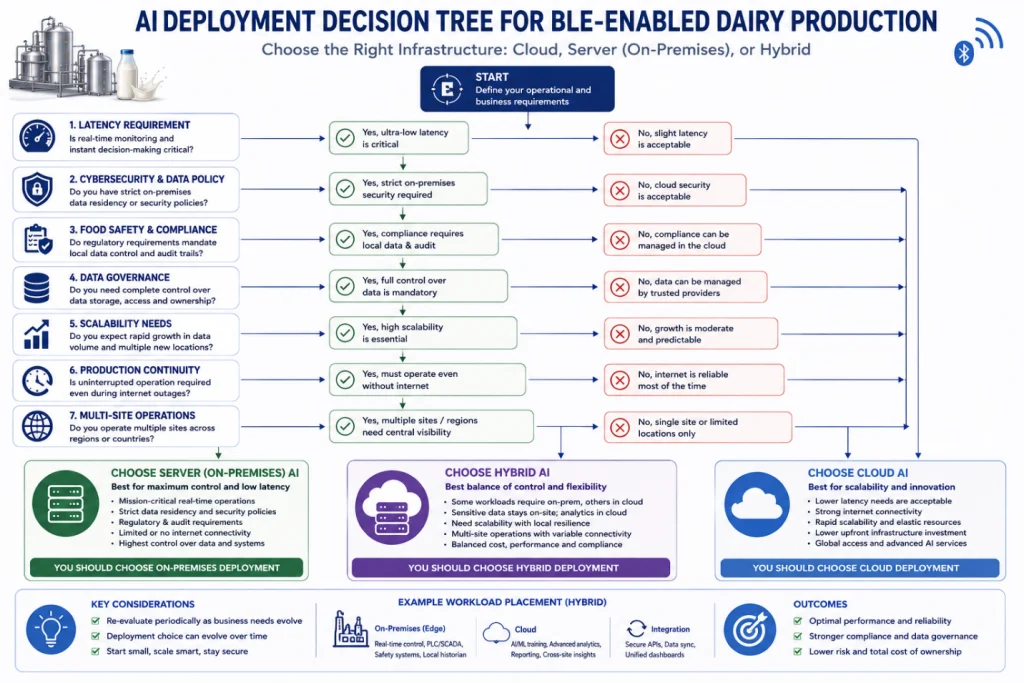
This decision tree helps dairy manufacturers identify the most appropriate Artificial Intelligence (AI) deployment model for Bluetooth Low Energy (BLE)-enabled production systems. It evaluates operational requirements such as latency, cybersecurity, food safety compliance, data governance, scalability, or Hybrid AI deployments that best align with business objectives and manufacturing needs.
Implementation Recommendations
Organizations planning AI-enabled BLE deployments should adopt a structured implementation strategy.
Recommended practices include:
- Define measurable business objectives before deployment.
- Conduct wireless site assessments.
- Prioritize high-value production assets during initial implementation.
- Validate sensor accuracy before commissioning.
- Integrate BLE data with existing MES, ERP, QMS, CMMS, WMS, and LIMS platforms.
- Develop cybersecurity policies before deployment.
- Validate AI model performance.
- Train engineering, maintenance, production, and quality personnel.
- Continuously monitor operational KPIs.
- Periodically retrain AI models using updated production and operational data.
A phased implementation approach helps dairy manufacturers reduce deployment risk while demonstrating measurable operational improvements before expanding AI-enabled BLE solutions across the enterprise.
Driving the Future of Intelligent Dairy Production
Artificial Intelligence (AI) combined with Bluetooth Low Energy (BLE) technologies is transforming dairy production by enabling continuous monitoring, predictive analytics, intelligent automation, and data-driven operational management. BLE sensors, beacons, and gateways provide real-time visibility into equipment performance, pasteurization systems, refrigeration assets, environmental conditions, inventory movement, and production processes, while AI converts this operational data into actionable insights that improve efficiency, product quality, and food safety.
By implementing AI-enabled BLE solutions, dairy manufacturers can reduce unplanned downtime, strengthen food safety programs, improve product traceability, optimize inventory management, enhance equipment utilization, and maintain regulatory compliance. These capabilities help organizations build more resilient, efficient, and scalable production environments while ensuring consistent dairy product quality and operational excellence.
As digital transformation continues across the food manufacturing industry, AI-powered BLE solutions provide a strong foundation for intelligent dairy production by enabling predictive decision-making, operational transparency, and continuous process optimization. GAO supports these initiatives by delivering BLE gateways, beacons, sensors, and Industrial IoT technologies that help organizations implement secure, scalable, and reliable intelligent dairy production systems.
Building the Future of Industrial AI and IoT with Aperture Venture Studio and GAO
For more than three decades, GAO has invested extensively in the development of Bluetooth Low Energy (BLE), RFID, and Industrial IoT technologies serving organizations throughout North America. As Artificial Intelligence continues to transform industrial operations, GAO has expanded its focus on AI-enabled BLE solutions that help dairy production facilities improve equipment reliability, operational efficiency, product quality, food safety, inventory management, and regulatory compliance.
To accelerate innovation in Industrial AI and IoT, GAO established Aperture Venture Studio, bringing together AI engineers, Industrial IoT specialists, manufacturing experts, technology partners, research organizations, and investors to develop practical AI-powered industrial solutions. This collaborative ecosystem supports the design, testing, and commercialization of intelligent technologies that address real-world manufacturing challenges.
Complementing these innovation initiatives, Aperture Ventures Summit and TekSummit provide collaborative forums where industry professionals explore emerging developments in Artificial Intelligence, Bluetooth Low Energy, RFID, Industrial IoT, cybersecurity, smart manufacturing, digital transformation, and automation. These initiatives encourage knowledge sharing and foster innovation across industrial sectors.
Organizations seeking to modernize dairy production operations can collaborate with GAO to implement secure, scalable, and future-ready AI-enabled BLE solutions tailored to their operational requirements. Through advanced hardware, intelligent software, engineering expertise, and ongoing technical support, GAO helps manufacturers accelerate digital transformation while improving operational performance and long-term competitiveness.