
AI for Display Panel Manufacturing with BLE-Based Tracking and Analytics
AI for Display Panel Manufacturing
AI for display panel manufacturing combines machine learning, computer vision, production analytics, equipment monitoring, and real-time asset visibility to improve yield, quality, throughput, and factory operations. BLE gateways, BLE beacons, and BLE sensors provide a practical wireless data layer for locating materials, monitoring mobile equipment, tracking production carriers, and capturing environmental or machine-related conditions.
Display panel production involves tightly controlled processes such as substrate handling, cleaning, coating, deposition, photolithography, etching, inspection, cell assembly, testing, and packaging. Small deviations in temperature, humidity, vibration, process timing, material movement, or equipment condition can affect yield and create expensive rework. AI can analyze these operational signals to identify abnormal patterns, predict failures, optimize production flows, and support faster decisions.
For display manufacturers, BLE is particularly useful where assets and materials move between production areas and where continuous visibility is difficult to achieve with fixed identification systems alone. GAO provides BLE, RFID, and IoT hardware products and systems that can support these manufacturing workflows, including location monitoring, sensor data collection, and integration with factory software.
AI and BLE Smart Factory for Display Panel Manufacturing
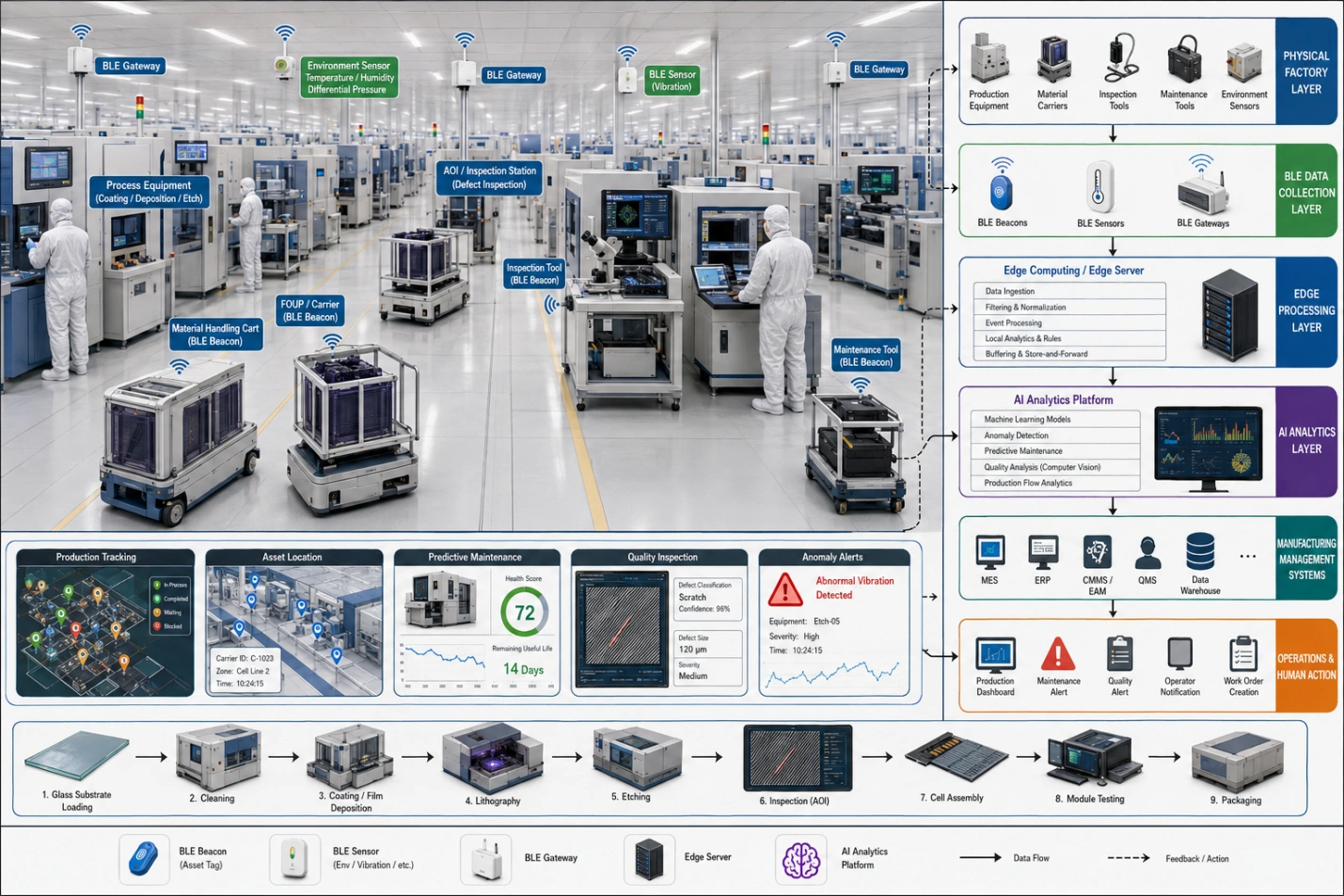
How AI Improves Display Panel Manufacturing
Display panel manufacturing generates large volumes of process, equipment, quality, material, and environmental data. AI converts these data streams into predictions, classifications, anomaly detection results, and operational recommendations.
Typical AI applications include:
- AI quality inspection: Computer vision models can identify surface defects, scratches, contamination, mura, pixel abnormalities, alignment issues, and other visual quality deviations during inspection.
- AI yield analysis: Machine learning can correlate process parameters, equipment states, material lots, environmental conditions, and inspection results to identify factors associated with yield loss.
- Predictive maintenance: AI models can detect changes in equipment behavior and identify conditions that may precede failures or unplanned downtime.
- Production flow optimization: AI can analyze work-in-process movement, equipment utilization, queue times, and process bottlenecks to improve production scheduling.
- Material tracking: BLE-enabled location information can help determine where mobile carriers, tools, inspection equipment, maintenance equipment, and other movable assets are located.
- Environmental monitoring: BLE sensors can provide temperature, humidity, vibration, differential pressure, or other relevant measurements depending on the selected sensor hardware.
- Process anomaly detection: AI can identify deviations from normal operating patterns across equipment and production stages.
- Energy optimization: Machine learning can analyze equipment utilization and environmental conditions to identify opportunities to reduce unnecessary energy consumption.
- Maintenance workflow optimization: Real-time asset location can help maintenance personnel find equipment, tools, spare parts, and mobile service assets more quickly.
The combination is important because AI requires reliable operational data. BLE does not replace manufacturing control systems or dedicated process instrumentation. Instead, BLE can complement existing systems by adding wireless identification, location, and sensor information where fixed infrastructure does not provide sufficient visibility.
Display Panel Manufacturing Workflows Supported by AI
Display panel production requires coordination between materials, process equipment, operators, maintenance teams, quality engineers, and factory software. AI applications become more useful when their models receive contextual information about where an asset is located, which production stage it is associated with, and what conditions surrounded the event.
Material and Substrate Movement
Glass substrates, panels, carriers, containers, tools, and work-in-process materials move through multiple manufacturing stages. Unclear material location can increase search time, create production delays, and complicate work-in-process management.
BLE beacons can be attached to selected mobile assets, while BLE gateways positioned at strategic factory locations receive beacon transmissions. The resulting location data can be processed by software to estimate asset presence or movement between defined zones.
AI can then use this information together with manufacturing execution system data to identify:
- Unexpected material dwell times
- Excessive queue duration
- Repeated movement between production zones
- Abnormal material flow
- Equipment waiting for material
- Potential bottlenecks
- Assets that remain inactive for unusually long periods
Production Equipment Monitoring
Display manufacturing equipment represents a major capital investment, and unexpected downtime can affect production schedules and yield. Equipment such as deposition systems, coating equipment, etching systems, inspection machines, cleaning systems, curing equipment, conveyors, material handling systems, and environmental control equipment can generate operational signals through existing controllers and sensors.
BLE sensors can supplement these signals where wireless monitoring is appropriate, particularly for mobile or auxiliary equipment. AI models can combine sensor observations with equipment logs, maintenance records, alarms, cycle times, and production information.
This allows maintenance teams to move from purely reactive maintenance toward condition-based and predictive maintenance practices.
Inspection and Quality Operations
Automated optical inspection and other inspection systems produce extensive quality information. AI can classify defects, detect subtle visual patterns, and identify correlations between defects and upstream manufacturing conditions.
A useful implementation connects inspection results with:
- Production equipment
- Process recipes
- Material lots
- Production timestamps
- Operator activities
- Environmental conditions
- Equipment maintenance history
- Work-in-process movement
BLE location data can provide additional context when inspection tools, carriers, or mobile equipment move between production areas.
Maintenance and Service Operations
Maintenance teams frequently work with specialized tools, meters, replacement components, mobile computers, and diagnostic equipment. Losing time locating these assets can extend equipment downtime.
BLE-based asset visibility can provide zone-level or room-level location information depending on gateway density, RF conditions, beacon configuration, and the selected positioning method.
AI can analyze maintenance records and equipment conditions to prioritize service activities based on predicted failure risk, equipment criticality, production impact, and maintenance history.
BLE Data Acquisition for Display Panel Factories
A BLE-enabled AI solution normally begins with physical data acquisition.
The basic data path can be represented as:
BLE Beacons and Sensors → BLE Gateways → Edge or Server Software → Data Processing → AI Analytics → Manufacturing Systems → Operational Action
BLE Beacons
BLE beacons transmit wireless identifiers and, depending on the device, additional telemetry. They can be attached to:
- Material carriers
- Mobile production equipment
- Inspection tools
- Maintenance tools
- Carts
- Containers
- Spare-part assets
- Portable instruments
Beacon configuration should consider transmission interval, battery life, RF interference, mounting position, and required location accuracy.
BLE Sensors
BLE sensors can provide wireless measurements such as temperature, humidity, vibration, acceleration, contact status, or other parameters supported by the selected hardware.
Sensor selection should be driven by the actual manufacturing requirement rather than simply maximizing the number of measured parameters. Cleanroom compatibility, battery performance, measurement accuracy, calibration requirements, enclosure design, and maintenance access should all be considered.
BLE Gateways
BLE gateways receive BLE transmissions and forward collected information to local or remote software. Gateway placement is particularly important in display manufacturing because cleanroom construction, metal equipment, machinery, racks, walls, and other RF obstacles can affect signal propagation.
A production deployment should therefore begin with an RF site survey or controlled pilot rather than assuming that theoretical BLE range will provide the required coverage.
BLE-to-AI Data Workflow for Display Panel Manufacturing
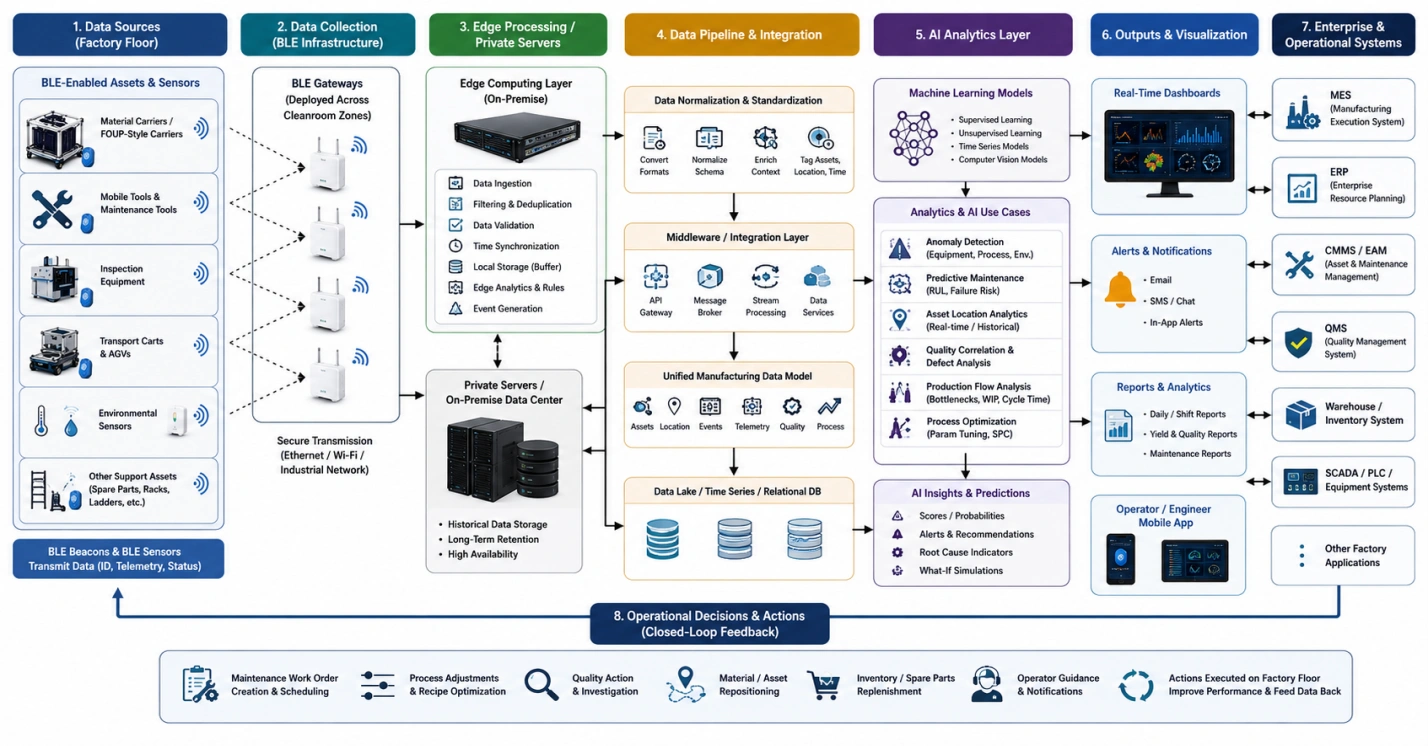
AI and BLE Applications Across Display Panel Production
| Manufacturing Area | AI Application | BLE Contribution | Operational Outcome |
|---|---|---|---|
| Material handling | Flow optimization | Asset and carrier location | Reduced search and waiting time |
| Production equipment | Predictive maintenance | Auxiliary sensor data | Earlier detection of abnormal conditions |
| Quality inspection | Defect classification | Process and asset context | Improved root-cause analysis |
| Work-in-process | Cycle-time analysis | Zone movement data | Better production visibility |
| Maintenance | Failure-risk prioritization | Tool and equipment location | Faster maintenance response |
| Environmental monitoring | Anomaly detection | Wireless sensor readings | Faster response to abnormal conditions |
| Factory logistics | Bottleneck analysis | Mobile asset tracking | Improved material movement |
| Spare-parts management | Demand prediction | Location of mobile inventory | Better maintenance readiness |
Display Panel Manufacturing Challenges AI Can Address
Several manufacturing challenges require more than simple asset identification or dashboard visualization. AI becomes valuable when large volumes of operational data must be interpreted continuously.
Yield Loss and Hidden Process Relationships
Yield problems may involve multiple interacting variables rather than a single failed process parameter. Machine learning can examine relationships between equipment conditions, process history, material information, environmental data, and inspection results.
The engineering challenge is data quality. AI models trained on incomplete, poorly synchronized, or incorrectly labeled production data can generate unreliable conclusions. Timestamp synchronization, equipment identifiers, lot identifiers, process-stage information, and defect classifications therefore need to be managed carefully.
Unplanned Equipment Downtime
A predictive maintenance system should not simply generate an alarm whenever a sensor value changes. It should distinguish normal operational variation from patterns associated with equipment degradation.
A practical implementation can combine:
- Vibration or condition data
- Equipment alarm history
- Operating cycles
- Maintenance history
- Runtime hours
- Failure records
- Temperature observations
- Production impact
- Equipment criticality
The AI model can then estimate abnormality or failure risk and help maintenance teams prioritize inspections.
Work-in-Process Visibility
Manufacturing execution systems can provide process information, but physical movement of mobile assets may remain difficult to observe continuously. BLE can fill selected visibility gaps by providing location events from carriers, carts, tools, and other tracked assets.
The objective should not be to track every object indiscriminately. A better approach identifies assets whose location has measurable operational value and then determines the accuracy, update rate, battery life, and coverage needed for those assets.
AI-Enabled BLE Monitoring vs. Conventional Monitoring in Display Panel Manufacturing
| Operational Area | Conventional Monitoring Approach | AI-Enabled Monitoring with BLE | Key Benefit |
|---|---|---|---|
| Material Visibility | Visibility is limited to scan points and manual transactions. Material location between process steps may be unclear. | BLE beacons on carriers provide location data across defined cleanroom zones and process areas. | Reduced material search time and delays |
| Mobile Asset Tracking | Manual sign-in/sign-out or paper-based tracking. Tools and carts may be difficult to locate between uses. | BLE beacons track mobile tools, carts, inspection equipment, and other selected assets. | Higher asset utilization and accountability |
| Equipment Condition Analysis | Maintenance is often reactive, based on alarms or equipment breakdowns. | BLE sensors can supplement condition data such as vibration and temperature, while AI identifies abnormal patterns and failure risks. | Earlier maintenance intervention and reduced unplanned downtime |
| Quality Correlation | Inspection results may be analyzed separately from process and equipment information. | AI correlates inspection results with process conditions, equipment status, environmental data, and asset movement. | Faster root-cause analysis and improved yield |
| Work-in-Process Visibility | Visibility primarily depends on MES transactions, with gaps between process areas. | BLE provides location and dwell-time information for selected WIP carriers and mobile assets. AI analyzes movement and cycle-time patterns. | Better WIP control and shorter cycle times |
| Maintenance Response | Technicians may receive reports after equipment problems occur and spend time locating tools or assets. | AI prioritizes maintenance based on risk, while BLE helps locate equipment, tools, and maintenance assets. | Faster response and higher equipment availability |
| Environmental Monitoring | Monitoring may rely on fixed points, manual readings, or periodic checks. | BLE sensors provide wireless environmental measurements, while AI detects abnormal trends and potential out-of-range conditions. | Improved process stability and risk reduction |
| Bottleneck Detection | Bottlenecks are identified through periodic reports and operator observations. | AI analyzes equipment utilization, production flow, asset movement, WIP dwell time, and cycle times to identify recurring bottlenecks. | Improved throughput and resource utilization |
| Root-Cause Analysis | Engineers manually gather information from multiple systems and records. | AI correlates data from equipment, quality, environmental, production, and BLE sources to identify relevant patterns. | Faster problem investigation and resolution |
| Decision Speed | Decisions depend heavily on periodic reports, manual investigation, and operator experience. | AI provides near-real-time analytics, anomaly alerts, predictions, and recommendations based on continuously collected data. | Faster and more data-driven operational decisions |
Engineering Design Considerations for AI and BLE
Successful deployment depends on selecting the right combination of BLE hardware, gateway density, data processing, AI methods, and manufacturing-system integration.
RF Coverage and Cleanroom Conditions
BLE operates in the 2.4 GHz ISM band, where interference and signal attenuation can affect communication reliability. Display manufacturing facilities may contain metallic machinery, equipment enclosures, racks, electrical infrastructure, and other materials that influence RF behavior.
Gateway placement should therefore be determined through measured site conditions. Important engineering considerations include:
- Gateway mounting height
- Equipment density
- Metal obstructions
- RF interference
- Required location accuracy
- Beacon transmission power
- Beacon advertising interval
- Battery requirements
- Gateway backhaul connectivity
- Cleanroom installation restrictions
Edge Processing and Data Latency
Some decisions require rapid local processing. An edge computing layer can preprocess BLE data, filter duplicate observations, normalize sensor readings, and generate immediate operational events before forwarding selected information to centralized software.
This is particularly useful when network connectivity to a remote cloud service is intermittent or when the manufacturing operation requires low-latency alerts.
Data Integration
BLE data becomes substantially more useful when correlated with existing manufacturing information. Integration may involve MES, ERP, CMMS, EAM, quality management systems, SCADA, databases, APIs, or message brokers.
GAO’s BLE and IoT hardware can serve as the physical data collection layer while software integration determines how location and sensor information is incorporated into production and maintenance workflows.
Display Panel Manufacturing Deployment Planning
A controlled deployment should begin with a clearly defined operational problem rather than with hardware installation alone.
The initial assessment should identify:
- Which production process has the highest visibility gap
- Which assets require location tracking
- Which environmental or equipment parameters require monitoring
- Which AI decision needs additional data
- Which existing factory systems contain relevant information
- What accuracy and update frequency are required
- What production KPI will measure success
- Which security and network requirements apply
- Which production zone is suitable for a controlled pilot
A pilot can then validate BLE coverage, gateway placement, sensor performance, data quality, integration reliability, and AI model usefulness before broader deployment.
GAO’s experience supplying BLE, RFID, and IoT products and systems to organizations in the United States and Canada supports this type of engineering-led evaluation, with product selection and implementation decisions based on the actual operational requirement rather than technology selection in isolation.
AI Models for Display Panel Manufacturing
AI methods should be selected according to the manufacturing problem, available data, and required decision latency. A display panel factory may use several model types rather than relying on one general-purpose AI model.
Computer Vision for Panel Inspection
Computer vision is particularly relevant to automated optical inspection and visual quality control. Convolutional neural networks, object detection models, image classification, segmentation, and anomaly detection techniques can process inspection images and identify defect patterns.
Typical applications include:
- Surface defect detection
- Scratch and contamination identification
- Pixel-level anomaly detection
- Pattern and alignment inspection
- Defect classification
- Defect severity assessment
- Inspection image triage
- Process-to-defect correlation
Model performance should be measured using manufacturing-relevant metrics such as false-negative rate, false-positive rate, precision, recall, defect detection sensitivity, and inference latency.
Predictive Maintenance Models
Predictive maintenance models can use historical failure records and equipment-condition data to estimate abnormal behavior or failure risk.
Depending on the available data, manufacturers may use:
- Classification models for failure-risk categories
- Regression models for remaining useful life estimation
- Time-series models for equipment behavior
- Unsupervised anomaly detection where failure labels are limited
- Clustering to identify different equipment operating states
BLE sensor data can supplement existing machine data when selected equipment or mobile support assets require additional monitoring.
Production and Flow Analytics
Machine learning can analyze cycle time, queue duration, equipment utilization, asset movement, process transitions, and production history.
For example, a model can identify that a particular production zone repeatedly experiences extended waiting periods after a specific process step. BLE location events can provide physical movement evidence that complements MES transaction data.
This distinction matters because a production database may show when a process transaction was recorded, while BLE can help indicate where a physical carrier or mobile asset was located during the corresponding period.
Communication and Software Infrastructure
A practical AI and BLE solution requires more than BLE devices. Data must move reliably from the manufacturing floor to the systems that analyze and act on it.
The communication layer can include:
- BLE communication between beacons, sensors, and gateways
- Ethernet for gateway backhaul
- Wi-Fi where appropriate for wireless gateway connectivity
- Industrial Ethernet within factory infrastructure
- TCP/IP for network communication
- HTTPS or MQTT for application data transfer where supported
- REST APIs for software integration
- Database interfaces for historical data exchange
- Message brokers for event-driven processing
Protocol selection should follow existing factory networking policies and cybersecurity requirements. BLE should remain an enabling wireless technology rather than becoming an isolated data island.
Cloud Version and Server Version for Display Manufacturing
The appropriate deployment model depends on factory connectivity, data governance, cybersecurity requirements, latency, IT resources, and the number of manufacturing locations involved.
Cloud Version
A cloud-hosted deployment places application software, centralized analytics, and potentially AI model services within cloud infrastructure. BLE gateways transmit selected data through the factory network to cloud services.
Cloud deployment can be appropriate when:
- Multiple manufacturing facilities need centralized monitoring
- Cross-site analytics is important
- Centralized software management is preferred
- Computing capacity must scale with demand
- Remote engineering teams require controlled access
- The organization already operates approved cloud infrastructure
Cloud processing can also simplify centralized model management, especially when AI models need to be updated across multiple sites.
However, manufacturers should evaluate WAN dependency, cybersecurity controls, data residency requirements, network reliability, latency, and the cost of transferring large datasets.
Server Version
A server deployment places application software on customer-managed servers, factory servers, private data centers, edge servers, or other privately hosted infrastructure.
This model can be appropriate when:
- Production data must remain within controlled infrastructure
- Factory networks have limited external connectivity
- Low-latency processing is required
- Internal IT teams manage application infrastructure
- Manufacturing operations require local service continuity
- Corporate policies restrict cloud processing
An edge server can process BLE events locally, while a private server can store historical data and run AI workloads. A hybrid arrangement can also distribute processing between factory servers and centralized infrastructure.
Integrating AI and BLE with Factory Software
AI results have limited operational value if they remain isolated from manufacturing workflows. Integration should connect analytical results with the systems and personnel responsible for taking action.
Relevant systems may include:
- Manufacturing Execution Systems
- Enterprise Resource Planning systems
- Computerized Maintenance Management Systems
- Enterprise Asset Management systems
- Quality Management Systems
- Supervisory Control and Data Acquisition systems
- Equipment monitoring software
- Production scheduling systems
- Warehouse and material management software
- Business intelligence dashboards
For example, a predictive maintenance model may identify elevated failure risk for a production-support asset. The result can be passed to maintenance software, where the maintenance team receives a prioritized inspection or service task.
Similarly, BLE location information can help a technician determine the current location of a tracked tool or mobile equipment item before traveling to the relevant production area.
Cybersecurity for AI and BLE Manufacturing Systems
Cybersecurity must cover the entire data path rather than only the BLE devices.
Important controls include:
- Device authentication
- Secure gateway configuration
- Network segmentation
- Role-based access control
- Encrypted communications
- Secure API authentication
- Firewall policies
- Credential management
- Software and firmware update procedures
- Logging and audit trails
- Security monitoring
- Backup and recovery procedures
- Controlled administrative access
BLE devices should be inventoried and managed as part of the factory’s broader connected-device environment.
Gateway networks should also be separated appropriately from critical production-control networks when required by the manufacturer’s cybersecurity policy.
AI systems introduce additional concerns. Training datasets, production images, equipment information, model files, inference results, and maintenance records can all require access controls and retention policies.
A security assessment should therefore cover BLE devices, gateways, edge servers, application servers, APIs, databases, cloud infrastructure where applicable, and connections to manufacturing systems.
KPIs for AI-Enabled Display Panel Manufacturing
Performance measurement should connect the technology deployment to measurable manufacturing outcomes.
Relevant KPIs include:
- Overall equipment effectiveness
- First-pass yield
- Manufacturing yield
- Defect rate
- Scrap rate
- Rework rate
- Mean time between failures
- Mean time to repair
- Unplanned downtime
- Equipment utilization
- Cycle time
- Queue time
- Work-in-process dwell time
- Material search time
- Asset utilization
- Maintenance response time
- Predictive maintenance precision
- Anomaly detection rate
- False-positive rate
- False-negative rate
- Inspection throughput
- Defect detection accuracy
- Energy consumption per production unit
- Production throughput
- On-time production completion
The baseline should be recorded before deployment. Comparing pre-deployment and post-deployment performance makes it easier to determine whether the AI and BLE solution is producing measurable operational improvement.
Scaling from Pilot to Production
Controlled Pilot
A suitable pilot can focus on one production area, asset category, or maintenance workflow.
Pilot measurements should include:
- BLE communication reliability
- Gateway coverage
- Location accuracy
- Sensor measurement quality
- Battery performance
- Data transmission reliability
- AI model performance
- Integration reliability
- Alert response time
- User acceptance
- KPI improvement
A pilot that proves only that BLE devices can communicate is insufficient. The deployment should demonstrate whether the collected information improves a real manufacturing decision.
Production Commissioning
After successful pilot validation, commissioning should include physical installation, device registration, gateway configuration, network validation, software configuration, data mapping, integration testing, user acceptance testing, and operational training.
Device identifiers should be mapped consistently to asset IDs, equipment IDs, material IDs, or other manufacturing identifiers.
This mapping is critical for AI analytics. If the same physical asset appears under different identifiers in BLE software, MES, CMMS, and analytics databases, historical correlations can become unreliable.
Continuous Optimization
AI models should be monitored after deployment because manufacturing conditions change. Equipment replacements, process modifications, production volume changes, new product designs, and changes in environmental conditions can affect model performance.
Model monitoring should therefore include:
- Prediction accuracy
- Drift detection
- Data quality
- Missing data
- Sensor failures
- False alerts
- Model latency
- Changes in production patterns
- User feedback
BLE infrastructure should also be maintained through battery replacement, device inspection, gateway health monitoring, firmware management, and periodic RF assessment.
Implementation Roadmap: AI and BLE Enabled Smart Manufacturing
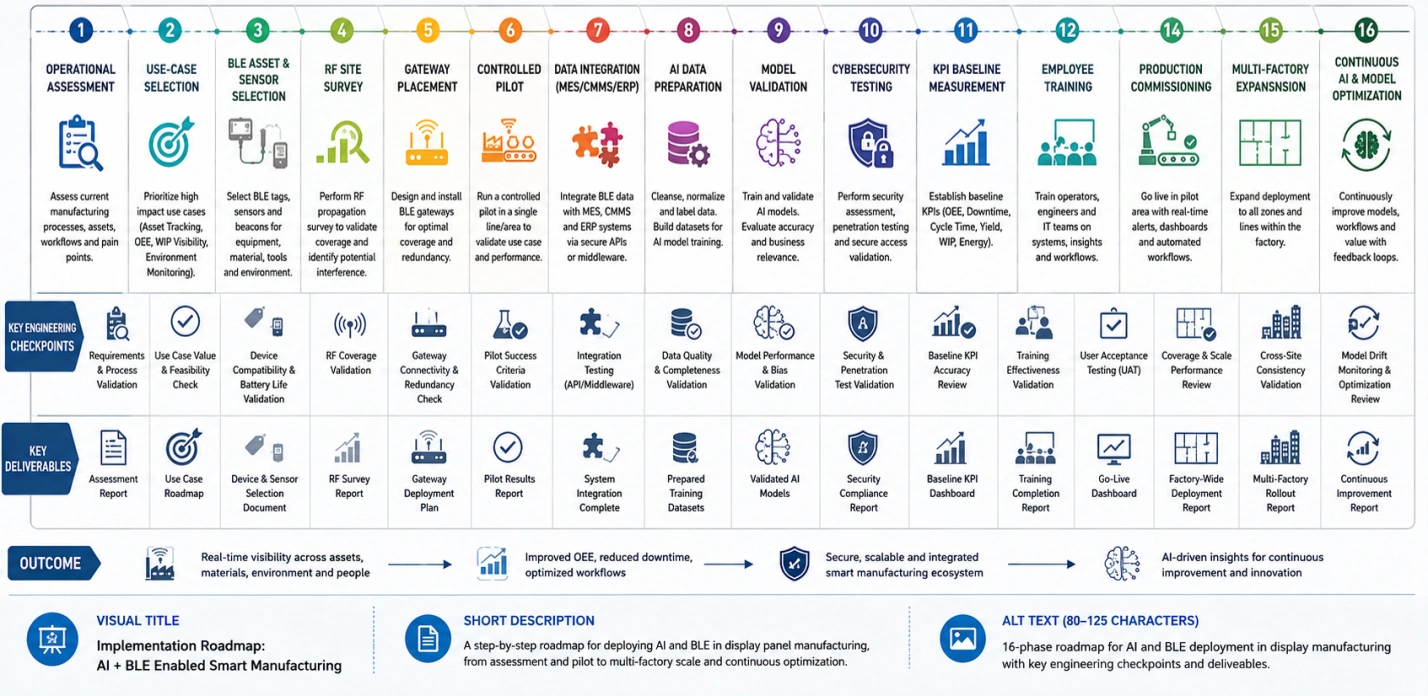
Practical Implementation Recommendations for Display Panel Manufacturers
Successful deployment depends on treating AI, BLE, factory software, and operational processes as one engineering problem.
- Begin with a measurable production, quality, maintenance, or material-visibility problem.
- Select tracked assets according to operational value rather than attempting to track every physical object.
- Conduct an RF assessment before finalizing BLE gateway locations.
- Validate BLE performance under actual cleanroom and equipment conditions.
- Establish consistent asset identifiers across BLE software and manufacturing systems.
- Synchronize timestamps across BLE, MES, equipment, inspection, and maintenance data.
- Keep AI model training data traceable to production conditions and quality outcomes.
- Use edge processing where low latency or local operational continuity is important.
- Apply cybersecurity controls to BLE gateways, servers, APIs, databases, and connected devices.
- Establish KPI baselines before the pilot.
- Validate AI predictions with manufacturing and maintenance specialists.
- Monitor model performance after commissioning.
- Design battery replacement and device maintenance procedures before large-scale deployment.
- Scale only after the pilot demonstrates measurable operational value.
Why AI-Enabled BLE Systems Matter for Display Panel Manufacturing
The primary value of AI-enabled BLE deployment is not simply the ability to locate an asset or collect another sensor reading. The greater value comes from combining physical-world information with manufacturing data so that operational teams can identify patterns and make better decisions.
For display panel manufacturers, this can mean connecting the physical movement of carriers and tools with production records, associating environmental conditions with process outcomes, correlating equipment behavior with maintenance events, and connecting inspection results with upstream manufacturing conditions.
BLE provides a flexible wireless method for collecting selected location and sensor information. AI then adds analytical capability by converting these observations into predictions, classifications, anomaly indicators, and decision support.
GAO supplies BLE, RFID, and IoT hardware products and systems that can be incorporated into these applications, with technical support and engineering guidance for organizations evaluating connected manufacturing requirements.
AI + BLE Enabled Intelligent Display Panel Manufacturing Ecosystem
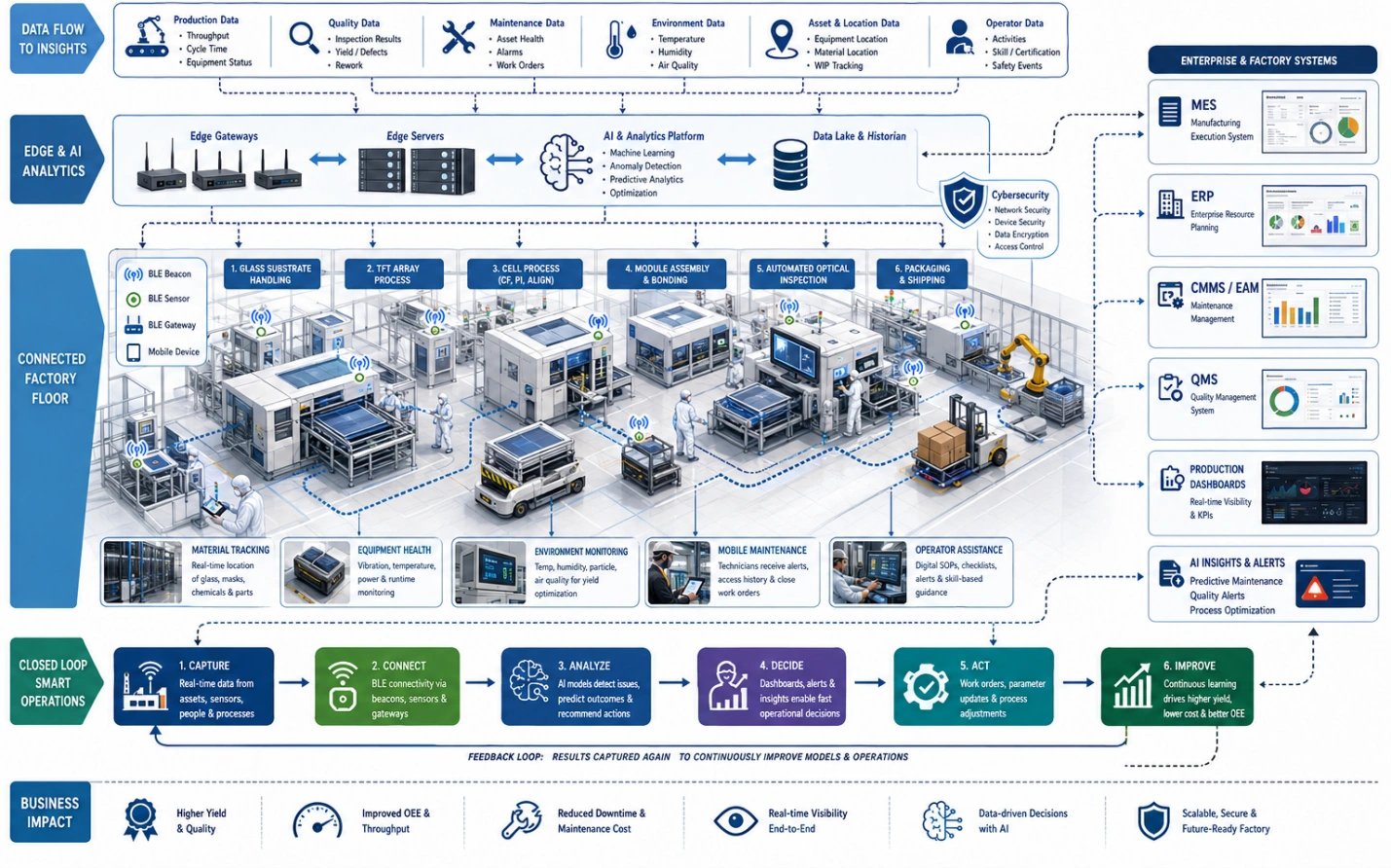
Key Takeaways for AI and BLE in Display Panel Manufacturing
AI can improve display panel manufacturing when it is connected to reliable production, equipment, quality, environmental, and asset data. BLE provides useful wireless visibility for selected mobile assets and sensors, while existing manufacturing systems remain important sources of process and production information.
The strongest implementations focus on specific manufacturing problems such as yield improvement, defect analysis, predictive maintenance, work-in-process visibility, material flow, and equipment utilization. Engineering validation, RF planning, data integration, cybersecurity, model monitoring, and KPI measurement should be treated as core parts of deployment rather than secondary activities.
GAO’s BLE, RFID, and IoT products and systems can support organizations evaluating these connected manufacturing applications, from initial technology assessment through production deployment and ongoing technical support.
Building the Future of Industrial AI and IoT with Aperture Venture Studio and GAO RFID Inc.
For more than three decades, GAO Group of Companies has invested heavily in R&D for industrial BLE, RFID, and IoT products and systems. As AI has become increasingly useful for industrial applications, our work has expanded toward combining AI analytics with technologies such as BLE and RFID to address manufacturing challenges including asset visibility, predictive maintenance, quality analysis, and operational intelligence. We have also founded Aperture Venture Studio to support advanced AI and IoT initiatives relevant to industrial applications such as display panel manufacturing.
Aperture brings together AI and IoT technical experts, entrepreneurial and operational executives, investors, and leading companies. We also organize Aperture Ventures Summit and TekSummit to discuss advanced AI and IoT topics.
We welcome you to join us as:
- Advisors, co-founders, or employees
- Investors
- Customers