
AI and BLE for Distribution Operations
AI-Driven Distribution Operations for Real-Time Fulfillment Visibility
AI for distribution operations combines operational data, machine learning, connected devices, and business systems to identify fulfillment problems and support faster decisions. In distribution centers, AI can analyze inventory movements, picking activity, replenishment demand, dock activity, order queues, asset locations, labor utilization, shipping events, and returns data. BLE beacons, BLE sensors, and BLE gateways can provide location, movement, proximity, environmental, and event data that helps make these AI applications more timely and operationally useful. The resulting system can connect physical activity with warehouse management systems, transportation systems, order management software, labor management systems, and analytics tools. For distribution operations managers, the objective is not simply to collect more data. It is to convert operational events into actionable information that helps reduce inventory discrepancies, picking delays, stockouts, asset loss, order backlogs, dock congestion, and fulfillment exceptions while improving service levels and resource utilization.
Distribution Operations AI and BLE Overview
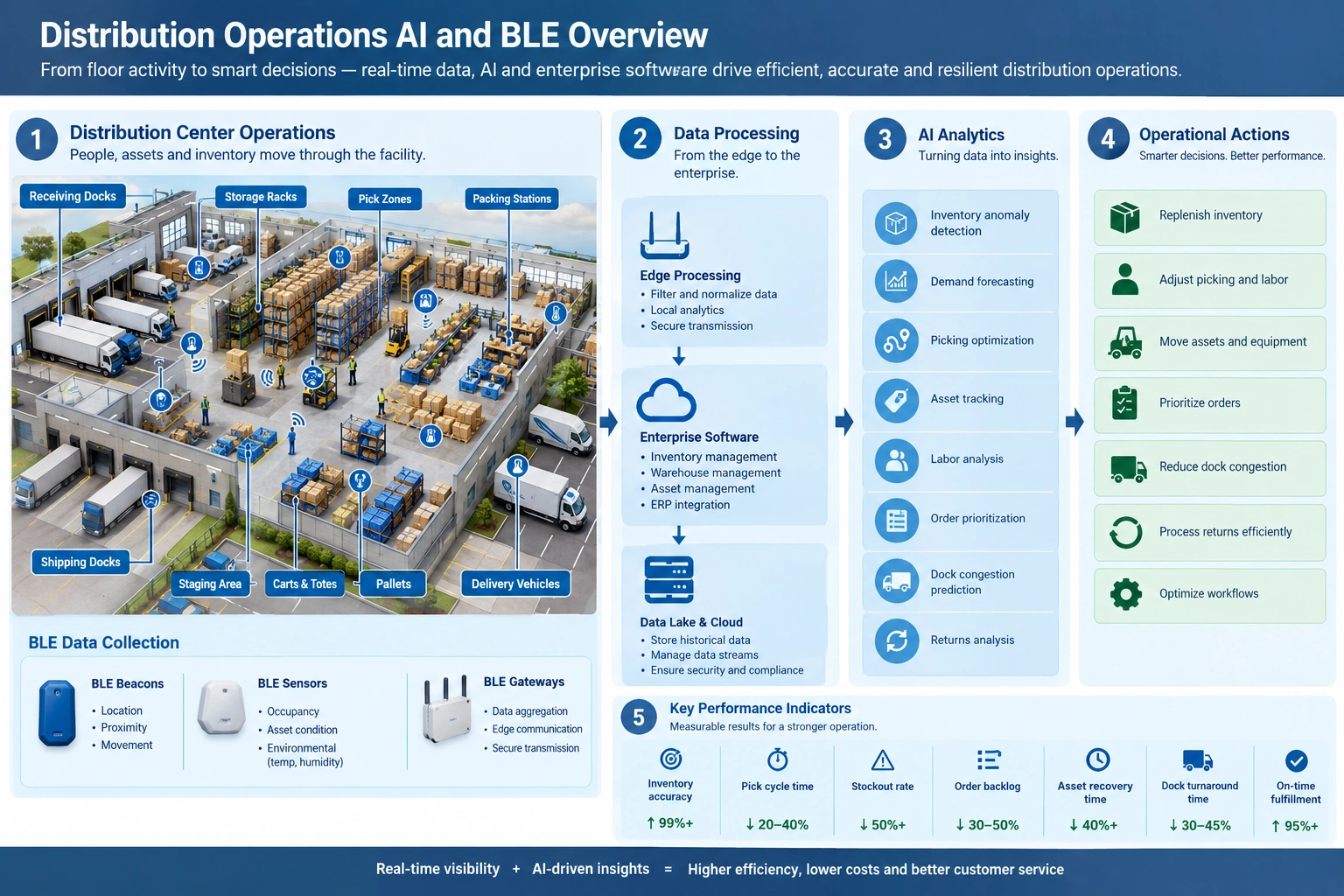
This enterprise infographic illustrates how BLE beacons, devices, and gateways collect distribution-center data for edge processing, enterprise software, and AI analytics. It connects AI-driven insights to operational actions and measurable KPIs such as inventory accuracy, pick cycle time, dock turnaround, and on-time fulfillment.
How AI Improves Distribution Operations
Distribution operations generate large volumes of events across receiving, putaway, storage, replenishment, picking, packing, staging, shipping, and returns. Conventional reporting often examines these events after a problem has already affected throughput or service levels. AI can analyze operational data continuously and identify patterns that are difficult to detect through manual reporting.
AI inventory management can compare expected stock positions with observed movement events and identify unusual discrepancies. AI-based demand forecasting can use historical order activity, SKU velocity, seasonal behavior, lead times, and replenishment history to estimate future requirements. AI warehouse management applications can analyze pick sequences, travel paths, station utilization, queue lengths, and task completion times to identify process bottlenecks.
BLE contributes operational observations that can complement barcode scans, RFID events, WMS transactions, and other existing data sources. For example, a BLE-tagged cart can provide location and movement information between picking and packing areas. BLE sensors can provide information about temperature, humidity, occupancy, or equipment conditions where the application requires it. BLE gateways positioned throughout operational zones can receive beacon or sensor transmissions and forward relevant events to software systems.
The value comes from combining these observations with distribution-specific business data. A location event by itself may have limited meaning. When associated with a warehouse task, SKU, order, workstation, time window, and WMS transaction, it can become useful for operational analysis.
GAO provides BLE hardware products and IoT systems that can support these types of data collection requirements. Selection should be based on the physical layout, required location accuracy, radio environment, battery requirements, gateway placement, data frequency, and integration requirements of the distribution operation.
Distribution Operations Applications for AI and BLE
AI Inventory Management and Stock Accuracy
Inventory discrepancies can occur when physical movement does not match system transactions. Common causes include misplaced inventory, incomplete scans, incorrect putaway, unrecorded movement, damaged goods, and transaction timing differences.
AI can correlate inventory records with movement and location events to identify unusual patterns. BLE-enabled location information can provide additional evidence about where tagged inventory, carts, totes, or handling equipment is moving.
Operational applications include:
- Detecting unusual inventory movement patterns
- Identifying frequently misplaced inventory
- Monitoring movement between storage and picking zones
- Supporting cycle-count prioritization
- Identifying discrepancies requiring investigation
- Improving visibility of mobile inventory assets
- Supporting SKU-level replenishment analysis
Relevant KPIs include inventory accuracy, inventory discrepancy rate, stockout incidents, cycle-count productivity, and inventory adjustment frequency.
AI Picking Optimization and Delay Detection
Picking is often one of the most labor-intensive activities in distribution operations. Congestion, inefficient travel paths, poorly balanced workloads, high-distance picks, and delayed task completion can reduce throughput.
AI can analyze historical and real-time task information to identify bottlenecks and improve task allocation. BLE location data can add information about worker, cart, tote, or equipment movement where BLE tags are deployed.
Applications include:
- Pick-path analysis
- Worker and cart movement analysis
- Zone congestion detection
- Pick-cycle-time analysis
- Task delay identification
- Workload balancing
- Station utilization analysis
- Identification of repeated travel patterns
Operational teams can use these insights to rebalance assignments, adjust zone layouts, prioritize urgent orders, or investigate process constraints.
AI Replenishment and Stockout Prevention
Replenishment shortages occur when inventory at pick locations falls below operational requirements. A distribution center may have sufficient inventory in reserve while a forward-pick location becomes empty, creating avoidable picking delays.
AI demand forecasting can estimate future consumption using order history, SKU velocity, seasonality, lead times, and current inventory conditions. BLE-enabled location and movement data can supplement conventional inventory transactions by showing movement between storage zones and replenishment areas.
Potential actions include:
- Prioritizing critical SKU replenishment
- Generating replenishment alerts
- Identifying frequently depleted pick locations
- Predicting potential stockouts
- Redirecting available inventory
- Analyzing replenishment lead time
Important KPIs include stockout rate, fill rate, replenishment lead time, inventory availability, and order fulfillment rate.
AI Asset Tracking for Carts, Totes, and Handling Equipment
Distribution centers depend on reusable assets such as carts, totes, roll cages, containers, handheld equipment, and material-handling equipment. Asset loss can increase replacement costs and create operational delays.
BLE tags can provide location visibility for selected mobile assets. BLE gateways can receive tag transmissions across operational zones and forward location-related events to the asset tracking software. AI can then identify unusual movement patterns, extended idle periods, unexpected zone changes, or recurring loss patterns.
The system can support:
- Real-time asset location visibility
- Asset utilization analysis
- Geofencing alerts
- Unauthorized movement detection
- Recovery prioritization
- Asset idle-time analysis
- Investigation of recurring loss locations
KPIs can include asset loss rate, asset utilization, recovery time, replacement cost, and asset idle time.
AI and BLE Solution Matrix for Distribution Fulfillment
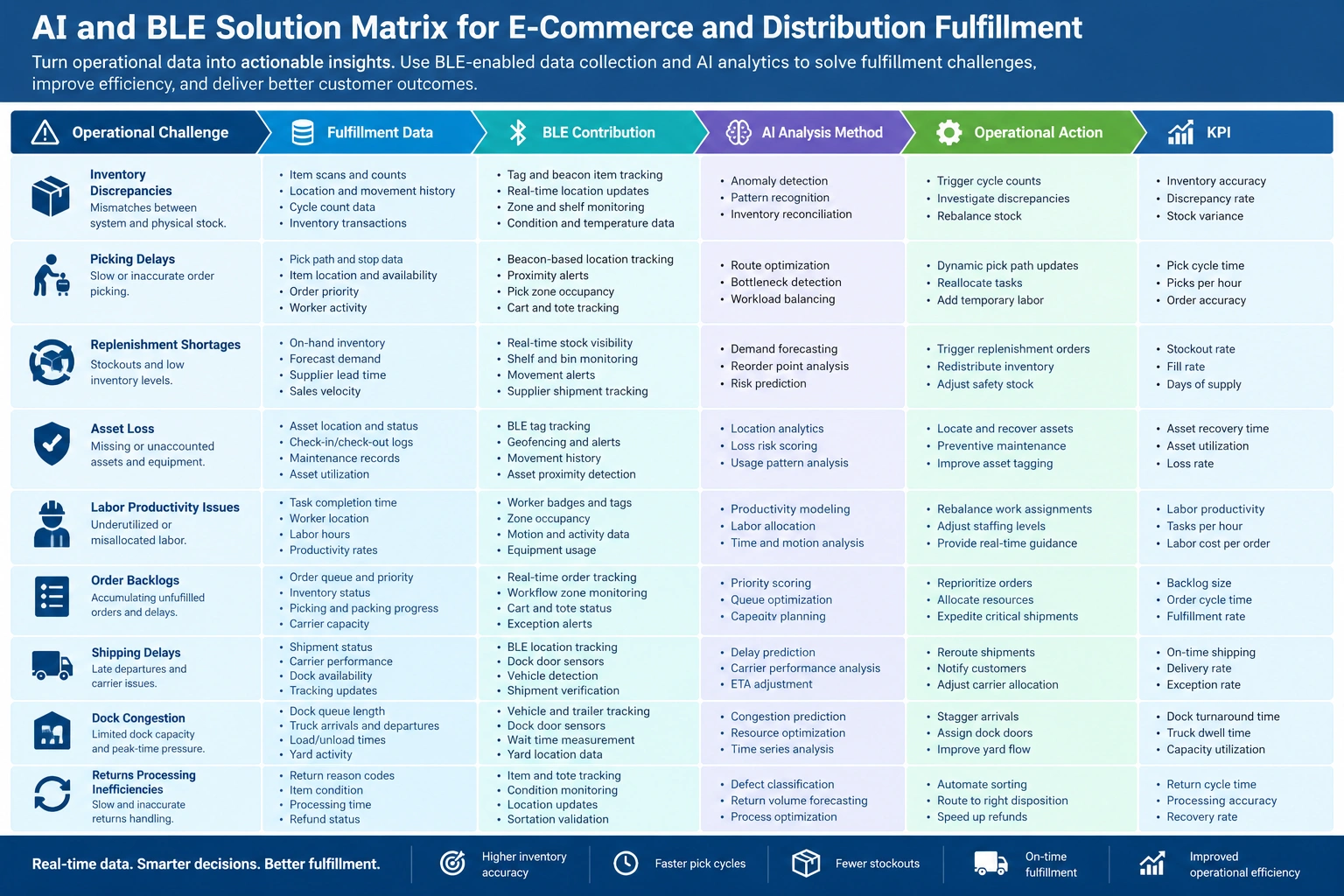
This solution matrix maps common e-commerce and distribution fulfillment challenges to relevant operational data, BLE contributions, AI analysis methods, operational actions, and KPIs. It highlights applications including inventory reconciliation, picking optimization, replenishment, asset recovery, labor productivity, order prioritization, shipping, dock management, and returns.
AI Labor Productivity and Workflow Analysis
Distribution operations require accurate measurement of task completion, labor utilization, queue times, and station activity. AI can identify differences between expected and actual task performance without relying solely on end-of-shift reports.
BLE movement data can help provide additional information about time spent in operational zones, movement between work areas, and equipment utilization. This information should be interpreted together with task records rather than treated as a standalone measure of worker performance.
Applications include:
- Identifying process bottlenecks
- Measuring task completion time
- Detecting excessive idle time
- Comparing workflow performance across zones
- Identifying training requirements
- Supporting workload balancing
- Improving staffing decisions
Relevant KPIs include picks per labor hour, task cycle time, idle time, throughput per shift, and productivity by operational zone.
AI Order Backlog and SLA Risk Analysis
Order backlogs can develop when incoming demand exceeds available processing capacity. Delays can originate in picking, packing, staging, inventory availability, staffing, or shipping handoff.
AI can analyze order queues, task timestamps, available capacity, historical processing rates, and priority information to identify orders at risk of missing fulfillment targets. BLE location events can supplement this analysis when the physical movement of orders, totes, carts, or other tagged assets is relevant.
Operational actions may include:
- Reprioritizing urgent orders
- Assigning additional labor
- Adjusting shift resources
- Expediting critical orders
- Identifying processing bottlenecks
- Monitoring SLA risk
KPIs include backlog size, order cycle time, SLA compliance, on-time fulfillment rate, and orders processed per shift.
Distribution Operations Data Flow from BLE Events to AI Decisions
A practical AI solution for distribution operations requires more than BLE devices. The complete workflow must connect physical operational events with data processing, business systems, analytics, and human or automated actions.
Data Acquisition at Operational Zones
BLE beacons and sensors can be assigned to assets, containers, equipment, locations, or other operational objects depending on the use case. BLE gateways are installed at suitable receiving, storage, picking, packing, staging, shipping, or returns locations.
The deployment should account for rack structures, metal surfaces, RF interference, gateway coverage, battery life, tag density, expected movement patterns, and required location accuracy.
Communication and Edge Processing
BLE gateways receive transmissions from nearby BLE devices and can forward relevant information through the site’s available network infrastructure. Depending on the system design, initial filtering, event processing, buffering, or normalization can occur close to the operational area.
Edge processing can be useful where distribution operations require lower latency, reduced network traffic, local continuity, or controlled handling of operational data.
Data Integration and Middleware
BLE events become more useful when correlated with existing distribution systems. Middleware can normalize device events and connect them with software such as:
- Warehouse management systems
- Order management systems
- Transportation management systems
- Labor management systems
- Enterprise resource planning systems
- Inventory management software
- Yard management systems
- Service management and ticketing systems
- Business intelligence and analytics software
Common integration methods can include REST APIs, message brokers, databases, event streams, and file-based interfaces, depending on the customer’s existing software environment.
AI Analytics and Operational Decisions
AI models can process normalized operational data to identify anomalies, forecast demand, predict delays, classify exceptions, and recommend actions.
Examples include:
- Anomaly detection for inventory discrepancies
- Time-series forecasting for replenishment demand
- Predictive analysis for order delays
- Pattern recognition for asset loss
- Process mining for fulfillment workflows
- Optimization models for task assignment
- Risk scoring for SLA breaches
- Classification models for returns and fulfillment exceptions
The output should be connected to a practical operational workflow. An alert that does not reach the responsible team or trigger an appropriate action has limited operational value.
BLE Hardware and Software for Distribution Operations
BLE-based data collection can be implemented using different combinations of tags, beacons, sensors, gateways, networking equipment, processing software, and enterprise integrations. The appropriate configuration depends on the operational question being solved rather than simply the availability of BLE hardware.
BLE beacons can be used for asset identification, proximity detection, zone-level movement, and location-related applications. BLE sensors can provide additional operational measurements such as temperature, humidity, motion, occupancy, or other supported parameters. BLE gateways provide the connection between BLE devices and the distribution operation’s wider data infrastructure.
GAO can supply BLE beacons, BLE sensors, BLE gateways, and related IoT hardware for distribution applications. Hardware selection should consider transmission interval, battery requirements, operating environment, mounting method, enclosure requirements, gateway density, network availability, and required data latency.
Cloud Version for Multi-Site Distribution Operations
A cloud-hosted software deployment can be appropriate when distribution organizations operate multiple facilities and need centralized access to operational data and analytics. A cloud deployment can simplify centralized software management and support aggregation of data from multiple distribution centers.
Typical applications include:
- Multi-site asset visibility
- Centralized operational analytics
- Cross-site KPI comparison
- Demand and fulfillment analysis
- Centralized alert management
- Remote monitoring
The design should still address identity management, encryption, API security, device authentication, data retention, network reliability, and separation of customer or facility data.
Server Version for Controlled Distribution Environments
A privately hosted server deployment can be appropriate where operational data must remain within customer-managed infrastructure or where connectivity requirements favor local processing. The server can operate on an edge server, customer-managed server, private data center, or other privately hosted infrastructure.
This approach can support:
- Local data processing
- Facility-level operational continuity
- Integration with privately hosted WMS or ERP systems
- Controlled data retention
- Local AI inference
- Reduced dependence on external connectivity
A hybrid approach can also be considered when local operational processing is required while selected analytics or reporting functions are hosted centrally.
Security and Interoperability Considerations
Distribution operations should treat connected devices as part of the broader operational technology and IT environment. Security controls should include device identity, authenticated communication, network segmentation where appropriate, least-privilege access, secure credential management, software update procedures, logging, and controlled API access.
Interoperability is equally important. BLE data should not create an isolated data source that requires operators to manually reconcile information. Mapping BLE events to SKU records, asset IDs, task IDs, order IDs, zones, timestamps, and WMS transactions can make the resulting information substantially more useful.
AI Applications Across Distribution Fulfillment Processes
AI can provide value across the complete distribution workflow when operational events are connected with inventory, order, labor, equipment, and transportation data. BLE-enabled observations can strengthen this data layer where location, movement, proximity, or environmental conditions are important to the operational decision.
AI for Shipping Delay Prediction
Shipping delays can result from late picking, packing bottlenecks, staging congestion, carrier arrival variability, incorrect shipment preparation, or delays at the dock. AI can analyze historical shipment records, processing timestamps, carrier performance, order priority, and current operational conditions to identify shipments with elevated delay risk.
BLE-enabled location information can provide additional visibility into package carts, staging assets, loading equipment, or tagged shipments as they move through shipping areas.
Operational teams can use these insights to:
- Prioritize shipments approaching carrier cutoff times
- Identify orders delayed before loading
- Analyze carrier-specific delay patterns
- Improve staging coordination
- Escalate exceptions before shipment cutoff
- Support more accurate estimated delivery decisions
Useful KPIs include on-time shipment rate, on-time delivery rate, average transit time, shipment delay incidents, and order-to-ship cycle time.
AI Dock Congestion Management
Dock congestion can reduce receiving and shipping throughput when trucks, trailers, pallets, carts, or personnel accumulate around limited dock capacity. Traditional dock reporting may show that congestion occurred without identifying the conditions that caused it.
AI can analyze dock occupancy, appointment schedules, vehicle arrival patterns, loading and unloading duration, shipment priority, and historical turnaround times to predict congestion.
BLE tags and gateways can support location and movement visibility for selected vehicles, carts, trailers, or equipment.
Potential operational actions include:
- Reallocating dock assignments
- Adjusting inbound and outbound flow
- Prioritizing time-sensitive shipments
- Coordinating carrier arrivals
- Identifying extended dock dwell times
- Improving dock scheduling
Relevant KPIs include dock turnaround time, dock utilization, truck dwell time, queue length, loading time, and unloading time.
AI Returns Processing and Reverse Logistics
Returns create additional handling requirements because returned goods must be received, identified, inspected, classified, routed, and either restocked, repaired, refurbished, recycled, or disposed of according to business rules.
AI can analyze return reasons, product categories, processing times, condition information, customer order history, and disposition outcomes. This can help identify recurring return patterns and predict processing requirements.
BLE-enabled tracking can provide movement visibility for return containers, carts, or tagged goods as they pass through receiving and inspection areas.
Applications include:
- Return reason analysis
- Returns routing
- Processing-time prediction
- Identification of recurring product issues
- Return-container tracking
- Inspection workflow monitoring
- Reverse-logistics process analysis
KPIs include return cycle time, first-time resolution rate, processing cost per return, return-to-stock time, and percentage of returns processed within SLA.
Engineering Design Considerations for Distribution Operations
Successful AI and BLE deployments depend on operational requirements, physical conditions, data quality, integration design, and measurable business objectives. A distribution center should not begin with device deployment alone. The engineering process should begin by defining the operational problem and the data required to make a reliable decision.
Define the Operational Event Before Selecting Hardware
A useful design question is: What operational event must be detected, measured, or predicted?
For example, inventory accuracy may require location and movement information, while dock congestion may require occupancy and dwell-time information. A picking optimization application may require task timestamps and zone-level movement rather than precise centimeter-level positioning.
The required accuracy directly affects BLE gateway density, tag configuration, deployment cost, network requirements, and software complexity.
Plan BLE Coverage Around the Facility Layout
Distribution centers contain metal racks, shelving, conveyors, machinery, vehicles, and other objects that can affect radio propagation. Gateway placement should therefore be designed from the actual facility layout rather than using a uniform spacing assumption.
A deployment assessment should consider:
- Storage rack configuration
- Ceiling height
- Picking and packing zones
- Dock doors
- Receiving areas
- Shipping and staging areas
- Returns processing areas
- High-density metal environments
- Gateway mounting locations
- Network availability
- Required location accuracy
A site survey or pilot deployment can help validate signal behavior before large-scale installation.
Establish Data Quality Controls
AI analysis depends on reliable input data. Missing timestamps, duplicate events, incorrect asset IDs, inconsistent zone names, or inaccurate system transactions can produce misleading results.
Data quality controls should address:
- Device identity
- Asset identity
- Timestamp synchronization
- Zone definitions
- Duplicate-event handling
- Missing-event detection
- Battery status
- Gateway connectivity
- API failures
- Data retention
- Event validation
Operational teams should also define how exceptions are reviewed when BLE observations conflict with WMS or other enterprise records.
Integrate With Existing Distribution Systems
BLE should complement existing distribution technology rather than create another disconnected source of operational information.
A practical integration can associate a BLE event with identifiers already used by the organization, such as:
- SKU
- Asset ID
- Order ID
- Task ID
- Cart ID
- Tote ID
- Shipment ID
- Dock ID
- Employee or workstation identifier where appropriate
- Warehouse zone
- Timestamp
REST APIs, databases, message queues, event streams, and other interfaces can be used depending on the customer’s existing software environment.
Test AI Outputs Before Automating Decisions
AI recommendations should be validated against historical and live distribution data before they are used for automated operational actions.
A controlled deployment can begin with monitoring and recommendations. Operations teams can compare AI predictions against actual outcomes and determine whether the model provides sufficient accuracy.
Testing should examine:
- False-positive alerts
- False-negative events
- Prediction accuracy
- Processing latency
- Data completeness
- Operational response time
- KPI improvement
- User acceptance
Automation can then be introduced gradually for well-understood use cases.
Operational Benefits of AI for Distribution Operations
The measurable value of AI in distribution operations comes from connecting operational data with decisions that affect throughput, inventory, labor, service levels, and cost.
Higher Inventory Accuracy
AI can identify unusual inventory behavior and prioritize discrepancies for investigation. BLE location and movement observations can provide additional operational evidence for selected assets and inventory-handling processes.
The result can be fewer unexplained inventory adjustments, faster discrepancy investigation, and improved confidence in inventory records.
Faster Fulfillment Throughput
AI can identify picking, packing, staging, and shipping bottlenecks. Movement and task data can reveal where processing time is being lost and help operations teams rebalance workloads.
Improved throughput can be measured through picks per hour, orders processed per shift, order cycle time, and fulfillment throughput.
Reduced Stockouts and Replenishment Delays
Demand forecasting combined with inventory and movement information can help identify SKUs and locations that require earlier replenishment.
This can reduce the likelihood that an otherwise available SKU becomes unavailable at a forward-pick location.
Better Asset Utilization
Location and movement information can reveal where carts, totes, containers, and other mobile assets spend their time. AI can distinguish frequently used assets from assets that remain idle or repeatedly become difficult to locate.
This can support better asset allocation and reduce unnecessary replacement purchases.
Improved Labor Utilization
AI can analyze task completion, workload distribution, processing times, and workflow bottlenecks. The objective should be process improvement and appropriate resource allocation rather than simply monitoring individual workers.
Distribution managers can use these insights to adjust staffing, training, work assignments, and operating procedures.
Improved Shipping and Dock Performance
Predictive analysis can identify orders and shipments that are likely to miss processing or carrier deadlines. Dock analytics can identify recurring congestion and excessive dwell times.
This allows operations teams to intervene earlier rather than responding after service levels have already been affected.
Scaling AI and BLE Across Distribution Facilities
A pilot should normally begin with a clearly defined operational problem, measurable baseline KPIs, and a limited physical area. Examples include asset tracking in one shipping zone, replenishment visibility for selected high-volume SKUs, or congestion monitoring around a specific dock group.
Once the pilot demonstrates reliable data collection and measurable operational value, the deployment can expand to additional zones or facilities.
Scaling considerations include:
- Standardizing device configuration
- Establishing repeatable gateway installation practices
- Managing device batteries and maintenance
- Defining common asset and zone identifiers
- Maintaining API and data integration standards
- Monitoring gateway health
- Establishing cybersecurity controls
- Managing software versions
- Training operations personnel
- Comparing KPIs consistently across facilities
Multi-site deployments should preserve facility-specific operating requirements while maintaining consistent data definitions where cross-site analysis is required.
GAO can support organizations evaluating BLE hardware and IoT systems for different distribution environments, including applications requiring remote technical support or onsite implementation assistance.
Cybersecurity and Operational Reliability
Connected distribution systems should be designed with security and operational continuity in mind. BLE devices, gateways, servers, APIs, and analytics systems introduce additional components that require controlled access and monitoring.
Important controls include:
- Unique device identification
- Controlled administrative access
- Strong authentication
- Network segmentation where appropriate
- Encryption for applicable communications
- Secure API authentication
- Credential management
- Gateway health monitoring
- Software and firmware update procedures
- Audit logging
- Backup and recovery procedures
- Defined data retention policies
Operational reliability also requires planning for gateway outages, network interruptions, depleted batteries, damaged tags, and temporary loss of connectivity.
Local buffering or edge processing can help maintain event continuity during short network interruptions, depending on the selected hardware and software design.
AI models should also be monitored after deployment. Changes in order patterns, SKU mix, warehouse layouts, staffing, carrier behavior, or operating procedures can affect model performance. Model validation and periodic retraining may therefore be necessary for predictive applications.
Implementation Roadmap for AI-Enabled Distribution Operations
A practical implementation can progress from operational assessment to controlled deployment and continuous optimization.
- Operational assessment: Identify the highest-impact fulfillment problem and establish baseline KPIs.
- Use-case definition: Define the operational event, required data, decision process, and expected business outcome.
- Site evaluation: Review facility layout, RF conditions, network connectivity, device mounting locations, and environmental requirements.
- Hardware selection: Select appropriate BLE beacons, BLE sensors, BLE gateways, batteries, enclosures, and mounting methods.
- Integration design: Map BLE events to WMS, OMS, TMS, labor management, inventory, and analytics data.
- Pilot deployment: Install devices in a controlled operational area and validate data quality.
- AI validation: Test anomaly detection, forecasting, prediction, classification, or optimization models against actual operational outcomes.
- Operational testing: Confirm that alerts and recommendations reach the appropriate distribution personnel.
- KPI measurement: Compare operational performance against the baseline.
- Scale-up: Expand the solution to additional zones or facilities after technical and operational validation.
- Continuous optimization: Monitor device health, data quality, AI performance, cybersecurity, and business KPIs.
Key Takeaways for Distribution Operations Managers
AI for distribution operations is most effective when it is connected to specific operational decisions. Inventory discrepancies, picking delays, replenishment shortages, asset loss, labor bottlenecks, order backlogs, shipping delays, dock congestion, and returns inefficiencies each require different data and analytical methods.
BLE beacons, BLE sensors, and BLE gateways can provide useful location, movement, proximity, occupancy, and environmental observations. Their value increases when those observations are correlated with WMS, OMS, TMS, inventory, labor, and shipment data.
A successful implementation should begin with a measurable operational problem, establish baseline KPIs, validate the physical deployment, integrate with existing systems, test AI predictions, and introduce automation only after the data and decision process have been validated.
GAO supplies BLE, RFID, and IoT hardware products and systems for organizations developing connected operational solutions. Our experience supporting customers in the United States and Canada includes work with Fortune 500 companies, R&D organizations, universities, and government agencies. GAO has maintained R&D and quality-assurance activities around connected hardware and provides remote or onsite technical support.
Building the Future of Industrial AI and IoT with Aperture Venture Studio and GAO RFID Inc.
For more than three decades, GAO Group of Companies has invested heavily in R&D covering industrial BLE, RFID, and IoT. As generative AI became increasingly useful for industrial applications, we expanded work around AI and IoT technologies, including BLE and RFID, and founded Aperture Venture Studio to support the development and scaling of AI and IoT companies relevant to industries such as distribution and fulfillment.
Aperture has attracted AI and IoT technical experts, entrepreneurial and operational executives, investors, and leading companies. We have also developed Aperture Ventures Summit and TekSummit to discuss advanced AI and IoT topics.
Our broader technical communities support collaboration around practical industrial AI and IoT applications.
We welcome participation as:
- Advisors, co-founders, or employees
- Investors
- Customers