
AI and BLE for Emergency Response Operations
AI-Driven Emergency Response Intelligence for Faster and Safer Incident Management
Emergency response organizations increasingly rely on real-time situational awareness, rapid resource coordination, and data-driven decision-making to protect lives, property, and critical infrastructure. AI-powered emergency response solutions supported by BLE gateways, BLE beacons, and BLE sensors help emergency management agencies, fire departments, emergency medical services (EMS), urban search and rescue teams, disaster response organizations, and public safety agencies improve operational visibility and response effectiveness.
Artificial Intelligence of Things (AIoT) combines AI, connected sensors, responder equipment, communications systems, and operational software to create intelligent emergency response environments. BLE-enabled location awareness and telemetry data provide critical inputs that allow AI models to analyze responder locations, equipment availability, incident conditions, evacuation progress, resource deployment, and operational risks.
Emergency response organizations face challenges involving incident complexity, responder safety, communication overload, equipment accountability, and dynamic field conditions. AI-driven systems help transform large volumes of operational data into actionable intelligence that supports command staff, incident commanders, dispatch centers, and emergency operations centers.
GAO has helped organizations by supplying BLE, RFID, and IoT hardware solutions that support real-time monitoring, operational awareness, and mission-critical response activities.
Understanding AI-Enabled Emergency Response Systems
Emergency response operations involve coordinated activities across multiple agencies, facilities, vehicles, responders, and communication systems. AI technologies improve operational effectiveness by analyzing large volumes of information generated throughout emergency incidents.
AI-supported emergency response solutions commonly utilize:
- Resource tracking
- Personnel accountability
- Incident command support
- Emergency dispatch optimization
- Hazard monitoring
- Search and rescue coordination
- Equipment readiness monitoring
- Medical response coordination
- Evacuation management
- Disaster recovery planning
BLE infrastructure provides location and status information from personnel, vehicles, medical equipment, rescue tools, mobile command assets, staging areas, shelters, and operational facilities.
AI systems process these inputs to generate:
- Resource allocation recommendations
- Risk assessments
- Operational forecasts
- Incident progression analysis
- Personnel safety alerts
- Response optimization recommendations
- Logistics coordination insights
Emergency response organizations benefit from improved decision quality, faster operational execution, and enhanced responder safety.
Integrated AI-Driven Emergency Response Operational Ecosystem
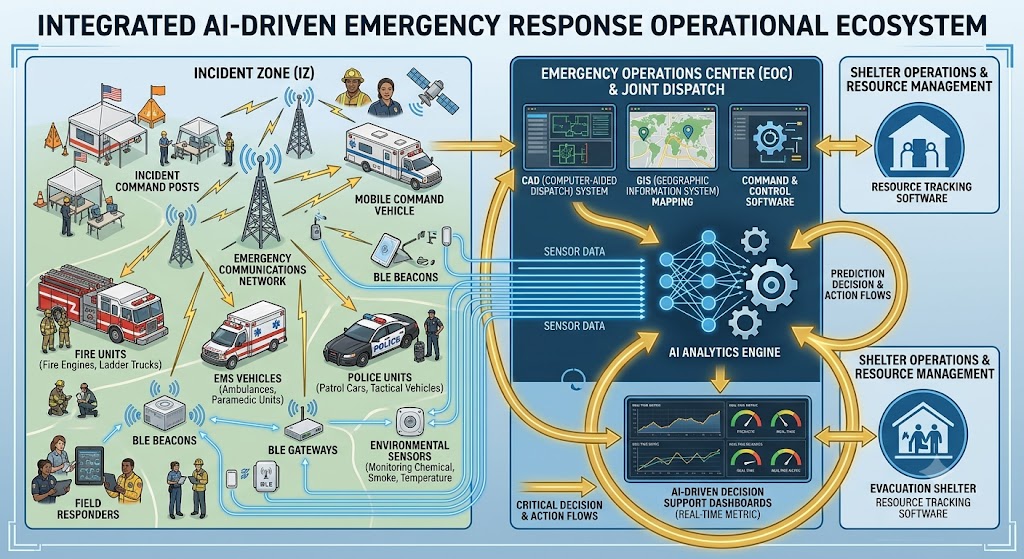
A comprehensive enterprise-grade operations overview diagram illustrating the real-time data flow from field assets (emergency vehicles, responders, BLE sensors, environmental monitors) in an Incident Zone to a central Emergency Operations Center (EOC) & Joint Dispatch, where an AI Analytics Engine processes the information to provide decision support dashboards, optimized prediction, resource tracking, and critical decision flows back to the field and shelter management.
Emergency Response Applications Enabled by AI and BLE Data
Incident Command and Situational Awareness
Incident commanders require accurate operational information during emergencies.
AI systems can continuously analyze:
- Responder positions
- Hazard zones
- Resource availability
- Evacuation progress
- Incident growth patterns
- Mutual aid deployment status
Operational benefits include:
- Improved command visibility
- Faster tactical decisions
- Better resource coordination
- Enhanced responder accountability
Fire and Rescue Operations
Fire departments frequently operate in dynamic and hazardous environments.
AI-assisted fire response solutions support:
- Crew accountability
- Equipment tracking
- Apparatus deployment optimization
- Hazard zone monitoring
- Resource staging coordination
- Personnel rehabilitation monitoring
BLE-based location awareness can help identify responder movement patterns within staging areas, command posts, and operational support zones.
Emergency Medical Services Optimization
EMS organizations manage ambulances, medical personnel, medical devices, pharmaceuticals, and patient transport resources.
AI applications support:
- Ambulance deployment optimization
- Hospital destination recommendations
- Equipment readiness monitoring
- Medical inventory management
- Response time reduction initiatives
Expected outcomes include:
- Improved unit availability
- Better patient care coordination
- Reduced operational delays
- Enhanced fleet utilization
Disaster Response and Recovery Operations
Natural disasters create highly complex operational environments.
AI solutions assist with:
- Shelter occupancy analysis
- Resource distribution planning
- Damage assessment prioritization
- Logistics coordination
- Volunteer deployment management
- Recovery planning
Emergency management agencies can use these capabilities to improve response efficiency during hurricanes, floods, wildfires, earthquakes, severe storms, and large-scale emergencies.
Search and Rescue Operations
Search and rescue missions often involve large geographic areas and rapidly changing conditions.
AI-driven analysis supports:
- Search area prioritization
- Resource assignment
- Personnel coordination
- Mission progress monitoring
- Operational risk analysis
These capabilities improve operational effectiveness while helping protect responder safety.
Emergency Response Operational Workflow from Data Collection to AI-Driven Action
Successful AI-enabled emergency response systems require coordinated information flow across field operations, communications networks, command systems, and analytics environments.
Field Data Acquisition
Operational data originates from:
- BLE beacons attached to responder equipment
- BLE-enabled personnel accountability tags
- Environmental monitoring sensors
- Emergency vehicles
- Portable medical equipment
- Incident command assets
- Mobile communication systems
- Shelter management systems
- Logistics resources
Data collected may include:
- Location information
- Equipment status
- Environmental conditions
- Personnel movement
- Operational readiness indicators
- Resource utilization metrics
Communications Infrastructure
Data is transmitted through:
- BLE gateways
- Public safety wireless networks
- LTE networks
- Private broadband systems
- Wi-Fi infrastructure
- Satellite communications
- Emergency communications systems
Reliable communications are critical because emergency operations frequently occur in disrupted or degraded environments.
Edge Processing and Local Intelligence
Field-deployed edge computing systems process information close to incident locations.
Common edge functions include:
- Sensor aggregation
- Data filtering
- Event prioritization
- Operational alert generation
- Temporary communications continuity
- Incident-specific analytics
Edge processing reduces latency and supports operations when cloud connectivity is limited.
Integrated AI-Driven Emergency Response Operational Workflow Diagram
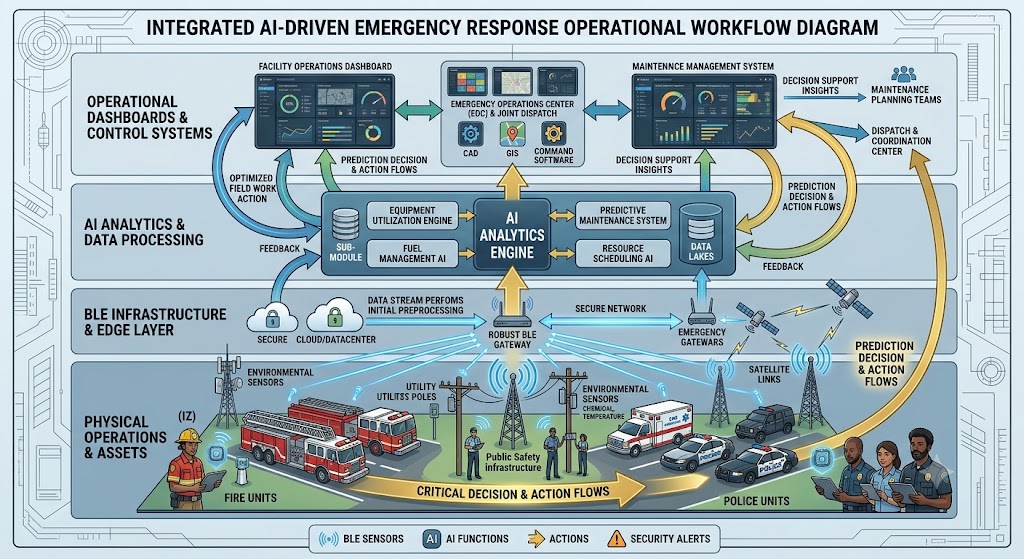
A detailed workflow diagram illustrating the end-to-end operational data flow from incident scene assets through BLE gateways and edge networks into an AI analytics engine, powering CAD, GIS, and real-time emergency management dashboards.
Enterprise Software Integration
Emergency response solutions commonly integrate with:
- Computer-Aided Dispatch (CAD) systems
- Emergency Operations Center software
- Geographic Information Systems (GIS)
- Records Management Systems (RMS)
- Incident Management Systems
- Asset Management Systems
- Emergency Notification Systems
- Public Safety Communications Systems
Integration enables operational consistency and improves information sharing across agencies.
AI Analytics and Decision Support
AI engines analyze operational information using:
- Machine learning
- Predictive analytics
- Pattern recognition
- Risk assessment models
- Resource optimization algorithms
- Geospatial analytics
These technologies generate operational insights that help emergency managers allocate resources more effectively and respond to rapidly changing conditions.
Operational Execution and Continuous Feedback
Insights generated by AI systems support:
- Resource deployment decisions
- Personnel safety monitoring
- Equipment utilization management
- Operational planning adjustments
- Mutual aid coordination
- Recovery activities
Operational outcomes continuously feed back into AI models, improving future performance and decision support quality.
BLE Infrastructure, AI Technologies, and System Components for Emergency Response
Emergency response environments require resilient and scalable technology systems capable of operating under demanding conditions.
BLE Hardware Components
Key BLE infrastructure components include:
- BLE beacons
- BLE gateways
- BLE environmental sensors
- Personnel accountability devices
- Vehicle-mounted gateways
- Mobile command center receivers
- Wearable responder devices
These technologies help generate operational awareness across emergency response environments.
AI Technologies Used in Emergency Response
Common AI capabilities include:
- Predictive incident analysis
- Resource optimization
- Computer vision
- Geospatial intelligence
- Behavioral pattern analysis
- Operational forecasting
- Anomaly detection
- Emergency logistics optimization
Communication Protocols and Supporting Infrastructure
Emergency response deployments often utilize:
- Bluetooth Low Energy
- MQTT
- HTTPS
- REST APIs
- LTE
- 5G
- Wi-Fi
- Satellite communications
- Public safety broadband networks
Cloud and Server Deployment Models
Cloud-hosted deployments are appropriate when organizations require:
- Multi-agency collaboration
- Regional visibility
- Rapid scalability
- Centralized analytics
- Disaster recovery redundancy
Server-hosted deployments are often preferred when agencies require:
- Greater operational control
- Sensitive data protection
- Local processing capability
- Reduced external dependencies
- Agency-specific security policies
Key Technical Capabilities and Operational Benefits for Emergency Response
Emergency response agencies operate in highly dynamic environments where situational awareness, responder accountability, resource coordination, and incident command effectiveness directly influence outcomes. AI-enabled emergency response solutions supported by BLE location and sensing infrastructure help transform fragmented operational data into actionable intelligence for emergency operations centers, dispatch teams, field commanders, and first responders.
AI-Based Responder Location Awareness
Real-time responder accountability is one of the most critical requirements during fire suppression, hazardous materials incidents, urban search and rescue operations, mass casualty events, and disaster recovery activities.
AI continuously analyzes location telemetry from personnel badges, wearable devices, apparatus-mounted transmitters, and incident-zone infrastructure to:
- Monitor responder positions within incident sectors
- Identify personnel entering restricted zones
- Detect prolonged inactivity
- Track evacuation compliance
- Support mayday response procedures
- Improve personnel accountability reporting
This capability reduces responder risk while improving command visibility across complex emergency scenes.
AI Resource Deployment Optimization
Emergency response organizations manage diverse resources including:
- Fire engines
- Ladder trucks
- Rescue units
- Ambulances
- Command vehicles
- Hazmat trailers
- Medical caches
- Portable generators
- Incident command equipment
- Search and rescue assets
AI analyzes historical incident data, dispatch patterns, seasonal demand trends, weather conditions, population density changes, and equipment utilization records to recommend optimal resource allocation.
Benefits include:
- Reduced dispatch delays
- Faster unit assignment
- Improved fleet utilization
- Enhanced station coverage
- Better mutual aid coordination
- Increased emergency readiness
Organizations supported by GAO hardware systems frequently use these insights to improve operational planning and emergency preparedness initiatives.
AI Incident Prediction and Risk Assessment
Emergency management agencies increasingly use predictive analytics to identify elevated risk conditions before incidents occur.
AI models evaluate:
- Weather intelligence
- Wildfire conditions
- Flood indicators
- Severe storm forecasts
- Infrastructure status
- Public event schedules
- Traffic congestion patterns
- Utility outage reports
- Historical emergency records
Predictive risk scoring helps emergency operations centers prepare personnel, equipment, and response plans before emergency demand escalates.
AI Asset Tracking and Equipment Readiness
Emergency response equipment frequently moves between stations, training facilities, maintenance locations, staging areas, and active incident scenes.
AI-supported asset management solutions help agencies monitor:
- Medical equipment availability
- Self-contained breathing apparatus inventories
- Portable radio distribution
- Thermal imaging camera locations
- Hazmat equipment readiness
- Rescue tool availability
- Mobile command assets
- Disaster recovery equipment
Benefits include:
- Reduced equipment loss
- Improved inventory accuracy
- Faster deployment readiness
- Better maintenance scheduling
- Enhanced asset utilization
- Increased operational accountability
AI-Driven Emergency Communications Analysis
Emergency communication centers process large volumes of:
- Emergency calls
- Radio transmissions
- Incident reports
- Dispatch messages
- Situation updates
- Mutual aid communications
Natural language processing and machine learning technologies can assist with:
- Incident classification
- Call prioritization
- Resource recommendations
- Event correlation
- Operational reporting
- Situation summarization
Emergency communication supervisors gain improved visibility into developing incidents while reducing information overload.
BLE Infrastructure, AI Models, Software, Security, and Deployment Considerations
Successful emergency response deployments require careful integration of sensing infrastructure, communication systems, analytics software, cybersecurity controls, and incident management workflows.
BLE Hardware Components
Typical emergency response BLE deployments include:
- BLE beacons for responder identification
- BLE badges for personnel accountability
- BLE wearable devices for field crews
- BLE environmental sensors
- BLE equipment tags
- BLE gateways in stations and command centers
- Vehicle-mounted BLE receivers
- Portable incident-scene gateways
These components support location awareness, equipment visibility, personnel monitoring, and environmental data collection.
AI Models Used in Emergency Response
Common AI techniques include:
- Machine learning for incident prediction
- Time-series forecasting for resource demand
- Computer vision for emergency scene analysis
- Anomaly detection for responder safety monitoring
- Predictive maintenance models for apparatus readiness
- Optimization algorithms for dispatch planning
- Natural language processing for emergency communications
- Geospatial analytics for disaster management
AI models may operate at the edge, within command vehicles, or inside centralized data centers depending on operational requirements.
Communication Infrastructure
Emergency response systems often integrate:
- BLE communications
- Wi-Fi networks
- LTE and 5G connectivity
- Public safety broadband networks
- Land mobile radio systems
- Satellite communications
- Fiber backbone connections
- Mobile command networks
Multiple communication layers improve resiliency during large-scale emergencies where network disruptions may occur.
Cloud Version and Server Version Deployment Models
Cloud Version
Cloud-hosted deployments are suitable when agencies require:
- Multi-jurisdiction visibility
- Regional coordination
- Centralized analytics
- Disaster recovery capabilities
- Remote software management
- Rapid scalability
Cloud environments can support emergency management agencies operating across multiple municipalities, counties, or regions.
Server Version
Privately managed server deployments are often preferred when agencies require:
- Sensitive public safety data control
- Criminal justice compliance requirements
- Local processing capabilities
- Isolated operational networks
- Mission-critical reliability
- Integration with existing government infrastructure
Many emergency operations centers utilize hybrid deployments combining private servers with cloud-based analytics services.
Security and Resilience Requirements
Emergency response systems must maintain operational integrity during critical incidents.
Important security controls include:
- Role-based access control
- Multi-factor authentication
- Device identity management
- Data encryption
- Secure gateway communications
- Audit logging
- Incident response procedures
- Network segmentation
- Backup and recovery processes
- Continuous monitoring
GAO has supported organizations by providing BLE and IoT hardware systems designed to integrate with secure public-sector operational environments while supporting stringent reliability requirements.
Implementation Recommendations for Emergency Response Agencies
Successful AI-enabled emergency response initiatives typically begin with clearly defined operational objectives rather than technology-first deployments.
Recommended implementation practices include:
- Establish responder accountability requirements before infrastructure deployment
- Define incident command reporting objectives
- Identify high-value assets requiring tracking and monitoring
- Integrate with CAD, GIS, RMS, and emergency management software
- Conduct radio and wireless coverage assessments
- Validate responder location accuracy requirements
- Develop cybersecurity governance policies
- Implement phased deployment strategies
- Perform regular field validation exercises
- Continuously refine AI models using operational incident data
Emergency response organizations should also establish measurable success criteria including:
- Dispatch time reduction
- Incident response improvement
- Equipment utilization improvements
- Personnel accountability accuracy
- Maintenance cost reduction
- Emergency readiness enhancement
- Resource allocation efficiency
- Operational visibility improvements
For more than three decades, GAO has supplied BLE, RFID, and IoT hardware products and systems to organizations throughout North America, helping customers implement reliable data collection and operational visibility solutions across mission-critical environments.
Advancing Emergency Response Operations with AI and BLE
AI-enabled emergency response solutions supported by BLE infrastructure help public safety organizations improve responder accountability, resource coordination, situational awareness, equipment readiness, and emergency preparedness. By combining real-time operational visibility with predictive analytics, machine learning, geospatial intelligence, and automated decision support, emergency response agencies can strengthen incident management capabilities while improving responder safety and community outcomes.
Organizations evaluating AI-driven emergency response modernization initiatives should focus on interoperability, cybersecurity, data quality, deployment scalability, operational resilience, and integration with existing emergency management systems. GAO provides BLE, RFID, and IoT hardware products and technical expertise that help emergency response agencies build reliable data-driven operational environments designed for mission-critical public safety applications.
Building the Future of Industrial AI and IoT with Aperture Venture Studio and GAO RFID Inc.
For more than three decades, GAO Group of Companies has invested heavily in research and development of BLE, RFID, IoT, and industrial data collection technologies. As AI adoption continues to expand across emergency response and public safety operations, we have advanced AI and IoT capabilities and have established Aperture Venture Studio to accelerate the development of AI and IoT solutions addressing real-world operational challenges across many sectors.
Aperture has attracted leading AI and IoT experts, operational executives, investors, and industry participants. Through Aperture Ventures Summit and TekSummit, we facilitate discussions on emerging AI and IoT technologies and their practical applications.
We welcome participation as:
- Advisors, Co-founders, or Employees
- Investors
- Customers